

Saved Bookmarks
This section includes 7 InterviewSolutions, each offering curated multiple-choice questions to sharpen your Current Affairs knowledge and support exam preparation. Choose a topic below to get started.
| 1. |
A thin converging glass lens made of glass with refractive index 1.5 has a power of +5.0 D. When this lens is immersed in a liquid of refractive index n, it acts as a divergent lens of focal length 100 cm. What must be the value of n? |
|
Answer» <P> Solution :`(1)/(F)=[(n_(2))/(n_(a))-1][(1)/(R_(1))-(1)/(R_(2))]``p=(1)/(f)=5andn_(2)=1.5,n_(a)=1,f=20cm` `(1)/(20)=[(1.5)/(1)-1][(1)/(R_(1))-(1)/(R_(2))]` `(1)/(20)=0.5[(1)/(R_(1))-(1)/(R_(2))]` `(1)/(f_(1))=[(n_(2))/(n_(1))-1][(1)/(R_(1))-(1)/(R_(2))]` `p=(1)/(f_(1))=1,(1)/(f_(1))=-100cm,n_(2)=1.5,n_(1)=n` `(1)/(-100)=[(1.5)/(n)-1][(1)/(R_(1))-(1)/(R_(2))]` Ratio of equation `(2) DIV (1)` `(1)/(-5)=(((1.5)/(n)-1))/(0.5)` `-(0.5)/(5) = (1.5)/(n) - 1` `0.9 = (1.5)/(n)` `n = (1.5)/(0.9) = (5)/(3)` |
|
| 2. |
How many AND gates are needed for NAND gate? |
|
Answer» 4 NAND = NOT + AND `THEREFORE` 1 AND and 1 NOT GATE are NEEDED. |
|
| 3. |
Obtain an expression for magnetic field inside the toroid. |
|
Answer» <P> Solution :CONSIDER three circular Amperian loops 1, 2 & 3 as shown in the figure by dotted line.Let the magnetic field along loop 1 be `B_(1)` in magnitude. The length of the length `intdl=2pir_(1)`. This current loop does not enclose current. Therefore `I_(e)=0 " and " B_(1)=0`. Therefore, the magnetic field at any POINT P in the open space inside the toroid is zero. Consider the Amperian loop 3. Let `B_(3)` be the magnetic field along the loop. Here `intdl=2pir_(3)`. The current coming out of the planes is cancelled exactly by the current going into it. Therefore `I_(e)=0 " and " B_(3)` at any point Q outside the toroid is zero. Let the magnetic field inside the toroid be B. The length of Amperian in loop `2=intdl=2pir_(2)`. The current enclosed for N turns of toroidal COIL is NI. From Amperian Circuital law, `""Bintdl=mu_(0)I_("enclosed")` i.e., `""B(2pir_(2))=mu_(0)NI` i.e., `""B=(mu_(0) NI)/(2pir_(2))` Let the number of turns per unit length be n. Then `N/(2pir_(2))=n`. Thus, `""B=mu_(0)nI`. 
|
|
| 5. |
What did Mitra finally eat? |
|
Answer» Breadcrumbs |
|
| 7. |
In a transistor , the collector current varies by 0.49mA and emitter current varies by 0.50mA current gain beta measured is |
|
Answer» 49 |
|
| 8. |
A disc of mass 5 kg is kept floating horizontally in mid air by firing 10 bullets per second vertically up. If the mass of each bullet is 50 gm and bullets rebound with same speed, the speed of each bullet is, (g = 10ms^(-2)) |
|
Answer» `100 MS^(-1)` |
|
| 9. |
The minimum distance between the man and the reflecting surface so that he can hear the echo is |
|
Answer» 16.5 m |
|
| 10. |
You throw a ball toward a wall at speed 25.0 m/s and at angle theta_(0)=40.0^(@) above the horizontal. The wall is distance d = 22.0 m from the release point of the ball. (a) How far above the release point does the ball hit the wall? What are the (b) horizontal and ( c) vertical components of its velocity as it hits the wall? (d) When it hits, has it passed the highest point on its trajectory? |
| Answer» SOLUTION :(a) 12.0 m, (b) 19.2 m/s, ( c) 4.80 m/s, (d) does not reach the HIGHEST POINT | |
| 11. |
The phase difference between incident ray and reflected ray of light is : |
| Answer» ANSWER :D | |
| 12. |
Assertion: Distance between posittion of bright and dark fringe remain same in YDSE. Reason: Fringe width beta=(lamdaD)/(d). |
|
Answer» If both ASSERTION and reason are true and reason is the correct EXPLANATION of assertion. |
|
| 13. |
The ground state energy of hydrogen atom is -13.6 eV. The kinetic energy of the electron in this state is: |
|
Answer» 27.2 eV |
|
| 14. |
""_(92)U^(238) undergoes alpha-decay giving rise to thorium. What is the mass number of the daughter nuclide ? |
| Answer» SOLUTION :MASS number of the daughter NUCLIDE 234 | |
| 15. |
The speed of sound wave in a medium is 1200m/s . If 2400 waves are passing through a point in the medium in one minute, what is the wavelength of the wave ? |
|
Answer» SOLUTION :`v = 1200m/s`, `n = 2400 `wave/min `= 2400/60 = 40` m/s `v = nlamda `therefore LAMDA = v/n = 1200/40 =30 m`. |
|
| 16. |
A spherical conductor A contains two spherical cavities. The totalcharge on the conductor itself is zero. However, there is a point charge q_b at the centre of one cavity and q_c at the centre of the other. At considerable distance r away from the centre of the spherical conductor, there is another charge q_d. Forces acting on q_b, q_c and q_d are F_1, F_2, and F_3, respectively. [Assume all charges are positive.] |
|
Answer» `F_1ltF_2ltF_3` 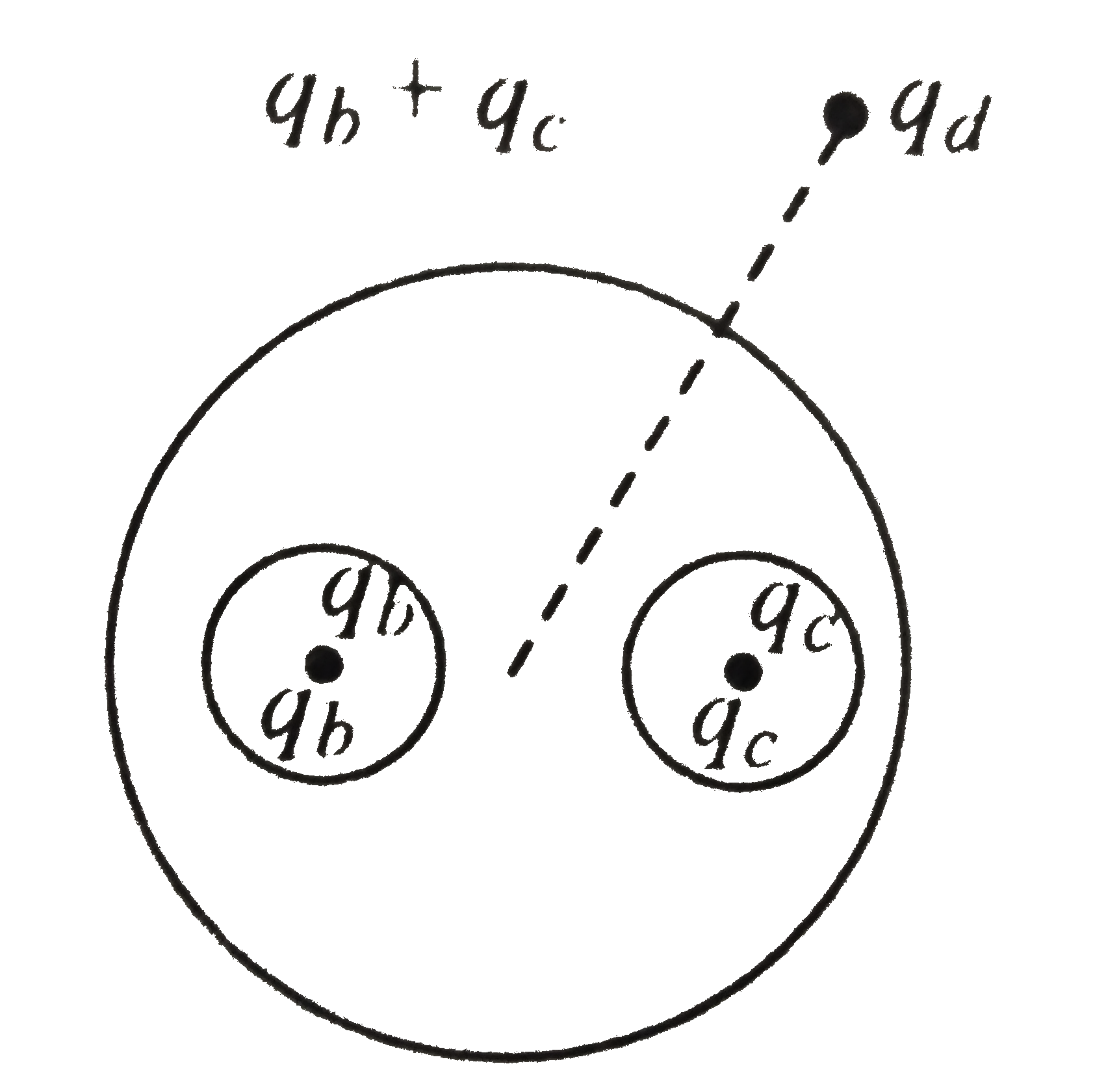
|
|
| 17. |
A uniform rod of mass m and length l is hinged at upper end. Rod is free to rotate in vertical plane. A bail of mass m moving horizontally with velocity vo collides at lower end of rod perpendicular to it and sticks to it. The minimum velocity of the ball such that combined system just completes the vertical circle will be |
|
Answer» `2[sqrt(2gl)]` |
|
| 18. |
A ray of light is incident on an equilateral glass prism placed on a horizontal table. For minimum deviation which of the following is true ? |
|
Answer» PQ is horizontal |
|
| 19. |
Let m_p be the mass of a proton , m_n the mass of a neutron, M_1 the mass of a ._10^20Ne nucleus and M_2 the mass of a ._20^40Ca nucleus . Then |
|
Answer» `M_2 = M_1` `._10^20Ne` nucleus CONSISTS of 10 protons and 10 neutrons . `therefore M_1 lt 10 (m_p + m_n)` |
|
| 20. |
2 kg of water at 60°C is mixed with I kg of water at 30°C kept in a vessel of heat capacity 200 Jk-^(1) . The specific, heat of water is 4, 200 J kg^(-1 K^(-1). Then the final temperature is nearly |
|
Answer» 45°C |
|
| 21. |
The speed of electromagnetic waves in vaccum depends upon the source of radiation. |
| Answer» Solution :The speed of all electromagnetic WAVES in vaccum is `3XX10^(8)ms^(-1)` and does not DEPEND upon the source of radiation. | |
| 22. |
The equation of the resultant motion of the number of simple harmonic motions is E_(c)=(1+K sin omega_(2)t) sin omega_(1)t. The number of simple harmonic components is/are. |
|
Answer» 1 |
|
| 23. |
Velocity of light is equal to |
|
Answer» `SQRT(epsilon_0mu_0)` |
|
| 24. |
A point object O is placed at a distance of 20 cm is front of a equiconvex lens (.^(a)mu_(g) = 1.5) of focal length 10 cm. The lens is placed on a liquid of refractive index 2 as shown in figure. Image will be formedat a distance h from lens the value of h is |
|
Answer» 5 cm `1/10 = (1.5-1)(1/R+1/R)=0.5xx2/R rArr R = 10 cm` `:. (mu_(2))/(V) - (mu_(1))/(u) = (mu_(2) - mu_(1))/(R)` Refraction fromfirst surface, `(1.5)/(v_(1)) - (1)/(-20) = (1.5-1)/(+10) rArr v_(1) =oo` For the second surface, `2/v-(1.5)/(oo)=(2-1.5)/(-10) = v = - 40 cm :. h = 40 cm` |
|
| 25. |
The current I in a n inductance coil varies with time, t according to the graph shown in the figgure. Which one of the following plots shows the variation of voltage in the coil with time ? |
|
Answer»
|
|
| 26. |
State whether true or false and justify . a Zener diodes are used under forward bias. b. In n-p-n transistor , current conduction is primarily due to electrons. c. Transistor amplifiers do not strictly obey law of conservation of energy since output power is greater than input power . d. In a transistor amplifier all the frequency will have exactly equal gain . |
|
Answer» SOLUTION :a. FALSE . ZENER diodes are USED under reverse bias . B. Truec . Falsed . False |
|
| 27. |
What holds nucleons together in a nucleus? |
| Answer» SOLUTION :NUCLEAR FORCES AMONGST the nucleons in a nucleus. | |
| 28. |
Answer the following questions: (a) In a single slit diffraction experiment, the width of the slit is made double the original width. How does this affect the size and intensity of the central diffraction band? |
| Answer» Solution :The size REDUCES by HALF according to the relation: size `~lambda//d`. INTENSITY INCREASES four fold. | |
| 29. |
A wire carrying a current I is bent into the shape of an exponential spiral, r=e^(theta), from theta=0 to theta=2pi as shown in figure (a0 . To complete a loop, the ends of the spiral are connected by a straight wire along the x- axis. Find the magnitude and direction of vec(B) at the origin. |
|
Answer» `(mu_(0)I)/(4pi)(1-e^(-2pi))` `tan beta=(r)/((dr)/(d theta))`  Thus in this CASE, we have `r=e^(theta)` and so we get `tan beta =1` and `beta=(pi)/(4)`. Therefore, the angle between `DVEC(1)` and `hat(r)` is `(pi-beta) =(3pi)/(4)` . ALSO`dvec(1)=(dr)/(sin((pi)/(4)))=sqrt(2)dr` From Biot `-` Savart's law, we know that there is no contribution from the straight portion of the wire since `dvec(1)xxvec(r)=0`.For the field of the spiral, we have `dB=(mu_(0)I)/(4pi)((dvec(1)xxhat(r)))/(r^(2))impliesB=(mu_(0)I)/(4pi)int_(theta=0)^(2pi)(|dvec(1)|sin theta|vec(r)|)/(r^(2))` `=(mu_(0)I)/(4pi)int_(theta=0)^(2pi)sqrt(2)dr[sin((3pi)/(4))](1)/(r^(2))` `implies B=(mu_(0)I)/(4pi)int_(theta=0)^(2pi)r^(-2)dr=-(mu_(0)I)/(4pi)(r^(-1))|_(theta=0)^(2pi)` Substitute `r=e^(theta)`, we get `impliesB=-(mu_(0)I)/(4pi)(e^(-theta))|_(0)^(2pi)=-(mu_(0)I)/(4pi)(e^(-2pi)-e^(theta))` `=(mu_(0)I)/(4pi)(1-e^(-2pi))` out of the page. |
|
| 30. |
The block in Fig. 8-12a lies on a horizontal frictionless surface, and the spring constant is 50 N/m. Initially, the spring is at its relaxed length and the block is stationary at position x=0. Then an applied force with a constant magnitude of 3.0 N pulls the block in the positive direction of the x axis, stretching the springuntil the block stops. When that stopping point is reached, what are (a) the position of the block, (b) the work that has been done on the block by the spring force ? During the block's displacement, what are (d) the block's position when its kinetic energy is maximum and (e) the value of that maximum kinetic energy ? |
|
Answer» |
|
| 31. |
In Young's experiment, the distance between two slits is 1 mm and the distance between two consecutive bright fringes is 0.03 cm. Now, on displacing the screen away from the slits by 50 cm, the distance between two consecutive dark fringes is doubled. Find the wavelength of light used. |
|
Answer» SOLUTION :When DISTANCE between SLIT and screen is `D_(1)=D,` distance between two consecutive bright fringes, `beta_(1)=(lamdaD_(1))/(d)""....(1)` When distance between slit and screen is `D_(1)=D+50` cm, distance between two consecutive bright fringes, `beta_(2)=(lamdaD_(2))/(d)""....(2)` `beta_(1)-beta_(2)=(lamda)/(d)(D_(2)-D_(1))` `:.beta_(2)-beta_(1)=(lamda)/(d)(D+50-D)` `:.2beta_(1)-beta_(1)=(50lamda)/(d)` `:.0.06-0.03=(50xxlamda)/(0.1)` `:.(0.03xx0.1)/(50)=lamda` `:.0.6xx10^(-4)=lamda` `:.lamda-6xx10^(-5)cm-6,000xx10^(-8)cm` `:.lamda=6000Å` |
|
| 32. |
A radioactive nucleus 'A' undergoes a series of decays according to the following scheme. AoversetalphatoA_1oversetbetatoA_2oversetalphatoA_3oversetgammatoA_4 Mass number of A_4=172, Atomic number of A_4=69 |
| Answer» SOLUTION :`_72A^180oversetalphato_70A_1^176oversetbetato_71A_2^176oversetalphato_69A_3^172oversetgammato_69A_4^172` | |
| 33. |
माना समतल में स्थित सभी रेखाओं के समुच्चय में मे संबंध R निम्नप्रकार परिभाषित है। (I_1,I_2)epsilonR= तथा ।, समान्तर है |
|
Answer» असममित |
|
| 34. |
(A): Sometimes HF waves can also pass through ionosphere. (R): The sky wave propagation depends on the vertical angle with which the radio waves are radiated from the antenna. |
|
Answer» Assertion and reason are TRUE and reason is the correct explanation of assertion |
|
| 35. |
There is a black spot at the bottom of a rectangular glass slab of thickness d and refractive index mu. When the spotis viewed perpendicularly from above, the spot appears to be shifted through a distance (mu-1)/(mu) towards the observer. Prove it. |
|
Answer» Solution :Read DEPTH of the black spot from the UPPER surface of the glass slab = d Let the apparent depth of the black spot from the upper surface of the glass slab be `d_(1)` REFRACTIVE index of glass `mu = (d)/(d_1) or, d_(1) = (d)/(mu)` `therefore` Apparent DISPLACEMENT of the black spot towards the observer `= d - d_(1) = d - (d)/(u) = d (1 - (1)/(mu)) = d ((mu-1)/(mu))` |
|
| 36. |
The peak value of an alternating emf is given by E= E_(0) cosomegat is 10 volt and its frequency is 50 Hz. At a time t = (1/600) second, the instantaneous value of the emf is : |
| Answer» Answer :C | |
| 37. |
The time period of oscillations of a freely suspended magnetic needle is given by |
|
Answer» `T= 2PI SQRT((I)/(mB_H))` |
|
| 38. |
A space traveler takes off from Earth and moves at speed 0.9950c toward the star Vega, which is 26.00 ly distant. How much time will have elapsed by Earth clocks (a) when the traveller reaches Vega and (b) when Earth observers receive word from the traveler that she has arrived? (c ) How much older will Earth observers calculate the traveler to be (measured from her frame) when she reaches Vega than she was when she started the trip? |
|
Answer» |
|
| 39. |
State Kirchhoff's rules. Apply these rules to the loops PRSPand PRQP to write the expressions for the currents I_1, I_2 and I_3 in the given circuit of Fig. |
|
Answer» Solution : In the network given as per Kirchhoff.s first LAW, we have `I_1 + I_2 = I_3`...(i) In loop PRQP, we have `- 20 I_3 - 60 I_1 + 4 = 0` ` 20 I_3 + 60I_1 = 4` Again in loop PRSP, we have `- 20 I_3 - 200I_2+ 5 = 0` `20I_3 + 200I_2 = 5` On solving equations (ii) and (iii), we GET `I_1 = 39/860 A, I_2 = 16/860 A " and " I_3 = 55/860 A` |
|
| 40. |
The susceptibility of a magnetic material is 1.9 xx 10^(-5). Name the type of magnetic materials it represents. |
| Answer» SOLUTION :As the SUSCEPTIBILITY of given MAGNETIC material `(x = 1.9 xx 10^(-5))` is EXTREMELY SMALL but positive, the material is a paramagnetic material. | |
| 41. |
The equation of wave travelling in a string can be written as y = 3 cos pi (100 t - x ) . Its wavelength is : |
|
Answer» Solution :y = 3 cos `(100 pi t - pi X )` comparing it with y= R cos `(omega t - kx)` we havek = `pirArr (2pi)/(lambda)pirArrlambda = 2 `cm. correct choice is (a) . |
|
| 42. |
The additional energy that should be given to an electron to reduce its de-Broglie wavelength from 1 mm to 0.5 mm is: |
|
Answer» 2 times the initial kinetic energy `lambda =H/sqrt(2m E_(x)) [therefore lambda=(1)/sqrtE_(k)]` (h and m remain constant), Here, in given condition `lambda_(1)/lambda_(2) =sqrt(K_(k_(2))/(E_(k_(1))), lambda_1/lambda_(2)=sqrt((4E)/(E)))` `lambda_(1)=2lambda_(2), lambda_(2)=lambda_(1)/2` So, if `E_(k)` is increased by four times, then `lambda` becomes half. Additional kinetic energy that should be SUPPLIED to the ELECTRON. `=4E_(k)-E_(k)=2E_(k)` |
|
| 43. |
A body is executing S.H.M. with maximum velocity of 16 cm/s and amplitude 4 cm. What is it's maximum acceleration ? |
|
Answer» Solution :`v_max=AOMEGA 16 = a omega` `1 =4xxomega` `THEREFORE omega=4` `A_max=aomega^2=(aomega)xxomega=v_maxomega` `=16xx4=64 cm//s^2` |
|
| 44. |
A comb rubbed with dry hair, can attract small pieces of paper because...... |
|
Answer» comb is a conductor. |
|
| 45. |
If eneryg E, velocity v and time t are taken t are taken as the fundamental units, what is the dimensional formula of intensity of radiation? |
|
Answer» `Ev^(-2)t^(-3)` `ML^(0)T^(-3)=E^(a)v^(B)t^(c )` `=[ML^(2)T^(-2)]^(a)[LT^(-1)]^(b)[T]^(c )=M^(a)L^(2a+b)T^(-2a-b+c)` `:.a=1` `2a+b=0` `b=-2a=-2` `-2a-b+c=-3` `-2+2+c=-3` `c=-3` `:.I=Ev^(-2)t^(-3).` Hence correct choice is `(a)` |
|
| 46. |
To convert a 800 mV range milli-voltmeter of resistance 40.Q into a milli ammeter of 100 mA range, the resistance to be connected as shunt is, |
|
Answer» `10OMEGA` |
|
| 47. |
In the presence of an applied electric field (vecE) in a metallic conductor. |
|
Answer» The electrons move in the DIRECTION of `vecE` |
|
| 48. |
A parallel -plate capacitor, whose plates are kept horizotnal is charged from a cell and then isolated from it. A dielectric slab which can just fit in the gap between the plates is now inserted to fill exactly half of the gap and then left alone. Neglect gravity and friction. The slab will |
|
Answer» remain stationary |
|
| 49. |
A battery or emf 10 V and internal resistance 3Omega is connected to a resistot. If the current in the circuit is 0.5 A, what is the resistance of the resistor ? |
|
Answer» `13 Omega`  CURRENT I =`(E)/( R + r) ` `THEREFORE R + r = (E)/(I)= (10)/(0.5) ` `therefore R + 3 = 20 Omega` `therefore R= 17 Omega` |
|
| 50. |
Using the curve for the binding energy per nucleon as a function of mass number A, state clearly how the release in energy in the processes of nuclear fission and nuclear fusion can be explained. |
|
Answer» Solution :From the curve showing variation of binding ENERGY per nucleon as a function of mass number A, we observe that binding energy per nucleon is practically constant for nuclei of middle mass number (`30ltA lt170`) and is lower for both light nuclei `(Alt 30)` and heavy nuclei `(A gt 170)`. (i) If a very heavy nucleus, say A = 235, breaks into two lighter nuclei of comparable masses, then the nucleons, get more tightly bound DUE to higher value of binding energy per nucleon. As a result, energy WOULD be released in the process of NUCLEAR fission. (ii) If two very light nuclei `(A lt 10)` JOIN to form a heavier nucleus, the binding energy per nucleon of the fused heavier nuclei is more than the binding energy per nucleon of the lighter nuclei. It means that the final system is more tightly bound than the initial system and energy would be released in such a process of nuclear fusion. |
|


