Saved Bookmarks
This section includes 7 InterviewSolutions, each offering curated multiple-choice questions to sharpen your Current Affairs knowledge and support exam preparation. Choose a topic below to get started.
| 1. |
A conducting ring of radius a is rotated about a point O on its periphery as shown in the figure in a plane perpendicular to uniform magnetic field B which exists everywhere. The rotational velocity is omega. Choose the correct statement(s) related to the induced current in the ring |
|
Answer» CURRENT FLOWS from `Qrarr Prarr OrarrRrarr Q` |
|
| 2. |
A conducting ring of radius a is rotated about a point O on its periphery as shown in the figure in a plane perpendicular to uniform magnetic field B which exists everywhere. The rotational velocity is omega. Choose the correct statement(s) related to the magnitude of potential differences |
|
Answer» `V_(P)-V_(O)=(1)/(2)B OMEGA a^(2)` `V_(Q)-V_(O)=1/2 Bomega(2a)^(2)=2Bomegaa^(2)` |
|
| 3. |
A conducting ring of radius a is rotated about a point O on its periphery as shown in the figure in a plane perpendicular to uniform magnetic field B which exists everywhere. The rotational velocity is omega. Choose the correct statement(s) related to the potential of the points P, Q and R |
|
Answer» `V_(P)-V_(O)GT0 and V_(R)-V_(O)LT0` `V_(P)-V_(O)=V_(R)-V_(O)=Bomegaa^(2)` `V_(P)=V_(R) gt V_(O)` 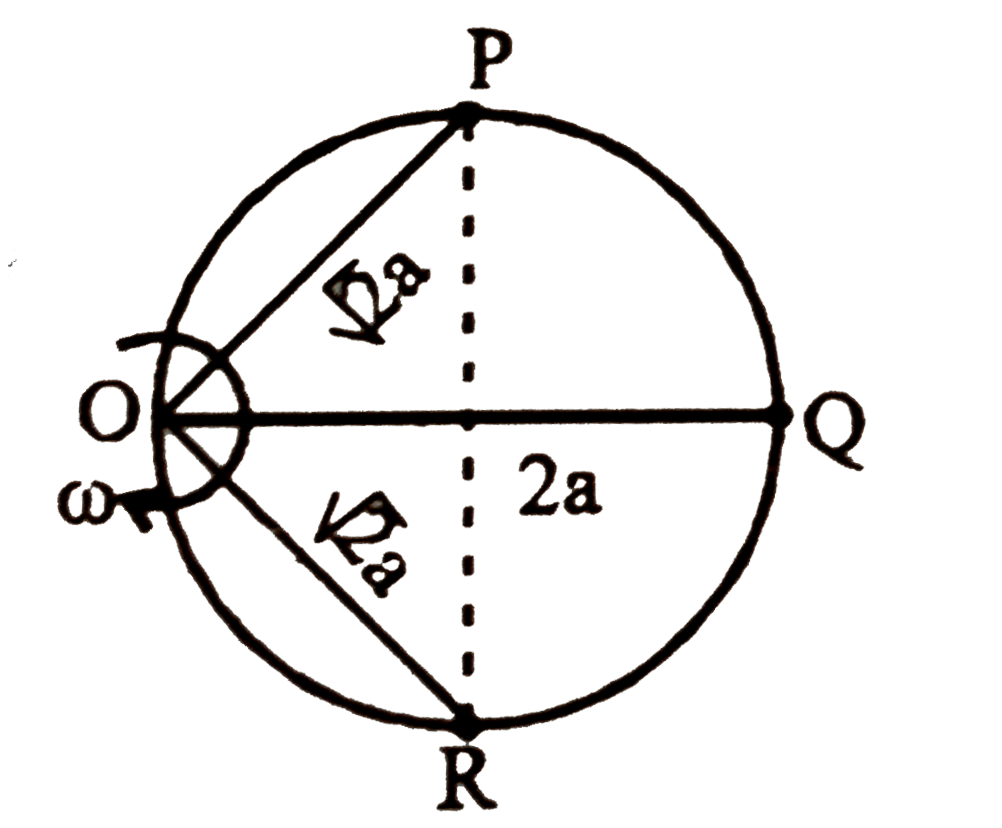 `V_(Q)-V_(P)=(V_(Q)-V_(P))-(V_(P)-V_(O))` `=1/2Bomega(2a)^(2)-(1/2Bomega(sqrt(2)a)^(2))=Bomegaa^(2)` `=V_(Q)-V_(P)=V_(P)-V_(Q)` |
|
| 4. |
High power lines cannot be insulated. Why? |
| Answer» SOLUTION :Insulator shows CONDUCTING property at HIGH VOLTAGE. | |
| 5. |
A vessel of volume V contains ideal gas having mass density rhoat temperature Tand pressure p. After a portion of the gas is let out, the pressure in the vessel is decreased by Delta p . The mass of the released gas is |
|
Answer» <P>`rho V Delta p// p` INITIAL VALUE of volume, pressure and temperature of an ideal gas in vessel. `V_1 = V, P_1 = P " and " T_1 = T` and density of gas ` = rho` ` P_2 =P - Delta P` ` T_2 = T_1` By an ideal gas EQUATION, `(P_1V_1)/(T_1) = (P_2 V_2)/(t_2) ` ` P_1/P_2 = V_1/V_2 "" [ because T_1 = T_2] ` `(P)/(P - Delta P) = (V - Delta V)/(V) = 1 - (Delta V)/(V)` ` (Delta V)/(V) = 1 - (P)/(P - Delta P)` ` =(P - Delta P - P)/( P - Delta P)` ` Delta V = (- Delta PV)/(P - Delta P) ` `therefore `Mass of released gas ` = rho Delta V = (rho Delta PV)/(P - Delta P) ~~ (rho Delta P V)/(P)` |
|
| 6. |
The total energy of electron in the ground state of hydrogen atom is (-13.6 eV). The kinetic energy of an electron in the first excited state is |
|
Answer» `6.8` eV `E_(2) = (E_(1))/(E_(2)) = (E_(1))/(E_(2)) = (-13.6)/(4) = -3.4 eV` ` K.E = - E_(2) = 3.4 eV` |
|
| 7. |
चावल कौन- सी ऋतु की फसल है? |
|
Answer» खरीफ |
|
| 9. |
Name and define elements of earth's magnetism. |
|
Answer» Solution :EARTH has THREE magnetic ELEMENTS : (i) Declination (ii) Dip or Inclination (iii) Horizontal component of the earth.s field. Let us consider each of them in detail. (i) Declination. It is defined as the angle between the magnetic meridian and the geographic meridian at a place. It is denoted by angle `theta` in Fig (a). In Fig., let PKLM represents the magnetic meridian and PK.L.M represents the geographic meridian at the place P. Then angle `theta` between these two planes, by definition, is the angle of declination at the place P. 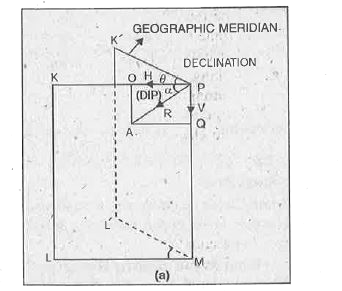 (ii) Dip or inclination `(delta)`. Dip at a place is defined as the angle between the direction of the TOTAL intensity of the earth.s magnetic field and a horizontal line in the magnetic meridian. In Fig. (a), PA represents the total or resultant intensity of the earth.s magnetic field R in magnitude as well as in direction. As PA makes an angle `delta` with PO, the angle of dip at the place P is `delta`. (iii) Horizontal Component (H). The total intensity of the earth.s magnetic field at any point can be resolved into two rectangular components, one along the horizontal and the other along the vertical direction. The component of the resultant intensity of the earth.s magnetic field in the horizontal direction in magnetic meridian is called its horizontal component. It is denoted by H. The component of the resultant intensity of the earth.s magnetic field in the vertical component. It is denoted by V. 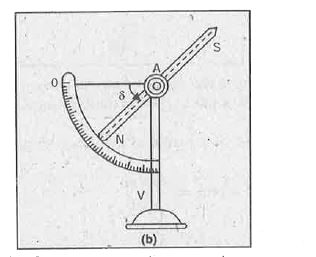 Relation between magnetic elements In Fig. (a) the resultant intensity, i.e. R along PA has been resolved into two rectangular components. Clearly, the horizontal component is along PO `i.e,""H=Rcosdelta""...(1)` and the vertical component is along PQ `i.e,""V=Rsindelta""...(2)` Dividing (2) by (1), we get `V/H=(Rsindelta)/(Rcosdelta)=tandelta""...(3)` Squaring (1) and (2) and adding, we get `H^(2)+V^(2)=R^(2)(cos^(2)delta+sin^(2)delta)` or `H^(2)+V^(2)=R^(2)` |
|
| 10. |
Mention any three application of polaroids |
|
Answer» Solution :(i) In SUNGLASSES (ii) In liquid CRYSTAL display (iii) To view 3-D PICTURES (iv) AUTOMOBILE head lights |
|
| 11. |
Find the heat energy produced in a resistance of 10Omega when 5 A current flows through it for 5 minutes. |
|
Answer» SOLUTION :`R=10Omega, I=5 A, t=5" MINUTES"=5xx60s` `H=I^(2)Rt=5^(2)xx10xx5xx60=25xx10xx300` `=25xx3000=75000J (or) 75kJ` |
|
| 12. |
A flat horizontal board moves up and down under SHM vertically with amplitude A. The shortest permissible time period of the vibration such that an object placed on the board may not lose contact with the board is |
|
Answer» `2PI sqrt((g)/(A))` |
|
| 13. |
Two pointcharges q_(1) and q_(2) of magnitude + 10^(-8) c and -10^(-8) crespectively are placed 0.1 m apart calculate the electricfields at points a, b and c |
Answer» SOLUTION :We know that direction of electric field due to a positive charge is always away from it and that due to a negative charge is always TOWARDS it. 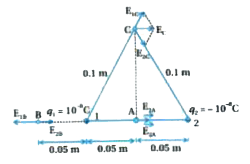 Magnitude of electric field at point A due to q, `E_(1A) = (kq_(1))/(r_(1A)^(2)) =(9 xx 10^(9))(10^(-8))/(0.05^(2)) = 3.6 xx 10^(4)` N/C (Direction: From `q_(1)` to `q_(2)`) SIMILARLY, magnitude of electric field at point A due to `q_(2)` `E_(2A) = (kq_(2))/r_(2A)^(2) = (9 xx 10^(9))(10^(-6))/(0.5)^(2) = 3.6 xx 10^(4) N//C` (Direction: From `q_(1)` to `q_(2)`) If resultant electric field at point A is: `vecE_(A) = vecE_(1A) + vecE_(2A)` `therefore E_(A) = E_(1A) + E_(2A) (therefore vecE_(1A) || vecE_(2A))` `=2E_(1A)(therefore E_(1A) || E_(2A))` `=2 xx 3.6 xx 10^(4)` `therefore E_(A) = 7.2 xx 10^(4)` N/C Magnitude of electric FIELDS at point C due to `q_(1)`and `q_2` are equal which is, `E = E_(1C) = E_(2C) = (kq_(1))/r_(1C)^(2) = (kq_(2))/(r_(2C)^(2))` `=(9 xx 10^(9))(10^(-8))/(0.1)^(2) = 9 xx 10^(3) N//C` Resultant electric field at point C is, `vecE_(C) = vecE_(1C) + vecE_(2C)` `therefore E_( C) = sqrt(2E^(2) + 2E^(2) (-1/2)) = sqrt(E^(2)) = E` `therefore E_( C) = 9 xx 10^(3)` N/C (In a direction, parallel to direction from `q_(1)`to `q_2`) (Towards right) |
|
| 14. |
There is a small air bubble inside a glass sphere (mu = 1.5) of radius 10 cm. The bubble is 4 cm below: the surface and is viewed normally from the outside. The apparent depth of the bubble is |
|
Answer» 3 CM below the surface |
|
| 15. |
By properly combining two prisms made of different materials, it is possible to |
|
Answer» have disersion whitout AVERAGE deviation |
|
| 16. |
The truth table of a logic gate is as follows : |
|
Answer» OR gate |
|
| 17. |
In a battery of 10 cell supposed to be in series some are wrongly connected. The cells are sealed in a box. When a similar cell is connected in opposition to the battery, the current produced by the combination through an external resistor of 14.5Omega is 0.075 A. How many cells are wrongly connected? What is the emf of the battery and what is its internal resistance if emf of each cell is 1.5V and internal resistance 0.5Omega? |
|
Answer» |
|
| 18. |
A piece of copper and another germanium are cooled from room temperature to 77K. The resistance of |
|
Answer» each of these DECREASES |
|
| 19. |
The electric and magnetic field of an electromagnatic wave are |
|
Answer» In OPPOSITE PHASE and PERPENDICULAR to each other |
|
| 20. |
The yeild of the nuclear reaction C^(13)(d,n)N^(14) has maximum magnitudes at the following values of kinetic energy T_(i) of bombarding deuterons: 0,60,0.90, 1.55,and 1.80MeV. Making use of the tabel of atomic masses, find the corresponding energy levels of the transitional nucleus through which this reaction proceeds. |
|
Answer» Solution :The reaction is `d+C^(13rarrN^(15))rarrn+N^(14)` Maxima of yields determine the energy LEVELS of `N^(15)`. As in the previous problem the excitation enrgy is `E_(exc)=Q+E_(K)` where `E_(k)=` available kinetic enrgy. This is found is as in the previous problem. The velocity of the centre of mass is `(sqrt(2m_(d)T_(i)))/(m_(d)+m_(c ))=(m_(d))/(m_(d)+m_(c ))sqrt((2Ti)/(m_(d)))` So `E_(k)=(1)/(2)m_(d)(1-(m_(d))/(m_(d)+m_(c ))^(2)(2Ti)/(m_(d)))+(1)/(2)m_(c )((m_(d))/(m_(d)+m_(c )))^(2)(2Ti)/(m_(d))=(m_(c ))/(m_(d)+m_(c ))Ti` `Q` is the `Q` value for the ground state of `N^(15)`: we have `Q=c^(2)xx(Delta_(d)+Delta_(c )^(13)-Delta_(N)^(15))` `1=c^(2)xx(0.01410+0.00335-0.00011)am U` `=16.14MeV` The excitaiton ENERGIES then are `16.66MeV,16.92MeV` `17.49MeV` and `17.70MeV`. |
|
| 21. |
(a) For what kinetic energy of a neutron will the associated de-broglie wavelength be 1.40xx10^(-10)m? (b) Also find the de-Broglie wavelength of a neutron, in thermal equilibrium with matter, having an average kinetic energy of 3/2kT at 300K. |
|
Answer» Solution :(a) Mass of neutron `m_(N)=1.675xx10^(-27)KG` and de-Broglie wavelength `lamda=1.40xx10^(-10)m` `because lamda=(h)/(p)=(h)/(sqrt(2m_(n)K))` `K=(h^(2))/(2m_(n)lamda^(2))=((6.63xx10^(-34))^(2))/(2xx(1.675xx10^(-27))xx(1.40xx10^(-10))^(2))=6.686xx10^(-21)J` `=(6.686xx10^(-21))/(1.6xx10^(-19))eV=4.174xx10^(-2)eV`. (b) As kinetic energy of neutron `K=(3)/(2)k_(B)T`, where `k_(B)=`Boltzmann.s constant`=1.38xx10^(-23)JK^(-1)` and T=300K (given) `therefore lamda=(h)/(sqrt(2m_(n)K))=(h)/(sqrt(3m_(n)k_(B)T))=(6.63xx10^(-34))/(sqrt(3xx(1.675xx10^(-27))xx(1.38xx10^(-23))xx300))=1.45xx10^(-10)m`. `=0.145nm`. |
|
| 22. |
High precision optical instruments uses prisms instead of mirror to reflect light What is the advantage of using prism instead ofmirror for reflecting light ? |
| Answer» Solution :Prism can be used for total INTERNAL reflection. MIRRORS can.t be SED for total intemal reflection, | |
| 23. |
Two projectiles are thrown from the same point simultaneously with same velocity 10 ms^(-1) . One goes straight vertically while other at 60° with the vertical. What will be the distance of separation between the two after 1 second of their throw ? |
|
Answer» 20m vertical velocity =`10 cos 60° = 5 ms^(-1)` Horizontal SEPARATION `Deltax = 5sqrt(3) xx 1` `=5sqrt(3)m` Vertical seperation = `h_(1)-h_(2)` `Deltay=(10t-1/2g^(2)t)-[5t-1/2g^(2)t]` `=10xx1-5xx1)=5m` `:.` displacement `|r|=sqrt((5sqrt(3))^(2)+5^(2))` |
|
| 24. |
Assertion: Electric field near a large conducting surface with uniform surface charge density (sigma) is E=sigma/epsilon_0 Reason: If there is an isolated metal plate then we cannot distribute charge only on one surface. Whatever charge is given it uniformly gets distributed on both sides. We are neglecting thickness of the plate, On the other hand, if we have two metal plates carrying equal and opposite charges and place them parallel to each other, charge on plates stays only on the inner faces. |
|
Answer» If both ASSERTION and REASON are CORRECT and reason is a correct EXPLANATION of the assertion . |
|
| 25. |
A ball falls from rest from a height 'h' and rebounds to a height h/4. The value of coefficient fo restitution is : |
| Answer» ANSWER :B | |
| 26. |
Two blocks of masses m_(1) and m_(2) are connected by a spring having spring constant K. Initially , the spring is at its natural length. The coefficient of friction between the blocks and the surface is mu. What minimum constant force has to be applied in the horizontaldirection to the block of mass m_(1), in order to shift the other block? |
|
Answer» `F=mu(m_(1)+(m_(2))/(2))G` |
|
| 27. |
The half-life period of a radioactive element X is same as the mean lifetime of another radioactive element Y. Initially they have the same number of atoms. Then |
|
Answer» X and Y DECAY at same RATE aways. |
|
| 28. |
Modern Civilization is the worship of....... |
|
Answer» Material |
|
| 29. |
A moving charge is subjected to an external magnetic field. The change in the kinetic energy of the particle |
|
Answer» INCREASES with the INCREASEIN the field strength |
|
| 30. |
If a full-wave rectifier circuit is operating from 50 Hz mains, the fundamental frequency in the ripple will be |
|
Answer» 50 Hz |
|
| 31. |
Which of the following is more close to a black body ? |
| Answer» Answer :C | |
| 32. |
An inductor of inductance L = 400 mH and resistors of resistance R_(1) = 2 Omega and R_(2) = 2Omega are connected to a battery of emf 12V as shown in the figure.The internal resistance of the battery is negligible.The switch S is closed at t = 0.The potential drop across L as a function of time is |
|
Answer» `(12)/(t)e^(-3t)V` `i = (E)/(R_(2))[1 - e^(-R_(2)t/L] Rightarrow (di)/(dt) = (E)/(R_(2)).(R_(2))/(L) e^(-R_(2)t/L) = (E)/(L)e ^(-(R_(2)t))/(L)]` Hence, potential drop across `L = ((E)/(L)e^(-R_(2)t/L))L = Ee^(-R_(2)t/L) = 12 e -(2t)/(400 xx 10^(-3)) = 12e^(-5tV)` |
|
| 33. |
Findthe difference of potential the ends of a horizaontal induction of earth's field =2 xx 10^(-5) tesla) |
|
Answer» |
|
| 34. |
ऑक्सीजन अणु के एक मोल का द्रव्यमान कितना होगा |
|
Answer» 16gm |
|
| 35. |
Show diagrammatically two different arrangements used for winding the primary and secondary coils in a transformer. Assuming the transformer to be an ideal one, write expressions for the ratio of its (i) output voltage to input voltage. (ii) output current to input current in terms of the number of turns in the primary and secondary coils. Mention two reasons for energy losses in an actual transformer. |
Answer» Solution :TWO different ARRANGEMENTS used for winding of primary and secondary coils in a transformer are shown in Figs. 7.35 (a) and (b) given below For an IDEAL transformer (i) `V_("output")/I_("input") = N_(s)/N_(p)` or (ii) `I_("output")/I_("input") = N_(p)/N_(s)` Two possible reasons for energy loss in an ACTUAL transformer are : (i) EDDY currents, and (ii) hysteresis. |
|
| 36. |
A deflection magnetometer is placed with its arm along the east-west direction (tan A position) and a short bar magnet is placed symmetrically along its axis at some distance with its north pole pointing towards east. In this position the needle of the magnetometer shows a deflection of 60^(@). If we double the distance of the bar magnet, then the deflection will be |
|
Answer» `sin^(-1)[(SQRT3)/(8)]` |
|
| 37. |
Can moving coil galvanometer be used to detect an a.c. in a circuit? Give reason. |
|
Answer» The COIL bends EASILY |
|
| 38. |
Copper Sulphide precipitate is of ............... color |
|
Answer» Black |
|
| 39. |
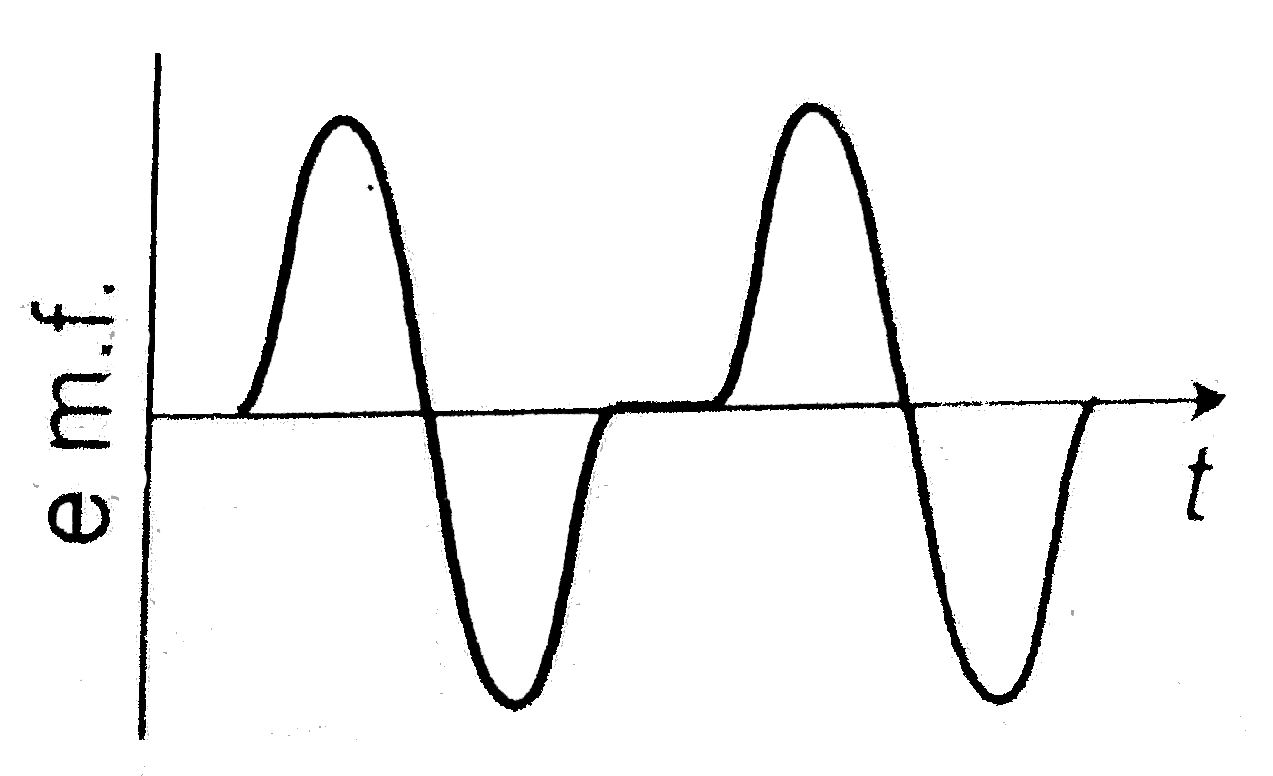
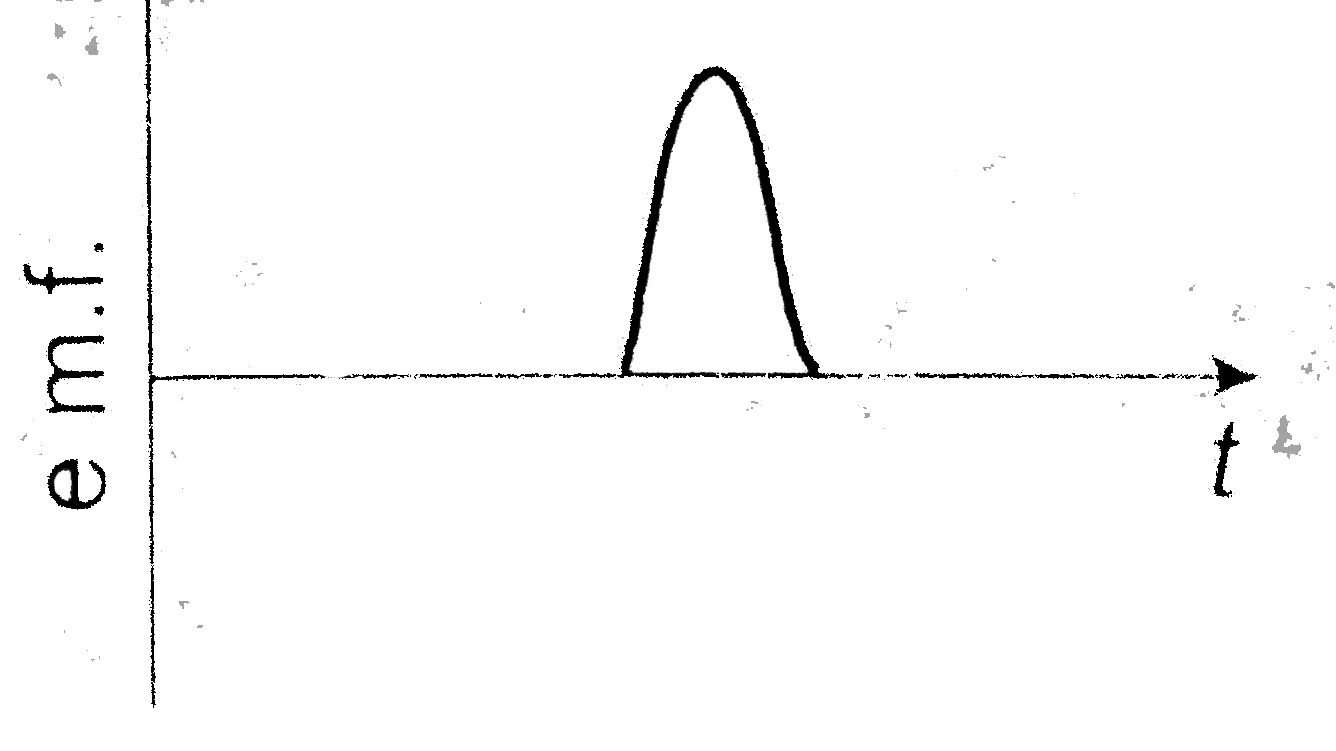
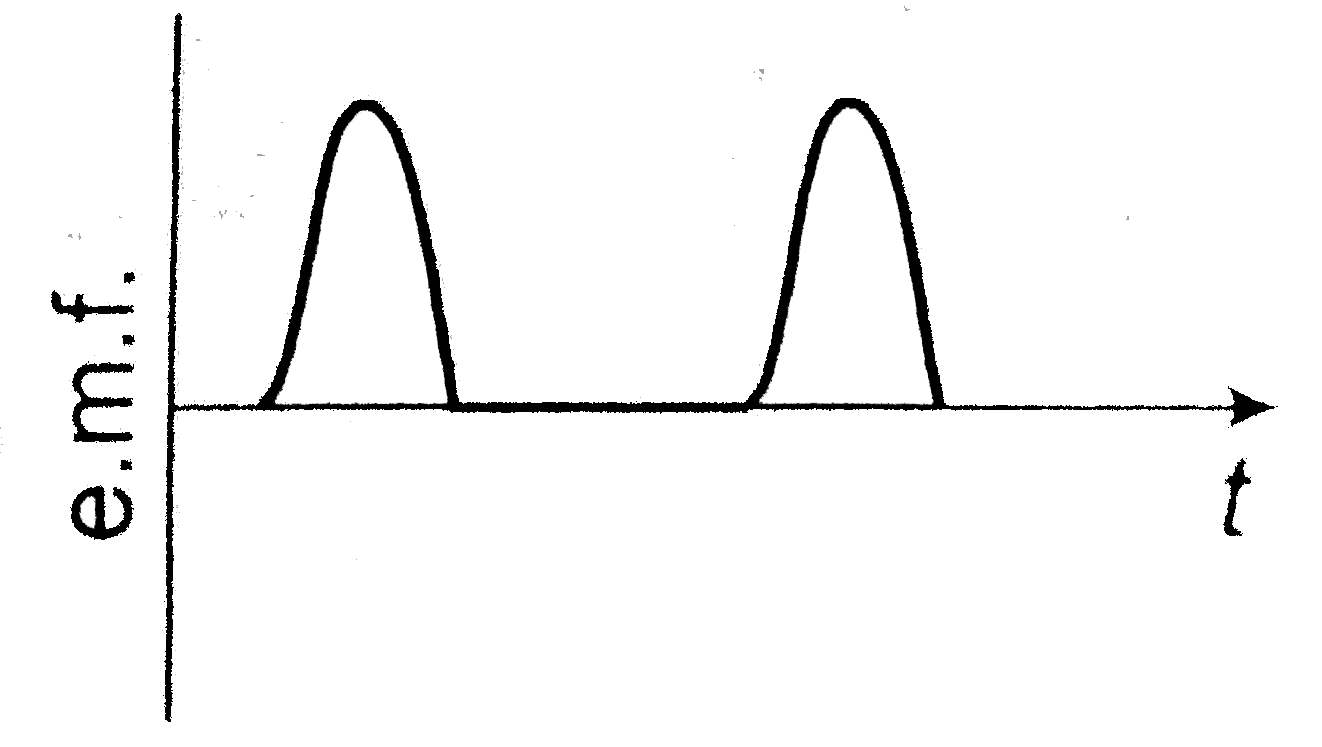
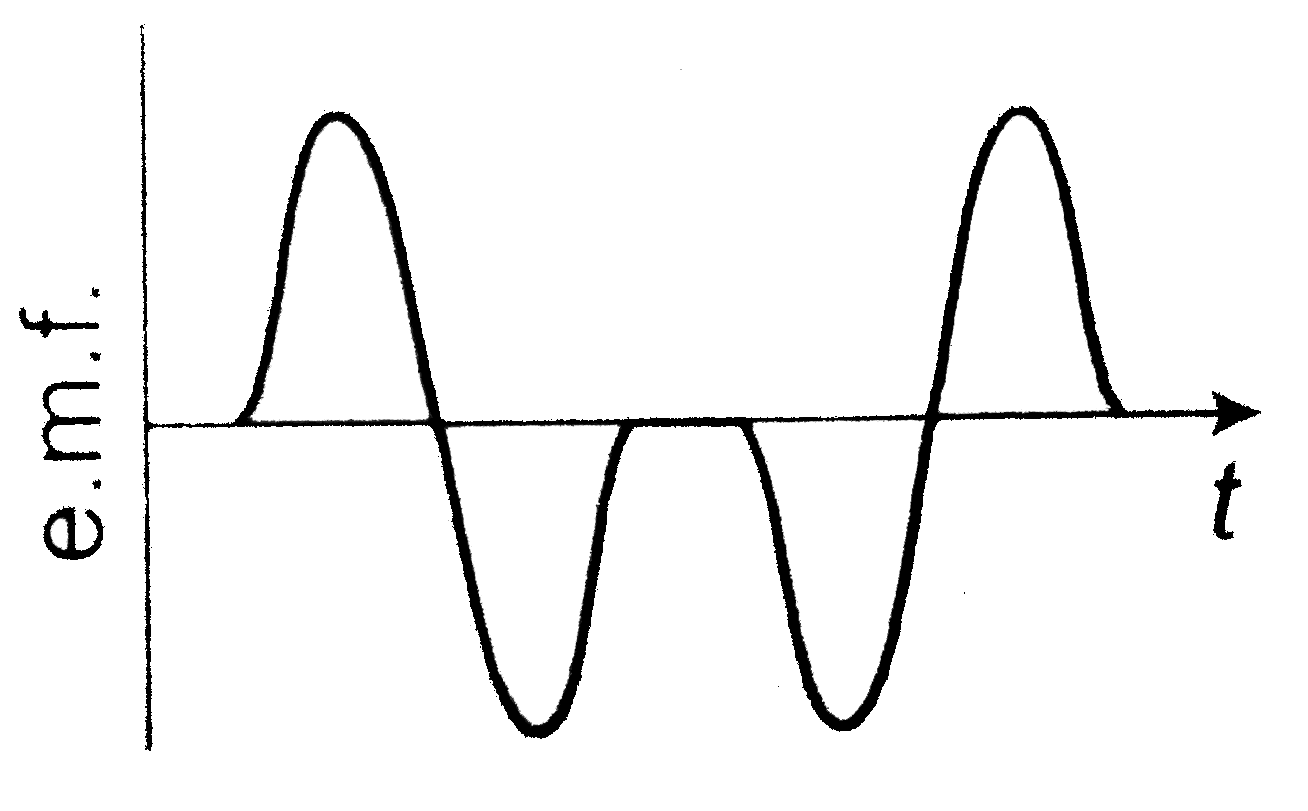
A magnetic is made to oscillate with a particular frequency, passing through a coil as shown in figure. The time variation of the magnitude of e.m.f. generated across the coil during one cycle is |
|
Answer»
|
|
| 40. |
Two long and parallel straight wires A and B carryingcurrents of 8.0 A and 5.0 A in the same direction are seperated by a distance of 4.0 cm . Estimate the force on a 10 cm section of wire A. |
|
Answer» Solution :`I_1 = 8.0 A, I_2 = 5.0 A, R = 4.0 CM = 4.0 xx 10^(-2) m ` I = 10 cm = 0.1 m `F= (2 xx 10^(-7) I_1I_2)/(r) = (2 xx 10^(-7) xx 8 xx 5 xx 0.1)/(4 xx 10^(-2))= 2 xx 10^(-3)N` ( towards B) |
|
| 41. |
The de Broglie wavelength of an electron in a metal at 27^@C is (Given m_e=9.1xx10^-31 kg, K_B = 1.38xx10^-23 J kg^-1) |
|
Answer» `6.2xx10^-9 m` |
|
| 42. |
The length of a sonometer wire tuned to a frequency of 256 Hz is 0.6 m. Calculate the frequency of the tuning fork with which the vibrating wire will be in tune when the length is made 0.4 m |
| Answer» Answer :C | |
| 43. |
Two identical capacitors A and B are charged to the same potential and then made to discharge through resistances R_(A) and R_(B) respectively, with R_(A) gt R_(B). |
|
Answer» A will require greater TIME than B to DISCHARGE completely. |
|
| 44. |
It was James Clark Maxwell who modified Amperes Circuital Theorem by introducing the concept of displacement current. What do you mean by displacement current ? |
| Answer» Solution :Displacement current is DUE to the displacement of electrons in TIME VARYING electric fields. | |
| 45. |
The following configuration of gate is equivalent to : |
|
Answer» NAND 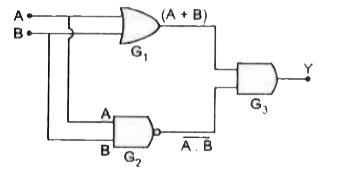 `Y=(A+B).bar(AB)` The GIVEN output equation can also be written as `Y=(A+B).(bar(A)+bar(B))""` (De Morgan.s THEOREM) `=AbarA+AbarB+BbarA+BbarB=0+AbarB+barAB+0=barAB+AbarB` This is the EXPRESSION for XOR GATE. |
|
| 46. |
In a region magnetic field along x axis changes with time according to the given graph. If time period, pitch and radius of helix path are T_(0),P_(0) and R respectively then which of the following is incorrect if the paticle is projected at an angle theta_(0) with the positive x-axis in x-y plane from origin: |
|
Answer» At `t=T_(0)/2`,co-ordinates of charge are `(P_(0)/2,0,-2R_(0))`. |
|
| 48. |
A particle moving along the x-axis has a position given by x= 16t t metres where t is in second, then how far is the particle from the origin when it just stops momentarily ? |
|
Answer» `( E)/(16)` METER |
|
| 49. |
A p-n photodiodeis fabricated from a semiconductor with a band gap of 2.5 eV. It can detecta signal of wavelength …….. |
|
Answer» 4000 NM `lambda_("max")=(hc)/(E )=(6.6xx10^(-34)xx3xx10^(8))/(2.5xx1.6xx10^(-19))=4950`Å The wavelength obtained by the PHOTODIODE is less than `lambda_("max")` so it can detected to a SIGNAL having wavelength 4000 Å. |
|
| 50. |
Ordinary light incident on a glass slab at the polarising angle suffers a deviation of 24^@. The value of the angle of incidence is : |
| Answer» ANSWER :B | |