

Saved Bookmarks
This section includes 7 InterviewSolutions, each offering curated multiple-choice questions to sharpen your Current Affairs knowledge and support exam preparation. Choose a topic below to get started.
| 1. |
SI unit of magnetic intensity vecH as well as magnetisation vecM is ________ . |
| Answer» SOLUTION :`A m^(-1)` | |
| 2. |
A coil of wire enclosing an area of 100cm^(2) is placed at an angle of 70^(@) with a magnetic field B to 10^(-1) Wbm^(-2). What is the flux through the coil? B is reduced to zero in 10^(-3)sec. What e.m.f. is induced in the coil? |
|
Answer» |
|
| 3. |
The radii of curvatore of two surfaces of a convex lens is 0.2 m and 0.22 m. Find the the forcal length of the lens if refractive index of the material of lens is 1.5. Also find the change in focal length, if it is immersed in water of refractive index 1.33. |
|
Answer» Solution :GIVEM: ` R_(1) + 0.2m ` ` R_(2) = - 0.22 m ` , ` n = 1.5 , n_(w) = 1.33 ` w.k.t ` 1/t = (n_(2) - 1) ((1)/(R_(1)) - (1)/(R_(2))) ` i.e., ` 1/f = (1.5 -1) ((1)/(0.2) + (1)/(0.22)) ` i.e., ` 1/f = 0.5 xx (5 + 4.550 = 4.78` Hence `f = (1)/(4.78) = 0.209 m" but " (f_(w))/(f_(a)) = (n_(r) -1)/(t^(n_(G)) -1) ` i.e., ` (f_(w))/(f_(a)) = (1.5 -1)/((1.33)/(1.33)-1) = 3.91 ` i.e., ` f_(w) = 3.91 f_(a) = 3.91 xx 0.209 = 0.817 m ` FOCAL length of LENS in water = 0.817 m |
|
| 4. |
What is the value of the angle between the vectors vecPandvecE for which the potential energy of an electric dipole of dipole moment p, kept inan external electric field vecE , has the maximum value. |
|
Answer» SOLUTION :`P.E.=-vecp.vecE=-pEcostheta` `thereforeP.E` is the MAXIMUM when `costheta=-1,i.ethetapi(180^(@))` |
|
| 5. |
To a germanium sample, traces of galium are added as an impurity. The resultant sample would behave like …….. |
|
Answer» a GOOD conductor. In short the absence of ELECTRON in a COVALENT bond of Ge EXIST HENCE hole are positive, so it is called p-semiconductor. |
|
| 6. |
Two nicols are so oriented that the maximum amount of light is transmitted. To what fraction of its maximum value is the intensity of transmitted light reduced when the analyser is rotated through (i) 30^(@) (ii) 60^(@) ? |
| Answer» SOLUTION :75% of MAX. INTENSITY | |
| 7. |
Two distant sources situated together emit sound each of frequency 300cycles persecond. Ifoneofthemweretoapproach and the other to recede from a stationary observer each with a velocity of 1//100^th the velocity ofsound, calculate the number of beats per second heard by the observer. |
Answer» Solution :The situation is shown in figure-6.87. 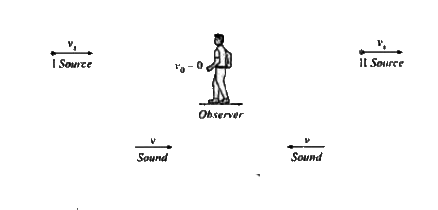 The first source is approaching the stationary OBSERVER. The frequencyof the source as heard by observeris given by `n_(1) = n((v)/(v - v_(s)))` Where n is the actual frequency of source `n_(1) = 300((v)/(v - v//100))` `(300 xx 100)/(99)` = 303.03 Hz The second source is receding from the observer in the direction opposite to the sound. Hence the APPARENT frequency `n_(2)` `n_(2) = ((v)/(v + 0.01v)) xx 300` `(300 xx 100)/(101)` = 297.03 Hz Hence BEAT frequency detected by observer is `Delta n = 303.03 - 297.03 = 6 Hz` |
|
| 8. |
How does the effective junction potential barrier change when a p-n junction is reverse biased ? |
| Answer» Solution :When a p-n junction is reverse BIASED, the d.c.voltage aids the ficititous battery, developed ACROSS the junction and thus the POTENTIAL drop across the junction increases and as a RESULT, the diffusion of holes and electrons across the junction decreases and the p-n junction offeres high resistance . So the width of depletion layer increases. | |
| 9. |
In a coil , the e.m.f. induced by a change in current from 4A to 8A in 0.1 second is 8V. The inductance of the coil is |
|
Answer» `0.1H` |
|
| 10. |
Find the current in the wire for the configuration shown in figure. Wire PQ has negligible resistance. vecB, the magnetic field is coming out of the paper. theta is a fixed angle made by PQ travelling smoothly over two conducting parallel wires separated by a distance d. |
Answer» Solution :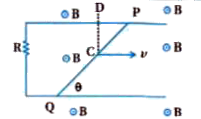 INDUCE emf in rod can be given by , `epsilon=Bvl` Here, `vecB, VECV` and `VECL`all should be mutually perpendicular and if it is not then we consider their perpendicular component. 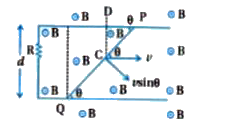 Here `vecB` and `vecv` is perpendicular to each other but length of rod PQ is not perpendicular to `vecv` and `vecB`. But Isine component is perpendicular to both `vecv` and `vecB`. From figure , LSIN`theta`=perpendicular distance between two wire (d) `therefore lsintheta =d` `therefore epsilon=Bvd` Induced emf `epsilon=Bv(lsin theta) = Bvd` Induced current `I=epsilon IR` `=(Bvd)/R` Direction of this induced current is in clockwise direction according to Lenz.s LAW. |
|
| 11. |
Figure shows an equiconvex lens (of refractive index 1.50 ) in contact with a liquid layer on top of a plane mirror. A small needle with its tip on the principal axis is moved along the axis until its inverted image is found at the position of the needle. The distance of the needle from the lens is measured to be 45.0 cm. The liquid is removed and the experiment is repeated . the new distance is measured to be 30.0 cm. What is the refractive index of the liquid ? |
|
Answer» SOLUTION :f = 45 cm , N = 1.5 , `f_(1) = 30` `therefore (1)/(f_(1)) + (1)/(f_(2)) = (1)/(f) , (1)/(f_(2)) = (1)/(f) - (1)/(f_(1))` `(1)/(f_(2)) = (1)/(45) - (1)/(30) = (30 - 45)/(45 xx 30) = (-1)/(90)` `f_(2) = - 90 ` cm but `(1)/(f_(1)) = (n - 1) [(1)/(R_(1)) - (1)/(R_(2)) ] , R_(1)= R_(2) "" therefore (1)/(f_(1)) = (n - 1)[ (2)/(R) ] ` `(1)/(30) = (1.5 - 1) xx (2)/(R) =(1)/(R) "" therefore R= 30 cm ` ` f_(2) = - 90 cm , n = ? , R_(2) = infty , R_(1) = - 30 cm "" therefore (1)/(f_(2)) = (n - 1) [ (1)/(R_(1)) - (1)/(R_(2)) ]` ` (1)/(-90) = (n - 1) [(1)/(-30) - (1)/(infty) ]= (n - 1) xx (1)/(-30) "" therefore n - 1 = (30)/(90) = (1)/(3) = 0.33 ` `therefore n = 0.33 +1 "" n = 1.33 ` |
|
| 12. |
A source emitting a sound of frequency V is placed at a large distance from an observer. The source starts moving towards the observer with a uniform acceleration a. Find the frequency heard by the oserver corresponding to the wave emitted just after the source starts. The speed of sound in the medium is v. |
|
Answer» `(VV^(2))/(2Vv-a)` |
|
| 13. |
Derive an expression for the impedance of a series LCR circuit, when an AC voltage is applied to it. |
Answer» Solution :Consider a RESISTANCE R, an inductor of self inductance L and a capacitor of capacitance C connected in series across an AC source.The applied voltage is given by, `v=v_0 sin omegat` …(1) 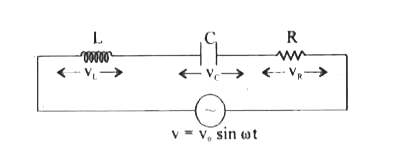 where, `v_0` is the instantaneous value, v. is the peak value and `omega = 2pif`, f being the frequency of AC. If i be the instantaneous current at time t, the instantaneous VOLTAGES across R, L and Care respectively iR, `iX_L` and `iX_C`. The vector sum of the voltage amplitudes across R, L, C EQUALS the amplitude `v_0` of the voltage applied. Let `v_R,v_L` and `v_C` be the voltage amplitudes across R, L and C respectively and `I_0` the current amplitude. Then `v_R=i_0R` is in phase with `i_0`. `v_L=i_0 X_L=i_0 (omegaL)`leads `i_0` by `90^@` `v_c=i_0X_C=i_0 (1/(omegaC))` lags behind`i_0` by `90^@` .  The current in a pure resistor is phase with the voltage, whereas the current in a pure inductor lags the voltage by `pi/2` rad. The current in a pure capacitor leads the voltage by `pi/2` rad. For`V_L > V_C`, phase angle `phi` between the voltage and the current is positive. From the RIGHT angled triangle OAP, `OP^2 = OA^2 +AP^2 =OA^2+ OB^2 (becauseAP=OB)` `=v_R^2 +(v_L-v_C)^2` `=(iR)^2 + (iX_L - iX_C)^2` `=i^2 (R^2 + (X_L -X_C)^2)` `therefore i=v/sqrt(R^2 + (X_L -X_C)^2)=v/Z` and `Z=sqrt(R^2 + (X_L -X_C)^2)` Where Z is the impedance of the circuit Phase angle between v & i. `tan phi =(v_L-v_C)/v_R =(X_L-X_C)/R_L` `phi=tan^(-1) ((X_L-X_C)/R)` |
|
| 14. |
Light guidence in an optical fiber can be understood by considering a structure comparising of thin solid glass cyclider of refractive index n_(1) surrounded by a medium of lower refractive index n_(2). The light giudence in the structure takes place due to successive total internal reflections at the interface of media n_(1) and n_(2) as shown in Fig. All rays with the angle of nicidence i less than a particular value i_(m) are confined in a medium of refractive index n_(1). The numerical aperture (NA) of the structure is defined as sin i_(m). For two structure namely S_(1) with n_(1) = (sqrt(45))/(4) and n_(2) = (3)/(5), and S_(2) with n_(1) = (8)/(5) and n_(2) = (7)/(5) and taking refractive index of water to be (4)/(3) and their of air to be 1, the correct option (s) is (are). |
|
Answer» `NA` of `S_(1)` immersed in WATER is same as that of `S_(2)` immersed in a liquid of refractive index `(16)/(3sqrt(15))`, As `n_(s) sin i_(m) = n_(1) sin(90^(@) - C)`…(i) ALSO, `sin C = (1)/(mu) = (n_(2))/(n_(1))`…(ii) As `NA = sin i_(m)` From (i), `sin i_(m) = (n_(1))/(n_(s)) sin (90^(@) - C)` `= (n_(1))/(n_(s)) cos C = (n_(1))/(n_(s)) sqrt(1 -sin^(2) C)` `:. NA = (n_(1))/(n_(s))sqrt(1 - (n_(2)^(2))/(n_(1)^(2))) = (1)/(n_(s))sqrt(n_(1)^(2) - n_(2)^(2))` [from (ii)] For `S_(1)` in air, `n_(s) = 1, n_(1) = (sqrt(45))/(4), n_(1) = (3)/(2)` `NA = (1)/(1) = sqrt((45)/(16) - (9)/(4)) = (3)/(4)` `NA = (sqrt(15))/(6)sqrt((45)/(16) - (9)/(4))= (3sqrt(15))/(24) = (sqrt(15))/(8)` For `S_(1)` in water `NA = (1)/(4//3)sqrt((45)/(16) - (9)/(4)) = (3)/(4)((3)/(4)) = (9)/(16)` For `S_(2)` inair , `n_(s) = 1, n_(1) = (8)/(5), n_(2) = (7)/(5)` `NA = (1)/(1)sqrt((64)/(25) - (49)/(25)) = (sqrt(15))/(5)` For `S_(2)` in water, `n_(2) = (4)/(3)` `NA = (1)/(4//3)sqrt((64)/(25) - (49)/(25)) = (3)/(4)(sqrt(15))/(5)` For `S_(2)` in `n_(s) = (16)/(3sqrt(15))` `NA = (3sqrt(15))/(16)sqrt((64)/(25) - (49)/(25)) = (9)/(16)` For `S_(2)` in `n_(s) = (4)/(sqrt(15))` `NA = (sqrt(15))/(4)sqrt((64)/(25) - (49)/(25)) = (3)/(4)` Hence, options 'a' and 'c' are correct. |
|
| 15. |
A point charge q is isolated at the centreO of a spherical uncharged conducting layer provided with a small orifice. The inside and outside radii of the layer are equal to r_(1) and r_(2) respectively. Find the amount of work done to slowly transfer the charge q from the centre O, through the orifice and to infinity. |
Answer» Solution :Because of q, charges will INDUCE on the outer and inner surface of the layer. Thoseare +q and -q RESPECTIVELY.  POTENTIAL at the centre `=(q)/(4pi in_(0)) [(1)/(r_(1)) -(1)/(r_(2))]` Work done in transferring q from centre to infinity. `intVdq=int (q)/(4pi in_(0)) [(1)/(r_(1))-(1)/(r_(2))] dq=(q^(2))/(8pi in_(0)) ((1)/(r_(1))-(1)/(r_(2)))` We can do this even by finding the difference in electric potential ENERGY of the SYSTEM. |
|
| 16. |
The line joining the points on earth's surface where dip needle becomes horizontal is called as ________ . |
| Answer» SOLUTION :MAGNETIC EQUATOR | |
| 17. |
Electric field E, current density J and conductivity sigmaof a conductor are correlated as per therelation : |
|
Answer» `E = SIGMA J` |
|
| 18. |
A source emits electromagnetic waves of wavelength 3 m. One bema reaches the observer directly and other after reflection from a water surface, travelling 1.5 m extra distance and withintensity reduce to (1/4) as compared to intensity due to direct bema alone. The resultant intensity will be : |
|
Answer» `(1/4)` fold `therefore` Total phase difference `= pi - pi = 0` HENCE, resultant amplitude is ` = sqrt I + sqrt(I)/(4) = 3/2 sqrtI` Then intensity = `(3/2 sqrtI)^(2) = 9/4 I`. |
|
| 19. |
When a current of 100mA is passed through a coil of moving coil galvanometer, the coil deflects by 20 degree. If torsional constant of suspension fibre is 2xx10^(-7)(Nm)//(deg) then the deflection torque is equal to: |
|
Answer» `10^(-7)` NM |
|
| 20. |
A rectangular loop of area A and carrying a steady current I is placed in a uniform magnetic field:-Increasing the current sensitivity may not necessarily increase the voltage sensitivity of a galvanometer. Justify. |
| Answer» Solution :CURRENT sensitivtity can be INCREASED by incraesing number of turns. When number of turns doubble, the resistance of the wire will ALSO be doubbled. HENCE the voltage sensitivity does no CHANGE | |
| 21. |
Two plane concave lenses of glass of refractive index 1.5 have radii of curvature 20 cm and 30 cm respectively. They are placed in contact with the curved surface towards each other and the space between them is filled with a liquid of refractive index 5/2. The focal length of the combination is (in cm) |
| Answer» Answer :D | |
| 22. |
Three small charges of equal magnitude and same sign lie on the circumference of a circle forming an equilateral triangle. What is the value of electric field at the centre of circle ?(##U_LIK_SP_PHY_XII_C01_E09_019_Q01.png" width="80%"> |
|
Answer» Solution :As SHOWN in electrical fields at the centre of circle due to THREE charges are ` E_A ,E_B and E_C ` whose magnitudes are equal. As these intensities are being represented by three vectors of same magnitude and making an ANGLE of `120^(@)` from ONE another, the resultant field ` oversetto E =oversetto (E_A) +oversetto (E_B) +oversetto (E_C) =oversetto 0` |
|
| 23. |
In a region of space, the electric field is the x direction and is given as vec(E ) = E_(0)x hat(i). Consider an imaginary cubical volume of edge a, with its edges parallel to axes of coordinates. The charge inside this volume is : |
|
Answer» ZERO |
|
| 24. |
A transistor is used in the common emitter mode as an amplifier. Then |
|
Answer» the base-emitter junction is forward-biased |
|
| 25. |
A gas mixture consists of 2 moles of oxygen and 4 moles of argon at temperature T. Neglecting all vibrational modes, the total internal energy of the system is |
|
Answer» 4 RT `E_(Ar)=(n_(2)f_(2)RT)/(2)=4XX(3)/(2)xxRT` TOTAL INTERNAL energy of the system is `E=2xx(5)/(2)RT+4xx(3)/(2)RT=11RT` |
|
| 26. |
A beam of light consisting of red, green and blue colours is incident on a right-angle prism. The refractive indices of the material of the prism for the red, green and blue wavelengths are 1.39, 1.44 and 1.47 respectively. The prism will 1) separate the red colour from thegreen and blue colours 2) separate the blue colour from thered and green colours 3) separate all the three colours from one another 4) not separate even partially any colour from the other two colours. |
|
Answer» Solution :The colours for which `i gt theta_C ` , will GET total int-ernal reflection `i gttheta_Corsinigt sintheta_C ` `orsin45^@gt(1)/(mu ) (or) (1)/(sqrt2) gt (1)/(mu)` of for which `mugtsqrt(2)or mugt 1.414` HENCE, the RAYS for which `mugt 1.414` will get TIR. For green and blue `mugt 1.414, `so they will SUFFER TIR on face AC only red comes out from this face. 
|
|
| 27. |
The ratio of magnetic field and magnetic moment at the centre of a current carrying circular loop is x. Whenboth the current and radius is doubled the ratio will be |
|
Answer» `x/8` `B = (mu_(0)2piI)/(2piR)=(mu_(0)I)/(2R)` Its magnetic moment is `M = IA = I (piR^(2))` `therefore B/M = (mu_(0)I)/(2R)xx1/(IpiR^(2))=(mu_(0))/(2piR^(3))=x` [Given] When both the current and radius is DOUBLED, the ratio becomes `(B.)/(M.)=(mu_(0))/(2pi(2R)^(3))=1/8(mu_(0)/(2piR^(3)))=x/8` |
|
| 28. |
If the number of turns per unit length of a coil of solenoid is doubled, the self-inductance of the solenoid will |
|
Answer» REMAIN unchanged when n is the NUMBER of turns PER unit length. So self induction `prop n^(2)` So inductance becomes 4 times when number of turns per unit length is doubled. |
|
| 29. |
When a battery connected across a resistor of 16Omega , the voltage across the resistor is 12 V. When the same battery is connected across the resistor of 10Omega voltage across it is 11 V. The internal resistance of the battery in ohm is |
|
Answer» `(10)/(7)` |
|
| 30. |
A straight wire of length pi//2 m is bent into a circular shape. O is the center of the circle formed and P is a point on its axis which is at a distance 3 times the radius from O. A current of 1 A is passed throughit. Calculate the magnitude of the magnetic field at the points O and P. |
|
Answer» Solution :Given : Circumference `C=PI/2` m I =IAn=1 Circumference of a circle =`2pir` `cancelpi/2=2cancelpir RARR r=1/4m` r=0.25 m We known that `B=(mu_0 2 pi n Ir^2)/(4PI(r^2+x^2)^(3//2))` At `THETA` , x=0 `B=(mu_02pinIr^(cancel2))/(4pir^(cancel31))` `B=(mu_02pinI)/(4pir)=mu_0/(4pi)(2pinI)/(r)=10^(-7)XX(2xx3.14xx1xx1)/0.25` `B=25.12xx10^(-7)` T At `Px=3r=3xx0.25=0.75` `B=mu_0/(4pi)(2pinIr^2)/((r^2+x^2)^(3//2))=10^(-7)xx(2xx3.14xx1xx1xx(0.25)^2)/([(0.25)^2 +(0.75)^2]^(3//2))` `B=(0.3925xx10^(-7))/([0.062+0.562]^(3//2))=(0.3925xx10^(-7))/((0.624)^(3//2)) = (0.3925xx10^(-7))/((0.624)sqrt(0.625))=(0.3925xx10^(-7))/0.4933` `B=0.795xx10^(-7)` T. |
|
| 31. |
To decrease light losses due to reflection from the glass surface the latter is coated with a thin layer of substance whose refractive index n' = sqrt(n), where n is the refractive index of the glass. In this case the amplitudes of electromagnetic oscillations that coating is the glass reflectivity in the direction of the normal equal to zero for light with wavelength lambda? |
|
Answer» Solution :When the glass surface is coated with a material of `R.I. n' = sqrt(n) (n = R.I.` of glass) of appropriate thickness, reflection is zero because of interference between various multiply reflected waves. We shown this below. Let a wave of unit amplitide be normal incident from the left. the reflected amplitude is `-r` where `r = (sqrt(n) - 1)/(sqrt(n) + 1)` Its phase is `-ve` so we WRITE the reflected wave as `-r`. The transmitted wave has amplitude `t` `t = (2)/(1 + sqrt(n))` This wave is reflected at the SECOND face and has amplitude -TR (beacuse `(n - sqrt(n))/(n + sqrt(n)) = (sqrt(n) - 1)/(sqrt(n) + 1.))` The emergent wave has amplitude `-tr' r`. We prove below that `-tt' = 1- r^(2)`. there is also a reflected part of emplitude `tr r' = -tr^(2)`, where `r`' is the reflection coefficient for a ray incident from the coating towards air. After reflection from the second face a wave of amlitude `+ tt' r^(3) = + (1 - r^(2))r^(3)` emerges. Let `del` be the pahse of the wave after TRAVERSING the coacting both ways. Then the complete reflected wave is `-r-(1 - r^(2)) re^(i del) + (1 - r^(2)) r^(3) e^(2i del)` `-(1- r^(2)) r^(5) e^(3i del)`........ `= -r- (1- r^(2)) re^(idel) (1)/(1 + r^(2) e^(i del))` `= -r[1 + r^(2) e^(idel) + (1 -r^(2)) e^(i del)](1)/(1 + r^(2) e^(i del))` `= -r(1 + e^(idel))/(1 + r^(2) e^(idel))` This vanishes if `del = (2k + 1) pi`. But `del = (2pi)/(lambda) 2 sqrt(n) d` so `d = (lambda)/(4 sqrt(n)) (2k + 1)` We now deduce `tt' = 1- r^(2)` and `r' = + r`. This follows from the principle of reversibility of light path as shown in the figure below. `t t' + r^(2) = 1` `-r t + r't = 0` `:. tr' = 1 - r^(2)` `r' = + r`. `(-r` is the reflection ratio for the wave entering a denser medium).  
|
|
| 32. |
One end of a cylindrical rod is grounded to a hemispherical surface of radius R = 30 mm. The refractive index of rod is 1.5. Find the position of the image placed on the axis of the rod at 10 cm from the pole. |
Answer» Solution :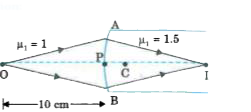 Refraction OCCURS from air to glass at CONVEX spherical surface APB. `mu_(1)=1,""mu_(2)=1.5` `u=-10cm,""R=30mm=3cm` We have, `(mu_(2))/(v)-(mu_(1))/(u)=(mu_(2)-mu_(1))/(R )` `rArr""(1.5)/(v)+(1)/(10)=(1.5-1)/(3)=(0.5)/(3)` `rArr""(1.5)/(v)=(0.5)/(3)-(1)/(10)` `""=(5-3)/(30)=(2)/(30)=(1)/(15)` `rArr""v=15xx1.5=22.5cm` As v is positive, so a real image is formed at 22.5 cm from END P of the rod. |
|
| 33. |
Drawa labelled diagram of a full-wave rectifier circuit and briefly explain its working, Show the input-output waveforms. Or A student wants to use two p-n junction diodes to convert a.c. into d.c. Draw the labelled circuit diagram she would use and explain how it works. |
Answer» Solution :The circuit arrangement of a ful-wave rectifier using two diodes `D_(1)` and `D_(2)` has been shown in . We USE a centre tap transformer having its SECONDARY wound into two equal parts such that voltages at any instant at A (input of diode `(D_(1))` and B (input of diode `(D_(2))` are out of phase with each other. Let initially input voltage at A is positive then it will be negative voltage at B at that instant. Consequently diode `D_(1)` being in forward bias, conducts while `D_(2)`, being in reverse bias, does not conduct. We get output CURRENT and hence output voltage ACROSS load resistance R, joined between X and Y due to `D_(1)` . After half-cycle of a.c. input, voltage at A becomes negative and thatat B positive. Now diode `D_(1)` does not conduct but `D_(2)` conducts and output voltage is again OBTAINED across `R_(L)` in the same direction. Thus, output i obtained throughout the input wave cycle. The input and output waveforms have been shown in . 
|
|
| 34. |
The real angle of dip if a magnet is suspended at an angle of 30^(@)needle makes and angle of 45^(@)with horizontal is |
|
Answer» `tan^(-1)sqr(3)/(2)` `tan 45^(@)=(v)/(H cos 30^(@))` `delta^(-1)sqrt(3)/(2)` |
|
| 35. |
Organelle other than nucleus, containing DNA iş |
|
Answer» ENDOPLASMIC reticulum |
|
| 36. |
Which of the following particle will have minimum frequency of revolution when projected with the same velocity perpendicular to a magnetic field ? |
|
Answer» electron |
|
| 37. |
Obtain the maximum kinetic energy of beta- particle and the radiation frequencies corresponding to gamma- decays in the figure given below. (rest mass of au -198.968233 u and r.m. of Hg=198=197.966760 u) |
|
Answer» Solution :Energies of `gamma`- PHOTONS `gamma_(1), gamma_(2), gamma_(3)` are `E_(1)=(1.088-0) MeV=1.088 MeV=1.088xx1.6xx10^(-13)=1.7408xx10^(-13)J` `E_(2)=(0.412-0) MeV=0.412 MeV=0.412 MeV=0.412xx1.6xx10^(-13)=0.6592xx10^(-13)J` `E_(3)=(1.088-0.452) MeV=0.676 MeV=0.672xx1.6xx10^(-13)=1.0816xx10^(-13)J` but frequency of RADIATION `v=(E)/(h)`  `therefore""v_(1)=(1.7408xx10^(-13))/(6.625xx10^(-34))=0.2628xx10^(21) Hz=2.628xx10^(24)Hz` `v_(2)=(0.6592xx10^(-13))/(6.625xx10^(-34))=0.0955xx10^(21)Hz=9.55xx10^(19)Hz` `v_(3)=(1.0816xx10^(-13))/(6.625xx10^(-34))=0.1633xx10^(21)Hz=1.633xx^(20)Hz` `beta_(1)^(-)` decay, `_(79)^(198) Au rarr _(80)^(198)Hg+_(-1)^(0)e+Q_(2)( bar beta_(1))+Q_(1)(gamma_(1))` The maximum KINETIC energy of `beta _(1)^(-)=[197.968233-197.966760]xx931.5 MeV=0.284 MeV` `beta_(2)^(-)` decay, `_(79)^(198) Au rarr _(80)^(198)Hg+_(-1)^(0)e+Q_(2)( bar beta_(2))+Q_(2)(gamma_(2))` The maximum kinetic energy of `beta _(2)^(-)=[197.96822233-197.966760]xx931.5 MeV-0.412 MeV=0.96 MeV` |
|
| 38. |
Water drops fall form the rood of a building 20m high at regular time intervals.If the first drop strikes the floor when the sixth drop begin to fall,the height of the second and fourth drops from the ground at that instant are (g=10 ms^(-2)) |
|
Answer» 12.8 m and 3.2m |
|
| 39. |
Study the table given below: The above table gives I-V relationship for a manganin coil prepared from a wire of cross-section area 1 xx 10^(-7)m^2 and length 4.1 m.Now answer the following questions:(a) Does the maganin coil behave as an ohmic resistor ? (b) What is its electrical resistance ? (c) Determine the resistivity of manganin.(d) Compare the resistivity of manganin with that of copper.(e) Why do you consider manganin an ideal choice for preparing standard resistors ? |
|
Answer» Solution : (a) Yes, manganin COIL behaves as an ohmic resistor because ratio `V/I`(i.e., the resistance R of the coil) is a CONSTANT for all the values of current ranging from 0.2 A to 8.0 A and if we plot a graphthen graph will be a linear graph. (b)Value of resistance of given manganin wire R = 1.95 `Omega` (c) Resistivity of manganin`rho = (RA)/(l) = (1.95 xx (1 xx 10^(-7)))/((4.1)) = 47.6 xx 10^(-8) Omega m` (d) Resistivity of manganin is much more than that of copper `(1.7 xx 10^(-8) Omega m)`. (e) From the table we observe that resistance of manganin coil remains unchanged even for aflow of very strong current of 8.0 A, when the coil will become quite hot. It MEANS that resistivity and hence resistance of a manganin coil remains practically unchanged and is not altered on changing the temperature. Due to this property we consider manganin an ideal MATERIAL for preparing standard resistors. |
|
| 40. |
Variation of acceleration due to gravity (g) with distance x from the centre of the earth is best represented by (R rightarrow Radius of the earth) |
|
Answer»

|
|
| 41. |
Write and explain Kirchhoff's second law (Loop rule). |
Answer» Solution : `rArr` for LOOP ahdcba, ` - 30 I_(1) + 45 - I_(3) - 40 I_(3) =0` `therefore -30 I_(1) - 41 I_(3) + 45 = 0 `... (1) For loop ahdefga, `- 30 I_(1) + 20 I_(2) + I_(2) - 80= 0 ` ` therefore - 30 I_(1) + 21 I_(2) - 80 = 0 `... (2) For closed loop abdefga, ` 40 I_(3) + I_(3) - 45 + 20 I_(2) + I_(2) - 80= 0` `therefore 41 I_(3) + 21 I_(2) - 125 = 0"" ` .... (3) |
|
| 42. |
Time image formed by an objective of a compound microscope is |
|
Answer» VIRTUAL and DIMINISHED |
|
| 43. |
If the angle of prism is 60^@ and the angle of minimum deviation is also 60^@, find the refractive index of the material of the prism. |
| Answer» SOLUTION :`SQRT(3)` | |
| 44. |
Usingthebetatroncondition, find the radiusof a roundorbit of an electron if themagneticinduction is knownas a function of distance r fromthe axisof the field. Examine this problem for the specfic case B = B_(0) - alpha r^(2), where B_(0) and a are positive constants. |
|
Answer» Solution :The condtion, `B(r_(0)) = (1)/(2) lt B gt = (1)/(2) int_(0)^(r_(0)) B.2pi r dr//pi r_(0)^(2)` or, `B (r_(0)) = (1)/(r_(0)^(2)) int_(0)^(r_(0)) Br dr` The gives `r_(0)`. In the present case, `B_(0) - ar_(0)^(2) = (1)/(r_(0)^(2)) int_(0)^(r_(0)) (B - ar^(2)) RDR = (1)/(2) (B_(0) - (1)/(2) ar_(0)^(2))` or, `(3)/(4) ar_(0)^(2) = (1)/(2) B_(0)` or `r_(0) = sqrt((2 B_(0))/(3a))` |
|
| 45. |
The figure shows a schematic diagram showing the arrangement of Young.s Double Slit Experiment Choose the correct statement (s) related to the wavelength of light used |
|
Answer» Larger the wavelength of LIGHT larger the fringe width |
|
| 46. |
A small sphere of radius r_1 and charge q_1 is enclosed by a spherical shell of radium r_2 and charge q_2. Show that if q_1 is positive , charge will neecessarily flow from the sphere to the shell ( when the two are connected by a wire ) no matter what the charge q_2 on the shell is . |
| Answer» Solution :Hint: By Gauss’s law, field between the SPHERE and the SHELL is determined by `q_(1)` alone. Hence, potential DIFFERENCE between the sphere and the shell is independent of `q_(2)`. If `q_(1)`is positive, this potential difference is always positive. | |
| 47. |
Statement- 1 : The conductivity of electrolyte is very low, than that of metal at room temperature Statement-2 : The resistance of solution electrolyte is high than metal. The ions in electrolyte drift muchmore slowly thin electrons in metal under the given electric field |
|
Answer» STATEMENT - 1: is TRUE ,Statement - 2: is true ,Statement - 2: is correct explanation of statement - 1, |
|
| 48. |
One mole of monoatomic gas is taken through cyclic process shown below T_(A)=300 K.Process AB is defined as PT=constant. |
|
Answer» Work done in process AB is `-400` R. `W=undersetAoversetBintPdV=undersetAoversetBint(const)/T dv Rightarrow(dV)/(dT)=(2nRT)/(const.)` `W=underset300overset100int(const.)/T.(2nRT)/(const.) dt Rightarrow (P_(A))/P_(B)=T_(B)/T_(A) Rightarrow 1/3=T_(B)/T_(A)` `Rightarrow T_(B)=300/3=100 RightarrowW=2nR(100-300) RightarrowW_(AB)=-400` nR (B)Process CA: Isochoric P//Tconst:`T_(A)//T_(C)=P_(A)//P_(C)` `T_(A)//T_(C)=P_(A)//P_(B) RightarrowT_(A)//T_(C)=1//3RightarrowT_(C)=3T_(A)` `T_(C)=900R RightarrowDeltaU=nC_(v)DeltaT` `=(1) 3/2Rxx(T_(A)-T_(C))=3/2Rxx(300-900)=3/2Rxx-600=-900R Rightarrow|DeltaU|=(900R)` (C) Process BC: Isobaric `Q=nC_(P)DeltaT RightarrowQ=(1) 5/2Rxx(T_(C)-T_(B))` `Q=5/2Rxx(900-100)Rightarrow Q=5/2Rxx800 RightarrowQ=2000R` |
|
| 49. |
A body cools from 60^(@)C to 52^(@)C in five minutes. What will be further fall in temperature in the next five minutes? If the temperature of the surrounding is 28^(@)C |
|
Answer» `4^(@)C` `(8)/(5)=k(56-28)`.. .(i) `(52-theta)/(5)=k((52+theta)/(2)-28)`. . . (II) `(52-theta)/(8)=((52+theta-56))/(2xx28)` `theta=46` `d theta=52-46=6^(@)C ` |
|


