

Saved Bookmarks
This section includes 7 InterviewSolutions, each offering curated multiple-choice questions to sharpen your Current Affairs knowledge and support exam preparation. Choose a topic below to get started.
| 1. |
Which of the following substance has negative value of chi_(m) ? |
|
Answer» DIAMAGNETIC |
|
| 2. |
Figure 27-41 shows a battery connected across a uniform resistor R_0. A sliding contact can move across the resistor from x=0 at the left x= 10 cm at the right. Moving the contact changes how much resistance is to the left of the contact and how much is to the right. Find the rate at which energy is dissipated resistor R as a function of x. Plot the function for epsi_(0)=50V, R=2000 Omega and R_(0)=100 Omega |
|
Answer» |
|
| 3. |
A ray of light travels in the way as shown in the figure. After passing through water, the ray grazes along the water air interface. The value of the interms of i' is |
|
Answer» `(1)/(SIN i)` |
|
| 4. |
The ratio of the densities of oxygen and nitrogen is 16:14. At what temperature, the velocity of sound in oxygen will be equal to its velocity in nitrogen at 14°C? |
|
Answer» `45^(@)` C `v=sqrt((lambda RT)/M)` where `lambda` is the ratio of specific HEATS `(C_(p)/C_(V))` R is the universal gas constant T is the absolutee temperature and M is the molecular weight of the gas. Let the velocity of sound in oxygen at t°C be equal to the velocity of sound in nitrogen at `14^(@)` C Now, velocity of sound in oxygen at `t^(@) C, v_(0) = sqrt((lambdaR(t+273))/M_(0))` and velocity of sound in nitrogen at `14^(@)` C, `v_(N) = sqrt((gammaR(14 + 273))/M_(N))` The value of `gamma` for both the gases will be same as both are, diatomic. Now, according to the question, `v_(0) =v_(N)` or `sqrt((gamma R(14 + 273))/M_(N))` or `(t+273)/287 = M_(O)/M_(N)` But, ratio of the densities of oxygen and nitrogen is, `M_(O)/M_(N) = 16/14` `therefore (t + 273)/287 = 16/14 = 8/7` or `7t + 273 xx 7 = 8 xx 287` or `t = 55^(@)` C Therefore, the velocity of sound in oxygen at 55°C will be equal to the velocity of sound in nitrogen at 14°C. |
|
| 5. |
A force between two protons is same as the force between proton and neutron. The nature of the force is : |
|
Answer» weak nuclear FORCE HOWEVER, it also has the shortest range, MEANING the particle of the nucleus (protons which carry a POSITIVE CHARGE ad neutrons, which carry no charge. These particles are collectively called nucleons). |
|
| 6. |
Which of the following options is correct for having a straight line motion represented by t-s graph. |
|
Answer» The object moves with CONSTANTLY increasing VELOCITY from O to A then it moves with constant velocity. |
|
| 7. |
On placing a transparent glass cube on the printed page of a book, it was found that the covered printed words are not visible from any of the lateral sides of the cube. Explain why? |
|
Answer» Solution :The REFRACTIVE index of glass relative to AIR, `mu = 1.5.` So the critical angle for the two media, `theta_(c) = sin^(-1)""((1)/(mu)) = sin^(-1)""((1)/(1.5))` `= 42^(@) ("nearly")` There is always a thin layer of air between the glass cube and the paper [Fig. 2.79]. If any ray from printed words is INCIDENT on the lower surface of the cube even with the maximum angle of `90^(@)`, then it enters glass with a maximum angle of refraction `42^(@)`. Then, the minimum angle of incidence of the ray on the side face of the cube becomes `(90^(@) - 42^(@)) or 48^(@)`. A total internal reflection OCCURS as this angle is greater than the critical angle, and no ray can emerge out of the side face. So, the printed words are not visible to an eye placed outside any of the side faces. 
|
|
| 8. |
A circular coil of 20 hours and radius 10cm is placed in an uniform magnetic field of 0.17 normal to the plane of the coil if the current in the coil is 5.0A. What is the average force on each electron in the coil due to the magnetic field ? The coil is made of copper wire of cross - (a) sectional area 10^(-5) m ^(+2)and the free clectron density in copper is given to be about 10^(29)//m^(3) . |
| Answer» Solution :(a) ZERO, (b) zero, (c) force on each ELECTRON is `evB = IB//(nA) = 5 ×x 10^(-25)`N. Note: Answer (c) denotes only the MAGNETIC force. | |
| 9. |
In a same medium and at same temperature. Velocities of two sound waves of 200Hz and 400Hz are in what ratio ? |
| Answer» SOLUTION :Velocity does not CHANGE if the motion is same Hence the RATIO is 1 : 1. | |
| 10. |
From what material is the anode of an X-ray tube made, if the K_(alpha)-line wavelength of the characteristic spectrum is 0.76 Å ? |
|
Answer» `z=1+sqrt(4/(3lamdaR))` Knowing the atomic number, we can easily find the material of the anti-cathode. |
|
| 11. |
Arrange three point charges 2muC, 4muCand 1mu C on a straight line segment of 1 m such that net force experienced by the 1muC charge is zero |
| Answer» SOLUTION :`1 muC` charge should be placed at DISTANCE of 0.41 m from `2 muC` charge | |
| 12. |
Demagnetisation of magnets can be done by |
|
Answer» rough handling |
|
| 13. |
What is the frequency in Hz of emitted radiation when an electron jumps from fourth orbit to secondth orbit in a hydrogen atom ? [Where R=10^(5)cm^(-1) ] |
|
Answer» `(3)/(4)xx10^(15)` `=10^(5)((1)/(2^(2))-(1)/(4^(2)))""( :.R=10^(5)cm^(-1))` `=10^(5)((1)/(4)-(1)/(16))` `=10^(5)((4-1)/(16))` `(1)/(lamda_(ik))=10^(5)XX(3)/(16)` but `c=3xx10^(10)cm//s` `(c)/(lamda_(ik))=(3xx10^(10)xx10^(5)xx3)/(16)` `:.f_(ik)=(9)/(16)xx10^(15)Hz` |
|
| 14. |
Find E_(0), B_(0), intensity I and force exerted on surface for a spherical surface 20 m away from the point source bulb of 2000 W. Efficiency of bulb is 2% and consider the bulb as point source. (epsilon_(0)=8.85xx10^(-12)SI and c=3xx10^(8)ms^(-1)) |
|
Answer» SOLUTION :Here, `P=2000 W, R=20 m, eta = 2%` `epsilon_(0)=8.85xx10^(-12)C^(2)N^(-1)m^(-2), c=3xx10^(8)ms^(-1)` Energy per second by the bulb, U = 2% of `P=2000xx0.02=40 W` AREA of circular surface `A=4pi R^(2)=4xx3.14xx(20)^(2)=5024 m^(2)` Intensity of radiation, `I=("incidient radiated energy in one second (U)")/("area (A)")` `therefore I=(40)/(5024)` `therefore I=7.96xx10^(-3)(W)/(m^(2))` `I=[(1)/(epsilon_(0)c)]^((1)/(2))` `E_(rms)=[(7.96xx10^(-3))/(8.85xx10^(-12)xx3xx10^(8))]^((1)/(2))=[(7.96)/(8.85xx3)]^((1)/(2))` `therefore E_(rms)=1.73 NC^(-1)` `E_(0)=sqrt(2)XX E_(rms)` `=1.414xx1.73` `therefore E_(0)=2.45 NC^(-1)` Now,`c=(E_(0))/(B_(0))` `therefore B_(0)=(E_(0))/(c )=(2.45)/(3xx10^(8))` `therefore B_(0)=8.167xx10^(-7)T` Momentum per second gained by the surface means force, `therefore F=(U)/(c )=(40)/(3xx10^(8)) ""[because P=(U)/(c )]` `therefore F=1.333xx10^(-7)N` Energy density on surface `rho=(I)/(c )=(7.96xx10^(-3))/(3xx10^(8))` `therefore rho=2.653xx10^(-11)Jm^(-3)` |
|
| 15. |
A long, cylindrical iron core of crosssectional area 5.00 cm^(2) is inserted into a long solenoid having 2000 turns/m and carrying a current 2.00 A. The magnetic field inside the core is found to be 1.57 T. Neglecting the end effects, find themagnetization I of the core and the pole strength developed. |
|
Answer» Solution :The magnetic intensity H inside the SOLENOID is `H=ni=2000m^(-1)xx2A=4000A//m` Also `B=mu_(0)(H+I)` or, `I=B/(mu_(0))-H=(1.57T)/(4pixx10^(-7)T-m//A)-4000A/m` `=(1.25xx10^(6)-4000)A//m=1.25xx10^(6)A//m` Note again that the magnetization I > > H for iron core. The pole STRENGTH developed at the ends is `m=IA=(1.25xx10^(6)A//m)xx(5xx10^(-4)m^(2))=625A-m` |
|
| 16. |
A conductor of length I and mass m can slide without friction, but with an ideal electrical contact, along two vertical conductors AB and CD connected through a capacitor (Fig. 30.2). Perpendicular to the plane of the figure a uniform magnetic held of induction B is set up. Find the voltage across the capacilor plates as a function of h. |
|
Answer» |
|
| 17. |
मान लीजिए कि f(x)=3x द्वारा परिभषित फलन f:RrarrR है । तब f |
|
Answer» एकैकी |
|
| 18. |
Choose the correct alternative from the clues given at the end of the each statement: Thepositively charged part of the atom possesses most of the mass in .......... (Rutherford’s model/both the models.) |
| Answer» SOLUTION :Both the MODELS | |
| 19. |
Explain : In Wheatstone's metre bridge experiment, the null point is obtained in the middle one-third of the wire. |
| Answer» Solution :In Wheatstone's metre bridge experiment, major sources of error are the nonuniformity in the CROSS SECTION of the bridge wire and the end resistance at the two ends of the wire. To minimize these errors, readings must be TAKEN by ADJUSTING the standard known resistance such that the NULL point is obtained close to the centre of the wire. Also, the measurments must be repeated with the standard resistance and the unknown resistance interchanged in the gaps of the bridge. When several readings are to be taken, the null points should lie in the middle one-third of the wire. | |
| 20. |
A chain AB of length l is lying in a smooth horizontal tube so that the fraction 'h' of its length hangs freely and just touches the surface of the table with its end B. At a certain moment the end A of the chain is set free. The velocity of end A of the chain when it just slips out of tube is : (##MOD_RPA_OBJ_PHY_C04_A_E01_089_Q01.png" width="80%"> |
|
Answer» `hsqrt((2g)/(lh))` `(M)/(l)xxhxxg=(M)/(l)xxXxx(dupsilon)/(dt)` or`hg.dx=x(dupsilon)/(dt).dx` or`int_(h)^(l)hg(dx)/(x)=int_(0)^(V) nu DNU` `[log_(e)x]_(h)^(l)=(upsilon^(2))/(2)`or`upsilon=(2hg log_(e) (l)/(h))^(1//2)` (B) is the choice. |
|
| 21. |
A transverse wave propagating on a stretched string of linear density 3xx10^-4 kg-m^-1 is represented by the equation y=0.2sin(1.5x+60t) Where x is in metre and t is in second. The tension in the string (in Newton) is |
|
Answer» 0.24 |
|
| 22. |
What is natural point ? |
| Answer» SOLUTION :It is a POINT near a MAGNET where the resultant intensity of the magnetic field due to magnet and the EARTH is zero. | |
| 23. |
In Fig a rod of length l and mass m moves with an intial velocity u on a fixed frame containing inductor L and resistance R.PQ and MN are smooth conducting wires. There is auniform magnetic field of strength B. Initially, there is no current in the inductor. find the total cherge flows through the inductor by the time, velocity of rod becomes nu_(f) and the rod has travelled a distance x. |
Answer»  `(Bl nu)/(R ) = i_(2) RARR Bl nu = L(di_(1))/(dt)` `m(d nu)/(dt) = - IlB = - (i_(1) + (Bl nu)/(R )) lB` `rArr m int d nu = - lB int i_(1) dt - (B^(2)l^(2))/(R )int nu dt` `rArr m(nu_(f) - u) = - lBQ - (B^(2)l^(2))/(R ) x` `(nu_(f) =` velocity when it has moved a distance `x`) `rArr Q = ((-B^(2)l^(2))/(R) x - m(nu_(f) - u))/(Bl)` |
|
| 24. |
A non0conducting disk of radius R has surface charge density which varies with distance from the centre as sigma (r ) = sigma _(0)[1+ sqrt((r )/(R ))], where sigma _(0) is a constant. The disc rotates about its axis with angular velocity omega. If B is the magnitude of magnetic induction at the centre, then (B)/(mu_(0) sigma _(o)omega R) will be |
|
Answer» `3/4` 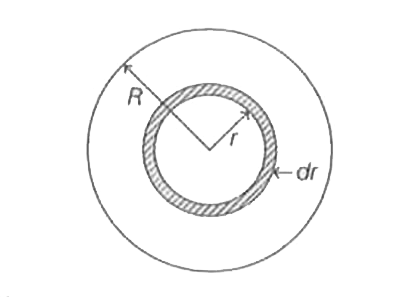 Charge on ring `dq = `Area of ring `xx` Charge density `implies dq =(2pi r. dr) sigma` `implies` CURRENT through ring, di `= (dq)/(T),` as angular VELOCITY of disc is `omega.` So, `(2pi)/(omega) =T` `implies di = (omega dq)/(2pi) = (omega (2pi r. dr)sigma)/(2pi) = omega r sigma dr` Now, manetic INDUCTION due to elemental ring at thte centre, `DB= (mu_(0)di)/(2r) =(mu_(0) omega r sigma)/(2r).dr = (mu_(0) omega sigma)/(2).dr` As` sigma = sigma _(0) (1+ sqrt((r)/(R)))` For magnetic induction due to entire dusc, we integrate from `r =0` to `r =R` `implies B = (mu_(0) omega sigma _(0))/(2) int _(0) ^(pi) (1+ sqrt((r)/(R))).dr` IInd part `implies B= (mu_(0) omega sigma _(0))/(2) [r+ (2r ^(3//2))/(3 sqrtR)]_(0) ^(R)` `implies B = (mu_(0) omega sigma _(0))/(2) [ R = (2)/(3)R]` `implies B= 5/6 mu _(0)omega sigma _(0) R implies (B)/(mu_(0) omega sigma _(0)R) =5/6` |
|
| 25. |
Which of the following electromagnetic waves have minimum frequency? |
|
Answer» Ultaviolet rays |
|
| 26. |
An inductor L is allowed to discharge through capacitor C. The emf induced across the inductance when the capacitor is fully charged is |
|
Answer» MAXIMUM |
|
| 28. |
Which is the dimensional formula for conductance from the given below ? |
|
Answer» `M^(1) L^(2) T^(-3) A^(-2)` CONDUCTANCE = `(1)/(R)` `= (1)/(V) = (QI)/(J) = (I^(2) t)/(J)` `therefore |G| = ([J^(2) ] [t])/([J]) = (A^(2) T^(1))/(M^(1) L^(2) T^(-2))` ` = M^(-1) L^(-2) T^(3) A^(2)` |
|
| 29. |
In which of the following transition will the wavelength be minimum? |
|
Answer» N=5 to n=4 |
|
| 30. |
The x-z plane separates two media A and B with refractive indices mu_(1) and mu_(2) respectively. A ray of light travels from A to B. Its directions in the two media are given by the unit vectors, vecr_(A)=ahati+bhatj & vecr_(B)=alpha hati+betahatj respectively where hati and hatj are unit vectors in the xand y directions. Then |
|
Answer» `mu_(1)a=mu_(2)alpha` |
|
| 31. |
Energy of an electron in the nth orbit of hydrogen atom is given by E,- ev. How much energy is required to take an electron from the ground state to the first excited state? |
|
Answer» Solution :In HYDROGNE atoms groundstatecorrepondsto N = 1AND the firstexcited state corresponds to n = 2. HENCE, energyrequired . `E = E_(2)- E_(1) = (-13.6)/((2)^(2))-[(-13.6)/((1)^(2))] = - 3.4+13.6 = +10.2 eV` |
|
| 32. |
Two satellites of massesM_1 and M_2 are revolving around the earth in circular orbits of radii r_1 and r_2respectively. The ratio of their speed of v_1/v_2 is |
|
Answer» a)`SQRT2:sqrt12` |
|
| 33. |
The spectrum of light emitted by a glowing solid is |
|
Answer» CONTINUOUS spectrum |
|
| 34. |
Dimensions of (L)/(RCV) are : |
|
Answer» `A^(-1)` But `(L)/(R)` has the dimensions of TIME and `Q=AT.` `:.(L)/(RCV)=(T)/(AT)=A^(-1)` HENCE correct CHOICE is `(a).` |
|
| 35. |
A nucleus of mass M emits an X-ray photon of frequency n. Energy lost by the nucleus is given as |
|
Answer» HV |
|
| 36. |
In the measurement of a physical quantity (L), the formula used is L=k(m xx n), where k is a constant and m and n are the quantities to be measured. If the % errors in m and n are respectively 3% and 5%. The % error in the measurement of L is |
| Answer» ANSWER :C | |
| 37. |
The variation of gravitational field intensity (E ) due to the earth is represented by curve in Fig. (R is radius of earth): |
|
Answer»
SINCE from centre of earth to surface of earth `g prop r` and above the surface of earth `g prop (1)/(r^(2))` `therefore` The variation of E is represented by FIG. d. |
|
| 38. |
The nucleus of ._(90)^(230)Th is unstable against alpha-decay with a half-life of 7.6xx10^(3)"years". Write down the equation of the decay and estimate the kinetic energy of the emitted alpha-particle from the following data: m(._(90)^(230)Th)=230.0381 "amu", m(._(68)^(226)Ra)=226.0254 "amu" m(._(2)^(4)He)=4.0026"amu". |
|
Answer» Solution :The equation of the decay is `._(90)^(230)Th rarr_(88)^(225)RA+_(2)^(4)He+Q` The energy `Q` is given by `Q=[m(Th)-m(Ra)-m(He)]c^(2)` Using the given data and `c^(2)=931.5 MeV//"amu"`, we get `Q=9.41 MeV`. This energy is SHARED by `Ra` and `He`. If the original nucleus `Th` is at rest, i.e. if the MOMENTUM of the system before `alpha`-decay is zero, thetotal momentum after the decay will also be zero. Thus `Ra` and `He` will have equal and OPPOSITE linear MOMENTA. `:. m_(He)v_(He)= -m_(Ra)V_(Ra)` or `m_(He)v_(He)=m_(Ra)^(2)v_(ra)^(2)` ......(i) Now `(K.E.(HE))/(K.E.(Ra))=(1//2m_(He)v_(He)^(2))/(1//2m_(Ra)v_(Ra)^(2))=((m_(He)v_(He))/(m_(ra)v_(Ra)))xx((m_(Ra))/(m_(He)))` `=(m_(Ra))/(m_(He))`"" [use Eq.(i)] `~~(226)/(4)~~56.6`......(ii) i.e. the kinetic energy of `He` is `56.5` times that of `Ra`, the total energy being `K.E.(He)+K.E.(Ra)=9.41 MeV` ""(ii) From eqs (ii) and (iii) we have `K.E. (Ra)=0.16 MeV` and `K.E.(He)~~9.25 MeV`. |
|
| 39. |
What is the acceleration of the upper block of the system as shown in the figure? Assume pullies and strings area ideal. Given m_(A)~~0 |
|
Answer» Solution :From F.B.D. We GET `mA-4T=mA_(2)` `mA+2t-T=mA_(1)`  On solving these two get `a_(A)=4g` |
|
| 40. |
The direction of the magnetic field in a current carrying conductor is given by ............... |
| Answer» SOLUTION :Maxwell.s RIGHT CORK SCREW RULE | |
| 41. |
The earth moves round the sun once in a year with a speed of 30 km/sec. What is the centripetal acceleration of the earth towards the sun ? (r_sun =1.5 xx 10^11) |
|
Answer» `6XX10^(-7) m/s^2` |
|
| 42. |
Derive the relation between the linear velocity and the angular velocity of a particle in circular motion. A conical pendulum has length 1 m and the angle made by thestring with the vertical is10^(@) . The mass of thebob is 100 g .Find the tension in hte string. |
Answer» Solution :Consider a particle performing circular motion in an anticlockwise sense, along a circle of radius r as shown in thefigure. In a very small time interval `delta t`, the particle MOVES from point A to point B through a distance `delta s` and its angular POSITION changes by ` delta theta`. 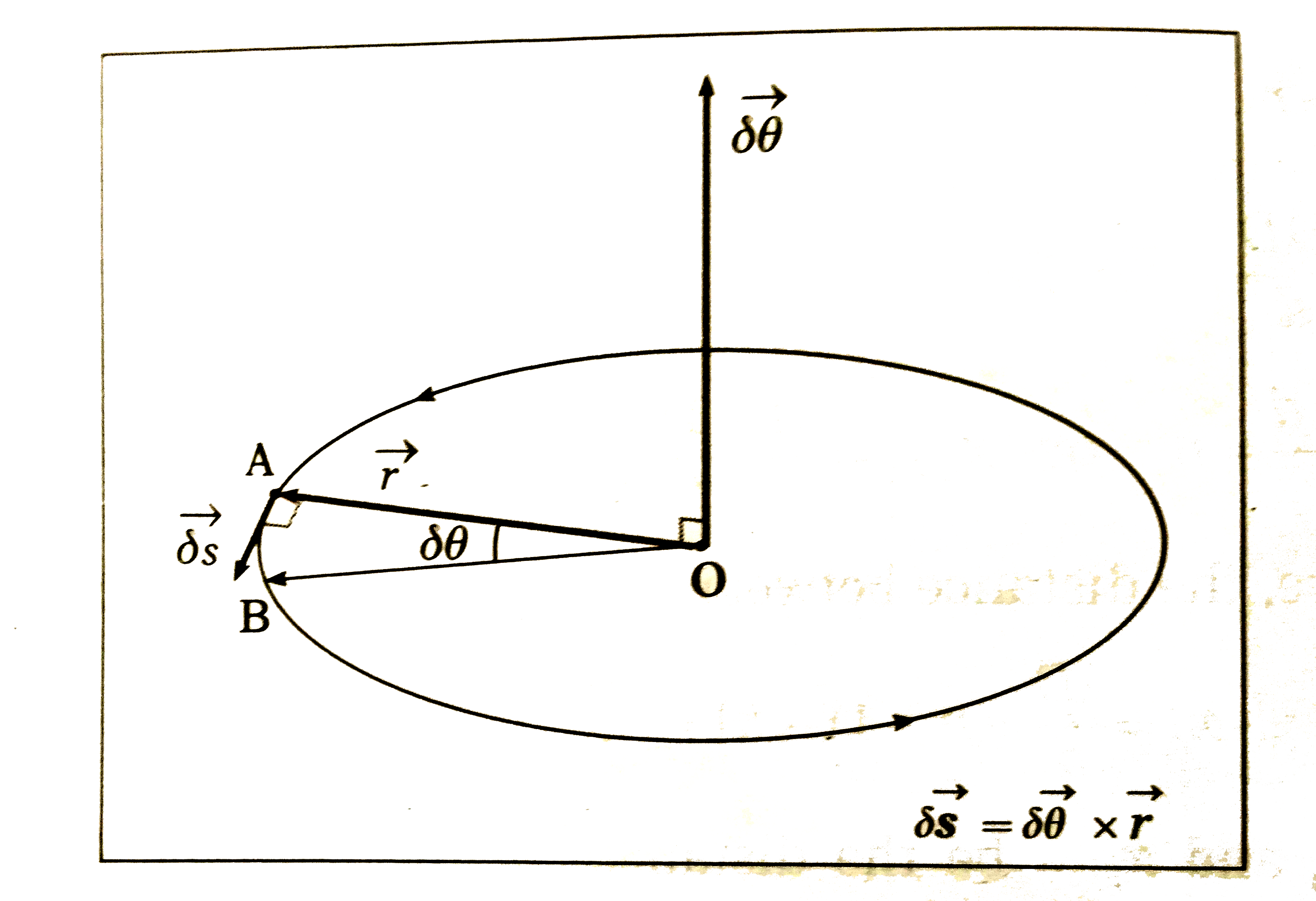 ` delta theta = (arc AB)/("radius") = (deltas)/r` As ` deltat to 0`, point B will be very close to A and the displacement `vec(AB) = vec(delta s) ` will be a straight line perpendicular to radius vector `vec(OA)= vecr`. By right hand rule of cross product, `vec(deltas) = vec(deltatheta) xx vecr` ` :.underset(deltat to 0)"lime" (vec(deltas))/(deltat) = (underset(deltat to 0)"lime" (vec(deltatheta))/(deltat))xx vecr` ` :. vec(d s)/(dt) = vec(d theta)/(dt) xx vecr`...(1) The linear velocity `vecv` of the particle is the time RATE of displacementand its angular velocity `vec omega` is the time rate of angular displacement. `:. vecv = (vec(ds))/(dt) andvecomega = vec(d theta)/(dt)` Therefore, from EQ. (1) , `vecv= vec omega xx vec r` Since ds is tangential, the instantaneous linear velocity `vecv` of a particle performing circular motion is along the tangent to thepath, in the sense of motion of theparticle . `vecv, vec omega and vec r` are mutuallyperpendicular, so that in magnitude , v =` omega r`. Data : ` L = 1 m, theta = 10^(@) , m = 0.1 kg , g = 9.8 m//s^(2)` The tension in thestring, ` F = (mg)/(cos theta)` ` = (0.1 xx 9.8)/(cos 10^(@))` ` = (0.98)/(0.9848) = (9.8)/(9.848)` ` = 0.9949` N `{:(log 9.8,," "0.9912),(log 9.848,,ul(-0.9934)),(,,ul(" "bar(1).9978)):}` AL ` bar(1).9978 = 0.9949` |
|
| 43. |
A ray of light travelling in air is incident at 45^@ on a midium of refractive index sqrt2. The angle of refraction in the medium is : |
| Answer» ANSWER :C | |
| 44. |
A radioactive nucleus A undergoes a series of decays according to following scheme A overset(alpha)to A_1 overset(-beta)to A_2 overset(alpha)toA_3 overset(gamma)toA_4 The mass number and atomic number of A4 are 172 and 69 respectively. What are these numbers for A ? |
| Answer» SOLUTION : MASS no. of A = 180, ATOMIC no. of A = 72 | |
| 45. |
A conductor A witha cavityas shownin is given a charge Q. show that the entire charge must appearon the outer surfaceof the conductor. Another conductor B with charge q is inserted into the cavitykeepingB insulatedfrom A. Show that the total charge on the outside surface of A is Q+q (c) A sensitive instrument is to be shielded from the strongelectrostatic fields in its environment. Suggest a posible way. |
|
Answer» Solution :Weknow that electricfield ` oversetto E `insidea conducting shell is zero. Consider an imaginary Gaussion surface (shown bydotted curve in ) Around the cavityof the conductor A. As `oversetto E ` is zero TOTAL electric flus `phi_in `over the Gaussian surface will be zeroand it implies that no charges is PRESENT within the Gaussian surface. It leads to the CONCLUSION that entire charge given to the conductor must appear on the outer surface of conductor only. (b) When a conductorB with charge q is inserted into the CAVITY of A, it induces a charges -q on the inner surface of conductor A and a charges +q is induced on the outer surface on conductor A. Consequently, total charge on the outer surface of conductor A becomes (Q+q). (c) To shield a senstive instrument from strong electrostatic FIELDS in its environment the instrument is placed inside a hollow conductor. Now irrespective of charge present on the conductor or any environmental electric field the electrostatic field in the cavitymust be zero. ` (##U_LIK_SP_PHY_XII_C01_E02_004_S01.png" width="80%"> |
|
| 46. |
The magnitude of electrostatic force between two identical ions that are separted by a distance of5xx 10 ^(-10) mis3.7 xx 10 ^(-9)N.a. What is the charges of each ions? b . How many electrons are missing from each ions? |
|
Answer» Solution :Data supplied ` R= 5 xx10 ^(-10) m` ` F = 3.7 xx10 ^(9) N, q_1 =q_2 =q ` (IDENTICAL ) a.F=`(1)/( 4pi in _0) .(q^(2))/( r^(2)) =9xx 10^(9) (q^(2))/( r^(2)) ` ` q^(2) =( FR^(2))/( 9xx 10 ^(9)) =( 3.7xx 10^(9) xx( 5xx 10 ^(10) )^(2))/( 9xx10 ^(9)) =( 3.7xx10 ^(-9) xx 25 x10 ^(-20))/( 9xx10 ^(9)) =( 3.7xx25xx10 ^(-28)) /( 9) ` ` thereforeq= SQRT(( 3.7xx25 xx10 ^(-38))/( 9)) =3.2 xx10^(-19) C ` b . q = ne` "" n= (q)/( e) = ( 3.2xx10 ^(-19))/( 1.6xx 10^(-19)) "" therefore n=2` |
|
| 47. |
Energy required to move a body of mass m from an orbital of radius 2R to 3R is (where M = mass or earth, R = radius of earth) |
|
Answer» `(GMm)/(12R^(2))` Correct CHOICE is (a). |
|
| 48. |
An electric spark jumps along a straight line of length L = 10 m, emitting a pulse of sound that travels radially outward from the spark. (The spark is said to be a line source of sound.) The power of this acoustic emission is P = 1.6 xx 10^4W. (a) What is the intensity I of the sound when it reaches a distance r = 12 m from the spark? (b) At what time rate P_A is sound energy intercepted by an acoustic detector of area A_d = 2.0 cm^2?, aimed at the spark and located a distance r = 12 m from the spark? |
Answer» Solution :(1) Let us CENTER an imaginary cylinder of radius R = 12 m and length L = 10 m (open at both ends) on the spark, as shown in Fig. Then the intensity I at the cylindrical surface is the ratio P/A, where P is the time rate at which sound energy passes through the surface and A is the surface area. (2) We assume that the principle of conservation of energy applies to the sound energy. This means that the rate P at which energy is transferred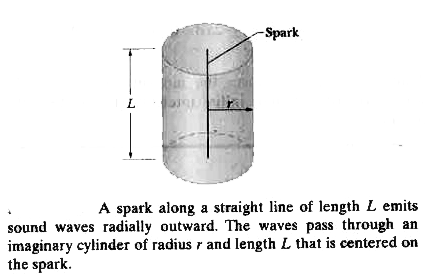 through the cylinder must equal the rate `P_s` at which energy is emitted by the SOURCE. Putting these ideas together and noting that the area of the cylindrical surface is `A = 2pir L` ,we have `I = P/A = (P_s)/(2pi r L)` This tells us that the intensity of the sound from a line source decreases with distance r (and not with the square of distance r as for a point source). Substituting the GIVEN data, we find `I = (1.6 xx 10^4 W)/(2pi (12m )(10 m))` ` = 21.2 W//m^2 ~~ 21 W//m^2` (b)We know that the intensity of sound at the DETECTOR is the ratio of the energy transfer rate `P_d` there to the detector.s area `A_d` : `I = (P_d)/(A_d)` We can imagine that the detector lies on the cylindrical surface of (a). Then the sound intensity at the detector is the intensity I( = `21.2 W//m^2`) at the cylindrical surface. Solving Eq. for `P_d` gives us `P_d= (21.2 W//m^2) (2.0 xx 10^(-4) m^2) = 4.2 mW` |
|
| 49. |
An object of size 3.0 cm is placed 14 cm in front of a concave lens of focal length 21 cm. Describe the image produced by the lens. What happens if the object is moved further away from the lens ? |
|
Answer» Solution :`(1)/(V) - (1)/(u)= (1)/(f)"" f =-21 ` cm , u = - 14 cm , `h_(0)` = 3 cm `(1)/(v) = (1)/(f)+ (1)/(u)= (1)/(-21) + (1)/(-14) ""therefore v = (-42)/(5) = - 8.4 ` cm `(h_(i))/(h_(0)) = (v)/(u) , h_(i) = h_(0) ((v)/(u)) = 3xx (-8.4)/(-14) = 1.8` cm image is virtual, erect diminished, formed on the same side of the object if the object is moved AWAY from the lens, image moves towards the focus and DECREASES in SIZE. |
|
| 50. |
Is the permeability of a ferromagnetic material independent of the magnetic field ? If not,is it more for lower or higher fields ? |
| Answer» SOLUTION :No, as is evident from the magnetisation curve. From the slope of magnetisation curve, it is CLEAR that magnetic PERMEABILITY of a ferromagnetic material is greater for lower values of magnetic field. | |


