

Saved Bookmarks
This section includes 7 InterviewSolutions, each offering curated multiple-choice questions to sharpen your Current Affairs knowledge and support exam preparation. Choose a topic below to get started.
| 1. |
Define mutual inductance ? |
| Answer» SOLUTION :Mutual inductance is DEFINED as the MAGNETIC FLUX linked through one due coil due to FLOW of one ampere in the neighboring coil M=`phi_2/I^2` | |
| 2. |
The ratio of the wavelengths for 2 rarr 1transition inLi, He,and H is |
|
Answer» `1 : 2 : 3` |
|
| 3. |
In the given circuit the charge on the plates of 1 muF capacitor, when 100 V battery is connected to the terminals A and B will be |
| Answer» Answer :D | |
| 4. |
The current – voltage characteristic of an electric device is as shown in figure (b). The device gets damagedif power dissipated in it exceeds 1 Watt. This device is connected to a dc source of variable emf (V) and a resistance (R = 100 Omega) in series. What is possible range of V for which the device remains operational (i.e. consumes some power) and safe. |
|
Answer» |
|
| 5. |
A uniform cube of mass 4kg and side 30cm is placed on a fricitionless horizontal surface. A vertical force F is applied to the edge as shown in the figure. Choose the most appropriate option(s). (take g=10m//s^(2)) |
|
Answer» Cube will move in the upward direction if `F gt 40 N` `dvecp=d "mu"(costhetahati+sinthetahatj)` `=u LAMBDA[dlcosthetai+dlsinthetahatj]` `vecP=mu lambda[intdxhati+intdyhatj]` `vecp=u lambda[dhati+hhatj]` `P=u lambdasqrt(d^(2)+h^(2))` `=1xx1sqrt(3^(2)+4^(2))=5kg-m//s` 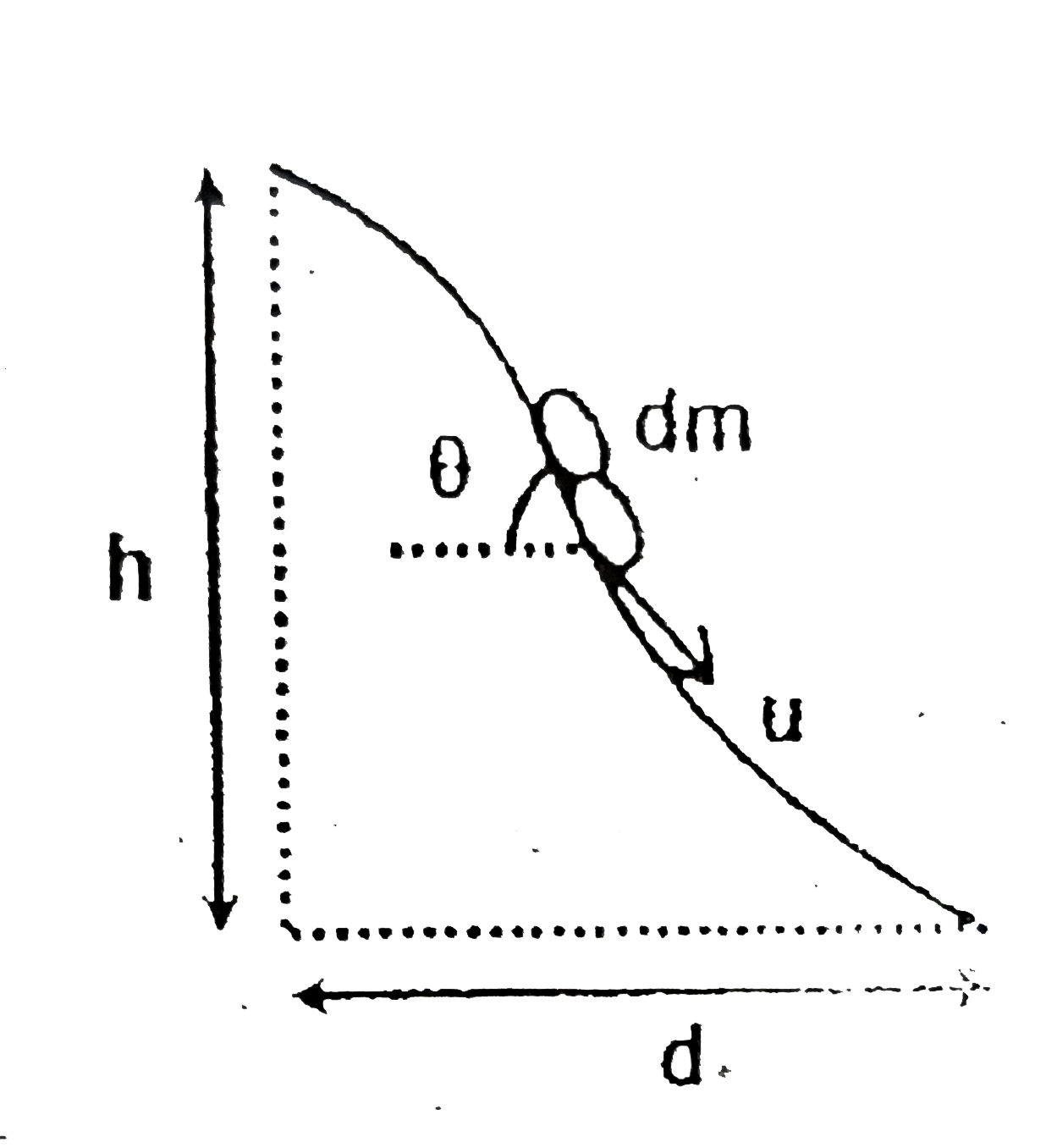
|
|
| 6. |
An object of length 2.5 cm is placed at the principal axis of a concavemirror at a distance 1.5 f. The image height is |
|
Answer» `+ 5m` Height image `= m XX "height of object" = - 2 xx 2.5 = - 5 CM` |
|
| 7. |
Figure showns four solid spheres, each with charge Q uniformly distributed through its volume. The figure also shows a point Pfor each sphere. All at the same distance from the centre of the sphere. Rank the spheres according to the magnitude of the electric field they produce at point P. |
|
Answer» ` I and II" TIE "to III to IV` |
|
| 8. |
Which one of the following is not a feature of developing country? |
|
Answer» AGRICULTURE as the MAJOR occupation |
|
| 9. |
Two charged particles of equal charges are placed 1 m apart. The initial acceleration of each of them is ms^(-2) . If their equal mass is 10^(-3) gm, find the charge on each of them. |
|
Answer» `sqrt(1.1) XX 10^(-8)` C `therefore ma= (kQ^(2))/1` `therefore Q^(2) = (ma)/k = (10^(-6) xx 1)/(9 xx 10^(9)) = 0.11 xx 10^(-15)` `(therefore m = 10^(-3) g = 10^(-6) kg)` `therefore Q = sqrt(1.1) xx 10^(-8)` C |
|
| 10. |
The dimensional formula for pressure gradient will be |
|
Answer» `ML^-1T^-2` |
|
| 11. |
आवृतबीजी पौधो में पुंकेसर है |
|
Answer» मादा जननांग |
|
| 12. |
A common emitter transistor amplifier has a current gain of 50. If the load resistance is 9kOmega and the input resistance is 500 Omega, voltage gain of the amplifier will be |
|
Answer» 900 |
|
| 13. |
किरचॉफ के प्रथम नियम को कहा जाता है? |
|
Answer» आवेश संरक्षण का नियम |
|
| 14. |
मीटर ब्रिज किस सिद्धांत पर काम करता है? |
|
Answer» वोल्टमीटर के सिद्धांत पर |
|
| 15. |
The susceptibility of a magnetic material is 0.9853. Identify the type of magnetic material. Draw the modification of the field pattern on keeping a piece of this material in a uniform magnetic field. |
|
Answer» SOLUTION :The given MAGNETIC MATERIAL is a paramagnetic material. The MODIFICATION of field pattern in such a material is given in FIG. |
|
| 16. |
Red shift' confirms the theory of expanding universe by using |
|
Answer» Stefan's LAW |
|
| 17. |
व्हीटस्टोन सेतु सबसे संवेदनशील कब है? जब - |
|
Answer» PQ=RS |
|
| 18. |
In diffraction froma a single -slit, the angular width of the centre maxima does not depends on |
|
Answer» `LAMBDA` of LIGHT used |
|
| 19. |
Mention one advantage of frequency modulation (FM) over amplitude modulation (AM) in communication. |
|
Answer» SOLUTION :1. IMPROVED signal to noise ration (about 25 dB) e.r.t to MAN made interference p. 2. Less RADIATED power. |
|
| 20. |
A breaker contains water up to a height h_(1) and kerosene of height h_(2) above water so that the total height of (water + kerosene) is (h_(1) + h _(2)). Refractive index of water is mu_(1) and that of kerosene is mu_(2). The apparent shift in the position of the bottom of the beaker when viewed from above is : |
|
Answer» `(1+(1)/(mu_(1)))h_(1)-(1+(1)/(mu_(2)))h_(2)` |
|
| 21. |
Read the two statements -(I) When a solid melts and changes to liquid state, its volume may increase on decrease. (II) As a result of increase in pressure, the melting point at a solid may be raised or lowered. With reference to these statements, the only correct statements out of the following's |
|
Answer» (I) is true but (II) cannot be true |
|
| 22. |
Magnetic field through a coil having 200 turns and corss sectional area 0.04m^(2) changes from 0.1wbm^(-2) to 0.04wbm^(-2) in 0.02s. Find the induced emf. Data : N=200, A=0.04m^(2), B_(1)=0.1wbm^(-2), B_(2)=0.04wbm^(-2), t=0.02s, e=? |
|
Answer» SOLUTION :`E= - (d PHI)/(DT) = - (d)/(dt) (phi)` `e = -(d)/(dt) (NBA) = -NA. (dB)/(dt) = -NA.((B_(2)-B_(1)))/(dt)` `e = -200xx4xx10^(2)((0.04-0.1))/(0.02)` `e=24V` |
|
| 23. |
What is 'depletion region' in a semiconductor diode? |
| Answer» SOLUTION :A small region around the JUNCTION free from mobile charge CARRIERS is CALLED DEPLETION region. | |
| 24. |
A radio active nucleus .A. decys in to radio active nucleus .B. and then in to stable nucleus .C.. Graph drawn between number of atoms of .A. and .B. with time is Hint : At t = 0, N_A = N_(0) and N_B = 0As time increases, N_Adecreases exponentially, N_Bincreases to maxi-mum and falls exponentially to zero. |
|
Answer»
|
|
| 25. |
Two charges -q and +q are locatedat points (0,0,-a) and (0,0,a) respectively. (i) What is the electrostaticpotentialat the pointsat the points (0,0,z) and (x,y,0)? (ii) Obtain the depentenceof potentialon the distancer of the point form theorigin, when (r)/(a) gt gt 1. (iii) How much work is done in movinga small test chargefrom the point (5,0,0) to (-7,0,0) alongthe x-axis. Does the answercharge if path of test chargebetweenthe same points is not along thex-axis ? |
|
Answer» <P> Solution :Here, -q is at (0,0, -a) and +q is at (0,0,a)(i) Potential at `(0,0,z)` would be `V = (1)/(4pi in_(0)) ((-q)/(z+a)) + (1)/(4pi in_(0)) (q)/((z-a)) = (q(z+a-z+a))/(4pi in_(0)(z^(2) - a^(2))) = (q2a)/(4pi in_(0)(z^(2) - a^(2))) = (p)/(4pi in_(0) (z^(2) - a^(2)))` Potential at (x,y,0), i.e., at a point `_|_` to z-axis where charges are located, is zero. (ii)We haveprovedthat`V = (p COS theta)/(4pi in_(0) (r^(2) - a^(2) cos^(2) theta))` If `(r)/(a) gt gt 1`, then `a LT ltr :. V = (p cos theta)/(4pi in_(0) r^(2)) :.Vprop (1)/(r^(2))` i.e.,POTENTIALIS inverselyproportionalto squareof the distance. (III) Potential at `(5,0,0) is V_(1) = (-q)/(4 pi in_(0)) (1)/(sqrt((5-0)^(2) + (-a)^(2))) + (q)/(4pi in_(0)) (1)/(sqrt((5-0)^(2) + a^(2)))` `= (-q)/(4pi in_(0) sqrt(25+a^(2))) + (q)/(4pi in_(0) sqrt(25+a^(2))) = zero` Potential at `(-7,0,0) is V_(2) =(-q)/(4pi in_(0)) (1)/(sqrt((-7 - 0)^(2) + a^(2))) + (q)/(4pi in_(0)) (1)/(sqrt((-7 - 0)^(2) + a^(2))) = zero`. As work done = charge `(V_(2) - V_(1)) :.`W = zero. As work doen by electrostaicfield is independentof the path connectingthe twopoints, therefore, work doen willcontinue to be zero along every path. |
|
| 26. |
A projectile is projected with a speed K Ve where Ve is escape velocity and K is a constant less than one. The maximum height reached by it from the centre of earth will be : |
|
Answer» R `(GMM)/R =(GMm)/(R+h)=1/2mK^(2)v_(e)^(2)` or `gR- (gR^(2))/(R+h)=1/2K^(2)(sqrt(2gR))^(2)` or `R/(R+h)=1-K^(2)`or `R+h=R/(1-K^(2))` |
|
| 27. |
An engine pumpsa liquid of density 'd' continuously through a pipe of area of cross-section A. If the speed with which the liquid passes through a pipe is v, then force exerted on liquid. |
|
Answer» `ADV^(3)//2` |
|
| 28. |
When viewing through a compound microscope, our eyes should be positionednot on the eyepiece, but a short distance away from it for best viewing . why ? How much should be that short distance between the eye and eyepiece? |
| Answer» Solution :The image of the objective in the eye-piece is known as eye-ring.. All the rays from the object refracted by objective GO through the eye-ring. Therefore, it is an ideal position for our eyes for VIEWING. If we place our eyes too close to the eye-piece, we shall not COLLECT much of the light and also reduce our field of view. if we position our eyes on the EYERING and the area of the pupil of our eye is greater or equal to the area of the eye-ring , our eyes will collect all the refracted by the objective. The precise location of the eyeing NATURALLY depends on the separation between the objective and the eye-piece. When you view through a microscope by placing your eyes on one end. the ideal distance between the eyes and eye-piece is usually built-in the desing of the instrument. | |
| 29. |
Total charge - Q is uniformly spread along length of a ring of radius R. A small test charge +q of mass m is kept at the centre of the ring and is given a gentle push along the axis of the ring. (a) Show that the particle executes a simple harmonic oscillation. (b) Obtain its time period. |
|
Answer» Solution :(a) The force acting on a point charge q at point P at DISTANCE x <<<< R from the centre of ring of radius R on its axis by (- dQ) charge at A on ring is, `dF = (K(-dQ)q)/(SQRT(R^(2)+x^(2)))^(2) =-k.((dQ)q)/(R^(2) + x^(2))` As shown in figure, rfFsin0 are same in magnitude but opposite in direction. Hence, they cancelled the effect of each other. Hence, F will be the sum of only `dFcostheta` components which are parallel to axis and TOWARDS centre O. `F = ointdFcos theta` `=oint -k((dQ)q)/(R^(2) + x^(2)) xx x/sqrt(R^(2) + x^(2))` `therefore F = -kQq x/(R^(2) + x^(2))^(3//2)(-Q)` Here, `x^(2) lt lt lt lt lt R^(2)` hence, `R^(2) + x^(2) = R^(2)` `F = -(kQq)/R^(3)`x.........(1) `therefore F prop (-x)`........(2) The above relation shows that the oscillations of +q about axis of ring is simple harmonic motion. If force constant is K., then `k. = -F/x = (Qq)/(4piepsilon_(0)R^(3))`..........(3) From EQNS. (1) (b) Here, time period of +q charge of mass M is `T = 2pisqrt(m/k.)` `therefore T = 2pi sqrt(m/((Qq)/(4piepsilon_(0)R^(3)))` `therefore T = 2pisqrt((4piepsilon_(0)mR^(3))/(Qq))`........(4) Equation (2) and (4) show the asked results. |
|
| 30. |
A concave mirror of focal length f, in air, is immersed in water of refractive index (4)/(3). The focal length of the mirror in water will be |
|
Answer» f |
|
| 31. |
What happens to the stored electric potential energy and the electric field between the plates of a charged isolated parallel plate capacitor when the plate separation is increased? |
|
Answer» Solution :When the plate separation is increased, the charge stored in the capacitor remains same and the capacitancedecreases. Therefore, potential DIFFERENCE across the plates INCREASES. `therefore` The stored electric potential energy will increase by `(1)/(2)QDeltaV`. Hence, electric field between the plates is: `E=(Q)/(in_(0)A)` charge(Q) remains CONSTANT. The electric field between the plates remains constant in strength but fills up more volume on increasing the separation. |
|
| 32. |
The intensity of a sound wave 20 m away from the sound source is 3 xx 10^(-9) W//m^(2). Find the intensity of the wave 32m away from the source, if the half thickness for sound of this frequency is 120m. |
|
Answer» |
|
| 33. |
Displacement method is applicable to determine the focal length of convex lens. In this method, the applicable formula is f= (D^(2) - X^(2) )/( 4D). Here D= distance between object plane and screen on which image is formed f= focal length of lens, X= distance between two position of lens. To determine focal length of lens, the measure value of D and x are 90.0cm and 30.0cm, respectively. If percentage error in measurement of focal length is n xx 10^(-1)%. Find the value of n. |
| Answer» ANSWER :D | |
| 34. |
How is the atmospheric refraction of sunlight affects the duration of the day ? |
| Answer» SOLUTION :DURATION of the DAY INCREASES | |
| 35. |
An electron in a hydrogen atom is in an excited state and corresponding principal quantum number is n. Obtain the expression for orbital magnetic moment of electron. Charge on electron is e, mass of electron is m. |
|
Answer» Solution :Let R be the radius of orbit. We can WRITE angular momentum of electron as FOLLOWS: `mvR = (nh)/(2 pi)` Where h is Planck.s constant. ` v = (nh)/(2 pi mR) ` …(i) Equivalent current due to electron can be written as follows: ` I = e/T = e/(2 pi R //v) = (ev)/(2 pi R)` SUBSTITUTING the value of u in equation (i) we get the following: ` I = (e(nh)/(2 pi mR))/(2 pi R) = (nhe)/(4 pi^(2) mR^(2))` Magnetic MOMENT for a current loop can be written as m ` = IA` `mu = I pi R^(2) = (nhe)/(4 pi^(2) mR^(2)) pi R^(2) = (nhe)/(4 pi m)` |
|
| 36. |
A capacitor of unknown capacitance is connected across a battery of V volts . The charge stored in it is 360 mu C . When potential across the capacitor is reduced by 120 V , the charge stored in it becomes 120 mu C. Calculate : What will be the charge stored in the capacitor , if the voltage applied had increased by 120 V ? |
|
Answer» Solution :When the potential applied is increased by 120 V , the potential becomes `V. = (V+120 )` VOLT = `(180 + 120)` volt = 300 volt `THEREFORE` Charge on capacitor `Q. = C V. = 2 MU F xx 300` volt = `600 mu C` |
|
| 37. |
Speed of electron with wavelength 10^(-10) m will be……. |
|
Answer» `7.25xx10^(6)MS^(-1)` `lambda=(h)/(p)=(h)/(mv)` `therefore V=(h)/(mlambda)=(6.6xx10^(-34))/(9.1xx10^(-31)xx10^(-10))` `therefore v=0.72527xx10^(7)` `therefore v~~7.25xx10^(6)ms^(-1)` |
|
| 38. |
A capacitor of unknown capacitance is connected across a battery of V volts . The charge stored in it is 360 mu C . When potential across the capacitor is reduced by 120 V , the charge stored in it becomes 120 mu C. Calculate : The potential V and the unknown capacitance C . |
|
Answer» Solution :LET the CAPACITANCE of given capacitor be C mF . Then as PER data given in the question : CV = `360 mu C "" …. (1)` and`C ( V - 120) = 120 mu C "" …. (2)` Substracting (2) from (1) , we have `C xx 120 = 240 mu C implies C = (240 mu C)/(120 V) = 2 mu F` and from (1) `V = (360 mu C)/(C) = (360 mu C)/(2 mu F) = 180 V ` |
|
| 39. |
Name the part of electromagnetic spectrum :used in radar systems. |
| Answer» SOLUTION :Micro-waves | |
| 40. |
In which of the following remote sensing technique is not used? |
|
Answer» Medical treatment |
|
| 41. |
The atoms of the same element which have same atomic number but different mass number, what we call them. |
| Answer» SOLUTION :ISOTOPES | |
| 42. |
In an interference arrangement similar to Young's double slit experiment. The slits S_(1) and S_(2) are illuminated with coherent microwave sources, each of frequency 10^(6)Hz. The source are synchronized to have zero phase difference and the slits are separated by a distance d = 150.0 m. The intensity I(theta) is measured at a large distance as a function of theta, where theta is defined as shown. If I_(0) is the maximum intensity, the (theta) for 0 le theta le 90^(@) is given by |
|
Answer» `I(THETA) = I_(0)//2` for `theta = 30^(@)` |
|
| 43. |
An infinitely long thin straight wire has uniform linear charge density of 1/3Cm^(-1) .Then, the magnitude of the electric intensity at'a point 18 cm away is (given epsilon_(0) = 8.8 xx 10^(-12) C^(2) Nm^(-2)) |
|
Answer» `0.33 XX 10^(11) NC^(-1)` |
|
| 44. |
A rod of length 10 cm is lies along the principal axis of a concave mirror of focal length 10 cm in such a way that the end closer to the pole is 20 cm away from it. The length of the image is |
|
Answer» 5 cm |
|
| 45. |
An L-C-R series circuit with inductor of reactance is 25 Omega, reactance of capacitor is 50 Omega and resistance of 10 Omega is connected to an A.C. source. The impedance of the circuit will be ……. |
|
Answer» `725 OMEGA` `=[(10)^2 +(50-25)^2]^(1/2)` `=[100+625]^(1/2)` `=(725)^(1/2)` `THEREFORE Z=26.9 Omega` |
|
| 46. |
Two polaroids are crossed to each other. One of them is rotated through 60^(@). What % of incident unpolarised light will pass through the system ? |
| Answer» ANSWER :A | |
| 47. |
The given electrical network is equivalent to |
|
Answer» NOT GATE |
|
| 48. |
Four wires of equal length and of resistance 10 Omega each are connected square. The equivalent resistance between two opposite corners is |
|
Answer» `10 OMEGA` |
|
| 49. |
Light of wavelength 488 nm is produced by an argon laser which is used in the photoelectric effect.When light from this spectral (cutoff)potential of photoelectrons is 0.38 V.Find the work function of the material from which the emitter is made. |
|
Answer» Solution :Here `LAMBDA=488nm=488xx10^(-9)m` `V_(0)=0.38 V` `h=6.63xx10^(-34)Js,c=3xx10^(8)ms^(-1)` `phi_(0)=?` `implies` In Einsteins.s EQUATION of photoelectric effect, `(1)/(2)mv_(MAX)^(2)=hv-phi_(0)` `therefore eV_(0)=hv-phi_(0)[because (1)/(2)mv_(max)^(2)=V_(0)]` `therefore phi_(0)=(hc)/(lambda)-eV_(0)[because v=(c)/(lambda)]` `therefore phi_(0)=(hc)/(lambda)-V_(0)to(in eV)` `therefore phi_(0)=(6.63xx10^(-34)xx3xx10^(8))/(1.6xx10^(-19)xx488xx10^(-9))-0.38` `therefore phi_(0)=(0.025473xx10^(2)-0.38)eV` `therefore phi_(0)~~(2.54-0.38)eV` `therefore phi_(0)=2.16eV or phi_(0)=3.46xx10^(-19)J` |
|
| 50. |
The variation of inductive reactance (X_(L)) of an inductor with the frequency (f) of the a.c. source of 100 V and variable frequency is shown in the figure. (i) Calculate the self-inductance of the inductor. (ii) When this inductor is used in series with a capacitor of unknown value and a resistor of 10Omega at 300 s^(-1), maximum power dissipation occurs in the circuit. Calculate the capacitance of the capacitor. |
|
Answer» Solution :(i) As per `X_(L)` -f graph for a frequency f = 100 Hz , `X_(L) = 20 Omega` `:. X_(L) = L omega = L.2pif ` `IMPLIES L = (X_(L))/(2pif) = (20)/(2xx3.14xx100) = 0.032 H or 32 ` mH (ii) As at a frequency `f_(0)=300 s^(-1)` maximum power dissipation occurs the frequecny `f_(0)` is the resonant frequency . We KNOW that `f_(0) = (1)/(2pisqrt(LC)), so C = (1)/(4pi^(2) f_(0)^(2) L) implies C = (1)/(4xx(3.14)^(2)xx(300)^(2)xx0.032) =8.85 F` |
|


