

Saved Bookmarks
This section includes 7 InterviewSolutions, each offering curated multiple-choice questions to sharpen your Current Affairs knowledge and support exam preparation. Choose a topic below to get started.
| 1. |
What is the modulation index of an FM signal having a carrier swing of 100kHz when the modulating signal has a frequency of 8kHz? |
|
Answer» 6.25 |
|
| 2. |
Block 1 of mass m_1 slides along a frictionless floor and into a one-dimensional elastic collision with stationary block 2 of mass m_2 = 3m_1. Prior to the collision, the center of mass of the two block system had a speed of 3.00 m/s. Afterward, what are the speeds of (a) the center of mass and (b) block 2 ? |
|
Answer» |
|
| 3. |
A prismof angle 60^(@) deviates a ray of light through 31^(@) for two angles of incidence, which differ by 17^(@) What is refractive index of prism ? |
|
Answer» 0.8 |
|
| 4. |
S is a monochromatic point source emitting light of wavelength l = 500 nm. A thin lens of circular shape and of focal length 0.10 m is cut into two identical halves L_(1) and L_(2) by a plane passing through a diameter. The two halves are placed symmetrically about the central axis SO with a gap of 0.5 mm. The distance along the axis from S to L_(1) and L_(2) is 0.15 m, while that from L_(1) and L_(2) to O is 1.30 m. The screen at O is normal to SO. If the third intensity maximum occurs at point A on the screen, find the distance OA. |
|
Answer» Solution :KEY IDEA The two pieces `L_(1)` and `L_(2)` act as independent lenses. `S_(1)` is the IMAGE of source S due to lens `L_(1)` and `S_(2)` that due to lens `L_(2)`. `S_(1)` and `S_(2)` serve as the two coherent light sources which produce interference pattern on the screen. Calculation: Given f = 0.10 m and u = - 0.15 m. The image distance v is OBTAINED by using the lens formula `(1)/(v)-(1)/(u)=(1)/(f)` which gives `(1)/(v)=(1)/(f)+(1)/(u)=(1)/(0.10)+(1)/(+0.15)=(1)/(0.30)` or v = 0.30 m. Rays from S that pass through the optical center `O_(1)` of lens `L_(1)` and through `O_(2)` of lens `L_(2)` go through undeviated. THEREFORE, triangles `SO_(1)O_(2)` and `S S_(1)S_(2)` are SIMILAR. Hence, 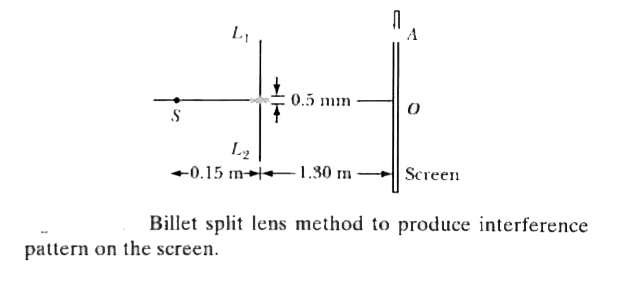 `(S_(1)S_(2))/(O_(1)O_(2))=(|u|+|v|)/(|u|).""(35-44)` However, `O_(1)O_(2)=0.5` mm (given). Therefore, `d=S_(1)S_(2)=((0.15+0.30)m)/((0.15)m) xx 0.5 m m=1.5 m m.` 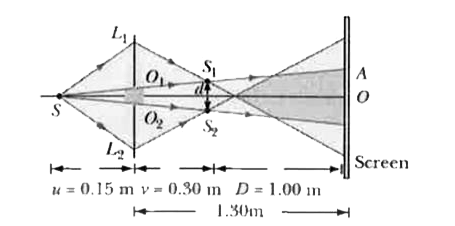 The distance of the vertical plane containing `S_(1)` and `S_(2)` from the screen is D = 1.30 - 0.30 = 1.00 m. The distance of the nth maximum from the central point O is given by `y_(n)=(n lambda D)/(d)` Since the third-order (n = 3) maximum occurs at A, we have `y_(3)=OA=(3 lambda D)/(d)=(3 xx 500 xx 10^(-9) xx 1.00)/(1.5 xx 10^(-3))` `=1.0 xx 10^(-3) m = 1.0 m m`. Note: What happens if the gap `O_(1)O_(2)` is reduced? If the gap `O_(1)O_(2)` is reduced, it follows from Eq. 35-44 that `S_(1)S_(2)= d` is ALSO reduced as u and v remain unchanged. Hence, OA increases. |
|
| 5. |
A small laser emits light at power 5.00 mW and wave- length 633 nm. The laser beam is focused (narrowed) until its diameter matches the 1266 nm diameter of a sphere placed in its path. The sphere is perfectly absorbing and has density 5.00 xx 10^(3)' kg/m^(3). What are (a) the beam intensity at the sphere's location, (b) the radiation pressure on the sphere, (c) the magnitude of the corresponding force, and (d) the magnitude of the acceleration that force alone would give the sphere? |
| Answer» Solution :(a) 3.97xx10^(9)W//m^(2),` (b) `13.2 PA,` (C) `1.67xx10^(-11)N,` (d) `3.14xx10^(3)m//s^(2)` | |
| 6. |
माना R प्राकृत संख्याओं के समुच्चय N में एक सम्बन्ध है, जो nRm यदि n विभाजित करता है m को, द्वारा परिभाषित है, तो R |
|
Answer» स्वतुल्य एवं सममित है । |
|
| 7. |
When a low flying aircraft passes overhead we sometimes notice a slight shaking of the picture on our TV screen. Why does it happen? |
| Answer» Solution :It is due to the interference between the direct SIGNAL RECEIVED by the ANTENNA with the weak signal REFLECTED by the passing aircraft. | |
| 8. |
Discuss about simple microscope and obtain the equation for magnificaiton for near point focusing and normal focusing. Simple microscope: |
|
Answer» Solution :A simple MICROSCOPE is a single magnifying (converging) lens of small focal LENGTH. The idea is to get an erect, magnified and virtual IMAGE of the object. For this the object is placed between F and P on one sid of the lens and viewed from other side of the lens. There are two magnificaitons to be discussed for two kinds of focusing. (i) Near point focusing - The image is formed at near point. i.e. 25 cm normal eye. This distance is also called as least distance D of distinct vision. In this position, the eye feels comfortable but there is little strain on theeye. (ii) Normal focusing - The image is formed at infinty. In this position the eye is most relaxed to view the image. Magnification in near point focusing Object distance u is than f. The image distance is the near point D. The magnification m is given by the relation. `m = (V)/(u)` With the help of lens equation, `(1)/(v) - (1)/(u) = (1)/(f)` the magnification can further be written as, `m = 1 - (v)/(f)` Substituting for v withsignconvention, v = - D `m = 1 + (D)/(f)` This is the magnification for near point focusing.  Magnification in normal focusing (angular magnification) We will now find the magnification for the image formed at infinty. If we take the ratio of height of image to height of object `(m = (h.)/(v))` to find the magnification, we will not get a particial relation as the image will also be of infintie size when the image if formed at infinity. Hence, we can practically use the angular magnification. The angular magnification is defined as the ratio of angle `theta_(1)` , subtended by the image with aided eye to the angle `theta_(0)` subtended by the obect with unaided eye.  `m = (theta_(i))/(theta_0))` For unaided eye, `tan theta_(0) approx theta_(0) = (h)/(D)` For aided eye, `tan theta_(1) approx_(1) = (h)/(f)` The angular magnification is, `m = (theta_(i))/(theta_(0)) = (h//f)/(h//D)` `m = (D)/(f)` This is the magnification for normal focusing. The magnification for normal focusing is one less than that for near point focusing. |
|
| 9. |
An audio signal of amplitude one half the carrier amplitude is employed in amplitude modulation. What is the modulation index? |
|
Answer» SOLUTION :`Here E_m=0.5Eundersetc,Eundersetmax=Eundersetc+0.5Eundersetc=1.5eundersetc ` and `Eundersetmin=Eundersetc-0.5Eundersetc=0.5Eundersetc` Now, `m_a=(E_max -E_min)/(E_max + E_min) = (1.5E_c-0.5E_c)/(1.5E_c+0.5E_c)` = `E_C/(2E_C) =0.5` |
|
| 10. |
Two wires A and B of the same material and of the same length have their area of cross-sections in the rario 2:1. If the same potential difference is applied across each wire, what will be the ratio of currents flowing in A and B? |
| Answer» SOLUTION :`I=V/R=V/p^l/A=VA/pl For the same LENGTH and MATERIAL I`PROPA`THEREFORE `I_1/I_2=A_1/A_2`=2:1 | |
| 11. |
In the steady state, the charge on the capacitor capacity 0.2muF is |
|
Answer» ZERO |
|
| 12. |
how can one distinguish between an unpolarised light beam and a linearly polarised light beam using a polaroid ? |
| Answer» Solution :To distinguish between an unpolarised light and a linearly (plane) polarised light using a polaroid, place a polaroid in the PATH of given light. SLOWLY rotate the polaroid and observe the intensity of light TRANSMITTED through the polaroid. If the intensity of light varies and in one COMPLETE rotation of polaroid, TWO times light intensity is maximum and two times light intensity is zero i.e., it is complete darkness, then the given light is plane polarised light. on the other hand, if on rotation of polaroid the intensity of transmitted light remains unchanged, the given light is unpolarised light. | |
| 13. |
The temperature of a piece of metal is raised from 27^@C to 327^@C. The rate at which the material radiates energy increases radiates energy increases nearly |
|
Answer» two times |
|
| 14. |
In the adjacent circuit a resisttance R is used.Initially with 'wire AB' not in the circuit, the galavanometer shhows a deflection of d divisions. Now, the wire AB is conneted parallel to the galvanometer and the galvanometer shows a deflection defiction nearly d/2 divisions. Therefore |
|
Answer» R=G |
|
| 15. |
An inverted L shaped conductor PRQ is made by joining two perpendicular conducting rods, each of length 1.5 L, at end R. This structure is moving in x-y plane containing variable magnetic field vec(B) = -3xhate(k) with a velocity vhate(i) + vhat(j). If potential of P is V_(p) and that of Q is V_(Q), then value of V_(P) - V(Q) at the instant when P is at origin as shown in Fig. Will be |
|
Answer» `(9vL^(2))/(8)` `=int (v hat(i)+vhat(j)) xx (-3 xhat(K))*dxhat(i)` `=3V int x(-hat(j)+hat(i)).dxhat(i)` `V_(Q)-V_(R)=int (vhat(i)+v hat(j)) xx (-3(1.5L)hat(k)).dy hat(j)` `=-4.5 vL int(-hat(j)+hat(i)).dyhat(j)` `=4.5 vl int_(0)^(1.5L_ dy=(27)/(4) vL^(2)` from above `V_(P)-V_(Q)=27/8 vL^(2)-27/4 vL^(2)=(-27)/(8) vL^(2)`. |
|
| 16. |
What made Nehru cooped up? |
|
Answer» HEAVY rains |
|
| 17. |
Discuss the experiment to determine thewavelength of different colours using diffraction grating. |
Answer» Solution :(i) When white light is USED, the diffractionpattern consists of a white centralmaximum and on both sides continuous coloured diffraction patters are formed.(ii) The central MAXIMUM is white as all the colours MEET here constructively with nopath DIFFERENCE.As `theta`increases, the path difference, `(a+b) sin theta`diffraction of DIFFERENT orders for all colours from violet to red. (iv) It produces a spectrum of diffraction pattern from violet to red on either side of central maximum as shown in Figure. (v) By measuring the angle at which thesecolours appear for various orders of diffraction, the wavelength of different colours could be calculated using the formula, ` lamda = (sin theta)/(Nm)` (vi) Here, N is the number of rulings per metre in the grating and m is the order of the diffraction image. |
|
| 18. |
Define the term 'resolving power of a telescope'. How will the resolving power be effected with the increase in (i)Wavelength of light used . (ii) Diameter of the objective Lens justify your answers. |
|
Answer» Solution :Resolving power of a TELESCOPE is its CAPABILITY to form distinct images of two distant objects, angular separation between which is very very small. Ifa telescope can just form distinct images of two distant objects having an angular separation `DELTATHETA`, then its reciprocal is called the resolving power of telescope. It is found that Resolving power of a telescopeR.P`=(1)/(Deltatheta)=(A)/(1.22 lambda)` where `lambda` = wavelength of light and A =aperture (diameter) of the objective LENS of telescope. (i) If wavelength of light `(lambda)` is increased then as per above relation the resolving power of telescope DECREASES because R.P.` prop (1)/(lambda)` . (ii) If diameter of the objective lens is increased then resolving power of telescope increases proportionately because R.P.` prop A` . |
|
| 19. |
A metal ball of radius R = 15 cm hasa charge q = 10mu C, Find the modulus of the vector of the electrostatic force acting on the charge located on one half of the ball |
|
Answer» 0.25 KN |
|
| 20. |
At a place, horizontal and vertical components of earth's magnetic field are equal. Angle of dip at the given place is |
|
Answer» `30^@` |
|
| 21. |
Calculate the energy required to separate ._50Sn^120 into its constituents if m_p=1.007825amu, m_(sn)=119.902199amu, m_n=1.008665amu |
|
Answer» 1.02 MeV |
|
| 22. |
A wire carrying current i has the configuration as shown in figure. The two semi-infinite straight sections are both tangents to the same circle, with all sections lying in the same plane. What must theta in order for B to be zero at the centre of the circle? |
| Answer» SOLUTION :`2[(mu_0)/(4 pi)(i)/(R)] = (mu_0 (theta)/(2pi))/(2R) rArr theta = 2" " RAD` | |
| 23. |
A U-shaped conducting frame is placed in a magnetic field B in such a way that the plane of the frame is perpendicular to the field lines. A conducting rod is supported on the parallel arms of the frame, perpendicular to them and is given a velocity v_0 at time t = 0. Prove that the velocity of the rod at time t will be given by v_t=v_0 "exp" ((-B^2l^2)/(mR)t). |
|
Answer» Solution :emf induced in a rod at time t is , `epsilon=-Bv_t L` `THEREFORE IR=-Bv_t l` `therefore I=- (Bv_t l)/R to` CURRENT at time t The force acting on the rod at time taccording to Lenz.s law is , `F=BI l sin 90^@` `therefore ` F=BI l [ `because sin 90^@ =1]` `therefore F=-(B^2l^2)/R. v_t`...(1) `therefore m.(dv_t)/(dt) =(B^2l^2)/R v_t [because F=ma=m . (dv_r)/(dt)]` `therefore (dv_t)/(v_t)=-(B^2l^2)/(MR). dt` Integrating on both sides `int_(v_o)^(v_t) 1/v_t . dv_t = -(B^2l^2)/(mR) int_(t=0)^t dt` `therefore [ln v_t]_0^t =-(B^2l^2)/(mR) [t]_0^t` ...(2) `therefore ln v_t - ln v_0 = - (B^2l^2)/(mR)t` `therefore ln ((vt)/v_0)=-(B^2l^2)/(mR)t` `therefore v_t=v_0 e^(-B^2l^2)/(mR)t` OR `v_t=v_0 "EXP" (-(B^2l^2)/(mR) t) ` |
|
| 24. |
For a higher resolving power of a compound microscope, the wavelength of light used should be __________ . |
|
Answer» |
|
| 25. |
Calculate the binding energy of a K electron in vanidium whose L absorption edgerhas the wavelength lambda_(L)=2.4nm. |
|
Answer» Solution :From the diagram above we see that the binding energy `E_(B)` of a `K` electron is the sum of the energy of a `K_(alpha)` line and the energy corresponding to the `L` edge of absorption spectrum `E_(b)=(2pi ħc)/(lambda_(L))+(3)/(4)ħR(Ƶ1)^(2)` For vanndium `Ƶ=23` and the energy of `K_(alpha)` line of vanadium has been CALCULATED in problem 134(b). Using `(2 pi ħc)/(lambda_(L))= 0.51 keV` for `lambda_(L)=2.4nm` we get `E_(b)=5.46keV` |
|
| 26. |
A and V are semi - spherical surfaces of radius r_(1)and r_(2) (r_(1) lt r_(2)) with E_(1) and E_(2) as the electric fields a the their surfaces. Charge q_(0) is placed as shown. What is the condition which may be statisfied ? |
|
Answer» `phi_(1)/phi_(2)=1` |
|
| 27. |
Time taken by the body to cool from 45^(@)C to 35^(@)C is |
|
Answer» 5 min AVERAGE temperature `=(50+40)/(2)=45^(@)` `:.(dT)/(dt)=-K(T-T_(c))` `(10)/(5)=-k(45-18)`. . . (i) `dT=45-35=10^(@)C` Average temperature, `(45+35)/(2)=40^(@)C` `:.(dT)/(dt)=-k[T-T_(c)]` `(10)/(t)=-k[40-18]`. . .(ii) DIVIDING (i) by (ii) `t/5=(45-18)/(40-18)` `rArrt=5xx(27)/(22)~=6` min So correct is (c ). |
|
| 28. |
A square coil of 600 turns, each side 20cm, is placed with its plane inclined at 30^(@) to a uniform magnetic field of 4.5xx10^(-4)Wbm^(-2), Find the flux through the coil. |
|
Answer» |
|
| 29. |
In a Bohr atom the electron is replaced by a particle of mass 150 times the mass of the electron and the same charge . If a_(0) is the radius of the first Bohr orbit of the orbital atom, then that of the new atom will be |
|
Answer» `150a_(0)` |
|
| 30. |
Who won the Nobel prize in physics in the year 1929 for the discovery of the nature of electrons ? |
|
Answer» Erwin Schrodinger |
|
| 31. |
In order to quadruple the resistance of a uniform wire, a part of its length was uniformly stretched till the final length of the entire wire was 1.5 times the original length, the part of the wire was fraction equal to |
|
Answer» `1//8` |
|
| 32. |
A coil carrying electric current is placed in uniform magnetic field. |
|
Answer» TORQUE is formed |
|
| 33. |
Calculate the upper and lower side band in the above problem |
| Answer» SOLUTION :1010 KHZ, 990 kHz | |
| 35. |
Substance on the choroid is |
|
Answer» JAPAN black |
|
| 36. |
When an electron falls form a height energy to a lower level, the difference in the energies appears in the form of electromegnetic radiation. Why can not it be emitted as other forms of energy ? |
| Answer» SOLUTION :When an ELECTRON falls form a heigher ENERGY to a LOWER energy level, DIFFERENCE in energies appears in the form of electromagnetic radiation only. This is because electrons (being charged) interact only electromagnetically. | |
| 37. |
What type of a wave front is observed from a distant source of light ? |
| Answer» Solution :A distance SOURCE of LIGHT produces plane wave front. | |
| 38. |
In a hydrogen atom, the electron is moving in a circular orbit of radius 5.3 xx 10^(-11)m with a constant speed of 2.2 xx 10^(6) ms^(-1) . The electric current formed due to the motion of electron is ...... |
|
Answer» 1.12 A Electric CURRENT DUE to motion of electron I = `(q)/(t)` `thereforeI = (e)/(T) ` ` = (eV)/(2 pi r ) "" (because V = (2PI r)/(T)) ` = `(1.6 xx 10^(-19) xx 2.2 xx 10^(6))/(2 xx 3.14 xx 5.3 xx 10^(-11))` `= 0.106 xx 10^(-2)` ` 1.06 ` mA |
|
| 39. |
The people were becoming unmanageable. How? |
|
Answer» A BAD song |
|
| 40. |
What according to Bohr's law ? |
| Answer» Solution :According to Bohr, the angular momentum of an electron is an INTEGRAL MULTIPLE of `h/(2PI)`. An electron does not radiate energy whem it is in STATIONARY orbit. | |
| 41. |
The surface charge density of a thin charged disc of radius R is sigma. The value of the electric field at the centre of the disc (sigma)/(2 epsilon_0) . With respect to the field at the centre, the electric field along the axis at a distance R from the centre of the disc is |
|
Answer» Solution :The electric field strength on the AXIS at a distance "x" from its centre of UNIFORM CHARGED circular disc is `E = (sigma)/(2 epsilon_0) (1-(x))/((x^2 + R^2)^(1//2))`. At centre , `E_(0) = (sigma)/(2 epsilon_0)` At distance `x = R`, `E = (sigma)/(2 epsilon_0) (0.37) = 0.37 E_0` |
|
| 42. |
What percentage of our land should be under forest according to the National Forest Policy (1952)? |
|
Answer» 33 |
|
| 43. |
An electron of mass m,moves around the nucleus in a circular orbit of radius 'r' under the action of centripetal force 'F'. The equivalent electric current is |
|
Answer» `(E )/(2 PI ) SQRT((F )/(mr ))` |
|
| 44. |
Consider N=n_(1)n_(2)indentical cells, each of emf(epsilon) and internal resistance r. Suppose n_(1) cells are joined in series to forn a line and n_(2) such are connected in parallel. The combination drives a current in an external resistance R.(a) find the current in the external resistance, (b) Assuming that n_(1)and n_(2) can be continuously varied, find the relation between n_(1) ,n_(2) R and r for which the current in R in maximum. |
|
Answer» Solution : Total e.m.f. = ` n_1` EIN one row Total e.m.f. in all rows = `n_1 E` Total RESISTANCE in one row = `n_1`r/`n_2` Net resistance = `R+ (n_1)r/(n_2)` ` So, Current = R + ((n_1)r/n_2)` ` (b) L = ((n_1)(n_2)E/ n_2 R + n_2 r)` For, L = MAX ` (n_1)r + (n_2)R = minimum ` ` rArr ((sqrt (n_1)r)- (sqrt(n_2)R))^2 + 2((sqrt(n_1)R(n_2)R)) = min. ` It is minimum when, ` (sqrt(n_1)r) = (sqrt(n_2)R) ` ` n_1r = n_2R` L is maximumwhen, ` n_1r = n_2R` . 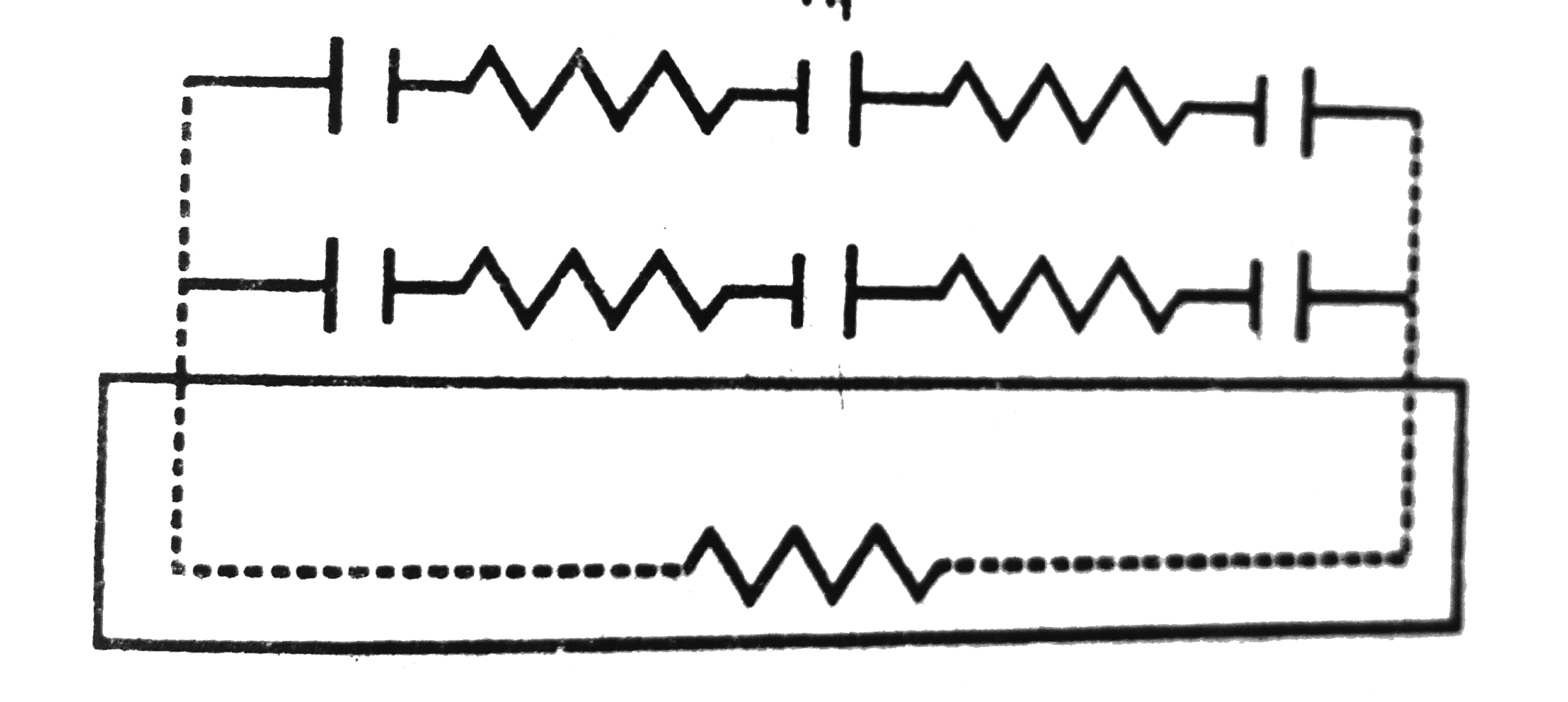
|
|
| 45. |
How many 600 KHz waves can be on a 5 mile transmission line simulaneously? |
|
Answer» 11 |
|
| 46. |
The horizontal and vertical components of earth’s magnetic field at a place are 0.22G and 0.38G respectively. Calculate the angle of dip and resultant intensity of earth’s field. |
| Answer» Solution :`tan delta = (B_(V))/(B_(H)) = (0.38 )/(0.22) = 1.73 = 60^@ , B = SQRT(B_(H)^(2)+ B_(V)^(2))= 0.44` G | |
| 47. |
A homogeneous magnetic field B is perpendicular to a sufficiently long fixed track of width l which is horizontal. A frictionless rod of mass m straddles the two rail of the track as shown in the figure. Entir arrangement lies in horizontal plane. For the situation suggested in column-II match the appropriate entries in column-II. The rails are also resistanceless. |
|
Answer» For (B): ROD is non-conducting so no current For (c ): No energy dissipated as no resistance `R rarr` Red EXECUTES SHM F=ilB to left `implies f_("EXT")` to right F=ilB, `(Ldi)/(dt)=Blv` impliesnot possible to move with CONSTANT v. |
|
| 48. |
Imagine the standard kilogram is located on Earth's equator, where it moves in a circle of radius 6.400x10^(6)m (Earth's radius) at a constant speed of 465m/s due to Earth's rotation. (a) What is the magnitude of the centripetal force on the standard kilogram during the rotation? Imagine that the stadard kilogram hangs from a spring balance at that location and assume that it would weigh exactly 9.80 N if Earth did not rotate. (b) What is the reading on the spring balance, that is what is the magnitude of the spring balance from the standard kilogram. |
|
Answer» |
|
| 49. |
Two particles A and B are moving as shown in the figure. Their total angular momentum about the point O is |
|
Answer» `9.8kgm^(2)//s` `vecL_("net")=vecL_(A)+vecL_(B)=vecr_(A)xxvecP_(A)+vecr_(s)xxvecp_(s)`  Here, `vecr_(A)=1.5mhatj,vecr_(B)=2.8mhati` `vecP_(A)=mvecv_(A)=(6.5)(2.2hati)=(14.3hati)NS` `vecP_(B)=mvecv_(B)=(3.1)(3.6hatj)=(11.16hatj)Ns` `thereforevecL_("net")=(1.5hatj)xx(14.3hati)+(2.8hati)xx(11.16hatj)` `=21.45(-hatk)+21.248(hatk)=9.8hatk` `abs(vecL_("net"))=9.8kgm^(2)s^(-1)` |
|
| 50. |
निम्न मे से कौन सा दशमलव प्रसार सांत है ? |
|
Answer» 19/70 |
|