

Saved Bookmarks
This section includes 7 InterviewSolutions, each offering curated multiple-choice questions to sharpen your Current Affairs knowledge and support exam preparation. Choose a topic below to get started.
| 1. |
The distance between the slit and biprism and screen and biprism are 50 cm each.The obtuse angle of biprism is 179^(@) and its refractive index is 1.5. If the distance between successive fringes is 0.135 mm, the wavelength of light used is : |
|
Answer» `5893 Å` `alpha = (0.5 pi)/(180^(@))rad` `d = 2a(MU - 1) alpha` 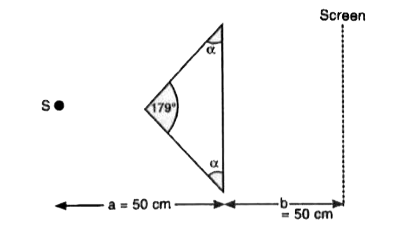 SOLVING , `d = (0.25 pi)/(180) m` `Rightarrowbeta = (D.lambda)/(d) = 5834 Å` Then `lambda = 11786 Å` |
|
| 2. |
If the radius of an orbit is r and the velocity of electron in it is v, then the frequency of electron in the orbit will be |
|
Answer» `2pi` rv |
|
| 3. |
The length of a metal wire is l_(1) when the tension is F_(1) and is 12 when the tension is F_(2). The original length of wire is: |
|
Answer» `(l_(1)+l_(2))/2` CHANGE in length with `F_(1) = l_(1) -L` Change in length with `F_(2) = l_(2) - L` Here `Y=(F_(1))/AxxL/(l_(1)-L)=(F_(2))/AxxL/(l_(2)-L)` `F_(1)l_(2)-F_(1)L=F_(2)l_(1)-F_(2)L` `L(F_(2)-F_(1))=F_(2)l_(1)-F_(1)l_(2)` `L=(F_(2)l_(1)-F_(1)l_(2))/(F_(2)-F_(1))` Correct choice is (d). |
|
| 4. |
A10 mu Fcapacitor and a 15Omega resistor are connected in series across a 220 V 50 Hz source . Calculate the value of rms current . |
|
Answer» |
|
| 5. |
Sand is piled up on a horizontal ground in the form of a regular cone of a fixed base radius R. The coefficient of static friction between sand layers is mu . The maximum volume of sand that can be pilled up, without the sand slipping on the surface is |
|
Answer» `(MUR^(3))/(3pi)` |
|
| 6. |
The angle between two vectors 2 hat i+3 hat j+hat k and 3 hat I + 6 hat j is : |
|
Answer» `0^(@)` |
|
| 7. |
The angle of dipole and the component of earth's magnetic field are related by tan phi = _____ |
| Answer» SOLUTION :`[B_v/B_h]` | |
| 8. |
Two identical fluts produces fundamental nodes of frequency 300 Hz at 27^(@)C. If the temperature of air in one flute is increases to 31^(@)C the number of the beats per second will be |
|
Answer» |
|
| 9. |
Ship A is 10km due west of ship B. Ship A is heading directly north ar a speed of 30 kmph while ship B is heading in a direction 600 west of north at a speed 20kmph. Their closest distance of approach will be.... |
|
Answer» Solution :`bar(V_(A))=30 j bar(V_(B))=20 sin 60^(@)(i)+20 Cos(60)(HATJ)` `=-10sqrt(3i)+10 hatj` `bar(V_(BA))=bar(V_(A))=-20hati- 10 SQRT(3i)` If `phi` is the angle MADE by `bar(V_(BA))` with X axis `TAN phi=(20)/(10 sqrt(3))=(2)/(sqrt(3)) and "sin" phi=(2)/(sqrt(7))` From `DeltaABC,(x)/(10)XX(2)/( sqrt(7))` `x=(20)/(sqrt(7))=7.6 Km` 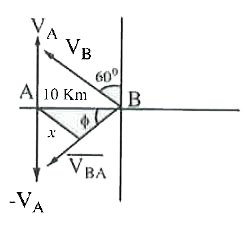
|
|
| 10. |
If electron is accelerated under 50 KV in microscope ,find its de-Broglie wavelength. |
|
Answer» `5.485xx10^(-12)m` `lambda=(h)/(SQRT(2meV))` `=(6.62xx10^(-34))/(sqrt(2xx9.1xx10^(-31)xx50xx10^(3)xx1.6xx10^(-19)))` `=(6.62xx10^(-34))/(1.207xx10^(-22))` `5.485xx10^(-12)m` |
|
| 11. |
Density of substance at 0^@Cis 10gm/ccand at 100^@C , it's density is 9.7g/cc. The coefficient of linear expansion of the substance is |
|
Answer» `10^(-4)` |
|
| 12. |
A charge moving with velocity v in X-direction is subjected to a field of magnetic induction in negative X-direction. As a result, the charge will |
|
Answer» Remain unaffected |
|
| 13. |
Assertion: Kinetic energy of a free charged particle remains constant in a magnetic field. Reason: Magnetic force always acts perpendicular to the velocity of charged particle and thus work done by magnetic force on a free charged particle remains zero. |
|
Answer» If both ASSERTION and REASON are CORRECT and reason is correct EXPLANATION of the assertion |
|
| 14. |
A bar magnet has a magnetic moment 5 xx 10^(-5) A-m^2. It is suspended in a magnetic field of 8xx 10^(-4) tesla. The magnet vibrates with a period of vibration equal to 15 s. The moment of inertia of the magnet is |
|
Answer» `22.5 KG m^2` |
|
| 15. |
Momentum is the ability of imparting or tending to import motion to other bodies. The total momentum of a system remains conserved if no external force is acting it. This is calculated by the formula vec(p)= m vec(v). Consider a situation where a cart carrying five boys is moving without friction due to inertia along a straight horizontal road, with a speed of 10 m/s. After travelling certain dfistance a boy jumps from the cart with a speed of 2 m/s with respect to cart in opposite direction to it. Then, second boy jumps with the same speed w.r.t. the cart, but in a perpendicular direction to the cart. The mass of the cart is 100 kg and mass of each boy is 20 kg.Answer the following questions.The speed of the cart after first boy has jumped out is |
|
Answer» 10 m/s |
|
| 16. |
For a gas molecule with 6 degrees of freedom, the law of equipartition of energy gives the relation between the molar specific heat (C_(V)) and gas constant (R ) is |
|
Answer» `C_(V)=(R )/(2)` Here, `f=6 therefore C_(v)=(6)/(2)R=3R` |
|
| 17. |
A capacitor consists of two air spaced concentric cylinders. The outer of radius b is fixed, and the inner is of radius a. If breakdown of air occurs at field strengths greater than E_b, show that the inner cylinder should have (i)radiusa = b/e if the potential of the capacitor is to be maximum (ii)radiusa =b//sqrt eif the energy per unit length of the system is to be maximum |
|
Answer» |
|
| 18. |
Momentum is the ability of imparting or tending to import motion to other bodies. The total momentum of a system remains conserved if no external force is acting it. This is calculated by the formula vec(p)= m vec(v). Consider a situation where a cart carrying five boys is moving without friction due to inertia along a straight horizontal road, with a speed of 10 m/s. After travelling certain dfistance a boy jumps from the cart with a speed of 2 m/s with respect to cart in opposite direction to it. Then, second boy jumps with the same speed w.r.t. the cart, but in a perpendicular direction to the cart. The mass of the cart is 100 kg and mass of each boy is 20 kg.Answer the following questions.Which of the following statement is true ? |
|
Answer» Linear momentum can't be conserved as BOYS are jumping out. |
|
| 19. |
In example 9, if B is the mid point of rod, then find e_(OB)//e_(BA). |
|
Answer» SOLUTION :`e_(OB)=(1)/(2)Bomega((l^(2))/(4))=(Bomegal^(2))/(8)` `e_(BA)=(1)/(2)Bomega(x^(2))_(1//2)^(l)=(1)/(2)Bomegaxx(3l^(2))/(4)Bomegal^(2)` `THEREFORE""(e_(OB))/(e_(BA))=(1)/(3)` |
|
| 20. |
Momentum is the ability of imparting or tending to import motion to other bodies. The total momentum of a system remains conserved if no external force is acting it. This is calculated by the formula vec(p)= m vec(v). Consider a situation where a cart carrying five boys is moving without friction due to inertia along a straight horizontal road, with a speed of 10 m/s. After travelling certain dfistance a boy jumps from the cart with a speed of 2 m/s with respect to cart in opposite direction to it. Then, second boy jumps with the same speed w.r.t. the cart, but in a perpendicular direction to the cart. The mass of the cart is 100 kg and mass of each boy is 20 kg.Answer the following questions.The speed of the cart after second boy jumps will |
|
Answer» change ALONG its initial direction |
|
| 21. |
What is resistance? Give its unit? |
|
Answer» SOLUTION :The resistance is the ratio of potential difference across the given CONDUCTOR to the current PASSING through the conductor. `R=(V)/(I)` |
|
| 22. |
Welders wear special glass goggles. Write working, why ? |
| Answer» Solution :Infrared waves incident on a substance increases th e INTERNAL energy and HENCE the TEMPERATURE of a substance. This is why they are called as HEAT waves. | |
| 23. |
A telephone cable at a place has four long straight horizontal wires carrying a current of 1.0 A in the same direction east to west. The earth's magnetic field at the place is 0.39 G, and the angle of dip is 35°. The magnetic declination is nearly zero. What are the resultant magnetic fields at points 4.0 cm below the cable ? |
Answer» Solution : Here, `B_(h) = B cos phi = 0.39 cos 35^(@) = (0.39) (0.8192)` `therefore B_(h) = 0.3195 G` `B_(v) = B sin phi = (0.39) (sin 35^(@) ) = (0.39) (0.5736)` `therefore B_(v) = 0.2237 G` Magnetic field at distance r from CABLE due to current passing through it, `B. = (mu_(0)I) /( 2pi r)` `therefore B. = (4pi xx 10^(-7) ) (4)/( (2pi ) (0.04) )` `therefore B. = 0.2 xx 10^(-4) T= 0.2 G` Resultant magnetic field at point Q in the FIGURE `overset(to) ((B_Q) )`. If horizontal COMPONENT of `overset(to)(B_Q)` is `overset(to) (R_h` then at point Q, `R_h= B_h + B. ""(because overset(to) (B_h) || overset(to) (B.) )` `=0.3195 +0.2` `therefore R_h= 0.5195 G` Now, `overset(to) (B_Q) = overset(to) (R_h) + overset(to)(B_v) ` `therefore B_(Q) = sqrt(R_(h)^(2) + B_(v)^(2) ) ""(because overset(to)( R_h) bot overset(to)(B_V))` `therefore B_Q = sqrt((0.5195)^(2) + (0.2237)^(2) )` `therefore B_Q = 0.5656 G`  For right angled `Delta abc`, `tan alpha_(1)= (B_v)/(R_h) = (0.2237)/( 0.5195) = 0.4306` `therefore alpha_(1) = 23^(@) 18.` Resultant magnetic field at point P in the figure `overset(to) ((B_P))`. If horizontal component of `overset(to) (B_P)` is `overset(to) (R_h)` then at point P, `R_(h) = B_(h) - B . ""(becauseoverset(to)(B_h) || (-overset(to) (B.)) )` `=0.3195 -0.2` `therefore R_(h) = 0.1195` G Now, `overset(to) (B_P) = overset(to) (R_h) + overset(to)(B_v) ` `therefore B_P = sqrt((R_(h)^(2) + B_(v)^(2) ) "" (because overset(to) (R_h) bot overset(to) (B_v) )` `therefore B_P = sqrt((0.1195)^(2) + (0.2237)^(2) ) )` `therefore B_(P) = 0.2536` G  For right angled `Delta ab.c.`, `tanalpha_(2) = (B_v)/( R_h) = (0.2237)/(0.1195)= 1.872` `therefore alpha_(2)= 61^(@) 54`. |
|
| 24. |
In a potentiometer experiment the balancing length with a cell is 560 cm. When an external resistance of 10Omega is connected in parallel to the cell, the balancing length changes by 60 cm. Find the internal resistance of the cell. |
|
Answer» SOLUTION :BALANCING LENGTH `l_(1)=560 cm` Change in balancing length `(l_(1)-l_(2))=60cm` `560 -l_(2)=60""therefore l_(2)=500cm` `r=R((l_(1)-l_(2))/(l_(2)))RARR r=10xx(60)/(500)=(6)/(5)=1.2Omega` |
|
| 25. |
How eddy currents can be produced? |
|
Answer» Solution :When copper coil is moving out of a magnetic field with CONSTANT velocity then INDUCED emf (`epsilon`) is developed. The work done against induced `emf=epsilonl`. If resistance of the coil is increased, then CURRENT will decrease and hence, work REQUIRED against induced emf will also decrease and it will be easier to remove the coil from the magnetic field. |
|
| 26. |
Give reason : "Small and light pieces of papers are attracted by comb run through dry hair |
|
Answer» SOLUTION :A COMB run through dry hair acquires charj through friction but the paper is not charged The charged comb .polarizes. the piece of papr induces a net dipole moment in the direction field. Further, the electric field due to the con is not uniform. In this SITUATION it is EASILY set that the paper should move in the direction the comb. |
|
| 27. |
To sustain the chain reaction, the mass of the material should be |
|
Answer» less than the CRITICAL mass |
|
| 28. |
Finding equivalent focal length Two equiconcave lens of focal length -20cm each having a refractive index of 1.50 are kept together and the space between them is filled with water as shown in Fig. 34-49. Find the equivalent focal length of the arrangement thus formed. |
Answer» Solution :(1) Here we can imagine a thin layer of air in between lens and water at both the surfaces (FIG. 34-50). This will give us two concave lenses combined with a convex lens of water. This thin layer of air will not affect the formation of image but rather will simplify the calculations a lot. 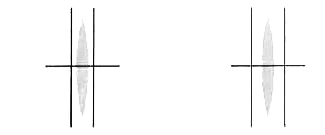 (2) First let us find the radius of curvature of the lens because this will needed to find the FOCAL length of the convex lens formed by water in between . Calculations : `(1)/(-20)=(1.5-1)((1)/(-R )-(1)/(R ))` `R=20cm` So, the focal length of water convex lens (in Fig. 34-50) is `(1)/(f) =((4)/(3)-1)((1)/(20)-(1)/(-20))` `f=30cm` Note here carefully that we are taking the focal length of the water lens in air because when we are USING the focal length of the concave lens, we are assuming that there is air on both the sides. `(1)/(f)=(1)/(f_(1))+(1)/(f_(2))+(1)/(f_(1))` `(1)/(f)=(1)/(-20)+(1)/(30)+(1)/(-20)` `f=-15cm` LEARN : Similarly, if a lens is cut into two parts, the focal length of the two parts are given by `(1)/(f)=(1)/(f_(1))+(1)/(f_(2))` where f is the focal length of the original lens and `f_(1)` and `f_(2)` are focal lengths of the two cut parts. The interesting situation is that if we join these lenses back, we will get back the original lens. We have studied previously that the focal length of the lens does not depend on the SIDE facing the light. So, the focal length of all the following four arrangements (Figs. 34-51a-d) will be the same. 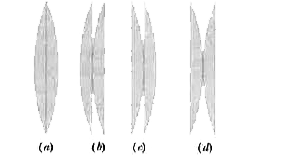
|
|
| 29. |
A man throws balls with the same speed vertically upwards one after the other at an interval of 2 second. What should be the speed of the throw so that two balls are in the sky at any time? |
|
Answer» At least 9.8 `m//s` The maximum time of flight for each ball is `=(2u)/(g)` THUS `(2u)/(g)` >4 s or U > 2g Bur g=9.8 `ms^(-2)` `:. ` u> 19.6 `ms^(-1)` |
|
| 30. |
What is atomic mass unit ? |
|
Answer» Solution :The MASS of the carbon-12 atom is `1.992678xx10^(-26)kg` which is very small. THEREFORE, it is useful to choose a convenient unit for EXPRESSING the mass of ATOMS. This unit is defined by taking mass of carbon C-12 atom equal to 12 atomic mass units. One atomic mass unit is defined as 1/12th of the actual mass of carbon. 1 a.m.u. = `1.660565xx10^(-27) kg` |
|
| 31. |
A point charge q is placed at a distance d from the centre of a circular disc of radius R. Find electric flux flowing through the disc due to that charge. |
|
Answer» Solution :We know that total flux originated from a point charge q in all DIRECTIONS is `q/(in_0)`. This flux is originated in a solid angle `4pi`. In the given case solid angle subtended by the cone subtended by the disc at the point charge is `omega = 2PI (1 - cos theta)` So, the flux of q which is PASSING through the surface of the disc is `phi = q/(in_0) (omega)/(4 pi) = q/(2 in_0) (1 - cos theta)` From the figure , `cos theta = d/(sqrt(d^2 + R^2))` so, `phi = q/(2 in_0) {1 - d/(sqrt(d^2 + R^2))}` |
|
| 33. |
A water heater has a well insulated vertical cylindrical container of radius a in which water is filled to a height h. A resistor made of an allow is used to heat the water in the tank from a temperature theta_(1) to theta_(2) (gt theta_(1)) in a time interval Deltat. The resistor wire has cross sectional radius b and its alloy material has resistivity rho. Calculate the length of the resistor wire. Density and specific heat capacity of water are d and s respectively. The power source connected to the resistor has emf epsilon. |
|
Answer» |
|
| 34. |
A mesoatom of hydrogen is a hydrogen atom in which a negative muon with a mass 207 times that of an electron orbits the nucleus instead of an electron. Find the Bohr radii and the energy levels of a mesoatom. |
|
Answer» `(m_(1)v_(1)^(2))/r_(1)=(m_(2)v_(2)^(2))/r_(2)=e^(2)/(4piepsi_(0)a^(2))` `a=r_(1)+r_(2)` `m_(1)v_(1)r_(1)+m_(2)v_(2)r_(2)=nh` `m_(1)r_(1)=m_(2)r_(2)` It follows from the first and the fourth equations that `v_(1)//r_(1)=v_(2)//r_(2)`, and from the third and the fourth that `v_(1)+v_(2)=(nh)/(m_(1)r_(1))=(nh)/(m_(2)r_(2))`  Hence we obtain the orbital speeds: `v_(1)=nh//am_(1),v_(2)=nh//am_(2)`. SUBSTITUTING this result into the first and the second equations, we obtain the radii: `r_(1)=n^(2)(4piepsi_(0)h^(2))/(m_(1)e^(2)),r_(2)=n^(2)(4piepsi_(0)h^(2))/(m_(2)e^(2))` Hence the Bohr radii of a mesoatom may be obtained: `a_(n)=n^(2)(4piepsi_(0)h^(2))/e^(2)*(m_(p)+m_(MU))/(m_(p)m_(mu))` The energy of an electron occupying an arbitrary energy level is `epsi_(n)=(m_(1)v_(1)^(2))/2+(m_(2)v_(2)^(2))/2-e^(2)/(4piepsi_(0)a_(n))=-e^(2)/(8piepsi_(0)a_(n))=-e^(2)/(8piepsi_(0)a_(0))*a_(0)/a_(n)` = `-hcRa_(0)/a_(n)` where `a_(0)` is the first Bohr radius of the hydrogen ATOM. |
|
| 35. |
If vecA=3 hati-4hatj, vecB=-2 hat i+3hat j and vec C = vecA xx vecB, then vec C is: |
|
Answer» `12hat i-9hat j-8hat K` |
|
| 36. |
Define magnetisation (M) and give its unit and dimension. |
|
Answer» Solution :Magnetisation M of a sample to be equal to its net magnetic moment PER unit volume. `overset(to) (M) = (overset(to) (m_("net") ))/( V) ""…(1)` M is a vector. DIMENSION of M is `L^(-1)` A. Unit is A/m. |
|
| 37. |
Show that a proejctile fired at an angle theta with the horizontal crosses a certain height at two timings t_(1) and t_(2) and sum of these two is equal to : |
|
Answer» TOTAL TIME of FLIGHT |
|
| 38. |
(A): The resistivity of metals increases with increase in temperature. (R): The free electron density in metals in creases with increase in temperature. |
|
Answer» Both 'A' and 'R' are true and 'R' is the CORRECT EXPLANATION of 'A' |
|
| 39. |
The potential difference between two points A(2,1,0)m and B(0,2,4) m in an electric field (xhat(i) - 2 yhat(j) + z hat(k) ) Vm^(-1) is |
|
Answer» |
|
| 40. |
The magnetic field produced due to current carrying straight solenoid is same as is due to……………………. . |
|
Answer» |
|
| 41. |
Two particles move in a uniform gravitational field with an acceleration "g". Al the initial moment the particles were located at same point and moved with velocities u_(1)=0.8 ms^(-1) and u_(2)=4.0 ms^(-1) horizontally in opposite directions. Find the distance between the particles at the moment when their velocity vectors become mutually perpendicular. (g=10 ms^(-2)) |
Answer» Solution :`t= SQRT((u_(1)u_(2))/(G)),x=(u_(1)=u_(2))t` 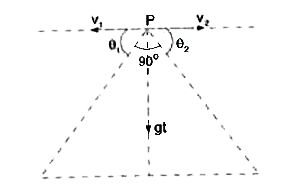
|
|
| 42. |
Water rises upto a height h in a capillary tube of a certain diameter. This capillary tube is replaced by a similar tube of half the diameter. Now, calculate the height of water will rise. |
|
Answer» Solution :`h = (26 COSTHETA)/(rPg) h PROP R prop R^-1` Where D id diameter the capillary tube and `h^.= 2/D`. `THEREFORE (h^.)/h = 2 or h^1` =2h |
|
| 43. |
An ac. generator consists of a coil of 50 turns and area 2.5 m^(2) rotating at an angular speed of 60 rad sin^(-1) in a uniform magnetic field B = 0.2 T between the two fixed pole pieces. The resistance of the circuit including that of the coil is 500Omega. (i) Calculate the maximum current drawn from the generator. (ii) What is the flux when the current is zero? (iii) Would the generator work if the coil were stationary and instead the pole pieces rotated together with the same speed as above? Give reason. |
|
Answer» |
|
| 44. |
Three different objects of masses m_(1) m_(2) and m_(3) are allowed to fall from rest and from the same point o along three different frictionless paths. The speeds of three objects, on reaching the ground, will be in the ratio of |
|
Answer» `m_(1):m_(2) :m_(3)` |
|
| 45. |
A ray of light travelling inside a glass slab of refractive index sqrt2 is incident on the glass air interface at an angle of incidence of 45^@. The refractive index of the air is one. In the case, the ray : |
|
Answer» will be absorbed by the glass slab |
|
| 46. |
A power transmission line feeds input power at 2300 V to a stepdown transformer withits primary windings having 4000 turns. What should be the number of turns in the secondary in order to get output power at 230 V? |
|
Answer» SOLUTION :`V_P/V_S = N_P/N_S` `N_S = (N_P)/(V_P) XX V_S = (4000 xx 230)/(2300) = 400 ` |
|
| 47. |
A transparent cube of side 0.18 m has an air bubble in it. When viewed normally through one face the bubble appears to be at a distance of 0.08 m from that surface. When viewed normally through the opposite face, the distance of the bubble appears to be 0.04 m. Find the actual distance of the air bubble from the first face and refractive index of the material of the cube. |
|
Answer» SOLUTION :LET .X. be the actual distance of the air bubble from one face. Then,`n=(RD)/(AD)=(x)/(0.08)""`......(1) Similarly from the second face `n=(0.18-x)/(0.04)""`......(2) from (1) and (2) 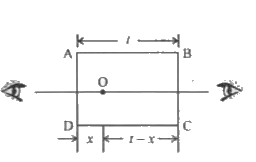 `(x)/(0.08)=(0.18-x)/(0.04)` `0.04x=0.0144-0.08x` ` 0.12x=0.0144` `therefore x=0.12m` using x in (1) we get `R.I=n=(0.12)/(0.08)=1.5` Hence REFRACTIVE index of the MATERIAL of glass is 1.5. |
|
| 49. |
Gauss.s law is true only if force due to a charge varies as: |
|
Answer» `r^(-1)` |
|
| 50. |
In the figure shown the spring is relaxed and mass m is attached to the spring. The spring is compressed by 2A and released at t = 0. Mass m collides with the wall and loses two third of its kinetic energy and returns. Starting from t = 0, find the taken by it to come back to rest again (instant at which spring is given undermaximum compression). Take sqrt(m)/(k) = (12)/(pi) |
Answer» 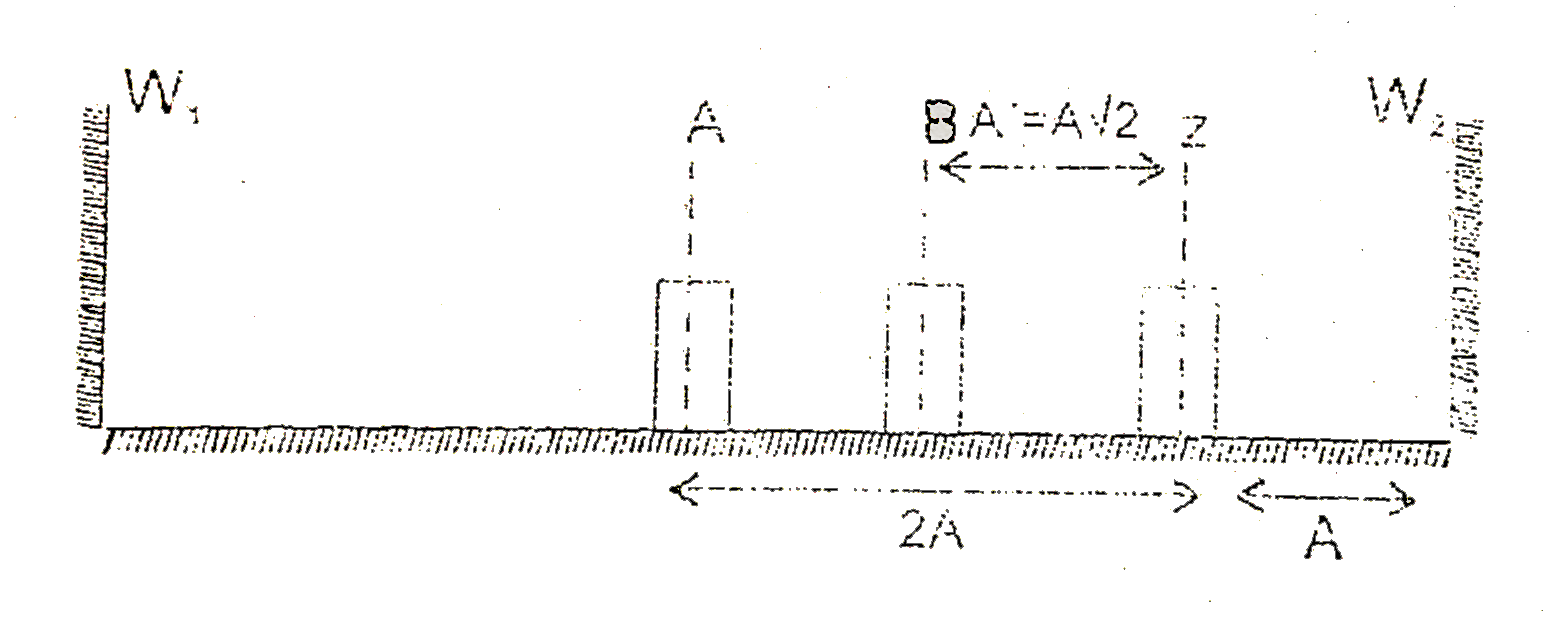 The motion STARTS from position `A` the time taken from `A` to `W_(2) (t_(1)) = (T)/(4) + (T)/(12)` Before collision the energy of the block just before collision `K_(i) = (1)/(2)K(2A)^(2) - (1)/(2) KA^(2)` & just after collision `K_(1) = (K_(f))/(3)` (given) `= (1)/(2)KA^(2)` Now during motion after collision, the energy is again conserved Hence, `K_(1) + (1)/(2) KA^(2) = (1)/(2)KA^('2)` `A' =` maximum compresion after collision `rArr = Asqrt(2)` IE. Now motion has amlitude `Asqrt(2)` Now time taken by block from `W_(2)` to positon `B = (T)/(4) + (T)/(8)` `:.` total time taken `= t_(1) + t_(2) = (T)/(4) + (T)/(12) + (T)/(4) + (T)/(8) = (17)/(24)T = (17pi)/(12)sqrt((m)/(K)) = 17sec {sqrt((m)/(k)) = (12)/(pi)}` |
|