

Saved Bookmarks
This section includes 7 InterviewSolutions, each offering curated multiple-choice questions to sharpen your Current Affairs knowledge and support exam preparation. Choose a topic below to get started.
| 1. |
Which of the following represents symport? |
|
Answer»
|
|
| 2. |
A body is thrown horizontally with a velocity 'u' from a tower H meter high. After how much time and a what distance from the base of the tower will the body strik the ground ? |
|
Answer» SOLUTION :`H = 1/2g t^2` time = `sqrt((2H)/g)` and horizontal distance `x = UT = u sqrt (2H/g)` |
|
| 3. |
For common emitter circuit of a transistor , when the base current changes by 80 muA, the collector current change by 4.8 mA. Then the current amplification factor will be : |
|
Answer» 120 |
|
| 4. |
The dimensions of an atom are of the order of an Angstrom. Thus there must be large electric fields between the protons and electrons. Why, then is the electrostatic field inside a conductor zero ? |
|
Answer» Solution :In any neutral ATOM, the number of ELECTRONS and protons are equal and the protons and electrons are bound into an atom with distinct and independent existence. Electrostatic fields are caused by the presence of excess charges. But, there can be no excess charge on the INTER surface of an isolated conductor. So, the electrostatic fields inside a conductor is zero despite the fact that the dimensions of an atom are of the order of an ANGSTROM. |
|
| 5. |
In the above question what is the force acting after 2 sec ? |
|
Answer» `(4overset(WEDGE)(i)+8overset(wedge)(J))N` `:.veca=(dvecupsilon)/(dt)=2hati+2thatj` Now at 2 `sec veca_(t)=(2hati+4hatj)` `vecF=2(2hati+4hatj)` `=(4hati+8hatj)N` Hence (a) is the right CHOICE. |
|
| 6. |
The output characteristics of an n-p-n transistor represent, (I_(C) = Collector current, V_(CE) = difference between collector and emitter, I_(B) = base current, V_(BB) = Voltage given to base, V_(BE) = difference between base and emitter) |
|
Answer» Changes in `I_(C) ANA I_(B) and V_(BB)` are changed 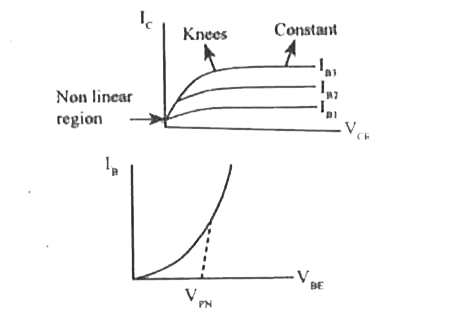
|
|
| 7. |
A solid brass sphere is subjected to a pressure of 1.0xx10^(5) Pa due to the Earth's atmosphere. On Venus the pressure due to the atmosphere is 9.0xx10^(6) Pa. By what fraction Delta r//r_(0) (including the algebraic sign) does the radius of the sphere change when it is exposed to the atmosphere on Venus ? Assume that the change in radius is very small relative to the initial radius. |
|
Answer» `-4.4xx10^(-5)` |
|
| 8. |
800 व्यक्तियों के एक समूह में 500 व्यक्ति हिंदी बोलते है तथा 450 अंग्रेजी बोलते है। उन व्यक्तियों की संख्या ज्ञात कीजिए जो हिंदी व अंग्रेजी दोनों बोलते हो। |
|
Answer» 130 |
|
| 9. |
Slope of V_(0)etoV represent…… |
|
Answer» h `eV_(0)=hv-hv_(0)` Comparing with y=mx+c SLOPE m=h |
|
| 10. |
Explain the process of electrostatic induction . |
Answer» Solution :Whenever a CHARGED rod is touched by another condductor charges START to flow from charged rod to the conductor . This type of charging without actual contact is called electrostatic induction . 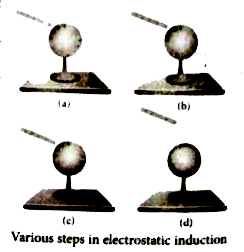 (i) Consider an uncharged (neutral ) conducting sphere at rest on an insulating stand . Suppose a negatively charged rod is brought near the conductor without touching it as shown in figure (a). The negative charge of the rod repels the electrons in teh conductorto the opposite side . As a result positive charges are induced near the REGION of the charged rod while negative charges on the farther side . Before introducing the charged rod the free electrons were distributed uniformly on the surface of the conductor and the net charge is zero. Once the charged rod is brought near the conductor the distribution is no longer uniform with more electrons LOCATED on the farther side of the rod and positive charges are located closer to the rod . But the total charge is zero . (ii) Now the conducting sphere is connected to the ground through a conducting wire . This is called grounding . Since the ground can always receive any amount of electrons , grounding removes the ELECTRON from the conducting sphere . Note that positive charges will not flowto the ground because they are attracted by the negative charges of the rod ( figure (b)). (iii) When the grounding wire is removed from the conductor the positive charges remain near the charged rod (figure (c)) . (iv) Now the charged rod is taken away from the conductor . As soon as the charged rod is removed the positive charge gets distributed uniformly on the surface of the conductor (figure (d)). By this process the neutral conducting sphere becomes positively charged. |
|
| 11. |
A spherical shell of radius R carries a uniformly distributed charge q. The electrical forces arising cause the ex-pansion of the shell. Find the mechanical stress in the shell. |
| Answer» Solution :The mechanical stress is equal to the energy density of the electric field (SEE 37.8). We have `p=w_(0)=epsi_(0)E^(2)//2`. But we have already found the field on the surface of a sphere (see PROBLEM 24.14): `E=q//(4pi epsi_(0)R^(2))`. HENCE the RESULT SOUGHT. | |
| 12. |
In ahydrogen atom an electron undergoes a transition from second excited state to first excited state and then to the ground state Identify the spectral series to which these transition belong. |
| Answer» SOLUTION :SECOND excited stateto first excited STATE means n=3 to n=2 which represents `H^alpha` liner in Balmer series First excited state to the GROUND state n=2 to n=1 which is the first MEMBER of Lyman series. | |
| 13. |
Light consisting of a plane waves of wavelength, lamda_(1)=8xx10^(-5)cmandlamda_(2)=6xx10^(-5)cm generates an interference pattern in Young's double slit experiment. If n_(1) denotes the n_(1) th dark fringe due to light of wavelength lamda_(1) which coincides with n_(2) th bright fringe due to light of wavelength lamda_(2), then |
|
Answer» `n_(1)=3,n_(2)=1` `x_(n_(1))=(2n_(1)XX1)(Dlamda_(1))/(2d)` Position of `n_(2)^(th)` bright fringe due to light of wavelength `lamda_(2)` is given by `x_(n_(2))=-(n_(2)Dlamda_(2))/(d)` Since both the fringes are coincide to each other. Hence, `(2n_(1)+1)(Deltalamda_(1))/(2d)=(n_(2)Dlamda_(2))/(d)` `(2n_(1)+1)/(n_(2))=(2lamda_(2))/(lamda_(1))=(2xx6xx10^(-5))/(8xx10^(-5))` `(2n_(1)+1)/(n_(2))=(3)/(2)` `4n_(1)+2=3n_(2)` `4n_(1)-3n_(2)=-2` `4n_(1)-3n_(2)=-2""......(i)` when `n_(1)=1andn_(2)=2`, then Eq. (i) is SATISFIED. Hence, for `n_(1)=1andn_(2)=2` given fringes coincide to each other. |
|
| 14. |
Both limbs of a 'U' tube are of equal length. One of the limbs is sealed and contains a column of 28 cm of air at atmospheric pressure. The air is separated from the atmosphere by mercury. What will be the height of air in the sealed limb, if the other limb is now filled to the top with mercury ? Atmospheric pressure is 76 cm of mercury. |
| Answer» SOLUTION :21.77 CM | |
| 15. |
The binding energy per nucleus is a measure of it's : |
|
Answer» mass |
|
| 16. |
Which wave is used in UHF range ? |
| Answer» SOLUTION :`A_c=6V` | |
| 17. |
The half-life of radioactive Randon is 3.8 days. The time at the end of which (1/20)th of the Randon sample will remain undecayed is , ( given log_10e= 0.4343). |
|
Answer» 13.8 DAYS |
|
| 18. |
A particle moves along the plane trajectory y(x) with velocity v whose modulus is constant. Find the acceleration of the particle at the point x=0 and the curvature radius of the trajectory at that point if the trajectory has the form (a) of a parabola y=ax^2, (b) of an ellipse (x//a)^2+(y//b)^2=1, a and b are constants here. |
|
Answer» Solution :Let us DIFFERENCIATE twice the path equation `y(x)` with respect to time. `(dy)/(dt)=2ax(dx)/(dt)`, `(d^2y)/(dt^2)=2a[((dx)/(dt))^2+x(d^2x)/(dt^2)]` Since the PARTICLE moves UNIFORMLY, its acceleration at all points of the path is normal and at the point `x=0` it coincides with the direction of derivative `d^2y//dt^2`. Keepping in mind that at the point `x=0`, `|(dx)/(dt)|=v`, We get`w=|(d^2y)/(dt^2)|_(x=0)=2av^2=w_n` So, `w_n=2av^2=v^2/R`, or `R=(1)/(2a)` Note that we can also calculate it from the formula of problem `(1.35b)` (b) Differentiating the equation of the trajectory with respect to time we see that `b^2x(dx)/(dt)+a^2y(dy)/(dt)=0` (1) which implies that the vector `(b^2xveci+a^2yvecj)` is normal to the velocity vector `vecv=(dx)/(dt)veci+(dy)/(dt)vecj` which, of course, is along the tangent. Thus the FORMER vactor is along the normal and the normal component of acceleration is clearly `w_n=(b^2x(d^2x)/(dt^2)+a^2y(d^2y)/(dt^2))/((b^4x^2+a^4y^2)^(1//2))` on using `w_n=vecw.vecn//|vecn|`. At `x=0`, `y!=b` and so at `x=0` `w_n=+-(d^2y)/(dt^2):|_(x=0)` Differenciating (1) `b^2((dx)/(dt))^2+b^2x((d^2x)/(dt^2))+a^2((dy)/(dt))^2+a^2y((d^2y)/(dt^2))=0` Also from (1) `(dy)/(dt)=0` at `x=0` So `((dx)/(dt))=+-v` (since tangential velocity is constant `=v`) Thus `((d^2y)/(dt^2))=+-(b)/(a^2)v^2` and `|w_n|=(bv^2)/(a^2)=v^2/R` This gives `R=a^2//b`. |
|
| 19. |
Two conductors each of length 12 m lie parallel to each other in air. The centre to center distance between two conductors is 15 xx 10^(-2) m and the current in each conductor is 300 amperes. Determine the force in newton tending to pull the conductors together. |
|
Answer» SOLUTION :Force between two CONDUCTORS is given by `F=(mu_(0))/(2PI)(i_(1)i_(2)L)/r` Given `l=12m,r=15xx10^(-2)m` `i_(1)=i_(2)=300A` `thereforeF=2xx10^(-5)xx(300xx300xx12)/(15xx10^(-2))=1.44N` |
|
| 20. |
In the shown in the given figure, the resistances R_(1) and R_(2) are respectively |
|
Answer» `14Omega and 40Omega` CURRENT in `R_(2)=0.5A` `therefore R_(2)=(20V)/(0.5A)=40Omega=40Omega` Potential difference across `R_(1)=69V-20V=49V` Current in `R_(1)=0.5A+(20)/(10)+1A=3.5A` `therefore R_(1)=(49)/(3.5)=14Omega` |
|
| 21. |
If velocityof a galaxy relative to earth is 1.2 xx 10^(6) ms^(-1) then % increase in wavellenth of light from galaxy as compared to the similar source on earth will be : |
|
Answer» Solution :`(V)/(c) = (DELTA lambda)/(lambda)` `THEREFORE Delta = (v)/(c) lambda` `therefore (Delta lambda)/(lambda) = (v)/(c) = 4 xx 10^(-3)` or `(Deltalambda)/(lambda) xx 100 = 0.4 = 0.4 %`. |
|
| 22. |
A dip circle is at right angles to the magnetic meridian. The apparent dip is |
| Answer» | |
| 23. |
'n' transparent slabs of refractive index 1.5 each having thickness 1cm, 2cm, 3cm... in cm arearranged one over another. A point object is seen through this combination from top with perpendicular light. If the shift of the object by combination is 5cm. Then the value of 'n' is ........ |
|
Answer» 50 |
|
| 24. |
Figure 29-45 a shows, in cross section, two long, parallel wires carrying current and separated by distance L. The ratio i_(1)//i_(2) of their currents is 4.00, the directions of the currents are not indicated. Figure 29-45b shows the y component B_(y) of their net magnetic field along the x axis to the right of wire 2. The vertical scale is set by B_(ys)=4.0 nT, and the horizontal scale is set by x_(s)=20.0 cm. (a) At what value of xgt0 is B_(y) maximum ? (b) If i_(2)=3 mA, What is the value of that maximum ? What is the direction ( into or out of the page ) of (c ) i_(1) and (d) i_(2) ? |
|
Answer» |
|
| 25. |
Draw a ray diagram showing the formation of the image by a concave mirror of an object placed beyond its centre of curvature. If the lower half of the mirror's reflecting surface is covered, what effect will it have on the image ? |
|
Answer» Solution :A ray diagram showing the FORMATION of the IMAGE A.B. by a concave mirror of an object AB placed beyond its centre of CURVATURE C is shown in Fig. 9.34. If the lower half of the mirror.s reflecting surface is covered, we shall get a complete image of a given object. However, intensity of the image will be reduced. 
|
|
| 26. |
A parallel beam of light 500 nm is incident at an angle 30^(@) with the normal to the slit plane in a young's double slit experiment. The intensity due to each slit is Io. Point O is equidistant from S_(1) and S_(2). The distance between slits is 1mm. |
|
Answer» the INTENSITY at O is 4Io |
|
| 27. |
What is the velocity of electromagnetic wave in air or vacuum and in a medium in terms of permeability and permittivity ? |
| Answer» SOLUTION :`1/(SQRT(mu_0epsilon_0),1/(sqrtmuepsilon)` | |
| 29. |
If the highest modulating frequency of the wave is 5 kHz, the number of stations that can accommodated in a 150 kHz band width is |
|
Answer» 15 |
|
| 30. |
A charged paticle (charge q ) is moving in a circle of radius R with uniform speed V . The associated magentic moment is given by |
|
Answer» `Q V R^(2)` M = `(QV)/(2 pi R ) (pi R^(2)) = (qv R)/(2)` |
|
| 31. |
An infinite line charges produces a field of 9xx 10^(4) N//Cat a distance of 2cm . Calculate the linear charge density. |
|
Answer» Solution :Here `E= 9XX10^(4) N//C and r=2 cm =0.02 m . ` As for an infinite line charges electric field at a point is ` E=(LAMBDA)/(2pi in_0 r) ` `RARR ` Linearcharge density `lambda =2piin_0 rE` ` =2xx 3.14 xx8.85 xx10^(-12)xx0.02 xx9xx10^(4) =10^(7)Cm^(-1) =0.1mu Cm^(-1) ` |
|
| 32. |
A glass tube of 1.0 m length is filled with water. The water can be drained out slowly at the bottom of the tube. If a vibrating tuning fork cf frequency 500 c/s is brought at the upper end of the tube and the velocity of sound is 330 m/s, then the total number of resonances obtained will be |
|
Answer» 4 |
|
| 33. |
Why do we prefer to use the alloy alinco for making permanent magnets? |
| Answer» SOLUTION :This is because this alloy has high retentivity and high COERCIVITY. The only DISADVANTAGE is that ALNICO is brittle. | |
| 34. |
Fourpoint charges q_A =2 mu C , q_B =5 muC, q_C =2 mu C and q_D =5 mu Care located at the corners of a square ABCDof side 10 cm. What is the force on a charge of 1mu Cplaced at the centre of the square ?(##U_LIK_SP_PHY_XII_C01_E01_006_Q01.png" width="80%"> |
|
Answer» Solution :As SHOWN in the charge distribution is symetrical and `AO=BO=CO=DO=(10)/(SQRT(2)) cm , ` HENCE`oversetto (F_(OB) )and oversetto (F_(OD))` balance each other, Similarlly , ` oversetto (F_(OA) )and oversetto (F_(OC)) ` balance each other. ` therefore ` Net force F on ` 1 MU C ` charges placed at the centre point O of the square `ABCD= 0. ` |
|
| 35. |
What is band width? |
| Answer» Solution :The FREQUENCY RANGE, in which a transmitting system MAKES transmission is called BANDWIDTH. | |
| 36. |
Assertion (A) : A paramagnetic sample displays greater manetisation, for the same magnetising field, when cooled. Reason (R) : At lower temperature the individual atomic dipoles of a paramagnetic material can be easily aligned in the direction of the magnetising field. |
|
Answer» If both ASSERTION and reason are true and the reason is the correct explanation of the assertion |
|
| 37. |
A light wave has a frequency 4 xx 10^14 Hz and wavelength of 5.639 xx 10^-7 m. The refractive index of the medium in which it is travelling is: |
|
Answer» 1.33 |
|
| 38. |
The ratio of intensities of two waves is 9:1. If these waves are superimposed, what is the ratio of maximum and minimum intensities? |
|
Answer» `9:1` |
|
| 39. |
The speed of the particle, that can take discrete values is proportional to |
| Answer» Answer :D | |
| 40. |
what is the escape velocity of a body from the earth? |
| Answer» Solution :`V_(e_1)sqrt((2GM)/R),=sqrt((2G4M)/(2R))=sqrt((8GM)/R)thereforeV_(e_2)=sqrt2xxsqrt((2GM)/R)=sqrt2xxV_(e_1)=1.414xx11.2=15:8m//s`. | |
| 41. |
What is the electric field inside the 'dees? |
| Answer» Solution :Inside the .DEES. ELECTRIC field is ZERO | |
| 42. |
A car with a horn of frequency 620 Hz, travels towards a large wall with a speed 20ms^-1. If velocity of sound is 330ms^-1 the frequency of echo of sound of horn as heard by driver |
|
Answer» |
|
| 44. |
How does one understand this motional emf by invoking the Lorentz force acting on the free charge carriers of the conductor? Explain. |
|
Answer» SOLUTION :Let `vecB=B(-hatk)` (in the negative z-DIRECTION) The rod PQ is MOVED towards right, i.e., in the y-direction. So, the charge carriers (electrons) in the rod moves also in the y-direction with a VELOCITY, `vecv=vhatj` As the charge of an electron is -e, the Lorentz magnetic force acting on it is `vecF=-ehatvxxvecB=-e[vhatjxxB(-hatk)]=evBhati` So, the electron DRIFT in the rod PQ is in the x-direction, i.e., from P to Q. Then, as per convention, the motional emf in PQ will be directed from Q to P. This is the direction obtained by applying Flemings right hand rule. 
|
|
| 45. |
Momentum of a photon is 3.3xx10^(-28)kg" "ms^(-1). Its frequency will be |
| Answer» Answer :D | |
| 46. |
A glass slab of thickness 8 cm contains the same nmber of waves as 10 cm of water when both are traversed by the same monochromatic light. If the refractive index of water is 4/3, the refractive index of glass is: |
|
Answer» 5/3 |
|
| 47. |
What do you mean by neutral point in a magnetic field ? |
| Answer» SOLUTION :Neutral point is that point at which the resultant MAGNETIC FIELD intensity is ZERO. | |
| 48. |
In Fig. , two point sources S_1 and S_2 which are in phase and separated by distance D = 1.5 lamda , emit identical sound waves of wavelength lamda.(a) What is the path length difference of the waves from S_1 and S_2 at point P_1,which lies on the perpendicular bisector of distance D, at a distance greater than D from the sources ? (That is, what is the difference in the distance from source S_1 to point P_1 and the distance from source S_2 to P_1?) What type of interference occurs at P_1 ? (b) What are the path length difference and type of interference at point P_2 in fig.(c ) Figure shows a circle with a radius much greater than D, centered on the midpoint between sources S_1 and S_2. What is the number of points N around this circle at which the interference is fully constructive? (That is, at how many points do the waves arrive exactly in phase?) |
|
Answer» Solution :(a)Because the waves travel identical distances to reach `P_1` their path length difference is `Delta L = theta ` From Eq., this means that the waves undergo FULLY constructive interference at `P_1` because they start in phase at the sources and reach `P_1` in phase. (b)The wave from `S_1` travels the extra distance D(=1.5`lamda`) to reach `P_2` Thus, the path length difference is `DeltaL = 1.5 lamda` this means that the waves are exactly out of phase at `P_2` and undergo fully destructive interference there. 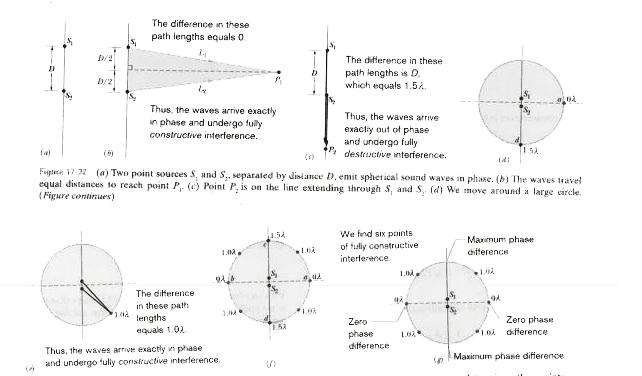 (c )STARTING at point a, let.s move CLOCKWISE along the circle to point d. As we move, path length difference `DeltaL`increases and so the type of interference changes. From (a), we know that is `Delta L = 0 lamda` at point a. From (b), we know that `Delta L = 1.5 lamda ` at point d. Thus, there must be one point between a and d at which `Delta L = lamda ` From Eq. , fully constructive interference occurs at that point. Also, there can be no other point along the way from point a to point d at which fully constructive interference occurs, because there is no other integer than 1 between 0 at point a and 1.5 at point d.We can now use symmetry to locate other points of fully constructive or destructive interference. Symmetry about LINE cd gives us point b, at which `Delta L = 0lamda ` . Also, there are three more points at which `Delta L = lamda` . In allwe have N = 6. |
|
| 49. |
Two weightless springs have force constants k_(1) and k_(2) and connected in series. The combination is loaded with m, the time period of oscillation is : |
|
Answer» `T=2pi SQRT((m)/(k_(1)+k_(2)))` `IMPLIES""T=2pi sqrt((m)/(k_(s)))` `T=2pi sqrt(m((1)/(k_(1))+(1)/(k_(2))))` So the CORRECT choice is (b). |
|
| 50. |
If in an A.C. L-C series circuit X_L gt X_C . Hence current ……. |
|
Answer» lags BEHIND the VOLTAGE by `pi/2` in phase |
|


