

Saved Bookmarks
This section includes 7 InterviewSolutions, each offering curated multiple-choice questions to sharpen your Current Affairs knowledge and support exam preparation. Choose a topic below to get started.
| 1. |
A point charge 50muC is located in the XY plane at the point of position vector vec(r_(0))=2hat(i)+3hat(j). What is the electric field at the point of position vector vec (r ) = 8 hat(i) - 5 hat(j) |
|
Answer» 1200 V/m |
|
| 2. |
Thermoelectricity refers to a phenomenon that occur at the junctions of dissimilar conductors or within a single conductor, when a temperature difference exists between the junctions or across a conductor. There are three thermogalvanic effects, namely Seebeck effect, Peltier effect and Thomson effect. They involve conversion of thermal energy into electrical energy or vica versa. They are all reversible in contrast with the Joule effect which is irrevesible. Seebeck effect is the superposition of Peltier effect and Thomson effect. In a thermocouple, if the two junctions are maintained at a potential difference, a temperature difference is established, i.e. heat is generated at one junction and absorbed at the other junction. This is called Peltier effect and its converse is the Seebeck effect. The relationship between the. thermo-emf across the junction and the temperature difference is parabolic. Which thermogalvnic effect takes place in a single conductor |
| Answer» Answer :D | |
| 3. |
Thermoelectricity refers to a phenomenon that occur at the junctions of dissimilar conductors or within a single conductor, when a temperature difference exists between the junctions or across a conductor. There are three thermogalvanic effects, namely Seebeck effect, Peltier effect and Thomson effect. They involve conversion of thermal energy into electrical energy or vica versa. They are all reversible in contrast with the Joule effect which is irrevesible. Seebeck effect is the superposition of Peltier effect and Thomson effect. In a thermocouple, if the two junctions are maintained at a potential difference, a temperature difference is established, i.e. heat is generated at one junction and absorbed at the other junction. This is called Peltier effect and its converse is the Seebeck effect. The relationship between the. thermo-emf across the junction and the temperature difference is parabolic. Magnitude of Seebeck emf between the junctions does not depend on |
|
Answer» thermocouple |
|
| 4. |
A body of mass 1 kg is tied to a string and revolved in a horizontal circle of radius 1 m. The maximum number of r.p.m made so that the string does not break is ? Breaking tension of the string is 9.86 N |
|
Answer» SOLUTION :`T=(mv^2)/R =mrw^2=mrxx4pi^2n^2` `THEREFORE n^2 = T/(4pi^2mr)=10/(4xx10xx1xx1)` `or n^2 = 1/4` or n=1/2 |
|
| 5. |
In a potentiometer experiment the balancing length with a cell is 560 cm. When an external resistance of 10 Omega is connected in parallel to the cell, the balancing length changes to 60 cm. The internal resistance of the cell is |
|
Answer» `3.6 OMEGA` |
|
| 6. |
Thermoelectricity refers to a phenomenon that occur at the junctions of dissimilar conductors or within a single conductor, when a temperature difference exists between the junctions or across a conductor. There are three thermogalvanic effects, namely Seebeck effect, Peltier effect and Thomson effect. They involve conversion of thermal energy into electrical energy or vica versa. They are all reversible in contrast with the Joule effect which is irrevesible. Seebeck effect is the superposition of Peltier effect and Thomson effect. In a thermocouple, if the two junctions are maintained at a potential difference, a temperature difference is established, i.e. heat is generated at one junction and absorbed at the other junction. This is called Peltier effect and its converse is the Seebeck effect. The relationship between the. thermo-emf across the junction and the temperature difference is parabolic. Which heat depends on the direction of current |
|
Answer» JOULE heat |
|
| 7. |
Two coherent monochromatic light beam of intensities I and 4I are supposed. What will be the maximum and minimum possible intensities. |
|
Answer» |
|
| 8. |
When is the couple acting on a bar magnet in a uniform magnetic field (i) maximum (ii) minimum. |
|
Answer» SOLUTION : i) If the magnet is at RIGHT angles to direction of the field the couple ACTING on a bar magnet is MAXIMUM. ii) If the magnet is parallel to the direction of the field, the couple acting on the bar magnet is MINIMUM. |
|
| 9. |
A galvanometer of resistance 200 ohm given full scale deflection with 10 milli ampere current .In order to convert it into a 10 volt range voltmeter, the value of resistance connected in series is: |
|
Answer» 800ohm |
|
| 10. |
A tokamak fusion test reactor works on |
|
Answer» bombardment of thermal neutrons with uranium-235 |
|
| 11. |
Two solid bodies rotate about stationary mutually perpendicular intersecting axes with constant angular velocities omega_1=3.0rad//s and omega_2=4.0rad//s. Find the angular velocity and angular acceleration of one body relative to the other. |
|
Answer» Solution :The angular velocity is a vector as infinitesimal rotation commute. Then the relative angular velocity of the body 1 with respect to the body 2 is clearly. `vecomega_(12)=vecomega_(1)-vecomega_2` as for relative linear velocity. The relative acceleration of 1 w.r.t. 2 is `((dvecomega_1)/(dt))_(s')` where S' is a frame corotating with the second body and S is a space fixed frame with ORIGIN COINCIDING with the point of INTERSECTION of the two axes, but `((dvecomega_1)/(dt))_s=((dvecomega_1)/(dt))_s+vecomega_2xxvecomega_1` SINCE S' rotates with angular with angular velocity `vecw_2`. However `((dvecomega_1)/(dt))_S=0` as the first body rotates with constant angular velocity in space, thus `vecbeta_(12)=vecomega_1xxvecomega_2`. Note that for any vector `vecb`, the relation in space forced frame `(k)` and a frame `(k^')` rotating with angular velocity `vecomega` is `(dvecb)/(dt):|:_K=(dvecb)/(dt):|_K+vecomegaxxvecb` |
|
| 12. |
An alternatinf e.m.f is applied to a seriescombination of L=2H, C=10muF and R=5Omega. For a particular value of the angular frequency of the applied e.m.f., the resonance is produced . Then the impedance z of the combination is : |
|
Answer» `20OMEGA` |
|
| 13. |
In the adjacent figure, the potential difference between A and B is |
|
Answer» 0 |
|
| 14. |
When the voltage drop across a p-n junction diode in increased from 0.70V to 0.71V the change in the diode current is 10mA. What is the dynamic resistance of the diode? |
|
Answer» |
|
| 15. |
The peak voltage in the output of a half wave dioderectifier fed with a sinusoidal signal without filter is 10V. The d.c. component of the output voltage is …….. |
|
Answer» `(20)/(PI)V` `V=(V_(0))/(pi)=(10)/(pi)V` |
|
| 16. |
Voltage and current in an ac circuit are given by V=5sin(100pit-(pi)/(6)) and I=4sin |
|
Answer» VOLTAGE leads the current by `30^(@)` |
|
| 17. |
Two circular coils, one of smaller radius r_(1) and the other of very large radius r_(2) are placed co-axially with centres coinciding. Obtain the mutal inductance of the arrangement. |
|
Answer» Solution :Suppose a current `I_(2)` flows through the outer circular coil. The field at the centre of the coil is `B_(2)= (mu_(0)I_(2))/(2r_(2))`  The second co-axially placed coil has very small radius. So `B_(2)` may be considered constant over its cross-sectional area Now, `phi_(1)= pi r_(1)^(2) B_(2)= pi r_(1)^(2) ((mu_(0)I_(2))/(2r_(2)))` or `phi_(1)= (mu_(0)pi r_(1)^(2))/(2r_(2)) I_(2)` Comparing with `PHI= M_(12)I_(2)`, we get `M_(12)= (mu_(0)pi r_(1)^(2))/(2r_(2))` Also, `M_(21)= M_(12)= (mu_(0)pi r_(1)^(2))/(2r_(2))` It WOULD havebeen difficult to calculate the flux through the bigger coil of the non-uniform field due to the current in the smaller coil and hence the mutual inductance `M_(12)`. The equality `M_(12)= M_(21)` is helpul. Note also that mutual inductance depends solely on the geometry. |
|
| 18. |
Read the following passage and answer question on the basis of your understanding of the following passage and the related studied concepts. Diamagnetic substances are those which have tendency to move from stronger to the weaker part of the external magnetic field and a magnet would repel a diamagnetic substance. When a bar of diamagnetic material is placed in an external magnetic field, the field lines are repelled or expelled and the field inside the material is slightly reduced. Each electron in an atom orbiting around nucleus is equivalent to a current carrying loop and thus possesses orbital angular moment. Diamagnetic substances are the ones in which resultant magnetic moment of all the electrons in an atom is zero. When a magnetic field is applied, those electrons having orbital magnetic moment in the same direction slow down and those in the opposite direction speed up due to induced current in accordance with lenz's law. Thus, the substance develops a net magnetic moment in a direction opposite to that of applied magnetic field and hence repulsion The most exotic diamagnetic materials are superconductors. These are metals cooled to very low temperatures and exhibit both perfect conductivity and perfect diamagnetism. This phenomenon was discovered by Meissner. Super conducting magnets can be exploited for running magnetically levitated bullet trains. Does diamagnetism depend on the temperature ? |
| Answer» SOLUTION :DIAMAGNETISM is INDEPENDENT of TEMPERATURE. | |
| 19. |
The frequency of the second overtone of the open pipe is equal to the frequency of the first overtone of the closed pipe. The ratio of the lengths of the open pipe and the closed pipe is : |
|
Answer» `2 : 1` `therefore` its frequency is `V_(0) = 3.(v)/(2l_(0))` First overtone of closed organ pipe is `3^(rd)` harmonic soits frequency is `v_(0) = 3 (v)/(4l_(c))` SINCE `v_(0) = v_(c) ` `therefore "" 3.(v)/(2l_(0)) = 3 (v)/(4l_(c))` `therefore "" (l_(0))/(l_(c)) = (2)/(l)`So correct choice is (a). |
|
| 20. |
The speed of an electromagnetic wave in a material medium of permeability mu and permittivity epsilon is |
|
Answer» a. `(1)/(mu EPSILON)` |
|
| 21. |
The electric field due to a dipole at a distnce r from its centre is proportional to |
|
Answer» `(1)/(R^(3.2))` |
|
| 22. |
A light body and heavy body have same linear momentum. Which one has greater KE? |
|
Answer» higher |
|
| 23. |
A liquid of higher refractive index forms a bubble inside water. What kind of lens does it act like? |
| Answer» Solution :It ACTS as a CONVEX LENS. This is because, the convex surfaces face the rarer medium. | |
| 24. |
A soap bubble enclosesair inside it |
|
Answer» the soap film consists of two surface layers of molecules back to back |
|
| 25. |
y=sin^(-1)x का प्रांतहै |
|
Answer» (-1,1) |
|
| 26. |
Two charges one +5 muC ,and another -5mu C,are placed 1 mm apart . Calculate the dipole moment. |
| Answer» Solution :Dipole moment `p=q.2a =(5mu C )(1MM)=5xx 10 ^(-6) C XX 10 ^(-3)m = 5xx 10^(-9)C-m` | |
| 27. |
Read the following passage and answer question on the basis of your understanding of the following passage and the related studied concepts. Diamagnetic substances are those which have tendency to move from stronger to the weaker part of the external magnetic field and a magnet would repel a diamagnetic substance. When a bar of diamagnetic material is placed in an external magnetic field, the field lines are repelled or expelled and the field inside the material is slightly reduced. Each electron in an atom orbiting around nucleus is equivalent to a current carrying loop and thus possesses orbital angular moment. Diamagnetic substances are the ones in which resultant magnetic moment of all the electrons in an atom is zero. When a magnetic field is applied, those electrons having orbital magnetic moment in the same direction slow down and those in the opposite direction speed up due to induced current in accordance with lenz's law. Thus, the substance develops a net magnetic moment in a direction opposite to that of applied magnetic field and hence repulsion The most exotic diamagnetic materials are superconductors. These are metals cooled to very low temperatures and exhibit both perfect conductivity and perfect diamagnetism. This phenomenon was discovered by Meissner. Super conducting magnets can be exploited for running magnetically levitated bullet trains. Give three examples of diamagnetic substances. |
| Answer» Solution :Some examples of DIAMAGNETIC substances are copper, bismuth, LEAD, water, mercury ETC. | |
| 28. |
Derive the expression for the intensity at a point where interference of light occurs. Arrive at the conditions for maximum and zero intensity, |
|
Answer» Solution :Let `y_(1) and y_(2)` be the displacements of the two waves having same amplitude a and `phi` is the PHASE difference between them. `y_(1) =a sin omegt....(1)` `y_(2)=a sin (omegat+phi)....(2)` The resultant displacement `y=y_(1)+y_(2)` `y=a sin omegat+a sin (omegat+phi)` `y=a sin omegat+a sin omegat cos phi+a cos omegat sin phi` `y=a sin omegat [1+cos phi]+cos omegat (a sin phi)`....(3) Let `R cos theta=a(1+cos phi).....(4)` `R sin phi=a sin phi ....(5)` `y=R sin omegat. cos theta+R cos omegat, sin OMEGA` `y=R sin (omegat+theta).....(6)` where R is the resultant amplitude at P, squaring equations (4) and (5), then adding `R^(2)[cos^(2) theta+sin^(2) theta]=a^(2) phi+2 cos phi+sin^(2)phi]` `R^(2)[1]=a^(2)[1+1+2 cos phi]` `I=R^(2)=2a^(2)[1+cos phi]=2a^(2)xx2cos^(2) (phi)/(2), I=4a^(2) cos^(2) (phi)/(2)` ......(7) (i) Minimum intensity `(I_(max))` `cos^(2) (phi)/(2)=1` `phi=2npi, "Where "n=0,1,2,3,......` `phi=0,2pi,4pi,6pi` `THEREFORE I_(max)=4a^(2)` (ii) Minimum intensity `(I_(min))` `cos^(2) (theta)/(2)=0` `phi=(2n+1)pi" where "n=0,1,2,3,......` `phi=pi,3pi,5pi,7pi......` `I_(min)=0`. 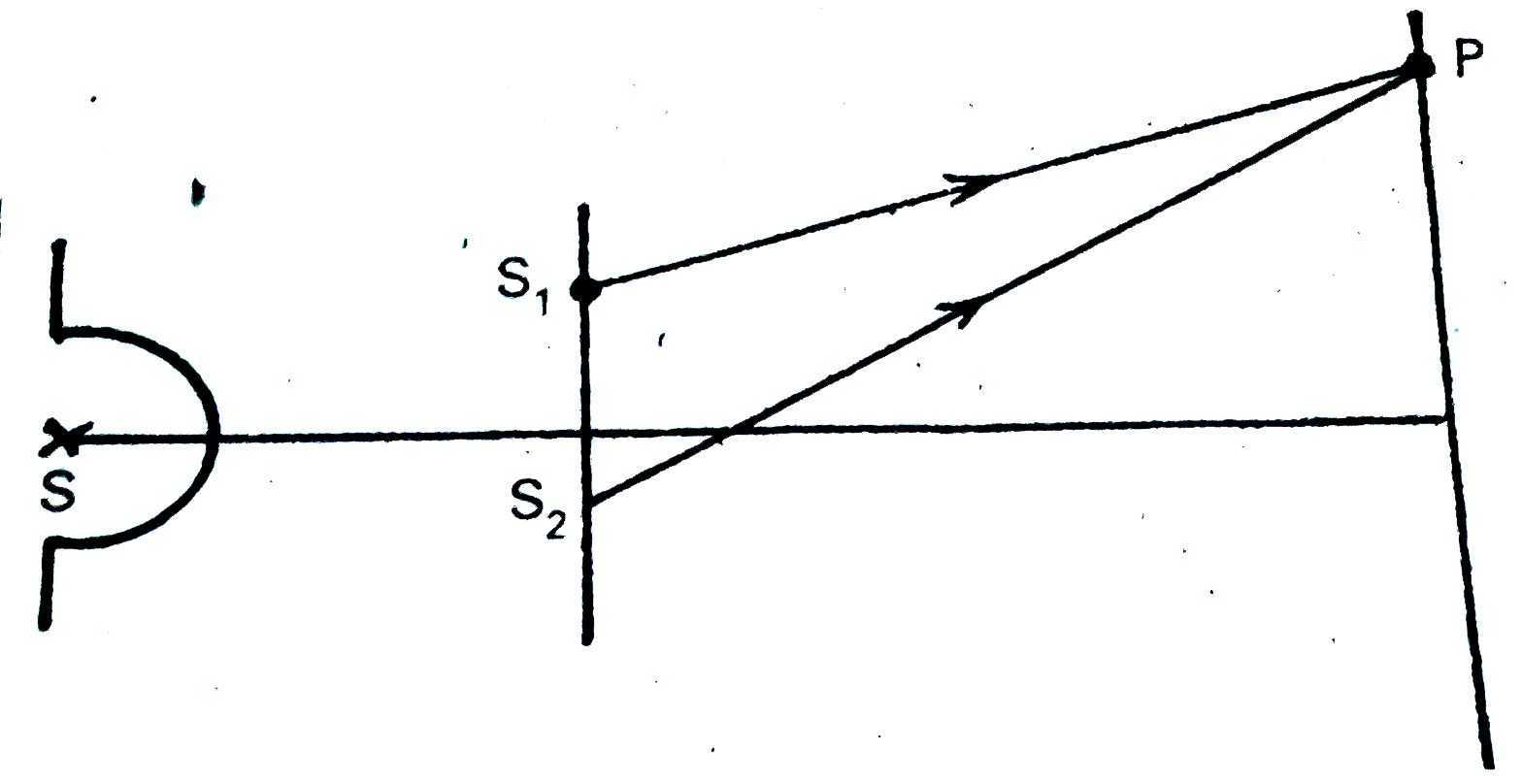
|
|
| 29. |
Calculate the resonant frequency and Q-factor of a series L-C-R circuit containing a pure inductor of inductance 3H, capacitor of capacitance 27muF and resistor of resistance 7.4Omega |
|
Answer» Solution :Here , L = 3H , `C = 27muF, = 7.4 Omega ,Q = ? , f_(r) = ? ` `f_(r)=1/(2pisqrt(LC))=1/(2xx3.14 sqrt(3xx27xx10^(-6)))` `f_(r) = 0.01768xx10^(3)Hz` or `f_(r) = 17.68 Hz` QUALITY FACTOR is GIVEN by `Q = 1/Rsqrt(L/C)` `=1/(7.4) sqrt(3/(27xx10^(-6))` `= 0.0450 xx10^(3)` Q = 45 |
|
| 30. |
Define resistivity of a conductor. Plot a graph showing the variation of resistivity with temperature for a metallic conductor. How does one explain such a behaviour, using the mathematical expression of the resistivity of a material |
|
Answer» Solution :We know that,`R=p 1/A`, IF Thus, resistivity of a material is numerically equal to the resistance of the conductor having unit length and unit cross-sectional area The resistivity of a material is found to be dependent on the temperature. Different materials do not EXHIBIT the same DEPENDENCE on temperatures. Over a limited RANGE of temperatures, that is not too large, the resistivity of a metallic conductor is approximately given by, .`P_T=p_0[1+a(T-T_0)]` ...........(i) Where `p_T`is the resistivity at a temperature T and`p_0` is the same at a reference temperature`T_0`is CALLED the temperature co-efficient of resistivity. The relation of equation (i) implies that a graph of`p_T`plotted against T would be a straight line. At temperatures much lower than `0^@C`, the graph, however, deviates considerably from a straight line (fig.)Resistivity `p_T`of metallic conductor as a FUNCTION of temperature T. 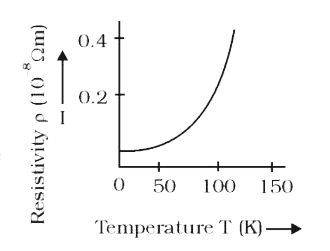
|
|
| 31. |
In an A.C. circuit, a resistor of ROmega is connected in series with an inductor of self inductance L. If phase angle between voltage and current be45^@, the value of inductance (X_L) will equal to ……….. |
|
Answer» R `THEREFORE tan 45^@ = (omegaL)/R` `therefore 1 xx R = X_L` `therefore X_L=R` |
|
| 32. |
In a diffraction pattern due to a single-slit, the angular size of the central maximum increases on decreasing the slit width. |
|
Answer» SOLUTION :True-Angular WIDTH of central MAXIMA`=2theta=(2lamda)/(a)`. So on DECREASING the SLIT width .a. the width of central maxima increases. |
|
| 33. |
A 120 m long train is moving towards west at a speed of 10ms^(-1).A small bird flying towards east at a speed of 5ms^(-1) crosses the train. What is time taken by the bird to cross the train : |
|
Answer» 4 s `:. t=(120)/(15)=8S` |
|
| 34. |
A uniform electric and magnetic fields are produced pointing in the same direction. An electron is projected pointing in the same direction |
|
Answer» the ELECTRON TURNS to RIGHT |
|
| 35. |
Read the following passage and answer question on the basis of your understanding of the following passage and the related studied concepts. Diamagnetic substances are those which have tendency to move from stronger to the weaker part of the external magnetic field and a magnet would repel a diamagnetic substance. When a bar of diamagnetic material is placed in an external magnetic field, the field lines are repelled or expelled and the field inside the material is slightly reduced. Each electron in an atom orbiting around nucleus is equivalent to a current carrying loop and thus possesses orbital angular moment. Diamagnetic substances are the ones in which resultant magnetic moment of all the electrons in an atom is zero. When a magnetic field is applied, those electrons having orbital magnetic moment in the same direction slow down and those in the opposite direction speed up due to induced current in accordance with lenz's law. Thus, the substance develops a net magnetic moment in a direction opposite to that of applied magnetic field and hence repulsion The most exotic diamagnetic materials are superconductors. These are metals cooled to very low temperatures and exhibit both perfect conductivity and perfect diamagnetism. This phenomenon was discovered by Meissner. Super conducting magnets can be exploited for running magnetically levitated bullet trains. What should be the value of magnetic susceptibility and relative magnetic permeability of a superconductor ? |
| Answer» SOLUTION :Magnetic susceptibility of a SUPERCONDUCTOR material is - 1 `(X = -1)` and its relative magnetic permeability is zero `(mu_r =0)` because it exhibits perfect diamagnetic. | |
| 36. |
The length of a cylinder is measured as 5 cm using a vernier calipers of least count 0.1 mm. The percentage error is |
|
Answer» 0.005 |
|
| 37. |
Does the appearance of bright and dark fringes in the interference pattern violate, in any way, conservation of energy ? Explain. |
| Answer» SOLUTION :The convervation law of energy holds good for the PHENOMENON of interference as well diffraction. Due to interference or diffraction we obtain maxima and MINIMA intensities at different points. From points of minima intensity the energy has been shifted to the points of maximum intensity. THUS, there is a redistribution of energy but total energy must remain conserved. the energy lost at minimas exactly reappears at diffraction maximas and the total energy remains UNCHANGED. | |
| 38. |
Read the following passage and answer question on the basis of your understanding of the following passage and the related studied concepts. Diamagnetic substances are those which have tendency to move from stronger to the weaker part of the external magnetic field and a magnet would repel a diamagnetic substance. When a bar of diamagnetic material is placed in an external magnetic field, the field lines are repelled or expelled and the field inside the material is slightly reduced. Each electron in an atom orbiting around nucleus is equivalent to a current carrying loop and thus possesses orbital angular moment. Diamagnetic substances are the ones in which resultant magnetic moment of all the electrons in an atom is zero. When a magnetic field is applied, those electrons having orbital magnetic moment in the same direction slow down and those in the opposite direction speed up due to induced current in accordance with lenz's law. Thus, the substance develops a net magnetic moment in a direction opposite to that of applied magnetic field and hence repulsion The most exotic diamagnetic materials are superconductors. These are metals cooled to very low temperatures and exhibit both perfect conductivity and perfect diamagnetism. This phenomenon was discovered by Meissner. Super conducting magnets can be exploited for running magnetically levitated bullet trains. Show modification of field lines when a bar of diamagnetic substance is placed in a magnetic field. |
Answer» Solution :MODIFICATION of FIELD lines in a BAR of diamagnetic material is SHOWN here fig. 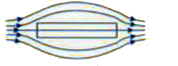
|
|
| 40. |
Read the following passage and answer question on the basis of your understanding of the following passage and the related studied concepts. Diamagnetic substances are those which have tendency to move from stronger to the weaker part of the external magnetic field and a magnet would repel a diamagnetic substance. When a bar of diamagnetic material is placed in an external magnetic field, the field lines are repelled or expelled and the field inside the material is slightly reduced. Each electron in an atom orbiting around nucleus is equivalent to a current carrying loop and thus possesses orbital angular moment. Diamagnetic substances are the ones in which resultant magnetic moment of all the electrons in an atom is zero. When a magnetic field is applied, those electrons having orbital magnetic moment in the same direction slow down and those in the opposite direction speed up due to induced current in accordance with lenz's law. Thus, the substance develops a net magnetic moment in a direction opposite to that of applied magnetic field and hence repulsion The most exotic diamagnetic materials are superconductors. These are metals cooled to very low temperatures and exhibit both perfect conductivity and perfect diamagnetism. This phenomenon was discovered by Meissner. Super conducting magnets can be exploited for running magnetically levitated bullet trains. What is Meissner effect? |
| Answer» SOLUTION :MEISSNER effect is the PHENOMENON of perfect DIAMAGNETISM exhibited by superconductor materials. | |
| 41. |
Explain briefly the following terms used in communication system : (i) Transducer (ii) Repeater (iii) Amplification |
|
Answer» Solution :(i) Transducer : Any device that converts one FORM of energy into another can be termed as a transducer. An electrical transducer may be defined as a device that converts some physical variable in the electrical SIGNALS. (II) Repeater : A repeater is a combination of a receiver and a transmitter. A repeater picks up the signal from the transmitter, AMPLIFIES and retransmits it to the receivers sometimes with a change in carrier frequency. (iii) Amplification : It is the process of increasing the amplitude of a signal using an electronic circuit called the amplifier. Amplification is done at a place between the source and the DESTINATION. |
|
| 42. |
One insulated metal sphere is charged to a potential of 3xx10^(5) Volts. What should be the radius of the sphere so that it may cause breakdown in air? Dielectric strength of air is 3xx10^(6)V//m. |
|
Answer» Solution :Electric FIELD intensity and electric potential at the surface of the metallic sphere of radius r and charge Q can be written as follows: `E=(1)/(4pi epsilon_(0)) *(q)/(r^(2)) "" …(i)` `V=(1)/(4pi epsilon_(0)) *(q)/(r )""...(ii)` So DIVIDING (i) by (ii), we get `(E )/(V)=(1)/(r ) rArr r=(V)/(E ) ""...(iii)` For BREAKDOWN in air, electric field intensity at the surface must be equal to dielectric STRENGTH of the air. `therefore E =` Dielectric strength `=3xx10^(6)V//m` Given, `V=3xx10^(5)V` `therefore` From (iii), `r=(3xx10^(5))/(3xx10^(6))=0.1m` |
|
| 43. |
The graph between resistivity and temperature for a limited range of temperature is a straight line for a meterial like |
|
Answer» copper |
|
| 44. |
a. State the law of distances . b.Using the law deduce that an object between F and 2F a concave mirror produces real image beyond 2F. |
|
Answer» Solution :a. `(1)/(V) + (1)/(u) = (1)/(f)` u - Object distance v - image distance f - FOCAL LENGTH b.For concave mirror, f `lt ` 0 Fro object, u `lt ` 0 For 2f `lt u lt f, ` we get `(1)/(2f) lt (1)/(u) lt (1)/(f) "" i.e.,- (1)/(2f)lt - (1)/(u) lt - (1)/(f) ` `(1)/(f) - (1)/(2f) lt (1)/(f) - (1)/(u) lt (1)/(f) - (1)/(f) ` `(2- f)/(2f) lt (1)/(v) lt 0 "" [ "SINCE" (1)/(v) = (1)/(f) - (1)/(u) ]` i.e,`(1)/(2f) lt (1)/(v) lt 0 `i.e., image lies on the left, beyond 2F and it is real. |
|
| 45. |
3.0 mw and and 400 nm light is incident on a photoelectric eell. If 0.1% of the photons are contributing in ejection of electrons,then the current in the cell is : |
|
Answer» `0.48 MU A` |
|
| 46. |
If the total electromagnetic energy falling on a surface is U, then the total momentum delivered (for complete absorption) is |
|
Answer» a. `(U)/(c )` |
|
| 47. |
The surface energy of a liquid drop is 20J. It is sprayed into 1000 identical drops. The total surface energy will be |
|
Answer» 1000 J |
|
| 48. |
The figure shows the interference pattern obtained in a double-slit experiment using light of wavelength 600 nm. Which fringe is the same distance from both slits? |
|
Answer» A |
|
| 49. |
The ground state energy of hydrogen atom is -13.6 eV. What are the kinetic and potential energies of the electron in this state ? |
| Answer» SOLUTION :K.E =- (T.E), P.E. =2T.E | |