

Saved Bookmarks
This section includes 7 InterviewSolutions, each offering curated multiple-choice questions to sharpen your Current Affairs knowledge and support exam preparation. Choose a topic below to get started.
| 1. |
Two cells, having emfs of 10 V and 8 V, respectively, are connected in series with a resistance of 24Omega. in the external circuit. If the internal resistances of each of these cells in ohm are 200% of the value of their emi's, respectively, find the terminal potential difference across 8 V battery |
| Answer» SOLUTION :.` 0.3 A, 3.2 V` | |
| 2. |
An electric dipole of moment p is placed in a uniform electric field E. Then (i) the torque on the dipole is p xx E, (ii) the potential energy of the system is p.E, (iii) the resultant force on the dipole is zero |
|
Answer» (i), (II) and (III) are CORRECT |
|
| 3. |
Unpolarised light of intensity I passes through an ideal polariser A. Another identical polariser B is placed behind A. The intensity of light beyond B is found to be I/2. Now another identical poariser C is placed between A and B. The intensity beyond B is now found to be I/8. The angle between polariser A and C is : |
Answer» Solution :When unpolarised light is passed through a polariser then intensity of light becomes half. Here intensity of light is `I//2` after passing through both the polarisers A and B hence axis of both of these polarisers must be PARALLEL to each other. 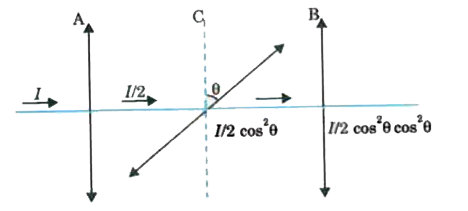 Let axis of polariser C be placed at an angle `theta` will A, then its angle with that of B will ALSO be `theta`. Let `I_0` be the intensity of unpolarised light. Intensity of light coming out from POLAROID A : `I = (I_0)/2` Intensity of light coming out from Polaroid C is `I. = (I_0)/2 cos^2 theta` Intensity of light coming out from Polaroid B : `I.. = (I_0)/2 cos^2 theta cos^2 theta` Given, `I.. = I_0//8 implies I.. = (I_0)/2 cos^2 theta = (I_0)/8` `implies cos theta = 1/(sqrt(2)) implies theta = 45^@` |
|
| 4. |
The gravitational unit of what( kg-m)equal to |
|
Answer» `9.8`NEWTON |
|
| 5. |
Sun glasses which have curved surfaces do not have power. Why? |
|
Answer» <P> SOLUTION :The outer and inner surfaces of sun glass are PARELLEL, i.e., they posses same radius of curvature.`1/f=(n-1)(1/R_1-1/R_2)=P`. Here `R_1=R_2=R``thereforeP=0` |
|
| 6. |
sqrt10xxsqrt5का मान है - |
|
Answer» `5sqrt6` |
|
| 7. |
A charge q is circulating with a constant speed v in a semicircular loop of wire of radius R. The magnetic moment of this loop is |
|
Answer» QVR `t="distance"/"velocity" = (R(pi+2))/v` and the current in the loop `I = q/t=(qv)/(R(pi+2))` Area of the loop `(A) = (piR^(2))/2` `therefore` Magnetic moment `M = IA = (qv)/(R(pi+2))xx(piR^(2))/2=(piRqv)/(2(pi+2))` 
|
|
| 8. |
A bullet fired into a fixed target loses half of its velocity after penetrating 3 cm. How much further it will penetrate before coming to rest assuming that it faces constant resistance to motion ? |
|
Answer» 3.0 CM `DELTAK`= work done against f. `1/2m[v^2-(v^2)/(4)]=fxx3` `1/2m[(v^2)/(4)-0]=fxx x` Dividing `([1-1/4])/(1/4)=3/x` or x=1 cm. |
|
| 9. |
92 fringes are obtained in the definite distance R on screen by Young's double slit experiment using sodium light of (lambda = 5898Å). If (lambda=5461Å) is used, how many fringes will be obtained in the same distance ? |
|
Answer» 62 Now `R=n_(1)barx_(1)=n_(2)barx_(2)` `:. (barx_(2))/(x_(2))=(n_(2))/(n_(1))`and by Young.s experiment `barx_(1) prop lambda_(1) and barx_(2) prop lambda_(2)` `:. (barx_(1))/(barx_(2))=(lambda_(1))/(lambda_(2))` `:. n_(2)=n_(1)xx(lambda_(1))/(lambda_(2))=92xx(5898)/(5481)` `:. n_(2)=99` |
|
| 11. |
A magnetic field directed into the page changes with time according to the expression B = (0.03t^(2) + 1.4)T, where t is in seconds. The field has a circular cross-section of radius R= 2.5cm. What is the magnitude and direction of electric field at P, when t= 3.0s and r= 0.02m |
|
Answer» Solution :`e= oint E.dl =(+d PHI)/(dt)` `E (2pi R)= A.(dB)/(dt)= PI r^(2) xx (d)/(dt) (0.03t^(2) + 1.4)` `E= (pi r^(2))/(2pi r) xx (0.06t) = (r )/(2) (0.06t)` `|E|= (0.02)/(2) xx 0.06 xx 3 = 18 xx 10^(-4) N`/columns |
|
| 12. |
The variation of the stopping potential (V_0) with the frequency (v) of the light incident on two different photosensitive surfaces M_1 and M_2 is shown in the figure. Identify the surfaces which has greater value of the work function. |
|
Answer» |
|
| 13. |
Identify the pair whose dimensions are equal : |
|
Answer» TORQUE and work Hence `(a)` is the right choice. |
|
| 14. |
Which ofthe following equations, pick out the possible nuclear fusion reactions? |
|
Answer» `._6^13C +._1^1H to ._6^14C` +4.3MeV |
|
| 15. |
Two coherent sources are 0.18 mm apart and the fringes are observed on a screen 80cm away. It is found that with a certain monochromatic source of light, the fourth bright fringe is situated at a distance of 10.8 mm from the central fringe. Calculate the wavelength of light. |
|
Answer» Solution : The distance of the nth fringe from the central fringe is `y =(n lamda D)/(d)` It is GIVEN that D = 80cm, d = 0.18mm=0.018cm, y = 10.8mm = 1.08 CM and n=4. ` therefore lamda = (YD)/(nD) = (1.08 xx 0.018)/(4 xx 80) = 6075 xx 10^(-8) cm = 6075Å` |
|
| 16. |
Find the (a)Maximm frequency,and (b)Minimum wavelength of X-rays produced by 30 kV electrons. |
|
Answer» Solution :Here V=30 KV=`3XX10^(4)` V,H=`6.63xx10^(-34)` Js (a) [maximum K.E of photon of X-ray]=[Maximum K.E. of electron accelerated with volt V] `therefore hv_(max)=eV` `therefore v_(max)=(eV)/(h)` `=(1.6xx10^(-19)xx3xx10^(4))/(6.63xx10^(-34))` `0.72398xx10^(19)Hz` `therefore v_(max)7.24xx10^(18)Hz` (b) Now, `C=V_(max)xxlambda_(min)` `therefore lambda_(min)=(c)/(v_(max))` `=(3xx10^(8))/(7.24xx10^(18))` `=0.41436xx10^(-10)m=0.0414` NM |
|
| 17. |
Calculate the charge on equivalent capacitance of the combination shown in figure between the points P and N. |
| Answer» Answer :A | |
| 18. |
A box of mass 8-Kg is placed on a rough inclined plane of inclination theta.Its downward motion can be prevented by applying an upward pull F. And it can be made to slide upwards by applying a force 2F. The coefficient of friction between the box and inclined plane is |
|
Answer» `1/3 TAN THETA` |
|
| 19. |
A transverse wave in a medium is described by the equationy = A sin 2(omegat - kx) . The magntiude of the maximum velocity of particles in the medium is equalthat of theof the wave velocity . If the value of A is |
|
Answer» ` lambda/(2pi)` Velocityof the particle= ` (dy)/(dt) = 2 A omegacos 2 (omegat - kx) ` Maximumvelocity` = 2 A OMEGA` Velocityof the wave = ` ("COEFFICIENT of t ")/( "Coefficient of x ") = (2 Omega)/(2kg) = Omega/k` As per QUESTION ` 2 A omega = omega/k or 2A = 1/k = lamda/(2pi) RightarrowA = lamda/(4pi)` |
|
| 20. |
A monochromatic light is travelling in a medium of refractive index n = 1.6. It enters a stack of glass layers from the bottom side at an angle theta = 30^(@). The interfaces of the glass layers are parallel to each other. The refractive indices of different glass layers are monotonically decreasing as n_(m)=nmDeltan, where n_(m) is the refractive index of the m^(th) slab and Deltan = 0.1 (see the figure). The ray is refracted out parallel to the interface between the (m – 1)^(th) and m^(th) slabs from the right side of the stack. What is the value of m ? |
|
Answer» `1.6 sin theta = n - m Delta n` `1.6 XX (1)/(2) = 1.6 - m(0.1)` `m xx 0.1 = 0.8` m = 8 MATHEMATICALLY answer is 8, but this value of refractive index is physically impossible. |
|
| 21. |
Two particles of equal mass m and charge t are placed at a distance 16 cm. They do no experience any force. The value of q/m is…….. |
|
Answer» 1 `(Gm^(2))/(16 xx 10^(-2))^(2) = (KQ^(2))/(16 xx 10^(-2))^(2)` `THEREFORE q/m = sqrt(G/K) = sqrt(4piepsilon_(0)G) [therefore k =1/(4piepsilon_(0))]` |
|
| 22. |
Obtain the expression for the energy stored per unit volume in a charged capacitor. |
|
Answer» Solution :Energy stored PER unit volume is KNOWN as energy density. The energy stored in capacitor, `U=(1)/(2)(Q^(2))/(C)` `=(1)/(2)((sigmaA)^(2))/(1)XX(d)/(in_(0)A)` where Q = `sigmaA` and `C=(in_(0)A)/(d)` `=(sigma^(2)Ad)/(in_(0))` but `(sigma)/(in_(0))=E` `U=(1)/(2) E^(2)in_(0)xxAd` But Ad is the volume of the region between the plates. `:. (U)/(Ad)=(1)/(2) in_(0)E^(2)` is a energy per unit volume . It is denoted by `rho_(E)` or u . `:. ` Energy per unit volume `rho_(E)=(1)/(2) epsilon_(0)E^(2)` |
|
| 23. |
A moving coil Galvanometer 'A' has 100 turns & resistance 502. Another M.C.G. 'B' has number of turns 500 and resistance 200 Omega other quantities are same in both cases. They are connected by a battery of 50 Omega . The ratio of deflection of B to A is |
|
Answer» 5 |
|
| 24. |
Radius of curvature of convex mirror is 40 cm and the size of the object is twice as the of the image .Then Image distant is : |
| Answer» Answer :A | |
| 25. |
A particle is moving three times as fast as an electron. The ratio of the de Broglie wavelength of the particle to that of the electron is 1.813xx10^(-4). Calculate the particle's mass and identifythe particle. |
|
Answer» Solution :de Broglie wavelength of a moving particle, having MASS m and velocity v : `lambda=(h)/(p)=(h)/(mv)` Mass, `m=h//lambda v` For an electron, mass `=h//lambda_(e ) v_(e )` Now, we have `m_(e )v//v_(e )=3` and `lambda/lambda_(e )=1.813xx10^(-4)` Then, mass of the particle, `m= me((lambda_(e ))/(lambda))((upsilon_(e ))/(UPSILON))` `m=(9.11xx10^(-31)KG)xx(1//3)xx(1//1.813xx10^(-4))` `m=1.675xx10^(-27)kg`. Thus, the particle, with this mass COULD be a proton or a NEUTRON. |
|
| 26. |
(A) : If an electron is not deflected while passing through a certain region of space, then only possibility is that there is no magnetic field in this region (R) : Force on an electron moving in a magnetic field is inversely proportional to the magnetic field applied. |
|
Answer» Both 'A' and 'R' are true and 'R' is the CORRECT EXPLANATION of 'A'. |
|
| 27. |
A spherical planet has a mass M_(p) and diameter D_(p). A particle of mass m falling freely near the surface of this planet will experience an acceleration due to gravity, equal to : |
|
Answer» `6GM_(p)m//D_(p)^(2)` THUS CORRECT choice is (B). |
|
| 28. |
A car covers (1)/(3)part of total distance with a speed of 20 km h^(-1) and second 1 /3and the last part with a speed of 60 km h^(1) The average speed of the car is: |
|
Answer» 55 km `h^(-1)` gives `v_(av) =30 km h^(-1)` |
|
| 29. |
The resultant of two forces 1 and Pis perpendi cular to 'l' and equal to 1. What is the value of 'P' and angle between |
|
Answer» `sqrt(2),N, 135^(@)` |
|
| 30. |
When an ideal capacitor is charged by a d.c. battery, no current flows. However, when an ac source is used, the current flows continously. How does one explain this, based on the concept of displacement current ? |
|
Answer» Solution :When an ideal CAPACITOR is charged by a d.c. battery, charge flows (momentarily) till the capacitor gets fully charged. When an a.c. source is connected then CONDUCTION current `i_c =(dq)/(dt)`keeps on flowing dt in the connecting wires. Due to changing current, charge deposited on the plates of the capacitor changes with time. This causes CHANGE in electric field between the plates of the capacitor which causes the electric flux to change and gives rise to a displacement current in the REGION between the plates of the capacitor. Displacement current i, is given by `i_d = epsi_0 = (dq_E)/(dt)` and is equal to the conduction current at all instants. |
|
| 31. |
(A) : If an electron is not deflected while passing through a certain region of space, then only possibility is that there is no magnetic field in this region. (R) : Magnetic force on a charged particle is directly proportional to specific charge of particle. |
|
Answer» Both 'A' and 'R' are TRUE and 'R' is the CORRECT EXPLANATION of 'A'. |
|
| 32. |
An alpha-nucleus of energy (1)/(2)mv^(2) bombards a heavy nuclear target of charge Ze. Then the distance of closest approach for the O-nucleus will be proportional to ...... |
|
Answer» `(Ze)^(-1)` `:.r_(0)PROP(1)/(m)` [All other terms are CONSTANT] |
|
| 33. |
The velocity-time plot for a particle moving on a straight line is shown in the figure (a) The particle has a constant acceleration. (b) The particle has never turned around. (c) The particle has zero displacement. (d) The average speed in the interval 0 to 10s is the same as the average speed in the in terval 10 s to 20 s |
|
Answer» a & b are CORRECT |
|
| 34. |
On the basis of magnetic properties the substance are classified into three a. What are these three classifications ? b. Explain each of them c. Give there examples for each . |
|
Answer» Solution :a. On the basis of magnetic properties, different materials are classified into i. DIAMAGNETIC substance, ii Paramagnetic substance and iii. Ferromagnetic substances. b. On the basis of magnetic properties , different materials and iii. Ferromagnetic substance . clue or ion does not posses any net magnetic moment of their own. These substances experience a very weak repulsive force in a magnetic field. e.g. Antimony , Bismuth, Copper , GOLD, Quartz, Mercury , Lead Water, Alcohol , Air, Hydrogen etc. Paramagnetic substances are those substances in which the individual ATOM or molecule or ion possesses a net NON - zero magnetic moment of their own. These substances experience a wea k attractive fore in a magnetic field. e.g. Alminium , Platinum , CHROMIUM , Manganese , Sodium , Copper chloride ,Crown glass , Liquid oxygen , Salt solutions of iron and nickel. Ferromagnetic substances are those substances in which each individual atom or molecule or ion possesses a non - zero magnetic moment . These substance experience a very strong force of attraction in a magnetic field . e.g. Iron, Nickel, Cobalt etc. c. Refer above |
|
| 35. |
In a single slit diffraction experiment first minimumfor lambda_(1) = 660 nm coincides with first maxima for wavelength lambda_(2) . Then lambda_(2) is |
| Answer» ANSWER :B | |
| 36. |
The maximum amplitude of an amplitude wave is found to be 15V while its minimum amplitude is found to be 3V. The modulation index is |
|
Answer» `FRAC{3}{2}` |
|
| 37. |
Vehicles carrying inflammable material usually have metallic ropes touching the ground during motion. Why? |
| Answer» Solution :MOVING vehicles get charged DUE to FRICTION. This will produce sparking and the inflammable material may catch fire. To avoid this METALLIC chains are used. Through these chains the charges are transferred to the EARTH. | |
| 38. |
A charge of Q coulomb is placed on a solid piece of metal of irregular shape. The charge will distribute itself |
|
Answer» UNIFORMLY in the metal object |
|
| 39. |
Explain with the help of a circuit diagram, the working of ap-n junction diode as a half-wave rectifier. |
Answer» Solution :A labelled circuit diagram of a half-wave rectifier is shown in . As the supply voltage is alternating one, hence the voltage supplied by the secondary of the transformer across terminals A and B is also alternating. When the voltage at A is positive, the diode is forward biased andit conducts. When A is NEGATIVE, the diode is reverse biased and it does not conduct. THEREFORE, in the positive half-cycle of a.c. there is a current through the load resistor Rs and we get an output voltage. But during negative half-cycle of a.c. there is no current and hence no output voltage. THUS, the output voltage is restricted to one direction only and is rectified. Since the rectified output of the circuit is only for half of the input a.c. wave, it is called as "half-wave rectifier". The input and output WAVEFORMS have been shown in . 
|
|
| 40. |
A ray of light entering from air to glass (mu = 1.5) is partly reflected and partly refracted. If the reflected and refracted rays are at right angles to each other, the angle of refraction is |
|
Answer» `SIN^(-1) (SQRT(2/13))` |
|
| 41. |
The electrical potential at a certain distance from a point charge is 600V the electric field is 200N//C. The distance of the point charge is….m. |
|
Answer» 2 `THEREFORE E=V/r` `r=V/E=600/200=3` |
|
| 42. |
A parallel plate capacitor is made of two circular plates separated by a distance of 5mm and with a dieclectric of dielectric constant 2.2 between them. When the electric field in the dielectric is 3 xx 10^4V/m, the charge density of the positive plate will be close to |
|
Answer» `6 XX 10^(-7)C //m^2` |
|
| 43. |
Determine the current in each branch of the network shown in Fig. |
|
Answer» SOLUTION :As per Kirchhoff.s first rule the distribution of current in various branches is shown in Fig. Now applying Kirchhoff.s SECOND law to mesh ABDA, we have ` - 10.I_1 - 5.I_2 + 5.(I - I_1) = 0` or` + 5I - 15I_1 - 5I_2 = `...(i) Again for mesh BDCB , we have ` - 5.I_2 - 10.(I - I_1 + I_2) + 5.(I_1 - I_2) = 0` or`-10 I + 15I_1 - 20I_2 = 0`...(ii) and for mesh ABCEA , we have ` - 10 . I_1 - 5.(I_1 - I_2) - 10.I + 10 = 0` or`10I + 15I_1 - 5I_2 = 10`....(iii) Solving these three equations , we FIND that `I =10/17 , I_1 = 4/17 A and I_2 = -2/17A` Hence , electric current in branch `AB , I_1 = 4/17`A, in branch `AD, (I - I_1) = 6/17 A` , in branch BD , `I_2 = -2/17A` , in branch BC , `(I_1 -I_2) = 6/17 A,` in branch `DC,(I - I_1 + I_2) = 4/17A` and the total current drawn from battery `I = 10/17 A` |
|
| 44. |
Whether charge is quantized or not ? |
| Answer» SOLUTION :Quantised | |
| 45. |
The farad. |
| Answer» Solution :The CAPACITANCE of an isolated conductor is SAID to be one farad if a CHARGE of one coulomb is requird to increase its potential by one VOLT . | |
| 46. |
Assertion : Electron capture occurs more often than positron emission in heavy elements. Reason : Heavy elements exhibit radio activity. |
|
Answer» ASSERTION and REASON are CORRECT and Reason is the correct explanation of Assertion. |
|
| 47. |
For an AC given by I = 50cos(100 t + 45^@)A. The value of rms = ..... A. |
|
Answer» `50sqrt2` `I_m`=50 A `therefore I_(RMS)=I_m/sqrt2=50/sqrt2=25sqrt2` A |
|
| 48. |
The ratio of angular momentum of the electron in the first allowed orbit to that in the second allowed orbit of hydrogen atom is : |
|
Answer» `SQRT(2)` |
|
| 49. |
The magnetic lines of force inside a bar magnet |
|
Answer» are from south POLE to north pole of the magnet |
|
| 50. |
twevle cells , each having emf E volt are connected in series ans are kept in a closed box. Some of these cells are wrongly connected with positive and negative terminals reversed . This 12 cell battery is connected In series with an ammeter , an external resistance R ohms adn a two -cell battery (two cells of the same type used earlier , connectedperfectly in sesries) . The current in the circuit when the 12 cell battery oppose each other Then , the number of cellsij 12 - cells battery that are connected wrongly is |
|
Answer» Solution :`R=(PL)/(A)` `L= (RA)/(P) = (4xxpixx(1.4xx10^(-3))^2)/(2.2xx10^(-8)xx4` = 280m |
|