Saved Bookmarks
This section includes 7 InterviewSolutions, each offering curated multiple-choice questions to sharpen your Current Affairs knowledge and support exam preparation. Choose a topic below to get started.
| 1. |
Which is only vector quantity out of the following |
|
Answer» CURRENT FOLLOWING in a metal |
|
| 2. |
A radioactive isotope is being produced at a constant rate dN/dt = R in an experiment. The isotope has half-life t_(1//2)Show that after a time t gt gt t_(1//2)the number of active nuclei will become constant. Find the value of this constant. |
|
Answer» |
|
| 3. |
Transistor is a |
|
Answer» current operated DEVICE |
|
| 4. |
For a plane electromagnetic wave propagating along + Y axis, magnetic field is,B_(x)=8xx10^(-6)sin{(3xx10^(8))t-(0.4xx10^(3))y}hat(i)T.Find periodic time, wave no and write equation of corresponding electric field. |
| Answer» Solution :`T=2.093xx10^(-8)s, (1)/(LAMBDA)=63.69m^(-1), vec(E )=vec(E)_(Z)=2400 sin {(3xx10^(8))t-(0.4xx10^(3))}hat(k)Vm^(-1)` | |
| 5. |
From which layer of atmosphere, radio waves are reflected back ? |
| Answer» SOLUTION :IONOSPHERE. | |
| 6. |
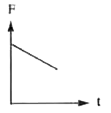
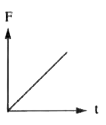
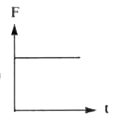
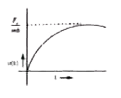
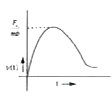
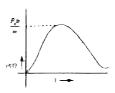
The linear momentum of a particle varies with time as p = a_0 +at+bt^2. Which of the following graph represents force and time relation ? |
|
Answer»
|
|
| 7. |
Consider figure for photoemission. How would you reconcile with momentum-conservation ?Note light (photons)have momentum in a different direction than the emitted electrons. |
| Answer» SOLUTION :When incident photon is absorbed completely.its momentum becomes zero.This momentum is GAINED by atoms of metal and so these atoms get excited.As a result ,electrons in them,transit from LOWER to higher ENERGY levels and along with this,some free electrons get emitted in the form of photoelectrons.Here,total momentum is definitely coserved ,IRRESPECTIVE of type of collision. | |
| 8. |
If vec(A)=2 hat(i) + 3 hat(j) - hat(k) and vec(B)= 4 hat(i) + 6 hat(j) -2 hat(k) the angle between vec(A) and vec(B)will be: |
|
Answer» `pi` `costheta=((2hati + 3hatj - hatk).(4hati + 6hatj - 2HATK)) (sqrt(4+9+1)sqrt(16+36+4))` `costheta=28/28=1` `implies theta=0^@` |
|
| 9. |
The equation of a progressive wave is Y = 5 x 10⁻³ sin (62.8t + pix) metre. The direction of propagation and the wavelength of wave respectively are |
|
Answer» positive X DIRECTION and 1 meter |
|
| 10. |
Distinguish between the terms 'average value' and 'rms value of an alternating current. The instantaneous current from an a.c. source is I = 5 sin (314 t) ampere. What are the average and rms values of the current ? |
|
Answer» Solution :The average value of a GIVEN a.c. is the average value of the a.c. for one complete cycle of a.c. and its value is zero. On the other hand, the rms value of a given a.c. is the square root of the mean square current of the a.c. for one complete cycle of a.c. and its value is `= I_(rms) = 1/sqrt(2) I_(m)`. When the INSTANTANEOUS value of a.c. is given by: `I =5 sin (314 t)`, then `I_(m) = 5 A` `THEREFORE (I_(m)) = 9`, and `I_(rms) = 5/sqrt(2) = 3.5 A`. |
|
| 11. |
A parallel sided block of glass of refractive index 1.5 which is 36 mm thick rests on the floor of a tank which is filled, with water (refractive index = 4/3). The difference between apparent depth of floor at A & B when seen from vertically above is equal to |
|
Answer» 2mm |
|
| 12. |
Considering aiming a beam of free electrons towards free protons. When they scatter an electron and a proton cannot combine to produce a H-atom. (a) because of energy conservation (b) without simultaneously releasing energy in the form of radiation (c) because o momentum conservation (d) because of angular momentumconservation |
|
Answer» Both 'a' and 'C' are true |
|
| 13. |
linear charge density of current carrying wire of infinite length is 4(muC)/m. Electric field intensity at distance 3.6cm from wire is............ [therefore 1/(4piepsilon_(0)) = 9 xx 10^(9) SI] |
|
Answer» `2 xx 10^(6)` V/m `E = lambda/(2piepsilon_(0)).1/r =(2lambda)/(4piepsilon_(0)r) = (2klambda)/r` `therefore E = (2 xx 9 xx 10^(9) xx 4 xx 10^(-6))/(3.6 xx 10^(-2))` `therefore E = 2 xx 10^(6)` V/m |
|
| 14. |
In an AC circuit current is 3 A and voltage 210 V and power is 63 W. The power factor is ……. |
|
Answer» 0.09 `THEREFORE` POWER factor `COS delta =P/(V_(rms) I_(rms))` `=63/(210xx3)` `=1/10` =0.10 |
|
| 15. |
.........are deflected in electric field. |
| Answer» Solution :Charged particles are deflected in electric field. X-rays, neutrons, `gamma`-rays have no charge, `alpha` -particle is a charged particle. | |
| 16. |
How did the author's fear vanish? |
|
Answer» With COURAGE, GUIDANCE and determination |
|
| 17. |
The galvanometer shown in the figure has resistance 10Omega. It is shunted by a series combination of a resistance S = 1Omega and an ideal cell of emf 2 V. A current 2 A passes as shown. |
|
Answer» The READING of the galvanometer is 1A. Let the currents be as shown in the figure. Applying KVL along ABCDA, we get `-10i-2 + (2-i) 1 = 0` `:. i = 0 ` Potential difference across = `(2-i)1 = 2XX1 = 2V` . 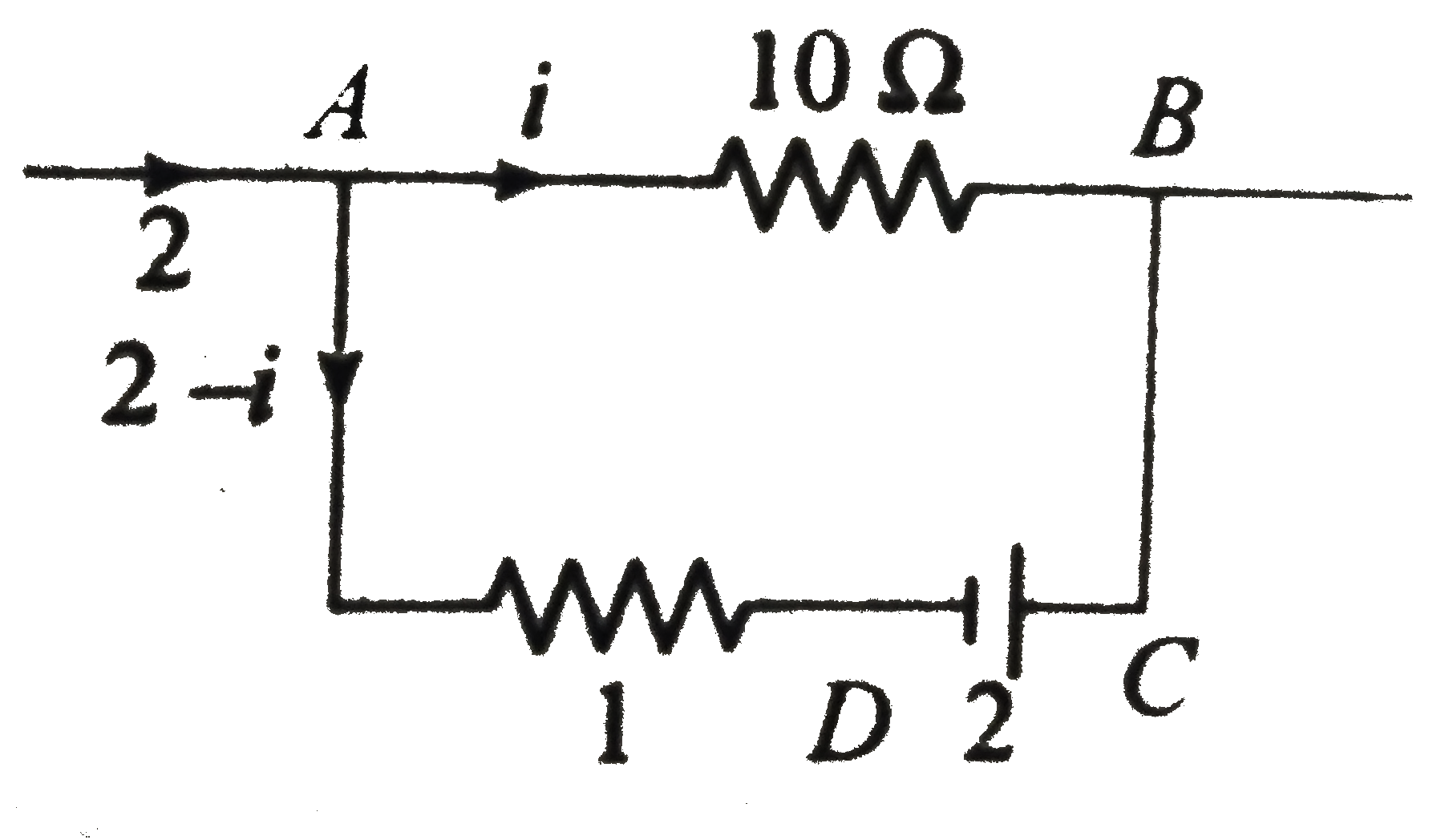
|
|
| 18. |
When of the following is not made by quarks? |
|
Answer» Neutron Neutron and proton are baryons. Positron is a lepton. `pie`-meson is a meson. |
|
| 19. |
(i) In a plot of photoelectric current versus anode potential, how does (a) the saturation current vary with anode potential for incident radiations of different frequencies but same intensity ? (b) The stopping potential vary for incident radiations of different intensities but same frequency ? (c) photoelectric current vary for different intensities but same frequency of incident radiations ? Justify your answer in each case. (ii) The work function of caesium is 2.14 eV. find (a) the threshold frequency for caesium, and (b) The wavelength of the incident light if the photocurrent is brought to zero by a stopping potential of 0.60 V. |
|
Answer» (b) 454 NM |
|
| 20. |
A potentiometer wire of length 10 m and resistance 20Omega is connected in series with 15V battery and external resistance 40Omega. A secondary cell of emf E is balanced by 240 cm long potentiomteter wire. The emf of the cell is |
|
Answer» 2.4 V |
|
| 21. |
A double convex lens is to be made of glass with refractive index. 1.5 One surface is to have twice the radius of curvature of the other surface and focal length is to be 60 mm. What are the radii ? |
|
Answer» |
|
| 22. |
पुष्प रूपान्तरण है: |
|
Answer» प्ररोह का |
|
| 23. |
Which of the following the atoms do not move from each other? |
|
Answer» SHAPE MEMORY alloys |
|
| 24. |
Where the phenomena of total internal reflection can be observed ? |
|
Answer» Solution :(1) MIRAGE(3) In prism (2) DIAMOND(4) In OPTICAL fibres |
|
| 25. |
Dispersion of light iscaused due to |
|
Answer» a) Wavelength |
|
| 26. |
Resistance of ammeter is ROmega. What will be the required shunt to decrease the value of passing current from 60 A to 20 A ? |
|
Answer» `R/1` `therefore` SHUNT S = `R/(n-1)=R/(3-1)` `thereforeS=R/2` |
|
| 27. |
In extrinsic semiconductors |
|
Answer» The conduction Band and Valence Band overlap |
|
| 28. |
Define relaxation time of the free electrons drifting in a conductor. How is it related to the driftvelocity of free electrons ? Use this relation to deduce the expression for the electrical resistivity of the material. |
|
Answer» Solution :Relaxation time : Relaxation time is the AVERAGE time between successive collisions of conduction electrons with heavy fixed ions inside a metal when a current flows through it on applying an electric field. The average is taken over a large number of collisions. The drift velocity of electrons through a current carrying conductor is GIVEN by the relation `I =epsi/R =n A e v_d "or" v_d = (epsi)/(RnAe)` where `v_d`is the drift velocity and R the resistance of given conductor. If instead of a conductor of length L we USE another conductor of same material and same area of cross-section but of length 3L, then resistance of new conductor will be R. = 3R (since resistance of a conductor is directly proportional to its length). New drift velocity `v_d = (epsi)/(R. nAe) = (epsi)/((3R) nAe) = (v_d)/(3)` |
|
| 29. |
A current I=I_(0)e^(-lambda l) is flowing in a circuit consisting of a parallel combination of resistance R and capacitance C. The total charge over the entire pulse period is |
|
Answer» `(I_(0))/(lambda)` `rArr (DQ)/(dt)=I_(0)e^(-lambda t) rArr int_(0)^(Q) dQ=I_(0) int_(0)^(OO) e^(-lambda t)dt` `rArr Q=I_(0)[(e^(-lambda t))/(-lambda)]_(0)^(oo)=(I_(0))/(lambda)` |
|
| 30. |
Where is the power dissipation in an alternating current ? In resistance ? In inductance ? In capacitance ? |
| Answer» SOLUTION :POWER is DISSIPATED in an a.c. CIRCUIT in resistanceonly. | |
| 31. |
(a) In a series LCR circuit connected across an a.c. source of variable frequency, obtain the expression for its impedance and draw a plot showing its variation with frequency of the a.c. source. (b) What is the phase difference between the voltages across inductor and the capacitor at resonance in the LCR circuit ? (c) When an inductor is connected to a 200 V d.c. voltage, a current of 1 A flows through it. When the same inductor is connected to a 200 V, 50 Hz a.c. source, only 0.5 A current flows. Explain, why ? Also, calculate the self inductance of the inductor. |
|
Answer» |
|
| 32. |
If two sources are used, what is the resultant amplitude of electric field and intensity of light for constructive interference? |
| Answer» SOLUTION :2E and `4E^(2)` | |
| 33. |
A photocell is placed at 1 m distance from light source when distance is changed to (1)/(2)m no.of photoelectron emitted from cathode will come |
|
Answer» become 2 times `THEREFORE I prop (1)/(d^(2)) therefore (I_(2))/(I_(1))=((d_(1))/(d_(2)))^(2)` From `d_(2)=(d_(1))/(2)` `(I_(2))/(I_(1))=(2)^(2)=4` intensity becomes four times. |
|
| 34. |
Young's double slit experiment is carried out using microwaves of wavelength lamda = 3 cm. Distance between the slits is d = 5 cm and the distance between the plane of slits and the screen is D= 100cm. (a) Find the number of maximas and (b) Their positions on the screen. |
|
Answer» Solution :(a) Since `d sin THETA = n lamda rArr sin theta = (n lamda)/(d) LT= 1` `therefore n lt= d/lamda = 5/3 = 1.6` maximum number of maxima are (2 [n]+1)= 3. Thus, in this case we can have only THREE maximas, one central maxima and two on its either side.  (b) The position of nth maxima `y = (n lamda D)/(d)` for n = 1 `y =(lamda D)/(d) = (3 XX 100)/(5) = 60CM` Thus, the three maximas will be at y = 0 and y = `pm60cm` |
|
| 35. |
In a radio receiver, the short-wave and medium-wave station are tuned by using the same capacitor but coil os different inductance. In which case the value of inductance is more? Explain. |
|
Answer» Solution :The value of INDUCTANCE is more while tuning a radio receiver at midium wave station than that at short wave station. We know that the short wave station EMIT radiowaves of short WAVELENGTH `(lambda_(s))` and medium wave station emit rediowaves of longer wavelength `(lambda_(m))`, i.e., `lambda_(m)gtlambda_(s)`. Let `v_(s),v_(m)` be the FREQUENCIES of short wave and medium wave signals. Then `v_(s)=c//lambda_(s)` and `v_(m)=c//lambda_(m)` or `v_(s)/v_(m)=lambda_(m)/lambda_(s)`.....(i) If `L_(s),L_(m)`be the self inductance of the short wave and the medium wave coils respectively and C be the capacitance of capacitor used, then `v_(s)=(1)/(2pisqrt(L_(s)C))` and `v_(m)=(1)/(2pisqrt(L_(m)C))` `:. v_(s)/v_(m)=sqrt(L_(m)/L_(s))` or `v_(s)^(2)/v_(m)^(2)=L_(m)/L_(s)`...(ii) From (i) and (ii), `L_(m)/L_(s)=(lambda_(m^(2)))/(lambda_(s^(2)))gt 1 (As lambda_(m)gtlambda_(s)) :. L_(m) gt L_(s)` |
|
| 36. |
प्राचीन समय में हिमालय के स्थान पर कौन सा सागर अवस्थित था? |
|
Answer» प्रशांत महासागर |
|
| 37. |
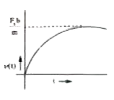
A particle of mass m is at rest at the origin at time t=0. It is subjected to a force F(t) =F_(0)e^(-bt)in the x direction. Its speed v(t) is depicted by which of the following curves ? |
|
Answer»
|
|
| 38. |
(a) An electrostatic field line is a continuous curve. That is, a field line cannot have sudden breaks. Why not ? (b) Explain why two field lines never cross each other at any point ? |
|
Answer» Solution :(a) ELECTRIC FIELD, surrounding to any charge system is found to be existing at every point surrounding to it with definite magnitude and definite direction up to infinite region in THREE DIMENSIONS. And we know that presence of electric field is depicted pictorially by electric field lines. Hence, if electric field exists everywhere surrounding to charge system then electric field lines also must be defined which can end up only at infinity. Till then, they have to continuous. They cannot have sudden BREAKS in between. (b) Electric field line is that characteristic curve the tangent drawn at every point on which gives us direction of electric field at that point. Hence, two or more electric field lines cannot intersect at any point in an electric field because if they do so then electric field would exist at that point in more than one directions, along more than one tangent drawn at that point, which is not possible. 
|
|
| 39. |
Four similar (+q) are placed at origin O, B, C and D as shown. The angles are as shown. Charges at B, C and D are equidistant from O at a distance of a. The forces of repulsion experienced by charge at O due to charges at B and D along CO are equal, given by (q^(2)sqrt(3))/(8piepsilon_(0)a^(2)). Find the relation between theta_(1), theta_(2) and theta_(3): |
|
Answer» `theta_(3)-theta_(2)=theta_(1)` |
|
| 40. |
Two different isolated coils have self inductances, L_(1)=8 mH and L_(2) = 2mH. The current in one coil is increased at a constant rate. The current in second coil is increased at same constant rate. At a certain instant, the power given to two coils is the same. At that time the current, induced voltage and the energy stored in first coil are i_(1)V_(1) and U_(1) respectively, Corresponding values for second coil at same instant are i_(2), V_(2) and U_(2) respectively. Then, |
|
Answer» `(i_(1))/(i_(2)) =(1)/(4)` |
|
| 41. |
(a) Suppose a beam of 4.5 eV protons strikes a potential energy barrier of height 6.0 eV and thickness 0.70 nm, at a rate equivalent to a current of 1000 A. How long would you have to wait-on average-for one proton to be transmitted? (b) How long would you have to wait if the beam consisted of electrons rather than protons? |
| Answer» SOLUTION :(a) `3.37xx10^(111)s~~10^(104)y,` (B) `2.1xx10^(-19)s` | |
| 42. |
If the earth had no atmosphere, the average surface temperature would have been |
|
Answer» the same |
|
| 43. |
Howdose the magnetic susceptibility per unit mass (x) of a paramagnetic gas depend on absolute temperature T ? |
|
Answer» |
|
| 44. |
If the binding energy per nucleon of deuteron is 1.115 Me V, its mass defect in atomic mass unit is |
| Answer» Answer :B | |
| 45. |
A flywheel of diameter 1 m is rotating at 600 r.p.m. Find the acceleration of a point on the rim of the fly wheel. |
|
Answer» SOLUTION :`w=2pin=2pixx10=20pi` `THEREFORE a=rw^2=1/2xx400pi^2=200pi m/s^2` |
|
| 46. |
How much energy is required to send the electron at infinite distance from the n = 3 orbit in He^(+) ? |
|
Answer» 12.08 eV For `He^(+)` n=3 and z=2 `:.E_(He)=(-13.6xx4)/(9)=-6.04 eV` The total energy should be equal to 6.04 eV given to electron of Het to be zero and hence electron goes infinite distance AWAY. |
|
| 47. |
The angle subtended by magnetic meridian with the geographical meridian at a place is called the angle of inclination. |
| Answer» Solution :False - The ANGLE SUBTENDED by magnetic MERIDIAN with geographical meridian at a place is CALLED the angle of declination at that place. | |
| 48. |
An e.m.f. of 40mV is induced in a solenoid when the current in it changes at the rate of 2A/s. What is the self-inductance of solenoid? |
|
Answer» SOLUTION :`e = L(dI)/dt ` `THEREFORE 40xx10^-3 = Lxx2` ` therefore L = 20xx10^-3H` = 20mH. |
|
| 49. |
A mctal wire of linear mass density 9.8 /m is stretched with a tension of 10 kg wt between two rigid supports 1 metre apart. The wire passes at its middle point between the poles of a permanent magnet and it vibreates in resonance when carrying an alternating current of frequency n. the frequency n of alternating source is : |
|
Answer» 50 Hz `rArrn = (1)/(2l) sqrt((T)/(m)) RARR = (1)/(2XX 1) sqrt((10xx 9.8)/(9.8 xx 10^(-3))) ` `rArr n = 50 `Hz Correct choice is (a) |
|
| 50. |
A microscope has objective of aperture 8mm and focal length 2.5 cm. Estimate its resolving power. Given lambda= 5500 dotA. |
|
Answer» Solution :We assume that the object is placed a little beyond its focal distance, say `2.5 CM`. `tan ALPHA = (4 mm)/(2.5 cm)= (0.4)/(2.5)=0.16` Since `sin alpha` is small, `sin alpha approx tan alpha = 0.16` Thus, `triangle x =(1.22 lambda)/(2 mu sin alpha)=(1.22(5500xx 10^(-10)m))/(2xx 1xx 0.16) approx 2xx 10^(-6)m`.  . .
|
|