

Saved Bookmarks
This section includes 7 InterviewSolutions, each offering curated multiple-choice questions to sharpen your Current Affairs knowledge and support exam preparation. Choose a topic below to get started.
| 1. |
What remains unchanged on reflection ? |
| Answer» SOLUTION :VELOCITY, FREQUENCY and WAVELENGTH | |
| 2. |
Assertion: Half of the ring is uniformly positively charged and other half uniformly negatively charged. The electric field is zero at centre. Reason:At the centre of uniformly charged ring electric field is non zero. |
|
Answer» Both ASSERTION and REASON are true and Reason is the CORRECT explanation of Assertion |
|
| 3. |
Can you photograph a virtual image ? |
| Answer» SOLUTION :Yes, This is because the diverging rays COMING from VIRTUAL images are real and can be FOCUSSED. | |
| 4. |
An object is x times, the focal length of a concave mirror away from the principal focus. Show that the image will be (1)/(nx) times the focal length of mirror away from principal focus, where n is : |
| Answer» Answer :C | |
| 5. |
A dynamo of emf varepsilon_(1)=120V and internal resistance r=0.5Omega, and a storage battery of varepsilon_(2)=110V are connected to an extenal resistance R. At what maximum value of R will there be no current through the storage battery? How will be the battery operate when the resistance R is large or smaller than the calculated value? |
|
Answer» |
|
| 6. |
When you "crack" a knuckle, you suddenly widen the knuckle cavity, allowing more volume for the synovial fluid inside it and causing a gas bubble suddenly to appear in the fluid. The sudden production of the bubble, called "cavitation, "produces a sound pulse - the cracking sound. Assume that the sound is transmitted uniformly in all directions and that it fully passes from the knuckle interior to the outside. If the pulse has a sound level of 50 dB at your ear, estimate the rate at which energy is produced by the cavitation. |
| Answer» SOLUTION :`1.13 XX 10^(-7) W ~~ 0.1 MU W. ` | |
| 7. |
The temperature of the sink of a carnot engine is 27^@C The efficiency of the engine is 25%. What is the temperature of the source ? |
|
Answer» `127^@C` |
|
| 8. |
Obtain an expression for the magnetic force on a current carrying conductor. |
|
Answer» Solution :Let l be the length of a conductor. Let A be its area of cross section. Let n be the number density of mobile charge carriers in the conductor. The total number of mobile charge carries is NAL. Let the averrage drift velocity be `'v_(d)'` corresponding to the current I. Let B be an external magnetic field surrounding the conductor. Magnetic force on these carriers is, `vec(F)=(nAlq)(vec(v_(d)) times vec(B))` where `q^(')=nalq` By DEFINITION current density `j=I/A` and q = e (charge on the ELECTRON) `""vec(F)="nAle "vec(v)_(d) timesvec(B)` `""=("NE"vec(v)_(d))Al times vec(B)` `""=vec(j)Al times vec(B)` `""=abs(vec(j))(HAT(j)l)A times vec( B)` `therefore""vec(F)=Ivec(l) times vec(B)` The direction of current is in the direction of `vec(l)` vector, `vec(l)=hat(j)l " and " jA=I=` current. 
|
|
| 9. |
Find the ratio of de-Broglie wavelengths associated with two electrons accelerated through 25 and 36 V. |
|
Answer» SOLUTION :`V_(1) = 25 V, V_(2) = 36 V` De-Broglie wavelength of an ELECTRON: `LAMBDA=(1.227)/(sqrtV)` `lambda_(1)=(12.27)/(sqrtV_(1))` and `lambda_(2)= (12.27)/(sqrtV_(2))` `:. (lambda_(1))/(lambda_(2))=sqrt((V_(2))/(V_(1)))=sqrt((36)/(25))` `(lambda_(1))/(lambda_(2))=(6)/(5)` |
|
| 10. |
Two identical capacitors A and B are charged to the same potential V and are connected in two circuits at t = 0 as shown in figure. The charge of the capacitors at a time t = CRare respectively- |
|
Answer» VC, VC |
|
| 11. |
Fill in the Blanks Q An object is kept symmetrically between two plane mirrors making an angle of 40° between them. The number of images of the object in the mirrors is…................... |
| Answer» | |
| 12. |
In a pure semiconductor, the number of conduction electrons is 6xx10^(19) per cubic metre. How many holes are there in a sample of size 1 cm xx cm xx 2 mm ? |
| Answer» SOLUTION :`1.2xx10^(13)` | |
| 13. |
In a rectangular glass slab of thickness t the emergent ray is parallel to _____ |
| Answer» SOLUTION :INCIDENT RAY | |
| 14. |
Find the radius of the light spot on the screen as shown in Fig. 34-44. Consider only the light rays refracted from the lens. Find the average intensity on the screen. The source is point source of power 100W. The lens has an aperture of 6cm. |
|
Answer» Solution :(1) Only a real image can be FOCUSED on a screen. A virtual image cannot be focused on a screen but can be seen with naked eyes. To see a real image with a naked eye, we should place the eye behind the image. (2) Here, we will TRY to locate the image formed by the lens. This image will be formed by all the rays collected by the lens. So, if we consider the extreme rays which are being focused at the aperture (Fig. 35-45), we will get the FIELD of view for the image. This will also show us the region in which the refracted light will be present. Calculation : If the screen was not present, the image would have formed at `v=(uf)/(u+f)=(-30xx20)/(-30+20)=60CM` From the lens, 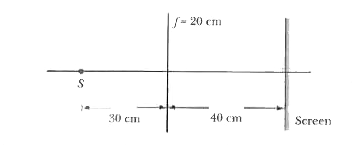 From similar triangles , we can estimate the radius of the image formed : `(R )/(3)=(20)/(60)` `R=1cm` The amount of light used to form the image can be estimated with the help of solid angle subtened by the lens at the location of the source : `("Power of image")/(100W)=(1-costheta)/(2)` Here, `tantheta=3//30=0.1`, for a small angle and `costheta=(1-theta^(2)//2)`. The power of the image `50xx(0.1)^(2)//2=0.25W` Intensity `=("Power")/("area")` `=(0.25)/(pixx(0.01)^(2))=(2500)/(pi)W//m^(2)`. Learn : Here we can see how the itensity can be quite high even THOUGH the power transmitted by the lens is very small . 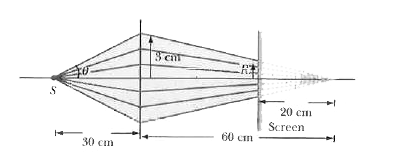
|
|
| 15. |
The magnitude of an electric intensity at a point which is at a distance 'r' from the centre of a charged spherical conductor of radius 'R' in terms of the surface charge density'sigma' is given by 'E' where |
|
Answer» `E=(SIGMA)/(Kepsi_(0)R^(2))` |
|
| 16. |
A block placed on a horizontal surface is being pushed by a force F making an angle theta with the vertical. The coefficient of friction between the block and surface is mu The force required to slide down the block with uniform velocity on the floor is |
|
Answer» `(MUMG)/(sintheta-mucostheta)` |
|
| 17. |
Condition for nth minimum in single slit diffraction is ...... where n = +- 1, +- 2, +-3, ... |
|
Answer» `nlambda=a sin theta_(N)` |
|
| 18. |
Name several repetitive phenomena occurring in nature which could serve as reasonable time standards. |
| Answer» Solution :Some REPETITIVE phenomena in NATURE that can serve as a REASONABLE time standards are SUNRISE and as a reasonable time standards are sunrise and SUNSET, phases of moon, axial rotation of earth, flowering of plants etc. | |
| 19. |
The temperature of a monatomic ideal gas with a mass per mole of 0.00750 kg/mol is 294 K. The absolute pressure of the gas is 1.05 xx10^5 Pa when its volume is 1.31 xx 10^(-3)m. What is the mass of the gas? |
|
Answer» `8.04 XX 10^(-5)kg` |
|
| 20. |
Which of the following statements wrong about aniline |
|
Answer» Positive isocyanide test |
|
| 21. |
A metallic rod of length 1 m, young's modulus 3xx10^(11)Nm^(-3) and density is clamped at its middle. Longitudinal stationary vibrations are produced in the rod with the total number of displacement nodes equal to 3. The frequency of vibrations is |
|
Answer» 30,000 Hz |
|
| 22. |
The sides of rectangular block are 2cm, 3cm and 4 cm. The ratio of the maximum to minimum resistance between its parallel faces is |
|
Answer» 3 |
|
| 23. |
Find the Q-value and the kinetic energy of the emitted o-particle in the a-decay of (a) " "_(88)^(226)Ra and (b) " "_(86)^(220)Rn. Given : m(" "_(88)^(226Ra)=226.02540 u, m(" "_(86)^(222)Rn)=222.01750 u, m(" "_(86)^(220)Rn)=220.01137u, m(" "_(84)^(216)Po)=216.00189 u. |
|
Answer» SOLUTION :(a) `ALPHA`-DECAY of `" "_(88)^(226)Ra` is having the reaction equation : `" "_(88)^(226)Ra (to)" "_(86)^(222)Rn+" "_(2)^(4)He+Q` `therefore Q_(value)=(M_(Ra) - M_(Rn) - M_(He))c^(2) = (226.02540-222.01750-4.002603)uxx931.5(MeV)/u=4.93MeV` `therefore` Kinetic energy of emitted `alpha`-particle, K=`((A-4)/A)Q=222/226xx4.93MeV=4.85MeV` (B)`alpha`-decay equation of `" "_(86)^(220)Rn` is: `" "_(86)^(220)Rn (to) " "_(84)^(216)Po +" "_(2)^(4)He +Q` `therefore Q_(value)=(M_(Rn)-M_(Po)-M_(He)).c^(2)=(220.01137-216.00189-4.002603)uxx931.5(MeV)/u=6.41MeV` `therefore` Kinetic of emitted `alpha`-particle K=`((A-4)/A).Q=216/220xx6.41MeV=6.29MeV`. |
|
| 24. |
What is the focal length of lens if the image distance remain same by keeping object at 24 cm and 16 cm from lens ? |
|
Answer» 22 CM but|-m|=|+m| `THEREFORE-(f)/(f-u)=(f)/(f-u)` `-(f)/(f-24)=(f)/(f-16)` `therefore(1)/(24-f)=(1)/(f-16)` `therefore24-f=f-16` `therefore40=2f` `thereforef=20` cm |
|
| 25. |
Electric potential (phi) of a quadrupole varies with distance 'r' on its axis as :- |
|
Answer» `phi OO R^(-1)` |
|
| 26. |
Find the particular solution of the time dependet Schrodinger equation for a freely moving particle of mass m. |
|
Answer» Solution :THEL Schrodinger equation in one dimension for a free particle is `i ħ(del Psi)/(delt)=-( ħ^(2))/(2m)(del^(2)Psi)/(delx^(2))` we WRITE `Psi(x,t)= varphi(x)chi(t)`. Then `((i)/ ħ(SQRT(2mEx-Et)) ħ)/(chi)(dchi)/(dt)=-( ħ^(2))/(2m)(1)/(varphi)(d^(2)varphi)/(dx^(2))=E`,say Then `chi(t)~exp(-(IET)/(h))` `varphi(x)~exp(isqrt(2mE)/( ħ)x)` `E` must be real and positive if `varphi(x)` is to be bounded everywhere. Then `Psi(x,t)=Const exp((i)/ (ħ)(sqrt(2mE)x-Et))` This particular solution DESCRIBES plane waves. |
|
| 27. |
Chemical property of a substance is determined by the number of |
|
Answer» ELECTRONS |
|
| 28. |
What is bandwidth of interference pattern? |
| Answer» Solution :The bandwidth `(beta)` is DEFINED as the DISTANCE between any two consecutive BRIGHT or DARK FRINGES. | |
| 29. |
In nature,amount of electriccharge, possessed by an isolated system is always…………. |
|
Answer» zero |
|
| 30. |
In a photoelectric experiment, if both the intensity and frequency of the incident light doubled, then the saturation photoelectric current |
|
Answer» a. remains constant |
|
| 31. |
Consider three charges q_(1), q_(2), q_(3) each equal to q at the vertices of an equilateral triangle of side l. What is the force on a charge Q (with the same sign as q) placed at the centroid of the triangle, as shown in Fig. ? |
|
Answer» Solution :Letthe force actingon +Q chargeat O dueto +q at A be `F_(1)`, +q at B be `F_(2)` and -q at C be `F_(3)` Here `AO=BO=CO=(d)/(sqrt(3))`  In magnitude `F_(1)=F_(2)=F_(3)=(1)/(4pi in_(0))(3q^(2))/(d^(2))` RESULTANT of `F_(1) and F_(2)` is `F_(4)=(1)/(4pi in_(0)) (3q^(2))/(d^(2))` (as angle between `F_(1) and F_(2)` is `120^(0)`) Directionof `F_(4)` is ALONGTHE direction of `F_(3)`. Hence the resultantforce on +q at O is `F=F_(3)+F_(4)=(3q^(2))/(2pi in_(0)d^(2))` |
|
| 32. |
For producing the X–rays, what is the value of voltage (nearly), which is applied on the tube: |
|
Answer» 10 VOLT |
|
| 33. |
A constant force acts on a body of mass m at rest fort second and then ceases to act. In next 't’ second the body travels a distance 'x'. Magnitude of force is : |
|
Answer» `(mx)/(t^(2))` `upsilon=(x)/(t)` Now `upsilon = U + at or (x)/(t) = 0 + at` or `a=(x)(t^(2))` and force `F=m.a=(mx)/(t^(2))` (a) is the CHOICE. |
|
| 34. |
A parallel plate capacitor of area A, plate separation d and capacitance C is filled with four dielectric materials hving dielectric constants K_(1), K_(2), K_(3) and K_(4) as shown in the figure below. If a single dielectric material is to be used to have the same capacitance c in this capacitor, then its dielectric constant K is given by |
|
Answer» `K=K_(1)+K_(2)+K_(3)+3K_(4)` |
|
| 35. |
What is the source temperature of the Carnot engine required to get 70% efficiency? Given sink temperature = 27^(@)C |
|
Answer» `1000^(@)C` `0.7 = 1 - (273 + 27)/(T_(1)) = 1 - (300)/(T_(1))` `(300)/(T_(1)) = 0.3` `T_(1) = 1000 K = 727^(@)C` |
|
| 36. |
(a) Drawa ray diagram to show the image formation by a combination of two thin convex lenses in contact . Obtain the expression for the power of this combination in terms of thefocal lengths of the lenses. (b)A ray of light passing from air through an equilateral glass prism undergoes minimum deviation when the angle of incidenceis (3)/(4)^(th) of the angle of prism . Calculate the speed ofltbRgt light in the prism. |
|
Answer» Solution :(a)Consider lenes A and B with focal length `f_(1) and f_(2)` placed in contact . Object is placed atO beyond focus of A . FIRST lens produces image at I, (its real) and SERVE as virtual object for lens B producing image I. As the lenses are lenses are thin , so optc centres of lenses are closer to each other . Let this centre point be denoted by P. Image formation by A `(1)/(v_(1)) - (1)/(u) = (1) /(f_(1)) ` and...(i) Image formation by B `(1)/(v) - (1)/(v_(1)) = (1)/(f_(2)) ` ...(ii) Adding(i) and (ii) we get , ` (1)/(v) - (1)/(u) = (1)/(f_(1)) + (1)/(f_(2))` ...(iii) 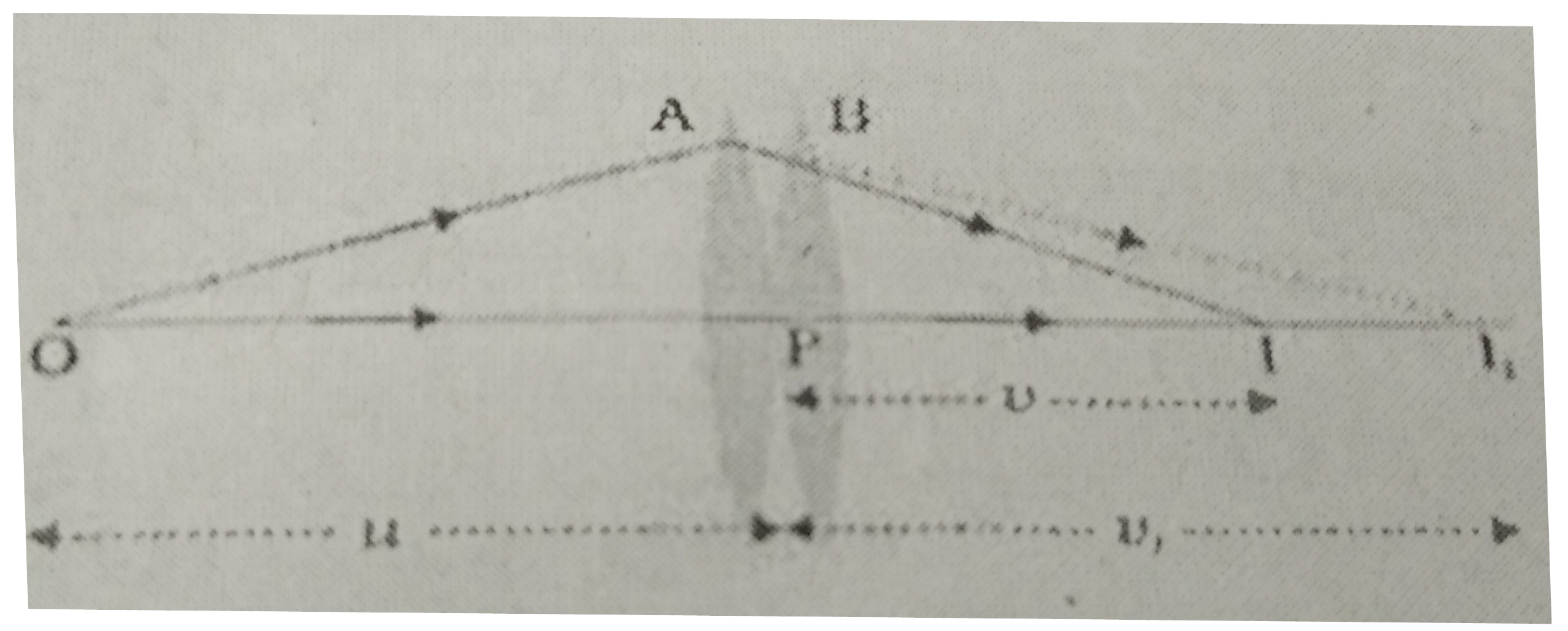 If two lenses system is taken as one lens equivalent system then, eq . (iii) can be ` (1)/(v)- (1)/(u) = (1)/(f)` where, ` (1)/(f) = (1) /(f_(1)) + (1)/(f_(2))`. Then is valid for any number of lens`f_(1) , f_(2) , f_(3)`... are the focal lengths of lenses in contact `(1)/(f) = (1)/(f_(1) ) + (1)/(f_(2)) + (1)/(f_(3)) +.....u` ` P = P _(1) + P_(2) + P _(3) + ...` (b)Given, ` i = (3)/(4) A` Also,`mu = ("SIN" [(A+ delta m)/(2)])/("sin" (A)/(2)) or, delta _(m) to `Angle of MIN . deviation . or`(C_(1))/(C_(2))= ("sin" [(A+ delta m)/(2)])/("sin" (A)/(2)) or, delta _(m) = 2i - A = 2xx (3A)/(4) - A = (A)/(2)` `delta _(m) = (60^(@))/(2) = 30^(@)` `C_(2) = (3xx10^(8))/(sqrt(2)) ms^(-1) = 1.5 sqrt(2)ms^(-1) xx10^(8)` `rArrC_(2)2.12 xx10^(8)` ms^(-1)`. |
|
| 37. |
A horizontal insulated cylinder is provided with frictionless non-conducting piston. On each side of the piston there is 50 litres of air at a pressure of 1 atmosphere and 273 K. Heat is slowly supplied to the air at the left hand side, until the piston has compressed the air on the right hand side to 2.5 atmosphere. Find Heat added to air on the left hand side. |
|
Answer» |
|
| 39. |
A bar magnet isplaced in a uniformmagnetic field whose strength is 0.8 T. Suppose the barmagnet orient an angle 30^(@) with the external field experiences a torque of 0.2 Nm .Calculate : (i)the magneticmoment of themagnet (ii)the work done by an appliedforce in moving it form moststable configuration to themost unstable configuration and alsocompute thework done by the applied magnetic field in this case . |
|
Answer» Solution :Uniform MAGNETIC field strength B = 0.8 T Bar magnet orient an angle with magnetic field `theta = 30^(@)` Torque `tau ` = 0.2 NM (i) Magnetic MOMENT of the magnet torque `tau = P_(m) B sin theta` `therefore` Magnetic moment `, P_(m) = (tau)/("Bsin" theta )= (0.2 )/(0.8 xx Sin 30^(@) )= (0.2)/(0.4) ` `P = 0.5 Am^(2)` (ii) Work done by external torque is stored in the magnet as potential energy . W = U = `-P_(m) " B Cos " theta` here, applied force acting on magnet its moving from most stable `theta`. to most unstable `theta`. `theta. = 0^(@) and theta = 180^(@)` So, workdone W = U = -`P_(m) " B "( Cos theta - Cos theta^(@) )` = - `p_(m) B (Cos 180^(@)- Cos theta^(@)) = - 0.5 xx 0.8 ((-1)-1) = - 0.4 (-2) ` W = U = 0.8 W = 0.8 J |
|
| 40. |
A particle of mass m slides down an inclined plane and reaches the bottom with linear velocity v. If the same mass is in the form of ring and rolls without slipping down the same inclined plane, its velocity will be: |
|
Answer» Solution :Here in the first case `(1)/(2)mv^(2)=mghorv=sqrt(2gh)` In second case `v.[(2gh)/(1+(K^(2))/(R^(2)))]^((1)/(2))` As for the ring, `k=r,v.=sqrt(gh)` `therefore (v.)/(v)=(1)/(sqrt(2))ORV.=(v)/(sqrt(2))` |
|
| 41. |
A horizontal insulated cylinder is provided with frictionless non-conducting piston. On each side of the piston there is 50 litres of air at a pressure of 1 atmosphere and 273 K. Heat is slowly supplied to the air at the left hand side, until the piston has compressed the air on the right hand side to 2.5 atmosphere. Find Final temperature of air on the left hand side |
|
Answer» |
|
| 42. |
Number of testicular lobules in testes is |
|
Answer» 100 |
|
| 43. |
A sinusoidal wave form is given by i=20 sin (6284 t + 20^@) A. What is its period ? |
|
Answer» 1 second |
|
| 44. |
A horizontal insulated cylinder is provided with frictionless non-conducting piston. On each side of the piston there is 50 litres of air at a pressure of 1 atmosphere and 273 K. Heat is slowly supplied to the air at the left hand side, until the piston has compressed the air on the right hand side to 2.5 atmosphere. Find : Final temperature of air on the right hand side |
|
Answer» |
|
| 45. |
An isolated radioactive source in the form a metal sphere of radius 1 mm undergoes beta -ray at a constant rate of 6.25 xx 10^(10) //sec . Assuming 70% of the emitted beta - particles escape from the source, time after which potential of the sphere rises by 1 V is |
|
Answer» `15.5 UMS` |
|
| 46. |
Which of the following figure represents the variation of particle momentum (P) and associated de Broglie wavelength(lambda)? |
|
Answer»
|
|
| 47. |
If the mass of the planet is 4 times that of the earth and radius of the planet is 2 times that of the earth • then escape velocity from surface of the planet is, (Given that escape velocity from the |
|
Answer» `4.9m//s^2` |
|
| 48. |
The kinetic energy of a body of mass 4 kg and momentum 6 N s will be |
|
Answer» 3.5 J =`((6)^2)/(2xx4)=(36)/(8)=4.5 J` |
|
| 49. |
A car travelling at 10" ms"^(-1) sounds a horn, which has a frequency of 500 Hz, and this is heard in another car which is travelling behind the first car in the same direction, with a velocity of 20" ms"^(-1). The sound can also be heard in the second car be reflection from a bridge ahead. What frequencies will be driver of the second car hear ? [Speed of sound in air =340" ms"^(-1)] |
|
Answer» 514 Hz, 528 Hz |
|
| 50. |
In the Bohr model of hydrogen atom. What is the de-Broglie wavelength lambda for the electron when it is in the (i) n = 1 level (ll) n = 4 level. In each case, compare the de-Broglie wave length to the circumference of the orbit. Data: n=1, n=4,lambda=? |
|
Answer» Solution :By Bohr.s first POSTULATE, angular momentum of the electron `=(nh)/(2pi)` `mvr=(nh)/(2pi)` `:. (2pir)/(n)=(h)/(mv)` ...(1) But, (de brogile wave length), `lambda=(h)/(mv)` ...(2) From the equation (1) and (2) `lambda=(2pir)/(n)` ...(3) (i) `n=1, R=r_(1)=0.53 Å` `:. lambda_(1)=2pir_(1)=2pi(0.53)Å=3.328Å` From equation(3), `(lambda)/(2pir)=(1)/(n),` for n=1, `(lambda)/(2pir)=1`, i.e., `lambda-2pir` `:.` In first ORBIT, de-brogile wave length of the electron is equal to the circumference of the orbit. (ii) n = 4, `r_(4)=4^(2)r_(1)` from equation (3), `lambda_(4)=(2pir_(4))/(4)=(2pi(4^(2)r_(1)))/(4)` i.e., `lambda_(4)=2pixx4xx(0.53)Å` `lambda_(4)=13.313Å` and from `lambda_(4)=(2pir_(4))/(4)`, the de-Brogile wavelength of the electron in the fourth orbit is equal to one fourth of the PERIMETER. |
|


