

Saved Bookmarks
This section includes 7 InterviewSolutions, each offering curated multiple-choice questions to sharpen your Current Affairs knowledge and support exam preparation. Choose a topic below to get started.
| 1. |
A beam of light is incident at polarising angle theta on air-glass interface. If lambda_a and lambda_g are the wavelength of light in air ang glass respectivly, then : |
|
Answer» `lambda_a = lambda_g COT THETA` |
|
| 2. |
The amplitude of a wave disturbance travelling in the positive x-direction is given by time t = 0 and by y =1/[1 +(x-1)^(2)] att= 2s , where x and y are in metre. The shape of the wavedisturbance does not change during the propagation. The velocity of the wave is 1/x m/s. Then x |
|
Answer» |
|
| 3. |
In Young's experiment, dark fringe of 5th order is obtained at point P on the screen so path difference at point P on the screen will be ...... |
|
Answer» `(10 lambda)/(2)` Path DIFFERENCE `=(2n-1)(lambda)/(2)=(9lambda)/(2)[ :.n=5]` |
|
| 4. |
As electromagnetic wave travels in free space, only one the following can happen to them: |
|
Answer» ABSORPTION |
|
| 5. |
The relation between the phase of current and voltage in a circuit containing only inductor is …. |
|
Answer» VOLTAGE leads ahead by `PI/2` |
|
| 6. |
A charge of 8 mC is located at the origin. Calculate the work done in taking a small charge of -2 xx 10^(-9)C from a point P(0,0,3 cm) to a point Q10,4 cm, 0) via a point R(0,6 cm, 9 cm). |
|
Answer» <P> Solution :As electrostatic field is a CONSERVATIVE field HENCE work done in taking a small charge from point P to Q is independent of the path followed.As q = 8 mC `= 8 XX 10^(-3) C, q_0 = -2 xx 10^(-9) C` At point P, `r_1 = 3 cm= 0.03 m` and at point Q,`r_2= 4 cm = 0.04 m` `:.` Work done `W = q_0 (V_2 - V_1) = q_0 1/(4pi epsi_0) .q[1/r_2-1/r_1] = (q_0q)/(4pi epsi_0) [ 1/r_2 - 1/r_1]` `:. W = 9 xx 10^9 xx (-2 xx 10^(-9))xx (8 xx 10^(-3)) [ 1/0.04 - 1/0.03] = 1.2 J` |
|
| 7. |
The values of voltage V andcurrent I for a given diode are given in the following table. Find the forward bias resistance and reverse bias resistance for a given diode for a straight line characteristics. |
| Answer» Solution :`r_(FB)=20Omega, r_(rb)=8XX10^(6)OMEGA` | |
| 8. |
A jet plane is travelling towards west at a speed of 1800 km/h. What is the voltage difference developed between the ends of the wing having a span 25m, if the earth's magnetic field at the location has a magnitude of 5xx10^(-4)T and the dip angle is 30^(@)? |
| Answer» Solution :`varepsilon=B_(V)lv=(Bsin30)lv=5xx10^(-4)XX(1)/(2)xx25xx((1800xx5)/(18))=3.125V` | |
| 9. |
The magnetic flux linked with a coil, in webers, is given as phi_(B) = 3t^(2)+ 4t + 9. The magnitude of induced emf at t = 2 s will be _____. |
|
Answer» |
|
| 10. |
A diode used in the circuit shown in fig. below, has a constant voltage drop of 0.5V at all currents and a maximum power rating of 100 mW. What should be the value of the resistance R connected in series with diode for obtaining maximum current |
| Answer» SOLUTION :5`OMEGA` | |
| 11. |
The binding energy of electron in a hydrogen atom is 13.6 eV, the energy required to remove the electron from the first excited state of Li^(++) is : |
|
Answer» 13.6eV |
|
| 12. |
A bar magnet of length 21 cm and pole strength m is placed in a uniform magnetic field , B inclined at angle 'theta' with the field . a. What is the force acting on each pole ? b. Why the magnet gets a rotating effect ? |
|
Answer» Solution :a. Force , F = mB where .m. is the pole STRENGTH and B is the magnetic INDUCTION. b. Because it is acted by a TORQUE. |
|
| 13. |
A long rubber tube having mass 0.9 kg fastened to a fixed support and the free end of the tube is attached to a cord which passase over a pulley and supports an object, with a mass of 5 kg as shown in fig. If the tube is struck by a transvers blow at one end, the time required for the pulse to reach the =49/625 kg //m) |
|
Answer» 5s |
|
| 14. |
A beam of monochromatic light is refracted from vacumm into a medium of refractive index 1.5. The wavelength of the refracted light will be : |
|
Answer» DEPENDENT on the INTENSITY of REFRACTED LIGHT |
|
| 15. |
Explain the formation of energy bands in solids and hence distinguish between conductors, semiconductors and insulators. |
|
Answer» Solution :Energy bands in Solids. Solids display a large range of electrical resistivity. Whereas some solids are good conductors of electricity, others are insulators (bad condutors) and still others, called semiconductors have properties in between conductors and insulators. The significant feature of atomic structure is that there exist discrete energy levels or shells in an atom called K,L,M......, shells. An electron revolving round the nucleus can occupy one of these shells to have a definite value of energy associated with it. Consider now a single valence electron in an atom like that in lithium or sodium atom. When another identical atom is brought CLOSE to it as in a crystal, the electron energy level gets modified because now it is under the electrostatic influence of two atomic cores (consisting of two nuclei plus the inner orbital electrons) instead of only one. Each of the two valence electrons may now occupy a different energy state, one a little higher, `E_(1)` and the other a little lower, `E_(2)` than that of the isolated atom, `E`. The magnitudes `(E_(1)-E)` and `(E-E_(2))` increase as the atoms are brought closer together. Now in a solid there are about `10^(23)` atoms per cubic centimetre and same, therefore, is the number of single valence electrons. Thus there is an enormously large number of energy levels which the electron may occupy with certain upper and lower limits (a certain energy range) depending upon the nature of the element. The enormous number of energy states constitutes an energy band in which there is a continuous distribution of energy WITHIN a certain energy range.  Consider lithiun atom. Its electronic configuration is `1s^(2)`, `2s^(1)`. Thus it has two electrons in the `s` state in K shell and they have opposite spins (fig. a). The third (valence) electron is in the state in L shell. In an isolated atom, each of the electrons in the K shell and the electrons in the L shell are associated with a definite amount of energy characteristic of lithium, irrespective of the atom to which these electrons belong. Let us consider a lithium crystal consisting of n atoms, say. These N atoms do no have corresponding electrons in identical energy states. There are evidently N energy states corresponding to each shell and they are so numerous and close to each other that they form energy bands as explained above. Any energy state in an energy band may be occupied by two electrons (and not more than two) with opposite spins. Hence, N energy states are COMPLETELY filled when they accummodate a maximum number of `2N` electrons. In fig. (a) which shows the energy levels for isolated lithium atom, there are two K shell electrons in the same energy level and one L shell electron in a higher level. Fig (b) which shows the energy bands for a lithium crystals, there are `2N` electrons in K shell filling N energy states in one band and N electrons in L shell in the higher energy band. Since the second band accommodates half the maximum number it can do, it is only half filled. In fig. (a), there is also shown an unoccupied level. It refers to the level which the electrons could enter on being excited. Fig (b) shows the corresponding unoccupied energy band. A solid can be classified as conductor , an insulator or a semiconductor on the basis of its energy band structure. Distinction between insulators, semiconductors and conductors Insulators. As show in energy band fig. (C), the valence band in this case is completely filled and conduction band is completely empty and the two bands are separated by a wide energy gap `E_(g)` (known as forbidden band). Since forbidden band is quite wide, an applied electric  field cannot give enough energy to an electron in the valence band to enable it to enter the conduction band. Thus, materials with large energy gap between valence and conduction bands behave as insulators. The example of insulators are wood, glass, mica, diamond etc. The resistivity of insulators is greater than `10^(4)` ohm-m . For diamond, the energy gap is `5.4eV`. Semiconductors. In this case, energy gap is smaller than insulator and it is nearly `1eV` (Fig.d). At ordinary temperature say `300K`, some electrons in the valence band may have enough thermal energy to surmount the valence band and enter the conduction band. The gap or valency caused in the valence band due to the shift of an electron to the conduction band is called a hole. Thus in such solids both holes and electrons contributes to the conduction process and such solids are called semiconductors. Their resistivity varies from `10^(-8)` and `10^(-4)Omegam`. Energy gap `E_(g)` for `Si` is `1.12eV` for `Ge`it is `0.75eV`. Conductors have resistivity less than `10^(-8)Omegam`. In such substances the valence bond and conduction band overlap each other so that electrons from the valence band can easily pass into conduction band as shown in fig. (e). Electrons in overlaping region are conduction electrons. |
|
| 16. |
In DeltaABC, If angleA=pi/6 , angleB=pi/4 and If (AB)^2 =K(BC)^2 + (AC)^2 , then value of K^2 is |
|
Answer» `(sin105^@)^2=k("sin"pi/6)^2 + (1/2)` `rArr k^2`=3 |
|
| 17. |
What do you understand by the statement 'Light from the sun is unpolarised'. Explain how does sunlight gets polarized by the process of scattering? |
|
Answer» SOLUTION :Light from the sun is unpolarised’ MEANS the electric field vector vibrates in all possible DIRECTIONS in the TRANSVERSE plane rapidly and randomly. Holarisation of sunlight by the method of scattering: |
|
| 18. |
A ray of light incident on the hypotenuse of a right angled prism after travelling parallel to the base inside the prism is incident on second refracting surface. If mu is the refrctive index of material of prism, the maximum value of the base angle for which light is totally reflected from the hypotenuse is |
|
Answer» `SIN^(-1)(1/(MU))` |
|
| 19. |
Calculate the de Broglie wavelength associated with a proton of kinetic energy 8xx10^(-17)J. |
|
Answer» Solution :DATA supplied, `K=8xx10^(-17)J, h=6.625xx10^(-34)Js` `lambda=(h)/(sqrt(2mK))=(6.625xx10^(-34))/(sqrt(2xx1.675xx10^(-27)xx8xx10^(-17)))=0.0128 A^(@)` |
|
| 20. |
Which of the following statement is currect? |
|
Answer» HOLE is an antiparticle of electron |
|
| 21. |
A pendulum bob has a period 24s. Its velocity 4 s after it has passed the mean position is 6.28" cm s"^(-1). The amplitude of its motion is : |
|
Answer» 12 cm `6.28=r""(2PI)/(24).cos((2pi)/(24).4)` `IMPLIES""r=48` cm. HENCE correct choice is ( c ). |
|
| 22. |
A circular coil of rauis 10cm, 500 turns and resistance 2Omega is placed with its plane perpendicualr to the horizontal component of the earth's magnetic field it is rotated about its vertical diameter through 180^(@) in 0.25 S estimate the magnitude of the emf and current induced in the coil. Horizontal component of earth's magnetic field at the place is 3xx10^(-5)T. |
|
Answer» Solution :Initial flux through the coil, `phi_(B("initial"))=BAcostheta` `=3.0xx10^(-5)XX(pixx10^(-2))xxcos0^(@)=3pixx10^(-7)Wb` Final flux after the rotation, `phi_(B("final"))=3.0xx10^(-5)xx(pixx10^(-2))xxcos180^(@)=-3pixx10^(-7)Wb` Estimated value of the INDUCED emf is, `epsilon=N(Deltaphi)/(DELTAT)=500xx((6pixx10^(-7)))/(0.25)=3.8xx10^(-3)V` |
|
| 23. |
A dipole is present in an electrostatic field of magnitude 10^6 NC^(-1). If the work done in rotating it from its position of stable equilibrium to its positionof unatable equilibriumequals 2 xx 10^(-23) J,find the magnitude of the dipole moment of this dipole. |
|
Answer» <P> Solution :Here `E = 10^6N C^(-1), theta_1 = 0^@, theta_2 = 180^@` and work done in rotating the dipole `W = 2 XX 10^(-23)J`,From the relation `W = pE (costheta_1 - cos theta_2),` we have ` 2 xx 10^(-23) = p xx 10^6 xx [ (1) - (-1)] = 2pxx10^(6) rArr p = 10^(-17) C-m` |
|
| 24. |
सरदार सरोवर बांध इनमें कौन-सी नदी पर बनाया गया है? |
|
Answer» नर्मदा |
|
| 25. |
A concave mirror of facal length 15cm forms an image having twice the linear dimensions of the object .The position of the object when the Image is virtual will be : |
| Answer» ANSWER :A | |
| 26. |
Young's experiment is performed with light of wavelength 6000Å where in 16 frignes occupy a certain region on the screen. If 24 fringes occupy the same region with another light of wavelength lamda then lamda is |
|
Answer» `6000Å` |
|
| 27. |
The perpendicular distance between two conductor of 12 m each is 0.15cm. They carry 300A in same direction. The force acti ng between them is |
|
Answer» 288N repulsion |
|
| 28. |
The angle subtended by the vector barA= 4hati +3hatj+12hatk with the x-axis is |
|
Answer» `SIN^(-1) ((3)/(13))` `cos THETA = (4)/(sqrt(4^(2)+3^(2)+(12)^(2)))=(4)/(13),theta=cos^(-1)((4)/(13))` |
|
| 29. |
Who thought of improving the sound of the Pungi? |
|
Answer» a musician |
|
| 30. |
Match the corresponding entries of Column I with Column II. |
|
Answer» If object is placed between focus and pole, then the image OBTAINED will be virtual and its magnification will be positive. In all other cases, concave mirror forms real images whose magnification will be negative. A convex mirror always forms a virtual image whose magnification will always be positive. |
|
| 31. |
Which of the following represents correct modified formula for Ampere's circuital law? |
|
Answer» `ointvecB*vecdl=[I+(dphi_(E))/(DT)]` |
|
| 32. |
Asha's mother read an article in the newspaper about a disaster that took place at Chernobyl. She could not understand much from the article and asked a few questions from Ashs regardingthe article . Asha tried to answer her mother's questions based on what she learnt in Class XII Physics. (a) What was the installation at Chernobyl where the disaster took place ? What according to you, wes the cause of this disaster? (b) Explain the process of release of energy in the intallation at Cheronbyl. (c) What, according to you, were the values displayed by Asha and her mother ? |
|
Answer» Solution :(a) At Chernobyl, there was nuclear power PLANT. The accident occurred in the year 1986 . The cause of this disaster was humen ERROR. Operators ran the plant at very low power, without adequate SAFETY precautions. There was a steam explosion. (b) The process of releasingenergy in a nuclear power plant is nuclear FISSION . `""_(92)^(235)U+""_(0)^(1)n to ""_(56)^(141) Ba + ""_(36)^(92) Kr + 3_(0)^(1) + Q` (c) Values displayed :Asha - Sincerr towardsher studies Mother - Curious |
|
| 33. |
Water at 20°C ( coefficient of viscosity= 0.01 poise) flowing in a tube of diameter 1 cm with an average velocity of 10 emfs has the Reynold number: |
|
Answer» 500 `N=(pvD)/(eta)` where p is DENSITY, v is velocity & D is diameter of the tube. `N=(1xx10xx1)/(0.01)` `N=1000` so CORRECT choice is (b). |
|
| 34. |
In the hysteresis cycle the value of H needed to make the intensity of magnetisation zero is called |
|
Answer» Susceptibility |
|
| 35. |
A stretched string is vibrating at 500Hz . If the tension is increased four times, the frequency shall become |
|
Answer» 250Hz |
|
| 36. |
For the circuit shown in figure when R = 2Omega, V=0.75 volts, when R=3Omega, V = 0.9 Volts when R = 4Omega, V = V_(1), where V_(1) equals (in volts) and I_(1)(in amp) |
|
Answer» `1_(1) = 1.2 A` |
|
| 37. |
Is the electric field due to a charge configuration with total charge zero necessarily zero? |
| Answer» Solution :No , not necessarily zero. As an EXAMPLE TOTAL charge on an electrical DIPOLE is zero but electric field to the dipole is FINITE at a givenpoint. | |
| 38. |
The electric amplitude of the wave is 5 Vm^(-1). The magnetic amplitude of this wave is: |
|
Answer» `5 A WB // m^(2)` |
|
| 39. |
Determine the speed of the electronin n=3 orbit of hydrogen atom . |
| Answer» SOLUTION :`7.29 XX 10^5 MS^(-1)` | |
| 40. |
A straight conductor of area of cross-section S and resistivity rho is connected to a ballistic galvometer. The conductor is moved with speed v and stoped suddenly. The ballistic gal=vom=nometer registors flow of q couloumbs of electricity Show that this observation can be used to measure (e)/(m) of electrons. "["Hint: Orderly motion of elcctrons is throuwn into randon motion within relaxation time tau"]" |
|
Answer» |
|
| 41. |
Two particles, wach having a mass m are placed at a separation d in a uniform magnetic field B as shown in figure. They have opposite charges of equal magnitudeq. At time t=0, the particles are projected towards each other, each with a speed v. Suppose the Coulomb force between the charges is negligible in comparision to magnetic force. |
|
Answer» FIND the maximum value `v_(m)` of the projection speed so that the two particles do not collide. |
|
| 42. |
(a) A hydrogen atom is excited by radiation of wavelength 97.5 nm. Find the principal quantum number of the excited state. (b) Show that the total number of lines in emission spectrum is (n(n-1))/2 and compute the total number of possible lines in emission spectrum. |
|
Answer» SOLUTION :(a) Wavelenth , `lambda = 97.5 nm = 97.5 xx 10^(-9) m` Principle quantum numbern = ? ACCORDING to Bohr atom model, `(1)/(lambda) = R((1)/(n_(1)^(2)) - (1)/(n_(2)^(2)))n_(1) = 1, n_(2) = 1` `(1)/(lambdaR) = 1 - (1)/(n^(2))` `THEREFORE n = sqrt((lambda R)/(lambda R -1))` Rydberg constant, `R = 1.09737 xx 10^(7) m^(-1)` `n = sqrt((97.5 xx 10^(-9) xx 1.09737 xx 10^(7))/((97.5 xx 10^(-9) xx 1.09737 xx 10^(7)-1)` = `sqrt((1.07)/(0.07))` n = 4 (b) A hydrogen atom initially in the ground LEVEL absorbs a photon, which excites it to then = 4 level So total number of LINES in emission spectrum is `(n(n-1))/(2)` ` = (4(4-1))/(2) = (4 xx3)/(2) = 6 ` So the total number of possible lines in emission spectrum is 6. |
|
| 43. |
In whichof the following 2^(nd) anion is more stable than first ? |
|
Answer» `O_(2)N-overset(ɵ)(C)H_(2)` and `F-overset()(C)H_(2)` |
|
| 44. |
Draw a schematic sketch of an generator describing its basic elements. State briefly its working principle. Show a plot of variation of (i) Magnetic flux and (ii) Alternating emf versus time generated by a loop of wire rotating in a magnetic field. (b) Why is choke coil needed in the use of fluorescent tubes with ac mains? |
|
Answer» Solution :Working ''As the armature coil is rotated in the magnetic field, angle `phi` between the field and the normal to the coil changes continuously. Therefore, magnetic flux linked with the coil changes and an emf is induced in the coil. According to fleming's right hand rule, current is induced from A to B in AB and from C to D in CD. In the external circuit, current flows from `B_(2)` to `B_(1)`. To calculate the magnitude of emf induced suppose `A rarr `Area of each turn of the coil. `N rarr` Number of turns is hte coil `bar(B)rarr` Strength of the magnetic field `O rarr `Angle which normal to the coil makes with at any instant t. 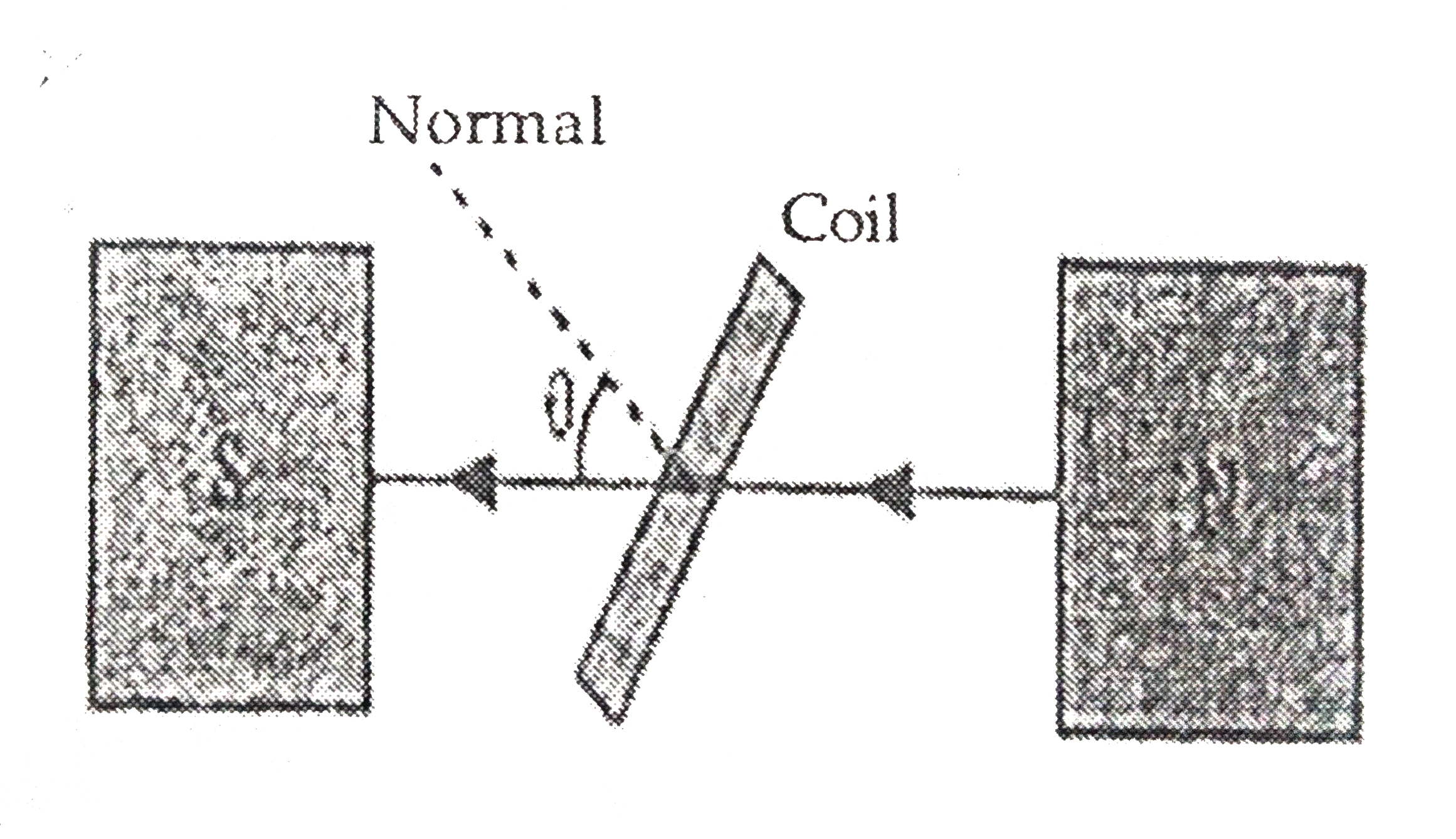 `therefore" Magnetic flux linked with the coil in this position is given by,"` `phi=N(B.A)` `=NBA cos theta=NBA cos omega t"...(i)"` where `'omega'` is angular velocity of the coil. Graph between magnetic flux and time, according to equation (i), is shown below: (ii) As the coil rotates, angle e changes. Therefore, magnetic flux `theta` linked with the coil CHANGE and an emf is induced in the coil. At this instant t, if e is the emf induced in the coil, then `e=-(d theta)/(dt)=-(d)(dt)(NAB cos omega theta)=-NAB(d)/(dt)(cos omega t)` `=-NAB(-sin omega t)omega` `e=NAB omega sin omega t` (iii) The graph between alternating emf versus time is shown below : 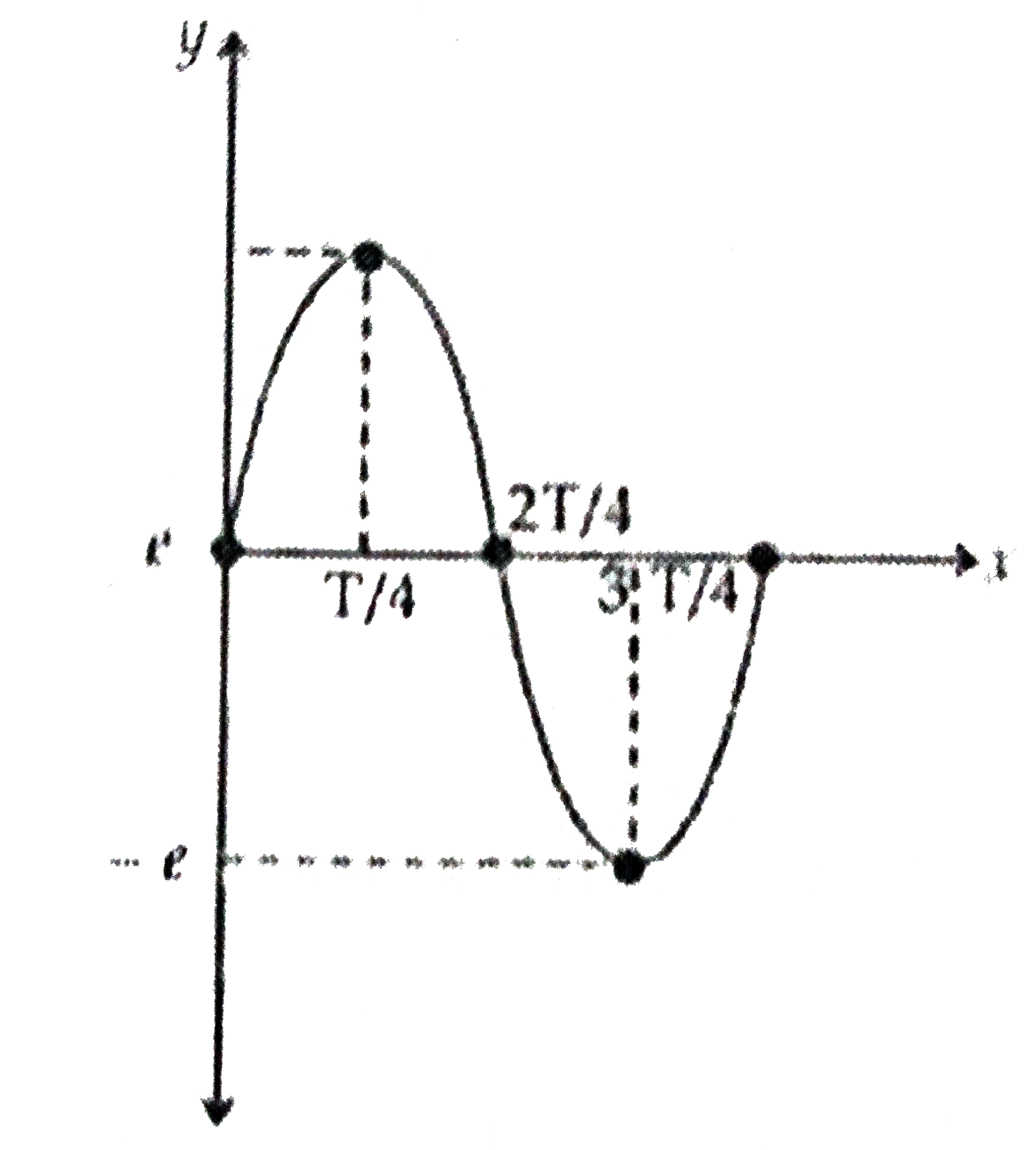 (b) A chock coil is an electrical appliance used for controlling current in an a.c. circuit. Therefore, if we use a RESISTANCE R for the same purpose, a lot of energy would be wasted in the form of heat ETC. |
|
| 45. |
Statement I : Sound waves show diffraction more prominently than the light waves. Statement II : The diffraction of light at a slitis more clearly visible when the slit width is increased. |
|
Answer» STATEMENT I is true, statement II is FALSE. |
|
| 46. |
Show that n=(1)/(sinC) where symbols have their usual notation. |
|
Answer» Solution :Applying Snell.s Law `n_(1)SIN i_(1)= n_(2)sin i_(2)` `N sin C= 1.sin90^(@)` `therefore n= (1)/(sinC)` |
|
| 47. |
On the basis of your understanding of the following paragraph and the related studied concepts. An electric dipole is a pair of equal and opposite point charges q and -9 separated by a distance '2a'. The total charge of the electric dipole is obviously zero but the field of the electric dipole at a point is non-zero because electric fields due to + qand - q charges at the point do not exactly cancel out. Electric field of a dipole, at large distances, depends on the product 'qa'. So we define a term dipole momentvector vecp of an electric dipole as vecp = q(2a) and its direction is along the line from q to + q charge. The dipole field at large distances fall off as 1/r^3. Further, the magnitude and direction of the dipole field depends not only on the distance r but also on the angle between the position vector vecr and the dipole moment vecp. Concept of electric dipoles is very significant for different materials. In most molecules, the centres of positive charges and of negative charges exactly coincide and their dipole moment is zero. However they develop a dipole moment when an electric field as applied. Such molecules are termed non-polar molecules. But in some molecules, the centres of positive charges do not exactly coincide with that of negative charges and the molecules has a permanent dipole moment even in the absence of an electric field. Such molecules are called polar molecules. Various materials give rise to interesting properties and important applications in the presence or absence of electric field. Define polarisation vector and give its SI unit. |
| Answer» Solution :The dipole moment developed per unit VOLUME in a DIELECTRIC in the direction of electric FIELD is termed as the polarisation vector `vec p`. Its SI unit is `C m^(-2)`. | |
| 48. |
Suppose, we think of fission of a " "_(26)^(56)Fe nucleus into two equal fragments, " "_(13)^(28)Al. Is the fission energetically possible ? Argue by working out Q of the process. Given m(" "_(26)^(56)Fe) = 55.93494 u and m(" "_(13)^(28)Al) = 27.98191 u. |
|
Answer» Solution :Let the fission reaction be expressed as `" "_(26)^(56)Fe to " "_(13)^(28)Al+ " "_(13)^(28)Al+Q` Here initial mass = m[`" "_(26)^(56)Fe]=55.93494 U` and final mass` = 2 m[" "_(13)^(28)Al] =2xx 27.98191 = 55.96382 u` `THEREFORE` GAIN in mass during fission reaction = 0.02888 u `therefore` Energy involved `Q = -0.02888 xx 931.5 MeV = - 26.90 MeV` As the process is ENDOTHERMIC and energy of 26.90 MeV is consumed i.e., initially we must supply an energy of 26.90 MeV to start the reaction. It shows that the fission is not energetically possible. |
|
| 49. |
A plane relectromagentic wave from of frequency v_(0) falls normally on the surfave of a mirror approaching with a relativistic velocity v. Then frequency of the reflected wave will be (given beta= (v)/(c)): |
|
Answer» `(1-beta)/(1 + beta)v_(0)` `omega. = (C + v)/(c) omega_(0)` Frequency of waves reflected from mirror and going towards source. `omega.. = (c)/(c-v) omega.` `therefore omega.. = (c)/(c-v) xx (c+ v)/(c) omega_(0)` `omega.. = ((c+ v)/(c-v))omega_(0) = ((1 + v/c))/(1 -v/c) omega_(0) = ((1 + beta)/(1 - beta))omega_(0)` where `beta = v/c" therefore v.. = ((1 + beta)/(1- beta)) v_(0)` |
|
| 50. |
Explain working of cyclotron. |
Answer» Solution :1. Figure shows a schematic view of the cyclotron.  2. Inside the metal boxes the PARTICLES is shielded and is not acted on by the electric field. (Electric field is prevailing only around two dees). 3. The magnetic field however acts on the particle and makes it go round in a circular path inside dee. 4. Every time the particle moves from one dee to another it is acted upon by the electric field. 5. The sign of the electric field is changed alternately in tune with circular motion of the particle. This ensures that the particle is always accelerated by the electric field. Each time the acceleration increases the energy of the particle. As energy increases, the radius of the circular path increases. So the path is a spiral one. 6. Charged particles (eg. proton) move in a semicircular path in one of the dees and arrive in the gap between the dees in time interval `T/2`, where T the time period of revolution. `T=1/V_(C)=(2pim)/(qB)orV_(C)=(qB)/(2pim)""...(1)` 7. This frequency is called the cyclotron frequency and denoted by `v_(c)`. 8. It is independent from speed of particle, momentum and kinetic energy. 9. The frequency `v_(a)` of the applied voltage is adjusted so that the polarity of the dees is reversed in the same time that it takes the IONS to complete one half of the revolution. The requirement `v_(a)=v_(c)` is called the resonance condition. 10. The phase of the supply is adjusted so that when the positive ions arrive at the edge of one dees another dees is at a lower potential and the ions are accelerated across the gap. 11. Inside the dees the particles travel in a region free of the electric field. The increase in their kinetic energy is qV each time they cross from one dee to another. 12. For circular motion, centripetal force = magnetic force, `(mv^(2))/r=qvB` `thereforer=(mv)/(qB)=p/(qB)""...(2)` where p is momentum 13. From this equation it is clear that the radius of their path goes on increasing each time their kinetic energy increases. 14. The ions are repeatedly accelerated across the dees until they have the required energy to have a radius approximately that of the dees. They are then deflected by a magnetic field and leave the system via an exit slit. 15. Speed of particle near Dee, `v=(qBR)/m""...(3)` where R is the radius of the trajectory at exit and equals the radius of a dee. 16. Hence, the kinetic energy of the ion is, `1/2mv^(2)=1/2m((qBR)/m)^(2)` `therefore1/2mv^(2)=1/2(q^(2)B^(2)R^(2))/m""...(4)` 17. Equation (1) and (2) indicates that, (1) (1) The time for one revolution of an ion is independent of its speed or radius of its orbit. (2) But, its kinetic energy depend on it radius of path. (By increasing speed, radius of the circle increase but frequency `v_(c)` remain constant). |
|