

Saved Bookmarks
This section includes 7 InterviewSolutions, each offering curated multiple-choice questions to sharpen your Current Affairs knowledge and support exam preparation. Choose a topic below to get started.
| 1. |
In the circuit shown, what is the energy stored in the coil at steady state is closed to? |
|
Answer» 21.3J |
|
| 2. |
An elastic metal rod will change its length when it |
|
Answer» falls vertically under its weight |
|
| 3. |
Define electric field. Write its SI units. Write the magnitude and direction of electric field due to an electric dipole of length '2a' at the mid-point of the line joining the two charges. |
|
Answer» Solution :Electric field at a point is defind as the ratio of force experienced by a small positive test charge PLACED at that point to the magnitude of test charge. Its SI units in `NC^(-1) ` We KNOW that electric field at a point on the equatorial line of a dipole is GIVEN by ` "" oversetto (E) =-(1)/(4 pi in _0) .(oversetto (p))/((a^(2) +r^(2))^(3//2)) ` At the mid-point of dipole r=0 and hence `oversetto E= (1)/(4 pi in _0).(oversetto p)/(a^(3)) ` Its direction is opposite to that of dipole moment ` oversetto p` |
|
| 4. |
What happens if we close one slit in a Young's double slit experiment? |
|
Answer» Solution :In the Young experiment closing one slit out of two slit then it will act like one slit. Now have a hole or slit, the diffraction pattern will be formed on screen DUE to diffraction occurred by a slit. The centre of the CENTRAL bright fringe will APPEAR at a point which lies on the STRAIGHT line `SS_(1)` or `SS_(2)`. |
|
| 5. |
(a) Three resistors 2Omega ,4Omega and 5Omegaare combined in parallel. What is the total resistance of thecombination ?(b) If the combination is connected to a battery of emf 20 V and negligible internal resistance,determine the current through each resistor, and the total current drawn from the battery. |
|
Answer» SOLUTION :Here `R_1 = 2Omega , R_2 = 4Omega` and `R_3 = 5Omega` In parallel combination RESULTANT RESISTANCE R is given by `1/R = (1)/(R_1) + (1)/(R_2) + (1)/(R_3) = 1/2 + 1/4 + 1/5= (10 + 5 + 4)/(20) = 19/20` ` rArr R = 20/19 Omega` (b) Here `epsi = 20V` and r = 0 ` therefore ` current through the THREE resistors are respectively `I_1 = (epsi)/(R_1) = 20/2 = 10 A, I_2 = (epsi)/(R_2) = 20/4 = 5 A, and I_3 = (epsi)/(R_3) = 20/5 = 4A` Total current drawn `I = I_1 + I_2 + I_3 = 10 + 5 + 4 = 19A` |
|
| 6. |
किसी एकांक धनावेश से वायु में निर्गत कुल विद्युत् फ्लक्स है |
|
Answer» `epsilon_0` |
|
| 7. |
When distance between two magnetic polesis doubled and pole strenght of each ishalved the magnetic force between them becomes |
|
Answer» `1/16` |
|
| 8. |
On the basis of your understanding of the following paragraph and the related studied concepts. An electric dipole is a pair of equal and opposite point charges q and -9 separated by a distance '2a'. The total charge of the electric dipole is obviously zero but the field of the electric dipole at a point is non-zero because electric fields due to + qand - q charges at the point do not exactly cancel out. Electric field of a dipole, at large distances, depends on the product 'qa'. So we define a term dipole momentvector vecp of an electric dipole as vecp = q(2a) and its direction is along the line from q to + q charge. The dipole field at large distances fall off as 1/r^3. Further, the magnitude and direction of the dipole field depends not only on the distance r but also on the angle between the position vector vecr and the dipole moment vecp. Concept of electric dipoles is very significant for different materials. In most molecules, the centres of positive charges and of negative charges exactly coincide and their dipole moment is zero. However they develop a dipole moment when an electric field as applied. Such molecules are termed non-polar molecules. But in some molecules, the centres of positive charges do not exactly coincide with that of negative charges and the molecules has a permanent dipole moment even in the absence of an electric field. Such molecules are called polar molecules. Various materials give rise to interesting properties and important applications in the presence or absence of electric field. Is the electric field due to a charge configuration with total charge zero necessarily zero ? Give an illustration in support of your answer. |
| Answer» Solution :Not necessarily zero. As an ILLUSTRATION net CHARGE of an electric dipole is zero but its electric FIELD at a point is FINITE. | |
| 9. |
Assertion:We always see the same face of the moon Reason : The period of rotation of the moon about its axis and its period of revolution about the earth are equal |
|
Answer» Both ASSERTION and REASON are true and Reason is the correct explanation of Assertion |
|
| 10. |
In photoelectric effect, the current |
| Answer» SOLUTION :Increase in INTENSITY of the incident RADIATION CORRESPONDS to an increase in the number of incidents photons, resulting an increase in the number of photo-electrons emitted. | |
| 11. |
The particle of ZnO material is 30 nm. Based on the dimension it is classified as |
|
Answer» Bulk MATERIAL |
|
| 12. |
A vertical circualr coil of raidus0.1 m and having10 turns carries a steady current when plane of coil is normal to magnetic merdiana neutral point is observedat centre of coilthe current in coil is |
| Answer» ANSWER :A | |
| 13. |
Distinguishbetween unpolarised and plane polarisedlight. An unpolarisedlight is incident on the boundary between two transparent media.State the consition when the reflected wave is totally plane polarised. Find out the expression for the angle of incidence in this case. |
|
Answer» Solution :The independent light waves whose planes of vibrations are randomly ORIENTED about the direction of propagation are SAID to be unpolarised. When the light waves TRANSMIT only one component parallel to a special axis, then the resulting light is called plane polarised or lineraly polarised light. When reflected WAVE is PERPENDICULAR to the refracted wave, the reflected wave is totally polarised wave. The angle of incidencein this case is called Brewster's angle and is denoted by `i_(B)`. The relation between incidence angle `i_(B)` is given by `mu= tan i_(B)`. |
|
| 14. |
A silver wire has a resistance of 2.1 Omega at 27.5^@C , and a resistance of 2.7 Omega at 100^@C. Determine the temperature coefficient of resistivity of silver at 27.5^@C. |
| Answer» SOLUTION :`0.0039^@ C^(-1)` | |
| 15. |
An intrinsic semiconductor has 10^(8)m^(-3) free electrons and is doped with pentavalent impurity atoms of density 10^(24)m^(-3) . The free electron density will increase by |
|
Answer» `10^8m^(-3)` The electron density will increase by `10^(24) m^(-3)`. |
|
| 16. |
(A ): When a capacitor is getting charged the conduction current in the connecting wires at any instant is equal to the displacement current in between the capacitor plates.(R) : Conduction current is always greater than the displacement current. |
|
Answer» Both 'A' and 'R' are true and 'R' is the correct explanation of 'A'. |
|
| 17. |
The radius of the oxygen nucleus (""_(8)^(16)O)is 2.8xx10^(-15)m . Find the radius of the lead nucleus ( ""_(82)^(205)Pb) . |
|
Answer» `8.55 xx10^(-15)m` |
|
| 18. |
On the basis of your understanding of the following paragraph and the related studied concepts. An electric dipole is a pair of equal and opposite point charges q and -9 separated by a distance '2a'. The total charge of the electric dipole is obviously zero but the field of the electric dipole at a point is non-zero because electric fields due to + qand - q charges at the point do not exactly cancel out. Electric field of a dipole, at large distances, depends on the product 'qa'. So we define a term dipole momentvector vecp of an electric dipole as vecp = q(2a) and its direction is along the line from q to + q charge. The dipole field at large distances fall off as 1/r^3. Further, the magnitude and direction of the dipole field depends not only on the distance r but also on the angle between the position vector vecr and the dipole moment vecp. Concept of electric dipoles is very significant for different materials. In most molecules, the centres of positive charges and of negative charges exactly coincide and their dipole moment is zero. However they develop a dipole moment when an electric field as applied. Such molecules are termed non-polar molecules. But in some molecules, the centres of positive charges do not exactly coincide with that of negative charges and the molecules has a permanent dipole moment even in the absence of an electric field. Such molecules are called polar molecules. Various materials give rise to interesting properties and important applications in the presence or absence of electric field. What do you mean by polarisation of a dielectric ? |
| Answer» Solution :In all dielectrics WHETHER polar or non-polar, there is a NET DIPOLE moment developed in the DIRECTION of electric field and thus phenomenon is KNOWN as polarisation of the dielectric. | |
| 19. |
If the charge on capacitor is increased by 5C, the energy stored in the capacitor is increased by 21%, what will be initial charge on the capacitor ? |
|
Answer» 10 C `U = (1)/(2) (Q^(2))/(C)` If charge BECOME Q + 5 then energy U. = 1.21 U `:. U = (1.21U)/(1)` `:. (1)/(2) ((Q+5)^(2))/(C) = 1.21 xx(1)/(2) (Q^(2))/(C)` `:. (Q+5)^(2) = 1.21 Q^(2)` `:. Q +5 =1.1 Q ` `:. 5 =0.1 Q :. = 50 C ` |
|
| 20. |
On the basis of your understanding of the following paragraph and the related studied concepts. An electric dipole is a pair of equal and opposite point charges q and -9 separated by a distance '2a'. The total charge of the electric dipole is obviously zero but the field of the electric dipole at a point is non-zero because electric fields due to + qand - q charges at the point do not exactly cancel out. Electric field of a dipole, at large distances, depends on the product 'qa'. So we define a term dipole momentvector vecp of an electric dipole as vecp = q(2a) and its direction is along the line from q to + q charge. The dipole field at large distances fall off as 1/r^3. Further, the magnitude and direction of the dipole field depends not only on the distance r but also on the angle between the position vector vecr and the dipole moment vecp. Concept of electric dipoles is very significant for different materials. In most molecules, the centres of positive charges and of negative charges exactly coincide and their dipole moment is zero. However they develop a dipole moment when an electric field as applied. Such molecules are termed non-polar molecules. But in some molecules, the centres of positive charges do not exactly coincide with that of negative charges and the molecules has a permanent dipole moment even in the absence of an electric field. Such molecules are called polar molecules. Various materials give rise to interesting properties and important applications in the presence or absence of electric field. In which direction is the magnitude of electric field due to a short dipole (i) maximum, (ii) minimum ? Write expression for the same. |
|
Answer» Solution :(i) Electric FIELD of a SHORT dipole is maximum ALONG its axial LINE. `vecE_("axial") = 1/(4pi epsi_0). (2 vecp)/r^3` (ii) Electric field of a short dipole has a least magnitude along its equatorial line. `vecE_("equatorial")= - (1)/(4pi epsi_0). (VEC p)/r^3` |
|
| 21. |
The P.E. of a simple harmonic oscillator, when the particle is half way to its end point is : |
|
Answer» `(2)/(3)E` `E=(1)/(2)m omega^(2)r^(2)` and potential energy `E_(P)=(1)/(2)m omega^(2)X^(2)` When `x=(r^(2))/(2)` then `E_(P)=(1)/(2)m omega^(2)(r^(2))/(4)` `IMPLIES""E_(P)=(E)/(4)` Correct choice is (b). |
|
| 22. |
Under Favourable conditions slime moulds form |
|
Answer» plasmodium |
|
| 23. |
Which of the following cannot be emitted by radioactive substance during their decay ? |
|
Answer» Protons |
|
| 24. |
On the basis of your understanding of the following paragraph and the related studied concepts. An electric dipole is a pair of equal and opposite point charges q and -9 separated by a distance '2a'. The total charge of the electric dipole is obviously zero but the field of the electric dipole at a point is non-zero because electric fields due to + qand - q charges at the point do not exactly cancel out. Electric field of a dipole, at large distances, depends on the product 'qa'. So we define a term dipole momentvector vecp of an electric dipole as vecp = q(2a) and its direction is along the line from q to + q charge. The dipole field at large distances fall off as 1/r^3. Further, the magnitude and direction of the dipole field depends not only on the distance r but also on the angle between the position vector vecr and the dipole moment vecp. Concept of electric dipoles is very significant for different materials. In most molecules, the centres of positive charges and of negative charges exactly coincide and their dipole moment is zero. However they develop a dipole moment when an electric field as applied. Such molecules are termed non-polar molecules. But in some molecules, the centres of positive charges do not exactly coincide with that of negative charges and the molecules has a permanent dipole moment even in the absence of an electric field. Such molecules are called polar molecules. Various materials give rise to interesting properties and important applications in the presence or absence of electric field. Distinguish between polar and non-polar molecules. Give examples too. |
|
Answer» Solution :Polar molecules are the molecules in which centre of positive CHARGE does not coincide with centre of negative charge and molecules have a definite dipole MOMENT of their own. Water `(H_2O)` and HCl are examples of polar molecules. Non-polar molecules are the molecules in which centre of positive charge exactly coincides with the centre of negative charge and molecules do not have a permanent dipole moment. HOWEVER, they DEVELOP a dipole moment in the presence of an electric FIELD. `H_2,O_2 and CO_2` are examples of non-polar molecules. |
|
| 25. |
From a given sample of uniform wire, two circular loops P and Q are made. P of radius 'r' and Q of radius nr. If the M.I. of Q about its axis is 4 times than that of P, then value of n is : |
|
Answer» `(4)^(1//3)` `THEREFORE mxx2pinr(nr)^(2)=4[(m2pir)r^(2)]` IMPLIES `n^(3)=4impliesn=4^(1//3)` |
|
| 26. |
At room temperature, the rms speed of the molecules of a certain diatomic gas is found to be 1920 m s^(-1). The gas is |
|
Answer» `H_(2)` As `v_(rms)=1920ms^(-1)=sqrt((3RT)/(M))=sqrt((3xx8.31xx300)/(M))` `therefore M=2xx10^(-3)kg=2g` It is hydrogen gas. |
|
| 27. |
In complete electromagnetic spectrum radiation having minimum wavelength is |
| Answer» Answer :D | |
| 28. |
The refractive angle of a prism is A and the refractive index of the material of the prism is cot(A/2). The angle of minimum deviation of the prims is |
|
Answer» `PI+2A` |
|
| 29. |
Internal energy of an ideal gas changes with change in its |
|
Answer» PRESSURE only |
|
| 30. |
The area of the coil in a moving coil galvanometer is 8 cm^2 and has 10 turns. The magnetic induction is 0.1 T and the couple per unit twist of the suspended fibre is 10^(-6) Nm per degree. If the deflection is 90^0, calculate the current passing through it |
| Answer» SOLUTION :`1.13 XX 10^(-1) A` | |
| 31. |
Centre of mass of a ring will be at a position: |
|
Answer» |
|
| 32. |
When two progressive waves y_(1) = 4 sin (2x - 6t) and y_(2) = 3 sin (2x -6t - (pi)/(2)) are superimposed, the amplitude of the resultant wave is ............. . |
|
Answer» 5 m `A_("resultant ") = (A_(1)^(2) + A_(2)^(2) + 2A_(1) A_(2) cos Delta phi )^(1//2) ` =` sqrt((4)^(2) + (3)^(2))`= 5 So, correct choice is (b) . 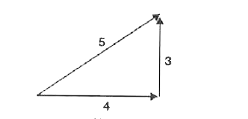
|
|
| 33. |
A bead of mass 100 g is attached to one end of a spring of natural length L and spring constant k=((sqrt3+1)mg)/L, where m is the mass of bead. The other end of the spring is fixed at point A on a smooth vertical ring of radius R as shown in the figure. The normal reaction at B just after it is released to move is (take, g=9.8ms^(-2)) |
|
Answer» 1.73 N = `sqrt((K^(2)x^(2)+m^(2)G^(2)))=2.55N` |
|
| 34. |
Two blocks are conncented by a spring of natural length 2 m. The force constant of spring is 200 N/m. If block 'A' and 'B' both are displaced by 0.5 m in opposite directio. |
|
Answer» SOLUTION :In this case, change in LENGTH of spring is 1 m so spring FORCE is `F=-Kx=-(200).(1)` `F=-200N` 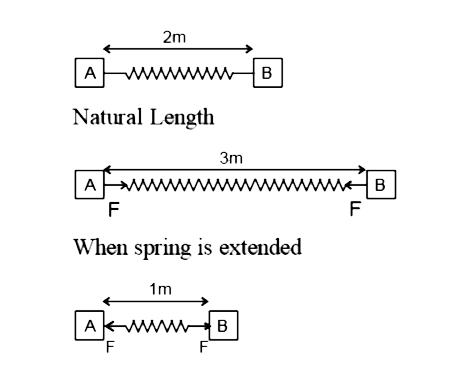
|
|
| 36. |
Distinguish the magnetic properties of dis-para and ferro-magnetic substance in terms (i) susceptibility, (ii) magnetic permeability , and (iii) coercicity. Give one example of each these materials. Draw the field lines due to an external magnetic field near a (i) diamagnetic , (ii) paramagnetic substance. |
Answer» SOLUTION :Distinction between dia-para and ferro-magnetic SUBSTANCE on the BASIS of required properties is as follows :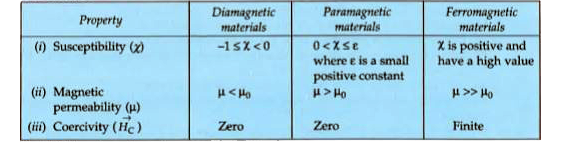 The field lines have been shown in FIG. |
|
| 37. |
Given below are some famous numbers associated with electromagnetic radiations in different contexts in physics . State the part of the electromagnetic spectrum to which each belongs . (a) 21 cm ( wavelength emitted by atomic hydrogen in interstellar space). (b) 1057 MHz [ frequency of radiation arising from two close energy levels in hydrogen, known as Lamb shift ]. (c) 2.7 K [ temperature associated with the isotropic radiation filling all space - thought to be a relic of the ..big - bang.. origin of the Universe ). (d) 5890 Å - 5896 Å [ double lines of sodium). (e) 14.4 keV [energy of a particular transition in (57)^Fe nucleus associated with a famous high resolution spectroscopic method ( Mössbauer spectroscopy)]. |
|
Answer» Solution :(a) Radio (short - wavelength end) waves (b) Radio ( short - wavelength end ) waves ( c) Microwave (d) Visible ( YELLOW ) LIGHT (e) X - rays (or SOFT `gamma`- rays) REGION. |
|
| 38. |
T.V transmission tower at a particular station has a height of 160 m (i) What is its coverage range? (ii) How much population is covered by transmission, if the average population density around the tower is 1200 km^(-2) (ii) By how much the height of tower be increased to double coverage range? Given radius of earth= 6400 km. |
|
Answer» |
|
| 39. |
The ration of minimum to maxmium wavelength in Balmer series is: |
|
Answer» `5:9` |
|
| 40. |
In the given circuit, with steady current, the potential drop across the capacitor must be |
|
Answer» Solution :In steady state, no current will pass through the capacitor. In the lower LOOP, `2V - 2iR-iR-V = 0` IMPLIES`i = V//3R` For the upper loop, `V-V_(c) - iR-V=0` implies`|V_(c) = iR = V//3` Hence, (B) is correct 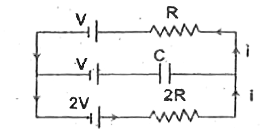
|
|
| 41. |
A voltmeter has resistance of 2000Omega and it can measure up to 2 volts.To make itsrange 10volt ,the necessary resistance to connect in series will be : |
|
Answer» `2000Omega` |
|
| 42. |
Calculate the equivalent capacitance between two points A and B in the following figure: |
|
Answer» Solution :Here capacitors, `C_(1),C_(2) and C_(3)` are CONNECTED in parallel. i.e., `C.=C_(1)+C_(2)+C_(3)` or `C.=2+3+5` or `C.=10muF` 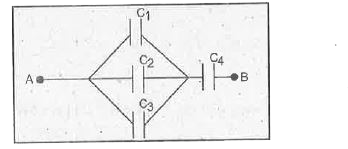 Now. and `C_(4)(10muF)` are in series. `therefore` Equivalent CAPACITANCE of the combination between A and B is `C=(C.xx10)/(C.+10)=(10xx10)/(10+10)=(100)/(20)=5muF`. |
|
| 43. |
The r.m.s. velocity of helium at temperature 0^@C is (density of helium= 1.01785 kg/m^3, atmospheric pressure = 1.013xx10^5 N/m^2 |
|
Answer» |
|
| 44. |
The ground state energy of hydrogen atom is - 13.6 eV. When its electron is in the first excited state, its excitation energy is. |
|
Answer» 6.8 EV Infirstexcited state `E_(2) = (13.6)/((2)^(2)) = -3.4 eV` `therefore ` Excitation energy ` = E_(2) = E_(1) =- 3.4 - (-13.6) eV = + 10.2 eV` |
|
| 45. |
In M.K.S. system unit of epsilon_0 equals: |
|
Answer» `9 XX 10^9 Nm^2//C^2` |
|
| 46. |
If the angular momentum of an electron in an orbit is J, then the kinetic energy of the electron in that orbit is: |
|
Answer» `J^2/(2M)` |
|
| 47. |
Wave property of electrons implies that they will show diffraction effects. Davission and Germer demonstrated this by diffracting electrons from crystals. The law governing the diffraction from a crystal is obtained by requiring that electron waves reflected from the planes of atoms in a crystal interfere constructively (see figure) In an experiment, electrons are made to pass through a narrow slit of width 'd' comparable to either de-Broglie wavelength. They are detected on a screen at a distance 'D' from the slit The following graphs that can be expected to represent the number of electrons 'N' detected as a function of the detector position 'y' (y=0 corresponds to the middle of the slit) is |
|
Answer»
|
|
| 48. |
A vertical rod of length l is moved with constant velocity v towards east. The vertical component of earth magnetic field is B and angle of dip is theta. The induced e.m.f. in the rod is |
|
Answer» `BLV SIN THETA` |
|
| 49. |
Two blocks are conncented by a spring of natural length 2 m. The force constant of spring is 200 N/m. If block 'A' and 'B' both are displaced by 0.5 m in same direction. |
| Answer» Solution :Since both blocks are DISPLACED by 0.5 m in same direction, so CHANGE in LENGTH of SPRING is zero. Hence, spring force is zero. | |


