

Saved Bookmarks
This section includes 7 InterviewSolutions, each offering curated multiple-choice questions to sharpen your Current Affairs knowledge and support exam preparation. Choose a topic below to get started.
| 1. |
A cyclotron's oscillator frequency is 10 MHz. What should be the opertaing magnetic field for accelerating protons ? If the radius of its 'dees' is 60 cm, what is the kinetic energy (in MeV) of the proton beam produced by the accelerator. (e=1.60xx10^(-19)C, m_(p)=1.67xx10^(-27)kg, 1 MeV = 1.6xx10^(-13) J). |
|
Answer» Solution :The oscillator frequency should be same as proton.s cyclotron frequency. USING Eqs. (4.5) and (4.6 (a)) we have `B=2pimv//q=1.67xx10^(-27)xx10^(7)//(1.6xx10^(-19))=0.66T` Final velocity of PROTONS is `v=rxx2piv=0.6mxx6.3xx10^(7)=3.78xx10^(7)m//s` |
|
| 2. |
Polarised light can be produced by : |
|
Answer» Dispersion |
|
| 3. |
What is the principle of potentiometer? |
| Answer» SOLUTION :The potential difference ACROSS any LENGTH of the POTENTIOMETER wire is directly proportional to its length. This is the PRINCIPLE of the potentiometer. | |
| 4. |
The figure shows a transparent slab of length 1m placedin air whose refractive index in x direction varies as mu =1 + x^(2) (0 lt x lt 1).The opticalpathlength of ray R will be |
| Answer» ANSWER :C | |
| 5. |
A perfectly black body in one whose emissivity is |
|
Answer» zero |
|
| 6. |
Given de- Broglie's explanation of quantisation of angular momentum as proposed by Bohr. |
|
Answer» Solution :For an electron MOVING in `n^(th)` drcular orbit of radius `r_(n)`, the TOTAL distanceis `=2pir_(n)` Circumference of a stationary Bohr orbit of radius `r_(n)` is EQUAL to integral multiple of wavelength of matter waves `2pir_(n)=nlamda""......(i)` The de-broglie wavelength of the electron moving in the `n^(th)` orbit. `lamda=(H)/(mv)""......(2)` From equation (1) and (2), `2pir_(n)=(nh)/(mv)` i.e., `mvr_(n)=(nh)/(2pi)` But, angular momentum of the electron is `L=mvr_(n)` Hence `L=(nh)/(2pi)` |
|
| 7. |
A carbon filament has resistance of 120Omega at0^(@)C what must be the resistance of a copper filament connected in series with carbon so that combi-nation has same resistance at all temperatures(alpha_(carbon)=5 xx 10^(-4)//^(0)C, alpha_(copper)=4 xx 10^(-3)//^(0)C) |
|
Answer» `120 OMEGA` |
|
| 8. |
Define wavefront of a travelling wave. Using Huygens principle, obtain the law of refraction at a plane interface when light passes from rarer to a denser medium. |
|
Answer» Solution :A wavefront is a surface of constant phase. CONSIDER a plane surface XY separating a rarer medium of refractive index `n_(1)` from a denser medium of refractive index `n_(2)`. Let `c_(1) and c_2` be the values of speed of light in the two media. AB is a plane wavefront incident on XY at an angle i. Let at a given INSTANT the end of wavefront just strikes the surface XY but the other end B has still to cover a path BC. If it takes time t, then `BC= c_(1)t.` According to Huygen.s principle, point A meanwhile begins to emit secondary wavelength which will cover a distance `c_(2)t` in second medium in time t. Draw a circular arc with A as centre and `c_(2)t` at as radius and draw a tangent CD from point C on this arc. Then CD is the refracted wavefront, which subtends an angle r from surface XY. 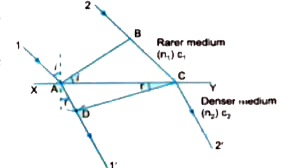 Now in `TRIANGLEABC SIN i=(BC)/(AC)=(c_(1)t)/(AC)` and in `triangleADC sin r=(AD)/(AC)=(c_(2)t)/(AC)` `(sin i)/(sin r)=(c_(1) t//AC)/(c_(2)t//AC)=c_(1)/c_(2)="a constant" =(n_(2))/(n_(1))=n_(21)` Which is Snell.s law of refraction. |
|
| 9. |
How many time constants will elapse before the energy stored in the capacitor reaches half of its equilibrium value in a charging RC circuit? |
|
Answer» 1.23 |
|
| 10. |
If the total number of neutrons and protons in a nuclear reaction is conserved how than is the energy absorbed or evolved in the reaction? |
|
Answer» Solution :(i) SINCE proton number and neutron number are CONSERVED in a NUCLEAR reaction, the total rest mass of neutrons and protons is the same on either side of a reaction. (ii) But the total binding energy of nuclei on the LEFT side need not be the same as that on the right hand side. (iii) The difference in these binding ENERGIES appears as energy released or obsored in nuclear reaction. |
|
| 11. |
Two ends of an 0.1 M Omega potentiometer are connected in the way as shown in the following figure. |
|
Answer» `R_(AB)=0.1 M Omega` for all values of x |
|
| 12. |
When we stretch a wire , we have to perform work, why ? What happen to the energy given to the wire in the process. |
| Answer» Solution :When a wire is stretched, the atoms are displaced from their respective positions and WORK is DONE against interatomic force of ATTRACTION. The work is stored in the wire form of ELASTIC potential ENERGY. | |
| 13. |
A stone weighs 100N on the surface of the Earth. The ratio of its weight at a height of half the radius of the Earth to a depth of half the radius of the earth will be approximately |
|
Answer» 3.6 `=(R^(2))/(((3R)/(2))^(2))=(4)/(9) rArr W_(h)=100xx(4)/(9)` `(W_(d))/(W)=(g.)/(g)=1-(d)/(R )=1-(1)/(2)=(1)/(2) rArr W_(d)=100xx(1)/(2)` `therefore (W_(h))/(W_(d))=((100xx4)/(9))/(100//2)=(8)/(9)=0.9` So CORRECT choice is (d). |
|
| 14. |
Two resistors R_(1) and R_(2) can slide without friction along two parallel metal guides dierected at an angle alpha to the horizontal and separated by a distance b . The guides are not connected at the bottom as shown. The entire system is placed in an upwardmagnetic field which decreases with time as (dB)/(dt) = beta ,x = 0 and x - axis is along the guide as shown in the figure. The resistors are made to slide with a constant velocity v downwards . The emf induced due to decreases of B with time only ( and the direction of current in loop ) respectively (ACW rarr anticlockwise, CW rarr clockwise ) |
|
Answer» AB `alpha` (ACW) e = - `(d phi )/(DT) = "ab" ( - (dB)/(dt)) = ab alpha ` ANTICLOCKWISE as seen from above. `therefore` (A) |
|
| 15. |
Two resistors R_(1) and R_(2) can slide without friction along two parallel metal guides dierected at an angle alpha to the horizontal and separated by a distance b . The guides are not connected at the bottom as shown. The entire system is placed in an upwardmagnetic field which decreases with time as (dB)/(dx) = beta ,x = 0 and x - axis is along the guide as shown in the figure. The resistors are made to slide with a constant velocity v downwards . The emf induced due to decrease in B due to change in position only |
|
Answer» `beta` abv(CW) `THEREFORE` (B) |
|
| 16. |
Assertion : The dominant mechanism for motion of charge carreis in forward and reverse biased silicon P-N junction are drit in both forward and reverse bias. Reaon : In reverse biasing, no current flow through the junction. |
|
Answer» If both assertion and REASON are true and the reason is the correct explanation of the assertion |
|
| 17. |
A 100 mH inductor, a 20muF capacitor and a 10Omega resistor are connected in series to a 100V ac source. Calculate (i) impedance of circuit at resonance (ii) current at resonance (iii) resonant frequency. |
|
Answer» Solution :(i) IMPEDANCE of circuit at resonance `Z=R=10Omega` (ii) CURRENT at resonance `=(E)/(R )=(100)/(10)=10A` (III) Resonant frequency, `v_(0)=(1)/(2pisqrt(LC))` `v_(0)=(1)/(2pisqrt((100xx10^(-3))(20xx10^(-6))))=112.5Hz` |
|
| 18. |
Consider example 14, taking the coefficient of friction, mu to be 0.4 and calculate the maximum compression of the spring (g=10ms^(-2)) |
Answer» Solution :Both the frictional force and the spring force act so to oppose the compression of the spring as shown in figure. 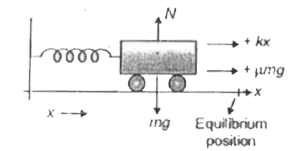 USE the work - energy theorem, The change in `KE=DeltaK=K_(f)-K_(i)=0-(1)/(2)mv^(2)` The work done by the net force is `W=-(1)/(2)Kx_(m)^(2)-mu mg x_(m)` Equating the two, we get `(1)/(2)mv^(2)=(1)/(2)Kx_(m)^(2)+mu mg x_(m)` `mumg=0.4xx1500xx10=6000N` `Kx_(m)^(2)+2mumg x_(m)-mv^(2)=0"(After rearranging the given equation)"` `x_(m)=(-2mu mg+sqrt(4mu^(2)m^(2)G^(2)-4(k)(-mv^(2))))/(2K)""("Taking +ve sign with square root as "x_(m)" is +ve")` `=(-mumg+sqrt(mu^(2)m^(2)g^(2)-4(k)(-mv^(2))))/(K)` `=(-0.4xx1500xx10+sqrt((0.4xx1500xx10)^(2)+1500xx7.5xx10^(3)xx10^(2)))/(7.5xx10^(3))` `=3.75m` Which, as expected, is less than the result in Example 14. If the two forces on the body consist of a conservative force `F_(c)` and a non - conservative force `F_(nc)` the conservation of mechanical energy FORMULA will have to be modified. By the W-E theorem. `(F_(c)+F_(nc))Deltax=DeltaK` But `F_(c)Deltax=-DeltaV` Hence, `Delta(K+V)=F_(nc)DeltaX` `DeltaE=F_(nc)Deltax` where E is the total mechanical energy. Over the path this assumes the form `E_(f)-E_(i)=W_(nc)` where `W_(nc)` is the total work done by the non - conservative forces over the path Unlike conservative force `W_(nc)` depends on the path taken. |
|
| 19. |
An electron starting at angle alpha=60^(@) with a uniform magnetic induction B=0.1 T moves with velocity v=10^(6) m s^(-1). A screen is held at right angles to the field at a distance l=5 cm from the strating point. Find the distance r from the straight point to the point on the screen where the electron strikes. |
|
Answer» |
|
| 20. |
Using Maxwell's equacations. Show that (a)a time dependentmagneticfield cannotexistwithoutan electric field, (b) a unifromelectric fieldcannotexist in thepresenceofa time-dependencemagneticfield, (c)insidean emptycavitya unifromelectric(or magnetic ) fieldcan betime-dependent. |
|
Answer» SOLUTION :(a) If `vec(B) = vec(B) (t)`, then, CURL `vec(E) = (-del vec(B))/(del t) != 0`. so, `vec(E)` cannot vanish. (b) Here also, curl `vec(E) != 0`, so `vec(E)` cannot be uniform. (c) Suppose for instance, `vec(E) = vec(a) f(t)` where `vec(a)` si spatially and temporally FIXEDVECTOR. Then `- (del vec(B))/(d t) = curl vec(E) = 0`. Generally speakingthis contradicts the otherequactioncurl `vec(H) = (del vec(D))/(del t) != 0` for in thiscase the left hand SIDE is TIME independentbut `RHS`dependson time. The onlyexception is when`f(t)` is linearfunction. Thena unifromfield `vec(E)`can be timedependent. |
|
| 21. |
Calculate the inductanceof a coil of100 turns of wire wouldon an iron ring ofradius10 cm and10 cm ^(2)in cross-section,the relativepermeabilityofiron being700 |
|
Answer» |
|
| 22. |
A voltmeter can measure upto 25 volt and its resistance is 1000Omega.How much resistance should be connerted in series so that it can measure voltage upto 250 volt? |
|
Answer» `90Omega` |
|
| 23. |
Which type of wave show the property of polarisation ? |
| Answer» SOLUTION :Only TRANSVERSE WAVES SHOW. | |
| 24. |
A thin double convex lens is cut into two equal pieces A and B by a plane containing principal axis. The piece 'B' is further cut into two more pieces 'C' and 'D' by another plane perpendicular to the principal axis. If the focal power of the original lens is 'P', then those of A and C are de |
|
Answer» <P>`P, P/4` |
|
| 25. |
A square current carrying loop abcd is palced near an infinitely long another current carrying wire ef. Now, match the following two columns. |
|
Answer» <P> |
|
| 26. |
A closed organ pipe of length 1.2 m vibrates in its first overtone mode. The pressure variation is maximum at |
|
Answer» 0.8 m from the OPEN end |
|
| 27. |
It has been determined experimentally that when light falls on a metal surface, the surface emits electrons. For example, you can start a current in a circuit just by shining a light on a metal plate. a. What is your explanation? b. Mention some other methods in which electron emission is possible. c. Are stopping potential and cut off potential the same? |
|
Answer» Solution :a. The electrons in the metal surface absorb photon ENERGY and are emitted. b. Thermionic EMISSION, PHOTOELECTRIC effect, field emission, secondary emission. c. Yes |
|
| 28. |
A wave is represented by the equation : y = Asin(10 pi x + 15 pit + pi//3),where, x is in metre and t is in second. The expression represents. |
|
Answer» a WAVE TRAVELLING in the positive x-direction with a velocity 1.5m/s |
|
| 29. |
In the figure shown, a particle is released from the position A on a smooth track. When the particle reaches at B, then normal reaction on it by the track. When the particle reachesat B, then normal reaction on it by the track is |
|
Answer» MG |
|
| 30. |
A body of mass 'm' slides down a smooth inclined plane having an inclination of 45^(@) with the horizontal. It takes 4sec to reach the bottom. If the body is placed on a similar plane having coefficient of friction 0.5. What is the time taken for it to reach the bottom? |
| Answer» Answer :A | |
| 31. |
Which scientist invented cathode rays? |
|
Answer» Maxwell |
|
| 32. |
What is the maximum angular speed of the electron of a hydrogen atom in a stationary orbit? |
|
Answer» Solution :Maximum ANGULAR speed will be in its ground STATE. Hence `omega_(MAX)=(V_(1))/(t_(2))=(2.2xx10^(6))/(0.529xx10^(-10))=4.1xx10^(16)rad//sec` |
|
| 33. |
…. radiation is emitted by hot bodies. |
| Answer» Answer :C | |
| 34. |
(a)Show using a proper diagram how unpolarised light can be linearly polarised by reflection from a transparent glass surface. (b) The figure shows a ray of light falling normallyon. the face AB of an equilateral glass prism having refractive index 3/2, placed A in water of refractive index 4/3. Will this ray suffer total internal reflection on striking the face AC? Justify your answer. |
|
Answer» Solution :The angle of incidence of the ray . On STRIKING the face AC is `i= 60^(@) ` ( as from figure ) Also , relative refreactive index of glass . With RESPECT OT the surrounding water is ` mur=(3//2)/( 4//3) =(9)/(8) ` Also ` sin i= sin 60^(@) =(SQRT(3))/( 2) =( 1.732)/( 2) ` `= 0.866` For total internal reflection ,the requuired CRITICAL angle , in this case , is given by ` sin i_e = (1)/( mu ) = ( 8)/(9) = 0.89` ` therefore i lt i_3` Hence the ray would not suffer total internal reflection on striking the face AC [The students-may just write the two conditions needed for total internal reflection without analysis of the given case , student may be awarded 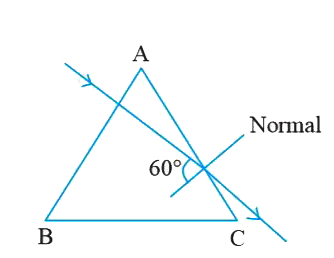
|
|
| 35. |
The temperature coefficient of resistance of a wire is 0.00125^@ C^(-1) w.r.t temperature at 300 K at which the resistance of the wire is one ohm. Find the temperature at which the resistance of the wire will be 2 ohm. |
|
Answer» Solution :`alpha = 0.00125^@ C, t_1 = 300 K,R_1 =1 Omega` `R_2 = 2Omega, t_2=?` Temperature coefficient resistance `alpha =(R_2 -R_1)/(R_ (t_2 -t_1)) , 0.00125 = (2-1)/(1(t_2 - 300))` `t_2-300 =1/(0.00125)` `t_2 =300 +(10^3)/(1.25) = 300 + 800 = 1100 K` Final temperature `t_2 = 1100 K` |
|
| 36. |
Who had the daring to eat in Mahadevi Verma's plate? |
|
Answer» Gillu |
|
| 37. |
On increasing the tube-length of a compound microscope its magnifying power |
|
Answer» increases |
|
| 38. |
._(29)^(64) Cu can decay by beta^(-) or beta^(+) emmision, or electron capture. It is known that ._(29)^(64) Cu has a half life of 12.8 hrs with 40% probability of beta^(-) decay 20% probability of beta^(+) decay and 40% probability of electron capture. The mass of ._(29)^(64) Cu is 63.92977amu whil e ._(30)^(64) Zn is 63.92914 amu and ._(28)^(64) Ni is 63.92796 amu. If initially there was 10^(22) atoms of._(29)^(64) Cu, what is the initial rate at which energy is being produced due to beta^(+) decay ? |
|
Answer» `5.8xx10^(4)` W `=3.2xx10^(3)` W |
|
| 39. |
._(29)^(64) Cu can decay by beta^(-) or beta^(+) emmision, or electron capture. It is known that ._(29)^(64) Cu has a half life of 12.8 hrs with 40% probability of beta^(-) decay 20% probability of beta^(+) decay and 40% probability of electron capture. The mass of ._(29)^(64) Cu is 63.92977amu whil e ._(30)^(64) Zn is 63.92914 amu and ._(28)^(64) Ni is 63.92796 amu. What is the half life for electron capture? |
|
Answer» `5.12` Hrs. `._(29)^(64)Cu rightarrow ._(28)^(64)Ni+._(+1)^(0)e+VQ=(m_(Zn)-m_(Ni)-2me)C^(2)` ` ._(29)^(64)Cu+._(-0)^(0)e rightarrow ._(28)^(64)Ni+VQ=(m_(2n)-m_(Ni))C^(2)` `lambda=lambda_(1)+lambda_(2)+lambda_(3)(lambda_(1)=0.4lambda,lambda_(2)=0.2lambda,lambda_(3)=0.4lambda)` `T_(1//2) e-capture=(T_(1//2))/(0.4)=(12.8)/(0.4)=32` hrs. |
|
| 40. |
._(29)^(64) Cu can decay by beta^(-) or beta^(+) emmision, or electron capture. It is known that ._(29)^(64) Cu has a half life of 12.8 hrs with 40% probability of beta^(-) decay 20% probability of beta^(+) decay and 40% probability of electron capture. The mass of ._(29)^(64) Cu is 63.92977amu whil e ._(30)^(64) Zn is 63.92914 amu and ._(28)^(64) Ni is 63.92796 amu. What is the Q value of beta^(-) decay? |
|
Answer» `0.587` MEV `=0.00063xx931.5=0.587` MeV |
|
| 41. |
Define SI unit of electric charge in terms of Ampere. |
|
Answer» Solution :1. The SI unit of charge namely the Coulomb can now be defined in terms of the ampere. 2. When a steady current of 1 A is SETUP in a conductor, the quantity of charge that FLOWS through its cross section in 1 SEC is ONE Coulomb (1 C). |
|
| 42. |
Both light and sound waves produce diffraction .It is more difficult to observe the diffraction with light waves because |
|
Answer» Light wave do not require medium |
|
| 43. |
How did Einstein'sphotoelectric equationexplain the effect of intensity and potentialincidenton photoelectric current ? Howdid thiseqaution accountfor the effectof frequencyof incident light on stopping potential? |
|
Answer» Solution :(1) Einstein postulated that a beam of light consists of small energy packets called PHOTONS or quanta. (2 ) The energy of photon is E = hv . Where ' h 'is PLANCK's constant , v is frequency of incident light ( or RADIATION ). (3 ) If the absorbed energy of photon is greaterthan the work function `(phi_(0) = hv_(0))` , the electron is emitted with maximum kinetic energy i.e,` K_("max") = 1/2 mv_("max")^(2) = eV_(0) = hv - phi _(0)`. Thisequationis KNOWN as Einstein's photoelectric equation . (4) Effect of intensity of light on photoelectric current : When the intensity (I) of incident light , with frequencygreaterthan the threshold frequency`(v_(0)gt v_(0))` is increased then the number of photoelectrons emitted decreases i.e the value ofphotoelectric current (i) increases ie. `i prop I`. , (5 ) On increasing the positive potential on collectingelectrode , the photoelectric current increases. At a particular positive potential , the photocurrentbecomes maximum which is known as saturated current . (ii) On increasing the value of negative potentialthe value of photoelectric current becomes zero. This is known as stopping potential `(v_(0))` (iii) Stopping potentialdoes not depend on the intensity of incident light . On increasing intensity ,the value of saturated current increases, whereas the stopping potential remains unchanged. (6) The effect of frequency of incident radiation on stopping potential : On increasing the frequency of incidentlight, the value of stopping potential goes on increasinggradually as shown in fig . That means `k_("max")` increases `eV_(0)`also increases . (7) From the graph , we note that (i) For a given photosensitive metal , the cut off potential `(v_(0))`varies linearly with the frequency of the incident rediation . (ii) For a given photosensitive metal, there is a certain minimum cut off frequency `v_(0)` (called threshold frequency ) for which the stopping potential is zero . (8)From the graph we note that , (i) The value of cut - off potential is different for radiation of different frequency . The value of stopping potentialis more negative for radiationof higherincident frequency . ( 9) From above experiments , it is found that , if the incident radiation is of higher frequency than THATOF threshold frequency , the photoelectric emission is possible . 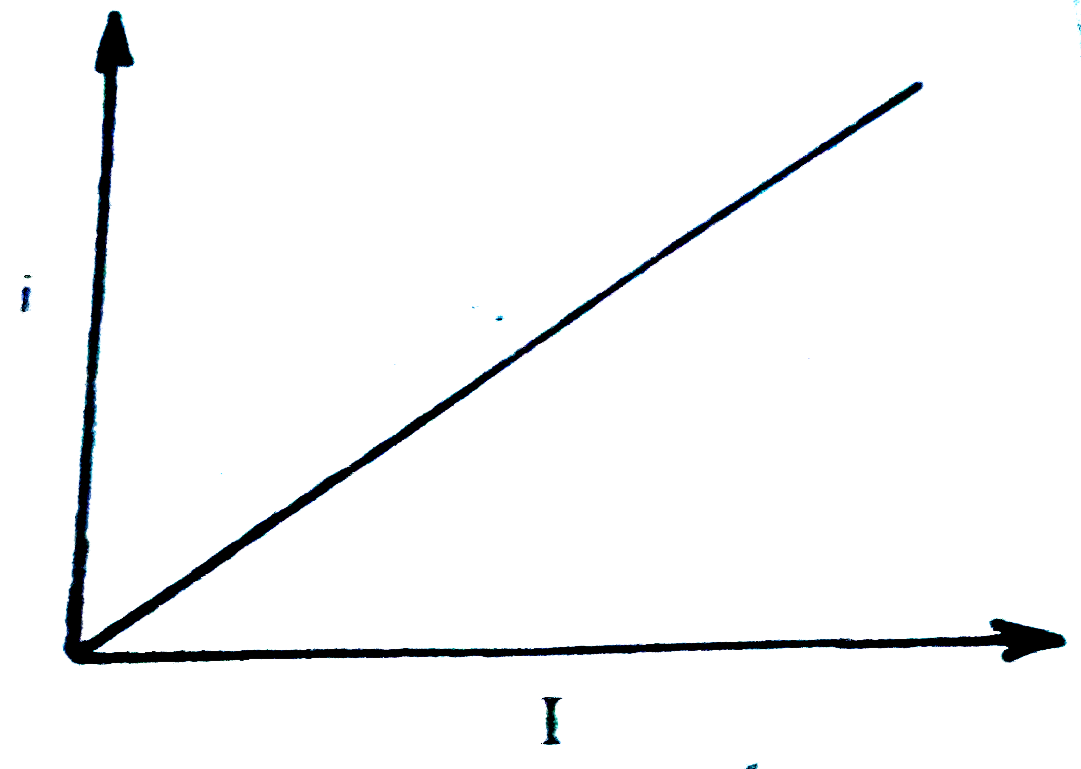 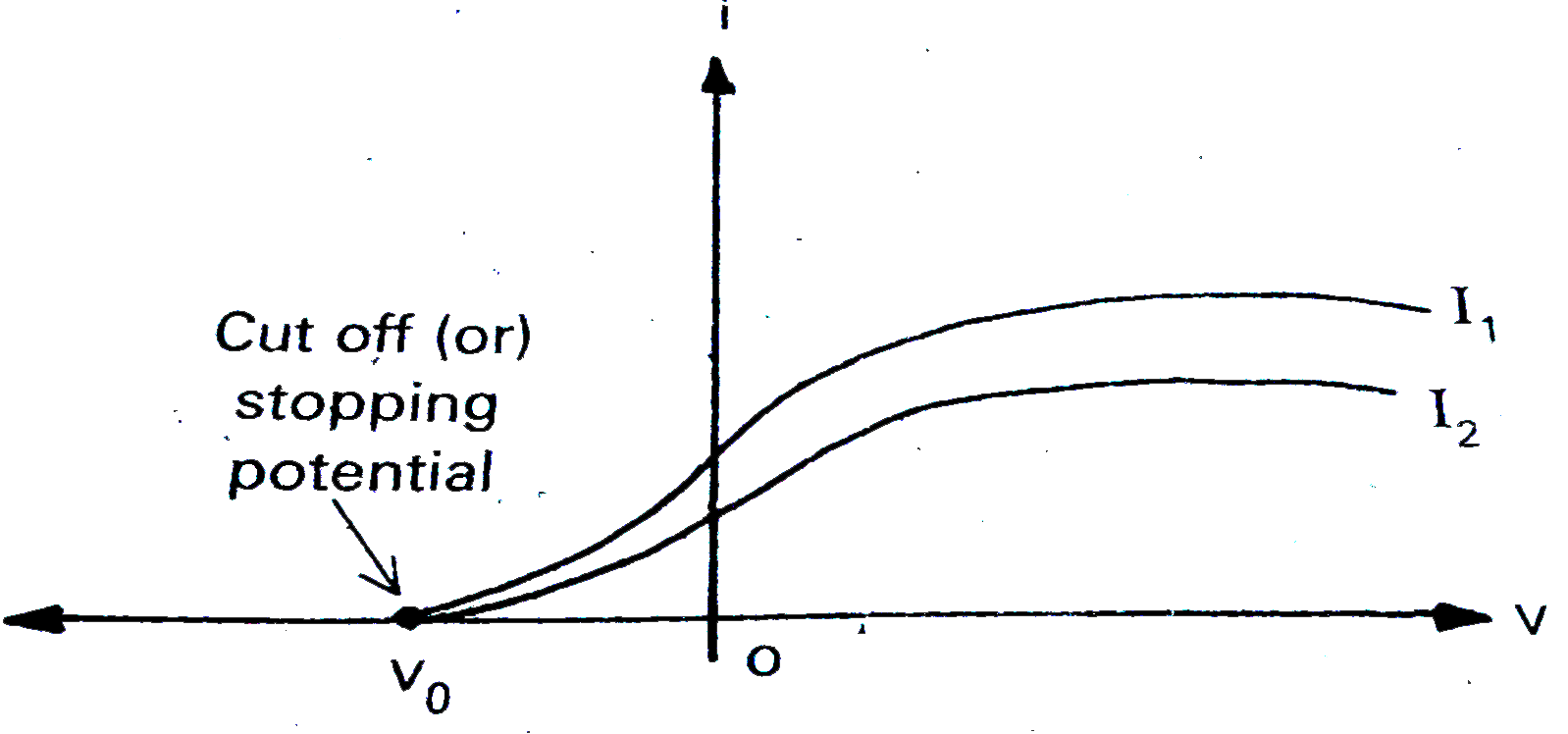 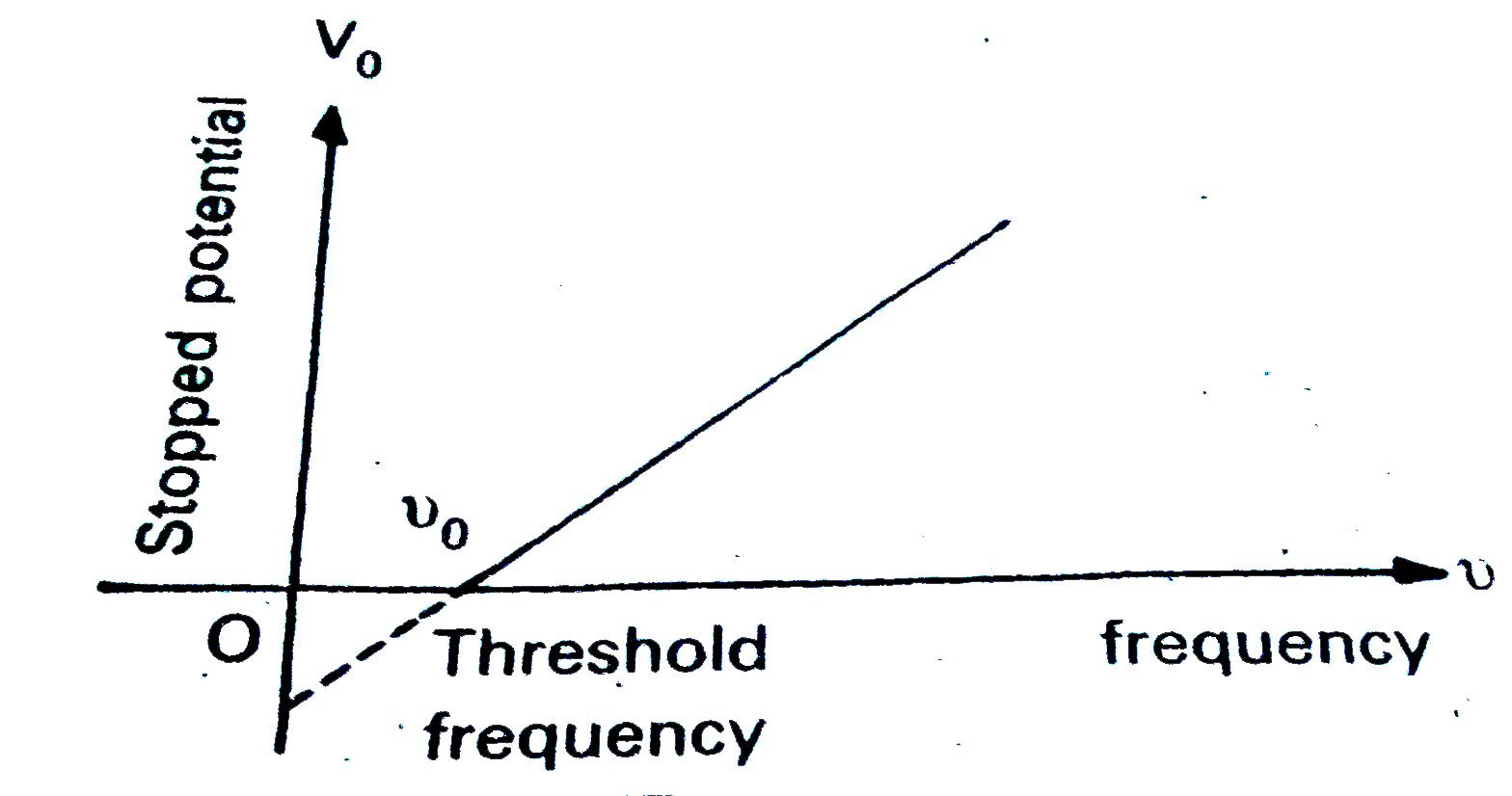 
|
|
| 44. |
The graph between log(R/Ro) and log A (R - radius of nucleus "A" mass number) is |
|
Answer» STRAIGHT line |
|
| 45. |
Solve for x and y,10x + 3y = 75, 6x − 5y = 11 |
|
Answer» (1,2) |
|
| 46. |
Evidence that electromagnetic waves carry momentum when |
|
Answer» The tail of acomet points away from the SUN |
|
| 47. |
An e.m.f is produced in a coil, which is not connected to an external voltage source. This can be due to |
|
Answer» the COIL being in a time varying magnetic FIELD. When loop is PLACED in separately varying magnetic field but not varying with time, then flux linked with coil does not get change hence, emf is not induced. So, (D) is incorrect. |
|
| 48. |
In the figure shown , the coefficient of static friction between B and the wall is (2)/(3) and the coefficient of kinetic friction between B and the wall is (1)/(3). Other contacts are smooth. Find the minimum force F required to lift B, up. Now if the force applied on A is slightly increased than the calculated value of minimum force, then find the acceleration of B. mass of A is 2m and the mass of B is m. Take tantheta=(3)/(4) |
Answer» Solution :  The FBDs of A and B are For A to be in equilibrium: `F=Nsintheta` .(1) For B to just lift off, `Nsintheta=mg+mu_SN^(`)` .(2) For horizontal equilibrium of B, `N^(`)=Nsintheta` .(3) From (2) and (3) `N(costheta-mu_Ssintheta)=mg` or `N((4)/(5)-(2)/(3)xx(3)/(5))mg` or `N=(5)/(2)mg`.(4) From equation (1) `F=Nxx(3)/(5)` `because` `F=(3)/(2)mg` (ii) The acceleration of the BLOCK A be a and B be b `F-Nsintheta=2ma` .(1) `Ncostheta-mg-mu_SN^(`)=MB` .(2) `N^(`)=Nsintheta` .(3) From constraint `=` `asintheta=bcostheta` Solving (1),(2),(3) and (4) we get `impliesb=(3g)/(7)` |
|
| 49. |
In a series LCR circuit with an AC so (E_(rms)=50V) and f=50//pi Hz), R=30 C=0.02mF, L=1.0H, which of the follwing is correct |
|
Answer» the rms current in the circuit is 0.1 A |
|
| 50. |
The following combination are concerned with experiments of the characterization and use of a moving coil galvanometer. The series combination of variab resistance R, one 100 Omega resistor and moving coil galvanometer is connected to a mobile phone charger having negligible internal resistance. The zero of the galvanometer lies the centre and the pointer can move 30 division full scale on either side depending on the directin of current. The reading of the galvanometer is 10 divisions and the voltages across the galvanometer and 100 Omega resistor are respectively 12mV and 16 mV. The figure os merit of the galvanometer is microampere per division is: |
|
Answer» 16 |
|