

Saved Bookmarks
This section includes 7 InterviewSolutions, each offering curated multiple-choice questions to sharpen your Current Affairs knowledge and support exam preparation. Choose a topic below to get started.
| 1. |
The sun having surface temperature T_s radiates like a black body. The radius of sun is R_s and earth is at a distance R from the surface of sun. Earth absorbs radiations falling on its surface from sun only and is at constant temperature T. If radiations falling on earth's surface are almost parallel and earth also radiates like a blackbody, then |
|
Answer» `T=T_s=SQRT(R/(2R))` |
|
| 2. |
Resonance occur in a series LCR . Circuit when : |
|
Answer» `X_(L)=X_(C)` |
|
| 3. |
Depict the fields diagram of an electromagnetic wave propagating along positive x-axis with its electric field along y-axis. |
Answer» SOLUTION :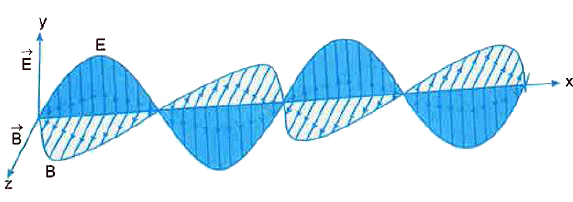
|
|
| 4. |
An electric field is represented by vecE= "Ax" hati where A = 10 (V)/(m^(2)) . Find the potential of the origin with respect to the point (10,20) m. |
|
Answer» <P> Solution :Here `vecE = "Ax" hati= 10 X hati`coordinates of origin = (0,0) m Suppose corrdinates P in the field = (10,20) m `V(0,0) - V(10,20) = - int_(((10,20)))^(((0,0)))vecE.vec(d)r` =- `int_(((10,20)))^(((0,0))) 10X hati . ( dx hati+ dy hatj)` `:. V(0,0)= -int_(10)^(0) 10 x.dx [ because V(10, 20) =0]` `=-10 [(x^(2))/(2)]_(10)^(0)` `:. V(0,0) = 500 V ` |
|
| 5. |
Using the data given below, state which two of the given lenses will be preferred to construct a (i) telescope (ii) Microscope. Also indicate which is to be used as objective and as eyepiece in each case |
| Answer» Solution : For telescope, lens `L_2` is chosen as objective as it APERTURE is largest, `L_3` is chosen as eyepiece as its FOCAL length is smaller.For MICROSCOPE lens `L_3` is chosen as objective because of its small focal length and lens `L_1`, SERVE as eye piece because its focal length is not larges. | |
| 6. |
The magnetic field in a travelling electromagnetic wave has peak value of 20 nT. The peack value of electric field strength is: |
|
Answer» 3 v/m |
|
| 7. |
The product of angular speed and tangential speed of electron in n^th orbit of hydrogen atom is |
|
Answer» Inversly PROPORTIONAL to `N^2` |
|
| 8. |
Mirage' is a phenomenon due to |
|
Answer» Reflection |
|
| 9. |
A parallel plate condenser of capacity 5muF is kept connected to a battery of emf 10v. If the space between the plates is filled with a medium of dielectric constant 12, then the additional charge taken from the battery is |
|
Answer» `400mu C` |
|
| 10. |
A coil of inductance L, resistor of resistance R and an ammeter are connected in series with a 110 V DC supply. The ammeter reads 1.1A. The combination is then connected in series with a 110 VAC and 50Hz lines. Now the ammeter reads 0.55A. Calculate the values of R and L. |
| Answer» SOLUTION :`R= 100 Omega ,L = 0.55` HENRY | |
| 11. |
Find the equivalent capacitance of the network shown in the fig , when each capacitor is of 1 mu F . When the ends X and Y are connected to a 6 V battery , find out (i) the charge and (ii) the energy stored in the network |
Answer» Solution :The NETWORK may be REDRAWN as shown in fig 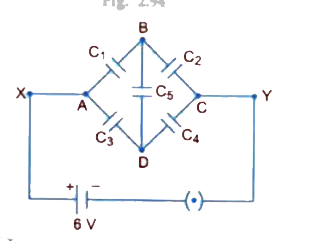 Here , `C_(1) = C_(2) = C_(3) = C_(4) = C_(5) = 1 MU F ` As `(C_(1))/(C_(2)) = (C_(3))/(C_(4))` , hence the network is like a balanced wheatstone bridge where `V_(B) = V_(D)` , Hence capacitor `C_5` may be omitted from the circuit . Now capacitance of series combination of `C_1` and `C_2` is `C_12 = (C_(1) C_(2))/(C_(1) + C_(2)) = (1 xx 1)/(1 +1) = 0.5 mu F ` Similarly capacitance of series combination of `C_3` and `C_4` is `C_34 = 0.5 mu F` SINCE `C_(12)` and `C_(34)` are in parallel across points X and Y . hence the equivalent capacitance of the network `C = C_12 + C_34 = 0.5 + 0.5 = 1.0 mu F ` (i) `therefore` Net charge in the network Q = CV = `(1.0 mu F) xx (6 V) = 6.0 mu C ` (ii) The energy stored in the network `U = (1)/(2) QV = (1)/(2) xx (6.0 mu C) xx 6 V = 18 mu J` |
|
| 12. |
A ball of radius r is rolling (pure rolling) on a convex stationary circular surface of radius R with angular velocity omega and angular acceleration alpha. The magnitude of vertical acceleration of top point of the ball is |
|
Answer» `OMEGA^(2)R((R+2r)/(R+r))` |
|
| 13. |
A nucleus is bombarded with a high-speed neutron so that resulting nucleus is a radioactive one. This phenomenon is called |
|
Answer» ARTIFICIAL RADIOACTIVITY |
|
| 14. |
A beam of electron posses undeflected through mutually perpendicular electric and magnetic fields. If the electric field is switched off and the same magnetic field is maintained, the electrons move, |
|
Answer» in a circular ORBIT |
|
| 15. |
The minimum energy required to remove an electron is : |
|
Answer» STOPPING potential |
|
| 16. |
A body of mass 2 gm is projected horizontally from the top of tower of height 20m with a velocity 10 m/s. The charge on the body is 2C. Electric field is applied vertically downwards and of intensity 10-N/C. Find the time taken by the body to touch the ground (g = 10 m/s^2) |
|
Answer» `1 SEC ` |
|
| 17. |
In photoelectric emission the maximum energy of the photoelectrons increases on increasing the intensity of incident light. |
| Answer» Solution :False: Maximum ENERGY of photoelectrons DEPENDS only on the FREQUENCY of INCIDENT radiation. | |
| 18. |
The field normal to the plane of a coil of ' n'turns and radius ' r ' which carries a current 'i' is measured on the axis of the coil at a small distance 'h' from the centre of the coil. This is smaller than the field at the centre by the fraction. |
|
Answer» `(3/2(H^(2))/(R^(2))` |
|
| 19. |
When a thin flake of mica (n_(m) = 1.58) covers one slit of a double - slit interfernce setup, the fringe pattern shifts byseven fringe widths. If the wavelength of the light used is5500Å, what is the thichness of the mica flake ? |
|
Answer» Solution :Data : `n _(m)= 1. 58, lambda = 5.5 xx 10^(-7) m, x_(0) = 7 X` `x_(0) = D/d (n_(m) - 1) b, "" X = (lambda D)/d` where `x_(0) -=` the lateral SHIFT of the central bright fringe, `b -=` the THICKNESS of themica flake of refractive index `n_(m), d -=` theseparation between the slits, `D -=` the slit - to - SCREEN DISTANCE, `X -=` the fringe width and ` lambda -=` the wavelength of light . Since `x_(0) = 7 X`, ` D/d (n_(m) -1) b = (7 lambdaD)/d` ` :. b = (7 lambda)/(n_(m) -1) = (7(5.5 xx 10^(-7)))/(1.58 -1)` ` = (3.85 xx 10^(-6))/(0.58)` `= (38.5 xx 10^(-6))/(5.8) ` ` = 6.639 xx 10^(-6) m` ` = 6.639 mu m` `{:(log 38.5,," "1.5855),(log 5.8,,ul(-0.7634)),(,," "0.8221):}` AL ` 0.8221 = 6.639` |
|
| 20. |
Two capacitors each of 1muF capacitance in parallel and are then charged by 200 volt D.C. supply. The total energy of their, charges is: |
|
Answer» 0.01 J |
|
| 21. |
A wave of frequency 500 Hz has a speed 360 m/s . The minimum distance between two points which are 30^@ out of phase is |
|
Answer» 25 cm |
|
| 22. |
A Copper atoms has 29 electrons revolving around the nucleus. A copper ball contains 4 xx 10^(23) atoms. What fraction of the electrons be removed to give the ball a charge of +9 6muC ? |
|
Answer» `-1.8 XX 10^(-13)` |
|
| 23. |
A 20 cm long string, having a mass of 1.9 g, is fixed at both the ends. The tesion in the string is 0.5 N. The string is set into vibrations using an external vibrator of frequency 100 Hz. Find te separation (in cm ) between the successive nodes on the string . |
|
Answer» 3.6 cm where T = tnesion in the string and `mu = ("mass")/("length")` ` v = sqrt( (0.5)/(10^(-3) // 0.2)) = 10 ` m/s the wavelength of the wave ESTABLISHED `lambda = (v)/(f) = (10)/(100) 0.1 ` m = 10 cm `therefore` The distance between two successive nodes = `(lambda)/(2) = (10)/(2) = 5 cm ` So correct choice is (a) . |
|
| 24. |
A rocket of mass 20kg has 180 kg of fuel. The exhaust velocity of fuel is 1.6 km/sec. Calculate the ultimate velocity of the rocket gained, when the rate of consumption of the fuel is 2kg/sec.(neglect gravity) |
|
Answer» 3.7 km/sec |
|
| 25. |
A thin circular wire carrying a current I has a magnetic moment M. The shape of the wire is changed to a square and it carries the same current. It will have a magnetic moment |
|
Answer» M |
|
| 26. |
A light emitting diode (LED) has a voltage drop of 2 volt across it and passes a current of 10 mA when it operates with a 6 volt battery through a limiting register R. The value of R is …… |
|
Answer» `40kOmega` As LED is connected to a battery through a resistance in series. The CURRENT flowing, 10 mA is THESAME. The voltage drop across `LED=2V` As the battery has 6 V, the potential DIFFERENCE across `R=4V` `therefore iR=4V rArr R=(4V)/(10xx10^(-3)A)` `=400Omega` |
|
| 27. |
A rectangular pipe having cross sectional area A. It is closed at one end and at its other end ablock having same cross-section and mass 'm' is placed such that system is air tight. Inequilibrium position of block the pressure and volume of air enclosed in pipe are P and Vrespectively. If block is displaced by small distance x inward and released then find the timeperiod of S.H.M. [Assume the walls are frictionless and compression of air is isothermal]. |
|
Answer» `T = 2pi ((mV)/(PA ^(2)))^(1//2)`  `PV =C ` `PdV +Vdp=0` `dP =(-P)/(V) dV` `dp = (-P)/(V) (Ax)` `implies F _(net) =(dP) A=- ((pa^(2))/(V))X` `implies F =-kx` |
|
| 28. |
In a biprism experiment, the eye piece was palced at a distance of 20 cm from the source.The distance between two virtual sources was found to be 0.075 cm. Find the wavelength of source of light if the eye piece ahs to be moved through a distance of 1.888 cm for 20 fringes to cross the field of view : |
|
Answer» `5900 Å` `beta = (x)/(N) = (1.888)/(20)cm = 0.0944 cm` Now `beta = (Dlambda)/(d), lambda = 5.9 xx 10^(-7) m = 5900Å` |
|
| 29. |
From a tower of height H, a particle is thrown vertically upwards with a speed u. The time taken by the particle, to hit the ground, is n times that taken by it to reach the highest point of its path. The relation between H, u and n is : |
|
Answer» `GH=(n-2)u^(2)` If `t_(2)` be the time taken to hit the ground, then `-H=ut_(2)-1/2g t_(2)^(2)` But `t_(2)=nt_(1)`(given) `implies-H=u(nu)/g-1/2g(n^(2)u^(2))/g^(2)implies2gH=nu^(2)(n-2)` |
|
| 30. |
Which of these books was written by John Locke? |
|
Answer» The Spirit of the Laws |
|
| 31. |
An air-cored solenoid with length 30 cm, area of cross-section 25 cm^(2) and number of turns 500, carries a current of 2.5 A. The current is suddenly switched off in a brief time of 10^(-3) s. How much is the average back emf induced across the ends of the open switch in the circuit? Ignore the variation in magnetic field near the ends of the solenoid. |
|
Answer» Solution :Inside a solenoid, the magnetic FIELD is given by `B = mu_(0)nI`, where n is the number of TURNS per unit length of the solenoid. The magnetic flux linked with the N turns of the solenoid of length I is `phi_(B) = NBA=N(mu_(0)nI)A=N(mu_(0)N/lI)A=(mu_(0)N^(2)IA)/l` `therefore` INDUCED emf `epsi=-(dphi_(B))/dt=-(mu_(0)N^(2)A)/l.(dI)/dt=(mu_(0)N^(2)A)/l((I_(1)-I_(2)))/t` As N = 500, l = 30 cm = 0.3m, A = 25 xx 10^(-4)m^(2), I_(1) = 2.5 A, I_(2) = 0 and t = 10^(-3)s. Here, `varepsilon = (4pi xx 10^(-7) xx (500)^(2)xx(25xx10^(-4)) xx (2.5-0))/((0.3)xx(10^(-3)))=6.5V. |
|
| 32. |
A wave of frequency 100 Hz travels along a string towards its fixed end. When this wave travels back, after reflection, a node is formed at a distance 10 cm from the fixed end. The speed of the wave (reflected and incedent ) is : |
|
Answer» 5 `m^(-1)` `(lambda)/(2) = 10 cm"" rArr "" lambda = 20 cm ` u = v `lambda = 100 X 20 = 2000 cm s^(-1) = 20 ms^(-1)`. hence the correct choice is (B) |
|
| 33. |
A charged particle goes undeflected in a region containing electric and magnetic fields. It is possible that i) vecE||vecB,vecV||vecE ii) vecE isperpendicular to vecB and both are perpendicular to vecV iii) vecV||vecB but vecE is not parallel to vecB iv) vecE||vecB but vecV is not parallel to vecE |
|
Answer» Only i & II are true |
|
| 34. |
What is telescope ? Discuss the types of telescopes that are used in general. |
|
Answer» SOLUTION :Tele means AWAY and scope means to see. Hence telescope name is given for purpose to see the things which are away. The optical instrument used to observe the objects which are far away is called telescope. Types of telescope : 1) Astronomical telescope : The objects which are far away like Sun, Stars, Planets, ETC. can be observed by this telescope. The final image obtained in this is INVERTED and diminished but as the objects are spherical, there is no EFFECT on image. 2) Terrestrial telescope : There is an additional pair of inverting lens in this telescope which will make the final image erect. Galileo used convex and concave lens in this telescope. 3) Refracting telescope : Concave mirror is used in this telescope in place of objective. E.g. : Cassegrain telescope. |
|
| 35. |
A pure semi conductor has |
|
Answer» an infinite resistance at `0^@` C |
|
| 36. |
A body of mass 1 kg is thrown vertically upwards with initial K.E. of 98 joule. The height at which its energy is reduced to half will be |
|
Answer» 2.5 m `mgh=49 J impliesh=(49)/(1xx9.8)=5 m`. |
|
| 37. |
If C is the critical angle for a medium and μ is its refractive index, then |
| Answer» Answer :C | |
| 38. |
green house effect is due to |
|
Answer» absorption of ULTRAVIOLET radiation by ozone layer |
|
| 39. |
How does an unpolarised light get polarised when passed through a polaroid ? Two polaroids are set in crossed positions. A third polaroid is placed between the two making an angle theta with the pass axis of the first polaroid. Write the expression for the intensity of light transmitted from the second polaroid. In what orientations will the transmitted intensity be (i) minimum and (ii) maximum ? |
|
Answer» Solution :A POLAROID consists of long chain molecules aligned in a particular direction. The electric vectors (associated with the propagating light wave) along the direction of the aligned molecules get absorbed. Thus, if an unpolarised light wave is incident on such a polaroid then the light wave will get linearly polarised with the electric vector oscillating along a direction perpendicular to the aligned molecules. (Give full credit if STUDENT explains it through a DIAGRAM) Expression for the intensity transmitted through second polaroid : `I=(I_(0)cos^(2)theta)cos^(2)(90^(@)-theta)` `=I_(0)(costhetasintheta)^(2)=I_(0)(sin^(2)2theta)/(4)` where `I_(0)` is the intensity of the polarized light after PASSING through the first polaroid. Intensity will be maximum when `theta=45^(@)` and MINIMUM when `theta=0^(@)`. |
|
| 40. |
Nickel shows ferromagnetic property at room temperature if the temperature is incresed beyond curie temperatrure then it will show |
|
Answer» ANTI FERROMAGNETISM |
|
| 41. |
The minimum number of cells in mixed grouping required to produce a maximum current of 1.5Athrough an external resistance of 30Omega, given the emf of each cell is 1.5 V and internal resistance is 1Omega is |
|
Answer» 30 |
|
| 42. |
A person cannot clearly see distance more than 40 cm. He is advised to use lens of power. |
|
Answer» <P>`-2.5 D` V = - 40 cm = - 0.40 m `therefore "" (1)/(f) = (1)/(v) - (1)/(u) = (1)/(-0.40) - (1)/(oo) = - 2.5 RARR P = - 2.5 D` |
|
| 43. |
A white precipitate can be obtained by adding dilute sulphuric acid to |
|
Answer» COPPER Sulphate |
|
| 44. |
Light is incident normally on the face AB of a prism as shown in figure. A liquid of refractive index n is placed on face AC of the prism. The prism is made of glass of refractive index sqrt3. The limiton n for which total internal reflection takes place on face AC is ........... |
|
Answer» `n gt sqrt3`  Refractive index of PRISM RELATIVE to LIQUID is `n_p=("nprism")/("nliquid")=(sqrt3)/(n)` …(1) `SIN c=(1)/(""^ln_p)=(n)/(sqrt3)` …(3) For total internal reflection i `gt` c sin i `gt` sin c `therefore sin 60 gt (n)/(sqrt3)` `therefore(sqrt3)/(2)=(n)/(sqrt3)""therefore n lt 3/2` |
|
| 45. |
1inch=........cm |
|
Answer» 2.54 |
|
| 46. |
When a glass rod is rubbed with a silk cloth, charges appear on both. A similar phenomenon is observed with many other pairs of bodies. Ecplain how this observation is consistent with the law of conservation of charge. |
| Answer» Solution :CHARGEIS not CREATED or DESTROYED it is MERELY transferred from one BODY to another | |
| 47. |
Find the equivalent resistances of the network shown in figure between the point a and b. |
|
Answer» Solution :(a) ` R_eff =((5r/3 XX R)/(5r/3 +r)) = 5r/8` ` (b) R_eff = (r/3)+r = 4r/3 ` ` (c) R_eff = (2r/2) = r ` ` (d) R_eff = r/4` ` (E) R_eff = r` . |
|
| 48. |
A horizontal beam of vertically polarized light o intensity 43 w//m^2is sent through two polarizing sheets. The polarizing direction of the first is 60^@to the vertical, and that of the second is horizontal. What is the intensity of the light transmitted by the pair of sheets? |
| Answer» SOLUTION :`8.1 w//m^2` | |
| 49. |
A circular aperture of radius 0.5 mm is illuminated by plane waves of monochromatic light and emergent light is collected by lense of focal length 30 cm. the distance between two dark bands is 0.18 mm. what is the wavelength of light. |
| Answer» SOLUTION :6000 Å | |