

Saved Bookmarks
This section includes 7 InterviewSolutions, each offering curated multiple-choice questions to sharpen your Current Affairs knowledge and support exam preparation. Choose a topic below to get started.
| 1. |
Define the term rms value of a.c. Derive the relation between rms and peak value of a.c. |
|
Answer» Solution :`THEREFORE I_(RMS)^(2) = 1/T int_(0)^(T) t^(2)dt = 1/T int_(0)^(T) I_(m)^(2) SIN^(2) omega t dt = I_(m)^(2)/(2T) int_(0)^(T) (1- cos 2 omega t) dt` `I_(m)^(2)/(2T) [(T-(0-0)/(2omega))] = I_(m)^(2)/2` `RARR I_(rms) = I_(m)/SQRT(2) = 0.707 I_(m)` |
|
| 2. |
A ball dropped from a building of height 12 m falls on a slab of 1 m height from the ground and makes a perfect elastic collision. Later the ball falls on a wooden table of height 0.5 m, makes inelastic collision and falls on the ground. If the coefficient of restitution between the ball and the table is0.5, then the velocity of the ball while touching the ground is about (Acceleration due to gravity, g=10 ms^(-2)) |
|
Answer» `15.5 ms^(-1)` 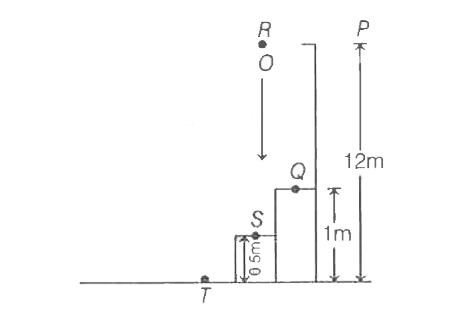 When ball is droped from point P, and collides at point Q, from third equation of the motion, `v_(Q)^(2)=u^(2)+2gh=0+2 TIMES 10 times (12-1)=220` `therefore` Velocity at a point Q, `V_(Q)=sqrt(220)m//s` In PERFECT elastic COLLISION at point Q, there is no loss of kinetic energy. Hence, the height gain by ball after collision, `rArr ""1/2mv_(Q)^(2)=mgh^(.)` `rArr""1/2(sqrt(220))^(2)=10 times h^(.)` `rArr ""h^(.)=11m` Let velocity of the ball before INELASTIC collision `=v_(s)` From energy conservation law, `rArr ""1/2mv_(s)^(2)=mg(11+0.5)` `rArr ""v_(s)^(2)=2 times 10 times 11.5` `rArr ""v_(s)=sqrt(230)m//s` `because` coefficient of restitution, `""e=0.5="velocity after collision (v)"/("velcoity before collision "(v_(s)))` `rArr 0.5=v/sqrt(230) rArr v=0.5sqrt(230)m//s` Again from energy conservation law, `""1/2mv^(2)=mgh..` `rArr ""1/2(0.5sqrt(230))^(2)=10 times h` `rArr h..=(0.5 times 230 times 0.5)/(20)=2.875 m` Hence, the total height from point T, `""h=h..+0.5=2.875+0.5=3.375m` From energy conservation law, `""1/2mv_(T)^(2)=mgh` Velocity of ball while touching the ground, `""v_(T)=sqrt(2gh)` `""=sqrt(2 times 10 times 3375)` `""=8.215 m//s` |
|
| 3. |
The susceptibility of a ferromagnetic substance is |
|
Answer» `gt gt 1` |
|
| 4. |
Alternating current can not be measured by D.C. ammeter because ……… |
|
Answer» A.C. can not pass through D.C. ammeter. |
|
| 5. |
A: Owl can move easily at night time.R : There are so many rods in the retina in The eye of owl. |
|
Answer» Both ASSERTION and REASON are TRUE and the reason is CORRECT EXPLANATION of the assertion. |
|
| 6. |
Can two p-junction diodes placed back to back act as a p-n-p transistor ? If not, why ? |
| Answer» Solution :No, because in that case the THICKNESS of the n-type base region will be thick and the doping level of the base will ALSO be too large and hence the base current will be considerably increased and very small NUMBER of majority CARRIER will reach the collector region and we may not get any APPRECIABLE collector current. | |
| 7. |
Two point monochromatic and coherent sources oflight of wavelength lambdaare each placed as shown in the figure below. The initial phase difference between the sources is zero. Select the incorrect statement. |
|
Answer» If `d=(7lambda)/2`, O will be minima So, if `d=(7lambda)/2`, O will be a minima. If `d=lambda`, O will be maxima . If `d=(5lambda)/2`, O will be minima and henceintensity is MINIMUM If d=4.8 `lambda` , then total 10 minimas can be observed on screen, 5 above and 5 below O,which correspond to `Deltax=pm lambda/2, pm(3lambda)/2 , pm (5lambda)/2 , pm (7lambda)/2, pm(9lambda)/2` |
|
| 8. |
A boat which has a speed of 4km/hr in still water crosses a river of width of 1 km in the shortest possible time. The speed of the river is 3km/hr. The time taken in minutes is |
| Answer» Answer :A | |
| 9. |
Formula of linear width of central maximum in diffraction is ........ |
|
Answer» `BETA=2beta_(0)` |
|
| 10. |
Assertion:Spherical aberration occur in lenses of larger aperture. Reason: The two rays, paraxial and marginal rays focus at different points. |
|
Answer» If both ASSERTION and reason are TRUE and the reason is the CORRECT explanation of the assertion |
|
| 11. |
A vertical disc has three grooves directed along chords AB, AC and AD. Three bodies begin to slide down the respective grooves from A simultaneously. If AB > AC > AD, the respective time intervals to reach the bottoms of the respective grooves t_1, t_2 and t_3 are |
|
Answer» `t_1 GT t_2 gt t_3` |
|
| 12. |
Draw a neat and labelled diagram of a cyclotron. State the underlying principal of it's working. |
| Answer» SOLUTION :REFER TEXT, TOPIC CYCLOTRON | |
| 13. |
An A.C.emf is given by l= 220 sin 314 t volt. Find the frequency ? |
|
Answer» SOLUTION :L= 330 `sin314 t` volt `rArr omega` =314 rad/sec. `thereforev= omega/(2pi) = 314/(2pi) = 157/(pi) = 50Hz` |
|
| 14. |
At a certain location in the northern hemisphere, the earth.s magnetic field has a magnitude of 42 muTand points downwards at 53^@ to the vertical. Calculate the flux through a horizontal surface of area 2.5 m^2. [sin 53^@ = 0.8] |
|
Answer» Solution :`phi_B = BA COS theta` `= 42 xx 10^(-6) xx 2.5 xx cos 53^@ = 63 mu Wb` |
|
| 15. |
Calculate magnitude of resistance X in the circuit shown in figure when no current flows through the 5Omegaresistor? |
|
Answer» Solution :SINCE wheatstone BRIDGE is balanced so ` ""(x)/( 18) =(2)/( 6) or x =( 18 XX 2)/( 6) =6OMEGA` |
|
| 16. |
The balancing point in a meter bridge is 44 cm. If the resistances in the gaps are interchanged, the new balance point is |
|
Answer» 44 cm |
|
| 17. |
All types of space communication systems use _____ radio wavesas the carrier of the message signal. |
| Answer» SOLUTION :HIGH FREQUENCY | |
| 18. |
If both the number of protons and neutrons in a nuclear reaction is conserved, in what way is mass converted into energy (or vice versa) ? Explain giving one example. |
|
Answer» Solution :Of course in a nuclear reaction both the number of protons and neutrons (i.e., the mass number as WELL as atomic number) remains conserved, yet total mass of products is not same as the total mass of reactants. There is some loss /gain in mass, which is converted into energy. Alternately we can say that total binding energy of products is not same as the total binding energy of reactants and the difference in these binding energies APPEARS as energy released or absorbed in a nuclear reaction. As an EXAMPLE consider fission of a heavy nucleus (X) of mass number A = 240 into two nuclides (Y) each of mass number A. = 120 each. Binding energy per NUCLEON of parent nucleus X is 7.6 MeV but that of each daughter nuclide Y is 8.5 MeV. This difference in binding energy is the cause of energy released. |
|
| 19. |
(b) A magnetised needle in a uniform magnetic field experiences a torque but no net force. An iron nail near a bar magnet, however, experiences a force of attraction in addition to a torque. Why ? |
Answer» Solution :(b) (i) A magnetised needle placed in uniform magnetic field :  Consider a magnetic needle with magnetic dipole moment `OVERSET(to) (m) = q_m (2 overset(to) (l) )` placed in uniform magnetic field `overset(to) (B)` at an angle `theta`. Here resultant force exerted on the magneticneedle is, `overset(to) (F) - overset(to) (F_N) + overset(to) (F_S)` `= q_m B HAT(i) + q_m B (- hat(i) )` `therefore overset(to) (F) = overset(to) (0)""...(1)` Amount of resultant torque (or moment of couple) exerted on the magnetic needle is, `tau=(F_N)` (Perpendicular distance ND) `therefore tau = (q_m B) (2l sin theta)` `= (q_m) (2l) (B) (sin theta)` `therefore tau m B sin theta [ because m=q_m (2l)]` CONSIDERING directions, `overset(to) (tau) = overset(to) (m) xx overset(to) (B)""...(2)` In above situation, direction of `overset(to) (tau)` is perpendicularly inside the plane of figure. From equations (1) and (2), we can see that in above situation `overset(to) (F) = overset(to) (0)` but `overset(to) (tau) ne overset(to) (0)`. (iii) An iron nail is a ferromagnetic substance which gets magnetised in the PRESENCE of external magnetic field. Its one end acts as induced north pole whereas another end acts as induced south pole. Here, because of non-uniform magnetic field, strengths of magnetic field at the positions of induced north and induced south pole are different and so magnetic forces exerted on them have different magnitudes GIVING rise to some resultant magnetic force. Here induced south pole in a nail is closer to north pole of bar magnet as compared to induced north pole. Hence, above resultant force is attractive in nature. When iron nail is placed in non-uniform magnetic field, magnetic forces exerted on its two induced poles are not colinear andnot equal in magnitude. Hence, such a pair of forces produce some torque also. |
|
| 20. |
In which region Lyman series is located? |
| Answer» SOLUTION :ULTRAVIOLET REGION | |
| 21. |
Coloures appear on a thin soap film and soap bubbles are due to the phenomenon of |
|
Answer» interference |
|
| 22. |
The number density of free electrons in the semiconductor is 10^(18) m^(-3) . It is doped with a pentavalent impurity atoms of number density 10^(24) m^(-3) . The number density of free electrons m^(-3) increases by a factor of |
| Answer» SOLUTION :number DENSITY of free electrons is `10^(18)+10^(24) ~=10^(24)` increase by factor `(10^(24))/10^(18)=10^6`. | |
| 23. |
A parallel-plate capacitor of capacity C_0is charged to a potential V_0(i) The energy stored in the capacitor when the battery is disconnected and the plat separation is doubled is E_1(ii) The energy stored in the capacitor when the charging battery is kept connected and the separation between the capacitor plates is doubled is E_2 .Find the ratio E_(1)//E_2 . |
|
Answer» |
|
| 24. |
A diatomic ideal gas is used in a Carnot engine as the working substance. If during the adiabatic expansion part of the cycle, the volume of the gas increases from V to 32 V, the efficiency of the engine is: |
|
Answer» `0.25` `TV^(gamma-1)=` constant `therefore (T_(2))/(T_(1))=((V_(1))/(V_(2)))^(gamma-1)=((1)/(32))^((7)/(5)-1)=((1)/(32))^(2//5)=(1)/(4)` `therefore eta =1-(1)/(4)=(3)/(4)=0.75` So, correct CHOICES are (c ). |
|
| 25. |
A solid disc first rolls without slipping and then slides without rolling down the same inclined plane. The velocities in two cases at the bottom are in the ratio of |
|
Answer» `1:2` `(1)/(2)mv_(1)^(2)+(1)/(2)xx(1)/(2)MR^(2)omega^(2)=mgh` `(1)/(2)mv_(1)^(2)+(1)/(4)mv_(1)^(2)=mgh` `(3)/(4)mv_(1)^(2)=mghimpliesv_(1)=sqrt((4gh)/(3))` When the disc slides then `(1)/(2)mv_(2)^(2)=mghimpliesv_(2)=sqrt(2gh)` `therefore (v_(1))/(v_(2))=(sqrt((4gh)/(3)))/(sqrt(2gh))=sqrt((4)/(6))implies(v_(1))/(v_(2))=2:sqrt(6)` |
|
| 26. |
The property of the circuit by virtue of which it tends to oppose a change in the strength of the current through it, by inducing e.m.f. in it is called? |
| Answer» SOLUTION :Self-induction. | |
| 27. |
A solenoid S_1 is placed coaxially inside another solenoid S_2 . The radii of the inner and outer solenoids are r_1 and r_2respectively. If N_1 and N_2are the number of turns of coil in solenoid S_1 and S_2respectively and l is the length of solenoid S_2 carrying current I , then calculate the mutual inductance between the two solenoids. |
|
Answer» Solution : Magnetic field of the OUTER solenoid is `B = (mu_0 N_2I)/(l)` , whencurrent I PASSES through it The flux associated with the inner coil is`phi_1 = N_1 B pi r_1^2` `rArr phi_1 = N_1 ((mu_0 N_2)/(l)) I pi r_1^2` `therefore` Mutual inductance between the TWO solenoid is GIVEN by `M = (phi_1)/(I) = ((mu_0 N_1N_2)/(l)) pi r_1^2` |
|
| 28. |
A parallel-plate capacitor having plate area 400 cm^(2)and separation between the plates 1.0 mm is connected to a power supply of 100 V. A dielectric slab of thickness 0.5 mm and dielectric constant 5.0 is inserted into the gap. Find the increase in electrostatic energy. |
|
Answer» ` 5.1 MUJ` |
|
| 29. |
In the previous problem calculate the ratio of voltage sensitivity if ratio of resistance of coil A to resistance of coil B is 1:3. |
|
Answer» |
|
| 30. |
State the principle of working of a transformer. Can a transformer be used to step up or step down a d.c. voltage? Justify your answer. |
| Answer» SOLUTION :The working PRINCIPLE of the transformer is the mutual induction. The nmagnetic fiux linked with the primary WINDING of the transformer must change, to produce an induced emf in the SECONDARY coil. Transformer cannot work on DC voltages. If a DC'supply is giving to the primary coil of a transformer, it produces a steady magnetic flux, So, no emf will be induced in the secondary coil. | |
| 31. |
Assertion (A): A potentiometer of longer length is preferred for precise measurement.Reason (R) : The potential gradient for a potentiometer of longer length with a given source of emf becomes small. |
|
Answer» If both ASSERTION and reason are true and the reason is the CORRECT explanation of the assertion. |
|
| 32. |
A large potential difference is produced between your body and floor when you run on a nylon carpet with shoes on. But on touching a metallic door knob, you only get a mild shock. On the other hand, if one comes in contact of a power line having comparable voltage the person gets a fatal shock. Explain the difference. |
| Answer» Solution :A potential developed in the FIRST case is DUE to accumulation of charges and can be neutralised by transfer of accumulated charges. So, in this case, whenthe charged body touches a conducting object, voltage will be SLOWLY neutralised by the transfer of charge. So, only a little charge is TRANSFERRED for the moment and hence, a mild shock. But in case of a POWER line, the voltage source is fixed and it cannot be neutralised. So, a large current or we can say a large amount of charge will pass through the body in this case. | |
| 33. |
A bodyy executes simpleharmonic motion. The potential energy (P.E.), the kinetic energy (K.E.) and total energy (T.E.) are measured as a function of displacement X. Which of the following statementsis true ? |
|
Answer» K.E. is maximum when X = 0 |
|
| 34. |
Answer the following : (c) An e.m. wave exerts pressure on the surface on which it is incident. Justify. |
| Answer» Solution :(c) An electromagnetic WAVE CARRIES MOMENTUM. When an e.m. wave is incident on a surface, transfer of momentum to the surface takes place. As a result of it the e.m. wave exerts a force on the surface and consequently a pressure is EXERTED by e.m. wave on the surface. | |
| 35. |
Expression for voltage sensitivity is (theta)/(v) = (NAB)/(CR) a. What are the factors on which voltage sensitivity depends on ? b. Why is it independent of number of turns ? c. How will you increase the voltage sensitivity ? |
|
Answer» SOLUTION :`i. N/R II. A . III B and iv . C` b. `N/R` is a constant. c. Voltage sensitivity can be increased by i. increasing magnetic field (B) ii. Increasing are (A) iii. Decreasing torque PER unit TWIST (C) |
|
| 36. |
To set a speed record in a measured ( straight-line)distance d, a race car must be driven first in one direction ( in time t_(1)) and then in the opposite direction( in time t_(2) ). (a) To eliminate the effects of the wind and obtain the car'sspeed v_(c) in a windless situation, should we find the average of d//t_(1) and d//t_(2)( method 1)or should we finddivide d by the average of t_(1) and t_(2) ? (b) What is the fractional difference in the two methods when a steady wind blows along the car's route and the ratio of the wind speed v_(w) to the car'sspeed v_(c) is 0.0240 ? |
|
Answer» |
|
| 37. |
State two applications of infrared radiations |
| Answer» Solution :(i) In green HOUSES to KEEP plants WARM.(ii) In reading SECRET writings on ancient walls. | |
| 38. |
The magnitude of the magnetic field at O ( centre of the circular part ) due to the current - carrying coil as shown is : |
|
Answer» `(mu_0i)/(4PI)((4pi)/a+sqrt2/b)` |
|
| 39. |
Which of the following is the relation of centripetal force? |
|
Answer» `(MV^(2))/(R )` |
|
| 40. |
Express 16 mg mass into equivalent energy in electron volt. |
|
Answer» `:.E=mc^(2)=16xx10^(-6)xx(3XX10^(8))J` `=(16xx10^(-6)xx9xx10^(16))/(1.6xx10^(-19))` `=9xx10^(-30)` EV |
|
| 41. |
If the momentum of a body increases by 0-01%, its kinetic energy will increase by: |
|
Answer» 0-0% `E=(p^2)/(2m)` `(DELTAE)/(E)=(2Deltap)/(p)`(`because` m is CONSTANT) `%(DeltaE)/€=2xx(0.01)/(1)=0.02%` |
|
| 42. |
Two idential pith balls. Each of mass 'm' and charges 'q' hang from noncoducting threads of length I as shown in figure , thetais very small and hence tan theta ~~sin theta . Show that , for equilibriumx=[( q^(2) l)/( 2pi in _0mg) ]^((1)/(3)) |
|
Answer» Solution :For equilibrium `T sin theta =F_e= ( 1)/( 4pi in _0) .( q^(2))/( x^(2))` ` "" T cos theta =MG ` ` "" therefore tan theta =sin theta =(x)/((2)/(l) =(x)/( 2L ) ` `(x)/(2l) =( q^(2))/( 4pi in _0 x^(2)mg ) ` ` x^(2) =( 2Q^(2) l)/( 4pi in_0mg ) "" therefore x= [(q^(2) l)/( 2PI in _0mg ) ]^(l) ` 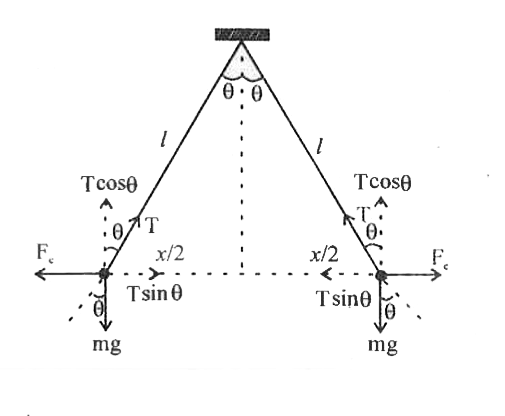
|
|
| 43. |
On what basis principle photoelectric effect is based. |
| Answer» SOLUTION :It is BASED on the CONSERVATION of ENERGY . | |
| 44. |
The period of revolution of electron inthe second orbit in a H atom is 1.836xx10^ s Hence the period in the third orbit is: |
|
Answer» `6.197xx10^-15 SEC` |
|
| 45. |
Name the gate obtained from the combination of gates shown in the figure given. Draw its logic symbol and write the truth table of the combination. |
|
Answer» SOLUTION :LOGIC gate. A logic gate is a digital CIRCUIT, which works ACCORDING to some logical RELATIONSHIP between input and ouput voltages. Nor Gate. When the output of OR gate is connected to the input of NOT gate we get a NOR gate as shown in figure (a) .  Logic symbol of NOR gate is shown in fig. (b). Truth table. The truth table of NOR gate 
|
|
| 46. |
State whether the following assertion is true or false : When a person walks on a rough surface, the frictional force exerted by the surface on the person is opposite to the direction of his motion. |
| Answer» Solution :False, when a person walks on a rough SURFACE the MAN exerts a backward frictional force on the surface. It is the third law force exerted by the ROAD on the person that causes the MOTION. | |
| 47. |
The ratio of kinetic energy of the total energy of an electron of a Bohr orbit of the hydrogen atom is ...... |
|
Answer» Solution :Kinetic energy `K=(1)/(8pi epsi_(0))*(Ze^(2))/(r)` Total energy `E_(n)=-(1)/(8pi epsi_(0))*(Ze^(2))/(r)` `:.(K)/(E_(n))=-1` |
|
| 48. |
The cross-section of a tank kept on a vehicle is shown in Fig. The rectangular tank is open to the atmosphere , During motion of the vehicle , the tank is subjected to a constant linear acceleration , a = 2.5 m//s^(2) . How much fluid will be left inside the tank if initially the tank is half filled . The vessel is 5 m wide and 2 m high . |
|
Answer» Solution :Using Eq, we can find the angle that the fluid will make with the horizontal `tan theta = (2.5)/(10) = (1)/(4)` Let.s assume that the dimensions of tank in the plane perpendicular to the PAGE is d . From geometry , it is easy to see that free surface on right - hand side will go down and the same will rise on left - hand side . Thus, if we assume that fluid on right-hand side has not TOUCHED the floor , we will have fluid taking a shape as shown in Fig . The cuboid part will have volume `x xx 5 xx d` , where x is the height above the bottom . The Wedge part will have the volume `1//2 xx h xx 5 xx d` , where h can be found in the following manner : `((h)/(5))= tan theta = ((1)/(4))` Thus , total volume will be `(1)/(2) xx (5)/(4) xx 5 xx d + x xx 5 xx d` and if we assume there is no spilling then it must be equal to the final volume , so `(1)/(2) xx (5)/(4) xx 5 xx d + x xx 5 xx d = 1 xx 5 xx d` Solving we get , x = 3/8 m . Therefore , total length `(5)/(4) + (3)/(8) = (10 + 3)/(8) = (13)/(8) lt 2` m Thus , height is less than 2 m . HENCE , water will not spill . Using Eq. we can find the angle that the fluid will make the horizontal `tan theta = (10)/(10) = 1 or theta = (pi)/(4)` In this case , fluid cannot remain inside . Fluid having an inclined free surface at `45^(@)` angle , and covering the bottom of length 5 m , will also be 5 m high . This will require the wall to be of 5 m height , which is just 2 m for the given vessel . Instead, if we think it other way round to keep in contact with the left-hand side wall , bottom will haveto be COVERED only 2 m with the fluid as shown in the Fig. 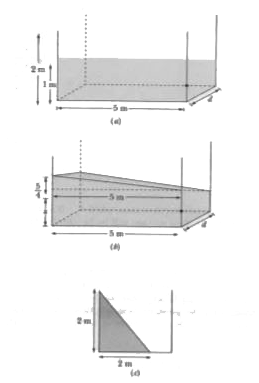 Volume of fluid inside = `(1//2) xx 2 xx 2 xx d m^(3) = 2 d m^(3)` . Thus , volume of fluid gone outside = ` 3 d m^3`. |
|
| 49. |
Can two equipotential surfaces intersect each other ? Justify your answer. |
| Answer» Solution :No, they cannot intersect at any POINT, because if TWO EQUIPOTENTIAL surfaces intersect at a point then there will be two VALUES of electric potential at one point, which is impossible. | |
| 50. |
If the units of force and velocity are doubled, then the units of power will : |
|
Answer» be halved HENCE `(c )` is correct choice. |
|