

Saved Bookmarks
This section includes 7 InterviewSolutions, each offering curated multiple-choice questions to sharpen your Current Affairs knowledge and support exam preparation. Choose a topic below to get started.
| 1. |
2C electric charge Is displaced from a point of electric potential -20 V to some other point. The work done is 200 J, then electric potential of second point V_(2) = ........ volt. |
|
Answer» 60 `:. (200)/(2) = V_(2)- (-20)` `:. 100 = V_(2) +20` `:. V_(@) =80 ` VOLT . |
|
| 2. |
A sphere of radius R has a variable charge density rho(r)=rho_(0)r^(n-1)(rleR). If ratio of "potential at centre" and "potential at surface" be 3//2 then find the value of n |
|
Answer» Hence `n=1` Method 2: You MAY use integration method also to solve this PROBLEM. |
|
| 3. |
The numerical aperture of an objective of a microscope is 0.5 and the wavelength of light used is 5000 A^(0). Its limit of resolution will be |
|
Answer» `6.1xx 10^(7)m` |
|
| 4. |
Following figure shows a metal rod PQ resting on the smooth ralls AH and positioned between the poles of a permanent magnet. The rails, the rod and the magnetic field are in three mutual perpendicular directions. A galvanometer G connects the rails through a switch K. Length of the rod 15 cm, B 0.50 T, resistance of the closed loop containing the rod 9.0 mOmega. Assume the field to be uniform. Is there an excess charge built up at the ends of the rods when K is open? What if K is closed? |
|
Answer» Solution :Given, length of the rod `l=15cm=15xx10^(-2)m` Magnetic field `B=0.50T` RESISTANCE of the CLOSED - loop containing the rod, `R=9mOmega=9xx10^(-3)Omega` Velocity of rod `V=12" cm/s "12 xx 106(-2) m//s.` YES, an excess positive charge developes at P and the same amount of negative charge developes at Q as the key is OPEN. When the key K is closed, the induced current FLOWS and maintains the excess charge. |
|
| 5. |
The densities of two substances are 2 3 and their specific heats are 0.12 and 0.09 respectively. What is the ratio of their thermal capacities per unit volume ? |
|
Answer» `8:9` `THEREFORE ("TH. Capacity/unit vol. of I")/("Th. Capacity/unit vol. of II")=(2xx0.12)/(3xx0.09)=(8)/(9)` `therefore` Correct choice is (a). |
|
| 6. |
Following figure shows a metal rod PQ resting on the smooth ralls AH and positioned between the poles of a permanent magnet. The rails, the rod and the magnetic field are in three mutual perpendicular directions. A galvanometer G connects the rails through a switch K. Length of the rod 15 cm, B 0.50 T, resistance of the closed loop containing the rod 9.0 mOmega. Assume the field to be uniform. How much power is required (by an external agent) to keep the rod moving at the same speed (=12" cm s"^(-1)) when K is closed ? How much power is required when K is open? |
|
Answer» Solution :Given, length of the rod `l=15cm=15xx10^(-2)m` Magnetic field `B=0.50T` Resistance of the closed - LOOP CONTAINING the rod, `R=9mOmega=9xx10^(-3)Omega` Velocity of rod `V=12" cm/s "12 xx 10^(-2) m//s.` To KEEP the rod moving at the same speed the required power `="retarding force "xx" velocity "=7.5xx10^(-2)xx12xx10^(-2)=9xx10^(-3)W` |
|
| 7. |
Two identical charged spheres suspended from a common point by two massless strings of length I are initially a distance dd |
|
Answer» ` V ALPHA X^(-1)` |
|
| 8. |
Following figure shows a metal rod PQ resting on the smooth ralls AH and positioned between the poles of a permanent magnet. The rails, the rod and the magnetic field are in three mutual perpendicular directions. A galvanometer G connects the rails through a switch K. Length of the rod 15 cm, B 0.50 T, resistance of the closed loop containing the rod 9.0 mOmega. Assume the field to be uniform. With K open and the rod moving uniformly, there is no net force on the electrons in the rod PQ even though they do experience magnetic force due to the motion of the rod. Explain. |
|
Answer» Solution :Given, length of the rod `l=15cm=15xx10^(-2)m` Magnetic FIELD `B=0.50T` RESISTANCE of the closed - loop containing the rod, `R=9mOmega=9xx10^(-3)Omega` Velocity of rod `V=12" cm/s "12 xx 106(-2) m//s.` When key is open, there is no net force on the electrons because the presence of excess charge at P and Q sets up an electric field and magnetic forcé on the electrons is balanced by force on them due to force by the electric field. So, there is no net force on the rod. |
|
| 9. |
A bettery of 10 V and negligible internal resistance is connected across the diagonally opposite corners of a cubical network consisting of 12 resistors each of resistance 1Omega Determine the equivalent resistance of the network and the current along each edge of the cube. |
|
Answer» 5/6 OHMS, 4 AMPERES |
|
| 10. |
In Young's double slit experiment, the two slits act as coherent sources of equal amplitude A and of wavelength lambda.In another experiment with same set up, the two slits are sources of equal amplitude A and wavelength lambda, but are incoherent.The ratio of intensty of light at the mid - point of the screen in the first case to that in the second case is : |
|
Answer» SOLUTION :In case of coherent SOURCES `I_(max) = 4a^(2) = 4I` In case of non- coherent sources `I = a_(1)^(2) + a_(2)^(2) = 2a^(2) = 2I` `(I_(max))/(I) = (4I)/(2I) = (2)/(I) = 2` |
|
| 11. |
An electromagnetic wave is travelling in a medium with a velocity vecv=vhati. Draw a sketch showing the propagation of the electromagnetic wave, indicating the direction of the oscillatign electric and magnetic fields. (b) How are the magnitudes of the electric and magnetic fields in the electromagnetic wave related to the velocity of the e.m. wave? |
|
Answer» Solution :(a) Sketch SHOWING PROPAGATION of e.m. wave is as GIVEN in Fig. Here OSCILLATING electric and magnetic field are along y - and z - axis respectively. (B) `(E )/(B)=c=` velocity of electromagnetic waves. 
|
|
| 12. |
Consider the following circuit in which tow identical capacitors are shown. The switch is initially closed and it is kept closed for a long time and then it is opened. How much charge will flow through the battery after the switch is opened? |
Answer» Solution :In the following figure we can see that CAPACITOR 2 is SHORT circuited and hence there will not be any charge on this capacitor. The total potential differenceV of the battery is available for capacitor 2. Hence, charge acquired by capacitor 1 will be CV. 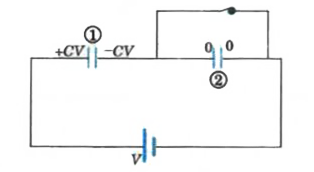 See the figure for charges on the capacitor before the switch is opened. When it is opened, then uncharged capacitor 2 acts as broken circuit for the battery. There will not be any change is charge DISTRIBUTION when the switch is opened after LNG time. No additional charge will flow through the battery after the switch is opened. Although it might appear that both capacitors get connected in series. Hence, the charge should be redistributed so that both the capacitors should finally attain CV/2 Charge. But for the redistribution of charge ACCORDING to new state of the circuit charge needs path to flow and here that is not present. |
|
| 13. |
According to maxwell's equation the velocity of light in any medium is expressed as: |
|
Answer» `(1)/saqrt(mu_0epsilon_0)` |
|
| 14. |
(a) What is meant by plane polarised light? An unpolarised light is incident at an angle theta on the surface of glass of refractive index n. If the reflected and refracted rays are perpendicular to each other, then obtain the relationship between n and theta. (b) Two polaroids P1 and P2 are placed in a crossed position. Unpolarised light of intensity I_(0) is incident on P_(1). If P_(2) is rotated through an angle theta about the direction of propagation of light, keeping P_(1) fixed, plot the graph of intensity of light for 0°lt theta < 360° which is (i) transmitted by P_(1) and (ii) transmitted by P_(2). |
|
Answer» <P> Let an unpolarised light be incident at an angle `theta` on the surface of glass of refractive index . n. such that the reflected and refracted rays are perpendicular to each other. Then as shown in adjoining figure. `angletheta+angler=pi/2rArrangler=pi/2-angletheta` As per Snell.s law of refraction, we can write `(sintheta)/(sinr)=n` `rArr(sintheta)/(sin(pi/2-theta))=nrArr(sintheta)/(costheta)=nrArrtantheta=n` 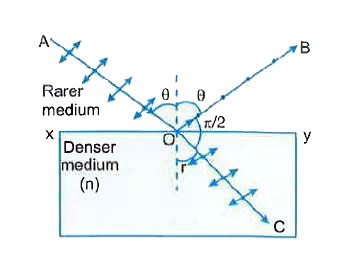 The RELATION n = tan `theta` is known as Brewster.s law and under this condition the reflected light is completely plane polarised one as shown in figure. (b) Here intensity of unpolarised light = `I_(0)` (i) Intensity of light TRANSMITTED by `P_(1),I_(1)=(I_(0))/2` and this intensity does not change on rotating `P_(2)`. (ii) Intensity of light transmitted by `P_(2),I_(2)=I_(1)cos^(2)theta` and it changes with change in VALUE of `theta`. Variation of `I_(1)` and `I_(2)` is shown below : 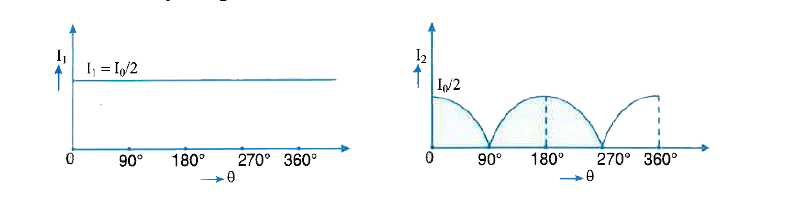
|
|
| 15. |
A circular coil of 500 turns of wire has an enclosed area of 0.1 m^(2) per turn. It is kept perpendicular to a magnetic field of induction 0.27 and rotated by 180^(@) about a diameter perpendicular to the field in 0.1 s. How much charge will pass when the coil is connected to a galvanometer with a combined resistance of 50 Omega. |
|
Answer» SOLUTION :`q=(phi_(i)-phi_(F))/(R)=(NBA-(-NBA))/(R)=(2NBA)/(R)` `q=(2 XX 500 xx 0.2 xx 0.1)/(50)` = 0.4 C. |
|
| 16. |
Two finite sets have m and n elements respectively. The total number of subsets of first set is 56 more than the total number of subsets of the second set. The values of m and n respectively are. |
|
Answer» 7,6 |
|
| 17. |
A short bar magnet of magnetic moment 5.25 xx 10^(-2) JT^(-1) is placed with its axis perpendicular to the earth's field direction. At what distance from the centre of the magnet, the resultant field is inclined at 45^@ with earth's field on (a) its normal bisector and (b) its axis. Magnitude of the earth's fleld at the place is given to be 0.42 G. Ignore the length of the magnet in comparison to the distances involved. |
Answer» Solution :(a) Figure shows the situation described in the STATEMENT.  Suppose `overset(to) (B_R)` is the resultant magnetic field at `P_1` which makes angle 45° with `overset(to)(B)`. Now, `TAN45^(@) = (B_e)/( B)` `therefore B_(e) = B` `therefore B_(e) = 0.42 xx 10^(-4) T` `therefore (mu_(0) )/( 4pi) ((m)/( r_(1)^(3) )) =0.42 xx 10^(-4)` `therefore (4pi xx 10^(-7) )/( 4pi) (0.0525)/( r_(1)^(3) ) =0.42 xx 10^(-4)` `therefore r_(1)^(3) = 125 xx 10^(-6)` `therefore r_(1) = 5 xx 10^(-2) ` m (b) Figure drawn as per the statement is as follows.  In above figure, `overset(to) (B)= ` Magnetic field of Earth at point `P_2` `overset(to) (B_a) =` Magnetic field of bar MAGNET at point `P_2`. `overset(to) (B_R) =` Resultant magnetic field at point `P_2` which makes angle 45° with `overset(to)(B)`. Here, `tan45^(@) = (B_a)/( B)` `therefore B_a= B (because tan45^@ =1)` `therefore B_a = 0.42 xx 10^(-4) T` `therefore (mu_0)/( 4pi) ((2M)/( r_(2)^(3)) ) = 0.42 xx 10^(-4)` `therefore ((4pi xx 10^(-7))/( 4pi) ) ((2 xx 0.0525)/( r_(2)^(3) ) ) = 0.42 xx 10^(-4)` `therefore r_(2)^(3) = 250 xx 10^(-6)` `therefore r_(2) = 6.2996 xx 10^(-2)` m |
|
| 18. |
A soap bubble of radius a is blown so that its diameter is doubled. If T is the surface tension of water, the energy required to do this, at constant temperature is : |
|
Answer» 8`pia^(2)`T Factor 2 is taken because soap bubble has 2 free SURFACES. `THEREFORE` Increase in area= 2`[4pi(2a)^(2)-4pia^(2)]` `=24pia^(2)` `therefore` Work done= surface tension `XX` Increase in area `=24pia^(2)T` Hence the correct choice is (d). |
|
| 19. |
Does the stopping potential in photo electric emission depends upon The incident radiation in a photo cell? |
| Answer» Solution :No, the stopping POTENTIAL does not DEPEND on the INTENSITY of the INCIDENT radiation. | |
| 20. |
A horizontal rod AB of length 1 is rotated with constant angular velocity omega about a vertical axis passing through end A. A non-uniform charge of the linear charge density lambda=lambda_(0)x is distributed on the rod where x is the distance from the endAand lambda_(0) is a constant.Find the ratio of the energy desity of magnetic field and electric field on the vertical line passing through A, at a point whose distance is 1 from the end A. |
|
Answer» where `B_(x)=int dB sin theta` `B_(y)=int dB cos theta` where `dB=(mu_(0))/(4pi).((lambda_(0)X)(Xomega)dx)/r^(2)` similarly `dE=(K(lambda_(0)X))/r^(2)dx` `E=E_(x)hati+E_(y)hatj` where `E_(x)=int dB cos theta` `E_(y)=int dB sin theta` Energy density ratio `=(B^(2)//2mu_(0))/(1/2 epsilon_(0)E^(2))=B^(2)/E^(2).c^(2)` put the vaue of `B` &`E` and solve. [Do not solve completely, it is VEY lengthy] 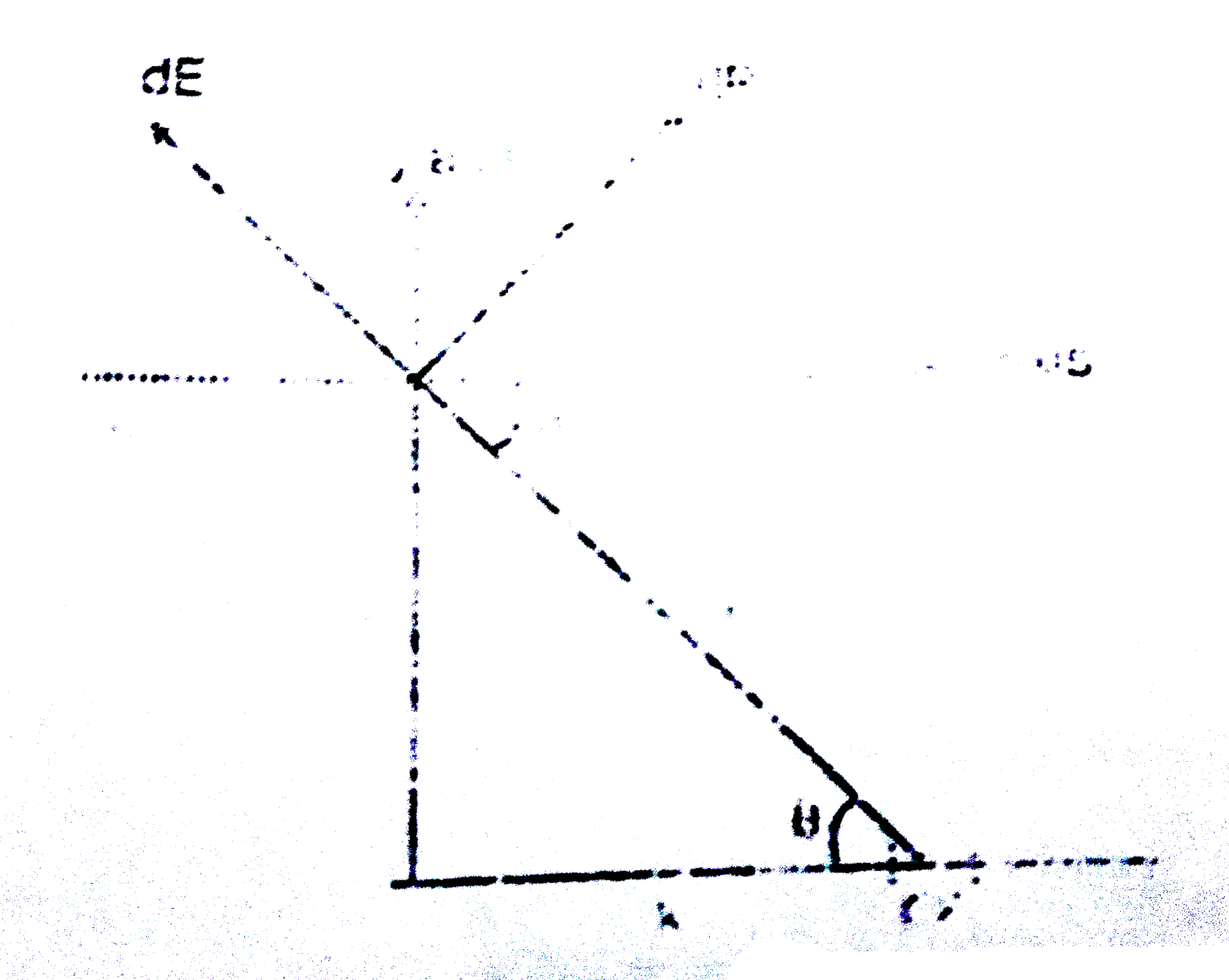
|
|
| 22. |
Which of the following reagents is best used for the conversion shown below ? |
|
Answer» `1.NaBH_(4)//2D_(3)O^(+)` 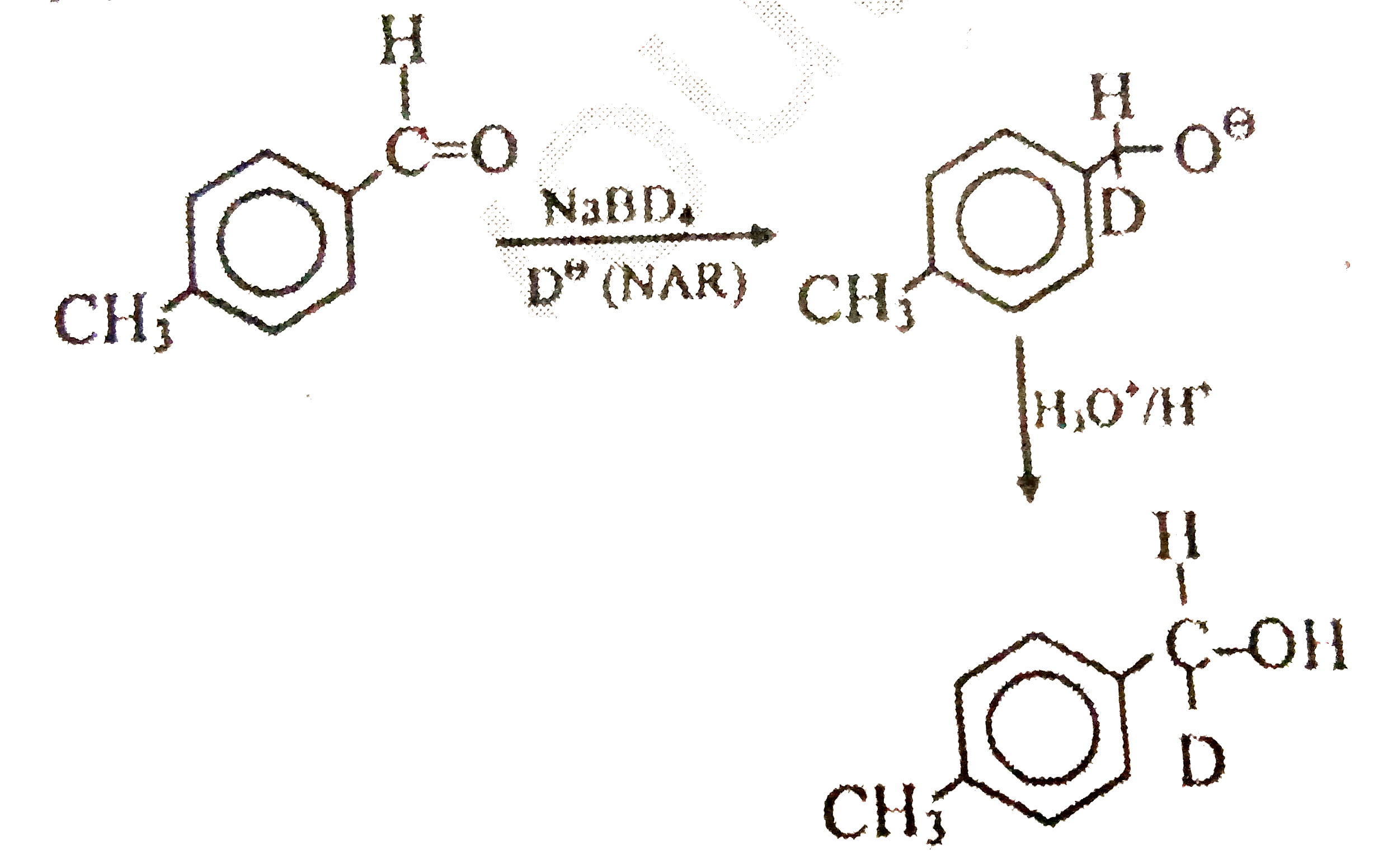
|
|
| 23. |
A 1.0 cm wire carrying a current of 30 A is placed inside a solenoid perpendicular to its axis. The magnetic field inside the solenoid is given to be 0.27 T. What is the magnetic force on the wire ? |
Answer» Solution : Consider MAGNETIC FIELD `vecB` produced along the axis of a current carrying LONG SOLENOID. As per the statement, magnetic force exerted on length I of a wire carrying current I, placed inside the solenoid perpendicular to its axis is, `F=IlBsintheta` = `(10)(0.03)(0.27)sin90^(@)` `F=8.1xx10^(-2)N` |
|
| 24. |
Explain the experiment to determine the resistivity of the material of the wire using meter bridge. |
Answer» Solution :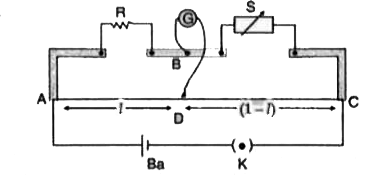 Formula `RHO = ( PI d ^(2) R )/( 4L) and R = (Sl )/((1 - l ))` Where `rho=` resistivity in `OMEGA-m` d = diameter of the wire in m R = RESISTANCE of the given wire in `Omega` L = length of the given wire in m |
|
| 25. |
Two wheels of same M.I. rotating in the same directions with same angular speed omega are coupled together. Their new speed of rotation is |
|
Answer» 2 `OMEGA` |
|
| 26. |
To get light in visible region through LED …….. Semiconductor is used. |
|
Answer» SILICON |
|
| 27. |
When a neutron induces fisssion in a ._(92)U^(235) nucleus, about 185MeV of usable enegry is released. If a reactor continuously generates 100MW of power using ._(92)U^(235)as fuel, then how long will it take for 1 kg of the uranium to be used up? |
|
Answer» Solution :Number of fissions `= (m)/(M)N_(A)` Energy released, `E = (m)/(M) N_(A) xx 185 xx 1.6 xx 10^(-13) J` POWER `= (E)/(t) = (mN_(A)xx185xx1.6xx10^(-13))/(235xxt) = 100 xx10^(6)` `t = (10^(3)xx6.023 xx 10^(23)xx185xx1.6xx10^(-13))/(235xx10^(8)) sec` `=7.57 xx 10^(5)s = (7.57 xx 10^(5))/(24xx3600)` `= 8.76 DAYS` |
|
| 28. |
(a) Deduce the relation between current I flowing through a conductor and drift velocity vecv_dof the electrons. (b) Figure shows a plot of current I flowing through the cross section of a wire versus the time t. Use the plot to find the charge flowing in 10 s through the wire. |
|
Answer» SOLUTION :Area under I-t graph gives the charge flowing: ` THEREFORE ` Charge flowing through a cross-section of wire in 10 s, q=area OABC = area OAD + area DABC= `1/2xx5xx5 + 5XX (10-5) = 12.5 + 25 = 37.5 C` |
|
| 29. |
Identical charges of magnitude Q are placed at (n-1) corners of a regular polygon of n sides each corner of the polygon is at a distance r from the centre. The field at the centre is |
|
Answer» `(kQ)/(R^(2))` |
|
| 30. |
Biprism fringes are produced with the help of sodium light (lambda=5893Å). The angle of the biprism is 179.5^(@) and tis refractive index 1.5. If the distance between the slit and the biprism is 0.4m and the distance between the biprism and the screen is 0.6 m, find the distance between successive bright fringes. Also calculate the maximum width of the slit for which the fringes will still be sharp. |
|
Answer» |
|
| 31. |
A living organism is unexceptionally differentiated from a non-living structure on the basis of |
|
Answer» reproduction |
|
| 32. |
A point object is placed at a distance of 20 cm on the principal axis from a thin plano-convex lens of focal length 15 cm. Find the position of final image, if the plane surface is silvered. |
| Answer» Solution :12 CM, TOWARDS CURVED SURFACE | |
| 33. |
Which of the following is the value of (sqrt 11 -sqrt7)(sqrt11 +sqrt7) |
| Answer» Answer :C | |
| 34. |
In case of a forced vibrations, the resonance wave becomes very sharp when the : |
|
Answer» damping forceis small Correct choice is (a). |
|
| 35. |
Name the part of the electromagneticspectrumofwavelength 10^(-2)m and mention its one application. |
| Answer» SOLUTION :MICROWAVE `to ` microwave OVEN | |
| 36. |
(A): The method of dimensions cannot be used to derive the formula N=N_(0c)^(-lambdaI) (R) : Exponetial functions have no dimensions. |
|
Answer» Both (A) and (R) are true and (R) is the correct EXPLANATION of (A) |
|
| 37. |
A coil of 0.01 henry inductance and 1Omega resistance is connected to 200 V, 50 Hz ac supply. Find the impedance of the circuit and time lag between max. alternating voltage and current. |
|
Answer» SOLUTION :Here , L=0.01 H, R=1 `Omega` ,V=200 V Frequency v=50 Hz Impendance of the circuit , `Z=sqrt(R^2+X_L^2)=sqrt(R^2+(2pivL)^2)` `therefore Z=sqrt((1)^2+(2xx3.14xx50xx0.01)^2)` `=sqrt(1+9.8596)=sqrt(10.8596)` `therefore Z=3.295 Omega` `therefore Z approx 3.3 Omega` `TAN phi =(omegaL)/R=(2pivL)/R` `therefore tan phi=(2xx3.14xx50xx0.01)/1` `therefore tan phi =3.14` `therefore phi = tan^(-1) (3.14)` `therefore phi =72^@` `=(72xxpi)/180` rad Phase DIFFERENCE , `phi=omegaDeltat` `therefore Deltat=phi/omega=(72pi)/(180xx2pivL)=72/(360xx50xx0.01)` `therefore Deltat=1/250` s |
|
| 38. |
The magnetic induction on the equatorial line of a short magnet at distance d from the centre of the magnet is B. At what distance on the equatorial line of the magnet the magnetic induction would become 4B? |
| Answer» SOLUTION :`d//2^(2//3)` | |
| 39. |
400 muCcharge is uniformly spread over the surface of a spherical shell and surface density is 0.314 cm^(-2). What is the radius of this shell ? |
|
Answer» 31.4 m `therefore R^(2) = Q/(4pisigma) = (400 XX 10^(-6))/(4 xx 3.14 xx 3.14 xx 10^(-2))` `therefore R = 0.00318`m |
|
| 40. |
A man of height 1.47 m stands on a straight road on a hot day. The vertical temperature in the air results in a variation of refractive index with height y as mu = mu_0 sqrt((1+ay))where mu_0 is the refractive index of air near the road a =1.5 xx 10^(-6) //m. What is the apparent length of the road man is able to see ? |
|
Answer» 700m |
|
| 41. |
A light emitting diode (LED) has a voltage drop of 2V volts across it and passes a current of 10mA. When it operates with a 6V battery through limiting resister R. The value of R is: |
|
Answer» `40KOmega` |
|
| 42. |
Write the expression for the magnetic moment due to an electron circulating around the nucleus of an atom. |
|
Answer» Solution :Current due to revolution of electron, `I = (e )/(T) & T = (2pir)/(V)` `therefore I = ev//2pir`. MAGNETIC moment, `mu_(i) = IPIR^(2) = evr//2`. |
|
| 43. |
A system goes from A to B via two processes. If deltaU_1and delta U_2 are the changes in the internal energies in the processes, then |
|
Answer» ` |
|
| 44. |
Resonance occurs in harmonic motion when |
|
Answer» The SYSTEM is overdamped |
|
| 45. |
A coil having inductance of 1 mH is connected to an A.C. source, its inductive reactance wil obtained to 1Omega then what will be the angulai frequency (in rad/s) of an A.C. source ? |
|
Answer» Solution :`X_L=omegaL` `THEREFORE omega=X_L/L=1/10^(-3) =10^3` rad/s |
|
| 46. |
Conductivity =________ and it's dimension is |
| Answer» SOLUTION :`[1/Resistivity, M^(-1)L^(-3)T^3A^2]` | |
| 47. |
C and Si both have same lattice structure, having 4 bonding electrons in each. However, C is insulator where as Si is intrinsic semiconductor. This is because, ……. |
|
Answer» in case of C the valence band is not completely filled at absolute ZERO temperature . Elecronic configurationof `""_(6)C` `1S^(2), 2s^(2)2p^(2)` Electronic configuration of `""_(14)Si` `1s^(2), 2s^(2)2p^(6), 3s^(2)3p^(2)` |
|
| 48. |
The relation connecting deflectiontheta, current I and reduction factor K of a tangent galvanometer is |
|
Answer» `I=K sin THETA ` |
|
| 49. |
If vectors vec P, vec Q, vec R have magnitudes 5, 12, and 13 units and vec P + vec Q = vec R the angle between Q and R is |
|
Answer» `COS^-1( 5/12)` |
|
| 50. |
Figure8-5a shows two industrial spies sliding an initially stationary 225 kg floor safe a displacement vec(d) of magnitude 8.50 m. The push vec(F)_(1) of spy001 is 12.0 N at an angle of 30.0^(@) downward from the horizontal, the pull vec(F)_(2) of spy 002 is 10.0 N at 40.0^(@) above the horizontal. The magnitudes and directions of these forces do not change as the safe moves, and the floor and safe make frictionless contact. (b) During the displacement, what is the work W_(g) done on the safe by the gravitational force vec(F)_(g) and what is the work W_(N) done on the safe by the normal force vec(F)_(N) from the floor ? |
|
Answer» Solution :KEY IDEA Because these FORCES constant in both magnitude and direction, we can find the WORK they do with EQ. 8-7. Calculations: Thus, with mg as the magnitude of the gravitational force, we write `W_(g)=mgd COS 90^(@)= mgd(0)=0` And `W_(N)=F_(N)d cos 90^(@)=F_(N)d(0)=0` We should have known this result. Because these forces are perpendicular to the displacement of the safe, they do zero work on the safe and do not transfer any ENERGY to or from it. |
|