

Saved Bookmarks
This section includes 7 InterviewSolutions, each offering curated multiple-choice questions to sharpen your Current Affairs knowledge and support exam preparation. Choose a topic below to get started.
| 1. |
A solenoid has a core of a material with relative permeability 200. The windings of the solenoid are insulated from the core and carry a current of IA. If the number of turns is 2000 per metre, calculate (a) H, (b) M, (c) B and (d) the magnetising current I_(m). |
| Answer» Solution :(a) `2 xx 10^(3) A//m,` (B) `0.5 T`, (C ) `3.96 xx 10^(5) A//m,` (d)` 198 A` | |
| 2. |
We have a disc of neglligible thickness and whose surface mass density varies as radial distance from centre as sigma=sigma_(0)(1+r/R), where R is the radius of the disc. Specific heat of the material of the disc isC. Disc is given an angular velocity omega_(0) and placed on a horizontal rough surface such that the plane of the disc is parallel to the surface. Coefficient of friction between disc and suface is mu. The temperature of the disc is T_(0). Answer the following question on the base of information provided in the above paragraph If the kinetic energy lost due to the friction between disc and surface is absorbed by the disc the moment heat is generated, by the mass lying at the point where the energy is lost. Assume that there is no radial heat flow in betwen disc particles. Rate of change in temperature at a point lying at r distance away from centre with time, before disc stops rotating, will be (alpha-magnitude of angular acceleration of rod) |
|
Answer» `(mu gr)/C(omega_(0)-ALPHAT)` `dE=(mu dmgr)(omega_(0)-alphat)dt=dmCdT` `=(dT)/(dt)=(mugr)/C(omega_(0) -alphat)` |
|
| 3. |
A series LCR circuit with R = 20 Omega, L = 1.5 H and C = 35 mu F is connected to a variable-frequency 200 V ac supply. When the frequency of the supply equals the natural frequencyof the circuit, what is the average power transferred to the circuit in one complete cycle ? |
| Answer» SOLUTION :2,000 W | |
| 4. |
A satellite is orbiting around the earth with total energy E . What happen if the satellite'skinetic energy is made 2E ? |
|
Answer» Radius of the orbit is doubled. ` therefore2 E =1/2 m (sqrt(2)v)^(2)` ` sqrt(2)v `is the escape velocityof the satellite from the earth.Whenthe KINETICENERGYOF satellite is made2 E,satelliteescape away. |
|
| 5. |
A survey of 500 television viewers produced the following information, 285 watchfootball,195watch hockey, 115 watch basket ball, 45 watch football and basket ball, 70 watch football and hockey, 50 watch hockey and basketball, 50 do not watch any of the three games. The number ofviewers, who watch exactly one of the three games, is |
|
Answer» 325 `=n(F)+n(H)+n(B)-n(F NNH) -n(F NN B) - n (H nn B) + n(F nn H nn B) ` `rArr 450=285+195+115-45-70-50+n(F nn H nn B)` `rArr n (F nn H nn B ) =20` n(EXACTLY one ) =`n(F)+n(H)n(B)-2n(F nn H)-2. n(H nn B) - 2. n(F nn B) + 3 n (F nn H nn B) ` `=285+195+115-2(45+70+50)+3.20` `=325` |
|
| 6. |
Coulomb's law is correct for......distance. |
|
Answer» all |
|
| 7. |
Find the total angular momentum of an atom in the state with S=3//2 and L=2 if its magnetic moment is known to be equal to zero. |
|
Answer» Solution :SINCE `mu=0` we MUST have EITHER `J=0` or `g=0` is incomplete with `L=2` and `S=(3)/(2)`. Hence `g=0`. Thus `0=1+(J(J+1)+(3)/(2)xx(5)/(2)-2xx3)/(2J(J+1))` or `-3J(J+1)=(15)/(4)-6=-(9)/(4)` Hence `J=(1)/(2)` Thus `M= ħsqrt((1)/(2)xx(3)/(2))=( ħsqrt(3))/(2)` |
|
| 8. |
A magnet is suspendedat an angle60^@ in an external magnetic field of5 xx 10^(-4) T . What is the work done by the magnetic field in bringing it in its direction ? [ The magnetic moment = 20 A-m^(2)] |
|
Answer» Solution :Work DONE by the MAGNETIC field, ` W = - MB( cos theta_1 - cos theta_2)` Here `theta_1 = 60^@ and theta_2 = 0` `:. W = -20 xx 5 xx 10^(-4) [ cos 60^(@) - cos 0]` `=-10^(-2)[(1)/(2)-1] = 5 xx 10^(-3) J`. |
|
| 9. |
How does diffraction limit the resolving power of an optical intstrument ? |
| Answer» Solution :The problem in identification of nearby points arises on account of diffraction of LIGHT, i.e. bending of light AROUND corners. When two POINT objects lie closeby, their diffraction patterns may overlap. Therefore, their images can no longer be identified separately. Hence their resolution BECOMES difficult. Thus the resolving power of the optical instrument is limited. | |
| 10. |
Two nicol prisms are inclined to each other at an angle 30^(@). If I is the intensity of ordinary light incident on the first prism. Then the intensity of light emerges from the second prism will be |
|
Answer» `(3I)/(4)` |
|
| 11. |
An angular magnification (magnifying power) of 30 X is desired using an objective of focal length 1.25 cm and an eye piece of focal length 5 cm. How will you set up the compound microscope ? |
|
Answer» Solution :`m_(e)=1+25//5=6` `m_(0)=30//m_(e)=5` `m_(0)=v_(0)//-u_(0)v_(0)=-5u_(0)` `1//f_(0)=1//v_(0)-1//u_(0)f_(0)=-(5//6)u_(0)` `u_(0)=1.5 cm, v_(0)=7.5cm` `u_(e)=-4.17cm` Length of the TUBE `=u_(e)+v_(0)=11.67cm` |
|
| 12. |
Find the fluz f the electric field through a spherical surface of radius R due to a charge of 10^(-7) Cat the centre and anotherequal charge at a point 2R away from the centre (figure ). |
|
Answer» Solution :Given: MAGNITUDE of the TWO charges placed = `( 10^-7)C` We know from Gauss's law that the FLUX experience by the sphere is only by due to internal CHARGE and not by the external ONE. Now, ` E xx ds = (Q/epsilon_0) = (10^-7)/ 8.85 xx (10^+12)` ` = 1.1 xx (10^4) N-m/C.` |
|
| 13. |
A circular coil of radius 2R is carrying current 'i'. The ratio of magnetic fields at the centre of the coil and at a point at a distance 6R from the centre of the coil on the axis of the coil is |
|
Answer» 10 |
|
| 14. |
Two bodies of masses m and 2m are kept at distance r apart from each other. Then the value of G varies as |
| Answer» ANSWER :D | |
| 15. |
What are the characteristics of nuclear forces? |
|
Answer» Solution :(i) These force are attractive by nature. (ii) These forces do not obey inverse square law, (III) NUCLEAR force are not CENTRAL forces. It means that these forces do not DEPEND upon the centre of ONE particle to another particle. |
|
| 16. |
The radius of gyration of a uniform solid sphere of radius R., about an axis passing through a point R/2 away from the centre of the sphere is: |
|
Answer» `sqrt((13)/(20))R` `=2/5 MR ^(2) + (MR^(2))/(4)` `= (13 MR ^(2))/(20)` RADIUS of gyratin `= sqrt((I _(AB))/(M )) = sqrt((13 R ^(2))/(20))= sqrt((13)/(20))R` 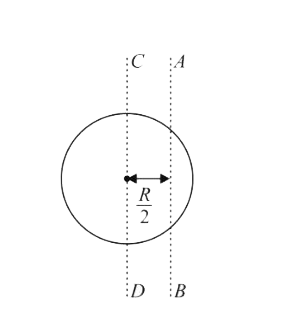
|
|
| 17. |
A 60 V, 10 W lamp is to be run on 100 V, 60 Hz a.c. mains. Calculate the inductance of a chock required to be connected in series with it to work the bulb. |
|
Answer» Solution :Resistacne of Lamp, `R = (V^(2))/(P) = ((60 xx 60))/(10) = 360 Omega` Current, `I_(rms) = (P)/(V) = (10)/(60) = (1)/(6)A` Impedance, `Z = (V_(rms))/(I_(rms)) = (100)/((1//6)) = 600 Omega` `Z = sqrt(R^(2) + XL^(2)) rArr L = (sqrt(Z^(2) - R^(2)))/(2pi f)` `L = (sqrt(600^(2) - 360^(2)))/(2(3.142)(60))` `= 1.273 H` |
|
| 18. |
The half lifr of a particle of mass 1.6 xx 10^(-26) kg is 6.9 s and a stream of such particles is travelling with the kinetic energy of a particles is travelling with the kinetic energy of a particle being 0.05 eV. The fraction of particles which will decay when they travel a distance of 1 m is |
|
Answer» `0.1` `(6.63)/(6.9)xx10^(-4) =10^(4)` |
|
| 19. |
According to Bohr's model of atom the orbit of an electron ...... [Where n is quantum number and Z = atomic number]. |
|
Answer» `r_(n)PROP(n)/(Z)` `r_(n)=(n^(2)H^(2)in_(0))/(piZe^(2)m)`, here `(h^(2)in_(0))/(PIE^(2)m)` =constant |
|
| 20. |
The deflection of a galvanometer falls to 1/10th when a resistance of 5 Omegais connected in parallel with it. If an additional resistance of 2Omegais connected in parallel to the galvanometer, the deflection is |
|
Answer» `1/6th` |
|
| 21. |
A nerrow beamof singly charged potassium ions of kinetic energy 32keVis injected into a region of width 1.00 cm having a magnetic field of strenght 0.500 T as shown in . The ions arecollected at a screen 95.5cm away from the field region. Ifthe beam contains isotopes of atomic weights 39 and 41, find the separaton between the points where these isotopes strike the screen. Take the mass of a potassium ion= A (1.6 X 10^(-27) kg where A is the mass number. |
|
Answer» Solution :For E-39 ` m = 39 xx 1.6 xx 10^(-7) ) kg , B= 5 xx 10^(-1) T ,` ` q = 1.6 xx 10^(-10)_(c) , KE = 32 kev` Velocity projection ` (1)/(2) xx 3 sin thetaxx (1.6 xx 10^(-27) )` , rArr`V^(2)= 32 xx 10^(2) xx 106 xx 10^(-19) ` ` V= 4.05 xx 10^(6) ` Through out the motion the horiantal velocity remation constant i = 24 xx 10^(-18) sec ` [ time taken to crossthe magnetic field ] Accle in theregion having magneticfield . `= 5193 , 53xx 10 ^(4) m/s ^(2) ` V (in vertical direction ) = at ` 5193.53 xx 10^(8) xx 24 xx 10^(-18) ` ` = 12464.48 m/s ` Totaltime taken to reach the screen ` = 0.000002382 sec`, Time gap= 2382 xx 10^(-0) - 24 xx 10^(-2) sec` , ` = 2358 xx 10^(-2) sec` Distance moved VERTICALLY (in the time) ` = 12464 .48 xx 2358 xx 10^(-0) ` = 0.0293m ` ` v^(2) = 2aS` Net display fromline ` = 0.0001495 + 0.0293912` ` = 0.0295407 on` for K-41l : (1)/(2)xx 41 xx 1.6 xx 10^(-17) v^(2)` ` = 32 xx 10^(0) xx 1.6 xx 10^(-0)` lt.brgt ` rArr v = 39 . 509 m/s ` ` a = 4818.193 xx 10^(0) m/s ^(2)` i = ( time taken for COMMING outside from magnetic field ltbbbrgt `= 25 xx 10(-0) sec` V = at (verticalvelocity ) ` = 4818. 193 xx 10^(8) xx 25 xx 10^(-0)` `= 12045.48 m/s `ltlbrgt ( time TOTAL to reach the screen ) `= 0.000002442 ` `time gap = 2442 xx 10^(-0) -25 xx 10^(-8)` `= 2417 xx 10^(-8)` distance moved vericaily `= 12045.48 xx 2417 xx 10^(-0)` ` = 0.0291` Now `V^(2) = 2aS = (2045.48)^(2)` `2 xx 4818.19 xx 10^(6)S` `rArr S = 0.0001505 m` Net distance traveiled `= 0.0001505 + 0.0291139` `= 0.0292644` Net gap between `K- 39 and K-41` `= 0.0295407 - 0.0292644` `0.0001763 m = 0.27 mm` . |
|
| 22. |
A closed cubical box made of a perfectly insulating material has walls of thickness 8 cm and the only way for the heat to enter or leave the box is through two solid cylinderical metal plugs , each of cross - sectional area 12 cm^(2) and length 8 cm fixed in the opposite walls of the box . The outer surface A of one plug is kept at a temperature of 100^(@)C while the outer surface of the other plug is maintained at a temperature of 4^(@)C~. The thermal coinductivity of the material of the plug is 0.5 cal // cmsec""^(@)C. A source of energy generating 36 cal s^(-1) is enclosed inside the box . Find the equilibrium temperature of the inner surface of the box assuming that it is the same at all points on the inner surface |
|
Answer» Solution :At equilibrium, the total energy generated by the source per second is equal to the HEAT leaving per second through the two metal plugs (Figure-4.12). Let T°C be the equilibrium temperature. Then heat leaving the box per second through surface A `(k(T-100)xx12)/(8)cals^(-1)` Heat leaving the box per second through the surface B `(k(T-4)xx12)/(8)cals^(-1)` Hence `(12k)/(8)(T-100+T-4)=36` or `2T-104=(36xx8)/(12k)=(36xx8)/(12xx0.5)=48 or T=76^(@)C` |
|
| 23. |
Assertion: Light emitted dipole (LED) emits spontaneous radiation. Reason: LED are forward biased p-n junctions. |
|
Answer» If both assertion and reason are true and reason CORRECT explanation of assertion. 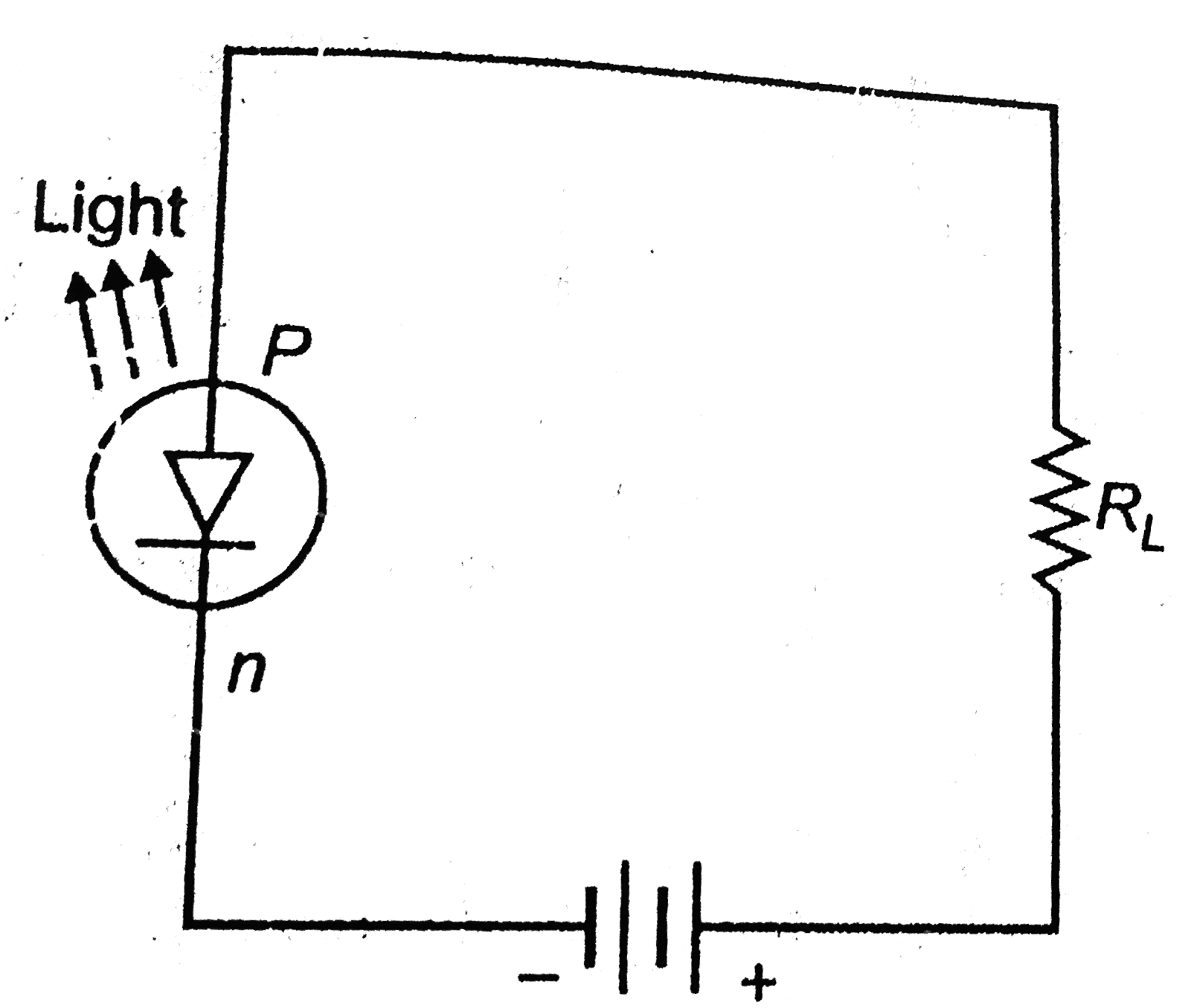
|
|
| 24. |
It there any relation between B and H ? |
|
Answer» Solution :YES The ratio of magnetic INDUCTION to magnetising field strength is DEFINED as the permeability `(mu)`. i.e., `mu=B/H` , where `mu=mu_0mu_r` |
|
| 25. |
STATEMENT -1 : A body kept at rest upon earth's surface near New Delhi, if allowed to move freely inside the Earth's surfface will reach the earth centre directly. and STATEMENT -2 : All bodies upon earth's surface experience centrifugal force. |
|
Answer» Statement 1- TRUE, Statement -2 is True, Statement -2 is a correct explanation for Statement -12 |
|
| 26. |
A hose pipe lying on the ground shoots a stream of water upward at an angle 60^@ to the horizontal at a speed of 20 ms^(-1). The water strikes a wall 20m away at a height of (g=10ms^2) |
|
Answer» 14.64 m |
|
| 27. |
Find the resultant of three vectors vecOA , vecOB, vecOC each of magnitude r as shown in figure. |
|
Answer» `R(1 - sqrt(2))` |
|
| 28. |
When a liquid drop is placed on a glass plate, the liquid-solid force is |
|
Answer» Adhesive |
|
| 29. |
The ratio of primary and secondary turns in a transformer is 3:2, if 30V a.c. is fed to primary, voltage across secondary will be ........ |
|
Answer» Solution :`N_2/N_1=epsilon_2/epsilon_1` `THEREFORE epsilon_2=epsilon_1xxN_2/N_1=30xx3/2` `therefore epsilon_2`=45 V |
|
| 30. |
The sensitivity of a galvanometer is 60 division per ampere .When a shunt is used, its sensitivity becomes 10 division per ampere . If galvanometer is of 25Omega resistance the value of stunt used is: |
| Answer» Answer :C | |
| 31. |
The Young's double-slit experiment is done in a medium of refractive index 4//3. A light of 600 nm wavelength isfalling on the slits having 0.45 mm separation. The lower shift S_(2) is covered by a thin glass sheet of refractive index. 1.5. The interference pattern is observed on a screen placed 1.5 mfrom the slits as shown in Figure a. Findthe location of central maximum (bright fringe with zero path difference) on the y-axis. b. Find the light intensity of point O relative to the maximum fringe intensity. c. Now , if 600 nm light is replaced by white light of range 400 - 700 nm, find the wavelengths of the light that from maxima exaclty at point O. (All wavelength in the problem are for the given medium of refractive index 4//3 Ignoe dispersion.) |
|
Answer» Solution :GIVEN `lambda nm = 6 xx 10^(-7) m, d = 0.45 MM = 0.45 xx 10^(-3) m, D = 1.5`. Thickness of glass sheet, `t = 10.4 mu m = 10.4 xx 10^(-6)m`. Refractive index of glass sheet, `mu_(g) = 1.5`. a. LET central maximum is obtained at a distance y below point O.Then, `Delta x_(1) = S_(1) P - S_(2) P = (yd)/(D)` Path difference due to glass sheet, `Delta x_(2) = (mu_(g)/(mu_(m) - 1 )) t` New path diffenence will be zero when `Deltax_(1) = Delta x_(2)` `implies (yd)/(d) = ((mu_(g))/(mu_(m)) - 1) t` `implies y = ((mu_(g))/(mu_(m)) - 1) t (D)/(d)` Subsituting the value, we have `y = ((mu_(g))/(mu_(m))-1)t (D)/(d)` or we can say `y = 4.33 mm.` a. At O, `Delta x_(1) = 0` and `Delta x (2) = ((mu_(g))/(mu_(m)) - 1)t` `:.` Net path difference `Delta x = Delta x_(2)` Corresponding phase difference, `Detla phi` or simply ` phi = (2 pi)/(lambda) Delta x`. Substituting the values, we have `phi = (2 pi)/(6 xx 10^(-7)) ((1.5)/(4//3) -1) (10.4 xx 10^(-6)) = ((13)/(3)) pi` Now, `I (phi) = I_(max) cos^(2) ((phi)/(2))` `I = I_(max) cos^(2) ((13 pi)/(6))` `= (3)/(4) I_(max)` At O, path difference is `Delta x = Delta x_(2) = ((mu_(g)) /(mu_(m) - 1)) t` For maximum intensity at O, ` Delta x = n lambda`(here `n = 1, 2, 3,...)` `lambda = (Delta x)/(1), (Delta x)/(2), (Delta x)/(3),....` and so on `Delta x = ((1.5)/(4//3) - 1) (10.4 xx 10^(-6) m)` `= ((1.5)/(4//3) - 1) (10.4 xx 10^(-3) nm` `= 1300 nm` Maximum intensity will be corresponding to `lambda 1300 nm, (1300)/(2) nm, (1300)/(3) nm, (1300)/(4) nm,...` `= 1300 nm, 650 nm, 433.33 nm, 325 nm,...` The wavelength in the range 400 to 700 nm are 650 nm and 433.33 nm. 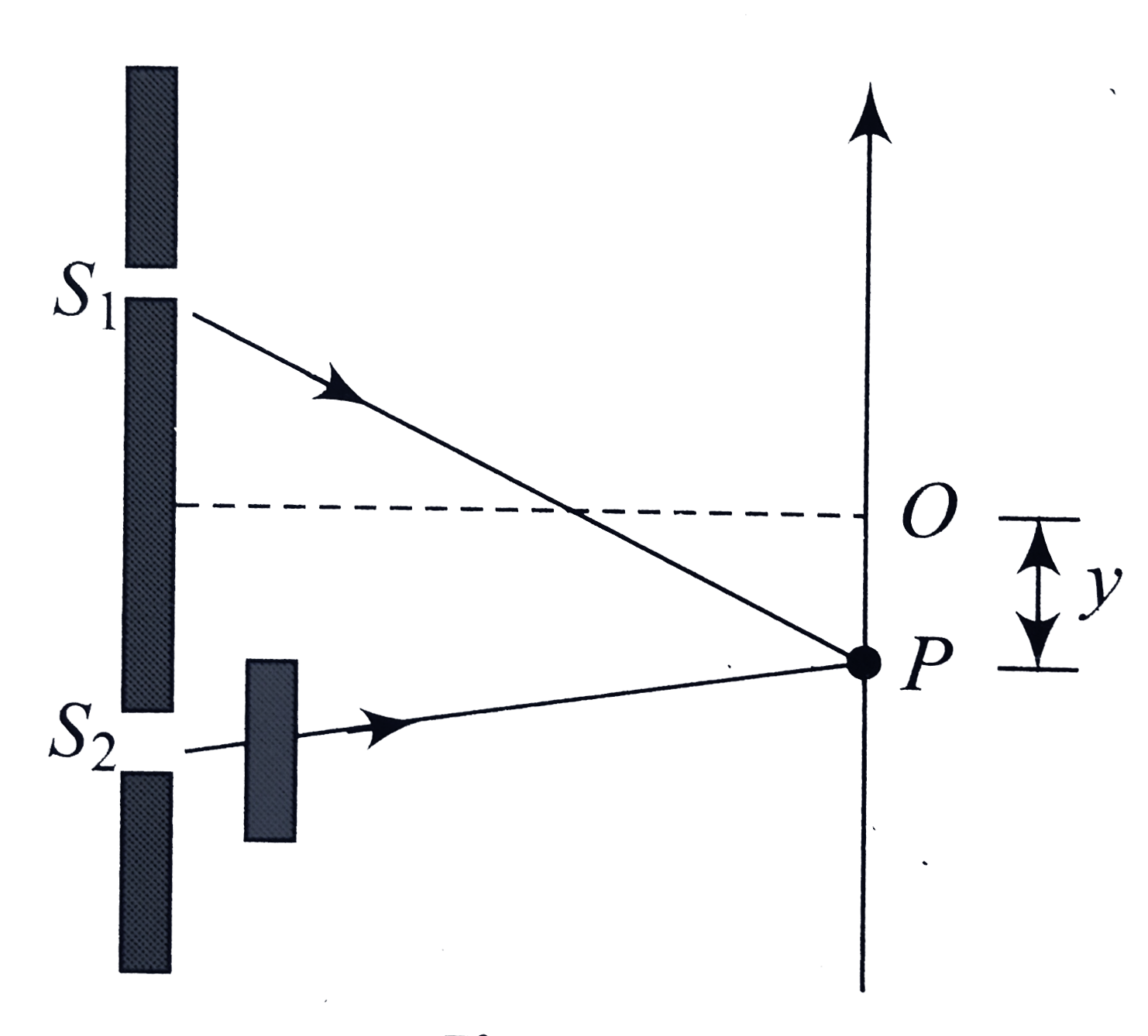
|
|
| 32. |
The physical quantity having SI unit N C^(-1) m is ______ . |
|
Answer» SOLUTION :electric potential (or potential DIFFERENCE or emf) Unit of electric potential as volt (V)`= (J)/( C)= (Nm) /( C)= NC^(-1)m` |
|
| 33. |
Calculate the voltage drop across 5 Omega resistance and current passing through the zener diode for the circuit given below: |
|
Answer» Solution :Since the voltage across the zener DIODE `V_(2)=50"volt"` `THEREFORE`Voltage drop across `5Omega` resistor =120-20=70 volt `therefore`Current through load resistor of `10kOmega` `I_(L)=(V_(z))/(R_(L))=(50)/(10kOmega)=5XX10^(-3)amp` Therefore ,current through the Zener diode `I_(z)=I-I_(L)=14-5xx10^(-3)` amp=13.996 amp. |
|
| 34. |
An ammeter has range I and resistance G. What resistance should be connected in series to decrease its range to 1/n ? |
| Answer» Answer :D | |
| 35. |
A Point object P moves towards a convex mirror with a constant speed V, along its optic axis. The speed of the image |
|
Answer» is always `lt V` |
|
| 36. |
Deducethe conditionforbalanceof awheatstone'sbridgeusingKirchoffsrules . |
Answer» Solution : It is the combination of four resistances P,Q,R and S in the form of quadrilateral ABCD. A galvanometer is connected between junctions B and D. The line BD is called galvanometer arm. A battery is connected between junctions A and C. This AC is called the battery arm. On APPLYING Kirchhoff.s loop RULE to the loop ABDA, we get `I_(1)P+I_(g)G-I_(2)R=0` But for balance of NETWORK `I_(g)=0` `I_(1)P-I_(2)R=0` `I_(1)P=I_(2)R""_________(1)` On applying Kirchhoff.s loop rule to the loop BCDB, we get `(I_(1)-I_(g))-(I_(2)+I_(g))S-I_(g)G=0` `I_(1)Q-I_(g)Q-I_(2)S-I_(g)S-I_(g)G=0` For balance of network `I_(g)=0` `I_(1)Q-I_(2)S=0` `I_(1)Q=I_(2)S""_________(2)` `((1))/((2))implies(I_(1)P)/(I_(1)Q)=(I_(2)R)/(I_(2)S)` `(P)/(Q)=( R )/(S)` This is the condition for balance wheatstone bridge. |
|
| 37. |
क्या आप मीटर ब्रिज की मदद से बहुत उच्च प्रतिरोधों को सटीक रूप से जान सकते हैं? |
|
Answer» हां |
|
| 38. |
A point source is situated at a distance x lt f from the pole of the concave mirror of focal length f. At time t=0 the point source starts moving away from the mirror with constant velocity. Which of the graphs below represents best, variation of image distance |v| with distance x between the pole of mirror and the source. |
|
Answer» |
|
| 39. |
A cylinder contains 0.15 kg of hydrogen. The cylinder is closed by a piston supporting a weight of 74 kg (Fig.). What amount of heat should be supplied to lift the weight by 0.6 m? The process should be assumed isobaric, the heat capacity of the vessel and the external pressure should be neglected. |
|
Answer» `W = m_wgh = p(V_2 - V_1) = m/M R (T_2 - T_1)` Therefore `DELTAT = m_wgh M//mR` The quantity of heat is obtained from the EQUATION `Q/W = (C_(mp))/(R) = 7/2` (diatomic gas!) . |
|
| 40. |
A convex surface of radiys of curvature 20 cm separates air from glass of refractive index 1.5. Find the position and the nature of the image of a small object placed at 50 cm in front of the convex surface. |
|
Answer» |
|
| 41. |
Two capacitors of equal capacity are first connected in parallel, and then in series. The ratio of the total capacities in the two cases will be: |
|
Answer» `2:1` |
|
| 42. |
Assertion: The coulomb force is the dominating force in the universe Reason:The coulomb force is non-conservative force |
|
Answer» Both Assertion and REASON are TRUE and Reason is the correct EXPLANATION of Assertion |
|
| 43. |
Distance between two image formed by upper and lower part of the point object placed at 30 cm from given lens is (60+x)cm, then the value of x is |
|
Answer» `implies f_(L)=20CM` `1/f=1/(-10)-2/20=-1/5` `1/v+1/(-30)=1/(-5)implies1/v=1/30-1/5` for lens `1/v-1/(-30)=1/20` |
|
| 44. |
A horizontal flat coil of radius a made of w turns of wire carrying a current sets up a magnetic field. A horizontal conducting ring of radius r is placed at a distance x_(0)from the centre of the coil (Fig. 30.6). The ring is dropped. What e.m.f. will be established in it? Express the e.m.f. in terms of the speed. |
|
Answer» The variable in thiscase is the COORDINATE `x=x_(0)-vt`, where is the velocity of fall. The magnitude of the individual e.m.f. is `|epsi|=(d Phi)/(dt)=(mu_(0)p_(m) r^2)/(2) (d)/(dt) (a^(2) x^2)^(-3//2)` `=-3/4 mu_(0)p_(m)r^2 (a^2+r^2)^(-5//2). 2r (dr)/(dt)=(3mu_(0)p_(m) r^2xv)/(2(a^(2)+x^(2))^(5//2))` |
|
| 45. |
Which of the following characteristics of electrons determines the current in a conductor ? |
|
Answer» Drift VELOCITY alone. |
|
| 46. |
In a balanced Wheatstone's network, the galvanometer resistance is increased by 20Omega. What happens to the balance of the network? |
| Answer» SOLUTION :The NETWORK will REMAIN BALANCED. | |
| 47. |
The blue color of the sky is due to ? |
| Answer» SOLUTION :SCATTERING of LIGHT. | |
| 48. |
Can the potential barrier across a p-n junction be measured by simply connecting a voltmeter across the junction? |
| Answer» Solution :Nom, because in this case, no CURRENT PASSES obtained in it. (Reason is : we know that barrier POTENTIAL is the potential difference between the boundaries of deplection layer. Since there are no free charge CARRIERS in the depletion layer, if we connect voltmeter across these boundaries, no current passes through it and hence barrier potential can not be measured by connecting voltmeter). | |
| 49. |
If the units of M and L are increased three times, then the unit of energy will be increased by |
| Answer» Answer :C | |
| 50. |
The following data was obtained for a given transistor For this data, calculate the input resistance of the given transistor. |
|
Answer» SOLUTION :Here, `Delta_(BE)=0.82-0.72=0.10V` `DeltaI_(B)=80-30=50muA=50xx10^(-6)A` Input resistance, `R_(i)=(DeltaV_(BE))/(DeltaI_B)` `(0.10V)/(50xx10^(-6)A)=2000Omega=2xx10^(3)OMEGA` |
|


