

Saved Bookmarks
This section includes 7 InterviewSolutions, each offering curated multiple-choice questions to sharpen your Current Affairs knowledge and support exam preparation. Choose a topic below to get started.
| 1. |
How much mass has to be converted into energy to produce electric power of 500 MW for one hour ? |
|
Answer» `2XX10^(-5)` kg Energy PRODUCED , E=P x t = `5xx10^8xx3600=18xx10^11` J As `E=mc^2` `therefore m=E/c^2=(18xx10^11)/((3xx10^8)^2)=(18xx10^11)/(9xx10^16)=2xx10^(-5)` kg |
|
| 2. |
An object is placed at 24 cm distant from a surface of a lake. If water has refractive index of 4//3, then at what distance from the lake surface, a fish will get sight of an object. |
|
Answer» 32 CM above the SURFACE of WATER |
|
| 3. |
An object kept on the principal axis and in front of a spherical mirror, is moved along the axis itself. It lateral magnification m is measured and plotted versus object distance |u| for a range of u, as shown fig. The magnification of the object when it is placed at a distance 20 cm in front of the mirror is |
|
Answer» `-1` |
|
| 4. |
A,B and C are voltmeters of resistance R, 1.5 R and 3R respectively as shown in the fig. When some potential difference is applied between X and Y, the voltmeter reading are V_(A), V_(B) and V_(C ) respectively. |
|
Answer» `V_(A)=V_(B) NE V_(C )` |
|
| 5. |
Prepare the truth table for the logic circuit given below. |
Answer» Solution :Here Y. is the OUTPUT of the AND gate having A and B as the input. The input to the OR gate is A and Y. `(=A*B)`. HENCE the output `Y=A+Y.=A+(A*B)`. The TRUTH table of the circuitcan be given as under. 
|
|
| 6. |
At themagnetic north poleof the earth the value of the horizontal component Hand the angle of dip theta is |
|
Answer» `H=0,theta=45^(@)` |
|
| 7. |
The magneticmomentof a magentof mass78 gm is 10.2xx 10^(-7) A-m^(2). Densityof thematerialis 7.8 xx 10^(3) kg//m^(3) Whyare they called ? |
|
Answer» |
|
| 8. |
Define unit of self-inductance. On which factors self-inductance depends. |
|
Answer» Solution :The unit of self INDUCTANCE is Henry. Self induced emf is GIVEN by, `epsilon=-L(dI)/(dt)`. "If `(dI)/(dt)=1 As^(-1)` and the induced emf is 1 V, then the self-inductance of the circuit is DEFINED as 1 Henry (H). Value of L depends on : Self inductance of solenoid is, (1) Inversly proportional to LENGTH of solenoid. (2) Directly proportional to length of solenoid. (3) Directly proportional to square of number of turns. (4) Instead of air, magnetic material is kept in core of solenoid, then its inductance increase. |
|
| 9. |
Five charges , q each are placed at the corners of a regular pentagon of side. (a) (i) What will be the electric field at 0, the centre of the pentagon? (ii) What will be the electric field at 0 if the charge from one of the corners (say A) is removed? (iii). What will be the electric field at 0 if the pentagon is replaced by n-sided regular polygon with charge q at each of its corner? |
|
Answer» Solution :(a) (i) The point O is equidistant from all the charges at the end point of pentagon. THUS, due to symmetry, the forces due to all the charges are cancelled out. As a RESULT ELECTRIC field at O is zero. (ii). When charge q is removed a negative charge will develop at A giving electric field `E=(qxx1)/(4piepsi_(0)r^(2))` along OA. (iii) If charge q at A is replaced by -q, then two negative charges -2q will develop there. thus, the value of electric field `E=(2q)/(4piepsi_(0)r^(2))` along OA. (b). When pentagon is replaced by N sided regular polygon with charge q at each of its corners, the electric field at O would continue to be zero as symmetricity of the charges is dueto the regularity of the polygon it doesn't depend on the number of sided or the number of charges. |
|
| 10. |
In a transistor, doping level in base is increased slightly. How will it affect (i) collector current and (ii) base current ? |
| Answer» SOLUTION :(i) COLLECTOR current decreases slightly. (ii) Base current increases slightly. | |
| 11. |
In the above problem, if F = 250 N, the acceleration of A and B are - |
|
Answer» `2MS^(-2),2.1ms^(-2)` |
|
| 12. |
When two bodies collide elastically, then |
|
Answer» Kinetic energy of the system alone is CONSERVED |
|
| 13. |
The output of the given circuit in figure. |
|
Answer» would be zero at all times.  In above circuit, when a is positive with respect to b, diode is in forward bias condition and so taking its RESISTANCE zero, output voltage `V_(0)=V_(d )-V_(c )=0` In above circuit, when a is negative with respect to b, diode is reverse biased and so taking its resistance infinite, current becomes zero and so, `V_(a)=V_(d )` `therefore V_(a)-V_(b)=V_(d)-V_(b)` `therefore V_(a)-V_(b)=V_(d)-V_(c )""(because V_(b)=V_(c ))` `therefore V_(a)-V_(b)=V_(0)` `therefore V_(0) lt 0 "" (because V_(a) lt V_(b))` Thus, for each positive half cycle of A.C. supply, `V_(0)=0` and for each negative half cycle of A.C. supply `V_(0)` remains negative. HENCE, output voltage will be like output voltage of half wave rectifier with alternative negative half cycles. |
|
| 14. |
Figure shows two binary star systems such that the distance of lighter star from the centre of rotation is same in both cases. If the ratio of time periods of rotation is (T_(1))/(T_(2))=n/8 sqrt(3/2) where n is an integer, find n |
|
Answer» `M_(1)=3M, M_(2)=4M` `((T_(1))/(T_(2)))^(2)=((l_(1))/(l_(2)))^(2)xx(M_(2))/(M_(1))=(9/8)^(2)xx4/3` `implies(T_(1))/(T_(2))=9/8sqrt(3/2)` |
|
| 15. |
A satellite is revolving round the earth in a circular orbit of radius R with velocity v_(0). At certain instant it gets an external tangential impulse so that its velocity become 2v_(0). Calculate its maximum and minimum distances from the earth's surface during subsequent motion of the particle, |
|
Answer» |
|
| 16. |
An electromagnetic radiation whose electric component varies with time as E=E_0(1+cos omegat)cos omega_0t(omega=6xx10^(15) "rad"//s, omega_0=2.8 xx10^(14) "rad"//s) is incident on a lithium surface (work function =2.39 eV) . The maximum kinetic energy of a photoelectron liberated from the lithium surface is (h=4.14 xx10^(-15) eV-s) |
|
Answer» 2.50eV |
|
| 17. |
Two wires of same length are made into a circle and square respectively. Currents are passed in them such that their magnetic moments are equal. Then the ratio of the magnetic field at their respective centres (circle: square) is |
|
Answer» `( sqrt(2) PI ^3)/( 32)` |
|
| 18. |
A ray of light is incident at 60^(@) on one face of a prism of angle 30^(@) and the emergent ray makes 30^(@) with the incident ray.the refractive index of the prism is |
|
Answer» 1.732 |
|
| 19. |
Two identical thin rings, each of radius R metre are coaxially placed at distance R metre apart. If Q, and Q, coul are respectively the charges uniformly spread on the two rings, the work done in moving a charge 9 from the centre of one ring to that of the other is : |
|
Answer» zero |
|
| 20. |
A pulse shown here is reflected from the rigid wall A and then from free end B. The shape of the string after these 2 reflection will be: |
|
Answer»
|
|
| 21. |
What is the ground state of an atom ? And what is the ionization energy and excitation energy of a hydrogen atom ? |
|
Answer» Solution :Total energy of electron in atom is `E_(n)=-(mZ^(2)e^(4))/(8n^(2)h^(2)epsi_(0)^(2))` `:. E_(n)=-(13.6Z^(2))/(n^(2))eV` Negative sign indicates that as the value of .n. increases the negative `E_(n)` decreases that is energy increases that is the energy of the electron increases gradually in far orbits from nucleus. When electron is revolving in an orbit closest to the nucleus MEAN in n = 1 orbit, the absolute value of the energy (maximum negative value) is smaller. Such a lowest state of the atom is called the ground state. The energy of electron orbiting in orbit of Bohr radius `a_(0)` is , `E_(1)=(13.6Z^(2))/(n^(2))eV` For hydrogen Z=1,n=1 `:. E_(1)=-13.6eV` Therefore, the minimum energy required to free the electron from the ground state of hydrogen atom is 13.6 eV is called the ionization energy. At room temperature, most of the hydrogen atoms are in ground state. When a hydrogen atom receives energy by processes, the atom may acquire sufficient energy to raise the electron to higher energy states. The atom is then said to be in an excited state. The energy required to EXCITE an electron in hydrogen atom to its first excited state (n = 2) `E_(2)-E_(1)=-(13.6)/(2^(2))-(-(3.6)/(1^(2)))` `=(13.6-(13.6)/(4))eV` energy needed `=13.6-3.4=10.eV` And the energy required to bring an electron in H atom from ground state to second EXCITEDSTATE (n=3) is `E_(3)-E_(1)=-(13.6)/(3^(2))-(-(13.6)/(1^(2)))` `=13.6-1.51` `=12.09eV` Hence, the energy required to bring an electron in H atom from ground state to second excited state is 12.09 eV. Similarly, the energy required to bring electron in third excited state and fourth excited state and infinite excited state are 12.75 eV, 13.06 eV and 13.6 eV respectively. If the electron returns from a excited state to a low energy state, a photon is emitted in this process. Thus, as the excitation of hydrogen atom increases that is as n increases, the value of minimum energy required to free the electron from the excited atom decreases. Thus, from equation `E_(n)=-(13.6)/(n^(2))eV`,the energy level diagram for stationary states of a hydrogen atom is shown in figure.  The energies corresponding to different orbits as shown by horizontal lines on vertical axis. The energy levesl of the hydrogen atom are shown by horizontal line. As the quantum nuber increases the energy difference between the two successive energy LEVELS decreases. |
|
| 22. |
Does the charges given to a metallic sphere depend on whether it is hollow or solid? Give reason for your answer. |
| Answer» Solution :The charges GIVEN to METALLIC SPHERE does not depend on the fact that it is hollow or solid. It ALSO because for a metallic sphere the charges lies only on its outer surface. | |
| 23. |
An electric field is described by the field lines as shown. Explain about the nature of the field. |
Answer» Solution :Considera closed path p q r as shown in the given field At pq field intensity is `E_(1)` and at rs field intensity is `E_(2)`. From the given distribution of field lines `E_(2) gt E_(1)`. Field is perpendicular to QR or ps Now `OINT BARE. d barl=int E_(1)(pq) +intE_(2)(sr)` `=(E_(1)-E_(2))pq NE 0` (`:. int barE. d barl=0` for qr and ps) Line integral of `barE. dbarl` alongclosed pathis nonzero in this CASE. But we know that electric field is conservative and `oint barE.d barl=0`. It means electric field as shown in not possible. |
|
| 24. |
Two identical loops, one of copper and other of manganin, are removed from a magnetic field simultaneously. In which loop, the current induced will be greater? |
| Answer» Solution :As the resistance of copper is LESS than manganin, therefore, the INDUCED CURRENT will be GREATER in copper than manganin, | |
| 25. |
At time t = 0, some radioactive gas is injected into a sealed vessel. At time T, some more of the same gas is injected into the same vessel. The graph representing the variation of the logarithm of the activity A of the gas with time t is. |
|
Answer»
|
|
| 26. |
The following logic gate symbol represents |
|
Answer» an OR GATE |
|
| 27. |
Deviation without dispersion and disperison without deviation What should be the condition on a combination of prism for the following ? (a) Angle of dispersion is zero but angle of deviation is not zero. |
|
Answer» Solution :(1) Deviation without DISPERSION is not possible for a single prism but we can combine two or more prisms so that dispersion is zero. Such a COMBINATION is known as achromatic combination of prisms. but in this case `theta_(1)+theta_(2)=0` Calculation We have `(n_(v_(1))-n_(R_(1)))A_(1)+(n_(V_(2))-n_(R_(2)))A_(2)=0` Since `n_(V)-n_(R )` is always greater than `0`, this is possible only where `A_(1)` and `A_(2)` are of the opposite signs. That is, `A_(2)=-((n_(V_(1))-n_(R_(1)))/(n_(V_(2))-n_(R_(2))))A_(1)` Now, `delta=delta_(1)+delta_(2)` `=(n_(V_(1))-1)A_(1)+(n_(v_(2))-1)A_(2)` `=(n_(V_(1))-1)A_(1)-(n_(V_(2))-1)((n_(V_(1))-n_(R_(1)))/(n_(V_(2))-n_(R _(2))))A_(1)` `=(n_(V_(1))-1)A_(1)[1-((n_(V_(1))-n_(R_(1)))/(n_(V_(1))-1)))((n_(V_(1))-1)/(n_(V_(2))-n_(R_(2))))]` `=delta_(1)[1-(omega_(1))/(omega_(2))]` (b) ANGLE of deviation is zero but angle of dispersion is not zero. (1) Dispersion without deviation is not possible for a single prism but we can combine two or more prisms so that deviation is zero. Such a combination is known as direct vision prism. (2) Mathematically we want that `delta_(1)+delta_(2)=0` but in this case `theta_(1)+theta_(2) ne 0` Calculation we know that `delta=delta_(1)+delta_(2)=0` where `delta` is average deviation for each prism , that is `(n_(V_(1))-1)A_(1)+(n_(V_(1))-1)A_(2)=0` `A_(2)=-(n_(Y_(1))-1)A_(1))/((n_(y_(1))-1))` This would mean that in this case also both angles of the prism are of opposite signs. `theta=theta_(1)+theta_(2)` Now, `theta_(1)=(n_(v_(1))-n_(R_(1))A_(1)` `theta_(2)=(n_(v_(2))-n_(R_(2))A_(2)` `theta=(n_(V_(1))-n_(R_(1)))A_(1)-(n_(V_(2))-n_(R_(2)))((n_(V_(1))-1)A_(1))/((n_(V_(2))-1))` Substituting the value of `A_(2)`, we get `(n_(V_(1))-n_(R_(1)))[1-[((n_(V_(2))-n_(R_(2)))/(n_(Y_(1))-1))((n_(Y_(2))-1)/(n_(V_(1))-n_(R_(2))))]]` Finally, we have `theta=theta_(1)+theta_(2)=theta_(1)[1-(omega_(2))/(omega_(1))]` (Only yellow color ray will not deviate, all other colored rays will deviate Learn : This kind of combination of prisms is possible only if the prisms are kept INVERTED with respect to each other as shown in the Fig. 34-67. 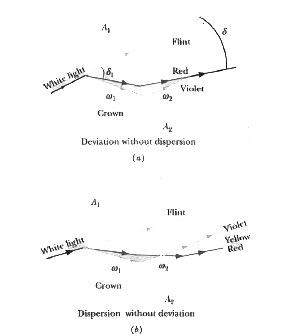 |
|
| 28. |
The threshold frequency of a metal surface is 6.2 eV energy. Stopping potential for incident radiation is 5V. Then incident radiation lies in : |
|
Answer» X-RAYS region `=6*2eV+5eV=11*2eV` which energy corresponds to that of ultraviolet rays. |
|
| 29. |
A convex lens is divided into two parts at a distance 5 mm from the centre and the two parts are placed at a separation of 5 mm as shown. A concave lens is also divided into two parts but .in the opposite sense that of convex lens.The focal lengths of convex and concave lenses are 30 cm and -50 cm respectively. Find the co-ordinate(s) of real Images wheh an object is placed at a distance of 90 cm from the plane of the convex lens. |
|
Answer» |
|
| 30. |
In a p-n junction (i) new holes and conduction electrons are produced continously throught the material (ii) new holes and conduction electrins are produced continuously throughout the material (iii) Holes and condution electrons recombine continuously throughout the material (iv) holes and conduction electrons recombine continuously throught the material exept in the depletion region |
|
Answer» `(i),(II)` |
|
| 31. |
Find the thickess of the wire The main scale division is of 1mm In a complete rotation the screw advances by 1mm and the circular scale has 100 devisions Zero error of the screwgase is 0.007mm . . |
| Answer» Solution :EXCESS reading (ZERO ERROR) = - 0.07 It is -0.07mm excess reading which has to be removed (subtracted) so actual reading `=7.95 - (-0.07) = 8.02mm` . | |
| 32. |
A screen is at a distance of 2m that are narrow slit illuminated with light of 6000 A^(@). The first maximum lies at 0.005mm on either side of the central maximum, then the distance between the slits will be |
|
Answer» 0.024 mm |
|
| 33. |
A scooterstrating from rest moveswith aconstant velocity for the nextDeltat_(1), thenwitha constant velocity for the next Deltat_(2)and finallywith a constantdeceleration for the next Delta_(3) to come to rest. A 500 N mansittingon thescooterbehindthe dricer manages to stayatrest with respectto the scooter withouttouching and other part . The force exerted by the seaton the man is |
|
Answer» 500 N throughoutthe journey |
|
| 34. |
In a household electrlic circuit, |
|
Answer» all electric appliances drawing power are joined in parallel |
|
| 35. |
The direction of ray of light incident on a concave mirror is shown by PQ while directions in which the ray would travel after reflection is shown by four rays marked 1, 2, 3 and 4 (See figure). Which of the four rays correctly shows the direction of reflected ray ? |
|
Answer» 1 Thus, path no. 2 is correct path for ray `vec(PQ)`. |
|
| 36. |
A resistance of R Omega draws current from a potentiometer. The potentiometer has a total resistance R _(0) Omega. A voltage V is supplied to the potentiometer. Derive an expression for the voltage across R when the sliding contact is in the middle of the potentiometer. |
|
Answer» Solution :While the slide is in the middle of the POTENTIOMETER only half of its resistance `(R_(0) //2)` will be between the POINTS A and B. Hence, the total resistance betweeen A and B, say, `R_(1),` will be given by the following expression: `(1)/( R _(1)) = (1)/( R )+ (1)/( (R _(0) //2 ))` `R _(1)= (R _(0) R )/( R _(0) + 2 R )` The total resistance between A and C will be the sum of resistance between A and B,B and C, i.e., `R_(1)+ R _(0)//2` `therefore` The current FLOWING through the potentiometer will be `I = ( V)/( R _(1) + R _(0) //2 ) = ( 2 V)/( 2 R _(1) + R _(0))` The voltage `V_(1)` TAKEN from the potentiometer will be product of current I and resistance `R_(1),` `V _(1)=IR _(1) = ((2 V)/( 2 R_(1) + R _(0))) xx R _(1)` SUBSTITUTING for `R _(1),` we have a `V _(1) = ( 2V )/( (( R _(0) xx R )/( R _() + 2 R))xx R _(0))xx (R _(0) xx R )/( R _(0) + 2 R)` ` V _(1) = ( 2 VR)/( 2 R + R _(0) + 2 R)` ` or V _(1) = ( 2 VR)/(R_(0) + 4 R)` |
|
| 37. |
The electric field at a distance 3R/2 from the centre of a charged conducting spherical shell of radius R is E. The electric field at a distance R/2 from the centre of the sphere is |
| Answer» Answer :A | |
| 38. |
A magnetic field of 100 G (1 G = 10^(-4) T) is required which is uniform in a region of linear dimension about 10 cm and area of cross-section about 10^(-3) m^(2). The maximum current-carrying capacity of a given coil of wire is 15 A and the number of turns per unit length that can be wound round a core is at most 1000 turns m^(-1). Suggest some appropriate design particulars of a solenoid of the required purpose. Assume the core is not ferromagnetic. |
|
Answer» SOLUTION :We know that magnetic field inside a solenoid is given by `B = (mu_0 N I)/(L)` For field to be uniform in a region of length 10 cm, the total length of the solenoid shouldbe much greater. With this IDEA in mind we suggest a PARTICULAR design of a solenoid as Length `l = 1 m`, radius = 2 cm, total number of turns N = 800 and current I = 10 A Then the magnitude field `B = (mu_0 N I)/(l) = (4 pi xx 10^(-7) xx 800 xx 10)/(1) = 10^(-2) T " or " 10^(2) G` These particulars are not unique. We may have other suitable parameters [l = 0.5 m, N = 400, radius R = 4 cm and current l = 10 A] which may also give the magnetic field of the same order. |
|
| 39. |
The pd across a resistance of 1 ohm is 1 volt, then the current is |
|
Answer» 1 amp |
|
| 40. |
Resistance of a given wire is obtained by measuring the current flowing in it and the voltage difference applied across it. If the percentage errors in the measurement of the current and the voltage difference are 3% eacgm then error in the value of resistance of the wire is: |
| Answer» ANSWER :D | |
| 41. |
In Fig. 10-78, two skaters, each of mass 50 kg, approach each other along parallel paths separated by 3.0 m. They have opposite velocities of 1.4 m/s each. One skater carries one end of a long pole of negligible mass, and the other skater grabs the other end as she passes. The skaters then rotate around the center of the pole. Assume that the friction between skates and ice is negligible. What are (a)the radius of the circle, (b) the angular speed of the skaters, and ( c) the kinetic energy of the two skater system? Next, the skaters pull along the pole unyil they are separated by 1.0 m. What then are (d) their angular speed and (e) the kinetic energy of the system? (f) What provided the energy for the increased kinetic energy? |
| Answer» Solution :(a) 1.5 m, (b) 0.93 rad/s, ( c) 98 J, (d) 8.4 rad/s, (e) `8.8xx10^(2)J`, (f) We account for the large increase in kinetic energy [PART (e) minus part ( c)] by noting that the skaters do a great deal of work (converting their INTERNAL energy into mechanical energy) as they pull themselves closer - "fighting" what appears to them to be large "CENTRIFUGAL forces" TRYING to keep them apart. | |
| 42. |
An astronomical telescope may be a refracting type or a reflecting type. Which of the two produces image of better quality ? Justify your answer. |
| Answer» SOLUTION :REFLECTING type TELESCOPE because image formed is FREE from CHROMATIC aberration. | |
| 43. |
According to New Cartesian Sign Convention : |
|
Answer» focal length of concave MIRROR is positive and that of CONVEX mirror is NEGATIVE |
|
| 44. |
How will you distinguish a diamagnetic substance from a paramagnetic substance in respect of their behaviour in a uniform and non-uniform field ? |
Answer» SOLUTION :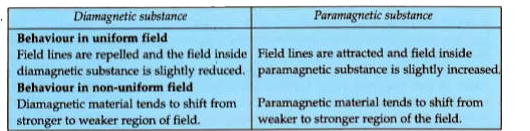
|
|
| 45. |
A refractive index of material of a prism with prism angle A is n=cotA/2 then angle of minimum deviation will be |
| Answer» Answer :B | |
| 46. |
In the figure shown a uniform conducing rod of mass m and length l is suspended invertical plane by two conducing springs of spring constant k each. Upper end of springs are connected to each other by a capacitor of capacitance C. A uniform horizontal magnetic field (B_(0)) perpendicular to plane of springs in space initially rod is in equillibrium. If the rod is pulled down and released, it performs SHM. (Assume resistance of springs and rod are negligible) Choose the correct options from the followng: |
|
Answer» ELECTRICAL energy stored in CAPACITOR is MAXIMUM |
|
| 47. |
What is corona discharge ? |
|
Answer» |
|
| 48. |
Magnetic properties of which of the following materials do not affected by temperature ? |
|
Answer» Diamagnetic |
|
| 49. |
An object is projected with velocity 20 m s^(-1) making an angle of 45° with horizontal. The equation for its trajectory is h = Ax - Bx^(2) , where h is the height and x the horizontal distance. The ratio of constants A : B |
|
Answer» `1:5` `:. A/B=(2u^(2)cos^(2)theta.tantheta)/g` `=(2xx400xx1/2)/10=40/1` |
|
| 50. |
A 100 milli henry coil carries a current of 1A. Energy stored in its magnetic field is |
|
Answer» 0.5 J |
|


