

Saved Bookmarks
This section includes 7 InterviewSolutions, each offering curated multiple-choice questions to sharpen your Current Affairs knowledge and support exam preparation. Choose a topic below to get started.
| 1. |
A flow of 10^(7) electrons per second in a conducting wire constitutes a current of |
|
Answer» `1.6xx10^(-26)A` `=1.6xx10^(-12)A` |
|
| 2. |
From what distance should a 100 eV electron be fired towards a large metal plate having a surface charge of -2.0 xx 10^(-6) Cm^(-2), so that it just fails to strike the plate ? |
|
Answer» 0.50 mm |
|
| 3. |
Two satellites A and B revolve in around the earth in a circular orbits. Satellite A has mass 200 kg revolving at a distance of 600 km from the earth surface.Satellite B of mass 400 kg revolves at a distance of 1600 km from earth surface. What will be the ratio of their time period? |
|
Answer» `(7/8)^(1/2)` |
|
| 4. |
In Exercises 7.3 and 7.4, what is the net power absorbed by each circuit over a complete cycle ? Explain your answer |
|
Answer» <P> Solution : Net POWER absorbed by an a.c. circuit is given by `P =V_(rms) I_(rms) COS phi`where `phi`is the phase difference between current and voltage.In EXERCISE 7.3, circuit is a purely inductive circuit where current LAGS behind the voltage by `pi/2`and circuit of Exercise 7.4 is a purely capacitive circuit in which current leads the voltage by `pi/2` Hence, in both circuits Power `=V_(rms) .I_(rms) .cos pi/2 = V_(rms).I_(rms)(0)= 0` (zero). |
|
| 5. |
A ray of light is refracted through a transparent sphere of refractive from mu in such a way that the ray passes through the ends of two radii inclined at an angle theta with each other. If delta is the angle of deviation of the ray while passing through the sphere then prove that, mu=("cos"(1)/(2)(theta-delta))/("cos"(theta)/(2)) |
|
Answer» Solution :Let the ray PQ incident at Q on the sphere, is refracted along QR and emerges from the sphere along RS [FIG. 2.12]. Of the triangle OQR , OQ = OR (both are radii of the sphere). `therefore "" angleOQR = angleORQ` Let angle of INCIDENCE of the ray at`Q = anglePQN = i` and angle of refraction ` = angleOQR = R` So the angle of incidence of the ray at R is r and angle of refraction i.e. angle of emergence is i. Angle of deviation of the incident ray, `delta = angleMTR = angleTQR + angleTRQ` `= (i -r) + (i -r) = 2(i - r)` From the triangle OQR we have, `r + r + theta = 180^(@)` `or, "" 2r + theta = 180^(@) or, r = 90^(@) - (theta)/(2)` From equation (1) we get, `(delta)/(2) = i - r or, i = (delta)/(2) + r = (delta)/(2) = 90^(@) + (delta)/(2) - (theta)/(2)` Considering refraction at Q, `mu = (sini)/(sinr) = (sin(90^(@) + (delta)/(2) - (theta)/(2)))/sin(90^(@) - (theta)/(2))` `sin{90^(@) - (1)/(2) (theta - delta)}/(cos(theta)/(2)) = (cos""(1)/(2)(theta - delta))/(cos(theta)/(2))` 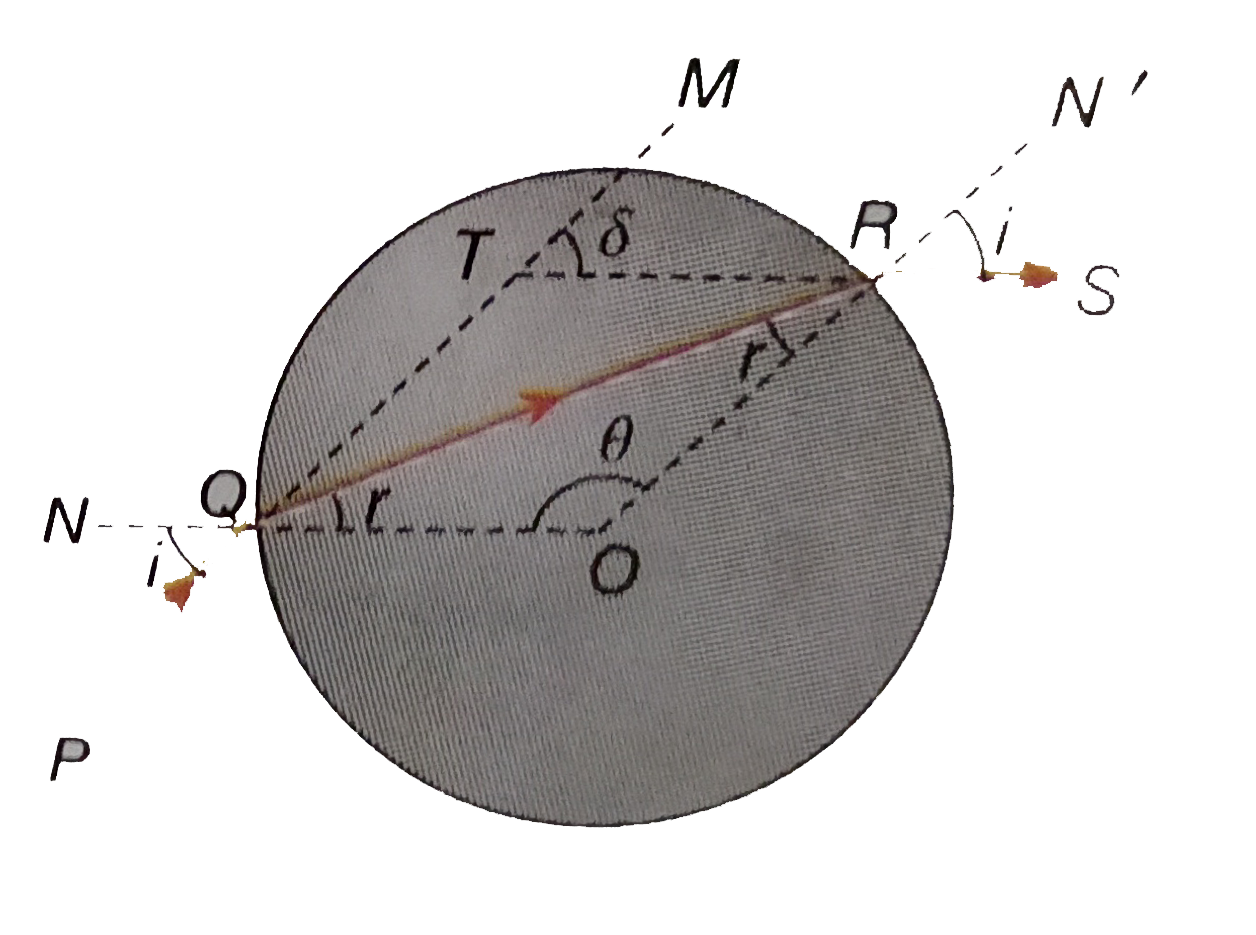
|
|
| 6. |
An inductance has a high resistance to A.C. and low to D.C., when a dc voltage source having some ac component superimposed on its sends current through an inductance to a load resistance : |
|
Answer» The DC voltage falls APPRECIABLY ACROSS the LOAD and ac component falls only a small amount |
|
| 7. |
In UHF range the frequencies are propagated by means of : |
|
Answer» SURFACE waves |
|
| 8. |
If S and T are two sets such that S has 21 elements,T has 32 elements,and SnnT has 11 elements,Howmany elements does SuuT have? |
|
Answer» 40 |
|
| 9. |
In case of a projectile fired at an angle equally inclined to a horizontal and vertical with velocity v, the greatest height is given by : |
|
Answer» `v^(4)/(4G)` |
|
| 10. |
Two light waves are represented by y_(1)= a sin omega t" and "y_(2)= a sin (omega t+ delta). When they overlap, the phase angle of the resultant wave is |
|
Answer» `2 DELTA` |
|
| 11. |
A : A 60 watt bulh has greater resistance than a 100 watt bulb. R : P = VI = I^(2) R = (V^(2))/(R) |
|
Answer» Both ASSERTION and REASON are true and the Reason is CORRECT explanation of the Assertion. Both Assertion and Reason are true, but Reason is not correct explanation of the Assertion. |
|
| 12. |
Define current sensitivity and voltage sensitivity of a galvanometer. Increasing the current sensitivity may not necessarily increase the voltage sensitivity of a galvanometer. Justify. |
|
Answer» Solution :The current sensitivity of a galvanometer is defined as the deflection per unit current. `:.` Current sensitivity `phi/I = (NAB)/(k)`, where`k`= restoring torque per unit deflection. The voltage sensitivity of a galvanometer is defined as the deflection per unit voltage. `:.` Voltage sensitivity `phi/V = (NAB)/k cdot 1/R`, where R is the resistance of the galvanometer. Increase in current sensitivity may not NECESSARILY increase the voltage sensitivity. To explain it let US double the number of turns N of galvanometer coil. So as to double the current sensitivity. However, on doubling the number of turns the resistance of galvanometer coil is also doubled from R to 2R consequently voltage sensitivity REMAINS unchanged. |
|
| 13. |
Two positives ions, each carrying a charge q, are separated by a distance d. If F is the force of repulsion between the ions, the number of electrons missing from each ior will be (e being the charge on an electron) |
|
Answer» `(4 PI epsilon_0 Fd^2)/(e^2)` |
|
| 14. |
What was Bhagat Singh reading? |
|
Answer» BIOGRAPHY of MAHATMA Gandhi |
|
| 15. |
The self-inductance of a circular coil increases many fold if a soft iron core is introduced inside the coil. |
| Answer» Solution :True - Self-inductance of a coil INCREASES `mu_(r)` TIMES, where `mu_(r)` is the RELATIVE MAGNETIC permeability of SOFT iron. | |
| 16. |
A green light is incident from the water to the air-water interface at the critical angle (theta). Select the correct statement. |
|
Answer» The entire spectrum of visible light will come out of the water at an angle of `90^@` to the normal. `sinC=(1)/(mu)` …(1)  For the wave of large wavelength (small frequency), refractive index u is small and from EQUATION (1), if u is small, then critical angle C will be large. Hence if light of smaller frequency is REFLECTED then it will refract at less than `90^@`. |
|
| 17. |
A piece of copper is to be shaped into a conducting wire of maximum resistance. The suitable length and diameter are …………and …………respectively. |
|
Answer» L and d `R=(rho1)/(A)=(rho1)/(pi r^(2))=(rho1)/(pi r^(2))` If the length of wire is increases, then the radius of wire is decreases. To get the maximum resistance the SUITABLE and diameter are 2L and d/2. |
|
| 18. |
ABCDE is a very long wire carrying current i_(1) as shown. The portion BCD is a semicircle with centre at O. Another very long wire passes through point O, perpendicular to the plane of ABCDE and it carries current i_(2) outside the plane of paper. The two wires |
|
Answer» ATTRACT each other |
|
| 19. |
A convex lens is held in water. What should be the change in focal length? |
| Answer» SOLUTION :FOCAL LENGTH INCREASES | |
| 20. |
What is the excess of pressure due to surface tension in a spherical liquid drop of radius R? |
|
Answer» <P> SOLUTION :P = 26/R or `P PROP R^-1` |
|
| 21. |
Name two radioactive elements which are not found in observable quantities. Why is it too? |
| Answer» Solution :Tritium and Plutonium are two RADIOACTIVE elements which are not FOUNDIN observable quantities in the universe. This is because HALF life PERIOD of each of the two elements is short compared to the age of the universe. | |
| 22. |
Two metals A and B have work functions 4e V and 10 eV respectively. Which metal has higher threshold wavelength ? |
|
Answer» Solution :`W_0 = hv_0 = (hc)/lambda_0 i.e., lambda_0 prop1/W_0` So, METAL A with lower WORK function has HIGHER THRESHOLD WAVELENGTH. |
|
| 23. |
The light from two coherent sources, each of intensity I, having a phase difference phi superimpose then resultant intensity (I_(R)) of light is given as _____. |
| Answer» SOLUTION :`I_(R)=4Icos^(2)((PHI)/(2))` | |
| 24. |
Displacement between maximum potential energyposition and maximum kinetic energy position for a particle executing S.H.M. is : |
|
Answer» `+-(a)/(2)` `:.` Displacement between maximum potential energy and maximum kinetic energy is `+- a Correct choice is (B). |
|
| 25. |
A uniform wire is cut into two pieces such that one piece is twice as long as the other. The two pieces are connected in parallel in the left gap of a metre bridge. When a resistance of 20 Omega is connected in the right gap, the null pooint is obtained at 60 cm from the right end of the bridge wire. Find the resistance of the wire before it was cut into two pieces. |
|
Answer» Solution :Let `R_(w)` be the resistance of the wire before it was CUT in two. Let `L_(1), L_(2)` and `X_(1),X_(2)` be the lenghts and resistance of the two PIECES. `therefore R_(w) = X_(1) + X_(2)` and `(X_(1)/X_(2))= (L_(1)/L_(2))` (`rho` and A being the same) Data: `L_(1)=2L_(2), R=20 Omega` (in the right gap), `L_(R) = 60 cm` `therefore L_(x) = 100-L_(R) = 40 cm` and `X_(1)/X_(2) = L_(1)/L_(2)=2` Since, the pieces are CONNECTED in parallel, their EQUIVALENT resistance is `X_(p) = (X_(1)X_(2))/(X_(1)+ X_(2)) = X/(X_(1)/X_(2) + 1) = X_(1)/(2+1) = 1/3X_(1)`.................(1) And, with the bridge balanced, `X_(p)/R = L_(X)/L_(R)` `therefore X_(p) = R(L_(X)/L_(R)) = 20 xx 40/60, 40/3 Omega`..................(2) From Eqs. (1) and (2), `1/3X_(1)= 40/3 therefore X_(1) = 40 Omega` `therefore X_(2) = 1/2X_(1) = 20 Omega` `therefore` The ORIGINAL resistance of the wire is `R_(w) = X_(1) + X_(2)= 40 + 20 = 60 Omega`. |
|
| 26. |
Two small magnets A and B of diple moments M_(0)and 2M_(0) respectively are fixed perpendicualr to each otherwith theirnorth polesmagnetic field the valueof alpha is |
| Answer» Answer :A | |
| 27. |
The ionization energy of 10 times the ionized sodium atom ...... |
|
Answer» 13.6 EV |
|
| 28. |
Assuming that the junction diode is ideal , in the circuit shown here , the current through the diode is : |
|
Answer» zero |
|
| 29. |
A proton und un electron move between two ports having a potential difference V. a. Which gains more energy b. Define electron volt. c. How is 1e V and 1 MeV related to joule? d. Write the dimensional formula of electrostatic potential. |
|
Answer» Solution :Both GAIN the same energy Work done=energy gain =Potential difference `xx " Charge"` The p.d. and charge are same for each. b. One eV is the kinetic energy acquired by an electron accelerated on an electric field of p.d. one volt. C. 1MeV `=10^(6)eV =1.6 xx 10^(-13)J` `1eV= 1.6 xx 10^(-19)J` `d. [V]=([W])/([q])=([ML^(2) T^(-2)])/([1 xx T])=[M^(1) L^(2) T^(-3) I^(-1)]` |
|
| 30. |
A diffraction pattern is obtaine usingbea of red light . What happens if the red light is replaced byblue light . |
|
Answer» no change |
|
| 31. |
Assertion : For a non-uniformly charged thin circular ring with net charge zero, the electric field at any point on axis of the ring is zero. Reason : For a non-uniformly charged thin circular ring with net charge zero, the electric potential at each point on axis of the ring is zero. |
|
Answer» If both ASSERTION and Reason are true and Reason is the correct EXPLANATION of Assertion. |
|
| 32. |
Electric field of electromagnetic wave is represented by E = 50 sin (omega t -(x)/(c ))NC^(-1). Intensity of wave is ….. Wm^(-2). |
|
Answer» (A) 50 `therefore E_(rms)=(50)/(sqrt(2))NC^(-1)` Intensity of wave, `I=c in_(0)E_(rms)^(2)` `=(3xx10(8)xx8.85xx10^(-12)xx2500)/(2)=3.3 Wm^(-2)` |
|
| 33. |
In the figure shown two loops ABCD &EFGH are in the same plane. The smaller loop carries time varying current I=bt, where b is a positive constant and t is time. The resistance of the smaller loop is r and that of the larger loop is R : (Neglect the self inductance of large loop ). The magnetic force on the loop EFGH due to loop ABCD is (mu_(0)^(2)Iab)/(xpi^(2)R) ln""(4)/(3) . Find the value of x. |
|
Answer» |
|
| 34. |
In principle what space communication systems make use ? |
| Answer» Solution :All type of space communication systems MAKE USE of high frequency radio WAVES (part of electromagnetic spectrum)as the carrier for the message SIGNAL. | |
| 35. |
A body is kept in a gravitational field. Its binding energy |
|
Answer» will be ZERO, if it is at rest |
|
| 36. |
A charged particle moves horizontally without deflection near the earth's surface. In this region |
|
Answer» only ELECTRIC field is present |
|
| 37. |
Distinguish between wireline and wireless communication? Specify the range of electromagnetic waves in which it is used. |
Answer» SOLUTION :
|
|
| 38. |
The displacement of a particle in a periodic motion is given by y = 4 cos^(2) (t/2) sin (1000t). This displacement may be considered as the result of superposition of n independent harmonic oscillations. Here n is |
|
Answer» 1 `y=2(1+cost) sin(1000t)(THEREFORE 2cos^(2) THETA -1 + cos 2theta)` `=2sin(1000t) +sin(1001t) + sin(999t)` `(therefore 2sinA COSB = sin(A+B) +sin(A-B))` |
|
| 39. |
[Co (H_(2) O) _(6)]Cl_(3) overset(NH_(3)) to A+B+C A, B and C are complexs with different coordination entity without any H_(2)O molecule. Among these C shows two different spatial arrangements one is green and another is violet complex respectively. Colour of A and B complexes are yellow & purple respectively. Then which of the following statement is CORRECT ? |
|
Answer» Aqueous solution of YELLOW complex shows Vant hoff factor (i) = 3 in COLLIGATIVE properties. `[Co(NH_(5)) _(5) Cl] Cl_(2):` purple cis : `[Co (NH_(3)) _(4) Cl_(2)]Cl :` violet trans : `[Co (NH_(5)) _(4) Cl_(2) ] Cl :` green |
|
| 40. |
The ends of the two rods of conductivities , radii and lengths in the ratio of 1:2 are maintained at the same temperature difference. If the rate of flow through the bigger rod is 12" cal s"^(-1), in shorter it will be (in "cal s"^(-1)) : |
|
Answer» Solution :`H=(Q)/(t)=(KA(T_(1)-T_(2)))/(d)` `therefore H_(1)=(k_(1)A_(1)(T_(1)-T_(2)))/(d_(1))` `H_(2)=(k_(2)A_(2)(T_(1)-T_(2)))/(d_(2))` `:.(H_(1))/(H_(2))=(k_(1))/(k_(2))*(A_(1))/(A_(2))xx(d_(2))/(d_(1))=(1)/(2)xx(1/2)^(2)xx2/1=(1)/(4)` `:.H_(1)=H_(2)xx1/4=12xx1/4=3" CAL s"^(-1)`. Thus correct choice is (c ). |
|
| 41. |
A parallel plate capacitor A is filled with a dielectric whose dielectric constant varies with applied voltage as K = V. An identical capacitor B of capacitance C_0with air as dielectric is connected to voltage source V_0 = 30Vand then connected to the first capacitor after disconnecting the voltage source. The charge and voltage on capacitor. |
|
Answer» A are `25C_0 and 25V` |
|
| 42. |
A small drop of water falls from rest through a large height h in air, the final velocity is |
|
Answer» PROPORTIONAL to SQRT of h |
|
| 43. |
When two point charges q_(A) and q_(B) areplaced at some separation on positive x-axis at points (x_(A), 0) and (x_(B), 0). Given that |q_(A)| and |q_(B)| and x_(B) gt x_(A). If null point is the point where net electric field due to both the charges is zero, then |
|
Answer» if both `q_(A)` and `q_(B)` are POSITIVE, null point lies at some point `x_(A) LT X lt x_(B)` |
|
| 44. |
A domain if ferromagnetic iron is in the form of cube of side length 1mum. Estimate the number of iron atoms in the domain and the maximum possible moment and magnetisation of the domain. The molecular mass iron is 55 g/mol and its density is 7.9g//cm^3 . Assume that each iron atom has a dipole moment of 9.27xx10^(-24) Am^2. |
|
Answer» Solution :The volume of the cubic domain is V = `(10^(-6)m) ^3=10^(-18)=10^(-12)cm^3` Its MASS is volume `xx` DENSITY `=7.9"g cm"^(-3) xx10^(-12)cm^3=7.9xx10^(-12)` g It is given that Avogadro number `(6.023xx10^(23))/(55) =8.65xx10^(10)` atoms. The maximum possible dipole moment `m_(max)` is achieved for the (unrealistic) CASE when all the atomic moments are PERFECTLY aligned. Thus, `m_(max)= 8.65x10^(10)xx(9.27xx10^(-24))=8.0xx10^(-13)Am^2` The consequent magnetisation is `M_(max)=(m_(max))/("Domain volume")` `=8.0xx10^(-13)Am^2//10^(-18)m^3=8.0xx10^(5)Am^(-1)` |
|
| 45. |
The potential energy per unit area of the liquid surface, is called |
|
Answer» SURFACE energy |
|
| 46. |
Calculate the magnifying power of a magnifying glass of 5 cm focal length, distance of distance vision is= 25 cm . |
|
Answer» SOLUTION :Data SUPPLIED, f = 5 cm,D = 25 cm m = 1 + `(D)/(f) = 1 + (25)/(5) = 1 + 5 = 6 ` |
|
| 47. |
For ionising an excited hydrogen atom, the energy required (in eV) will be |
|
Answer» a LITTLE LESS than 13.6 |
|
| 48. |
In a photoelectric set up, a point source of light of power 3.2xx10^(-3) W emits monoenergetic photons of energy 5.0 eV. The source is located at a distance of 0.8 m from the centre of a stationary metallic sphere of work function 3.0 eV and of radius 8.0xx10^(-3) m. The efficiency of photoelectron emission is one for every 10^(6) incident photon. Assume that state is isolated and initially neutral and that the photoelectrons are instantly swept away after emission. Calculate the number of photoelectron emitted per sec, by sphere : |
|
Answer» `10^(2)` `P=2.2xx10^(-3)W` Energy of onephoton `E=5.0eV=5xx1.6xx10^(-19)J=8.0xx10^(-19)J` Number of photon emitted PER sec by source, `N=(P)/(E)=(3.2xx10^(-3))/(8.0xx10^(-19))=4xx10^(15)` If `r=0.8 m` is the DISTANCE of the sphere from the source, then the number of photons incident on the sphere per sec unit area. `=(N)/(4pir^(2))` If `R=8.0xx10^(-3)m` is the radius of the sphere, the number of photons incident on sphere per sec. `=(N)/(4pir^(2))xx4pi R^(2)=(NR^(2))/(4pir^(2))xx4` `=(4xx10^(15)xx(8.0xx10^(-3))2)/(4XX(0.80)^(2))=4xx10^(11)` As efficiency of photoelectron EMISSION is 1 for every `106(6)` incident photons, therefore, the number of emitted photoelectrons per sec `=4xx(10^(11))/(10^(6))=4xx10^(5)~~10^(5)` |
|
| 49. |
In given circuit determine (a) Equivalent resistance (Including internal resistance). (b) Current I, i_(1), i_(2)'"and"i_(3) ( c) Potential difference across battery and each resistance (d) The rate at which the chemical energy of the cell is consumed (e ) The rate at which heat is generated insisde the battry (f) Electric power output (g) Which resistance consumes miximum power ? (h) Power dissipated across 4Omega resistance. |
|
Answer» (b) `i=2A, i_(1)=1/2A, i_(2)=1A, i_(3)1/2A` ( C)V=4V in each (d)12 W (e ) 4 W (f) 8 W (G) `4 Omega` (h) 4 W |
|
| 50. |
Consider a uniform electric field in the hatz direction. The potential is a constant |
|
Answer» inallspace Potential difference per unit DISPLACEMENT perpendicular to equipotential surface at a point gives the magnitude of electric field. So, equipotential surfaces will be the plane perpendicular to z-axis. Means, along XY plane, which includes any x or y-axis. |
|