

Saved Bookmarks
This section includes 7 InterviewSolutions, each offering curated multiple-choice questions to sharpen your Current Affairs knowledge and support exam preparation. Choose a topic below to get started.
| 1. |
A rectangular block of glass ABCD has a refractive index 1.6. A pin is placed midway on the face AB (See figure). When observed from the face AD, the pin shall |
|
Answer» appear to be near A.  Situation given in the statement is depicted in above figure. Here if glass to air critical angle is C then, `sinC=(1)/(mu)` (Where `mu` = refractive index of glass w.r.t. air) `therefore sinC=(1)/(1.6)` `therefore` sinC=0.625 ...(1) `therefore C=38^@40.` ...(2) Suppose angle `theta` shown in the figure is SMALLER than C. From the geometry of figure,`sintheta=(AE)/(EP)` `therefore sin theta=(y)/(sqrt(y^2+(a^2)/(4)))` ....(3) (Where a = side length of a square) Here when `theta lt C` in above equation, light will come out of point E and hence object at point P can be seen. If `theta` is INCREASED then value of y will also increase. Suppose when `theta = C, y = y_0` and so from above equation, `sinC=(y_0)/(sqrt(y_0^2+(a^2)/(4)))` `therefore 0.625=(y_0)/(sqrt(y_0^2+(a^2)/(4)))` [From equation (1)] Taking square, `therefore (y_0^2)/(y_0^2+(a^2)/(4))=0.4` `therefore y_0^2=0.4y_0^2+0.4xx(a^2)/(4)` `therefore 0.6y_0^2=(a^2)/(10)` `therefore y_0^2=(a^2)/(6)` `therefore y_0=(a)/(sqrt6)=(a)/(2.449)=(a)/(2.5)` `therefore y_0=0.4 a lt 0.5 a` When we observe with our eye, nearer to END A, object at P can be seen. Hence, option (A) is correct. |
|
| 2. |
Are (a) the kinetic energy and (b) the total energy of a 1GeV electron more than, less than, or equal to those of a 1 GeV proton? |
|
Answer» |
|
| 3. |
Draw graph showing variation of voltage and current with time over one cycle of ac.for X |
|
Answer» Solution :Potential diffrence devloped between the ends of the wings ` .e. =Blv` Given Velocity v= `9000km // "hour" ` `"" =250 m//s` wing span.= i= 20 m Vertical component of Earth .s megnetic FIELD ` B_ v= B_H tan gamma ` = ` 5xx 10^(-4) ( tan 30^(@) ) XX 20 xx250` ` = ( 5xx 20 xx 250 xx10^(-4))/( sqrt3) V ` `= 1.44` Volt |
|
| 4. |
A thin film of soap solution (mu_(s)=1.4) lies on the top of a glass plate (mu_(g)=1.5). When visible light is incident almost normal to the plate, two adjacent reflection maxima are observed at two wavelengths 420 and 630 nm. The minimum thickness of the soap solution is |
|
Answer» |
|
| 5. |
There are two co-axial non conducting cylinders of radii a and b (gt a). Length of each cylinder is L (gtgt b) and their curved surfaces have uniform surface charge densities of – sigma (on cylinder of radius a) and + sigma (on cylinder of radius b). The two cylinders are made to rotate with same angular velocity omega as shown in the figure. The charge distribution does not change due to rotation. Find the electric field (E ) and magnetic field (B) at a point (P) which is at a distance r from the axis such that(a)0 lt r lt a (b) a lt r lt b (c) r gt b. Assume that point P is close to perpendicular bisector of the length of the cylinders |
|
Answer» `=(asigma)/(in_(0)r)` RADIALLY inward for `a lt r lt b` `=((b-a))SIGMA)/(in_(0)r)` radially outward for `r lt b` `B=sigmaomega(b-a)` up along the AXIS for `r lt a` `=b sigmaomega` up along the axis for `a lt r lt b=0 for r lt b` |
|
| 6. |
The temperature of equal masses of three different liquids A, B and C are 12^(@)C, 19^(@)C and 28^(@)C respectively. The temperature when A and B are mixed is 16^(@)C and when B and C are mixed is 23^(@)C. The temperature when A and C are mixed is |
|
Answer» `18 cdot 2^(@)C` `mS_(1)(16-12)=mS_(2)(19-16)` `4S_(1)=3S_(2)` when B and C are mixed `mS_(2)(23-19)=mS_(3)(28-23)` `4S_(2)=5S_(3)` SOLVING (i) & (ii) `S_(1)=(3)/(4)S_(2)=(15)/(16)S_(3)` when A and C are mixed, let `T^(@)C` be the equilibrium temp. `mS_(1)(T-12)=mS_(3)(28-T)` `(15)/(16)S_(3)(T-12)=S_(3)(28-T)` on solving, `T=20 cdot 2^(@)C` `therefore` Correct choice is (b). |
|
| 7. |
The isotope ._92U^238 decays successively to form ._90Th^234 , ._91Pa^234 , ._92U^234 , ._90Th^230 and ._88Ra^226. What are the radiations emitted in these fivesteps? |
|
Answer» `ALPHA,alpha,alpha,BETA,beta` |
|
| 8. |
The phenomenon of refraction is associated with the change of velocity of light. When a ray of light is incident normally on a glass slab, change in velocity of light takes place. Then state why there is no change in the direction of light. |
|
Answer» Solution :Suppose, v and v. are the velocities of light in vacuum and glass MEDIUM RESPECTIVELY . According to Snell.s law, `(SINI)/(sinr) = (v)/(v.) or, sinr = (v.)/(v) sin i` For normal incidence, I = 0 `therefore "" sini = 0 therefore sinr = 0 or, r = 0` So, for normal incidence through change in velocity takes place, there is no change in direction- since both the angleof incidence and the ANGLE of refraction are zero. |
|
| 9. |
A long straight wire carries a current I_(0), at distance a and b=3a from it there are two other wires, parallel to the former one, which are interconnected by a resistance R(figure).A connector slides without friction along the wires with a constant velocity v.Assuming the resistance of the wires,the connector, the sliding contacts and the self-inductance of the frame to be negligible. The point of application (distance from the long wire) of magnetic force on sliding wire due to the long wire is (2a)/(lnx) from long wire.Then find out value of x. |
|
Answer» `(mu_(0)I_(0))/(2pi)Iint(XDX)/x=F_(0)barx=(mu_(0)I_(0))/(2pi)I ln (b/a) barx RARR barx=(b-a)/(ln(b//a))rArrbarx=(2a)/(ln3) rArr x=3` |
|
| 10. |
Calculated the phase velocity of electromagnetic wave having electron density and frequency for D-layer : (N = 400 electrion/cc and v = 300 kHz) |
|
Answer» `3 XX 10^(8)` m/s |
|
| 11. |
Why clouds are seen to be of white colour ? |
|
Answer» Solution :Scattering is proportional to `(1)/(lambda^4)` For `a GT gt lambda`i.e., large scattering objects (for example, raindrops, large dust or ICE particles) this is not true, all wavelengths are scattered nearly equally. Thus, clouds which have droplets of water with `a gt gt lambda` are GENERALLY white. |
|
| 12. |
A series circuit contains a resistor of 20 Omega, a capacitor and an ammeter of negligible resistance. It is connected to a source of 200 V, 50 Hz. If the reading of ammeter is 2.5 A, calculate the reactance of the capacitor. |
|
Answer» Solution :Here `R = 20 OMEGA, E_(RMS) = 200 V, v = 50 Hz, I_(rms) = 2.5 A` The circuit is CR circuit. Impedance of circuit. `Z_(CR) = (E_(rms))/(I_(rms)) = (200)/(2.5) = 80 Omega` But, `Z_(CR) = SQRT(R^(2) + X_(C)^(2))` or `X_(C)^(2) = Z_(CR)^(2) - R^(2)` or `X_(C)^(2)= sqrt(Z_(CR)^(2) - R^(2)) = sqrt((80)^(2) - (20)^(2)) = 77.46` ohm |
|
| 13. |
When two vectors a and b of magnitudes 'a' and 'b' respectively are added, the magnitude of resultant vector is always |
|
Answer» EQUAL to (a + B) |
|
| 14. |
A block is acted upon by a force F = kx (where k is a positive constant). Its potential energy at is zero Which curve correctly represents, the variation of potential energy of the block with respect tox? |
|
Answer»
`int_0^U dU=-int_0^x F.dx` =`-int_0^x kx.dx` or`U=-((kx^2)/(2))`. This equation is equation of a parabola.whose axis is the Yaxis and no point of CURVE has POSITIVE ORDINATE. |
|
| 15. |
AinyopicaduIthasafarpointatO.l m. His power of accomodation is 4D. What is his near point with out glasses? (Take the image distance from the lens of the eye to the retina to be 2 cm) |
|
Answer» 0.07 m Then, 4 =`P_(n)-P_(f)` or `P_(n)`=64D Let his near point be `x_(n)` , then `1/x_(n) + 1/0.02 = 64` or `1/(x_(n)+50) = 64` `1/x_(n) = 14 implies x_(n) = 1/14m = 0.07`m |
|
| 16. |
Mention and five properties of electric field lines. |
|
Answer» Solution :Properties electric FIELD LINES 1. Field lines starts from positive charges and end at NEGATIVE charges 2. In a charge free region electric field lines can be taken to be CONTINUOUS curves without any breaks 3. Two field lines can never cross each other 4. Electrostatic field lines do not FORM any closed loops |
|
| 17. |
Who is the writer of the play? |
|
Answer» CEDRIC Mount |
|
| 18. |
Let [epsilon_(0)] denote the dimensional formula of the permittivity of vacuum. If M=mass,L=length, T=time and A= electric current, then : |
|
Answer» `[epsilon_(0)]=[M^(-1)L^(-3)T^(4)A^(2)]` `epsilon_(0)=([A^(2)T^(2)])/([MLT^(-2)L^(2)])=[M^(-1)L^(-3)A^(2)T^(4)]` HENCE correct choice is `(a)`. |
|
| 19. |
In the arrangement shown in figure z_(1) and z_(2) are two screen. Line PO is the bisector line of S_(1)S_(2) and S_(3)S_(4) is removed, resultant intensity at O due to slits S_(1) and S_(2) is l Now z_(1) placed. For different values of y given in column-1 match the resultant intensity at O given in column-II |
|
Answer» |
|
| 20. |
The correct name of the structure |
|
Answer» (E ),(E )-2,4-hexadicene 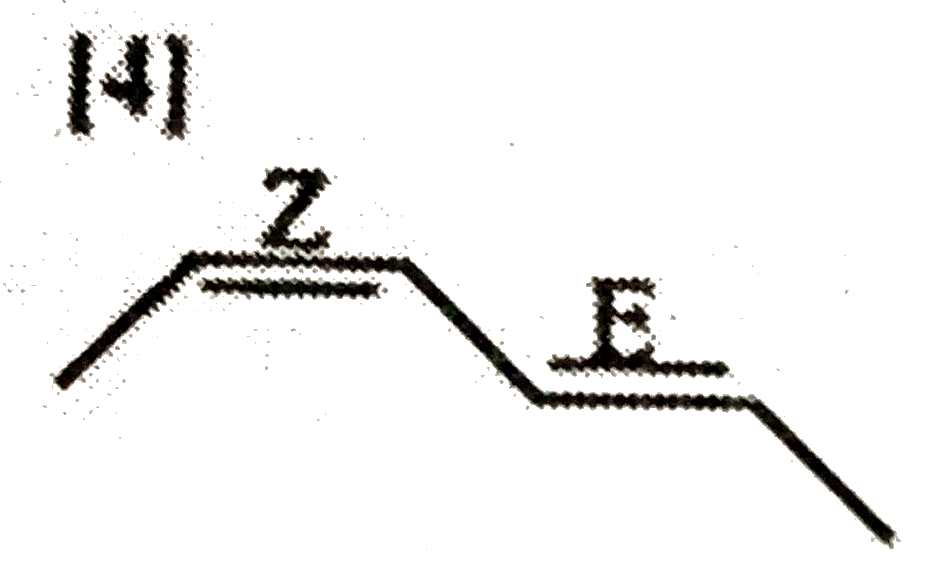
|
|
| 21. |
Which one of the following is not the characteristic of X-rays? |
|
Answer» No medium is requiredfor their propagation |
|
| 22. |
The AM wave of equivalent to the summation of |
|
Answer» two sinusoidal waves |
|
| 23. |
Electric charge passing through a resistor changes with time t as Q = at -bt^(2) . Then total heat produce in resistor R = .... |
|
Answer» `(a^(3) R)/(3B)` `Q= at - bt^(2)` `therefore I =(DQ)/(dt ) = (d)/(dt) "" [at - bt^(2) ]` `therefore I = a - 2 bt` `therefore 0 = a - 2 bt` `therefore t = (a)/(2b)` Now power P = `int_(0)^(t) I^(2) R dt = int_(0)^((a)/(2b)) ( a - 2bt)^(2) R dt` `thereforeP= int_(0)^((a)/(2b)) (a^(2) - 4abt + 4b^(2) t^(2) ) R dt ` = `[ a^(2) t - 4ab (t^(2))/(2) + 4b^(2) (t^(3))/(3) ]_(0)^((a)/(2b))R` = ` [ (a^(2) xx a)/(2b) - (4 ab xx a^(2))/(2 xx 4 b^(2)) + (4b^(2) xx a^(3))/(3 xx 8b^(3)) ]` R = `[ (a^(3))/(2b) - (a^(3))/(2b) + (a^(3))/(6b) ]R = (a^(3)R)/(6b)` |
|
| 24. |
A mass m is hung on an ideal massless spring another equal mass is connected to the other end of the spring the whole system is at rest at t=0 m is released and the system falls freely under gravity assume that natural length of the spring is L_(0)its initial stretched length is L and the acceleration due to gravity is g what is distance between masses as function of time |
|
Answer» `L_(0)+(L-L_(0))cos sqrt((2k)/m)t` `omega=sqrt(k/mu)=sqrt ((2k)/m)` initially PARTICLES are at EXTREME `DISTANCE = L_(0)+(L-L_(0))cos sqrt((2k)/m)t` |
|
| 25. |
If the earth were suddenly shrink to half its size and if its mass remains constant, what will be the new moment of inertia of earth? |
|
Answer» 2\5`MR^2` |
|
| 26. |
Shown in the figure are the displacement time graph for two children going home from the school. Which of the following statements about their relative motion is true after both of them started moving ? Their relative velocity: (##MOT_CON_NEET_PHY_C23_E01_043_Q01.png" width="80%"> |
|
Answer» FIRST INCREASES and then DECREASES |
|
| 27. |
An electric dipole is placed at an alignment angle of 30^(@) with an electric field of 2xx10^(5) N C^(-1) . It experiences a torque equal to 8 Nm. The charge on the dipole if the dipole length is1 cm is …………… |
| Answer» Answer :C | |
| 28. |
Four capacitors are connected as shown in figure. Their capacities are indicated in the figure. The effective capacitance between points x and y is (in muF ) |
|
Answer» `5/6` |
|
| 29. |
Is a laser which emits monochromatic fermions (electrons, neutrinos, etc.) possible? |
|
Answer» |
|
| 30. |
A particle of mass M and charge q is released from rest in a region of uniform electric field of magnitude E . After a time t, the distance travelled by the chargeis S ad the kinetic energy attained by the particle is T. Then , the ratio T/S |
|
Answer» remains constant with time t `rArra=(qE)/(M)andv=(qE)/(M)t` Using , `S=ut+(1)/(2)at^(2)` `S=(1)/(2)((qE)/(M))t^(2)(becauseu=0)` Now , kinetic energy of particle, `T=(1)/(2)Mv^(2)=(1)/(2)M((qE)/(M)t)^(2) ""(becausea=(qE)/(M)t)` `therefore(T)/(S)=((1)/(2)M((qE)/(M))^(2)t^(2))/((1)/(2)((qE)/(M))t^(2))` `(T)/(S)=qE`. |
|
| 31. |
Obtain an equation for sharpness of resonance in an L-C-R series AC circuit and what is quality factor Q ? And explain bandwidth. |
|
Answer» Solution :The amplitude of the current in the series L-C-R circuit is, `I_(m) = ( V_(m))/( sqrt( R^(2) + (( 1)/( omega C ) - omega L)^(2))) = ( V_(m))/( sqrt( R^(2) + ( X_(C ) - X_(L))^(2)))` when `omega = omega_(0) = ( 1)/( sqrt( LC ))`amplitude of curren is maximum This maximum amplitude is `I_(m) = ( V_(m))/( R ) `. For values of `omega `other than `omega_(0)` the amplitude of the current is less than the maximum value. A value of `omega ` for which the current amplitude is `( 1)/( sqrt(2))` times its maximum value. At this value the power dissipated by the circuit BECOMES half. `:.` If `I= ( I_(m))/( sqrt(2))` power becomes half and two values of `omega ` is OBTAINED according to as given figure.  Variation of `I_(m)` with `omega ` for two CASES (i) R = `100 Omega ` (ii) R = 200` Omega, L = 100 mH`. There are two such values of `omega` say, `omega_(1) ` and `omega_(2)` one greater and the other smaller than `omega_(0)` and symmetrical about `omega_(0)`. `:. omega_(1) = omega_(0) + Delta omega` and `omega_(2) = omega_(0) - Delta omega` The difference `omega_(1) - omega_(2) = 2 Delta omega` is called the bandwidth of the circuit. The quantity `(omega_(0))/( 2 Delta omega )` is regarded as a measure ofthe sharpness of resonance. The smaller the `Delta omega` the sharper or narrower is the resonance. |
|
| 32. |
The half-life of " "_(92)^(238)U undergoing alpha-decay is 4.5 xx 10^(9) years. Find the activity of 1 g sample of " "_(92)^(238)U. |
|
Answer» Solution :It is given that `T_(1/2) =4.5xx 10^(9) y =4.5 xx 10^(9) xx 3.154 xx 10^(7)s =1.42xx 10^(17)s` Number of atoms (or nuclides) of `" "_(92)^(238)U` PRESENT in 1 G sample `N= 1/238xxN_(A) = 1/238xx 6.023 xx 10^(23) = 2.53 xx 10^(20)` Activity of the sample `R=lambdaN= 0.693/T_(1/2)N = (9.693 xx 2.93 xx10^(20))/(1.42xx10^(7))=1.23 xx 10^(4)s^(-1) = 1.23 xx 10^(4) Bq` |
|
| 33. |
I have been planning to buy a new car and one of the major considerations for me is the fastest way to make a U turn on a horizontal road at constant speed. Suppose to make a 180^(@) turn on a circular path. The car's steering system does not allow a radius of less than 5m. The road is wide enough to allow a circle of maximum radius of 20m. If the acceleration is greater than 5 m//s^(2), the car skids. The maximum constant speed at which I can take a U turn is : |
|
Answer» `5 m//s` `v_("max")=10m//s` |
|
| 34. |
A : To observe diffraction of light the size of obstacle/aperture should be of the order of 10^(-7)m. R : 10^(-7)m is the order of wavelength of visible light. |
|
Answer» Both A and R are TRUE and R is the CORRECT explanation of A |
|
| 35. |
I have been planning to buy a new car and one of the major considerations for me is the fastest way to make a U turn on a horizontal road at constant speed. Suppose to make a 180^(@) turn on a circular path. The car's steering system does not allow a radius of less than 5m. The road is wide enough to allow a circle of maximum radius of 20m. If the acceleration is greater than 5 m//s^(2), the car skids. What is coefficient of static friction between car tires and road? |
|
Answer» 0.3 `mu=0.5` |
|
| 36. |
Acceleration of electron charge e and mass m moving electric fieldE will be…… |
|
Answer» `(E^(2))/(m)` `THEREFORE a=(F)/(m)` but F=Ee `therefore a=(Ee)/(m)` |
|
| 37. |
On a long horizontallymoving belt,a child runs to and fro with a speed 9km h^(-1) (with respect to the belt) between his father and mother located 50 m apart.The belt moves with sped of 4km h^(-1).For an observer on a stationary platform ,the speed of the child runing in the direction of motion of the belt is |
|
Answer» 4 KM `h^(-1)` |
|
| 38. |
The direction of line of magnetic field of bar magnet is |
|
Answer» From south POLE to north pole |
|
| 39. |
The efficiency of a heat engine is eta and the coefficient of performance of a refrigerator is beta. |
|
Answer» `eta=1/beta` |
|
| 40. |
A given number of atoms, N_(0) of a radioactive element with a half life T is uniformly distributed in the blood stream of a (i) Normal person A having total volume V of blood in the body. (ii) Person B in need of blood transfusion having a volume V' of blood in the body. The number of radioactive atoms per unitvolumein the blood streams of the two persons after a time nT are found to be N_1 and N_2. Prove mathematically that the additional volume of blood that needs to be transfused in the body of person B equals ((N_2 - N_1) /(N_2) ) V. |
|
Answer» Solution :Initial number of radioactive atoms, per unit volume, in the blood streams of persons A and B are `(N_(0) //V) and (N_(0) //V.)` respectively. After a time `NT (T = "Half life")`, these numbers would GET REDUCED by a factor `2^n`. HENCE` N_(1) = ((N_0) /( V) ) . (1)/ (2^n) ` and `N_2 = ((N_0) /( V.) ) . (1)/(2^n)` `(N_1) /( N_2) = (V.)/( V)` or `V.=V. (N_1) /( N_2)` `therefore` Additional volume of blood needed by PERSON B is `V-V. = V - V (N_1)/( N_2)` `= ((N_2 - N_1) /( N_2) )` V |
|
| 41. |
One gram of ice at 0^@C is added to 5 gram of water at 10^@C .if the latent heat of ice be 80cal/g then theFinal temperature of the mixture is |
| Answer» Answer :A | |
| 42. |
An air bubble under water shines brightly because of the phenomenon of : |
|
Answer» interference |
|
| 43. |
A sound wave propagates in a medium of Bulk's modulus B by means of compressions and rarefactions. If P_(c) and P_(r) are the pressures at compression and rarefaction respectively,a be the wave amplitude and k be the angular wave number then |
|
Answer» `P_(c)` is maximum and `P_(r)` is minimum |
|
| 44. |
The radius of capillary tube is 1.4mm. Water of height 0.28xx10^-4N rise in the capillary tube, when it is vertically dipped in water. What is the surface tension of water? |
|
Answer» SOLUTION :The upward force due to ST = `2pir XX T` [because` T = F/l]` and the down ward force = WEIGHT of the lifted WATER. `therefore T xx 2pir = 6.28 xx 10^-4` `therefore T = (6.28 xx 10^-4)/(2 xx 3.14 xx 1.4 xx 10^-3) = (10^-1)/1.4 = 7 xx 10^-2 N/m` |
|
| 45. |
Light travels with a speed of 2 xx 10^(8) m/s in crown glass of refractive index 1.5. What is the speed of light in dense flint glass of refractive index 1.8 |
|
Answer» `1.33 xx 10^(8) m//s` `mu_("crown glass")=1.5=(c)/(2XX10^(8))` For dence FLINT glass `mu = 1.8 = (3 xx 10^(8))/(c_("flint"))` `c_("flint glass")=(3xx10^(8))/(1.8)=1.67xx10^(8)m//s.` |
|
| 46. |
An element with Z = 11 emits Kalpha-X-ray with wavelength lamda. The atomic no. of element which emits Kalpha X-ray of wavelength 4lamda is: |
|
Answer» 6 `v=a^(2)(z-b)^(2)` `:. (C)/(LAMBDA)=a^(2)(z-b)^(2)` `:.(lambda_(1))/(lambda_(2))=((z_(2)-1)^(2))/((z_(1)-z)^(2))` here b=1 put `z_(1)=11, lambda_(1)= lambda, lambda_(2)= 4lambda_(2)` & find `z_(2)` Then `z_(2)=6.` |
|
| 47. |
If the wavelength of light used is 6000 Å. The angular resolution of telescope of objective lens having diameter 10 cm is ...... Rad |
|
Answer» `6.10xx10^(-6)` `alpha_(min)=(1.22 LAMBDA)/(D)` `=(1.22xx10^(-5)xx6)/(10)` `=7.32xx10^(-6)` |
|
| 48. |
As the frequency of an ac circuit increases, the current first increases and then decreases. What combination of circuit elements is most likely to comprise the circuit ? |
|
Answer» Inductor and capacitor. `X_L=2pivL "" therefore X_L prop v` where v is frequency of the AC circuit, reactance of the capacitor `X_C=1/(2pivC)` `therefore X_C prop 1/v` On increasing frequency v CLEARLY `X_L` increases and `X_C` decreases. For L-C-R circuit `Z=SQRT(R^2+(X_L-X_C)^2)` where Z=impedence of the circuit `=sqrt(R^2+(2pivL-1/(2pivC)^2)` As frequency (v) increases, Z decreases and a certain value of the frequency known as resonant frequency `v_0` impedence Z is minimum that is `Z_"min" = R`, current varies inversely with impedence and at `Z_"min"` current is MAXIMUM. 
|
|
| 49. |
What is the use of fly wheel in railway engine ? |
| Answer» Solution :A fly WHEEL is a LARGE HEAVY wheel with a long cylindrical axle passing through it.s centre of mass lying on it.s AXIS of rotation. | |
| 50. |
In the circuit shown below, the potential difference between the points B and D |
|
Answer» 1V |
|


