

Saved Bookmarks
This section includes 7 InterviewSolutions, each offering curated multiple-choice questions to sharpen your Current Affairs knowledge and support exam preparation. Choose a topic below to get started.
| 1. |
A rocket of initial mass 6000 kg ejects gases at a constant rate of 16 kg/s with constant relative speed of 11 km/s. What is the acceleration of the rocket one minute after the blast. |
|
Answer» `35 m/s^2` |
|
| 2. |
A 50 mH inductor is in series with a 10 Ohm resistor and a battery with an emf of 25 V. At t = 0 the switch is closed. Find Q: How long it takes the current to rise to 90% of its final value? |
|
Answer» Solution :We need the time taken for I to reach`0.91_(0) = 0.9 e/R.` `0.91_(0)= I__(0)(1-e^(-t/t)` From this we FIND that exp`(-t/zeta)( 0.1)`, which may be expressed as` (-t/zeta) = ln(0.1)` .THUS, `t=-zeta ln(0.1)= 11.5 xx 10^(-3)s` |
|
| 3. |
A spherical conductor of radius 12 cm has a charge of 1.6 xx 10^(-7) C distributed uniformly on its surface . What is the electric field (a) inside the sphere (b) just outside the sphere. (c) at a point 18 cm from the centre of the sphere ? |
|
Answer» Solution :(a) Electric field inside a spherical is ZERO. (b) Electric CHARGE on the surface of sphere can be considered as on the centre of sphere . Electric field at a point r (`gt`R) from the centre of sphere is, E(r) = `(kq)/(r^(2)) ` `= (9xx10^(9)xx1.6xx10^(-7))/((0.12)^(2))` `= 10^(5) NC^(-1)` (c ) Electric field at a point x = 18 cm from the centre of the sphere is, `E (18) = (kq)/(x^(2))` `= (9xx10^(9)xx1.6xx10^(-7))/((0.18)^(2))` `= 444xx10^(2)` `= 4.44 xx10^(4) NC^(-1)` |
|
| 4. |
5 A 50 mH inductor is in series with a 10 2 resistor and a battery with an emf oj 25 V. At t = 0 the switch is closed. Find Q(d) the power dissipated in the resistor |
|
Answer» <P> SOLUTION : The POWER dissipated in the RESISTOR is `P_(R) = I^(2)R = I_(0)^(2)R (1 - 2e^(-t/zeta)" +e^(-2t/zeta)` |
|
| 5. |
5 A 50 mH inductor is in series with a 10 ohm resistor and a battery with an emf oj 25 V. At t = 0 the switch is closed. Find Q(a) the time constant of the circuit |
| Answer» SOLUTION :The TIME constant iszeta=L/R = 5 X x10^(-3)s | |
| 6. |
The angle of a prism is 6^(@) and its refractive index for green light is 1.5. If a green ray passes through it, the deviation will be |
|
Answer» `30^(@)` |
|
| 7. |
यदि x=1, y=0 समीकरण x+3y=c का एक हल हो, तो का c मान है |
|
Answer» 4 |
|
| 8. |
The volume occupied by an atom is greater than the volume of the nucleus by a factor of about : |
|
Answer» `10^(1)` |
|
| 9. |
Assertion : A thin aluminiumdisc spinningfreely about a centralpivot is quickly brought to restwhen placedbetween the poles of a strong U-shaped magnet . Reason : A current induced in a disc rotating in a magnetic field produces aforce whichtends to oppose the disc's motion . |
|
Answer» If both the assertion and reason are true statement andreason is CORRECT explanation of the assertion . |
|
| 10. |
Two charges 2 mu C and -2 muC are placed at points A and B 6 cmapart. (a) Identify anequipotential surface of the system. (b) What is the direction of the electric field at every point on this surface ? |
|
Answer» Solution :(a) An equipotential surface is the surface, potential at all point of which is same and there is no potential gradient. For a dipole AB CONSISTING of 2 charges of `+ 2muC`, a plane CDpassing through the mid-point O of AB and perpendicular to AXIS AB (i.e., plane containing equatorial line of dipole) behaves as an equipotential surface because potential at all POINTS of this line is ZERO. (b) The direcction of electric field is always perpendicular to equipotential surface. Hence at any point P of equipotential surface electric field `vec E` is directed along axis of dipole from +ve cahrge towards -ve charge. 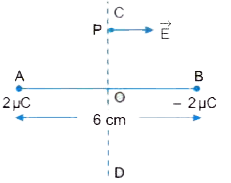
|
|
| 11. |
Aernier callipers has 1 mm marks on the main scale. It has 20 equal divisions on the Vernier scale which match with 16 main scale divisions. For this vernier callipers, the least count is |
|
Answer» `0.02` MM |
|
| 12. |
The switch S in the adjoined circuit is closed and then opened. The closed loop will show |
|
Answer» an ANTICLOCKWISE CURRENT PULSE |
|
| 13. |
The substances which are repelled by a magnet, are termed as: |
|
Answer» diamagnetic |
|
| 14. |
Explain mutual induction and derive equation of induced emf. |
Answer» Solution :As shown in FIGURE when current from coil `C_2` changes then flux linked with coil `C_1` also GET CHANGED and emf is induced in coil`C_1`. 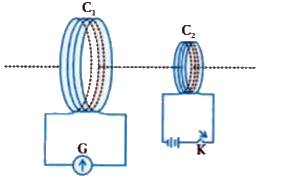 If number of turns in `C_1` is `N_1` then net flux `N_1Phi_1 prop I_2` `THEREFORE N_1Phi_1=MI_2` ACCORDING to Faraday.s law an emf `epsilon_1` is induced in coil-1 which is given by `epsilon_1=-(dN_1Phi_1)/(dt)-d/(dt)(M_12I_2)` `therefore epsilon_1=-M_12(dI_2)/(dt)` Similarly we can prove `epsilon_2=-M_21(dI_1)/(dt)` |
|
| 15. |
माना A=(2,4,6,8} तथा B=(s,t,u,v,w} दो समुच्चय हैंf_1 ,f_2,f_3तथा f_4,A से B में निम्न नियम है |
|
Answer» F1 तथा F2 फलन है |
|
| 16. |
What are a. Slow neutrons? b. thermal neutrons? |
|
Answer» Solution :a. Slow neutrons `to` energy LESS than 1 eV b. Thermal neutrons `to` energy RANGE `1 - 1.2 eV` c. Fast neutrons `to` energy greater than 1.2eV. |
|
| 17. |
When the number of turns and the length of the solenoid are doubled keeping the area of cross section same the self inductance is |
|
Answer» halved |
|
| 18. |
What is a parallel connection of capacitors ? Obtain the formula for the effectivecapacitance in the parallel combination of two different capacitors. |
Answer» Solution :Two capacitors is arranged as in figure is known as parallel connection.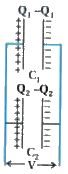 Two capacitors of capacitance `C_(1)` and `C_(2)` is JOINED as shown in figure. In this connection, the same potential difference is applied across both the capacitors but the plate charges on each CAPACITOR are different. Hence, TOTAL charge, `Q=Q_(1)+Q_(2)` but `Q_(1)=C_(1)V,Q_(2)=C_(2)V` `:. Q = C_(1)V+C_(2)V` `:. (Q)/(V)=C_(1)+C_(2)` But `(Q)/(V)` is the effective capacitance of two capacitors joined in parallel. `:. =C_(1)+C_(2)` |
|
| 19. |
The plate current in a triode is given be I_p=0.004 (V_p+10V_g)^(3//2)mA where I_p,V_p and V_g are the values of plate current , plate voltage and grid voltage , respectively. What are the triode parameters mu,r_p and g_m for the operating point at V_p = 120volt and V_g =-2volt |
|
Answer» `10, 16.7 kOmega , 0.6 ` m mho `implies(DeltaI_p)/(DeltaV_g)=0.004[3/2(V_p+10V_g)^(1//2)xx10]xx10^(-3)` `implies g_m = 0.004 xx3/2(120+10xx-2)^(1//2)xx10xx10^(-3)` `implies g_m=6xx10^(-4)` mho = 0.6 mho Comparing the given equation of `I_p` with `I_p=K(V_p+muV_g)^(3//2)` we GET `mu=10` Also from `mu=r_pxxg_mimplies r_p=(mu)/(8_m)=10/(0.6xx10^(-3))` `implies r_p = 16.67 xx10^(3) Omega =16.67kOmega` |
|
| 20. |
For example, the true value of a certain length is near 3.678 cm. In one experiment, the S measured value is found to be 3.5 cm.while in another experiment, the length is determined to be 3.38 cm.The second measurement is |
|
Answer» more ACCURACY but LESS PRECISION |
|
| 21. |
Three capacitors 2muF, 5muF and 10muF are joined in (a) series, (b) paralle. Find the equivalent capacitance. |
|
Answer» SOLUTION :(a) SERIES Data SUPPLIED, `C_(1)=2muF, C_(2)=5muF, C_(3)=10muF` `1/C_(s)=1/C_(1)+1/C_(2)+1/C_(3)=1/2+1/5+1/10` `C_(s)=1.25muF` (B) Parallel `C_(p)=C_(1)+C_(2)+C_(3)=2+5+10=17muF` |
|
| 22. |
The focal lengths for violet, green and red light rays are f_(V), f_(G) , and f_(R)respectively. Which of the following is the true relationship |
|
Answer» `f_(R) LT f_(G) lt f_(V)` |
|
| 23. |
STATEMENT-1 : Beats will be heard if a tuning fork is sounded along with a sonometer wire with the same fundamental frequency as the tuning fork because STATEMENT -2 : Beats are caused by alternate constructive and destructive interference between two sounds. |
|
Answer» STATEMENT -1 is True, statement -2 is True, Statement -2 is a CORRECT explanation for Statement -1. |
|
| 24. |
A radioactive substance has density rho , volume V_aand decay constant lamdaIf the molecular weight of the substance is M, and Avogadro numbers is N_athen the radioactivity of the substance after time .t. is |
|
Answer» `(lamdaV_(a)rhoN_(a)E^(-lamdat))/M` |
|
| 25. |
A parallel beam of white light falls on a thin film whose refractive index is equal to n = 1.33. The angle of indices is theta_(1) = 52^(@). What must be the film thickness be equal to for the reflected light to be coloured yellow (lambda = 0.60 mu m) most intensity ? |
Answer» Solution : Path difference between `(1)&(2)` is `2n d SEC theta_(2) - 2D tan theta_(2) sin theta_(1)` `=2d(N-(sin^(2)theta_(1))/(n))/sqrt(1-(sin^(2)theta_(1))/(n^(2)))=2d sqrt(n^(2) - sin^(2) theta_(1))` For bright fringes this must equal `(k + (1)/(2)) lambda` where `(1)/(2)` comes from the phase CHANGE of `pi` for `(1)`. Here `k = 0, 1, 2,....` Thus `4d sqrt(n^(2) - sin^(2) theta_(1)) = (2k + 1) lambda` or `d = (lambda(1 + 2k))/(4sqrt(n^(2) - sin^(2) theta_(1))) = 0.14 (1 + 2k) mu m...` |
|
| 26. |
(a) Arrange the following electromagnetic waves in the descending order of their wave-lengths: (i) microwaves (ii) IR rays, (iii) UV radiations (iv) gamma-rays (b) Write one use each of any two of them. |
|
Answer» Solution :(a) The given electromagnetic waves in the DESCENDING order of their wavelengths are: MICROWAVES, IR rays, UV RADIATIONS and `gamma-`rays. (b) Microwaves are used for RADAR systems, IR rays are used in remote SWITCHES, UV radiations are used in water purifiers and `gamma-`rays are used for treatment of cancer. |
|
| 27. |
Frequency of an electromagnetic wave is 6.0xx10^(15)Hz. The wave is |
|
Answer» radio wave. |
|
| 28. |
The driver of a train moving at 72 km h^(-1) sights another train moving at 4 ms^(-1) on the same track and in the same direction. He instantly applies brakes to produces a retardation of 1 ms^(-2). The minimum distance between the trains so that no collision occurs is |
|
Answer» 32 m |
|
| 29. |
which sample, A or B shown in fig has shorter mean life? |
|
Answer» Solution :form fig. , we find that at `t=0, ((dN)/(dt))_(A)=((dN)/(dt))_(B)` Therefore, `(N_(0))_(A)=(N_(0))_(B)` At any subsequent time, `((dN)/(dt))_(B)lt((dN)/(dt))_(A)` `:. lambda_(B)N_(B) lt lambda_(A)N_(A)` As `N_(B) lt N_(A)` (RATE of decay OFB is slower) `:. lambda_(B) lt lambda_(A)` Hence, `tau_(B) lt tau_(A)`, i.e., MEAN life time of B is SHORTER than that of A. 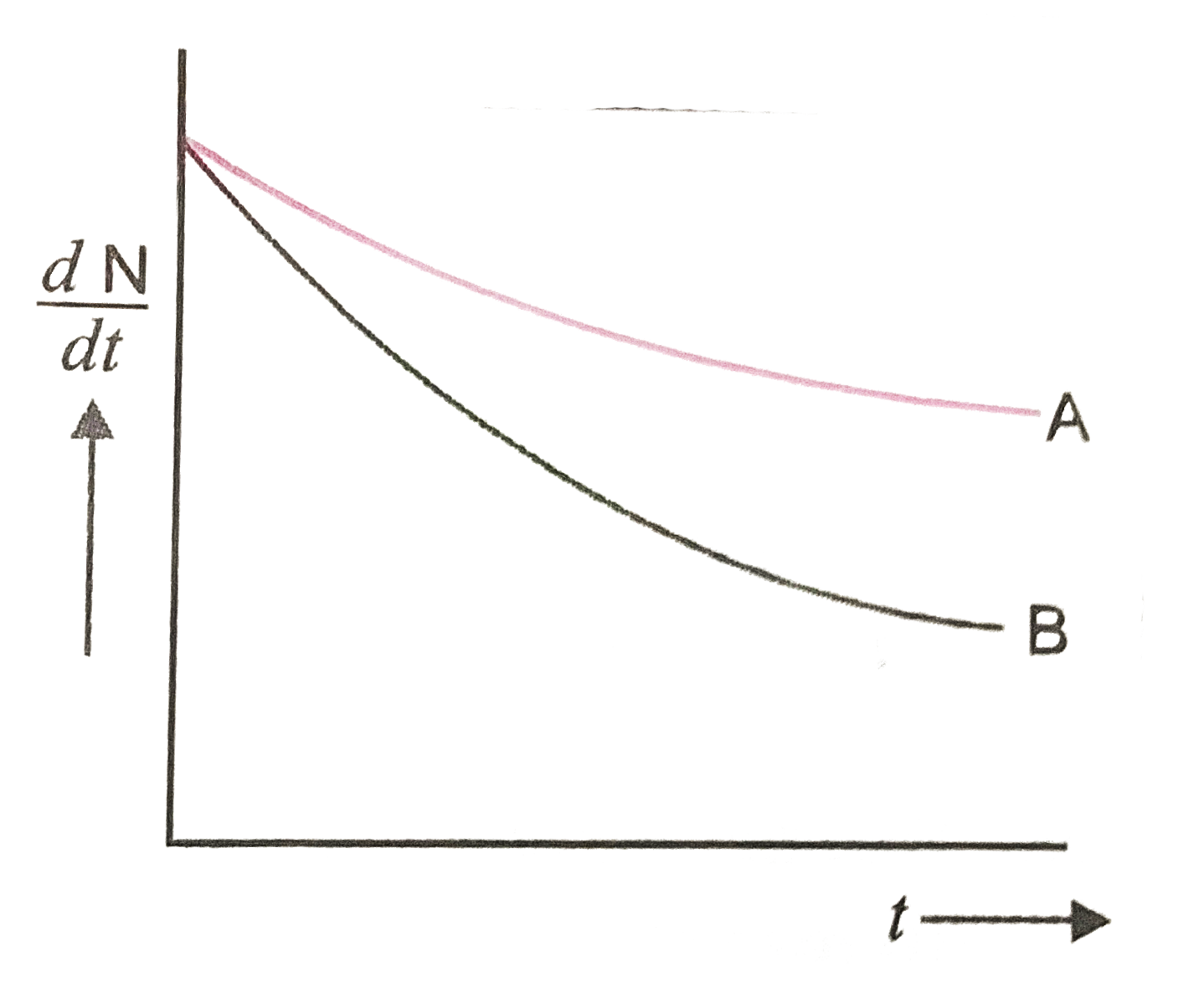
|
|
| 30. |
What do you mean by 'Simplification?' |
|
Answer» not MUCH DECORATED or ornamented |
|
| 31. |
Four identical pieces of copper are painted with different types of paints. Which one would you expect to lose heat most rapidly if they are all heated to be same temperature and allowed to cool in vacuum ? |
|
Answer» painted ROUGH white For black BODY `e=1` and for other BODIES `egt1` `:.` rate of loss of heat is maximum for ROD painted black. Thus correct choice is (c ). |
|
| 32. |
An object is placed at 21 cm in front of a concave mirror of radius of a curvature 10 cm. A glass slab of thickness 3 cm and u 15 is then placed close to the mirror in the space between the object and the mirror. The position of final image formed is |
|
Answer» `-3.94cm` `(mu-1)t=(1.5-1)3 cm` =1.5 cm `U'=-(21+1.5)cm` or u'=-22.5 cm Now, `1/(-22.5)+1/V=1/(-5)` or `1/v=1/22.5-1/5or1/v=(5-22.5)/(22.5xx5)` or `v=(22.5xx5)/17.5 or v=-6.43 cm` |
|
| 33. |
A 2 uF capacitor, 100 Omegaresistor and 8 H inductor are connected in series with an a.c. source. Find the frequency of the a.c. source for which the current drawn in the circuit is maximum. If the peak value of emf of the source is 200 V, calculate the (i) maximum current, and (ii) inductive and capacitive reactance of the circuit at resonance. |
|
Answer» Solution :Here `C = 2muF = 2 xx 10^(-6) F, R = 100 Omega, L = 8H` and `V_(m) = 200 V` `therefore` Frequency of a.c source for current in the circuit to be maximum = resonant frequency `omega_(r) = 1/sqrt(LC) = 1/sqrt(8 xx 2 xx 10^(-6)) rArr omega_(r) = 250 s^(-1)` (i) The maximum current `I_(m) = V_(m)/R = 200/100 = 2A` (ii) Inductive reactance `X_(L) = Lomega = 8 xx 250 = 2000 Omega` and capacitive reactance `X_(C ) =1/(C omega) = 1/((2 xx 10^(-6)) xx 250) = 2000 Omega` |
|
| 34. |
Sodium and copper have work functions 2.3eV and 4.5 eV. Then ratio of their wavelengths is nearest to : |
|
Answer» Solution :`W_(0)=(hc)/(lambda_(0))` `:.((lambda_(0))_(1))/((lambda_(0))_(2))=((W_(0))_(2))/((W_(0))_(1))=(4*5)/(2*3)~~2:1` |
|
| 35. |
A bus starts moving with acceleration of 2m/s^2. A cyclist 96m behind the bus starts simultaneously towards the bus at 20m/s . After what time will he be able to overtake the bus ? |
|
Answer» 4s |
|
| 36. |
Define focal length of a mirror and hence relate focal length and radius of curvature of a mirror. |
Answer» Solution : Let us consider a concave MIRROR of pole P, center of curvature C and FOCUS F. Let the focal length f and radius of curvature R. AM is incident ray, MF is reflected ray and MC is normal From `DeltaMCP, tan THETA= (MP)/(CP)` From `Delta MFP, tan 2THETA = (MP)/(FP)` Since `theta` is very SMALL `tan theta ~~ theta and tan 2theta ~~ 2 theta` `therefore = (MP)/(CP)and 2 theta = (MP)/(FP) or theta = (MP)/(2FP)` `therefore CP= 2FP therefore R= 2f or r = (R )/(2)` |
|
| 37. |
The half life of ._92^238U undergoing alpha-decay is 4.5xx10^9 years. The activity of 1 g sample of ._92^238U is |
|
Answer» `1.23xx10^4` Bq `=4.5xx10^9xx3.16xx10^7=1.42xx10^17` s One kmol of any isotope CONTAINS Avogadro's NUMBER of ATOMS, so 1G of `._92^238U` contains `=1/(238xx10^(-3))"kmol"xx6.025xx10^26` atoms per kmol `=25.3xx10^20` atoms Activity, R=`lambdaN` `=0.693/T_(1//2) N =(0.693xx25.3xx10^20)/(1.42xx10^17)s^(-1)` `=1.23xx10^(4) s^(-1) =1.23xx10^4` Bq |
|
| 38. |
What are waves ? |
| Answer» SOLUTION :A wave is a disturbance produced in a medium. A wave does not contain any particle or matter. A wave is specified by the quantities like frequency (v), wavelength (`lambda`), amplitude A , INTENSITY I and PHASE VELOCITY v . | |
| 39. |
A body of mass 2 gm is projected horizontally from the top of a tower of height 20m with a velocity 10 m/s. The charge on the body is 2C. Electric field is applied vertically downwards and of intensity 10^(-2) N//C. Find the time taken by the body to touch the ground (g=10m//s^(2)). |
|
Answer» |
|
| 40. |
यदि दो बिन्दु आवेशों के बीच की दूरी आधी कर दी जाए तो उनके मध्य लगने वाला बल, प्रारंभिक बल का- |
|
Answer» एक-चौथाई होगा |
|
| 41. |
The total electric flux , leaving spherical surface of radius 1 cm and surrounding an electric dipole is : |
|
Answer» `Q/epsilon_0` |
|
| 42. |
At the equator of one imaginary planet, magnetic field is about 0.16 G. If its radius is 8000 km then find its magnetic dipole moment. |
| Answer» SOLUTION :`81.92 XX 10^(23) "Am"^(2)` | |
| 43. |
If the angle between the transmission axis of the polarizer and the analyser is 45^@ what will be the ratio of intensities of the incident light and the transmitted light for the analyser? |
|
Answer» SOLUTION :`I=I_0cos^2theta=I_0(COS45)^2=I_0xx(1/sqrt2)^2=I_0/2` `I_0/I=2` |
|
| 44. |
Two particle A and B, of mass m each, are joined by a rigid massless rod of length l. A particle P mass m, moving with a speed u normal to AB, strikes A and sticks to it. The centre of mass of the 'A+B+P' system is C. |
|
Answer» The VELOCITY of C before IMPACT is u/3. |
|
| 45. |
The mass of ._3^7Li is 0.042 amu less than the sum of masses of its constituents. The binding energy per nucleon is |
|
Answer» 5.586 MeV = 0.042 x 931 MeV Binding energy per NUCLEON=`(0.042xx931)/7` =5.586 MeV |
|
| 46. |
On moving a charge of 7C from a point x where potential is +5.5V to a point y where potential is -7.6 V, the work done is - |
| Answer» | |
| 47. |
Monochromatic light waves of wavelength lambda from two coherent source fall on a larger plane screen. One of the waves is emanated from a point source S located at distance L from the screen and the other one is a broad plasne wave as shown in the figure. The spacing between the n^(th) and (n-1)^(th) bright fringe is |
|
Answer» `sqrt(2lambda L)(sqrt(N)-sqrt(n-1))`  `Delta x = sqrt(y^(2)+L^(2))-L` `Delta x = L ((1+y^(2))/(L^(2)))^(1//2) - L` `Delta x = (y^(2))/(2L)Delta x = n lambda`(for bright FRINGES) or`y = sqrt(2N lambda L)` |
|
| 48. |
In the case of forward biasing of p - n junction , which one of the following figures correctly depicts the direction of flow of charge carriers ? |
|
Answer»
|
|
| 49. |
If Coulomb's law involved 1//r^3 dependence (instead of 1//r^2), would Gauss's law be still true ? |
| Answer» SOLUTION :No, Gauss. law will not be true if Coulomb.s law INVOLVED `1/r^3` dependence. | |
| 50. |
The value of impact parameter in head-on collision is ...... |
| Answer» SOLUTION :zero | |


