

Saved Bookmarks
This section includes 7 InterviewSolutions, each offering curated multiple-choice questions to sharpen your Current Affairs knowledge and support exam preparation. Choose a topic below to get started.
| 1. |
An AM wave is represented by equation v=5 [1+0.6 cos(6280t)]sin (211 xx10^4t)V. if Am drives a resistance of 2k Omega then |
|
Answer» The carrir wave has a FREQUENCY 336 kHz with a bandwidth of 4 kHz. |
|
| 2. |
10 xx 10^(-6)C charge is uniformly spread over the cube of face length 1 mm. The density of charge will be .........Cm^-3 |
|
Answer» Solution :`RARR RHO = Q/V = Q/(l)^(3) = 10^(-5)/(10^(-3))^(3) = 10^(-5)/10^(-9)` `=10^(4)Cm^(-3)` |
|
| 3. |
An electric dipole consists of two charges of equal magnitude and opposite sign saperated by a distance 2 a as shown in figure . The dipole is along the x axis and is centered at the origin (A) Calculate the electric potential at point P . (B ) Calculate V at a point far from the dipole . |
|
Answer» Solution :For point P in FIGURE `V=K_(E)sum(q_(i))/(r_(i))=k_(e)((Q)/(x-a)-(q)/(x+a))=(2k_(e)qa)/(x^(2)-a^(2))` (B) If pointP is far from the dipole such that x`gtgt` a then `a^(2)` can be neglected in the term `x^(2)-a^(2)` and V becomes `V = (2k_(e)qa)/(x^(2)) "" (xgtgta)` |
|
| 4. |
Calculate the energies of the photons associated with the following radiation: violet light of 413 nm |
|
Answer» SOLUTION :ENERGY of photon, `E = h UPSILON ""h = 6.6 xx 10^(-34) Js` `E = (hc)/(lambda)""c = 3 xx 10^(8) ms^(-1)` (i) Violet light, `lambda = 413` nm `E = (6.6 xx 10^(-34) xx 3 xx 10^(8))/(413 xx 10^(-9)) = 0.04794 xx 10^(-17)` `= 4.794 xx 10^(-19) J` `= (4.794 xx 10^(-19))/(1.6 xx 10^(-19)) eV` E = 3 eV (II) X-rays of, `lambda = 0.1` nm `E = (6.6 xx 10^(-34) xx 3 xx 10^(8))/(0.1 xx 10^(-9)) = 198 xx 10^(-17) J` `= (198 xx 10^(-17))/(1.6 xx 10^(-19)) = 123.75 xx 10^(2)` E = 12375 eV (iii) Radio waves, `lambda = 10` m `E = (6.6 xx 10^(-34SD) xx 3 xx 10^(8))/(10) = 1.98 xx 10^(-26)J` `= (1.98 xx 10^(-26))/(1.6 xx 10^(-19)) = 1.2375 xx 10^(-7)` `E = 1.24 xx 10^(-7) eV` |
|
| 5. |
The plates S and T of an uncharged parallel plate capacitor are connected across a battery. The battery is then disconnected and the charged plates are now connected in a system as shown in the figure. The system shown is in equilibrium. All the strings are insulating and massless. The magnitude of charge on one of the capacitor plates is: [Area of plates = A] |
|
Answer» `SQRT(2mgAin_0)` |
|
| 6. |
Rutherfords experiments on scattering of alpha-particles proved that : |
|
Answer» The atoms as a WHOLE is positively charged |
|
| 7. |
A silver wire has a resistance of 2.1 Omega at 27.5^(@) C and a resistance of 2.8 Omega at 100^(@) C . Determine the temperature coefficient of resistivity of silver. |
|
Answer» SOLUTION :Here `R_(1) = 2.1 Omega,"" R_(2) = 2.7 Omega` `t_(1) = 27.5^(@) C, t_(2) = 100^(@)C ` `ALPHA = ? ` `R_(2) = R_(1) [ 1 + alpha (t_(2) - t_(1)) ] ` `therefore (R_(2))/(R_(1)) = 1 +alpha [ t_(2) - t_(1)]` `therefore (R_(2) - R_(1))/(R_(1))= alpha [ t_(2) - t_(1)]` `thereforealpha = (R_(2) - R_(1))/(R_(1) [t_(2) - t_(1)] )` ` = (2.7 - 2. 1)/(2.1(100- 27.5))` `= (0.6)/(2.1 XX 72.5)` = 0.00394 `= 0.0039^(@)C^(-1)` |
|
| 8. |
Calculate potential energy of a point charge - q placed along the axis due to a charge + Q uniformly distributed along a ring of radius-, R. Sketch P .F. as a function or axial distance z from the centre of the ring. Looking at graph, can you see what would happen if - q is displaced slightly from the centre of the ring (along the axis) ? |
|
Answer» Solution :Let us consider a ring of radius R = a having charge Q distributed uniformly over the ring. Also a point P at a distance z on its axis passing through centre. Take r is the distance of P from charge dq on the ring. 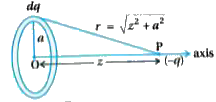 `r= sqrt(z^(2)+a^(2))` where a=R `:.` Electric potential at point P, `V= int(KDQ)/(r) = kint(dq)/(r)=kint(dq)/(sqrt(z^(2)+a^(2)))` `:. V= (k)/(sqrt(z^(2)+a^(2)))intdq= (kQ)/(sqrt(z^(2)+a^(2)))[ because int dq = Q]` If - q is at P then potential energy U = W ` = q xxV` ` = -q xx(kQ)/(sqrt(z^(2)+a^(2)))` `U=-(kQq)/(a[sqrt((z^(2))/(a^(2))+1)])` Now `(kQq)/(a) =S` supposing NEW CONSTANT `U=-(S)/((1+(z^(3))/(a^(2)))^(1//2))` `z gt gt gt a `then `(z^(2))/(a^(2)) gt 1` but `z=0 , (z^(2))/(a^(2))=0` `:. U =-S` The graph of `U rarr` Zis shown below , 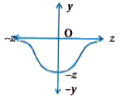 If charge is displaced, it WOULD PERFORM S.H.M. But from the graph, we cannot predict the type of oscillations. |
|
| 9. |
If 'r' is the radius and 'n' is number of turns of coil of a T.G, then to double its sensitivity |
|
Answer» both R and N should be doubled |
|
| 10. |
For base station to mobile communication the required frequency band is |
|
Answer» 540-1600 MHz |
|
| 11. |
Displacement of two light waves are e_(1)=4 sin omega t and e_(2)= 3 sin (omegat + pi/2). so amplitude of resultant wave = ..... |
|
Answer» 0 Amplitude of RESULTANT WAVE `delta =(pi)/(2)` `E=sqrt(E_(1)^(2)+E_(2)^(2)+2E_(1)E_(2) cos delta)` `=sqrt((4)^(2)+(3)^(2)+2(4)(4)"cos"(pi)/(3)) "" [ :. "cos" (pi)/(2)=0]` `=sqrt(16+9)= sqrt(25)` `:.E=5` unit |
|
| 12. |
How can you increaseKE and intensity of electron beam? |
| Answer» Solution :By increasing ACCELERATING POTENTIAL, we can INCREASE KE and by increasing the filament CURRENT we can increase intensity of electron beam. | |
| 13. |
For a transistor , the correct statement is |
|
Answer» Collector current INCREASES with INCREASE in EMITTER current |
|
| 14. |
In order to draw a transfer characteristics of a transistors ………….is kept constant. |
|
Answer» `V_(CE)` |
|
| 15. |
Sparkle in the diamond The purpose of a diamond is, of course, to sparkle . Part of the art of cutting a diamond is to ensure that all the light entering through the top face or side facets leaves through those surfaces, to participatein the sparkle. Figure 34-18 shows part of a cross-sectional slice through a brilliant-cut diamond, with a ray entering at point A on the top face. In this type of cut, the top and bottom surfaces have normal lines that intersect at the indicated 48.84^(@). At point B, at least part of the light reflects and leaves the diamond properly , but part could refract and thus leak out of the diamond. Consider a light ray incident at angle theta_(1)=40^(@) at A. Does light leak at B if air (n_(4)=1.00) lies next to the bottom surface ? Does light leak if greasy grime (n_(4)=1.63) coats the surface? The index of refraction of diamond is n_(din)=2.419. |
|
Answer» Solution :When light reaches the INTERFACE between two materials with different indexes of refraction (call them `n_(1)` and `n_(2)` ), part of all of the light is reflected. The reflection is total if (1) the incident light is in the material with the higher index of refraction `(n_(1) gt n_(2))` and `(2)` the incident angle exceeds a critical value given by Eq. 34-10 `theta=sin^(-1)((n_(1))/(n_(2)))` If those two conditions are not met, part of the light is refracted across the interface according to Snell.s law. CASE 1 : Clean diamond We need to FOLLOW the light from point A to point B to see if it can leak at point B. The light incident at point A is in the material (air `n_(1)=1.00`) with a lower index of refraction than the material on the other side of the interface (diamond `n_(dia)=2.419`). Thus, some of the light is refracted across the interface (the reflected portion is not shown in Fig. 34-18), and we find the angle of refraction from Snell.s law Calculation : `theta_(2)=sin^(-1)((sin40^(@))/(2.419))=15.41^(@)` Now, note that the given angle of `48.84^(@)` at point C is an exteriror angle of triangle ABC and thus (from Appendix E), we can write `theta_(3)+theta_(2)=48.84^(@)` or `theta_(3)=49.84^(@)-theta_(2)=33.43^(@)` This is the angle of incidence of the ray at point B. Now the incident light is in the material (diamond) with the greater index of refraction than the material (air) on the other side of the interface. However, if we apply Snell.s law at point B, we find no answer. The reason is that the light is incident at an angle greater than the critical value of `theta_(c )sin^(-1)((n_(4))/(n_(dia)))=sin^(-1)((1.00)/(2.419))=24.4^(@)` Thus, all the light reaching B reflects and none leaks out in the air. Case 2 : Grimy diamond We again follow the light from A to B, with the only difference lying in the last two calculations. Now at B, the material on the other side of the interface is grime with an index `n_(4)=1.63`. The incident light is again in the material with the greater index, but now the critical angle is `theta_(c )=sin^(-1)((n_(4))/(n_(dia)))=sin^(-1)((1.63)/(2.419))=42.4^(@)` Therefore, the incident angle `n_(3)=33.43^(@)` is less than the critical angle and light leaks through the bottom of the diamond. From Snell.s law, the angle of refraction is `theta_(4)=sin^(-1)((2.419)/(1.63)sin33.43^(@))=54.8^(@)` Learn Thus, to keep a diamond sparkling, clean both the top and bottom surfaces. 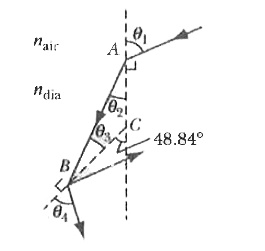
|
|
| 16. |
The maximum distance between the transmitting and receiving TV towers is 72 km. If the ratio of the heights of the TV transmitting tower receiving tower is 16 : 25, the heights of the transmitting and receiving towers are |
| Answer» Answer :C | |
| 17. |
Name the semiconductor device that can be used to regulate an unregulated d.c. power supply. With the help of I-V characteristics of this device, explain its working principle. |
|
Answer» Solution :A zener diode is used to regulate an unregulated d.c. power supply. The characteristics of zener diode have been shown It is clear that in reverse bias the current is EXTREMELY small but when the applied reverse bias voltage reaches the breakdown voltage `V_(z)`of the zener diode, there is a large change in the current. At breakdown voltage a large change in the current can be produced by almost insignificant change in the reverse bias voltage. Thus, EFFECTIVELY zener voltage remains constant, even THOUGH current through the zener diode varies over a wide range. This property of zener diode is used to regulate supply voltages. |
|
| 18. |
An inductor of inductance L carries an electric current i. How much energy is stored while establishing the current in it ? |
|
Answer» SOLUTION :Energy stoted in an inductor : Whenever a current is established in the circuit, the inductance opposes the growth of the current . In order to establish a current in the circuit , work is DONE against this opposition by some exteranl AGENCY. This work done is stored as magnetic potential energy. Let US assume that electrical RESISTANCE of the inductor is negligible and inductor effect alone is considered. The induced emf `varepsilon` at any instant t is `varepsilon =-L (di)/(dt)` ........(1) Let dW be work done in moving a charge dq in a time dt against the opposition, then dW =`-varepsilondq =-varepsilonidi``[because dq =idt]` substituting for `varepsilon` value from equation (1) `=-(-L(di)/(dt))idt` dW =Lidi...........(2) Total work done in establishing the current i is `W=int dW = int _(0)^(i) Lidi =L [(i^2)/2]_0^i` `W=1/2 Li^2` ...........(3) This work done is stored as magnetic potential eneergy `therefore U_B =1/2 Li^2` |
|
| 19. |
Figure 6-36 shows the cross section of a road cut Joint with ice into the side of a mountain. The solid line AA' represents a weak bedding plane along which sliding is possible. Block B directly above the highway is separated from uphill rock by a large crack (called a joint), so that only friction between the block and the bedding plane prevents sliding. The mass of the block is 1.5 xx 10^(7)kg, the dip angle theta of the bedding plane is 24^(@), and the coefficient of static friction between block and plane is 0.63. (a) Show that the block will not slide under these circumstances. (b) Next, water seeps into the joint and expands upon freezing, exerting on the block a force F parallel to AA'. What minimum value of force magnitude vecF will trigger a slide down the plane? |
| Answer» SOLUTION :`F=2.5xx10^(7)M` | |
| 20. |
What is linear speed of the second hand of a clock? If the second hand is 10 cm long |
|
Answer» `10.5 XX 10^(-2) m/sec` |
|
| 21. |
A hydrogen atom contains one electron But the spectrum of hydrogen atom has many lines.why? |
| Answer» SOLUTION :The single electron of the hydrogwn atom can be EXCITED to a number of energy LEVELS by APPLYING energy | |
| 22. |
A simple pendulum of length l and mass m is hinged at point A in a vertical plane as shown in the figure. The ball is released from the same horizontal level at a distance (sqrt(3)l)/(2) from point 'A'. At the lowest point bob hits a block of identical mass m elastically. Find the maximum compression in the spring. (take (ml)/(k)=(56)/(10kg-m^(2)//N and ground is smooth) |
|
Answer» |
|
| 23. |
In case of pulling & pushing minimum forces required (w sin alpha)/(cos(theta-alpha)) & (w sin alpha)/(cos(theta + alpha)) then acceleration are |
|
Answer» `a=g, a=g//mu` |
|
| 24. |
The u-v curve in a concave mirror as shown in figure. Find the focal length and power of the mirror. |
| Answer» SOLUTION : 10 CM, 10D | |
| 25. |
Five identical cells, each of emf E and internal resistance r, are connected in series to form (a) an open (b) closed circuit. If an ideal voltmeter is connected across three cells, what will be its reading ? |
| Answer» SOLUTION :(a) 3E , (B) ZERO | |
| 26. |
A short dipole is placed along the x - axis at x = x (Fig. 3.120). . a. Find the force acting on the dipole due to a point charge q placed at the origin. b. Find the force on the dipole if the dipole is rotated by 180^(@) about the z- axis. c. Find the force on dipole if the dipole is rotated by 90^(@) anticlockwise about z - axis, i.e., it becomes parallel to the y - axis. |
|
Answer» `U = - p E cos 0^(@) = - (q p)/(4 pi epsilon_0 x^2)`  `F = - (del U)/(del x) = (- p q)/(2 pi epsilon_0 x^3)` NEGATIVE sign indicates that force on DIPOLE is toward the positive x - direction or the force is attractive. b. `U = - pE cos 180^(@) = (q p)/(4 pi epsilon_0 x^2)` `F = - (del U)/(del x) = (p q)/ (2 pi epsilon_0 x^3)` (##BMS_V03_C03_E01_062_S02##). Positive sign indicates that force on dipole is toward the positive x - direction or the force is REPULSIVE. c. `E = (1)/(4 pi epsilon_0) P/(x^3)` Let us first force on q due to P.  `F = q E = (q p)/(4 pi epsilon_0 x^3)` Charges q will also apply the same force on dipole but in an opposite direction, so the force on dipole is `F = (q p)/(4 p[i epsilon_0 x^3)` along `vec p` or parallel to y - axis. |
|
| 27. |
Consider standrad cases for force on current carrying conductors. In the given table, Column I shows the action of current on the element, Column II shows the effect of the current in the element, Column II shows the effect of the current in the element and Column III shows the figure of the element under force of current and magnetic field and its equivalent figure in general mechanical form. What happens when current is passed through a spring ? |
|
Answer» (III)(i)(K) |
|
| 29. |
A non - conducting charged ring of charge q , mass m and radiusr is rotated with constant angular speed omega . Find the ratio of its magnetic moment with angular momentum is |
|
Answer» `(Q)/(m)` |
|
| 30. |
Order of magnitude of density of uranium nucleus is |
|
Answer» `10^(20)kgm^(-3)` |
|
| 31. |
Explain eddy current with suitable example, What should be done to decrease the effects of eddy currents ? |
|
Answer» Solution :When flux linked with metallic conductor changes CURRENT is produced in it. This current is called eddy current. This was first shown by Physicist Faucault. Consider the apparatus shown in figure. A copper plate is allowed to oscillate like a simple pendulum between the pole pieces of a strong magnet. It is observed the motion is damped and in a little while the plate comes to rest in the magnetic field. We can explain this phenomenon on the basis of electromagnetic induction. Magnetic flux associated with the plate keeps on changing as the plate moves in and out of the region between magnetic POLES. The flux change induces eddy currents in the plate. Directions of eddy currents are opposite when the plate swings into the region between the poles and when it swings out of the region. Eddy currents are undesirable since they heat up the CORE and dissipate ELECTRICAL energy in the form of heat. So, its cffcct should be reduced. 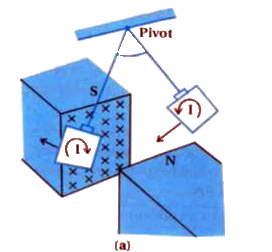 Method 1 to reduce effect of eddy currents : If RECTANGULAR slots are made in the copper plate as shown in figure, area available to the flow of eddy currents is less. Thus, the pendulum plate with holes or slots reduces electromagnetic damping and the plate swings more freely. 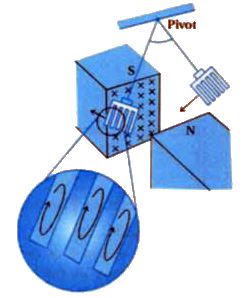 Method 2 to reduce effect of eddy currents : Eddy currents are minimized by using laminations of metal to make a metal core. The laminations are separated by an insulating material like lacquer. The plane of the laminations must be arranged parallel to the magnetic field, so that they cut across the eddy current paths. This arrangement reduces the strength of the eddy currents. Since the dissipation of electrical energy into heat depends on the square of the strength of electric current, heat loss is substantially reduced. 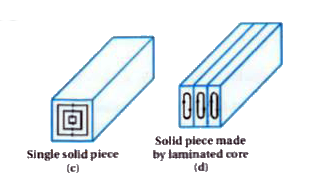 If solid piece of iron in figure (c) is made up of several layers, which are separated by insulating materials like varnish as shown in figure (d) then induced current will flow through individual laminations and effective are of eddy current reduces hence, effect of eddy current reduces. So, energy loss due eddy current can be minimized. |
|
| 32. |
Two wires of equal diameters of resistivities rho_1. and rho_2 , lengths X_1and X_2respectively are joined in series. The equivalent resistivity of the combination is |
|
Answer» `( rho_1 X_1rho_2 X_2)/( X_1 +X_2)` |
|
| 33. |
Four spheres each having mass m and radius r are placed with their centres on the four comers of a square of side a. Then the moment of inertia of the system about an axis along one of the sides of the square, is |
|
Answer» `8/5mr^(2)` `I=2/5mr^(2)+2/5mr^(2)+(2/5mr^(2)+ma^(2))+(2/5mr^(2)+ma^(2))` `=8/5mr^(2)+2ma^(2)` |
|
| 34. |
Estimate the wavelength at which plasma reflection will occur for metal having the density of electrons N~~4xx10^(27)m^(-3). Taking epsi_(0)=10^(-11)andm=10^(-30) where these quantities are in proper SI units. |
| Answer» ANSWER :B | |
| 35. |
A cylindrical vessel of radius R and height H and open at the top is completely filled with y . A small circular hole of radius r is made near the bottom of vessel . The time taken for 25 % of water to flow out is |
|
Answer» `sqrt(2H)/g(sqrt3-1)` |
|
| 36. |
State Ampere.s Circuital Law |
|
Answer» Solution : Ampere.s circuitallaw states that the LINE integral of the magnitic field around any CLOSED path in free SPACE is equal to `mu_(o)` times the current through any SURFACE enclosed by the closed path . i.e `intvecB.vecdI=mu_(0)I` |
|
| 37. |
An ideal gas confined to an insulated chamber is allowed to enter into an evacuated insulated chamber. If Q.W and Delta E_(int) have the usual meanings, then |
|
Answer» `Q=0, W ne0` `therefore W=0` This gives no change in intenal energy. CORRECT choice is (d). |
|
| 38. |
'Greater the height of T.V. transmitting antenna, greater is its range.'' Prove. |
|
Answer» Solution :Let `AB` be a T.V. tower of height `h` above the earth. `T.V.` signal is received within a circle of `CQ=QD` on the surface of earth. Let `R` be the radius of the earth. Let `CQ=QD=d` and `AB=h`. `:. OB=R+h` In rt. `/_d` triangle `OCB,` `OB^(2)=OC^(2)+BC^(2)` `(R+h)^(2)=R^(2)+d^(2)` `d^(2)=(R+h)^(2)-R^(2)` `=R^(2)+h^(2)+2Rh-R^(2)` or `d^(2)=h^(2)+2Rh` Since `h^(2)` can be neglected as COMPARED to `2hR` `:.d^(2)=2Rh` or `d=sqrt(2hR)` or `h=(d^(2))/(2R).`  AREA covered by T.V. signal `=PID^(2)` `=pi2hR=2pihR` Population covered = Area covered `xx` Population density Since `dpropsqrt(h,)( :.2R` is constant ) So greater the height of T.V. transmitting antenna, grater is its range. |
|
| 39. |
यदि द्विघात बहुपद p(x)=2x^2 +3x+4 के शून्यक alpha ,betaहो तो alpha+beta-alpha+betaका मान होगा - |
|
Answer» `-2/3` |
|
| 40. |
A capacitor consists of two parallel metal plates of area A separated by a distance d. A dielectric slab of area A, thickness b and dielectric constant k is placed inside the capacitor. If C_(k) is the capacitance of capacitor with dielectric, under what limits the values of k and b are to be restricted so thatC_(k)=2C, where C is capacitance without dielectric? |
|
Answer» `K=(4b)/(2B-d)` & `d/3 lt b LE d` |
|
| 41. |
Explain 'Conduction band' 'Valance band' and 'Energy gap', in semiconductors. |
|
Answer» Solution :In the case of conductors, CB and VB overlap with each other. Free electrons are the charge carriers. There are a number of electrons available to conduct ELECTRICITY at room temperature. In the case of insulators, there is a WIDE gap between CB and VB. FORBIDDEN gap energy is greater than 5 eV. There are no electrons in the CB to conduct electricity. In the case of semiconductors. Forbidden gap energy is less than 5 eV. There are EQUAL number of holes and electrons in a pure semiconductor. However these charges are too LOW so as to conduct electricity at room temperature. 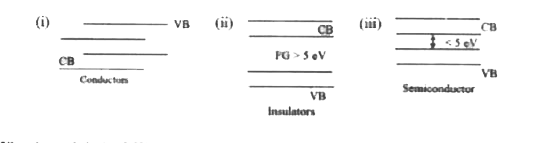
|
|
| 42. |
For a (R )/(C_(V))=0.67. This gas is made up of molecules which are |
|
Answer» DIATOMIC Thus gas is monatomic. |
|
| 43. |
When capacitor is connected to the circuit, the current when key is pressed, is: |
|
Answer» zero |
|
| 44. |
If the electron jumps from second to first orbit of the hydrogen atom. How much energy is liberated ? |
| Answer» SOLUTION :We KNOW `E= -13.6eV/n^2`. So , `E_1 = -13.6eV/1^2 = -13.6eV`. ENERGY LIBERATED = `E_2 - E_1 = 10.2eV`. | |
| 45. |
A ray PQ incident on the refracting face BA is refracted in the prism BAC as shown in the figure and emerges from the other refracting face AC as RS such that AQ = AR. If the angle of prism A = 60^(@) and refractive index of material of prism is sqrt(3) , calculate angle theta. |
|
Answer» Solution :The angle of the prism is `A = 60^(@)`. It is also given that AQ = AR. THEREFORE, the angles opposite to these two sides are also equal. Now for the triangle AQR, `angleA + angleAQR + angleARQ = 180^(@)` `angleA + angleAQR + angleARQ = 180^(@)` `therefore " " r_(1) = r_(2) = 30^(@) [therefore angleAQO = angleARO = 90^(@)]` `therefore " " r_(1) + r_(2) = 60^(@)` When `r_(1) and r_(2)` are equal, we have i = e. Now, according to Snell.s law, `mu = (sini)/(sinr_(1))` `therefore " " sini = musinr_(1) = sqrt(3) sin30^(@) = (sqrt(3))/(2)` `therefore " " i = 60^(@)` Now, the angle of deviation, `theta = i + e - A = 60^(@) + 60^(@) - 60^(@) = 60^(@)` 
|
|
| 46. |
A conducting wire of length land mass m is placed on two inclined rails as shown in figure. A current I is flowing in the wire in the direction shown. When no magnetic field is present in the region, the wire is just on the verge of sliding. When a vertically upwards magnetic field is switched on, the wire starts moving up the incline. The distance travelled by the wire as a function of time t will be: |
|
Answer» `1/2 [(IBI)/(m ) -2G]t^2` |
|
| 47. |
Identify the odd one |
| Answer» SOLUTION :POLARISATION,because polarisation is POSSIBLE only for transverse wave.So all other phenomenon are due to super POSITION of waves. | |
| 48. |
In figure, two positive charges q_2 and q_3 fixed along the y-axis, exert a net electric force in the + x direction on a charge q_(1)fixed along the x-axis. If a positive charge Q is added at (x, 0), the force on q_(1) |
|
Answer» shall increase along the positive x-axis. 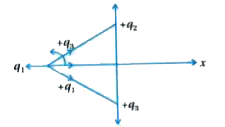 It means, `q_2` and `q_3` apply attractive force on `q_(1)` Hence, it can be said that QX is negative and `q_2` and `q_3` are positive. Now, if + Q charge is PLACED at (x, 0) then ATTRACTION force on negative charge ql will be in + x-axis. Hence, net force will be in + x-axis. 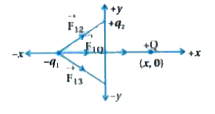
|
|
| 49. |
A current loop consists of two identical semicircular parts each of radius R, one lying in the x-y plane and the other in x-z plane. If the current in the loop is 'i' the resultant magnetic field due to the two semicircular parts at their common centre is |
|
Answer» `(mu_(0)i)/(sqrt2R)` |
|
| 50. |
If the electric amplitude of the electromagnetic wave is 5Vm^(-1), its magnetic amplitude will be |
| Answer» Answer :B | |