Saved Bookmarks
This section includes 7 InterviewSolutions, each offering curated multiple-choice questions to sharpen your Current Affairs knowledge and support exam preparation. Choose a topic below to get started.
| 1. |
If the load of a wire is increases such that its stress is twice as that of previous, then the new value of Youngs modulus is |
|
Answer» INCREASES |
|
| 3. |
Particle of mass m and energy E moves from the left to the potential barrier shown in figure. Find: (a) the reflection coefficient R of the barrier for E gt U_(0) (b) the effective penetration depth of the particles into the region x gt 0 for E lt U_(0)i.e., the distacne from the barrier boundary to the point at which the probability of finding a particle decreases e-fold |
|
Answer» Solution :(a) We start from the Schrodinger equation `(d^(2)Psi)/(dx^(2))+(2m)/( ħ^(2))(E-U(x))Psi=0` which we write as `Psi_(1)''+k^(2)Psi_(1)=0, x LT 0` `k^(2)=(2mE)/( ħ^(2))` and `Psi_(II)+alpha^(2)Psi_(II)=0x GT 0` `alpha^(2)=(2m)/( ħ^(2))(E-U_(0)) gt 0` It is convinient to look for solutions in the form `Psi_(I)=e^(ikx)+Re^(-ikx)x lt 0` `Psi_(II)=Ae^(i alphax)+Be^(-alpha x)x gt 0` In region (I)`(x lt 0)`, the amplitude of `e^(ikx)` is written as unity by conservation. In II we EXPECT only a transmitted wave to the right, `B=0` then. So `Psi_(II)=Ae^(ikx)x gt 0` The boundary conditions follow from the continuity of `Psi(dPsi)/(dx) at x=0` `1+R=A` `iK(1-R)= i alpha A` Then `(1-R)/(1+R)=(alpha)/(k)` or `R=(k-alpha)/(k+alpha)` The reflection coefficient is the absolute square of `R`: `r=|R|^(2)=|(k-alpha),(k+alpha)|^(2)` (b) In this case `E lt U_(0), alpha^(2)= -beta^(2) lt 0`. Then `Psi_(1)` is uncharged in from but `Psi_(II)=Ae^(-betax)+Be^(+betax)` we must have `B=0` since otherwise `Psi(x)` will become unbounded as `xrarroo`. INSIDE the barrier, the PARTICLE then has probability density equal to `|Psi_(II)|^(2)=|A|^(2)e^(-2betax)` This decreases to `(1)/(e )` of its value in `x_(eff)=(1)/(2beta)=( ħ)/(2sqrt(2m(U_(0)-E)))` |
|
| 4. |
Theoretically which of the following are best lubricants |
|
Answer» SOLIDS |
|
| 5. |
A current of 500 mA ſlows in the coil of the previous problem. When the current is switched off it vanishes after a time of 10^(-4) s. Supposing the current to decrease linearly, find the e.m.f. of self-induction |
|
Answer» |
|
| 6. |
Explain the idea of carbon dating. |
|
Answer» Solution :(i) The application of beta decay is radioactive dating or carbon dating. (ii) USING this technique, the age of an ancient object can be calculated. (iii) All living organisms absorb carbon dioxide `(CO_(2))` from air to synthesize organic molecules. In this absorbed `CO_(2)`, the MAJOR part is `""_(6)^(12)C` and very small fraction `(1.3xx10^(-12))` is radioactive `""_(6)^(14)C` whose half-life is 5730 years. (iv) Carbon - 14 in the atmosphere is always DECAYING but at the same time, cosmic rays from outer space are continuously bombarding the atoms in the atmosphere which produces `""_(6)^(14)C`. (v) Continuous production and decay of `""_(6)^(14)C` in the atmosphere keep the ratio of `""_(6)^(14)C` to `""_(6)^(12)C` always constant. Since our human body, tree or any living organism continuously absorb `CO_(2)` from the atmosphere, the ratio of `""_(6)^(14)C` to `""_(6)^(12)C` in the living organism is also nearly constant. (vi) But when the organism. get dies, it stops absorbing `CO_(2)`. SInce `""_(6)^(14)C` starts to decay, the ratio of `""_(6)^(14)C` to `""_(6)^(12)C` in a dead organism or specimen decreases over the years. Suppose the ratio of `""_(6)^(14)C` to `""_(6)^(12)C` in the ancient tree pieces excavated is known, then the age of the tree pieces can be calculated. |
|
| 7. |
Minimum angle of deviation for prism having angle prism 30^@ is 30^@, so find angle of incident. |
|
Answer» SOLUTION :`i+e=A+delta` `therefore2i=30^@+30^@` `=60^@` (`because" for "delta_(m),i=e` `THEREFORE i=30^@` |
|
| 8. |
In the given Fig. 6.16, a bar magnet is quickly moved towards a conducting loop having a capacitor. Predict the polarity of the plates A and B of the capacitor. |
| Answer» Solution :As seen from LEFT hand SIDE, induced CURRENT tends to flow anticlockwise. As a result plate A of the capacitor is at a +ve POTENTIAL and plate B at a -ve potential. | |
| 9. |
The total binding energy of an alpha-particle (._(2)He^(4)) is 24.4 MeV, where as the total binding energy of a deutron (._(1)H^(2)) is merely 2.2 MeV. When two deutrons are made to combine |
|
Answer» An `ALPHA`-PARTICLE will be obtained |
|
| 10. |
Sound of wavelenth lamda passes through a Quicke's tube, which is adjusted to give a maximum intensitiy I_(0). Through what distance should the sliding tube be moved to give an intensity I_(0)//2? |
|
Answer» `lamda//2` |
|
| 11. |
The three primary colours used in a colour television are ______. |
|
Answer» RED - BLUE -green |
|
| 12. |
Find the capacitance of a capacitor if the area of its plates is S, the distance between the plates is d_(0) and a dielectric sheet of the thickness dltd_(0) is inserted into the capacitor (Fig. 25.4) |
|
Answer» Solution :The CAPACITANCE of a CAPACITOR will remain unchanged, if we PLACE a very thin piece of foil on top of the insulating layer. For this REASON the capacitance sought should be regarded as made up of the capacitances of two capacitors connected in series, with capacitances `C_(1)=(EPSI epsi_(0)S)/(d) and C_(2)=(epsi_(0)S)/(d_(0)-d)`will remce of |
|
| 13. |
When metal surface with 2.1 eV work function is irridated with photon of 6.0 eV energy.Value of stopping potential will be…. |
|
Answer» `+8.1` `therefore eV_(0)hv-phi_(0)[because (1)/(2)mv_(max)^(2)=eV_(0)`] `therefore eV_(0)=(6.0-2.1)eV` `therefore eV_(0)=3.9 eV` Stopping POTENTIAL is NEGATIVE VOLTAGE. `therefore V_(0)=-3.9V` |
|
| 14. |
Magnification by a lens of an object at distance 10 cm from it is -2. Now a second lens is placed exactly at the same position where first was kept, without changing the distance between object and lens. The magnification by this second lens is -3. (a) Now both the lenses are kept in contact at the same place. What will be the new magnification. (b) What is the focal length of the combination when both lenses are in contact? |
| Answer» Solution :`(a) (-6)/(11) , (b ) (60)/(17) cm` | |
| 15. |
A bird of mass 1.23 kg is able to hover by imparting a downward velocity 10 m/s uniformly to air of density rho" kg"//"m"^(3) over an effective area 0.1" m"^(2). If the acceleration due to gravity is 10" m"//"s"^(2), then the magnitude of rho in "kg"//"m"^(3) is : |
|
Answer» `0.0123` |
|
| 16. |
Four identical charges each .q. are placed at four corners of a square of side .a.. Find the charge to be placed at the centre of the square so that the system of charges is in equilibrium |
Answer» Solution : Due to four IDENTICAL charges kept at four corners of a square, null point (E= 0) is formed at CENTRE O. Let .Q. be the charge placed at centre of square then the charge .Q. is in equilibrium. For system to be in equilibrium the force on each charge must be zero. Consider the forces on charge at C. Let `F_(A) , F_(B), F_(D) and F_(O)` be the forces on the charge at .C. due to the charges at A, B, D, and .O. respectively `F_(B) = F_(D) = (1)/(4pi in_(0)) (q^(2))/(a^(2))` Angle between `vec(F)_(B) and vec(F)_(D)" is " 90^(@)` The magnitude of resultant of `vec(F)_(B) and vec(F)_(D) = sqrt2 xx (1)/(4pi in_(0)) (q^(2))/(a^(2))` The direction of resultant is along AC. The force `F_(A) = (1)/(4pi in_(0)) (q^(2))/((sqrt2a)^(2)) = (1)/(4pi in_(0)) (q^(2))/(2a^(2))`. It acts along AC. The force on C due to ..Q.. is `vec(F)_(O) = (1)/(4pi in_(0)) (q^(2))/(((a)/(sqrt2))^(2))= 2 xx (1)/(4pi in_(0))(q^(2))/(a^(2))` The resultant force on charge at C is zero. `vec(F) = vec(F)_(A) + vec(F)_(B) + vec(F)_(D) + vec(F)_(O) = 0` `F= (1)/(4pi in_(0))[(q^(2))/(2a^(2)) + sqrt2. (q^(2))/(a^(2)) + (2Qq)/(a^(2))]=0` `(q)/(a^(2)) [(q)/(2) + sqrt2q + 2Q] = 0 rArr q [(1 + 2 sqrt2)/(2)] + 2Q= 0` `2Q = -q ((1+ 2 sqrt2)/(2)) rArr Q = (-q)/(4) (2 sqrt2 + 1)` Negative sign indicates that the forces `vec(F)_(O)` is OPPOSITE to the resultant of `vec(F)_(A), vec(F)_(B) and vec(F)_(D)` i.e., along `vec(CO)` |
|
| 17. |
A man of mass m climbs a rope of length L suspended below a balloon of mass M. The balloon is stationary with respect to ground (a) if the man begins to climb up the rope at a speed v_(rel) (relative to rope) in what direction and with what speed (relative to ground) will the balloon move ?(b) How much has the balloon descended when the man reached the balloon by climbing the rope ? |
Answer» Solution :(a) Given that INITIALLY the system is at rest, so initial momentum of the system is zero. In the claiming of the rope there is no external force.Therefore FINAL momentum of the system should also be zero.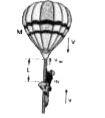 `m vec(v)+M vec(V)=0 ""` [as (m+M) = finite] i.e., `M vec(V)=-m vec(v) ""`......(1) Furthermore here it is given that `vec(v)_(rel)=vec(v)-vec(V ) ""`........(2) Substituting the value of `vec(v)` from EQN. (2) in (1), we get `M vec(V)=-m(vec(v)_(rel)+vec(V))` or `vec(V)=-(m vec(v)_(rel))/((m+M))` .......(3) This is the desired result and from this it is clear that the direction of MOTION of balloon is opposite to that of climbing `(vec(v)_(rel))`, i.e., vertically down. |
|
| 18. |
How refractive index and minimum deviation are related mathematically ? |
| Answer» SOLUTION :N= SIN A+D_m | |
| 19. |
If B.B/ nucleon in ""_(3)^(7)Li and ""_(2)He^(4) nuclic are 5.6 Mev and 7.06 MeV, then in the reaction p+""_(3)^(7)Li to 2 ""_(2)^(4) He, energy of proton must be : |
|
Answer» 39.2MeV B.E. of `""_(2)He^(4)=4 xx 7.06 =28.24MeV` So. B.E. of 2 `(""_(2)He^(4))=56.48 Mev` ENERGY of protons =56.48-39.20=17.28MeV |
|
| 20. |
A point source of light is placed at a depth of h below the calm surface of water. From the source, light rays can only be transmitted to air through a definite circular section. (i) Draw the circular section of the surface of water by ray diagram and mark its radius r. (ii) Determine the angle of incidence of a ray of light incident at any point on the circumference of the circular plane. ["Given : refractive index of water", mu = (4)/(3) , 48^(@)36' = sin^(-1)] (iii) Show that r = (3)/(sqrt7)h. |
|
Answer» Solution :(i)Let MN be the open SURFACE of water {Fig. 240]. O is the source of light at a depth h below the surface of water. Light rays incident on the surface of water from O at angles less than critical angle transmit in air after refraction. At the points A and B the light rays are incident at angles equal to the critical angle `(theta)`. So the refracted rays at these two point graze along the surface of separation. So light rays will transmit outside water only through the circular section of water excluding this circular section, they will be totally reflected from the surface of water and will return to water. (II) Let the angle of incidence be `theta`. `sintheta = (1)/(a^(mu)w) = (1)/(mu) = (3)/(4) = sin48^(@)36. or, theta = 48^(@)36.` (iii) From the triangle AOP, `tantheta = (AP)/(OP) = (r)/(h) or, (sintheta)/(costheta) = (r)/(h)` `or, "" ((1)/(mu))/(sqrt(1-(1)/(mu^(2)))) = (r)/(h) [therefore sintheta = (1)/(mu)]` `or, "" r = (h)/(sqrt(mu^(2) - 1)) = (h)/(sqrt(16/(9) -1)) = (3)/(sqrt(7))h` 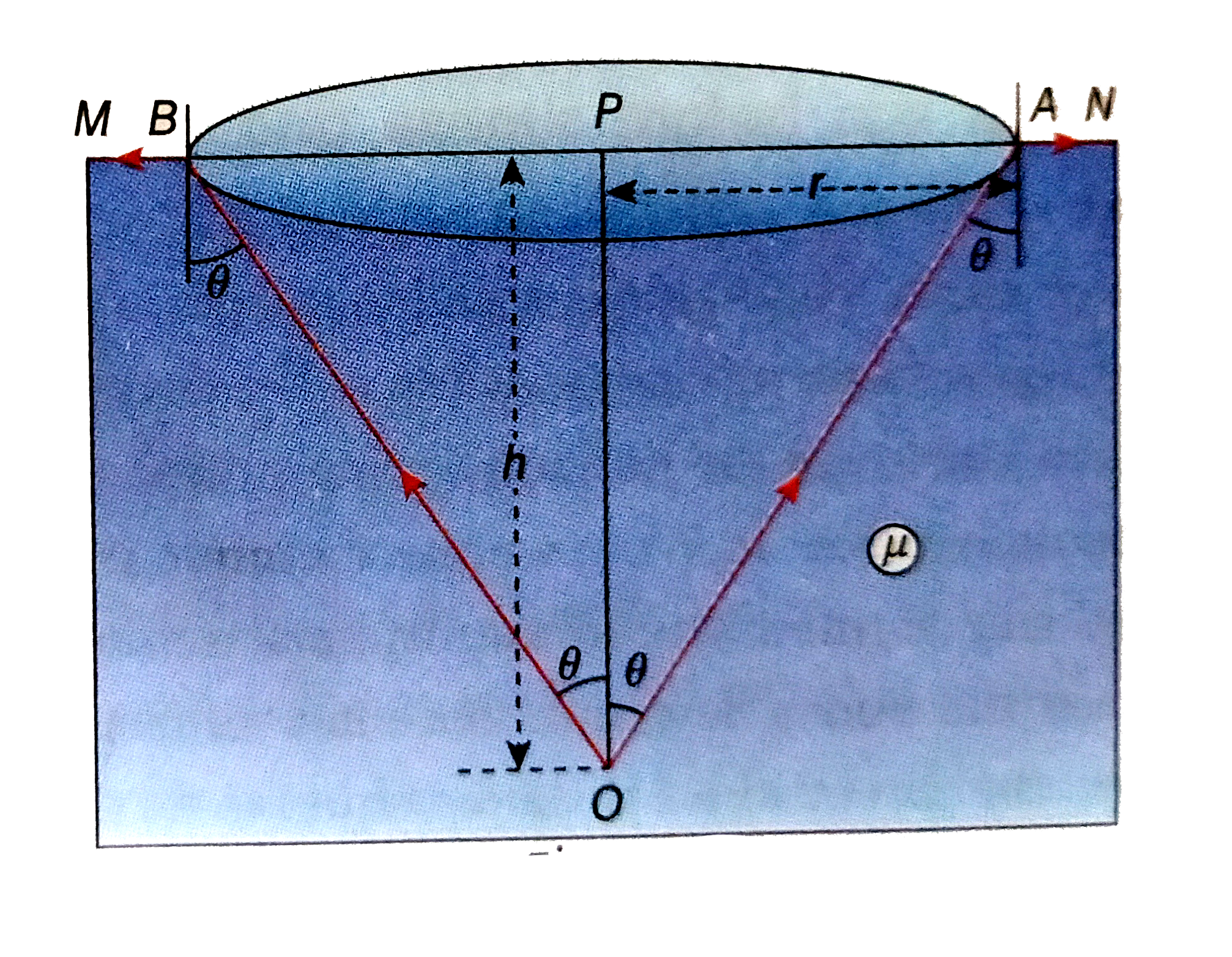
|
|
| 21. |
The wavelength of first line in Balmer series is 6563 Å. Calculate the longest and the shortest wavelengths of the first spectral lines in the Lyman series. |
|
Answer» Solution :`(1)/(lambda)=R[(1)/(n_(F)^(2))-(1)/(n_(i)^(2))]` For First LINE of Balmer series `n_(f)=2 and n_(i)=3` `(1)/(lambda_(B_(2)))=R[(1)/(4)-(1)/(9)]=(5R)/(36)` For Longest wavelength of Lyman series `(1)/(lambda_(L_(1)))=R[1-(1)/(4)](3R)/(4)` to find `lambda_(L_(1))=1215Å` For shortest wavelength of Lyman series `n_(f)=1 and n_(i)=OO` `lambda_(L_(oo))=911.54Å` |
|
| 23. |
An electric toaster uses nichrome for its heating element. When a negllgibly small current pases through it, its resistance at room temperature (27.0^(@)C) is found to be 75.3 Omega. When the toaster is connected to a 230 V supply, the current settles, after a few seconds, to a steady value of 2.68A. What is the steady temperature of the nichrome element ? The temperature coefficient of resistance of nichrome averaged over the temperature range involved is 1.70 xx 10 ^(-4)"" ^(@)C ^(-1). |
|
Answer» Solution :When the current through the element is very small, heating effects can be ignored and the temperature `T _(1)` of the elements is the same as room temperature. When the toaster is connected to the supply. Itys initial current will be slightly higher than its steady value of `2.68 A.` But due to heating effect of the current, the temperature will RISE. This will cause an increase in resistance and a slight decrease in current. In a few seconds, a stready state will be reachede when temperature will REISE no further, and b oth thte reststance of the element and the current drawn will achieve steady values. The resistance `R_(2)` at the steady temperature `T_(2)` is `R_(2) = (230)/( 2.68A) = 85.8 Omega` Using the relation `R_(2) = R_(1) [1 + alpha (T_(2) -T_(1))]` with `alpha = 1.70 xx10 ^(-4) ^(@)C ^(-1),` we GET `T_(2) - TG_(1) ((85.8 - 75.3))/((75.3) xx 1. 70 xx 10 ^(-4))= 820^(@)C` that is, `T_(2) = (820 + 27.0) ^(@)C=847 ^(@)C` Thus, the steady temperature of the heating element (when effect due to the current equals HEAT loss to the surroundings) is `847^(@)C.` |
|
| 24. |
In determining viscosity (eta)by poiseuille'smethod the formula used eta = (pi pr^(4))/(8 vl) . Which of the quantities in the formula must be measured more accurately |
|
Answer» p |
|
| 25. |
Where did Akash go for higher studies? |
|
Answer» Nepal |
|
| 26. |
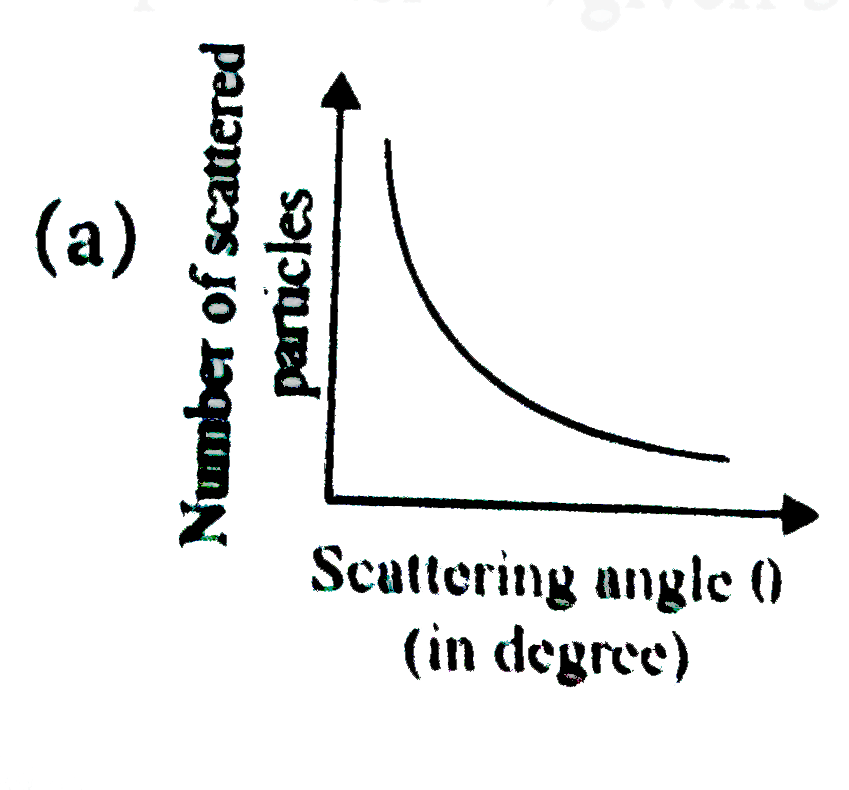
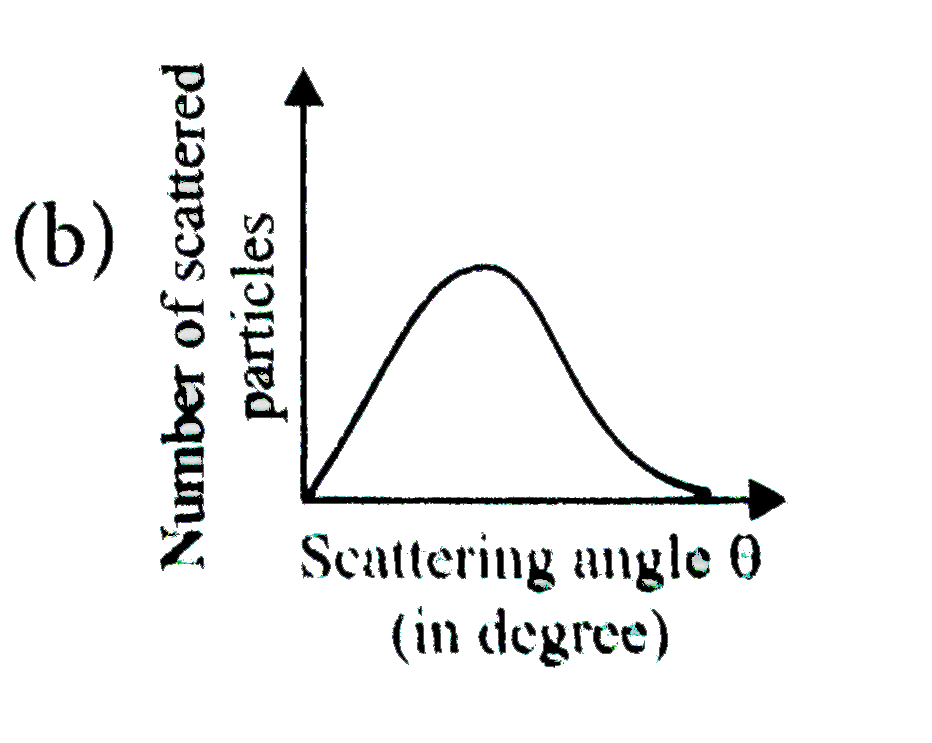
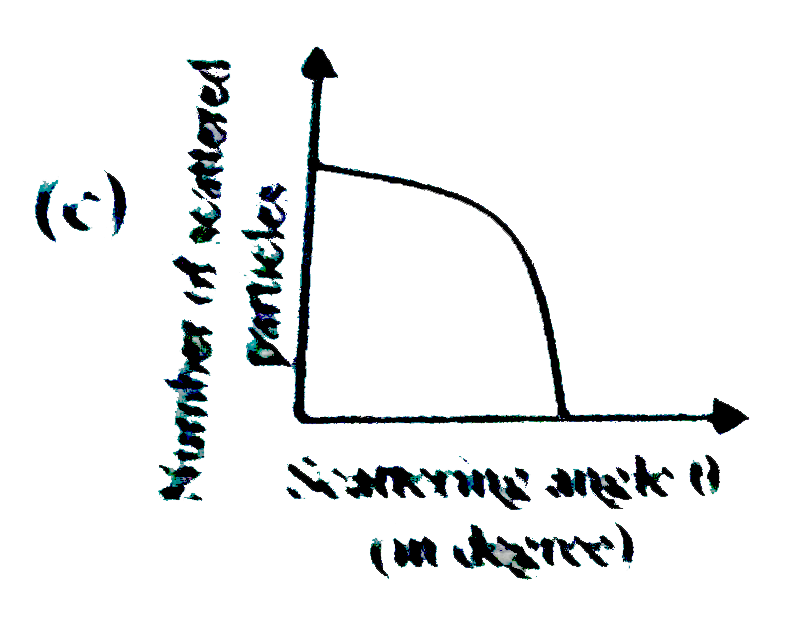
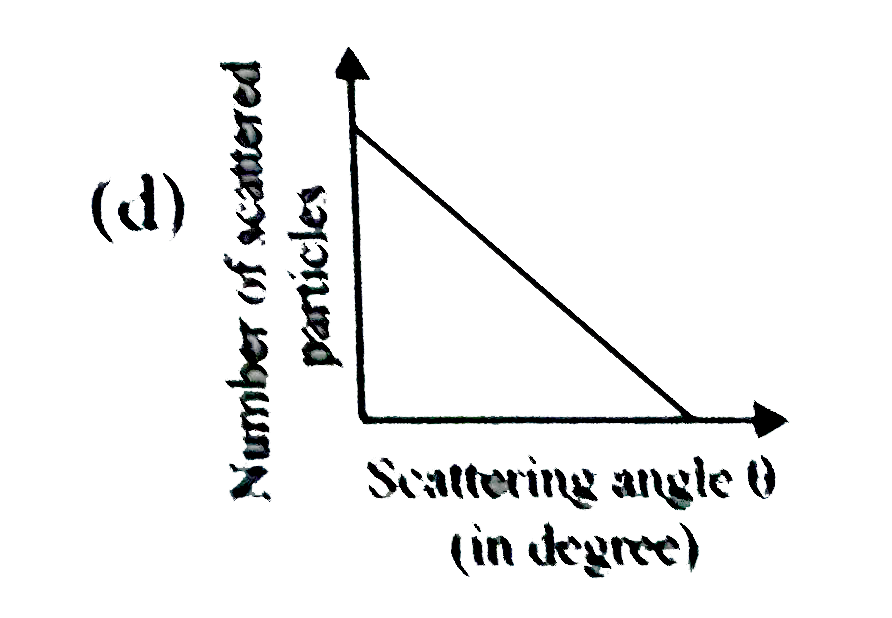
The graph of the total number of alpha-particles scattered at different angles in a given interval of time for alpha- particles scattering in the geiger- marsden experiment is given by |
|
Answer»
|
|
| 27. |
A potentiometer wiere has a length of 4 and resistance of 20 Omega. It is connected in series with resistance of 2980 Omegaand a cell of emf 4 V. Calcaulte the potential along the wire. |
|
Answer» SOLUTION :Length of the potential WIRE, `l=4m` Resistance of the wire, `r=20Omega` Resistance connected series with potentiometer wire, `R=2980Omega` Emf of the cell, `xi=4V` Effective resistance, `R_(s)=r+R=20+2980=3000Omega` Current FLOWING through the wire, `I=(xi)/(R_(s))=(4)/(3000)` `I=1.33xx10^(-3)A` Potential drop across the wire, `V=Ir` `=1.33xx10^(-3)xx20` `V=26.6xx10^(-3)V` Potential gradient `=("Potential drop across the wire")/("length of the wire")=(V)/(l)=(26.6xx10^(-3))/(4)` `=6.65xx10^(-3)` Potential gradient `=0.66xx10^(-2)Vm^(-1)` |
|
| 28. |
If a small amount of antimony is added to germanium crystal ……… |
|
Answer» it BECOMES a p-type semiconductor. When a SMALL amount of antimony (pentavalent) is added to GERMANIUM crystal, it formed n-type of semiconductor so it has more number of free electrons than the holes. |
|
| 29. |
In the circuit shown in figure. Find the currents I,I_(1),I_(2) and I_(3) given that emf of th battery=2V, internal resistance of the battery =2Omega and resistance of the galvanomter =4Omega. |
|
Answer» |
|
| 30. |
An electron of mass m and charge e initially at rest gets accelerated by a constant electric field E. The rate of change of de-Broglie wavelength of this electron at time t, ignoring relativistic effect is : |
|
Answer» `-(H)/(eEt^(2))` `e=(eE)/(m)` Now, `v=u+at+(eEt)/(m)` de-Brogilie wavelength of an electrons is given by `lambda=(h)/(mv)=(h)/(eEt)` `:. (d lambda)/(DT)=-(h)/(-eEt^(2))` |
|
| 31. |
A gas at 20^@C and atmospheric pressure is compressed to a volume one-fifteenth as large as its original volume and an absolute pressure of 3000 kPa. What is the new temperature of the gas? |
|
Answer» |
|
| 32. |
A beam of light converges at aoint P. Now a convex lens is placed in the path of the convergent beam at 15 cm from P. At what point does a beam converge if the convex lens has a focal length 10 cm? |
|
Answer» |
|
| 33. |
A crown glass prism of refracting angle 6^@ is to be used for deviation without dispersion with a flint glass of angle of prism alpha . Given : for crown glass mu_r=1.513 and mu_v = 1.523, for flint glass mu_r=1.645 and mu_v=1.665. Find alpha |
| Answer» ANSWER :A | |
| 34. |
The size of the image of an object which is at infinity as formed by a convex lens of focal length 30 cm is 2 cm. If a concave lens of focal length 20 cm is placed between the convex lens and the image at a distance of 26 cm from convex lens, find new size of image : |
|
Answer» 1.25 cm `- (1)/(u) + (1)/(v) = (1)/(f)`  `- (1)/(4) + (1)/(v) = (1)/(-20)` v = 5 cm `m = (v)/(u) = (5)/(4) = 1.25` `m = (I_(2))/(I_(1)) = (I_(2))/(2) "" therefore I_(2) = 2 xx 1.25 = 2.5 cm`. |
|
| 35. |
If electric charge on capacitor formed by two plates of area A is Q, then electric field between them is ….. |
|
Answer» `E=(Q)/(epsilon_(0)A)` |
|
| 36. |
Abn engine pumps 373 kg of water upto height of 16 m in 40 seconds. Rated power of engine if its efficiency is 80% is (1 horse power = 746 W and g =10 m/s^2) |
| Answer» Answer :a | |
| 37. |
For-a transistor in common emitter configuration, the voltage drop across the load of 100012 is 0.5 V If the value of a for the transistor is 0.98, then the base current will be approximately equal to |
|
Answer» `5muA` |
|
| 38. |
A uniform horizontal rod of length 40 cm and mass 1.2 kgf is supported by two identical wires as shown. Where should a mass of 4.8 kg be placed on the rod so that the same tuning fork may excite the wire on left into its fundamental vibrations and that on sight into its first overtone? Take g = 10 m//s^2. |
| Answer» SOLUTION :5 CM from the LEFT END | |
| 39. |
Eventhoughmetals have free electrons, they cannot escape from metal surface. Why? |
| Answer» Solution :If an ELECTRON tends to escape from metal surface, the ATOM which is losing the electron BECOMES a positive ION and pulls back the electron to itself. Hence free electrons of METALS cannot escapefrom the surface. | |
| 40. |
Two balls are dropped to the ground from different heights.One ball is dropped 2s after the other,but both strike the ground at the same time 5s after the 1st is dropped . a) What is the diffrence in the heights from which they were dropped? b)From what height was the first ball dropped? |
|
Answer» Solution :a) For the first ball s=`h_(1)`,u=0,t=5s `THEREFORE h_(1)0xx5+(1)/(2)9.8xx5^(2)=122.5m` For the second ball s =`h_(2)`,u=0,t=3s `therefore h_(2)=(1)/(2)"gt"^(2)=(1)/(2)xx9.8xx9=44.1m` Difference in HEIGHTS `H=h_(2)-h_(1)=122.5-44.1=78.4m` b)The first ball was dropped from a HEIGHT of `h_(1)=122.5m` |
|
| 42. |
T.V. transmission tower at a particular station has a height of 160 m. What is the coverage range ? |
|
Answer» Solution :Coverage range `d= SQRT(2Rh)` `= sqrt(2 XX 6400 xx 10^(3) xx 160M)= 45.454 km.` |
|
| 43. |
On increasing the temperature, widthforbidden gap …. |
|
Answer» becomes zero |
|
| 44. |
In a series LCR circuit connected to an ac source of variable frequency and voltage v =v_(m)sin omega t,draw a plot showing the variation of current (I) with angularfrequency (omega) for two different values of resistance R_(1) and R_(2) (R_(1) gt R_(2)). Write the condition under which the phenomenon of resonance occurs. For which value of the resistance out of the two curves, a sharper resonance is produced ? Define Q-factor of the circuit and give its significance. |
|
Answer» Solution : Figure shows the VARIATION of `i_(m)` with`OMEGA` in LCK series circuit for two values of resistance `R_(1) and R_(2) (R_(1) gt R_(2)).` The condition for resonance in the LCR circuit is, `omega_(0)=(1)/(sqrt(LC))` We see that the current amplitude is maximum at the resonantfrequency `omega`. Since `i_(m) =V_(m)//R` at resonance, the current amplitude for case `R_(2)` is sharper to that for case `R_(1)`. 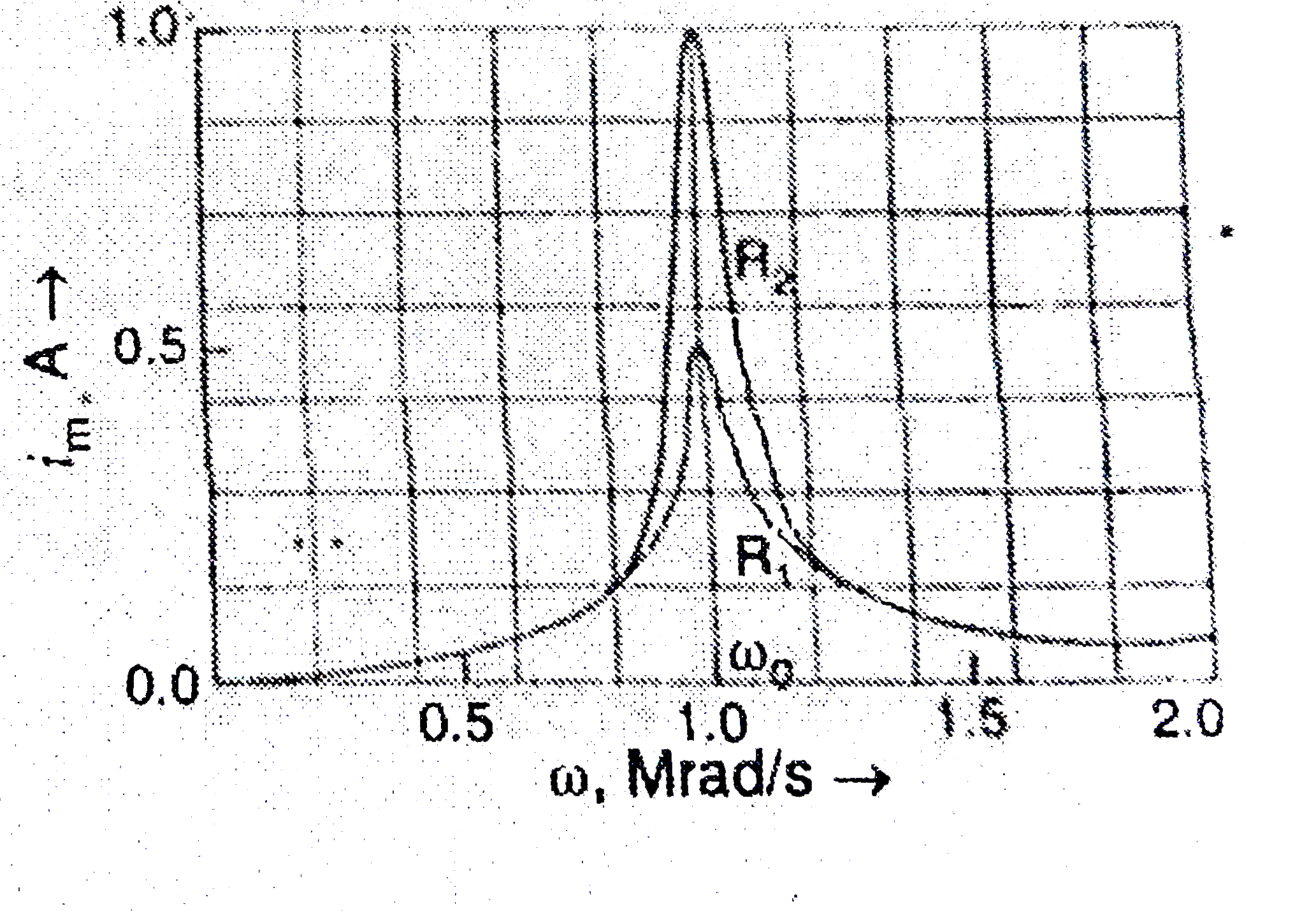 QUALITY factor or simply the Q-factor of a resonantLCR circuit is defined as the ratio of voltage drop across the capacitorto that of applied voltage . It is given by`Q=(1)/(R) sqrt((L)/(C)).` The Q factor determines the sharpness of the resonance curve and if the resonance is less sharp, not only is the maximum current less, the circuit is close to the resonance for a larger range `Delta`w of frequencies and the turning of the circuit will not be GOOD. So, less sharp theresonance, less is the selectivity of the circuit while higher is the Q, sharper is the resonance curve and lesser will be the loss in energy of the circuit. |
|
| 45. |
If a light of wavelength 330 nm is incident on a metal with work function 3.55 eV, the electrons are emitted. Then the wavelength of the emitted electron is (Take h = 6.6 xx 10^(-34) Js)……………………… |
|
Answer» `LT 2.75 xx 10^(-9)m` `K_max = (HC)/lambda phi_0 = (1240/330 -3.55)eV - (3.76 - 3.55) eV` `K_max = 0.21 eV` de-Broglic wavelength of emitted electron `lambda = h/sqrt(2mKE)= (6.63 xx 10^(-4))/(sqrt(2xx 9.1 xx 10^(-31) xx 0.21 xx 1.6 xx 10^(-19))) = 2.668 xx 10^(-9)m` `lambda = 2.67 xx 10^(-9)m` The Two wavelength of the emitted electron is `lt 2.75 xx 10^(-9)m` |
|
| 46. |
If the ring slips then will it be backward slipping or forward slipping. |
| Answer» SOLUTION :FORWARD SLIPPING | |
| 47. |
Mention the different units of radioactivity. |
|
Answer» Solution :Becquereal (BQ), Curie (Ci), RUTHERFORD (RF) 1 Bq = 1 disintegration/sec `1 Ci = 3.7 XX 10^(10)` desintegration/sec `1 Rf= 10^6` disintegration/sec. |
|
| 49. |
What is the relation between free electrons n_(e), and free holes n_(h) in intrinsic semiconductor ? |
|
Answer» `n_(e) gt n_(h)` |
|