

Saved Bookmarks
This section includes 7 InterviewSolutions, each offering curated multiple-choice questions to sharpen your Current Affairs knowledge and support exam preparation. Choose a topic below to get started.
| 1. |
A condenser of capacity 60muF is charged to 100 V. Its energy is equal to : |
|
Answer» `15xx10^-3J` |
|
| 2. |
Numerical aperture of an optical fibre (w.r.t air) having core and cladding refractive indices n_(1) and n_(2) respectively is |
|
Answer» `sqrt(n_(1)^(2) - n_(2)^(2))` |
|
| 3. |
A uniform magnetic field of 1.5 T exists in a cylindrical region of radius 10.0 cm, its direction parallel to the axis along east to west. A wire carrying current of 7.0 A in the north to south direction passes through this region. What is the magnitude and direction of the force on the wire if, (a) the wire intersects the axis, (b) the wire in the N - S to northest - northwest direction. (c) the wire in the N-S direction is lowered from hte axis by a distance of 6.0 cm ? |
|
Answer» Solution :(a) It is given that `B = 1.5 T` is present in a cylindircal region of radius r = 10.0 cm along east to west. It has been shown in fig. by sing `ox` , assuming east to west into the plane of paper. The wire carrying CURRENT I = 7.0 A is placed PERPENDICULAR to the magnetic axis along north (N) to south (S) direction. Then , `F = B I l SIN theta = 1.5 xx 7 xx (20 xx 10^(-2)) sin 90^@` `= 2.1 N ][ :. l = "diameter"= 20 cm = 20 xx 10^(-2) m]` Since `vecB` acts along east to west and `vecl` is in north to south, the force `vecF` is in direction `I vecI xx vecB`, ie., vertically downwards direction. 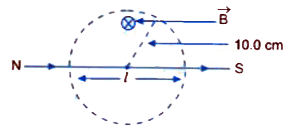 (b) As shown in fig, now the length of the wire inside the magnetic field is `2(10/(sin theta))` cm. The magnitude of the force is `F = B I l sin theta = B I [(2((10)/(sin theta)) xx 10^(-2)] sin theta` `= 1.5 xx 7.0 xx 20 xx 10^(-2) = 2.1 N` The force acts in vertically downward direction. 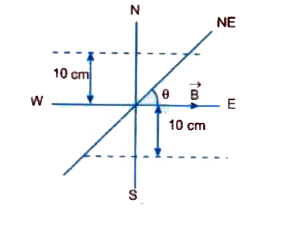 (C) When the wire is lowered from the axis by a distance of 6 cm, as shown in fig., the length of the wire inside the magnetic field is `l = 2 xx sqrt((10)^(2) - (6)^(2)) cm = 2 xx 8 cm` `= 2 xx 8 xx 10^(-) m = 0.16 m` `:. ` The magnitude ofthe magnetic force on the wire is `F = B I l sin 90^@` `= 1.5 xx 7.0 xx 0.16 = 1.68 N` 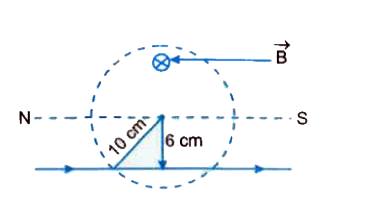
|
|
| 4. |
A conducting rod of length 2 m is placed on a horizontal table in north-south direction. It carries a current of 5A from south to north. Find the direction and magnitude of the magnetic force acting on the rod. Given that the Earth's magnetic field at the place is 0.6xx10^(-4)T and angle of dip is (pi)/(6). |
|
Answer» Solution :Here LENGTH of rod `l=2m`, current flowing in rod I = 5A, Earth.s MAGNETIC field `B_(E )=0.6xx10^(-4)T` and angle of dip `delta=(PI)/(6)`. As rod is placed horizontaly in north-south DIRECTION and current is flowing south to north, there is no magnetic force due to `B_(H)`, the horizontal component of earth.s field and force is solely due to VERTICAL component `B_(V)` of the earth.s magnetic field which is acting vertically downward. `therefore F=I l B_(V)=I l B_(E ) sin delta=5xx2xx(0.6xx10^(-4))xx"sin"(pi)/(6)=3xx10^(-4)N` In accordance with Fleming.s left hand rule the force F is in horizontal plane directed from east to west direction. |
|
| 5. |
The resistances in the left and right gaps of a balanced meter bridge are R_1R_2 The balance point is 50 cm. If a resistance of 24Omegais connected in parallel to R_2the balance point is 70 cm. The value of R_1 is |
|
Answer» `2 Omega ` |
|
| 6. |
Explain the refraction by two transparent spherically curved surface. |
|
Answer» Solution :An INFINITESIMAL part of a SPHERICAL surface can be regarded as PLANAR and the same LAWS of refraction can be applied at every point on the surface. Just as for reflection by a spherical mirror. The normal at the point of incidence is perpendicular to the tangent plane to the spherical surface at that point and therefore, passes through its centre of curvature. |
|
| 7. |
Why is diamagnetism, In contrast, almost Independent of temperature? |
| Answer» Solution :(b) When any diamagnetic SAMPLE is subjected to external uniform MAGNETIC field, dipole moment gets induced in it in a direction opposite to magnetising field, irrespective of change in TEMPERATURE over a large range. Thus, diamagnetism is Almost independent of temperature. | |
| 8. |
A cell is e.m.f 2V and internal resistance 1 Omega is connected to a potentiometer of length 1m and resistance 4 Omega Calculate the potential drop per cm. |
|
Answer» Solution :e.m.f of cell E = 2V Internal RESISTANCE of potentiometer wire R=` 4 Omega` Potential drop `V= E((R)/(R+r))= (2xx4)/(4+1) = 1.6 V` Potential drop PER cm `=V/l = (1.6)/(100) = 1.6 xx 10^(-2) ` volt/cm. |
|
| 9. |
In the motion of charged particles through a region containing either only uniform electric field vec(E)or only uniform magnetic filed vec(B0 or both, certain properties are listed in column A and their possibe reasons or explanations are given in column A and their possible reasons or explanations are given in column B. (Here, vecv denotes the velocity of the particle and force means the force acting on the particle.) |
|
Answer» |
|
| 10. |
Find the number of natural transverse vibration of a rigtht-angled parallelipoped of volume V in the frquency interval from omega to omega +d omega if the propogation velocity of vibrations is equal to v |
|
Answer» Solution :For transverse vibrations of a 3-diamensional continuum (in the from of a cube say). We have the equation `(del vec(xi))/(delt^(2))=V^(2)vecgrad^(2)vec(xi), di v vec(xi)=0` Here `vec(xi)=vec(xi)(x,y,z,t)`. We LOOK for solutions in the form `vec(xi)=vec(A) sink_(1)x,sink_(2)y,sink_(3Ƶ), SIN (omega t+delta)` This requires `omega^(2)=v^(2)(k_(1)^(2)+k_(2)^(2)+k_(3)^(2))` From the boundary condition that `vec(xi)=0` for `x=0, x=l,y=0,y=l,Ƶ=l`, we get `k_(1)=(n_(1)pi)/(l),k_(2)=(n_(2)pi)/(l)=(n_(2)pi)/(l),k_(3)=(n_(3)pi)/(l)` where `n_(1):n_(2),n_(3)` are NONZERO positive intergers. We then get `n_(1)^(2)+n_(2)^(2)+n_(3)^(2)=((lomega)/(pi v))^(2)` Each triplet `(n_(1),n_(2),n_(3))` determines a possible mode and the number of such modes whose frequency `le omega` is the volume of the all positive octant of a sphere of radius `(l omega)/(pi v)`. Considering also the fact that subsidiary conditions div `vec(xi)=0` implies two independent values of `vec(A)` for we find `N(omega)=(1)/(8).(4 pi)/(3)((l omega)/(pi v))^(3).2=(V omega^(3))/(3 pi^(2)v^(3))` Thus `dN=(Vomega^(2))/(pi^(2)v^(3))domega` |
|
| 11. |
(a) Using Biot-Savart's law, derive the expression for the magnetic field in the vector form at a point on the axis of a circular current loop. (b) What does a toroid consist of? Find out the expression for the magnetic field inside a toroid for N turns of the coil having the average radius r and carrying a current I. Show the magnetic field in the open space inside and exterior to the toroid is Zero. |
|
Answer» Solution :(a) Magnetic field on the axis of a circular LOOP I `rarr` Current , R `rarr` Radii X axis `rarr` Axis : x`rarr` Distance of OP DL `rarr` Conducting element of the loop According to Biot - Savart's Law, the magnetic field at P is `dB = (mu_(0)I |dl xx r|)/(4 pi r^(3))` `r^(2) = x^(2) + R^(2)` `|dl xx r| = r dl""(because "they are perpendicular")` `dB = (mu_(0))/(4 pi).(I dl)/((x^(2)+R^(2)))` dB has two components - dBx and `dB_(bot).dB_(bot)` is cancelled out and only the x-component remains. `therefore""dB_(x)=dB cos theta rArr cos theta=(R)/((x^(2)+R^(2))^(1//2))` `therefore""dB_(x)=(mu_(0)Idl)/(4PI)(R)/((x^(2)+R^(2))^(3//2))` Summation of dl over the loop is given by `2 pi R`. `therefore"'B=Bx hat(i)=(mu_(0)IR^(2))/(2(x^(2)+R^(2))^(3//2))hat(i)`. 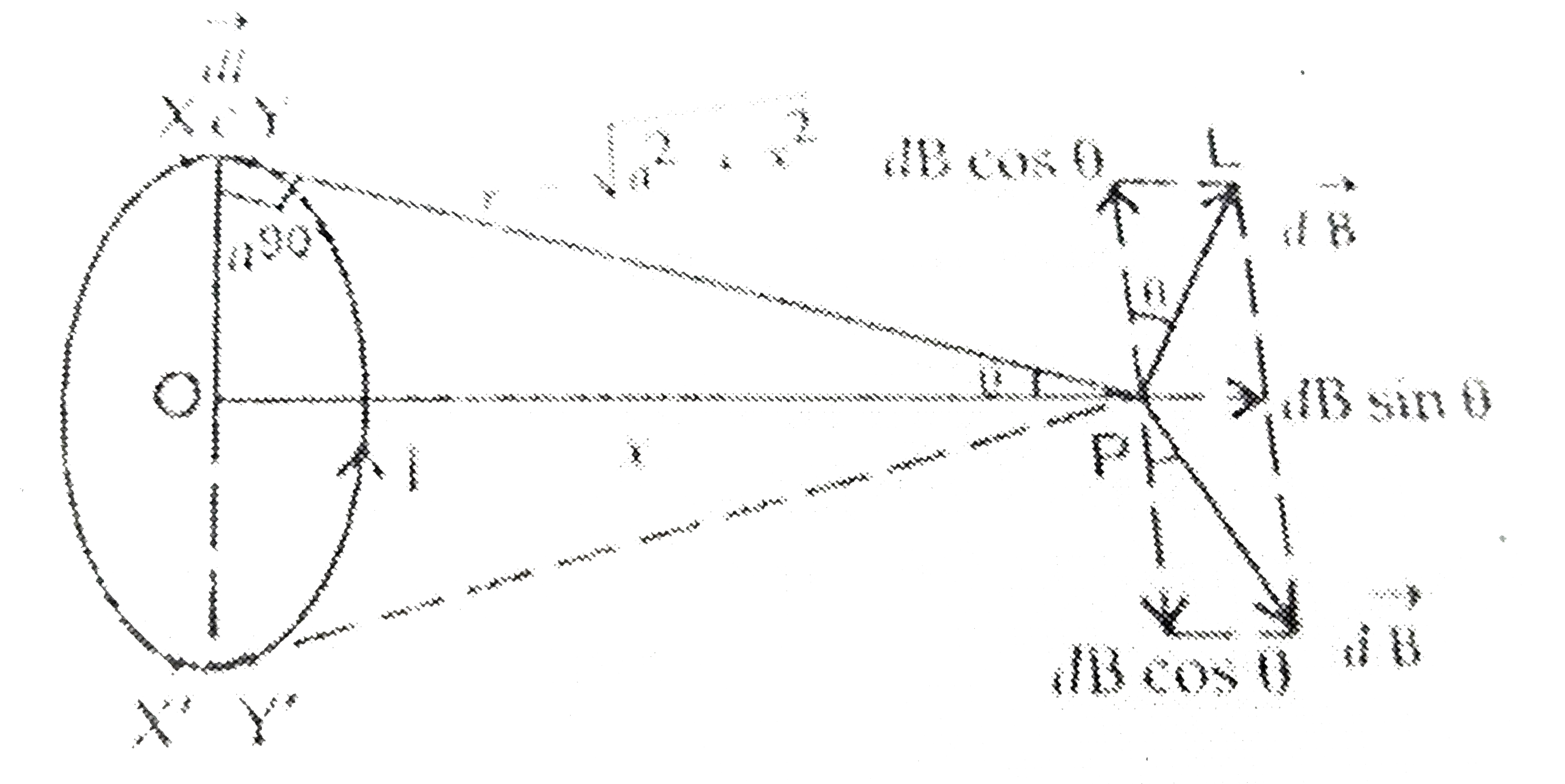 (b) Toroid is a hollow circular ring on which a large number of turns of a wire are closely wound. Figure shows a sectional view of the toroid. The direction of the magneitc field inside a clockwise as per the right-hand thumb RULE for circular loops. Three circular Amperian loops 1, 2 and 3 are shown by dashed lines. 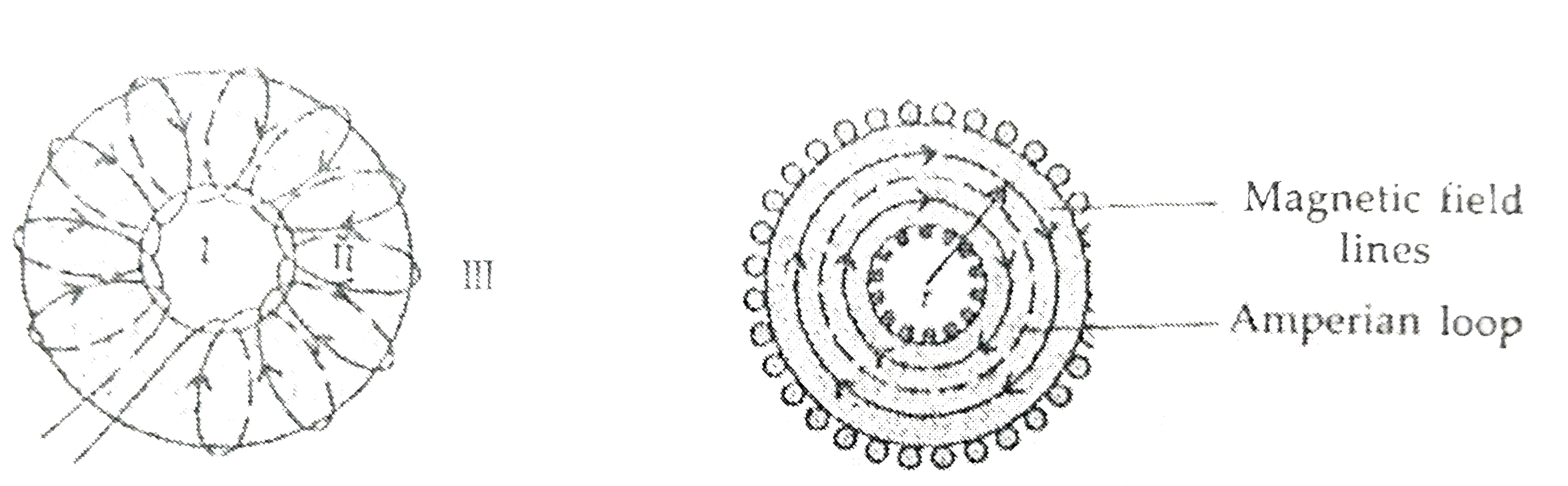 By symmetry, the magnetic field should be tangential to each of them and constant in magnitude for a given loop. Let the magnetic field inside the toroid be B. We shall now consider the magnetic field at S. Once again we employ Ampere's Law in the form of `oint vec(B).vec(dI)=mu_(0)I` `BL = mu_(0)NI` where, L is the length of the loop for which B is tangential, I be the current enclosed by the loop and N be the number of turns. We FIND, `""L = 2 pi r` The current enclose I is NI. `B (2 pi r) = mu_(0)NI`, therefore, `""B = (mu_(0)NI)/(2 pi r)` Open space inside the toroid encloses no current thus, I = O Hence, `""B = O` Open space exterior to the toroid - Each turn of current wire is cut twice by the loop 3. Thus, the current coming out of the plane of the paper is cancelled exactly by the current going into it . Thus, `I = O,""and""B = O` |
|
| 12. |
A body is allowed to fall on the ground from a height h_1. If it is to rebound to a height h_2,then the coefficient of restitution is |
|
Answer» (A) `h_2/h_1` |
|
| 13. |
Diameter of a plano-convex lens is 6 cm and thickness at the centre is 3 mm. If speed of light in material of lens is 2 xx 10^8 m/s., the focal length of the lens is ...... |
|
Answer» 15 cm `=(3xx10^ 8)/(2xx10^8)=3/2` `THEREFORE n=1.5` (2) From right angle TRIANGLE, `R^2=(R-0.3)^2+(3)^2` `therefore R^2=R^2-0.6R+0.09+9` `therefore0.6R=9.09 therefore R=15.15" cm "therefore R=15` cm (3) From lens maker.s formula, `1/f=(n-1)((1)/(R_1)-(1)/(R_2))` `1/f=(1.5-1)((1)/(INFTY)-(1)/(-15))` `therefore 1/f=1/2xx(1)/(15)=(1)/(30)" "therefore` f=30 cm 
|
|
| 14. |
Through which characteristic phenomenon we can distinguish the light waves from sound waves ? |
|
Answer» Interference |
|
| 15. |
What is Fraunhofer diffraction ? |
| Answer» Solution :In Fraunhofer diffraction, both the source and the SCREEN are the infinite distances from the aperture. This is achieved by PLACING the source at the FOCUS of a convex lens and the screen at the FOCAL PLANE of another convex lens. | |
| 16. |
For a small angled prism, angle of minimum deviationprism as shown in the graph |
|
Answer» <P> Point p CORRESPONDS to `mu=1` |
|
| 17. |
A thick rope of density p and length L is hung from a rigid support. The increase in lens of the rope due to its own weight is (Y is the Young's modulus). |
|
Answer» `1/(4Y)pL^(2)g` `THEREFORE` Only half the length of wire gets extended. Now Y`=F/A.((L//2))/(Deltal)rArrDeltal=(ALpgL)/(2AY)` `thereforeDeltal=(pL^(2)g)/(2Y)` So the correct choice is (B). |
|
| 18. |
Period of a wave . |
| Answer» Solution :Periodof a wave is defined as the TIME taken by a COMPLETE wave ( one wavelength LONG ) to pass a given POINT in the medium . | |
| 19. |
The capacitance of a variable capacitor joined with a battery of 100 V is changed from 2muF to 10 mu F. What is the change in the energy stored in it ? |
|
Answer» `2xx10^(2) J` `U_(1)= (1)/(2) xx2xx10^(-6)xx(100)^(2) =10^(-2)` J The energy stored in capacitor of `10 mu F ` `U_(2) = (1)/(2)xx10xx10^(-6)xx(100)^(2)` `U_(2) = 5xx10^(-2)` J `:.` The change in stored energy `U = U_(2)-U_(1)= 5xx10^(-2) - 1 xx10^(-2)` `:. U = 4xx10^(-2) `J |
|
| 20. |
Assertion (A) : Silicon is prefened over germanium for making semiconductor devices. Reason (R) : The energy gap for germanium is more than the energy gap of silicon. |
| Answer» Solution :Silicon is preferred over germanium for MAKING semiconductor devices from OPERATIONAL characteristics and reliability factor. The FORBIDDEN ENERGY gap for germanium (e.g. =0.7 eV) is less than that for silicon (e.g. = 1.1 eV). | |
| 21. |
How does the polarised cliclectric morufy the original external field inside it ? |
|
Answer» Solution :When POLAR or non-polar molecules placed in an external electric field a dielectric develops a net dipole moment. The dipole moment per unit volume is called polarisation and is denoted by `vecP` . For linear isotropic dielectrics , `vecPprop VECE` `:. vecP = chi_(e)` is a constant CHARACTERISTIC of the dielectric and is known as the electric susceptibility of the dielectric medium. 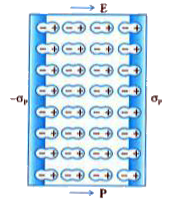 Consider a rectangular dielectric slab placed in a uniform external field `vecE_(0)` parallel to two of its faces as shown in figure. Titis field causes a uniform polarlzation`vecP` of the dielectric . Every volume element `DeltaV` of the slab has a dipole moment `vecP Delta` V in the direction of the field . The volume element AV is macroscopically small but contains a very large number of molecular dipoles. It has no net charge (Total charge on dipole is zero) but has net dipole moment. Because, the posldve charge of one dipole sits close to the negative charge of the adjacent dipole in rectangular slab. HOWEVER at the surfaces of the dielectric normal to the electric field there is a net charge DENSITY. In figure, the unbalanced charges are the induced charges due to the external field. Thus the polarized dielectric is equivalent to two charged surfaces with induced surface charge densities `sigma` and `sigma_(p)` . The field produced by these surface charges opposes the external field hence the total electric field `E_(0)` in the dielectric is reduced. The surface charge density `pm sigma_(p)` arises from bound charges but not by free charges in the dielectric. |
|
| 22. |
Passage : In the circuit shown in figure : Current through R_(2) is zero if R_(4)=2 Omega and R_(3)= 4 Omega. In this case : |
|
Answer» CURRENT through `R_(3)` is 2A |
|
| 23. |
An electron is moving with an initial velocity vecv=v_(0)hati and is in a magnetic field vecB=vecB_(0)hatj. Then its de-Broglie wavelength |
|
Answer» remains constant |
|
| 24. |
Two wires are fixed in a sanometer. Their tension are in the ratio 8:1 The lengths are in the ratio 36:35 The diameter are in the ratio 4:1 Densities of the materials are in the ratio 1:2 if the lower frequency in the setting is 360Hz. The beat frequency when the two wires are sounded together is |
|
Answer» |
|
| 25. |
Explain the phenomena of total internal reflection in right angle prism. |
Answer» SOLUTION :Prisms designed to bend light by `90^@` or by `180^@` make use of TOTAL internal reflection figure (a) and (b). In the first two cases, the critical angle `i_c` for the material of the prism MUST be less than `45^@`. Such a prism is also used to invert images without changing their SIZE figure (c). 
|
|
| 26. |
What is the diameter of sphere of 4V potential kept near the points situated at same distance from an electron ? |
|
Answer» `14.4 A^(@)` `:. r=(ke)/(V)` ( Electric charge ) `:. 2r = (2ke)/(V) = (2xx9xx10^(9)xx1.6xx10^(-19))/(4)` `:. "Radius " = 7.2 xx10^(10)m = 7.2 A^(@)` |
|
| 27. |
State the formulae for the frequency N of a tuning fork in Melde's experiment (i) in perpendicular position and (ii) in paraller position, if L is the vibrating length of the string having linear density m and under tension T. |
|
Answer» SOLUTION :The FREQUENCY of the tuning FORK. `N=n'=(p')/(2L)sqrt(T/m)` (perpendicular POSITION) `N=2n=p/Lsqrt(T/m)` (PARALLEL position) where n and n `-=` the frequencies of the string in the perpendicular and parallel positions, respectively, p and p are the corresponding number of loops of the stationary waves on the string. |
|
| 28. |
What is dispersion by a prism ? |
| Answer» SOLUTION :The separation of COLOURS DUE to refraction is called DISPERSION. | |
| 29. |
Consider the LCR circuit shown in Fig. Find the net current I and the phse of i. show that i= (upsilon)/(Z) . Find the impedence Z for this circuit. |
|
Answer» Solution :In Fig. let i. be the total current form the source. It is divided into two parts : `i_(1)` through R and `i_(2)` through series combination of C and L, such that `i= i_(1) + i_(2)`. As `R i_(1) = upsilon_(m) sin omega t, i_(1) = (upsilon_(m) sin omega t)/(R )` If `q_(2)` is charge on C at time t, then for series combination of C and L, `(q_(2))/(C ) + (dq_(2)^(2))/(DT^(2)) = upsilon_(m) omega t` Let `q_(2) = q_(m) sin (omega t + phi)` `:. (dq_(2))/(dt) = q_(m) omega cos (omega t + phi)` and `(d^(2) q_(2))/(dt) = - q_(m) omega^(2) sin (omega t + phi)` Putting in (ii), we get `q_(m) [(1)/(C ) = L omega^(2)] sin (omega t + phi) - upsilon_(m) sin omega t` If `phi = 0` and `((1)/(C ) - L omega^(2)) gt 0`, then `q_(m) = (upsilon_(m))/(((1)/(C ) - L omega^(2)))` From (iii), `i_(2) = (dq_(2))/(dt) = omega q_(m) cos (omega t + phi)` , using (iv), `i_(2) = (omega upsilon_(m) cos (omega t + phi))/((1)/(C ) - L omega^(2))` Taking `phi = 0`,`i_(2) = (upsilon_(m) cos (omega t))/(((1)/(omega C) - L omega))` From (i) and (v), we FIND that `i_(1)` and `i_(2)` are out of phase. Now, `i_(1) + i_(2) = (upsilon_(m) sin omega t)/(R ) + (upsilon_(m) cos omega t)/(((1)/(omega C) - L omega))` PUT `(upsilon_(m))/(R ) = A = C cos phi` and `(upsilon_(m))/(((1)/(omega C) - L omega)) = B = C sin phi` `:. i_(1) + i_(2) = C cos phi sin OMEG t + C sin phi cos omega t = C sin (omega t = phi)` Where `C = sqrt(A^(2) + B^(2))`and`phi = tan^(-1) ((B)/(A))` `C = [(upsilon_(m)^(2))/(R^(2)) + (upsilon_(m)^(2))/((1)/(omega C) - L omega)^(2) ]^(1//2)` and `phi (tan^(-1)) (R )/(((1)/(omega C) - L omega))` Hence, `i= i_(1) + i_(2) = [(upsilon_(m)^(2))/(R^(2)) + (upsilon_(m)^(2))/(((1)/(omega C) - L omega)^(2))]^(1//2) sin (omega t + phi)` or `(i)/(upsilon_(m)) = (1)/(Z) = [(1)/(R^(2)) = (1)/(((1)/(omega C) - L omega)^(2))]^(1//2)` This is the expression for impedance Z of the circuit. |
|
| 30. |
Calculate the number of electrons in one coulomb of negative charge. |
|
Answer» SOLUTION :According to the quantisation of charge q = ne Here q = 1 C . So the number of electrons in 1 coulomb of charge is `N=(q)/( E) = (1C)/(1.6xx10^(-19))= 6.25xx10^(18)` electrons. |
|
| 31. |
In experiment aimed to disprove Einstein's equation how millikan proved Einstein's equation? |
|
Answer» Solution :Einstein.s equation of photoelectric effect `(1)/(2)mv_(max)^(2)=v-phi0` but `(1)/(2)mv_(max)^(2)=eV_(0)` Where `V_(0)` is stopping potential `therefore eV_(0)=hv-phi0` `therefore V_(0)=((h)/(e))v-(phi0)/(e )` `therefore` above equation is similar to equation of straight line y=mx+c.  Here graph of `V_(0)tov` is straight line .`(h)/(e)` is slope of the graph which does not depend on material used. MILLIKAN MADE series of experiments and obtain slope of `V_(0)tov` graph.He obtained VALUE of slope and from that by using known value of charge of ELECTRON he obtained value of h`=6.626xx10^(-34)` Js which was known vlaue. Thus ,in attempt on disprove Einstein.s equation Millikan indirectly proved its validity. Millikan made experiment on number of alkali metals for large range of incident radiation and varified phtoelectric equation with great precision. |
|
| 32. |
A square of side LM lies in the xy plane in a region, when the magnetic field is given by vecB=B_0(2 hat i+3 hat j+4 hatk) T where B_0is constant. The magnitude of flux passing through the square is …..Wb. |
|
Answer» `2B_0L^2` `THEREFORE phi=vecA.vecB=L^2hatk.[B_0(2hati+3hatj+4hatk)]` `=B_0L^2(0+0+4)` `=4B_0L^2` |
|
| 33. |
On the basis of power dissipation in a.c. circuit, distinguish between resistance, reactance and impedance? |
|
Answer» SOLUTION :Power dissipation is maximum across a RESISTANCE Power dissipation across Z depends on power FACTOR cos `PHI` in accordance with the relation `p_(dc) = V_(rms) I_(rms) XX cos phi` |
|
| 34. |
The senstivity of a galvanometer that measures current is decreased by 1/40 times by using shunt resistance of 10Omega . Then, the value of the resistance of the galvanometer is |
|
Answer» `400OMEGA` |
|
| 35. |
A force of 1 N acts on a body of mass 0.5 kg initially at rest. The ratio of the works done by the force in the first, second and third second is : |
|
Answer» 1:2:3 Also`a=1//0.5=2 ms^(-2)` VELOCITY after one second `v_1=0+2xx1=2 ms^(-1)` Similarly`v_2=0+2xx2=4 ms^(-1)` `v_3=0+2xx3=6 ms^(-1)` Change in K.E. after 1 second `E_1=1/2xx0.5(4-0)=1 J` Similarly `E_2=1/2xx0.5(16-4)=3J` `E_3=1/2xx0.5(36-16)=5 J` Now work done = Change in K.E. `:.` Required RATIO for FIRST three second will be `E_1:E_2:E_3` or `1:3:5` |
|
| 36. |
Two coils of self inductance L_(1)and L_(2) are connected byin parlleland the thento cell ofemf epsilon and of resistance R throughta Key . Findthe instantaneous currentthroughtL after thekeyis closed . |
|
Answer» |
|
| 37. |
Explain the formation of PN junction diode. Discuss its V - I characteristics. |
|
Answer» Solution :A p-n JUNCTION diode is formed when a p-type semiconductor is fused with an-type semiconductor. It is a device with single p-n junction . The external voltage applied to the p - n junction is called bias voltage Depending on the polarity of the external source to the p -n junction , two types of biasing : (1) . Forward bias (2) Reverse bias 1. Forward bias : (i) If the positive terminal of the external voltage source is connected to the p - side and the negative terminal to the n - side , it is called forward biased. (ii) The application of a forward bias potential makes the electrons move into the n - side and the holes into the p - side. (iii) This initiates the recombination with the ions near the junction which in turn reduces the width of the depletion region and hence the barrier potential . (iv) The electron from the n - side is now accelerated towards the p - side as it EXPERIENCES a reduced barrier potential at the junction. (v) In addition, the accelerated electrons experience a strong attraction by the positive potential applied to the p - side. (vi) This results in the movement of electrons towards the p - side and in turn , holes towards the n - side. (vii) When the applied voltage is increased , the width of the depletion region and hence the barrier potential are further reduced. (viii) This results in a large number of electrons passing through the junction resulting in and exponential rise in current through the junction.  (2) Reverse Bias : (i) If the positive terminal of the battery is connected to the n - side and the negative potential to the p - side , the junction is said to be reverse biased shown in Figure.  (ii) As the positive potential is connected to the n-type material , the electrons in the n-type material are attracted towards the positive terminal in turn , the holes in the p - type material move towards the negative terminal (both away from the junction). (iii) It increases the immobile ions at the junction . The net effect is the widening of the depletion region . This leads to an increase in the barrier potential Consequently, the majority charge carriers from both sides experience a great barrier to cross the junction. (iv) This reduces the diffusion current across the junction effectively . Yet , a small current flows across the junction due to the minority charge carriers in both REGIONS. (v) The reverse bias for majority charge carriers serves as the forward bias for minority charge carriers. (vi) The current that flows under a reverse bias is called the reverse saturation current . It is represented as I. (vii) The reverse saturation current is independent of the applied voltage and is depended only on the thermally generated minority charge carriers. Even a small voltage is sufficient enough to drive the minority charge carriers across the junction. Characteristics of a junction diode : (i) It is the study of the variation in current through the diode with respect to the applied voltage across the diode when it is forward biased. (ii) An external resistance (R) is used to limit the flow of current through the diode . (iii) The voltage across the diode is varied by varying the biasing voltage across the dc power supply. (iv) A graph is plotted by taking the forward bias voltage (V) along the x- axis and the current (I) through the diode along the y- axis. (v) Three inferences can be brought out from the graph: (a) At room temperature , a potential difference equal to the barrier potential is required before a reasonable forward current starts flowing across the diode. This voltage is known as threshold voltage or cut - in voltage or knee voltage `(V_(th))` . It is approximately 0.3 V for Germanium and 0.7 V for Silicon . The current flow is negligible when the applied voltage is less than the threshold voltage . Beyond the threshold voltage , increase in currentis significant even for a small increase in voltage. (b) The current flow is not linear and is exponential . Hence it does not obey Ohm's law. (c) The forward resistance `(r_(f))`of the diode is the ratio of the small change in voltage `(DeltaV)` to the small change in current `(DELTAI` `(r_(f)=(DeltaV)/(DeltaI))` (d) Thus the diode behaves as a conductor when it is forward biased . However , if the applied voltage is increased beyond a rated VALUE, it will produce an extremely large current which may destroy the junction due to overheating . This is called as the breakdown of the diode and the voltage at which the diode breaks down is called the breakdown voltage. Reverse characteristics : (i) The p - region of the diode is connected to the negative terminal of the dc power supply. (ii) A graph is drawn between the reverse bias voltage and the current across the junction, which is called the reverse characteristics of a p -n junction diode. It is shown in Figure. (iii) Under this bias , a very small current in `muA` , flows across the junction . This is due to the flow of the minority charge carriers called the leakage current or reverse saturation current . Besides , the current is almost independent of the voltage . The reverse bias voltage can be increased only up to the rated value otherwise the diode will enter into the breakdown region. 
|
|
| 38. |
(i) InYoung'sdoubleslitexperimentthe conditionfor (a)constructive and (b )destructiveinterferenceat apointon thescreen. Drawagraphshowingvariationof intensity in theinterferencepatternagainstposition'x'on the screen . (ii)Comparetheinterferencepatternobservedin Young'sdoublesiltexperiment withsingleslitdiffractionpatternpointing outthreedistinguishingfeatures. |
Answer» Solution : (B ) 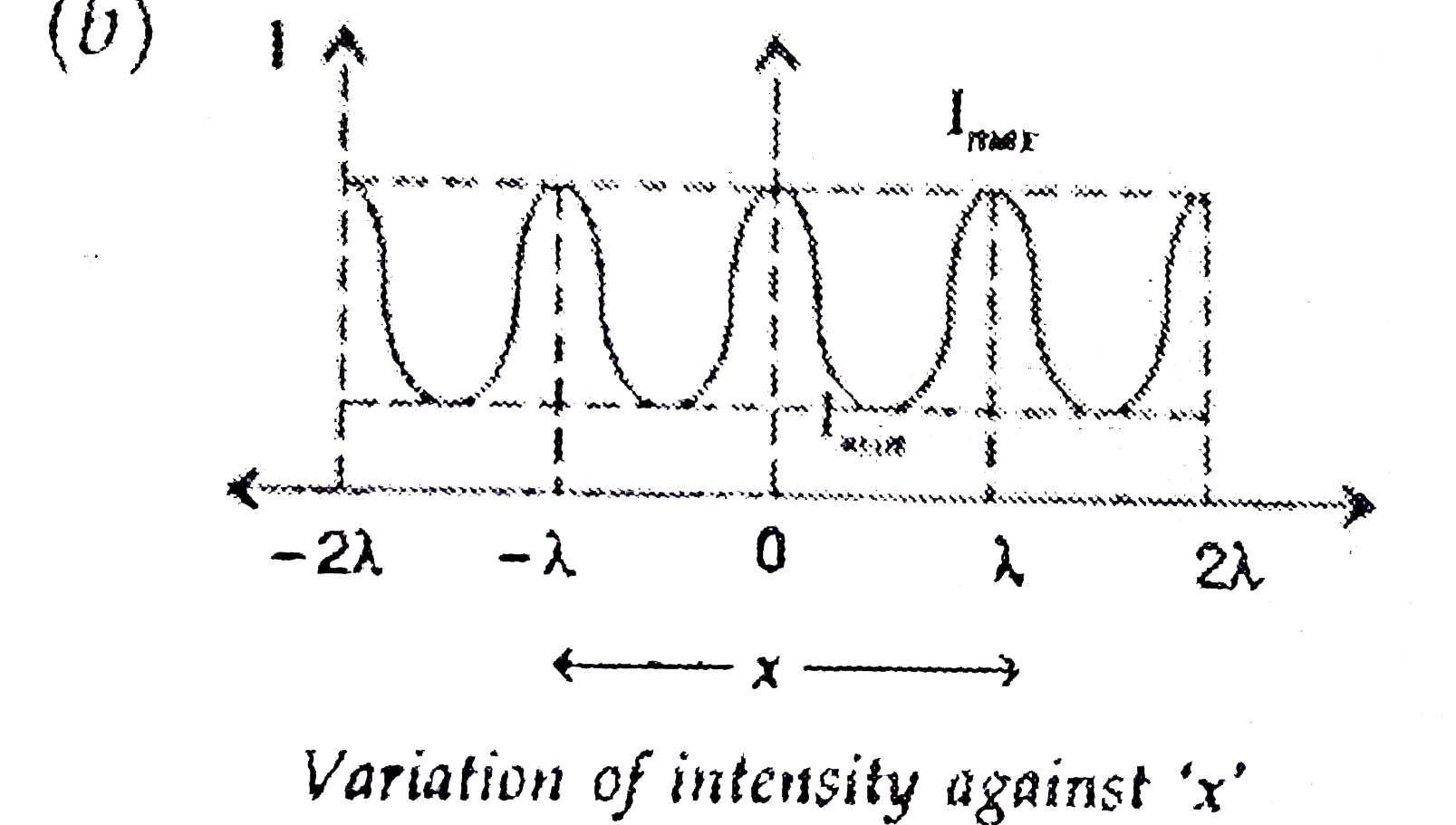 (II)In interferenceallmaximas areof sameintensitywhileindiffractioncentralmaxima HASMAXIMUM INTENSITY andthenintensityfalls forsecondarymaximas . Alsoin interferenceall FRINGES are ofequalwidthwhilein diffractioncentralfringe is twice in width |
|
| 40. |
Which of following quantities remains constant in transformer ? |
|
Answer» Frequency |
|
| 41. |
(a) If the maximum acceleration that is tolerable for passengers in a subway train is 1.34 m//s^(2) and subway stations are located 806 m apart, what is the maximum speed a subway tran can attain between stations ? (b)What is the travel time between stations ? (c) If a subway train stops for 20 s at each station, what is the maximum average speed of the train, from one start-up to the next ? (d) Graph x, v, and a versus t for the interval from one start-up to the next. |
|
Answer» SOLUTION :KEYIDEA We assume the train accelerates from rest ( `v_(0)=0` and `x_(0)=0`) at `a_(1)= +1.34 m//s^(2)` until the midway point and then deceleration at `a_(1)= -1.34 m//s^(2)` until it comes to a stop `(v_(2)=0)` at the next station. The velocity at the midpoiint is `v_(1)` , which occurs at `x_(1) = 806//2=403` m. Calculations : (a) Equation 2-16 leads to `v_(1)^(2) = v_(0)^(2) + 2a_(1)x_(1) rArr v_(1) = SQRT(2(1.34 m//s^(2))(403m))` ` = 32.9 m//s`. (b) The time `t_(1)` for the accelerating stage is ( using Eq. 2-15) `x_(1) = v_(0)t_(1) = 1/2 a_(1) t_(1)^(2) rArr t_(1) = sqrt((2(403m))/(1.34 m//s^(2)))=24.53s`. Since the time INTERVAL for the decelerating stage turns out to be the same, we double this result and obtain `t=49.1`s for the travel time between stations. (c) With a " dead time" of 20s, we have `T = t+20 = 69.1s` for the total time between start-ups. Thus, Eq. 2-2 gives `v_("avg") = (806 m)/(69.1 s) = 11.7 m//s`. (d) The graphs for x, v and a as a FUNCTION of t are shown below. The third graph , a(t), consists of three horizontal "steps" - one at `1.34 m//s^(2)` during `0 lt t lt 24.53`s, and the next at `-1.34 m//s^(2)` during `24.53 s lt t lt 49.1` s and the last at zero during the " dead time" `49.1 s lt 1 lt 69.1 s)`. 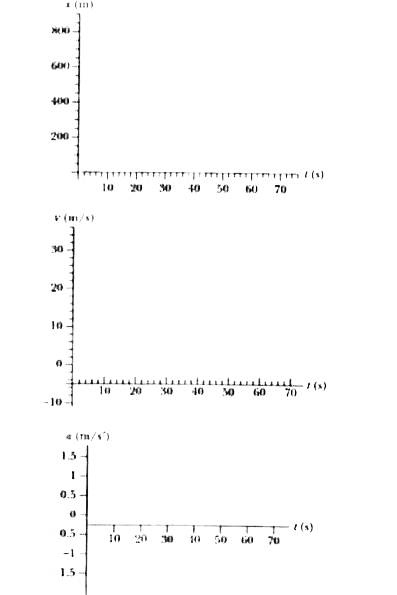
|
|
| 42. |
The output of an OR gate is connected to both the inputs of a NAND gate. The combination will serve as a : |
|
Answer» NOT gate When both INPUTS of NAND gate are connected , it BEHAVES as NOT gate OR + NOT = NOR . |
|
| 43. |
A proton and deutron are accelerated through the same accelerating potential. Which one of the two has (a) greater value of de-broglie wavelength associated with it, and(b) less momentum? Give reasons to justify your answer. |
|
Answer» Solution :de Broglie WAVELENGTH, `lambda=h/sqrt(2mqV)` Here V same for proton and DEUTRON. As mass of proton < mass of deutron and `q_p = q_d`.Therefore, `lambda_p > lambda_d` for same accelerating potential. |
|
| 44. |
In the YDSE the monochromatic source of wavelength lambda is placed at a distance (d)/(2) from the central axis (as shown in the figure), where d is the separation between two slits S_(1) and S_(2). Find the position of the central maxima. (Given d = 6 mm) |
|
Answer» |
|
| 45. |
If f is focal length and v is image distance for spherical mirror, then beteral magnification m = ….... |
|
Answer» `(F)/(f+v)` `1/f=1/u+1/v IMPLIES 1/u=1/f-1/v` `implies 1/u=(v-f)/(FV)` `THEREFORE v/u=(v-f)/(f)" "therefore m=-((v-f)/(f))=(f-v)/(f)` |
|
| 46. |
Answer the following questions: (b) In what way is diffraction from each slit related to the interference pattern in a double-slit experiment? |
| Answer» SOLUTION :The intensity of interference fringes in a double-slit ARRANGEMENT is modulated by the DIFFRACTION PATTERN of each slit. | |
| 47. |
The electric field in the region of the space is vecE = (5hati + 2hatj + 3hatk)NC^(-1). The electric flux passing through a surface of area 50m^2 placed in X-Y plane inside the electric field is....... |
|
Answer» 250 `Nm^(2)C^(-1)` `therefore phi=vecE.vecA` `=(5hati + 2hatj + 3hatk).50hatk =150 Nm^(2)C^(-1)` |
|
| 48. |
A wire-density 9 xx 10^3kg//m^3is stretched between two clamps 1m apart and is stretched to anextension of 4.9xx10^(-4) metre. Young's modulus of material is 9xx10^10 N//m^2transversal standing wave is setup. Then |
|
Answer» The LOWEST FREQUENCY of standing wave is 35 HZ |
|
| 49. |
The frequency of oscillation of a certain LC circuit is 200 kHz. At time t = 0, plate A of the capacitor has maximum positive charge. At what earliest time t > 0 will (a) plate A again have maximum positive charge, (b) the other plate of the capacitor have maximum positive charge, and (c) the inductor have maximum magnetic field? |
|
Answer» |
|
| 50. |
A magnetic needle lying parallel to a magnetic field requires W units of work to turn it through 60^@ . The torque required to maintain the needle in this position will be |
|
Answer» `SQRT3 ` W W= mB`[cos 0^@ - cos 60^@ ] = -(mB)/(2)` Torque required to MAINTAIN magnetic needle at `theta = 60^@ ` will be `tau = mB sin 60^@ = (mBsqrt3)/(2)` Hence `|tau|= sqrt3 |W|` |
|