

Saved Bookmarks
This section includes 7 InterviewSolutions, each offering curated multiple-choice questions to sharpen your Current Affairs knowledge and support exam preparation. Choose a topic below to get started.
| 1. |
Three resistances P, Q, R each of 2 12 and an unknown resistance S form the four arms of aWheatstone bridge circuit. When a resistance of 6Omegais connected in parallel to S, the bridge gets balanced. What is the value of S? |
|
Answer» `3Omega` ` therefore ` Resultant resistance of parallel COMBINATION of`S Omega` and 6 `Omega`is `2Omega i.e.,1/2 = 1/S+ 1/6rArr S = 3 Omega` |
|
| 2. |
A lift is moving upwards with a uniform velocity v in which a block of mass m is lying: The frictional force offered by the blockwhen the coefficient of friction is mu will be |
|
Answer» zero |
|
| 3. |
A gas is a mixture of two parts by volume of hydrogen and one part by volume of nitrogen. If the velocity of sound in hydrogen at 0^@Cis 1300 m/s. The velocity of sound in the gaseous mixture at 27^@C is 325sqrtxm//s . Find x |
|
Answer» |
|
| 4. |
A particle is simultaneously acted upon two forces equal to 4 N and 3 N. the net force on the particle is |
| Answer» Answer :D | |
| 5. |
Estimate the dimensions of a hydrogen atom in the nonexcited state, regarding it as an oscillator and assuming the zero-point energy of oscillations to be equal to the kinetic energy of the electron on the first orbit. |
Answer»  force to be of the Coulomb type and the amplitude to be equal to the radius, we obtain `omega=sqrt(e^(2)/(4piepsi_(0)m_(e)r^(3)))` Putting `K=epsi_(0)` and substituting the circular frequency, we obtain after some simple transformations `r=(4piepsi_(0)h)/(e^(2)m_(e))` Despite certain arbitrary ASSUMPTIONS, we have obtained a correct expression for the first Bohr radius. |
|
| 6. |
Which device is used to increase or decrease A.C. voltage ? |
|
Answer» Oscillator |
|
| 7. |
How can we write electric field intensity for small dipole at a point on its perpendicular bisector in vector form? |
| Answer» SOLUTION :`vecE=-(1/(4piepsilon_0) vecp/r^3)` , the direction of ELECTRIC field in opposite to DIPOLE MOMENT. | |
| 8. |
A mixture of light consisting of wavelength 590 nm and an unknown wavelength, illuminates Young's double slit and gives rise to two overlapping interface patterns on the screen. The central maximum of both light coincide. Further it is observed that the third bright fringe of known light coincides with the 4^(th) bright fringe of the unknown light. From this data, the wavelength of the unknown light is |
|
Answer» `393.4` nm `:.x_(1)barX_(1)=n_(2)barX_(2)` `:.n_(1)(lambda_(1)D)/(d)=n_(2)=(lambda_(2)D)/(d)` `:.n_(1)lambda_(1)=n_(2)lambda_(2)` `:. lambda_(2)=lambda_(1)(n_(1))/(n_(2))=590xx10(-9)xx(3)/(4)` `=442.5xx10^(-9)m` `=442.5 nm` |
|
| 9. |
A plane mirror is made of glass having thickness 1.5 cm. its back surface is coated with mercury. A man is standing at a distance of 50 cm from the front face of the mirror. If he looks at the mirror normally, where can he find his image behind the front face of the mirror? Refractive index of glass = 1.5. |
|
Answer» Solution :Real DEPTH of the mercury coated surface from the UPPER surface of the mirror = 1.5 CM If the apparent depth of the mercury coated surface is x cm, then `(1.5)/(x) = 1.5 or, x = 1cm` So the mercury coated surface APPEARS to be at a distance of 1 cm from the front face to the mirror. Therefore, the distance of the MAN from the apparent position of the mercury coated surface = 50 + 1 = 51 cm So the distance of the image from the apparent position of the mercury coated surface = 51 cm `therefore` The distance of the image of the man from the front surface of the mirror = 51 + 1 52cm. |
|
| 10. |
Three conducting plates, each of area A are connected as shown in figure: Correct options are |
|
Answer» If the middle plate can be MOVED (charging the value of `d_(1) and d_(2)` ), the minimum capacitanewill be `(4epsilon_0A)/(d_1+d_2)` |
|
| 11. |
The width od the depletion region in p - n junction diode is |
|
Answer» INCREASED by reverse bias |
|
| 12. |
A message signal of frequency 10 kHz and peak voltage of 10 volts is used to modulate a carrier of frequency 1 MHz and peak voltage of 20 volts . Determine (a) modulation index , (b) the side bands produced . |
|
Answer» Solution :(a) MODULATION index= `10//20= 0.5` (b) The SIDE bands are at `(1000 + 10) kHz= 1010 kHz` and (1000-10 kHz) = 990 kHz. Ave frequency. |
|
| 13. |
The length of potentiometer wire is 200 cm and the emf of standard cell is primary circuit is E volts. It is employed to a battery of emf 0.4 v the balance point is obtained at l = 40 cm from positive end, the E of the battery is (cell in primary is ideal and series resistance is zone |
|
Answer» 4v |
|
| 14. |
Discuss diffraction at single slit and obtain the consition for n^(th) minimum. Diffraction at single slit: |
|
Answer» Solution :(i) Let a parallel beam of light fall normally on a single slit AB of width. The diffracted beam falls on a screen kept at a distance. The center of the slit is G. (ii) A straight line through C perpendicular ll to the plane of slit meets the center of the screen at O. The intensity at any point P on the screen is to be found. (iii) The lines joining P to the different points on the slit can be treated as parallel lines, making an angle 8 with the normal CO. (iv) All the waves start parallel to each other. from different points of the slit and interfere at point P and other points to give the resultant intensities. (v) The point P is in the geometrically shadowed region, up to which the central maximum is spread due to diffraction. Condition for the point P to be of various minima. (vi) Divide the slit into much smaller even number of parts. Then, add their contributions at P with the proper path difference to show that destructive interference takes place at that point to make it minimum. 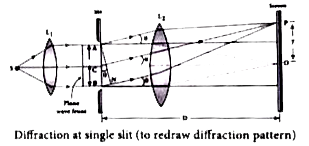 Condition for P to be first minimum : (i) Let us divide the slit AB into two half.s AC and CB. Now the width of AC is`(a/2)`. We have different points on the slit which are separated by the same width (here `a/2`) CALLED corresponding points as shown in FIGURE. 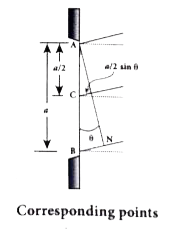 (ii) The path difference of light waves from different corresponding points meeting at point P and interfere destructively to make it first minimum. The path difference `delta`between waves from these corresponding points is, `delta = a/2 sin THETA` The condition for P to be first MINIUM, `a/2 sin theta = lamda/2` `a sin theta = lamda ` ( first minimum ) Condition for P to be second minimum : (i) Let us divide the slit AB into four equal parts. Now, the width of each part is `a/4`We have several corresponding points on the slit which are separated by the same width `a/4`. The path difference 8 between waves from these corresponding points is, `delta = a/4 sin theta`. `a sin theta = 2 lamda` ( second minimum ) Condition for P to be `N^(th)` order minimum : The same way the slit is divided in to six equal parts to explain the condition for P to be third minimum is, `a/(2n)sin theta lamda/2` `a sin theta = n lamda `(`n^(th)` minium ) |
|
| 15. |
In a common emitter amplifier output resistance is 5000 ohm and input resistance is 2000 ohm. If peak value of signal voltage is 10 mVand beta = 50 , then the peak value of output voltage is : |
|
Answer» `5xx 10^(-6)` VOLT Hence `A_v = beta xx R_0//R_i=50xx5000//2000=125` `DeltaV_e=A_vxx DeltaV_b=125xx10mV = 125 V` |
|
| 16. |
Figure shows four Gaussion surfaces consisting of identical cylindrical midsections but different end caps. The surfaces central axis of each . Cylindrical midsection , the end caps have these shapes, S_(1) convex hemispheres S_(2) concave hermisphere S_(3)cones S_(4)e flat disks. rank the surfaces acccordingto (a) the net electric flux through them and (b) the electric flux through the top end caps , greatest first. |
|
Answer» net FLUX through all the four Gaussian surface will be EQUAL |
|
| 17. |
What energy is required to extract a neutron from a carbon nucleus with mass number 13? |
|
Answer» `Deltaepsi=(12.00000+1.00867-13.00335)xx931.5=4.96MeV` |
|
| 18. |
Is the magnetic field influenced by the medium in which the conductor is placed? |
| Answer» SOLUTION :YES. The magnetic permeability MODIFIES the FIELD strength `(dBprop mu_1) ` | |
| 19. |
In a Ruby laser , the colour of laser light is due to ………… atom . |
|
Answer» oxygen |
|
| 21. |
How it is propagated? |
| Answer» Solution :Log distance radio communication in low frequency range is ESTABLISHED throughh GROUND wave PROPAGATION parallel to the surface of earth without attenuation. Such TYPE of propagation are possible during day and night. | |
| 22. |
Explain recombination coefficient of intrinsic semiconductor and obtain the relation n_(i)^(2)=n_(e )n_(h). |
|
Answer» Solution :Giving the energy to the SEMICONDUCTOR the CREATION of electron hole pair due to the migration of the electron to the conduction band is not a very stable situation. The electrons and holes colloid with each other as per the law of thermodynamics and the temperature. The electron one again occupy the hole. The creation of the electron hole pair and recombination process takes place at the same time. In thermal equilibrium position the RATE electron hole pair FORMATION and the recombination is equal. Recombination rate `prop n_(e ) n_(h)` where `n_(e )` and `n_(h)` are electron and hole number densities respectively. `therefore` The recombination rate `=Rn_(e )n_(h)` where Ris known as the recombination coefficient. For intrinsic conductor `n_(e )=n_(h)=n_(i)` `therefore` Recombination rate `Rn_(i)^(2)` In thermal equilibrium, `Rn_(i)^(2)=Rn_(e )n_(h)` `therefore n_(i)^(2)=n_(e )n_(h)` |
|
| 23. |
The possible quantum number for 3 d electron are |
|
Answer» `n = 3, l = 1, m_(1) = +1, m_(s) = - (1)/(2)` |
|
| 24. |
Under a constant pressure head, the rate of flow of orderly volume flow of liquid through a capillary tube is V, if the length of the capillary is doubled and the diameter of the bore is halved, the rate of flow would become |
|
Answer» `V//4` `thereforeVprop(R^(4))/l` since DIAMETER is halved so radius is ALSO halved. Also length is doubled. `thereforeV.` becomes `1/32` times V So correct choice is (d). |
|
| 25. |
The mutual inductance M_12 of coil 1 with respect to coil 2 |
|
Answer» increases when they are brought nearer. Mutual inductance does not depend on current hence, OPTION (B) is incorrect. |
|
| 26. |
In the given figure, atmospheric pressure p_0 = 1 atm and mercury column length is 9 cm. Pressure p of the gas enclosed in the tube is |
|
Answer» PRESSURE of 67 CM of Hg |
|
| 27. |
A full-wave rectifier used two diodes, the internal resistance of each diode may be assumed constant at 20Omega. The transformer r.m.s. secondary voltage from centre tap to each end of secondary is 50 V and load resistance is 980Omega Find: the mean load current |
| Answer» SOLUTION :`r_f=20Omega,R_L=980Omega`Max. a.c.voltage,`V_m=50xxsqrt2=70.7V`Max. load CURRENT,`I_m=V_m/(r_f+R_L)=(70.7V)/((20+980)OMEGA)=70.7mA`MEAN load current`I_(dc)(21M)/pi=(2xx70.7)/pi=45mA` | |
| 28. |
A full-wave rectifier used two diodes, the internal resistance of each diode may be assumed constant at 20Omega. The transformer r.m.s. secondary voltage from centre tap to each end of secondary is 50 V and load resistance is 980Omega Find: the r.m.s. value of load current |
| Answer» Solution :`r_f=20Omega,R_L=980Omega`MAX. a.c.voltage,`V_m=50xxsqrt2=70.7V`Max. LOAD CURRENT,`I_m=V_m/(r_f+R_L)=(70.7V)/((20+980)OMEGA)=70.7mA`R.M.S.value of load current is `I_(rms)=1_m/sqrt2=70.7/sqrt2=50mA` | |
| 29. |
Intensity of a sound wave depends on |
|
Answer» AMPLITUDE but not on FREQUENCY |
|
| 30. |
The forbidden gap in germanium crystal is |
|
Answer» 0.7eV |
|
| 31. |
Sn, Si and Ge have the same lattice structure . Why Sn is aconductor while Si and Ge are Semiconductor? |
| Answer» SOLUTION :SN is insulator and GE and Si are SEMICONDUCTOR | |
| 32. |
A ray of light enters a spherical drop of water of refractive index mu as shown in figure. Q. An expression of the angle between incident ray and emergent ray (angle of deviation) as shown in figure. |
|
Answer» `0^(@)` `delta=pi-2theta=pi-4alpha+2phi`. 
|
|
| 33. |
A galvanometer has a resistance of 500 ohm. It is shunted so that its sensitivity decreases by 100 times. Find the shunt resistance. |
| Answer» SOLUTION :`5.05 OMEGA` | |
| 34. |
In a Young' s experiment, two coherent sources are placed 0.90 mm apart and the fringes are observed one metre away. If it produces the second dark fringe at a distance of 1 mm from the central fringe, the wvaelength of monochormatic light used would be : |
|
Answer» `60 xx 10^(-4) cm` then `lambda = 6 xx 10^(-5)` cm. |
|
| 35. |
An audio signal given by 10 sin2 pi (1500)t is Superimposed on a carrier of 50 sin2 pi (1,00,000)t by AM technique .Determine (a)Modulation index (b)%of modulation (c )Frequency of audio signal and carrier (d)Frequency spectrum of modulated wave. |
|
Answer» Solution :(a)0,2, (B) 20% , (C )`f_(s)`=1500 HZ, `f_(c)`=1,00,000 Hz, (d)98.5 to 101.5 kHz |
|
| 36. |
A telescope is used to resolve two stars having an angular separation of 3.66 xx 10^-6 radian. What is the diameter of the objective of the telescope if monochromatic light of wavelength 6000 A is used ? |
|
Answer» 10 cm |
|
| 37. |
A bomb explodes on the moon. How long will it take for the sound to reach the earth |
|
Answer» 10 sec |
|
| 38. |
In the following list of different electromagnetic waves and its source, which one is not correct ? |
|
Answer» Gamma rays `to` decay of a radioactive nucleus |
|
| 39. |
A convex lens has 20 cm focal length in air. What is focal length in water? (Refractive index of air-water = 1.33, refractive index for air-glass = 1.5.) |
|
Answer» 39.1 CM |
|
| 40. |
The time that elapses before the body again meets the horizontal plane through the point of projection is called _____. |
|
Answer» |
|
| 41. |
What astronomical telescope contains? |
| Answer» Solution :It is used to VIEW heavenly objects SINCE inversion of their IMAGE CREATES no PROBLEM. | |
| 42. |
Mark out the correct statement with respect to thermal radiations emitted by a black body |
|
Answer» At a given temperature, , energy is distributed NON - uniformly among different wavelengths |
|
| 43. |
A body of capacity 4u Fis charged to 80V and another body of capacity 6 mu F is charged to 30V. When they are connected the energy lost by 4 mu F is |
|
Answer» `7.8mJ` |
|
| 44. |
What is the name of famous experiment, which established the quantum nature of electric charge? |
| Answer» SOLUTION :Millikan.s OIL DROP EXPERIMENT. | |
| 45. |
A copper ring having a cut such as not to form a complete loop is held horizontallyand a bar magnet is dropped through the ring with its length along the axis of the ring . The acceleration of the falling magnet is __ (neglect air friction)__ |
|
Answer» g |
|
| 46. |
Five long wires A, B, C, D and E, each carrying currentl I are arranged to form edges of a pentagonal prism as shown in figure. Each carries current out of the plane of paper. a) What will be magnetic induction at a point on the axis O? Axis is at a distance R from each wire. b) What will be the field if current in one of the wires (say A) is switched off? c) What is current in one of the wire (say) A is reversed? |
|
Answer» `0, (mu_0 I)/(2pi R) , (mu_0 I)/(2pi R) ,(mu_0 I)/(pi R)` 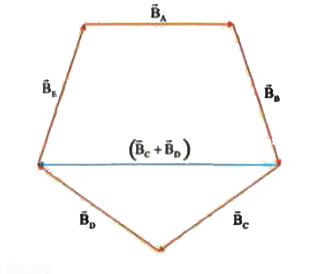 In figure `vecB_A, vecB_B , vecB_C , vecB_D " and " vecB_E`represent magnetic fields due to long WIRES A, B, C, D and E(each carrying current I out of the plane of paper) at a point on the axis O. NOTE that`vecB_A BOT OA, vecB_B bot OB, vecB_C bot OC, vecB_D bot OD, vecB_E bot OE` a) Magnetic induction at O due to all five current carrying conductors, i.e `vecB_R = vecB_A + vecB_B + vecB_C + vecB_D + vecB_E` `= vecB_A + (vecB_C + vecB_D) (because vecB_B = - vecB_E)` ` = vecB_A - vecB_A ( because vecB_C+ vecB_D = vecB_A) = 0` b) Magnetic field at O due to four current carrying conductors B, C ` = 0 vecB_A (as vecB_C + vecB_D= - vecB_A)` or `|vecB_A| = B_A = (mu_0I)/(2pi R)` Perpendicular to AO, TOWARDS left C) Magnetic field at O due to five current carrying conductors with current in wire A reversed, i.e `B_R = - vecB_A + vecB_B + vecB_C + vecB_D + vecB_E` ` = -vecB_A + (vecB_C + vecB_D) (as vecB_B = - vecB_E)` `= -vecB_A - vecB_A = - 2vecB_A` or `|vecB_R| = - vecB_A + vecB_B + vecB_C + vecB_D + vecB_E` ` = - vecB_A - vecB_A = - 2 vecB_A` or `|vecB_R| = 2vecB_A = 2 ( (mu_0 I)/(2pi R) ) = (mu_0 I)/(pi R)` Perpendicular to OA, towards left . |
|
| 47. |
An electron is accelerated to a potential of 200 V and acquires a velocity of 8.4xx10^(6)ms^(-1). The e/m is: |
|
Answer» `1.76xx10^(9)C//kg` `=1*764xx10^(11)XXC kg^(-1)` |
|
| 48. |
A bus starts from rest with a constant acceleration of 5 m//s^(2).At the same time a car travelling with a constant velocity 50 m/s overtakes and passes the bus.How fast is the bus travelling when they are side by side ? |
|
Answer» 10 m/s |
|
| 49. |
A converging lens of focal length 12 cm and a diverging mirror of focal length 7.5 cm are placed 5.0 cm apart with their principal axes coinciding. Where should an object be placed so that its image falls on itself? |
| Answer» Solution :30 CM from the lens further AWAY from the mirror | |
| 50. |
Core of electromagnets are made of ferromagnetic material which has |
|
Answer» LOW PERMEABILITY and low RETENTIVITY |
|