

Saved Bookmarks
This section includes 7 InterviewSolutions, each offering curated multiple-choice questions to sharpen your Current Affairs knowledge and support exam preparation. Choose a topic below to get started.
| 1. |
A silicon diode has a threshold voltage of 0.7 V. If an input voltage given by 2 sin(pi t) is supplied to a half wave rectifier circuit using this diode, the rectified output has a peak value of |
|
Answer» 2 V |
|
| 2. |
Two long coaxial insulated solenoids, S_1 and S_2 of equal lengths are wound one over the other as shown in the figure. A steady current "I" flow through the inner solenoid S_1 to the otherend B, which is connected to the outer solenoid S_2 through which the same current "I" flows inthe opposite direction so as to come out at end A. If n_1 and n_2 are the number of turns per unit length, find the magnitude and direction of the net magnetic field at a point (i) inside on the axis and (ii) outside the combined system. |
|
Answer» SOLUTION :(i) Inside the axis - FIELD due to solenoid `S_1, B_1 = mu_0 n_1 I` and field due to solenoid `S_2, B_2 = mu_0 n_2I` Moreover, DIRECTIONS of `vec(B_1) and vec(B_2)` are mutually opposite, hence net magnetic field `B = B_1 - B_2 = mu_0 (n_1 - n_2) I` in the DIRECTION of `vec(B_1)` (II) Outside the combined system - Field due to both the solenoids is zero. Hence, net field is zero. 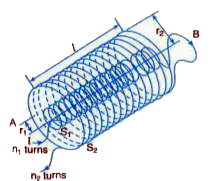
|
|
| 3. |
Sag in a bar of length T to weight applied its mid-point when it is supported at its end by fixed points at the same height proportional to |
| Answer» ANSWER :C | |
| 4. |
A metallic wire of resistance 40 Omega is stretched to twice its length. The new resistance approximately |
| Answer» Answer :D | |
| 5. |
The displacement y of a particle in a medium can be expressed as y = 10^(-6) sin (100t+20 x+ (pi)/(4))m where 't' is in second and x in metre. The speed of wave is |
|
Answer» `2000 ms^(-1)` |
|
| 6. |
An oil-immersion objectives of a microscope uses oil of refractive index 1.414. The wavelength of illuminating light is 4850 Å and the semivertical angle is 45^(@). Find the limit of resolution and the resolving power of the microscope. |
|
Answer» Solution :Data: `n=1.414, lambda=4.85 xx 10^(-7)m, i_("max") = 45^(@)` The limit of resolution, `d_("MIN") = lambda/(2nsin i_("max")) = (4.85 xx 10^(-7))/(2(1.414) sin45^(@))` LTBGT `=(4.85 xx 10^(-7))/(2(1.414)1/sqrt(2)) = (4.85 xx 10^(-7))/2` `=2.425 xx 10^(-7)`m The resolving power of the microscope, `=1/(d_("min")) = 1/(2.425 xx 10^(-7)) = 4.124 xx 10^(6) m^(-1)` |
|
| 7. |
A bar magnet of magnetic moment 1.5 JT^(-1) lies aligned with the direction of a uniform magnetic field of 0.22 T . a . What is the amount of work required by an external torque to turn the magnet so as to align its magnetic moment : (i) normal to the direction , (ii) opposite to the field direction ? b. What is the torque on the magnet in cases (i) and (ii) ? |
|
Answer» Solution :`m = 1.5 "JT"^(-1), B = 0.22T` a. i mB = 0.330 J `""ii.2mB=0.66J` b. i. Maximum = 0.33 , TENDING to turn it towards the direction of the field. ii.Zero`(SIN 180^@=0)` |
|
| 9. |
An object of specific gravity . p. is hung from a thin steel wire. The fundamental frequency for transverse standing waves in the wire is 300Hz. The object is immersed in water, so that one half of its volume is submerged. The new fundamental frequency (in Hz) is |
|
Answer» `300((2RHO-1)/(2rho))^(1//2)` |
|
| 10. |
Wave length of light in denser medium is 4000Å, it is grazing into a rarer medium. If critical angle for the pair of media is sin^(-1) (2/3)then the wave length of light in rarer medium is |
|
Answer» 4000Å |
|
| 11. |
A beam of electron passes undeflected through mutually perpendicular electric and magnetic fields. If the electric field is switched off, and the same magnetic field is maintained, the electrons move |
|
Answer» in a CIRCULAR orbit |
|
| 12. |
Define half life of a radioactive material. |
|
Answer» |
|
| 13. |
Figure shows a 2.0 V potentiometer used for the determination of internal resistance of a 1.5 V cell. The balance point of the cell in open circuit is 76.3 cm. When a resistor of 9.5 Omega is used in the external circuit of the cell, the balance point shifts to 64.8 cm length of the potentiometer wire. Determine the internal resistance of the cell. |
| Answer» SOLUTION :`1.7 OMEGA` | |
| 14. |
If the two particles performing S.H.M. with different initial phase angle and amplitude, then the initial phase angle of resultant motion depends on |
|
Answer» INITIAL PHASE angle only |
|
| 15. |
It is desired to measure the magnitude of field between the poles of a powerful loud speaker magnet. A small flat search coil of area 2 "cm"^2 with 25 closely wound turns, is positioned normal to the field direction, and then quickly snatched out of the field region. Equivalently, one can give it a quick 90^@ turn to bring its plane parallel to the field direction). The total charge flown in the coil (measured by a ballistic galvanometer connected to coil) is 7.5 mC. The combined resistance of the coil and the galvanometer is 0.50 Omega. Estimate the field strength of magnet. |
|
Answer» Solution :Here initial magnetic flux linked with given coil is, `phi_1=ABcos0^@ "" (because vecA||vecB)` =AB FINAL magnetic flux `phi_2=AB cos 90^@` =0 OR `phi_2=AB cos PHI` =A(0)cos`theta` =0 Induced emf, `epsilon=-N(dphi)/(dt)` `therefore epsilon=-N((phi_2-phi_1)/t)` `=-N((0-AB)/t)` `therefore epsilon="NAB"/t` `therefore IR=(NAB)/t` `therefore (Q/t)R=((NAB)/t)` (Where Q=charge induced in the coil in t TIME ) `therefore B=(QR)/(NA)` `therefore B=((7.5xx10^(-3))(0.5))/((25)(2XX10^(-4))` `therefore` B=0.75 T |
|
| 16. |
A 10 m long wire of resistance 20Omega is connected in series with a battery of emf 3V and a resistance of 10Omega. The potential gradient along the wire in volt per metre is |
|
Answer» 0.02 Potential gradient `=(V)/(l)=(2)/(10)=0.2V//m` |
|
| 17. |
Matching the block type |
|
Answer» a-g, b-h, C-f, d-e |
|
| 18. |
How many type of dopants are there ? |
| Answer» SOLUTION :They are two types:Pentavalet (five valence Ex. P, Sb etc, CALLED i donor electrons.) TRIVALENT dopants (THREE valence) Ex. GA,AZ, B etc. | |
| 19. |
(A) : A series resonant circuit is also known as an acceptor circuit. (R) : For large value of Ohmic resistance, the quality factor of a series resonant circuit is high. |
|
Answer» Both 'A' and 'R' are TRUE and 'R' is the CORRECT explanation of 'A'. |
|
| 20. |
A square loop of side l carrying current I is part of the shown arrangement . Minium current I to just move the block up the inclined plane is |
|
Answer» `(mg sin theta+MU mg cos theta)/(BL)`  To just move the block up, `T=mg sin theta+mu mg cos theta` and `""2T=Bil` `:. i=[(2mg sin theta+2 mu mg cos theta )/(Bl)]` |
|
| 21. |
A stone weighing 2 kg falls from the top of a tower 40 metre heigh and burries itself 1m deep in sand. The time of penetration is : |
| Answer» Answer :C | |
| 22. |
a के किस मान के लिए x=−1,y=2 समीकरण 2x−5y=a का एक हल है? |
|
Answer» 12 |
|
| 23. |
When does Snell's law of refraction fail ? |
|
Answer» Solution :When the incident light is normal to the surface of separation between two media, then snell.s law FAILS, i.e., ANGLE of INCIDENCE, I = `0^(@)` and angle of refraction, r = `0^(@)` |
|
| 24. |
Show diagrammatically the behaviour of magnetic field lines in the presence of (i) paramagnetic and (ii) diamagnetic substances. How does one explain this distinguishing feature ? |
Answer» Solution :The behaviour of field lines in the presence of a PARAMAGNETIC anddiamagnetic substance has been shown in Fig.  In paramagnetic substance more field lines pass on placing the substance in a magnetic field because relative permeability `mu`, of it is greater than 1 and the substance experiences a FEEBLE FORCE of attraction. In diamagnetic substance LESSER number of field lines pass through the substance when placed in a magnetic field because for it `mu lt 1` and the substance experiences a feeble force of repulsion. |
|
| 25. |
A sound source emits two sinusoidal sound waves, both of wavelength lambda, along paths A andB as shown in figure.The sound travelling along path B is reflected from five surfaces as shown and then merges at point Q, producing minimum intensity at that point.The minimum value of d in terms of lambda is : |
Answer» Solution :Because the two waves emerge from the same source, they must emerge in phase with each other. When they merge at point their phase difference can depend only on the path length difference `DELTA L`between the two PATHS they followed.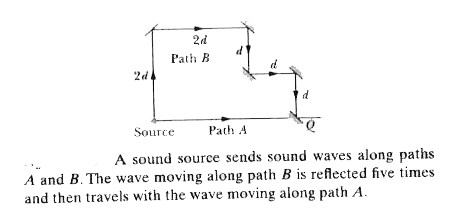 To reach Q , the wave following path A travels distance 3d, and the wave following path B travels distance 7d. thus , their path length difference `Delta L` is 4d. If the waves are to be exactly out of phase at Q, we must have `(Delta L)/(LAMDA) = 0.5, 1.5, 2.5 ,...` Substituting `Delta L = 4d` and solving for d then give us `d= 1/8 lamda , 3/8 lamda , 5/8 lamda,..............` Similarly , if the waves are to be exactly in phase at point Q, we must have `(Delta L)/(lamda) = 0,1,2,3 ........` We can eliminate 0 from the list (which that there is no path difference in fig. ) . solving for d, we find `d = 1/4 lamda ,1/2lamda, 3/4 lamda`......... ` |
|
| 26. |
A Satellite is revolving around a planet having mass M=8xx10^(22)kg and radius R=2xx10^(6)m as shown in figure. Find the number of revolutions made by the satellite around the planet in 24 hours. |
|
Answer» 9 |
|
| 27. |
A long charged cylinder of linear charge density lambda surrounded by a hollow co-axial conducting cylinder. What is the electric field in the space between the two cylinders? |
Answer» Solution :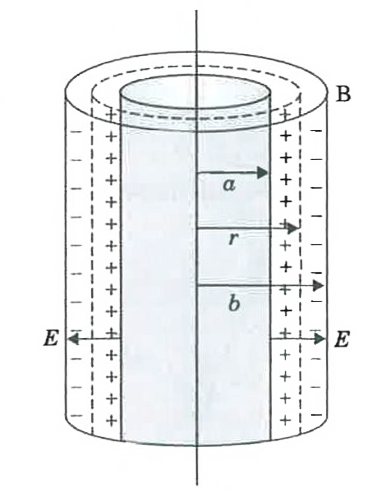 As the CHARGED cylinder is surrounded by the coaxial CONDUCTING cylinder, it will induce charge on the conducting cylinder. The electric field in between due to the charged cylinder will be directed radially outwards and perpendicular to the axis of the cylinder Let us take a Gaussian surface in the form of a closed cylinder of radius r and length `L` that is coaxial to the charged cylinder and lying in between the two CYLINDERS. Let E be the magnitude of the electric field intensity in the space between the two cylinders. Flux associated with lower and upper circular faces of the Gaussian surface will be zero as the electric field lines are parallel to these surfaces. Electric flux associated with the Gaussian cylinder, `phi = int_("cylinder") vecE.d vecS=E(2pi rl)` According to Gauss.s law the total flux for a three-dimensional, closed Gaussian surface, is equal to net charge enclosed within surface divided by `epsilon_(0)`. `rArr E(2pi rl)=(lambda l)/(epsilon_(0)) rArr E=(lambda)/(2pi epsilon_(0)r)` |
|
| 28. |
A mobile phone lies along the principal axis of a concave mirror, as shown in Fig. 9.7. Show by suitable diagram, the formation of its image. Explain why the magnification is not uniform. Will the distortion of image depend on the location of the phone with respect to the mirror? |
| Answer» Solution :The ray diagram for the formation of the image of the phone is SHOWN in FIG. 9.7. The image of the part which is on the PLANE perpendicular to principal axis will be on the same plane. It will be of the same size, i.e., B′C = BC. You can yourself realise why the image is DISTORTED. | |
| 29. |
(A) : We use a thick wire in the secondary of a step down transformer to reduce the number of turns per unit length. (R): When the plane of the armature is parallel to the line of force of magnetic field, the magnitude of induced e.m.f. is maximum |
|
Answer» Both 'A' and 'R' are TRUE and 'R' is the CORRECT EXPLANATION of 'A'. |
|
| 30. |
A tangent galvanometer shows no deflection when a currenl is passed through it, but when the current through it is reversed it gives a deflection of 180°, then the plane of the coil is |
|
Answer» in the MAGNETIC meridian |
|
| 31. |
In the circuit given, the charge on capacitor C_(3) at steady state is |
| Answer» Answer :B | |
| 32. |
_____ has it's origin in the cirulating charges with the atoms of any substance. |
| Answer» SOLUTION :MAGNETISM | |
| 33. |
Distinguish between wireline and wireless communication. |
Answer» SOLUTION :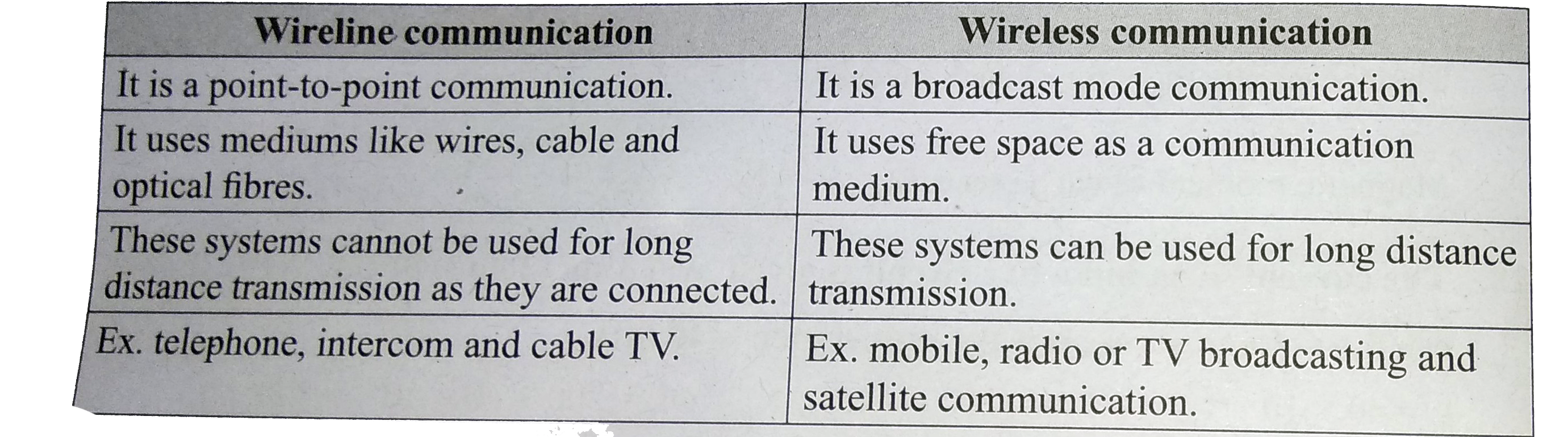
|
|
| 34. |
What is the equivalent resistance between point A and C in the circuit shown in fig. ? |
| Answer» Answer :D | |
| 35. |
A cylindrical conductor of diameter 0.1 mm carries a current of 90 mA. The current density( in Am^(-2)) is pi= 3 |
|
Answer» `1.2xx10^(7)` Radius (R ) `= (D)/(2)=(0.1)/(2)mm` Current (I) = 90 mA `= 90xx10^(-3)A` We know that, Current DENSITY `(J)=(I)/(A)` `= (I)/(pi r^(2))` `= (90xx10^(-3))/((22)/(7)xx((0.1xx10^(-3))/(2))^(2))` `= (90xx10^(-3))/(3.14xx((0.1xx10^(-3))/(2))^(2))` `= 12000xx10^(3)` `= 1.2xx10^(7)A//m^(2)` |
|
| 36. |
A narrow stream of monoenrgetic electrons falls at an angle of incidence theta=30^(@) on the natural facet of a n aluminum single crystal. The distacne between the neighbouring cystal planesparallel to that fact to d= 0.20nm. Theaximum mirror reflection is observed at a certain accelecrating voltage V_(0). Find V_(0) if the next maximum mirror reflection is known to be observed when the acceleration voltage is increased eta=2.25 time s |
|
Answer» Solution :From Bragg's law, for the first case `2 d sin THETA=n_(0)lambda=n_(0)(2pi ħ)/(sqrt(m e etaV_(0)))` THUS `n_(0)=(n_(0)+1)/(sqrt(eta))` or `n_(0)(1-(1)/(sqrt(eta)))=(1)/(sqrt(eta))` or `n_(0)=(1)/(sqrt(eta-1))` Going back we get `V_(0)=(pi^(2) ħ^(2))/(2 me d^(2)sin^(2) theta).(1)/((sqrt(eta-1))^(2))- 0.150keV` Note: In the Bragg's formula, `theta` is the glancing angle and not the incidence. We have obtained correct RESULT by taking `theta` to be the glancing angle. If `theta` is the angle of incidence, then the glancingk angle will be `90-theta`. Then the final ANSWER will be similar by a factor `TAN^(2)theta=(1)/(3)`. |
|
| 37. |
If two positive integers p and can be expressed as p = ab^2and q = a^3b, a, b being prime numbers, thenLCM (p, q) is- |
|
Answer» `AB` |
|
| 38. |
The coil of the ballistic galvanometer oscillates due to: |
|
Answer» SELF induction |
|
| 39. |
In proton-proton cycle, what is the approximate energy released? |
| Answer» SOLUTION :About 50 MEV of energy is RELEASED in proton-proton cycle. | |
| 40. |
When the width of slit aperture is increased by keeping 'd' as constant in Young's experiment . |
|
Answer» FRINGE WIDTH will increase |
|
| 41. |
Which two countries are being discussed here ? |
|
Answer» DEVELOPING countries |
|
| 42. |
The plates of a paraller-plate capacitor are made of circular discs of radii 5.0cm each .If the separation between the plates is 1.0mm,What is the capacitance? |
|
Answer» SOLUTION :Area of the plate `A = pie R^(2) = piexx (5 xx 10^(-2))^(2)` `d = 1.0 xx 10^(-3) m ` `C =eplision_0 A / d` `= 8.8 xx 10^(-12) xx 3.14 xx 25 xx 10^(-4) / 10^(-3)` `= 695 xx 10 ^(-5) mu F` |
|
| 43. |
A philatelist examines the printing details on a stamp using a convex lens of focal length 10.0 cm as a simple magnifier. The lens is held close to the eye and the lens to object distance is adjusted so that the virtual image is formed at the normal near point (25 cm). Calculate magnification. |
|
Answer» |
|
| 44. |
A current loop of area 0.01m^2 carrying a current of 10A is held perpendicular to a magnetic field of intensity 0.1 tesla. The torque acting on the loop in N-m is. |
|
Answer» 0.001 |
|
| 45. |
{:(1.,"Diamagnetic materials",(a),"Steel,Alnico"),(2.,"Paramagnetic materials",(b),"Bi, Sb,Cu"),(3.,"Ferromagnetic materials",(c),"Pt,Cr,Mn"),(4.,"Permanent magnets",(d),"Fe, Ni, Co etc.,"):} |
|
Answer» `{:("(1)","(2)","(3)","(4)"),(B,a,d,C):}` |
|
| 46. |
Ajet plane is travelling towards west at a of 1800 km h^(-1). What is the voltage difference developed between the ends of the wing having a span of 25 m, if the Earth's magnetic field at the location has a magnitude of 5.0 xx 10^(-4) and the dip angle is 30^(@). |
|
Answer» Solution :Velocity of plane, `v = 1800 km h^(-1)= 500 ms^(-1)` Vertical COMPONENT of Earth.s magnetic field B is `B_(V) = B SIN delta = 5.0 xx 10^(-4) sin 30^(@) (delta "is the angle of DIP")` `= 2.5 xx 10^(-4)T` , Wing span, L = 25 m Induced emf across the wind span will be `epsilon = B_(V)lv =25 xx 10^(-4) xx 25 xx 500= 3.125 V` |
|
| 47. |
Find the binding energy of a valence electrons in the ground state of a Li atom if the wavelength of the first line of the sharp series is known to be equal to lambda_(1)=813nm and the short-wave cut-off wavelength of that series to lambda_(2)=350nm. |
|
Answer» Solution :For the first LINE of the sharp series `(3Srarr2P)` in a `Li` atom `(2piħC)/(lambda_(1))=-(ħR)/((3+alpha_(0))^(2))+(ħR)/((2+alpha_(1))^(2))` For the short wave cut-off wave-length of the same series `(2piħc)/(lambda_(2))=(ħR)/((2+alpha_(1))^(2))` From these two EQUATIONS we get on SUBSTRACTION `3+alpha_(0)=sqrt(ħR//(2piħc(lambda_(1)lambda_(2)))/(lambda_(1)lambda_(2)))` `=sqrt((Rlambda_(1)lambda_(2))/(2piCDeltalambda)),Delta lambda=lambda_(1)-lambda_(2)` Thus in the ground state, the binding energy of the electron is `E_(b)=(ħR)/((2+alpha_(0))^(2))=ħR//(sqrt(Rlambda_(1)lambda_(2)/(2picDeltalambda)-1))^(2)=5.32eV` |
|
| 48. |
A body made up of an alloy (40% copper +60% nickel) of mass0.1 kg is placed in a container of water equivalent 10 gm which contains 90 g of water at 10^(@)C. If the equilibrium temperature is 20^(@)C, find the initial temperature of the body. Given that specific heat of water is 4200 J//kg^(@)C and that of copper is 420J//kg^(@)C and that of nickel is 460 J//kg^(@)C |
|
Answer» |
|
| 49. |
A block of mass 5kg is lying on a rough horizontal surface. The coefficient of static and kinetic friction are 0.3 and 0.1 and g=10ms^(2). If a horizontal force of 50N is applied onthe block, the frictional force is |
|
Answer» 25 N |
|
| 50. |
Calculate the electric flux through the ractangle of sides 5 cm and 10 cm kept in the rigion of a uniform field 100 NC^(-1) . The angle thetais 60^(@) . Suppose thetabecomes zero what is the electric flux? |
|
Answer» Solution :The electric flux `phi_(E)=vecExxvecA=Eacostheta=100xx5xx10xx10^(-4)xxcos60^(@)` IMPLIES `phi_(E)=0.25N.m^(2)C^(-1)` For `theta=0^(@)` `phi_(E)=vecE.vecA=EA=100xx5xx10xx10^(-4)=0.5 N.m^(2)C^(-1)` |
|