

Saved Bookmarks
This section includes 7 InterviewSolutions, each offering curated multiple-choice questions to sharpen your Current Affairs knowledge and support exam preparation. Choose a topic below to get started.
| 1. |
What is critical angle ? How it is connected to refractive index ? |
| Answer» SOLUTION :RI GIVEN by sini/sinr=sinC/sin90^@=I/n, n=1/sinC | |
| 2. |
What is binding energy ? |
| Answer» Solution :An atomic nucleus is a stable structure. INSIDE it, PROTONS and neutrons are bound TOGETHER by strong attractive nuclear FORCE. To SEPARATES them, work is required to be done. BE is the energy required to break and separate neutrons and protons. | |
| 3. |
Figure shows an arrangement of four identical rectangular plates A,B,C, and D each of area S. Find the charges appearing on each face (from left to right) of the plates. Ignore the separation between the plates in comparison to the plate dimensions. |
|
Answer» Potential difference between the plates A and B is INDEPENDENT of `Q_1`. `xa+xb+(Q_(2)+X)c=0` `x=(-Q_(2)c)/(a+b+c)` `Q_(1)=y+x+y-Q_(2)-x` `y=(Q_(1)+Q_(2))/(2)` `V=(Q_(2)ca)/((a+B+c)Sepsilon_(0))` 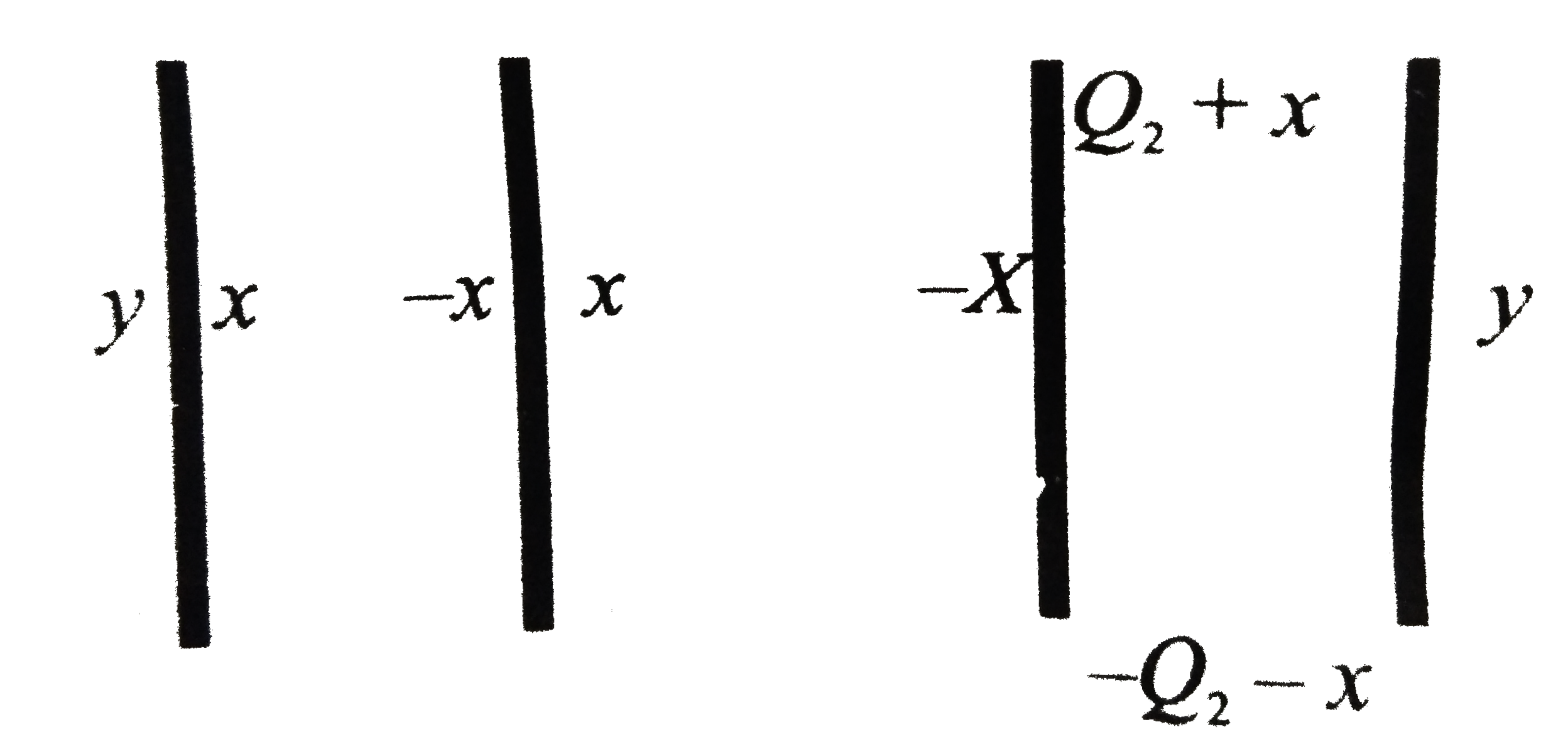
|
|
| 4. |
The number of turns in primary and secondary windings of a transformer are 1000 and 100 respectively. If 200V dc voltage is impressed across the primary terminals, the voltage across secondary terminals is |
| Answer» Answer :D | |
| 5. |
Assertion : Interference is not observed if the two coherent slit sources are broad. Reason : A broad source is equivalent to many narrow slit sources. |
|
Answer» If both assertion and reason are true and reason is the correct EXPLANATION of assertion. |
|
| 6. |
A wire of uniform cross-section is stretched between two points 1m apart. The wire is fixed at oneend and n weight of 9 kg hung over a pulley at the other end produces fundamental frequency of 750Hz. What is the velocity oftrnnsverse waves propagating in the wire ? |
|
Answer» SOLUTION :In case of fundamental vibrations of STRING `(lambda//2) =L.i.e., lambda= 2xx1 =2M`.  Now as `v =f lambda and f = 750 Hz, V_T =2 xx 750 = 1500 m//s` i.e., `lambda=2m, f = 750 Hz and V_T =1500 m//s` |
|
| 7. |
Ultraviolet light of wavelength 2271 Å fro a 100 W mercury source irradiates a photocell made of molybdenum metal. If the stopping potential is -1.3V, estimate the work function of the metal. How would the photocell respond to a high intensity (~10^(5)Wm^(-2)) red light of wavelength 6328 Å produced bya He-Ne laser ? |
|
Answer» Solution :Here `lamda=2271Å=2271xx10^(-10)m=2.271xx10^(-7)m`, and stopping potential `V_(0)=-1.3V` USING Einstein.s photoelectronic equation `hv-phi_(0)=eV_(0)`, we have `phi_(0)=hv-eV_(0)=(hc)/(lamda)-eV_(0)=(6.63xx10^(-34)xx3xx10^(8))/(2.271xx10^(-7))-1.3xx1.6xx10^(-19)J` `=8.758xx10^(-19)-2.08xx10^(-19)J=6.678xx10^(-19)J=(6.678xx10^(-19))/(1.6xx10^(-19))eV=4.17eV` For He-Ne LASER light of wavelength `lamda.=6328Å=6.328xx10^(-7)m,` the enrgy of a PHOTON will be `E.=(hc)/(lamda.)=(6.63xx10^(-34)xx3xx10^(8))/(6.328xx10^(-7))J=(6.63xx10^(-34)xx3xx10^(8))/(6.328xx10^(-7)xx1.6xx10^(-19))eV=1.964eV` As `E.ltphi_(0)`, hence no photoelectric emission will take place IRRESPECTIVE of intenstiy of laser beam. |
|
| 8. |
Show that linear SHM is the projection of a uniform circular motion on any diameter. |
Answer» Solution :Consider a PARTICLE which moves with a constant angular speed `OMEGA` around a circular path of radius A. Let the path lie in the x-y plane with the centre at the origin O. The INSTANTANEOUS POSITION Q of the particle is called the REFERENCE point and the circle in which the particle moves is called the reference circle. 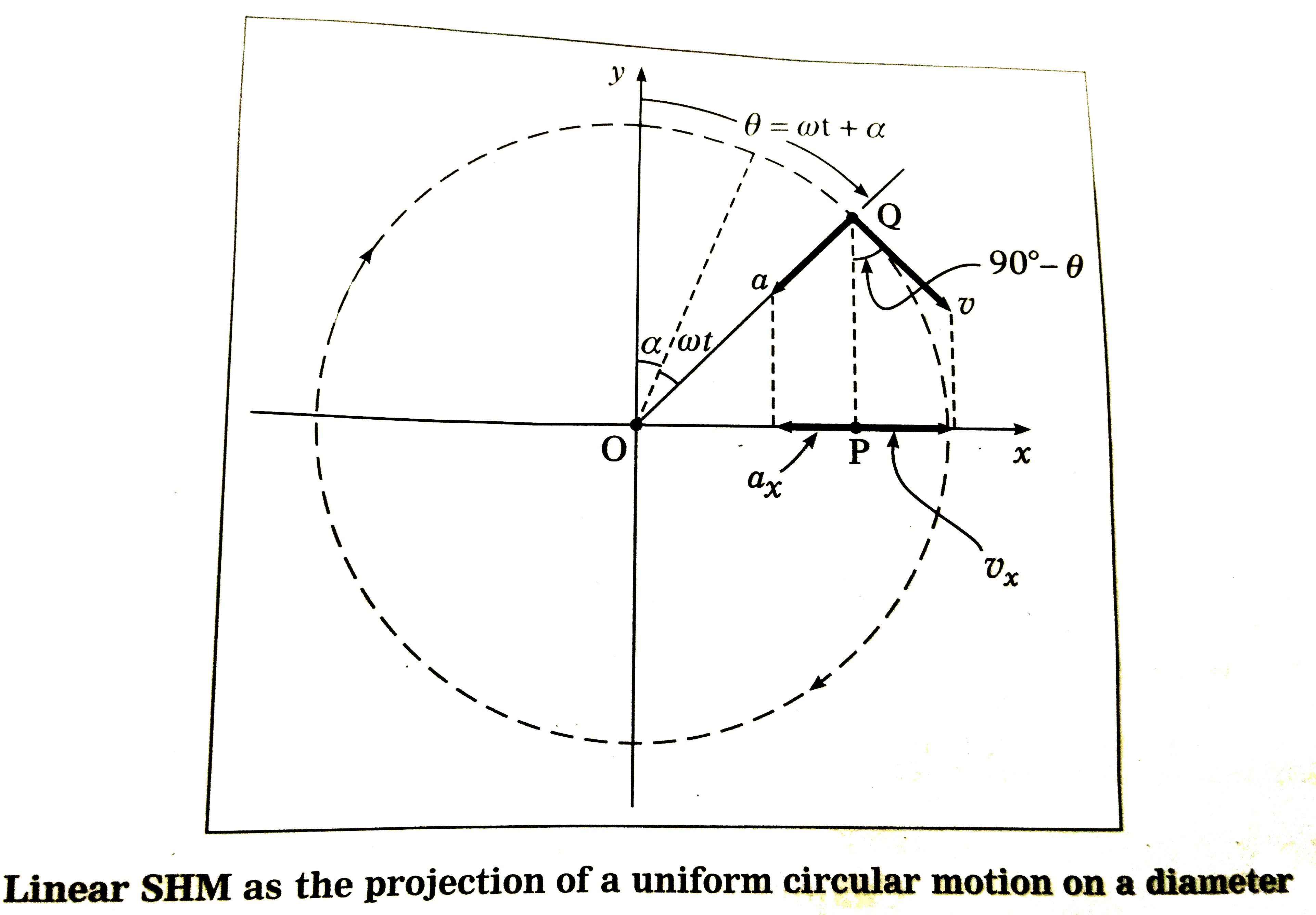 The perpendicular projection of Q onto the x-axis is P. Then as, the particle travels around the circle, P moves to-and-fro along the x-axis. Line OQ makes an angle `prop` with the y-axis at t=0. At time t, this angle becomes `theta=omegat+alpha`. The projection P of the reference point is described by the x-coordinate, `x=OP=OQ sin angle OQP." Since "angle OQP=omega t+alpha,` `x=A" sin "(omega t+alpha)` The tangential velocity of the refrence particle is `v=omega A.` Its x-component at time t is `v_(x)=omega A" sin "(90^(@)-theta)=omega A cos theta` `therefore v_(x)=omega A cos (omega t +alpha)` Tbe centripetal accelertation of the reference particle is `a=-omega^(2)A,` so that its x-component at time t is `a_(x)= a sin angle OQP` `therefore a_(x)=-omega^(2)A sin (omega t+alpha)=-omega^(2)x` These results for x, `v_(x) and a_(x)` correspond to the general expressions for displacement, velocity and acceleration of a particle executing linear SHM. Thus, linear SHM can be described as the projection of uniform circular motion onto a fixed diameter of the circular path. |
|
| 9. |
An infinite plane of uniform dielectric with permittivity epsilon is uniformly charged with extraneouschagre fo space density rho. The thicknessof the plate is equalto 2d. Find: (a) the magnitude of the electric field strength and the potential as functions ofdistancel fromthe middlepoint of the plane.(wherethe potentialis assumedto be equalto zero), having chosen teh x coriditnateaxis perpendicular to the plate, draw the approximate plotsof teh projection E_(x) (x) of the vector E and the potentail varphi (x), plotsfo the projection E_(x) (x) of the vector E adn the potential varphi (x), (b) the surface and space denstitesof the boundcharge. |
|
Answer» Solution :(a) div `vec(D) = (del D)/(del x) = rho` and `D = rho l` `E_(x) = (rho l)/(epsilon epsilon_(0)),l lt d` and `E_(x) = (rho d)/(epsilon_(0))` constantfor `l gt d`. `varphi (x) = - (rho l^(2))/(2epsilon epsilon_(0)), l lt d` and `varphi (x) = A - (rho ld)/(epsilon_(0)), l gt d` then`varphi (x) = (rho d)/(epsilon_(0)) (d - (d)/(2e) - t)`, by continuity. On the basic of obtained expressions`E_(x) (x)` and `varphi(x)` can be PLOTTED as SHOWN in fig of answersheet. (b) `rho' = -"div " vec(p) = -"div " (epsilon - 1) epsilon_(0) vec(E) = -rho ((epsilon - 1))/(epsilon)` `sigma' = P_(1n) - P_(2n)`, where `n` is the normal from 1 to 2. `P_(1n)`, (`vec(p_(2)) = 0` as 2 is vacumm.) `= (rho d - rho d//epsilon) = rho d (epsilon - 1)/(epsilon)` |
|
| 10. |
In Fig., two curved plastic rods, one of charge +q and the other of charge -q form a circle of radius R = 4.25 cm in an xy plane. The x axis passes through both of the connecting points and the charge is distributed uniformly on both rods. If q = 15.0 pC, what are the (a) magnitude and (b) direction (relative to the positive direction of the x axis) of the electric field vec(E) produced at P, the center of the circle ? |
| Answer» SOLUTION :(a) 95.1 N/C, (B) `-90^(@)` | |
| 11. |
A bomb of 1 kg is thrown vertically up with speed 100 m/s. After 5 seconds, it explodes into two parts. One of mass 400 gm goes down with speed 25 m/s. What will happen to the other part just after explosion |
|
Answer» Solution :After 5 sec, VELOCITY of bomb V=u-gt =100 - 10 `xx 5= 50` m/s `therefore` Initial momentum before explosion `=1 xx 50 kg ms^(-1)` From momentum conservation `,1 xx 50 = -0.4 xx 25 + 0.6 v` `therefore v. = 100 m//s` UPWARDS |
|
| 12. |
The electric field in a region is radially out ward with magnitude E= Ar. Find the charge contained in a sphere of radius 20cm. Given A= 100V m^(-2) |
|
Answer» `8.89 xx 10^(-11)C` |
|
| 13. |
STATEMENT-1: When a prism of p = 3/2 is immersed in water (mu = 4/3),. deviation through the prism becomes 1 /4 th of the deviation, when the prism is in air STATEMENT-2: It follows from1/f=[1/R_1-1/R_2] |
|
Answer» STATEMENT-1 is TRUE, STATEMENT-2 is True, STATEMENT-2 is a CORRECT EXPLANATION for STATEMENT-1 |
|
| 14. |
The frequency at which communication will not be reliable is |
|
Answer» `100KHz` |
|
| 15. |
The horizontal component of the earth’s magnetic field at a certain place is 3.0 x×10^(-5) T and the direction of the field is from the geographic south to the geographic north. A very long straight conductor is carrying a steady current of 1A. What is the force per unit length on it when it is placed on a horizontal table and the direction of the current is (a) east to west, (b) south to north? |
|
Answer» Solution :`F = Il xx B` `F - IlB sin theta ` The force per unit length is `f = F//l = l B sin theta ` (a) when the current is flowing from EAST to west ` theta = 90^@` Hence , `f= IB` ` = 1 xx 3 xx 10^(-5) = 3 xx 10^(-5) Nm^(-1)` This is larger than the value `2 xx 10^(-7) Nm^(-1)`quoted in the definition of the ampere. Hence it is IMPORTANT to eliminate the effect of the EARTH’s magnetic field and other stray fields while standardising the ampere. The direction of the force is downwards. This direction MAY be obtained by the directional property of cross product of vectors. (b) When the current is flowing from south to north, `theta = 0^@` ` f = 0` Hence there is no force on the conductor . |
|
| 16. |
Drift velocity is given by u=__________ |
| Answer» SOLUTION :`[(eEtau)/m]` | |
| 17. |
What is the nature of image ? |
| Answer» SOLUTION :ERECT and DIMINISHED. | |
| 18. |
The water equivalent of a calorimeter is 10 g and it contains 50 g of water at 15^@ C. Some amount of ice, initially at -10^@ C is dropped in it and half of the ice melts till equilibrium is reached. What was the initial amount of ice that was dropped (when specific heat of ice = 0.5 cal g^(-1) ""^(@) C^(-1), specific heat of water = 1.0 cal g^(-1) ""^(@) C^(-1) and latent heat of melting of ice = 80 cal g'^(-1))? |
|
Answer» 10 g  Massofwaterequivalent ofa calorimeterand watercontinedby it `m_1 = 10G+ 50 g =60 g ` the amount of heatlost bythe water ` Q_1 = m_1s Delta T ` wheres=specificheatof water,` DeltaT =`temperature ` thereforeQ_1( 60 xx 1xx 15)`cal AMOUNTOF heatgainedby iceis `Q_2 =(m )/(2) xx10 + (m)/(2)xx 80 = (45m)`cal in steadystateheatgained`= `heatlost `therefore45m= 60xx 1 xx 15 implies m -20g` |
|
| 19. |
The ratio of contributions made by the electric field and magnetic field components to the intensity of the EM wave is……… |
|
Answer» `C:1` `I_m=(B_(rms)^2)/(mu_0)c` `THEREFORE I_e/I_m=(E_(rms)/B_(rms))^2mu_0epsi_0=c^2 times 1/c^2=1 IMPLIES 1_e=I_m` |
|
| 20. |
The radii of curvature of two spherical surfaces of a concave convex lens (mu=1.5) are 20 cmand 40 cm. (i) What is its focal length when it is in air? Also find its focal length whenitis mimmersed in a liquid of refractive index(ii) mu=1.2 (iii) mu=2 |
|
Answer» (80CM, 160CM, -160cm) |
|
| 21. |
Two cells of same emf epsilon but of different internalresistances r_1 and r_2 are connected in series with an external resistance R. The potential drop across the first cell is found to be zero. The external resistance R is |
|
Answer» `r_1+r_2` `I=(EPSILON+epsilon)/(r_1+r_2+R)=(2epsilon)/(r_1+r_2+R)` As TERMINAL potential drop across `1^(st)` CELL is zero , hence `V_1=epsilon-Ir_1=epsilon-(2epsilon)/((r_1+r_2+r))r_1=0` `RARR epsilon=(2epsilonr_1)/((r_1+r_2+R))` or `r_1+r_2+R=2r_1` or `R=(r_1-r_2)` 
|
|
| 22. |
A boat going down stream crosses a float at a point A. 't_1' minutes later the boat reverses its direction and in the next 't_2' minutes it crosses the float at a distance L from the point A. The velocity of the river is |
|
Answer» `2L//t_1` |
|
| 23. |
What is capacitive reactance ? |
|
Answer» Solution :It is the opposition offered by the capacitor to the FLOW of current. `X_C =1/WC` where W =Angular VELOCITY. C= CAPACITANCE of capacitor. |
|
| 24. |
A Car is travelling at (v)/(10) ms^(-1) and sounds horn of frequency 990 Hz. The apparent frequency heard by a police chasing the car at v/9 ms^(-1),where V is velocity of sound |
| Answer» Answer :C | |
| 25. |
show a 2.0V potentiometer used for the determination of internal resistance of a 1.5V cell. The balance point of the cell in open circuit is 76.3 cm. When a resistor of 9.5Omega is used in the external circuit of the cell, the balance point shifts to 64.8 cm length of the potentiometer wire. Determine the internal resistance of the cell. |
|
Answer» Solution :Here, `l_(1) = 76.3 ` cm, `l_(2) = 64.8` cm R = 9.5 `OMEGA` With the help of POTENTIOMETER , interna resistance of CELL , ` r =R ((l_(1) - l_(2))/(l_(2))) ` `thereforer= 9.5 (( 76.3 - 64.8)/(64.8)) = (9.5 xx 11.5 )/(64.8)` = ` 1.68 Omega approx 1.7 Omega` |
|
| 26. |
Here's another paradox from the theory of relativity. Let a spring be perpendicular to the speed of the reference frame. Acted upon by the force F, the spring extends by a length to l_(0)=F_(0)//k. As is well known, transition from one reference frame to another leaves the lateral dimensions unaltered (see Problem 6.1), therefore != lo- Isn't this in contradiction with the fact that as a result of such a transition the lateral force changes in accordance with the lawF=F_(0) sqrt(1-v^2//c^2)? |
|
Answer» Solution :The rigidity of the SPRING is due to the existence of electrical forces of INTERACTION between the particles of the material. In a moving reference frame the lateral FORCE decreases and hence the rigidity of the lateral spring decreases as well: `k_(BOT)=k_(q) bot sqrt(1-v^2//c^2)` But if the acting ſoree changes according to the same law as the rigidity (the spring constant) of the spring, the lateral dinension of the spring remains unchanged in full agreement with the theory of relativity. |
|
| 27. |
In a p-type semiconductor, the majority carriers of current are |
|
Answer» protons |
|
| 28. |
A polyster fibre rope of diameter 3 cm has a breakingstrength of 150 kN. If it is required to have 600 kN breaking strength. What should be the diameter of similar rope? |
|
Answer» 12 cm |
|
| 29. |
On increasing the temperature of a conductor, its resistance increases because |
|
Answer» RATE of collision increases |
|
| 30. |
(a) Using the phenomenon of polarisation, show how transverse nature of light can be demonstrated. (b) Two polaroids P_(1) and P_(2) are placed with their pass axes perpendicular to each other. Unpolarised light of intensity I_(0) is incident on P_(1). a third polaroid P_(3) is kept in between P_(1) and P_(2) such that its pass axis makes an angle of 30^(@) with that of P_(1). determine the intensity of light transmitted through P_(1),P_(2) and P_(3). |
|
Answer» Solution :(b) When unpolarised light of intensity `I_(0)` is incident on polaroid `P_(1)`, the intensity of plane polarised transmitted light: `I_(1)=(I_(0))/(2)` As PASS axis of polaroid `P_(3)` makes an angle of `30^(@)` with that of `P_(1)`, the intensity of light transmitted through `P_(3)` is `I_(2)=I_(1)cos^(2)(30^(@))=(I_(0))/(2)xx((sqrt(3))/(2))^(2)=(3I_(0))/(8)` Further the polaroid `P_(2)` is PLACED with its pass axis perpendicular to that of `P_(1)`, hence `P_(2)` is INCLINED an angle `90^(@)-30^(@)=60^(@)` with `P_(3)`. hence, the intensity of light transmitted through `P_(2)` is `I_(3)=I_(2)cos^(2)(60^(@))=(3I_(0))/(8)xx((1)/(2))^(2)=(3I_(0))/(32)`. |
|
| 31. |
Dia-atomic molecule is composed of masses m_(1) and m_(2) and distance between them is r. By using the principle of quantisation of angular momentem of Bohr its energy of rotation is given by the formula ....... [Where n is integer and h=(h)/(2pi) ] |
|
Answer» `(n^(2)h^(2))/(2(m_(1)+m_(2))R^(2))`  Reduced mass of this system `m=(m_(1)m_(2))/((m_(1)+m_(2)))` `:.` Moment of inertia `I=mr^(2)` `=(m_(1)m_(2))/((m+m_(2)))r^(2)"".......(1)` `:.` Angular momentum in `n^(th)` orbit in Bohr model `L=(nh)/(2pi)=nh""......(2)` `:.` ROTATIONAL energy `E=(L^(2))/(2I)` `:.E(n^(2)h^(2)(m_(1)+m_(2)))/(2m_(1)m_(2)r^(2))` |
|
| 32. |
Derive the expression for the radius of the orbit of the electron and its velocity using Bohr atom model. |
|
Answer» Solution :Radius of the orbit of the electron and velocity of the electron : Consider an atom which contains the nucleus at rest and an electron revolving around the nucleus in a circular orbit of radius `r_n` as shown in figure. Nucleus is made up of protons and neutrons. Since proton is positively charged and neutron is electrically neutral, the CHARGE of a nucleus is PURELY the total charge of protons. LET Z be the atomic number of the atom, then +Ze is the charge of the nucleus. Let -E be the charge of the electron. From Coulomb.s law, the force of attraction between the nucleus and the electron is `vecF_"COLOUMB"=1/(4piepsilon_0)((+Ze)(e))/r_n^2 hatr` `=-1/(4piepsilon_0) (Ze^2)/r_n^2 hatr` This force provides necessary centripetal force `vecF_"centripetal"=(mv_n^2)/r_n hatr` where m be the mass of the electron that moves with a velocity `v_n` in a circular orbit. Therefore , `|vecF_"coloumb"|=|vecF_"centripetal"|` `1/(4piepsilon_0)(Ze^2)/r_n^2 =(mv_n^2)/r_n` `r_n=(4piepsilon_0(mv_nr_n)2)/(Zme^2)`...(1) From Bohr.s assumption, the angular momentum quantization condition,`mv_n r_n=I_n = n_h`. `therefore r_n=(4piepsilon_0 (mv_n r_n)^2)/(Zme^2)` `r_n=(4piepsilon_0 (nh)^2)/(Zme^2) =(4piepsilon_0 n^2h^2)/(Zme^2)` `r_n=((epsilon_0h^2)/(pime^2))n^2/Z (therefore h=h/(2pi))` ...(2) where n `in NN`. Since `epsilon_0 , h,e` and `pi` are constants.Therefore , the radius of the orbit becomes `r_n=a_0 n^2/Z` where `a_0=(epsilon_0h^2)/(pime^2)`=0.529 Å. This is known as Bohr radius which is the smallest radius of the orbit in an atom . Bohr radius is also used as unit of length called Bohr. 1Bohr =0.53 Å.For hydrogen atom (Z=1) ,the radius of `n^(th)` orbit is `r_n=a_0n^2` For the first orbit (ground state ), `r_1=a_0`=0.529 Å For the second orbit (first excited state), `r_2=4a_0`=2.116 Å For the third orbit (second excited state) , `r_3=9a_0`=4.761 Å and so on. Thus the radius of theorbit from centre increases with n, this is `r_n prop n^2` as shown in figure .Further, Bohr.s angular momentum quantization conditionleads to `mv_n r_n =mv_n a_0 n^2=n h/(2pi)` `v_n=h/(2pima_0)Z/n` `v_n prop 1/n` Note that the velocity of electron decreases as the principal quantum number increases as shown in figure. This curve is the rectangular hyperbola. This implies that the velocity of electron in ground state is maximum when compared to excited states. 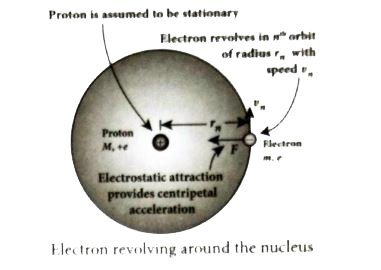 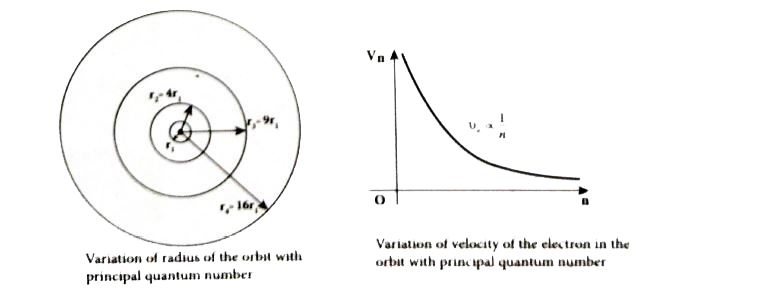
|
|
| 33. |
In a regular hexagon each corner is at a distance 'r' from the centre. Identical charges of magnitude 'Q' are placed at 5 corners. The field at the centre is (K=(1)/(4piepsilon_(0))) |
| Answer» Answer :A | |
| 34. |
A water molecule has an electric dipole moment 6.4xx10^-30 cm when it is in vapour state. The distance in meter between the centre of positive and negative charge of the molecule is : |
|
Answer» `4xx10^-10m` |
|
| 35. |
A uniform chain of length l and mass m lies on the surface of a smooth hemisphere of radius R(Rgtl) with one end tied to the top of the hemisphere as shown in the figure. Gravitational potential energy of the chain with respect to the base of the hemisphere is |
|
Answer» `(mgl)/2`  We have, `h/R=sinthetaorh=Rsintheta` Also, `DL=Rd THETA` Mass of dl length of CHAIN = `DM=m/l*dl` PE of dm mass = `dU=dmgh=(mgh)/l*dl=(mgh)/lRd theta=(mgR^(2))/lsinthetad theta` So, PE of complete chain is `U=int_(pi//2)^(pi//2-theta)dU=(mgR^(2))/lsin(l/R)` |
|
| 36. |
There are two particles of same mass. If one of the particles is at rest always and the other has an acceleration veca. Acceleration of centre of mass is? |
|
Answer» Zero |
|
| 37. |
An inductor coil is connected to a 10 V battery and in steady state, a current of 10 A is found to flow through it. Now this inductor coil is connected in series with a capacitor , and this combination is connected across AC supply of rms voltage 12 V. it is found that current flowing in the circuit is in the same phase with the voltage. Find the rms current flowing through the circuit. |
|
Answer» Solution :We can understand that RESISTANCE is also ASSOCIATED with the inductor coil and the same can be calculated by applying ohm.s law in case of DC circuit given to us. V = IR `rArr 10 = 10 xx R rArr R = 1 Omega`. If Z is the net impedance in the circuit, then rms current can be written as `I_(rms) = (V_(rms))/(Z)` . In this QUESTION, it is given that current is in the same PHASE with the voltage , and this is possible only when net reactance of the circuit is zero. We know that in series LCR circuit net neactance may be zero when reactance of inductor and capacitor is equal . In such a SITUATION, net impedance of the circuit becomes equal ot resistance of the circuit. Hence, Z = R = 1 `Omega`. Hence, rms current of this circuit can be written as ` I_(rms) - (V_(rms))/(Z) = (12)/(1) = 12 `A |
|
| 38. |
What is a cyclotron? |
|
Answer» SOLUTION :Cyclotron is a machine USED to accelerate positvely charged PARTICLES or ions to HIGH energies. OR Charged particles/ions to high energies. |
|
| 39. |
Select the correct option in the following. |
|
Answer» CHRISTIAN Huygens a contemporary of Newton established the wave theory of LIGHT by assuming that light waves were transverse |
|
| 40. |
The electric flux of a surface enclosing an electric dipole is |
|
Answer» Maximum |
|
| 41. |
When a sky wave is reflected onto the ground |
|
Answer» frequency of the REFLECTED WAVE is different to that of incident wave |
|
| 42. |
If a ray of light propagates from a rarer to a denser medium, how does its frequency change ? |
| Answer» SOLUTION :FREQUENCY REMAINS UNCHANGED. | |
| 43. |
Dr. Radhakrishnan did more than any other man to bring out and explain |
|
Answer» INDIAN PHILOSOPHICAL thought |
|
| 44. |
Two identical lumps of ice collide head on. What must their speed be for their complete sublimation to take place as a result of an inelastic collision? The initial temperature is t_0=-30^@C. Radiative losses are to bo neglected. |
|
Answer» The change in the internal energy is `Deltaepsilon_0=2m(c_1Deltat_1+lamda+c_2Deltat_2+L)` where `c_1`and `c_2`are the specific heats of ice and water, respectively, and `Deltat_1=0^@-(-30^@)=30^@C,Deltat_2=100^@-0^@=100^@C` Hence `v=sqrt(2(c_1Deltat_1+lamda+c_2Deltat_2+L))` |
|
| 45. |
A point source of light is kept below the surface of water (n_(w) = 4//3) at a depth of sqrt(7)m. The radius of the circular bright patch of light noticed on the surface of water is : |
|
Answer» `sqrt(7) m`  Hence, the radius of the CIRCULAR bright patch oflight noticed on the surface of water is GIVEN by `R h tan theta_(c )` `=sqrt(7)(sintheta_(c))/(costheta_(c))=sqrt(7)(1//mu)/(sqrt(1-(1)/(mu^(2))))=(sqrt(7))/(sqrt(mu^(2)-1))=3m` |
|
| 46. |
A source .S. emitting sound of 300Hz is fixed on block .A. which is attached to free end on spring SA as shown in the figure. The detector .D. fixed on block .B. attached to the free end of spring S_Bdetects this sound. The blocks .A. and "B. are simulataneously displaced towards eachother through a distance of lm and then left to vibrate. Find the maximum and minimum frequencies of sound detected by.D. if the vibrational frequency of each block is 2Hz (speed of sound 340 ms^(-1)) |
|
Answer» 323 HZ, 278.6 Hz |
|
| 47. |
What is the meaning of 'befall? |
|
Answer» (USED about something bad) to HAPPEN to somebody |
|
| 48. |
A block of mass 'm' is attached to a spring and is placed on a platform as shown in the figure, and the spring at this stage remains in a relaxed stage. When supporting platform is suddenly removed the mass begins to oscillate and moves down to a lowest position of 5 cm from its initial position. Then calculate the time taken by block to reach a height of 3 cm from its lowest position? |
| Answer» Solution :`(PI)/(40) + (1)/(20) SIN^(-1) (1//5)` | |
| 49. |
What's an a.m.u. ? |
| Answer» SOLUTION :Atomic MASS unit is the unit of mass, used in nuclear physics as ADOPTED by the international union of PURE and applied physics (IUPAP) one a.m.u. is `1/12th` of one `6^(C^12)` atom. | |
| 50. |
If radius of a hollow metallic sphere is .R.. If the P.D between it.s surface and a point at a distance 3R from it.s centre is V then the electric field intensity at a distance 3R from it.s centre is |
| Answer» Answer :D | |