

Saved Bookmarks
This section includes 7 InterviewSolutions, each offering curated multiple-choice questions to sharpen your Current Affairs knowledge and support exam preparation. Choose a topic below to get started.
| 1. |
A constant voltage is applied to n groups of resistors in siries where each group has m identical resistros in parallel. One resistor burns out in one group. Find the percentage increase of current in each resistor of the faulty group, and the percentage decrease of current in each resistor of the second group. |
|
Answer» |
|
| 2. |
When impact parameter is ........, then collision occurs. |
| Answer» Solution :0 m, Head on | |
| 3. |
Three charges +q, -q and +q are kept at the corners of an equilateral triangle of side d. Find the resultant electric force on a charge +q placed at the centroid O of the triangle. |
Answer» Solution :Let the force acting on +q charge at O due to +q at A be `F_(1), +q` at B be `F_(2) and -q` at C be `F_(3)`. Here `AO = OB = OC = (d)/(sqrt3)`  In magnitude `F_(1) = F_(2) = F_(3) = (1)/(4pi in_(0)) (3q^(2))/(d^(2))` Resultant of `F_(1) and F_(2) " is " F_(4) = (1)/(4pi in_(0)) (3q^(2))/(d^(2))` (an angle between `F_(1) and F_(2) " is" 120^(@)`) Direction of `F_(4)` is along the direction of `F_(3)`. HENCE the resultant force on +q at O is `F- F_(3) + F_(4) = (3q^(2))/(2PI in_(0)d^(2))` |
|
| 4. |
A domain in a ferromagnetic substance is in the form of a cube of volume 10^(-18)m^(3). Calculate the number of atoms present in the given volume and a hypothetical dipole moment and magnetisation of the domain ( given density of the substance 7.9xx 10^(3) "kgm"^(-3) molecular mass 55g / mole and dipole moment of each atom is 9.2 xx 10^(-24) "Am"^(2)). |
|
Answer» Solution :Given VOLUME of the cube = `10^(-18) m^(3)` MASS = (volume ) (density ) `= 10^(-18) m^(3)xx7.9xx 10^(3) "kg m"^(-3)` i.g., `"" m = 7.9 xx 10^(-15) ` kg Number of atoms = `(7.9 xx 10^(-15) xx 6.0235 xx 10^(23))/(55xx10^(-3))` `= 0.865 xx 10 ^(11)` =` 8.65 xx 10 ^(10)` atoms |
|
| 5. |
The ratio of angular momentum of an electron in the second excited state and the third excited state of hydrogen atom is |
|
Answer» 0.12777777777778 |
|
| 6. |
A 10muFcapacitor and 20muFcapacitor are connected in series across 200 V supply line. The charged capacitors are then disconnected from the line and reconnected with their positive plates together and negative plates together and no external voltage is applied. What is the potential difference across each capacitor? |
| Answer» Answer :A | |
| 7. |
A curent i ampere flows in the loop having circular are of r meter subtending an angle theta as shown in fig. The margeticfield at center O of the circle is : |
|
Answer» `(mu_@itheta)/(4pi R)sin theta` |
|
| 8. |
The inductance of a coil is proportional to ... |
|
Answer» its length |
|
| 9. |
A uniform magnetic field of 1000 G is established along the positive z-direction. A rectangular loop of sides 10 cm and 5 cm carries a current of 12 A. What is the torque on the loop as shown in the figure? |
|
Answer» ZERO |
|
| 10. |
Stae the essential conditions for two light waves must be coherent ? |
|
Answer» Solution :(i) The TWO waves MUST be continuous. (ii) The two waves should be of same FREQUENCY of wavelength. (iii) They should have content or zero phase difference. (iv) Prefectly, they should have equal AMPLITUDE. |
|
| 11. |
A electric motor working on a 100V d.c. supply draws a current of 15A. If efficiency of motor is 40%, then resistance of the windings of motor is : |
|
Answer» `4OMEGA` |
|
| 12. |
In half wave rectification, what is the output frequency if the input frequency is 50 Hz. |
|
Answer» 25 HZ In the halfwave rectification, the frequency remains CONSTANT. |
|
| 13. |
The following table gives the reactance and rms voltage across the elements of a series RCL circuit : {:("Circuit element","Reactance","Voltage across element"),("Resistor", 2.00xx10^2 Omega, 86V),("Inductor",3.77xx10^2 Omega,162V):} Determine the peak (not rms) voltage of the ac generator . |
| Answer» ANSWER :C | |
| 14. |
A straight rod of mass m and length L is suspended from the identical springs as shown in Fig. The spring is stretched by distance x_0 due to the weight of the wire. The circuit has total resistance R_0 When a magnetic field perpendicular to the plane of paper is switched on the spring are observed to extend further by the same distance. The strength of the magnetic field applied is |
|
Answer» `(MG R_0)/(E )` |
|
| 15. |
Two infinite planes each with uniform surfao charge density +sigma C/m^(2) are kept in such a wa m that the angle between them is 30°. Th electric field in the region shown between then is given by: |
|
Answer» `sigma/(2epsilon_(0))[(1+sqrt(3)/2)haty - 1/2hatx]` 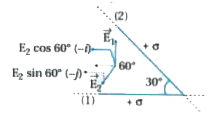 `vecE_(1) = sigma/(2epsilon_(0))(hatj)` `vecE_(2) = sigma/(2epsilon_(0)) SIN60^(@) (-hatj) + sigma/(2epsilon_(0))cos60^(@)(-hati)` `=sigma/(2epsilon_(0)) xx sqrt(3)/2hatj -sigma/(2epsilon_(0)) xx 1/2hati` `THEREFORE` Resultant ELECTRIC FIELD, `VECE =vecE_(1) + vecE_(2)` `=sigma/(2epsilon_(0))hatj - sigma/(2epsilon_(0)) xx sqrt(3)/2hatj - sigma/(2epsilon_(0)) xx 1/2hati` `=sigma/(2epsilon_(0))[(1-sqrt(3)/2)haty - 1/2hatx]` |
|
| 16. |
Draw 3 equipotential surfaces corresponding to a field that uniformly increases in magnitude but remains constant along Z-direction. How are these surfaces different from that of a constant electric field along Z-direction ? |
Answer» Solution :THREE EQUIPOTENTIAL surfaces having potentials `V_1= 3V,V_2=2 V and V_3=V` CORRESPONDING to a field `vecE = E_0 vecZ` , which increases uniformly in magnitude but remains constant along Z-direction, have been SHOWN in figure. As `vecE` is increasing along +ve direction of Z-axis, distance between two successive equipotential surfaces goes on DECREASING. 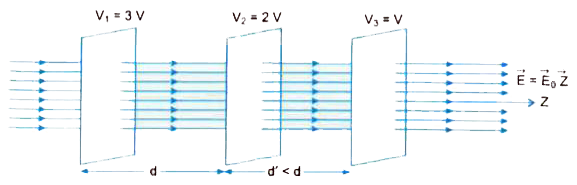 For a constant electric field along Z-direction distance between successive equipotenital surfaces is same as shown in figure. |
|
| 17. |
The Indian remote sensing satellite is |
|
Answer» Aryabhatt |
|
| 18. |
A proton and a deuteron are accelerated through the same accelerating potential. Which one of the two has : (a) Greater value of de-Broglie wavelength associated with it, and (b) Less momentum ? Give reasons to justify your answer. |
|
Answer» SOLUTION :(a) de-Broglie wavelength is given by `LAMBDA=(h)/(SQRT(2mqV))` As mass of proton `lt` mass of deuteron and `q_(p)=q_(d)` and v is same `implies lambda_(p) gt lambda_(d)` for same accelerating potential. (b) Momentum `= (h)/(lambda)` `:. lambda_(p) gt lambda_(d)` `:.` Momentum of proton will be less, than that of deutron. |
|
| 19. |
The principle used in the transmission of signals through an optical fibre is |
|
Answer» TOTAL INTERNAL reflection |
|
| 20. |
In the given circuit Ammeter reading is same when both switches S_(1), S_(2) are closed or opened . The value of resistance R is |
|
Answer» `200OMEGA` |
|
| 21. |
A conductor AB of length 10 cm is a distance of 10 cm from an infinitely long parallel conductor carrying 10A. What work must be done to move AB to a distance of 20 cm if it carries 5 A ? |
|
Answer» Solution :FORCE on a conductor at a distance ` x= (mu_0 i_1 i_2l)/(2 pi xx)` Work done to displace it through a small distance `"DR" = "force" xx "direction"` `rArr dw = (mu_0 i_1 i_2 l)/(2pir) dr` `w = int_(0.1)^(0.2) = (mu_0 i_1 i_2 l)/(2pir) dr ,` `w = (mu_0 i_1 i_2 l)/(2PI) ["LOG"_e xx]_(0.1)^(0.2)` ` w= (4 pi xx 10^(-7) xx 10 xx 5 xx 10 xx 10^(-2))/(2pi) "log"_e 2` `w = 0.693 xx 10^(-6)J.` |
|
| 22. |
Choose the correct alternative from the clues given at the end of the each statement : In the ground state of .......... electrons are in stable equilibrium, while in ....... electrons always experience a net force. (Thomson's model/Rutherford's model) |
| Answer» SOLUTION :Thomson.s MODEL, Rutherford.s model | |
| 23. |
What is the significance of time constant of R-L circuit ? |
| Answer» Solution :TIME constant of R-L circuit TELLS us how FAST or how slow is the growth/decay of current in the R-L circuit. LOW value of time constant INDICATES that the growth and decay are fast. Large values of time constant indicate that growth and decay of current in the current are slow. | |
| 24. |
Two like poles of strength49 xx 10^(-3)A-m and 9 xx 10^(-3)A -m are separated by a distance of 10 cm . Find the distance of the neutral point from the stronger pole wherethe magnetic induction due to the two poles will be zero . |
|
Answer» Solution :Let the distance of the netural point from the WEAKER pole `m_1 ` of the magnetic be x then , ` x = (d)/(sqrt((m_2)/(m_1)) + 1) = ( 10)/(sqrt((49 xx 10^(-3))/(9xx 10^(-3)) + 1) = (10)/((7)/(3) +1) = 3 cm` Then the distance of the neutral point from stronger pole = 10CM - 3cm = 7 cm |
|
| 25. |
Careful measurement of the electric field at the surface of a black box indicates that the net outward flux through the surface of the box is 8.0 xx10^(3) Nm^(2)/C. If the net outward flux through the surface of the box were zero, could you conclude that there were no charges inside the box? Why or Why not? |
| Answer» Solution :zero the NUMBEROF LINES entering the cube is the same as the numberof lines LEAVING THECUBE | |
| 26. |
I-V characteristic of four devices are shown in Fig Identify device that can be used for modulation |
|
Answer» (i) and (iii) |
|
| 27. |
(a) Derive the expression for the torque on a rectangular current carrying loop suspended in a uniform magnetic field. (b) A proton and a deuteron having equal momenta enter in a region of uniform magnetic field at right angle to the direction of the field. Depict their trajectories in the field. |
|
Answer» SOLUTION :(b) When a charged particle of charge .q. and momentum .p. enters in a region of uniform magnetic field `vecB` at right angle to the direction of the field, it describe a circular trajectory of radius `r = p/(qB)` As proton and deuteron have same charge and EQUAL momenta, hence both will revolve in EXACTLY the same circular path as shown FIG. 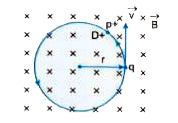
|
|
| 28. |
Explain the reverse characteristics of p-n junction diode by circuit diagram with graph. |
Answer» Solution :The circuit arrangement for reverse characteristics of the p-n junction diode is shown in the figure (B).  The battery is connected to the diode through a potentiometer or reheostat so that the applied VOLTAGE to the diode can be changed. For different values of voltages, the value of the current is noted. A graph between V and I is obtained as in figure (c ) question 30. Here current is of the order of `muA`. The current under reverse bias is essentially voltage independent upto a critical reverse bias voltage known as breakdown voltage `V_("br")`. When reverse bias voltage becomes equal to break down voltage `(V=V_("br"))`, the diode reverse current increases sharply. Even or slight increase in the bias voltage causes large change in the current. If the reverse current is not limited by an external circuit below the rated value, the p-n junction will get destroyed. Once it EXCEEDS the rated value, the diode gets destroyed due to overheating. For the diode in reverse bias, the current is very small `(-muA)` with opposite direction and almost remains constant with change in bias. It is called reverse saturation current. The general PURPOSE diode are not used beyond the reverse saturation current region. For diode, a quantitycalled dynamic resistance as the ratio of small change in voltage `DeltaV` to a small change in current `DeltaI` `r_(d)=(DeltaV)/(DeltaI)` The resistance of the diode in forward bias mode is approximately between `10Omega` to `100Omega` in reverse bias mode it is about of the order `10^(6)Omega (M Omega)`. |
|
| 29. |
Statement I: In the potentiometer circuit shown in figure. E_1 and E_2 are the emf of cells C_1 and C_2, repsectively, with E_1gtE_2. Cell C_1 has negligible internal resistance. For a given resistor R, the balance length is x. If the diameter of the potentiometer wire AB is increased, the balance length x will decrease. Statement II: At the balance point, the potential difference between AD due to cell C_1 is E_2 , the emf of cell C_2. |
|
Answer» Statement I is true, Statement II is True, Statement II is a correct EXPLANATION for Statement I. decrease. Hence, the potential DIFFERENCE between A and B due to CELL `C_1` will decrease. Therefore, the null point will be obtained at a higher VALUE of x. |
|
| 31. |
A uniform, horizontal beam of light is incident upon a quarter cyclinder of radius R=5cm, and has a refractive index 2//sqrt(3). A patch on the table at a distance 'x' from the cylinder is unilluminated. Find the value of 'x'? |
Answer» Solution :When the ANGLE of incidence is , .x. region will remain unillumiated. This is the LIMITING case.  When the angle of icidence is greater than CRITICAL agle T.I.R. will place, In this case also .x. region is unillaminated.  When angle of incidence `theta LT theta_c` , then the incident ray will refract and hence .x. region will be illuminated. So, in limiting case:  In ` Delta PQR , cos theta theta_c = (R )/(R +x) ` ` sintheta_c = (mu_r )/(mu _d )=(1)/( 2 //sqrt(3)) = ( sqrt(3))/(2)` ` thereforetheta_c = 60^@, R = 5cm`( given ) `impliescos 60= (5)/( 5+x) implies 5 +x =10` ` implies x=5cm`. |
|
| 32. |
Which part of the electromagnetic spectrum has the largest penetrating power ? (] Ans. Y-rays. |
| Answer» SOLUTION :`GAMMA-`RAYS | |
| 33. |
A 100 mu F capacitor in series with a 40 Omegaresistance is connected to a 110V. 60 Hz supply. What is the maximum current in the circuit ? |
|
Answer» Solution :For a RC CIRCUIT, if `V=V_(0) sin omega t` `I=(V_(0))/(sqrt(R^(2)+(I//omega C)^(2))) sin(omega t+phi)` where `tan phi=(1)/(omegaCR)` (a) `I_(0)=3.23A` (B) `phi=33.5^(@)` Time LAG `=(phi)/(omega)=1.55ms` |
|
| 34. |
Two magnets have the same lengthand the samepole strenght . But one of themagnets have a smallholeat its centre. Then |
|
Answer» Both have EQUAL magnetic MOMENT |
|
| 35. |
find the speedoftwoobjectssuchthatwhenthey moveuniformlytowardseachother,theyget4.0metersclosereachsecondandwhentheymoveuniformlyin thesamedireactionswithorigiinalspeedstheyget4.0metersclosereach10sec . |
|
Answer» Solution :Let their speeds be `v_(1)` and `v_(2)` and le t`v_(1) GT v_(2)` In First CASE: In second case: RELATIVE velocity, `v_(1) -v_(2) =4/10 = 0.4`…….(2) Solving eqns. (1) and (2), we get `v_(1) =2.2 ms^(-1), v_(2) =1.8 ms^(-1)` |
|
| 36. |
In angiosperms, the functional megaspore in the linear tetrad is generally |
|
Answer» Micropylar |
|
| 37. |
Fig represents an amplifier circuit with an input internal resistance r_(i)=50kOmega. It is connected to an ac voltage source through a series resistor of 100kOmega. The no load voltage gain of the transistor is 100. What is the apparent gain of the amplifier? |
|
Answer» |
|
| 38. |
What is a ground wave? |
| Answer» Solution :A RADIOWAVE signal PROPAGATING from ONE point to ANOTHER following the SURFACE of the earth is called surface or ground wave. | |
| 39. |
The distance time graph of a particle at time t makes an angle of 45^(@) with time axis. After 1 second it makes an angle of 60^(@) with time axis, what is the acceleration of the particle ? |
|
Answer» `sqrt(3-1)` Velocity after ONE sec=v=`TAN60^(@)=sqrt(3)` `:. a=(v-u)/(t)=(sqrt(3-1))/(1)=(sqrt(3-1))`. |
|
| 40. |
Derive an expression for electric field due to an electric dipole at a point on the axial line. |
|
Answer» SOLUTION :Let +1C be the test CHARGE at P, at a distance r from the centre of an electric dipole. Test charge +1C experiences a force of repulsion along BP DUE to +g at B and attraction due to -g along PA. Since .+q. is nearer than-q from P, the resultant force points along BP. Force experienced by a unit +ve charge is called electric field. Net `vecE=vecE_(+q)-vecE_(-q)=q/(4piepsilon_0) [1/((r-a)^2)-1/((r-a)^2)]hatp` where `hatp` representsthe unit vector of dipole momentpoint from -q to +q. `therefore vecE=(q/(4piepsilon_0))((2(2AR))/((r^2-a^2)^2))hatp` i.e., `vecE=("2pr"/(4piepsilon_0)) (1/((r^2-a^2)^2))hatp` `vecE=(1/(4piepsilon))(2vecpr)/((r^2-a^2)^2)` where , p=2aq and `vecp=phatp` 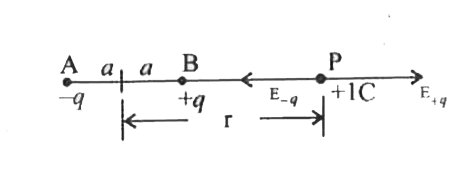 `|vecE|=((2pr)/(4piepsilon_0(r^2-a^2)))Vm^(-1)` `E=(2P)/(4piepsilon_0r^3)` for r > > a (for a short dipole) |
|
| 41. |
Can quantum of light be associated with particle? |
|
Answer» Solution :Photoelectric effect gave one unusual fact that when light interact with matter it behave as if it is made up of discrete quantum.ENERGY of each quantum is hv. There are two evidences that light can be associated with particle. (i)Einstein derived an important result that quantum of light has momentum of `(hv)/(c)` where h=planck.s constant v =frequency of light and c=speed of light. THUS,quantum of light has energy of hv and momentum of `(hv)/(c)`.Hence quantum of light can be associated with particle .Quantum of particle is called photon. (ii)Another evidence to associate light of quantum with particle was GIVEN by scientist A.H. Compton in 1924.He made experiment of scattering of X-ray by using ELECTRON. In 1921,Einstein was awarded Nobel prize for theoretical physics and invention of photoelectric effect. In 1923,Millikan was awarded Nobel prize for his work on invenrion of elementary charged particles and work on photoelectric effect. |
|
| 42. |
The coils of self inductances 6 mH and 8 mH are connected in series and are adjusted for highest co-efficient of coupling. Equivalent self inductance L for the assembly is approximately |
|
Answer» SOLUTION :Equivalent self inductance, `L_(eq)=L_(1)+L_(2)+2sqrt(L_(1)L_(2))` Here, `L_(1)=6 mH, L_(2)=8 mH, L_(eq)=L=?` `THEREFORE L=6+8+2xx SQRT(6xx8)~~ 28 mH` |
|
| 43. |
The particle which gives mass to protons and neutrons are |
|
Answer» HIGGS particle |
|
| 44. |
Demagnetisation of magnets is effected by |
|
Answer» ROUGH handling |
|
| 45. |
What helps you to manage an emergency situation? |
|
Answer» SKILLS of medical |
|
| 46. |
A disc revolves with a speed of 33(1/3) rev/min, and has a radius of 15 cm. Two coins are placed at 4 cm and 14 cm away from the centre of the record. If the coefficient of friction between the coins and the. record is 0.15, which of the coins will revolve with the record ? |
|
Answer» Solution : For the coin to revolve with be disc, the force of FRICTION should be enough to PROVIDE the necessary centripetal force, i.e. `(mv^(2))/r le mumg`. Now, `v=romega`, where `omega =(2pi)/T` is the ANGULAR frequency of the disc. For a given `MU` and `omega`, the condition is `r le (mug)/omega^(2)` The condition is SATISFIED by the nearer coin (4 cm from the centre). |
|
| 47. |
(a) Explain two features to distinguish between theinterferencepattern inYoung's doubleslit experimentwith the differencepatternobtaineddue to a single slit. (b)A monochromatic light of wavelength 500 nm is incidentnormally on a single slit of width 0.2 nm ofproducea diffraction pattern. Find the angular widthof the centralmaximumobtainedon the screen. Estimate the number of fringes obtainedin Young'sdouble slit experimental with fringewidth 0.5 mm, which can be accommodatedwithin the regionof total angularspread ofthe centralmaximumdue tosingle slit. |
Answer» SOLUTION :Explanation of TWO features (dintinguishing between INTERFERENCE PATTERN and DIFFRACTION pattern.)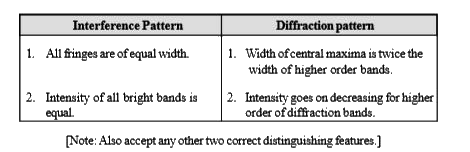
|
|
| 48. |
Two progressive waves y_(1) = 4 sin 400 pi t and y_(2) = 3 Sin 404 pi t moving in the same direction superpose on each other producing beats. Then the number of beats per second and the ratio of maximum to minimum intensity of the resultant waves are respectively |
|
Answer» 2 and `5/1` |
|
| 49. |
An observer moves towards a stationary source of sound with a velocity one-fifth of velocity of sound. The percentage increase in apparent frequency is |
| Answer» Answer :B | |