

Saved Bookmarks
This section includes 7 InterviewSolutions, each offering curated multiple-choice questions to sharpen your Current Affairs knowledge and support exam preparation. Choose a topic below to get started.
| 1. |
Velocity of particle having 1 mg mass is 72 km/hr.Its de-Broglie wavelength is …. |
|
Answer» <P>`3.3xx10^(-29)` `V=(72xx1000)/(3600)(m)/(s)` `lambda=(h)/(p)=(h)/(MV)` `therefore lambda=(6.6xx10^(-34))/(10^(-6)xx20)` `therefore lambda=3.3xx10^(-29)m` |
|
| 2. |
Draw a graph representing the change in specific resistance with temperature. |
|
Answer» SOLUTION :Let a' be the coefficient of linear expansion and a be the temperature coefficient of resistance of the material of the conductor. IF the resistivity of the material of the conductor at `0^@C` and `t^@C` and `rho_0` and `rho` respectively then, `rho=rho_0[1+(a+a')t]` or,`rho=rho_0(a+a')t+rho_0` IT is similar to the general EQUATION of straight line i.e., `y=mx+c` `rho-t` plot is SHOWN in the fig.1.101 
|
|
| 3. |
List-I gives different lens configurations. The radius of curvature of each surface is R. Rays of light parallel to the axis of lens from left of lens traversing through the lens get focused at distance f from the lens. List-II gives corresponding values of magnitudes of f (mu represent refractive index):- |
|
Answer» `{:(P,Q,R,S),(1,3,2,4):}` `(1)/(f)=(mu_(L)-mu_(s))/(mu_(s)^(')R_(I))-(mu_(L)-mu_(s)^('))/(mu_(s)^(')R_(2))` `(1)/(f)=(1)/(R)[(1.5-1.0)/(1.4)+(1.5-1.4)/(1.4)]` `(1)/(f)=(1)/(1.4R)[0.5+0.1]` `(1)/(f)=(6)/(14R)=(3)/(7R)` `f=(7R)/(3)` `(Q) (1)/((f_(eq))_(m))= (1)/(f_(m))-(2)/(f_(L))=-(2)/(R)-(2)/(f_(L))` `(1)/(f_(L))=((mu_(L))/(mu_(s))-1)(2)/(R)=(1.5/(1.4)-1)(2)/(R)=(0.1)/(1.4)xx(2)/(R)` `(1)/(f_(L))=(1)/(7R)` `(1)/((f_(eq))_(m))=-(2)/(R)-(2)/(7R)=-(16)/(7R)` `implies (f_(eq))_(m)=-(7R)/(16)` 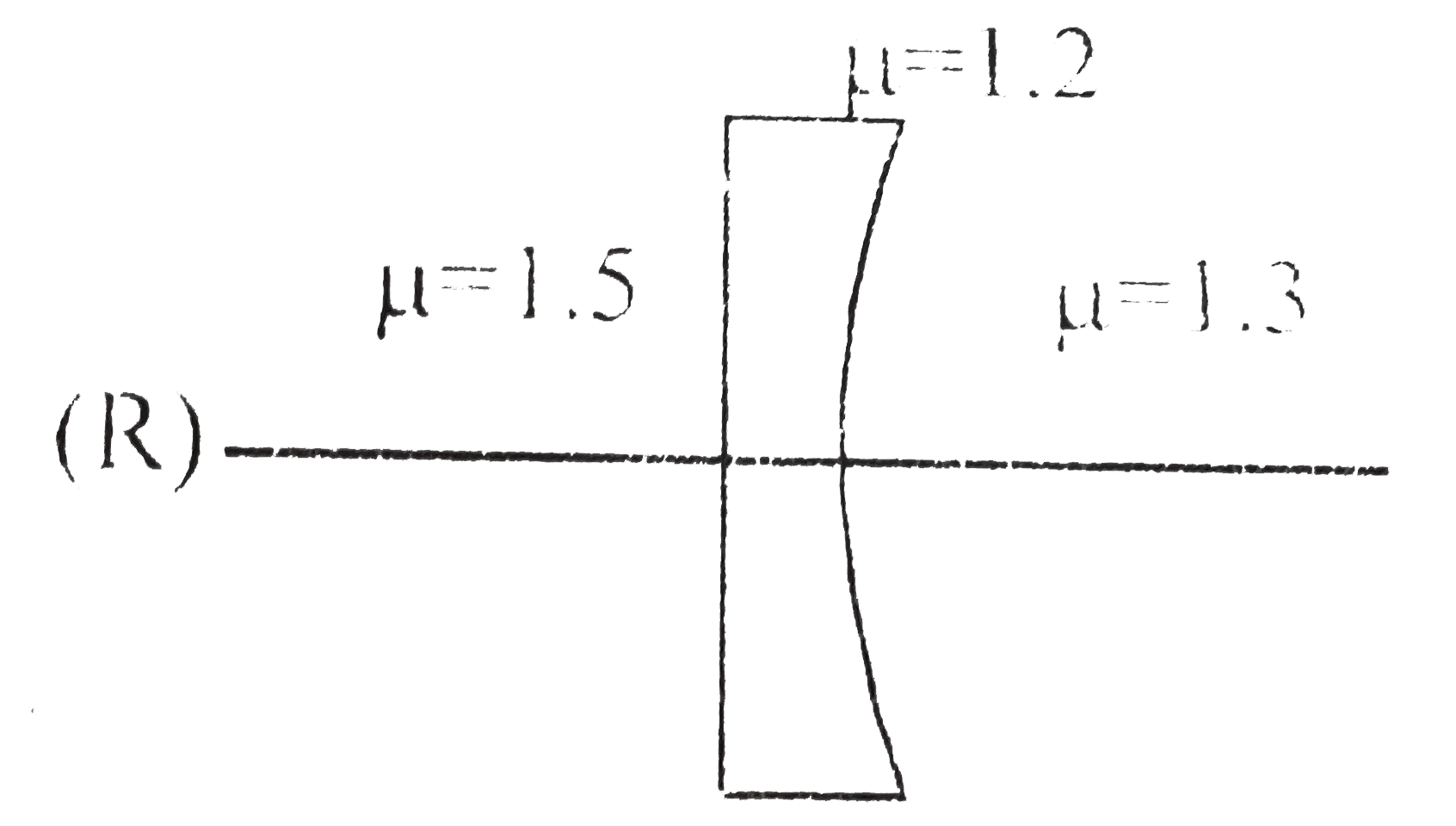 `(1)/(f)= [(1.2-1.5)/(1.3xxoo)-((1.2-1.3))/(1.3xxR)]` `(1)/(f)=(1)/(13R)` `(S) = 13R` `(1)/(f_(1))=((1.2)/(1.3)-1)(-(2)/(R))=+(0.1)/(1.3)((2)/(R))=(2)/(13R)` `(1)/(f_(2))=((1.4)/(1.3)-1)((2)/(R))=(2)/(13R)` `(1)/(f_(eq))=(1)/(f_(1))+(1)/(f_(2))=(4)/(13R)` `(1)/(f_(eq))=(13R)/(4)` |
|
| 4. |
How are infrared waves produced ? Why are these referred to as 'heat waves' ? Write their one important use. |
|
Answer» Solution :Method of production : By HOT BODIES and molecules / due to vibrations of atoms and molecules / due to transition of electrons between two (closely spaced) ENERGY levels in an atom. Infrared waves are called heat waves as they cause heating effect/ RISE in TEMPERATURE. Any one use : Maintains earth.s warmth, physical therapy, remote switches etc. |
|
| 5. |
A p-typesemiconductor is made from a silicon specimen by doping on an average one indium atom per 5xx10^(7) silicon atoms .If the number density of atoms in the silicon specimen is 5xx10^(26) atom//m^(3), then the number of acceptor atoms in silicon per cubic centimetre will be |
|
Answer» `2.5xx10^(30)` |
|
| 6. |
Four identical charges, Q each, are fixed at the vertices of a square. A free charge q is placed at the centre of the square. Investigate the nature of equilibrium of charge q if it is to be displaced slightly along any of the two diagonals of the square. |
|
Answer» |
|
| 7. |
A thin walled spherical conducting shells S of radius R is given charge Q,the same amount of charge is also placed at its centre C.Which of the following statements are correct. |
|
Answer» On the outer SURFACE of S, the charge DENSITY is `Q//2piR^2`. Charge density at the outer surface (Fig. SAI.59) is `(2Q)/(4piR^(2))=(Q)/(2piR^(2))` `E_("inside")=(Q)/(4piepsilon_(0)R^(2)),E_("outside")=(2Q)/(4piepsilon_(0)R^(2))` `therefore E_("outside")=2E_("inside")` 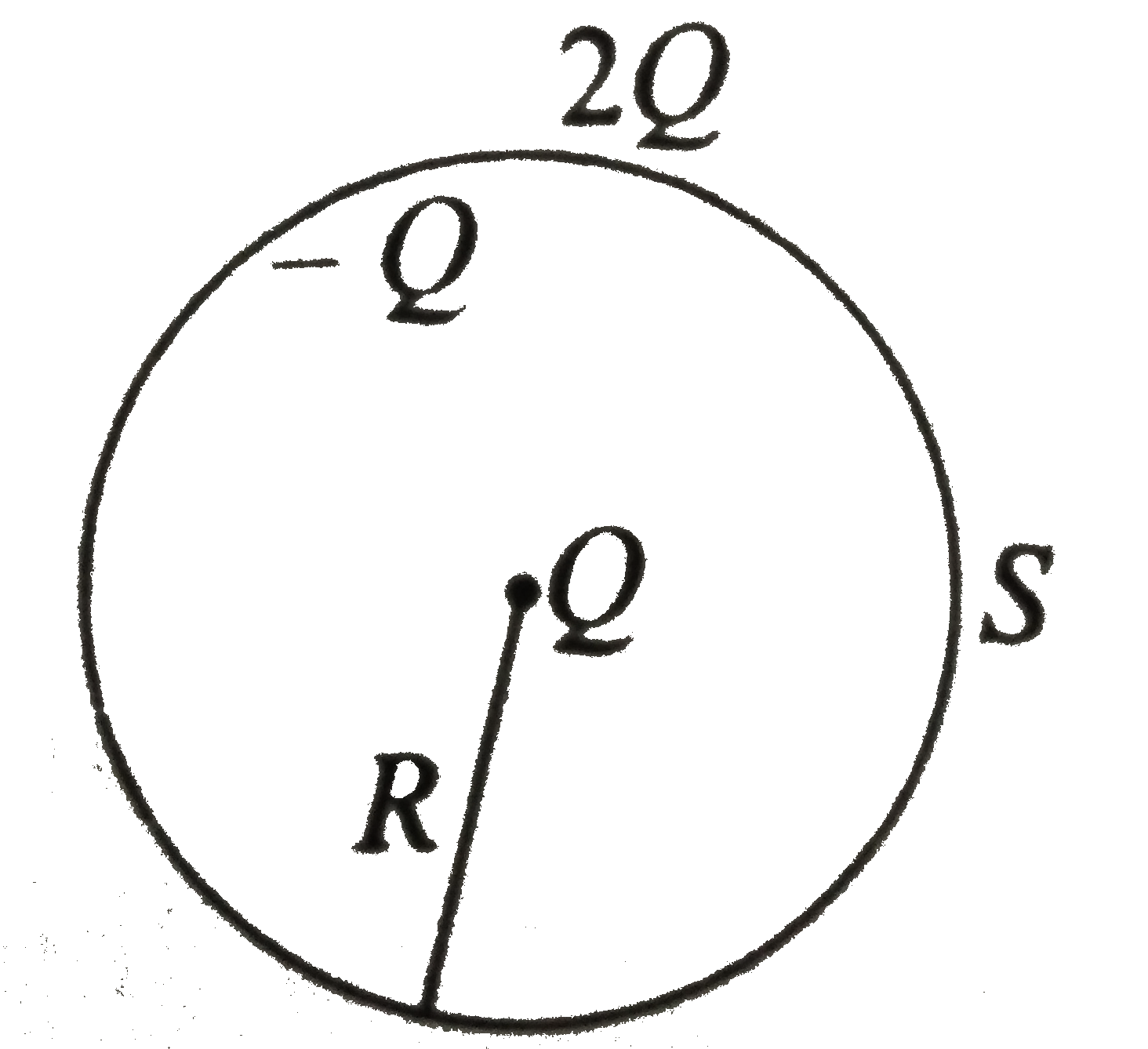
|
|
| 8. |
A conducting rod of mass 1 kg and length 1 m is suspended by two strings, so as to remain horizontal. If 2T horizontal magnetic field is applied perpendicular to the length of the rod then what amount of current should be passed through this rod to remove tension in two strings ? (Take g = 10ms^(-2)) |
|
Answer» 0.5A  For equilibrium of CONSIDERED ROD, `2T+F_(m)=W` `thereforeF_(m)=W" "(because"As per the statement "2T=0)` `thereforeIlBasin90^(@)=MG` `thereforeI=(mg)/(lB)=(1xx10)/(1xx2)=5A` |
|
| 9. |
The coulomb electrostatic force is defined for |
|
Answer» TWO SPHERICAL CHARGES at rest |
|
| 10. |
The coefficient of mutual induction of primary and secondary of an induction coil is 6H and a current of 5A is cut off in 3xx10^-4sec. The induced e.m.f. produced in secondary coil is: |
|
Answer» `1.0xx10^-4V` |
|
| 11. |
A cell of emf of 1.5V is connected in series with a potentiometer wire of 10m length and a resistance of 2980 Omegain primary circuit. Resistance of potentiometer wire is 2 Omega /m. If one junction of thermo couple in hot oil and the other is in melting ice, balancing point is 450cm. Thermo emf generated is |
|
Answer» 0.0045V |
|
| 12. |
Considering the case of a parallel plate capacitor being charged, show how one is requiredto generalize Ampere's circuital law to include the term due to displacmentcurrent. |
|
Answer» Solution :Using GAUSS' law, the electric flux `phi_(epsi)` of a parallel plate capacitor having an area A, and a total charge Q is `phi_(epsi)=EA=(1)/(epsi_(0))(Q)/(A)xxA=(Q)/(epsi_(0))` Where electric field is, `E=(Q)/(Aepsie_(0))`. As the charge Q on the capacitor plates CHANGES with time, so CURRENT is given by `i=dQ//dt` `(phi_(epsi))/(dt)=(d)/dt((Q)/(epsi_(0)))=(1)/(epsi_(0))(dQ)/(dt)` `rArrepsi_(0)(depsi_(0))/(dt)=(dQ)/(dt)=i`This is the missing. Term in Ampere's circuital law. So the total current through the conductor is `i="Conduction current"(ic)+"Displacement current" (id)` `therefore ""i=i_(c)+i_(d)=i_(c)+epsi(dphi_(E))/(dt)` As Ampere's circuital law is given by `therefore phivecB*vecdt=mu_(0)I` After modification we have Ampere's Maxwell law is given as `phiB.dt=mu_(0)i_(c)+mu_(0)epsi_(0)(dphi_(E))/(dt)` The total current passing through any surface, of which the closed loop is the perimeter, is the sum of the conduction and diplacement current. |
|
| 13. |
(a) Define a wavefront. Using Huygen's principle, verify the laws of reflection at a plane surface. (b) In a single-slit diffraction experiment, the width of the slit is made double the original width. How does this affect the size and intensity of the central diffraction band? Explain. (c) When a tiny circular obstacle is placed in the path of light from a distant source, a bright spot is seen at the centre of the obstacle. explain why. |
|
Answer» Solution :(b) When slit width .a. is doubled, angular width (and, consequently, the linear width too) of central diffraction band GIVEN by `theta=pm(LAMDA)/(a)` is reduced to one-half of its previous value. Consequently, the amplitude of light for central diffraction band will become twice of its previous value and as a result, the new intensity will be 4 times the origiinal value. (c) Waves diffraction from the edge of the CIRCULAR OBSTACLE INTERFERE constructively at the centre of the shadow of circular obstacle. as a result, the centre point is a bright spot. |
|
| 14. |
In the above problem, this horizontal distance between the two fragments when their position vectors ares |
| Answer» ANSWER :A | |
| 15. |
A body of mass 2 gm is projected horizontally from the top of tower of height 20m with a velocity 10 m/s. The charge on the body is 2C. Electric field is applied vertically downwards and of intensity 10^(-2) N//C. Find the time taken by the body to touch the ground (g = 10 m//s^2) |
| Answer» ANSWER :B | |
| 16. |
A galvanometer of resistance 1000Omega gives full-scale deflection for a current of 1mA. To measure a P.D of 10V, the resistance to be connected with the galvanometer is |
|
Answer» `9kOmega` in SERIES |
|
| 17. |
Dielectric strength of air is 3xx10^(6) V.m^(-1). Suppose the radius of a hollow sphere in the Van de Graff generation is R =0.5 m , calculate themaximum potential difference created by this Van de Graaff generator . |
|
Answer» Solution :The electric field on the SURFACE of the sphere (by Gauss LAW ) is GIVEN by `E=(1)/(4piepsilon_(0))(Q)/(R^(2))` The potential on the surface of the hollow METALLIC sphere is given by `V=(1)/(4piepsilon_(0))(Q)/( R)=ER` with `V_("max")=E_("max")R` Here `E_("max")=3xx10^(6)(V)/(m)`. So the maximum potential difference created is given by `V_("max")=3xx10^(6)xx0.5=1.5xx10^(6)V` (or) 1.5 million VOLT |
|
| 18. |
When the tension in a string is increased by 44%. the frequency increased by 10Hz the frequency of the string is |
| Answer» Answer :D | |
| 19. |
A concave mirror has a focal length 20 cm. The distance between the two positions of the object for which the image size is double of the object size is |
|
Answer» 20 cm |
|
| 20. |
Find an expression for the potential at a point due to a point charge Q. |
|
Answer» Solution :Consider a charge + Q situated at point O and let us want to determine electric potential due to it at a point P situated at a distance r. Then, by DEFINITION potential is equal to AMOUNT of work done in order to bring unit +ve charge, WITHOUT any ACCELERATION, from `oo` to point P. `:. V = W_(oo-p)= underset(oo)oversetrintvecE.vecdx= -undersetoooversetrintE dx = -undersetoooversetrintQ/(4pi epsi_0x^2)dx` `=(Q)/(4pi epsi_0)[1/x]_oo^r = Q/(4pi epsi_0)[1/r-1/oo] = Q/(4pi epsi_0r)` 
|
|
| 21. |
A uniform magnetic fieldvecB is set up along the positive x-axis. A particle of charge 'q' and mass 'm' moving with a velocity vecv entresthe field at the origin in X-Y plane such that it has velocity companents both along and perpendicular to the magnetic field vecB. Trace, giving reason. the fraectory followed by the particle . Find out the expression for the distance moved by the particle along the magnetic field in one rotation. |
|
Answer» Solution :field at an axial point OFA circular coil: ` B= oint DB sin theta` where, `dB= mu_(0)/(4PI) (idl)/x^(2)` Where N is the number of TURNS of the circular coil. If M -iA is the magnetic moment of the coil, then ` sin theta = a/x Rightarrow B = mu_(0)/(4pi) (ia)/x^(3) oint dl = mu_(0)/(4pi) ( ia (2pia))/ ( r^(2) +a^(2))^(3//2)` ` B= (mu_(0) ia^(2) N)/(2 (r^(2) +a^(2))^(3//2))` Where, N is the number of turns of the circular, coil. If M =iA is the magnetic moment of thecoil, then `M = i pia^(2) ` for single turn ` M= pia^(2)` for a coil of N turns ` B = mu_(0)/(4pi) .(2M)/((r^(2) +a^(2))^(3//2)) ` for small loop, ` B =(mu_(0))/(4pi) .(2M)/r^(3) Wb // m^(2)` This is a SIMILAR result as obtained end on position of electric dipole where, ` E= 1/ (4pie_(0)). (2p)/(r^(3)) ` ( where is electric moment. 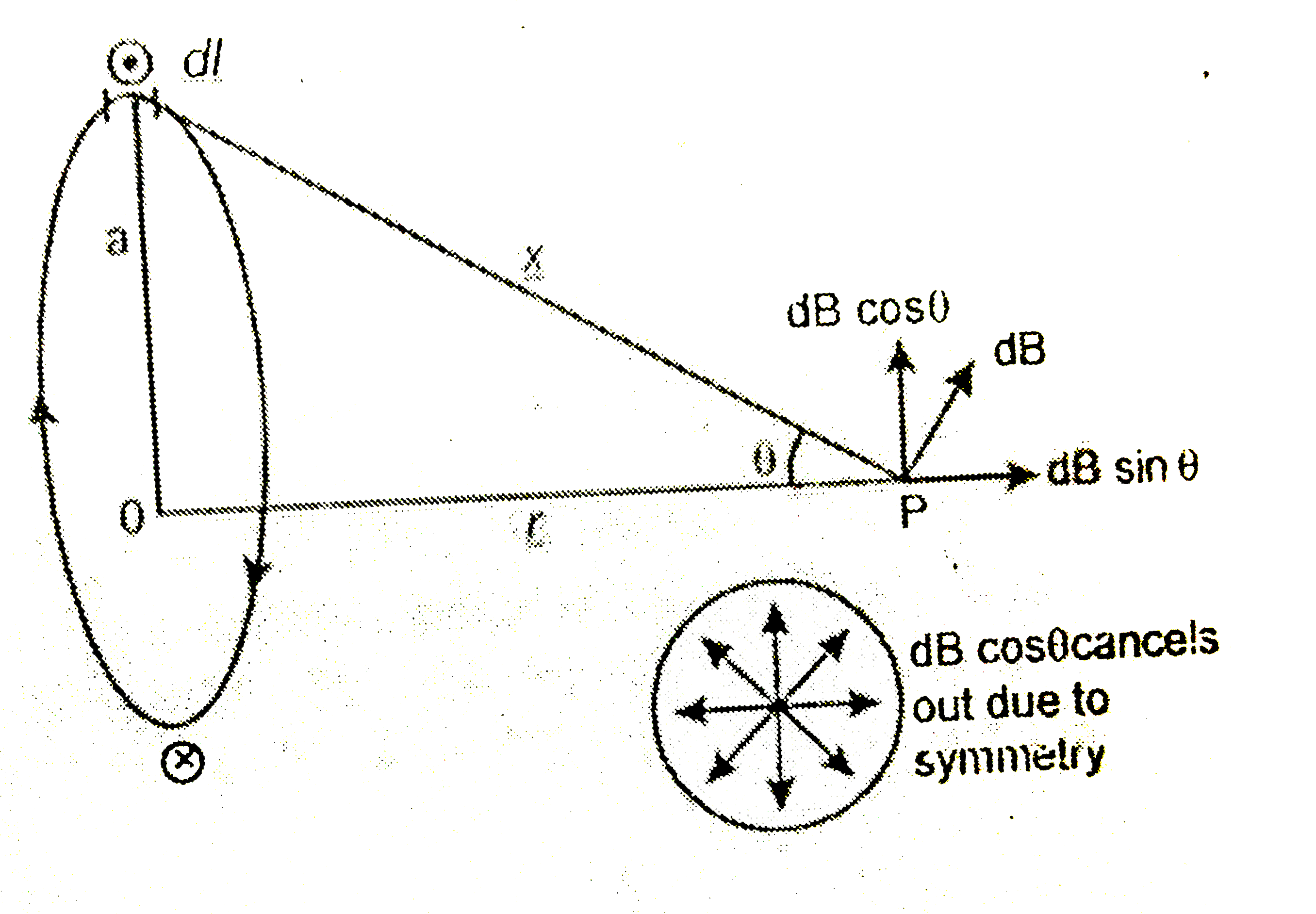
|
|
| 22. |
A 2 MeV proton is moving perpendicular to a uniform magnetic field of 2.5 T the force on the proton is (mass of proton = 1.6 xx 10^(-27) kg) |
|
Answer» `10 xx10^(-12) N` |
|
| 23. |
In a wheatstone bridge, the resistance of the arms of the bridge are AB = 2Omega, BC = 4Omega ,AD = 1Omega and DC = 3Omega. The terminals of negligible resistance to A and C. If a galvanometer of resistance 100Omega is connected between B and D, find the current in the galvanometer. |
|
Answer» |
|
| 24. |
Given a current carrying wire of nonuniform cross section. Which of the following quantity or quantities are constant throughout the length of the wire? |
|
Answer» CURRENT, ELECTRIC FIELD and drift speed |
|
| 25. |
Three spring mass systems in vertical plane are shown in the figure. The mass of all the pulleys and connecting strings and springs are negligible and friction at all contacts is absent. [g = 10 m//s^(2)] Calculate T_(1), T_(2) and T_(3) which are the time periods of small vertical oscillation of mass m in system, l system - II and system -III respectively. |
Answer» Solution :`T_(1) = 2pi sqrt((3m)/(2k)), T_(2) = 2pi sqrt((9m)/(8k)), T_(3) = 2pi sqrt((3m)/(4k))` 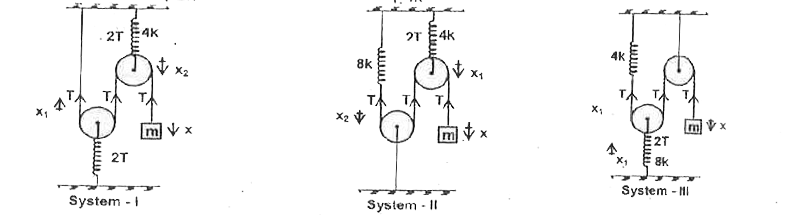 From constraint, `x =2 (x_(1) + x_(2))` `(T)/(k_(eq)) = 2 ((2T)/(8k) + (2T)/(4k))` `(1)/(k_(eq)) = (1)/(2k) + (1)/(k) = (3)/(2k)` `:. k_(eq) = (2k)/(3)` Time period `T = 2pi sqrt((3m)/(2k))` From constraint, `x = 2x_(1) + x_(2)` `(T)/(k_(eq)) = 2 ((2T)/(4k)) + (T)/(8k)` `(1)/(k_(eq)) = (1)/(k) + (1)/(8k) = (9)/(8k)` `:. k_(eq) = 8k//g` `rArr T = 2pi sqrt((9m)/(8k))` From constraint, `x= 2x_(1) + x_(2)` `(T)/(k_(eq)) = 2 ((2T)/(8k))+ (T)/(4k)` `(1)/(k_(eq)) = (1)/(2k) + (1)/(4k) = (3)/(4k)` `k_(eq) = (4k)/(3)` `:. T = 2pi sqrt((3m)/(4k))` |
|
| 26. |
A spring of force constant 800 N/m has an extension of 5 cm. The work done in extending it from 5 cm to 15 cm is: |
|
Answer» 16 J `W = 1/2k_2x_2^2 - 1/2 k_1x_1^2 = 1/2k(x_2^2 - x_1^2) = 1/2 xx 800[(15/100)^2 - (5/100)^2] = 8J`. |
|
| 27. |
The figure below shows currents in a part of electric circuit. The current is: |
|
Answer» 1.7A |
|
| 28. |
(a) Derive the relationship between the peak and the rms value of current in an a.c. circuit. (b) Describe briefly, with the help of a labelled diagram, working of a step-up transformer. A step-up transformer converts a low voltage into high voltage. Does it not violate the principal of conservation of energy? Explain. |
|
Answer» Solution :(a) Root Mean Square (r.m.s) or virtual value of A.C. : It is that steady current, which when passed through a resistance for a GIVEN time will produce the same amount of heat as the alternating current does in the same resistance and in the same time. It is denoted by `I_("rms") or I_(V)`. Derivation of r.m.s value of current : The instantaneous value of A. C. passing through a resistance R is given by, `I = I_(0) sin omega t` The alternating current changes continuously with time. Suppose that the current through the resistance remains constant for an INFINITESIMALLY small time dt. Then, small amount of heat produced the reistance R in time dt is given by `dH = I^(2) R dt = (I_(0) sin omega r)^(2) R dt` `= I_(0) R sin^(2) omega t dt` The amount of heat produced in the resistance in time T/2 is `H = underset(0)overset(.^(T)//_(2))int I_(0)^(2) R sin^(2) omega t dt = I_(0)^(2) R underset(0)overset(.^(T)//_(2))int (1 - cos 2 omega t)/(2) dt` `H = (I_(0)^(2)R)/(2) [t - (sin 2 omega t)/(2 omega)]_(0)^(.^(T)//_(2)) H = (i_(0)^(2)R)/(2) [(T)/(2) = (sin 2 omega t.(T)/(2))/(2 omega) - 0]` `H = (I_(0)^(2)R)/(2) [(T)/(2) - (sin 2.(2pi)/(T).(T)/(2))/(2 omega] h = (I_(0)^(2)R)/(2) [(T)/(2) - (sin 2 pi)/(2 omega)]` `H = (I_(0)^(2) R)/(2).(T)/(2) " " ..(i) { :' sin 2pi = 0]` If `I_(rms)` be the r.m.svalue of a.c., then by definition `H = I_(rms)^(2) R (T)/(2)`...(ii) From equations (i) and (ii), we have `I_(rms)^(2) R (T)/(2) = (I_(0)^(2)R)/(2).(T)/(2)` `I_(rms)^(2) = (I_(0)^(2))/(2) rArr I_(rms) = (I_(0))/(sqrt2) = 0.707 I_(0)` (b) Transformer : It is a device which converts high A.C. voltage into low A.C. voltage and vice versa. It is based upon the principle of MUTUAL induction. When alternating current passed through a coil, an iduced e.m.f. is set up in the NEIGHBOUR coil. A transformer when increases voltage, the current is reduced so that input power and output power remains same. So, it does not violate conservation of ENERGY principle |
|
| 29. |
Moving particles of matter should display wavelike properties under suitable conditions. Which experiment established the wave nature of particles? |
| Answer» SOLUTION :DAVISSION GERMER EXPT | |
| 30. |
A protom and an alpha particle are both accelerated through a potential difference of 100 V. the ratio of the de-Broglie wavelength associated with the progom to that associated with the alpha particle is |
|
Answer» `1:1` `(lamda_(p))/(lamda_(alpha))=sqrt((m_(prop)q_(prop))/(m_(p)q_(p)))=sqrt(4xx2)=2sqrt(2)implies lamda_(p):lamda_(alpha)=2sqrt(2):1`. |
|
| 31. |
A coil has a self inductance of 0.01H. The current through it is allowed to change at the rate of 1A in 10^(-2)s . Calculate the emf induced. |
|
Answer» 1V |
|
| 32. |
A source emitting sound of frequency 180 Hz is placed in front of a wall at a distance of 2m from it. a detector is also placed in front of the wall at the same distance from it. The minimum distance between the source and the detector is x mtrs for which the detector shows a maxima of sound. Speed of sound in air = 360 m/s |
|
Answer» |
|
| 33. |
A particle of mass 100 g tied to a string is rotated along the circle of radius 0.5 m. The breaking tension of the string is 10 N. The maximum speed with which particle can be rotated without breaking the string is |
|
Answer» `10 " MS"^(-1)` |
|
| 34. |
A ball moving with speed u collides with an identical ball at rest. The velocities of two balls after collision are (If the collision is elastic): |
|
Answer» (0,V) |
|
| 35. |
Which of the following does give a correct correspondence between an electrical quantity and a mechanical quantity ? |
|
Answer» CHARGE `to`moment of inertia, INDUCTANCE `to` COEFFICIENT of friction |
|
| 36. |
A wedge of mass M lies on a smooth fixed wedge of inclination theta. A particle of mass m lies on the wedge of mass M in the figure. All surfaces are frictionless and the distance of the block from the fixed wedge is l. Find. (a) Normal reaction between m and M (b) the time after which the particle will hit the fixed plane. |
Answer» Solution :In the reference FRAME attachedto wedge of mass M the PARTICLE of mass m can only move horizontally.  FBD of wedge of mass M with respect to FBD of particle w.r.t. wedge of mass M ground APPLYING Newton.s `2^(nd)` law of the particle `N+ma_(WQ)SIN theta=mg "" ...(i)` `ma_(wq)cos theta=ma_(mM)""...(ii)` Applying Newton.s `2^(nd)` law for wedge of mass M `N sin theta+mg sin theta=Ma_(wq)"" ...(iii)` Solving (i), (ii) and (iii) we get `a_(wq)=((M+m)g sin theta)/(M+m sin^(2)theta)` `N=(Mmgcos^(2)theta)/((M+m sin^(2)theta))` `a_(mM)=((M+m)g sin theta cos theta)/(M+m sin^(2)theta)` |
|
| 37. |
A charged capacitor of capacitance C is discharged through a resistance R. A radioactive sample decays with an average-life tau . Find the value of R for which the ratio of the electrostatic field energy stored in the capacitor to the activity of the radioactive sample remains constant in time. |
|
Answer» |
|
| 38. |
An e.m. wave trevelling along z -axis: vecE=vecE_0cos (kz-omegat). Choose the correct option from the following : |
|
Answer» The associated magnetic FIELD is given as `vecB=1/C hatkxxvecE` `vecE=vecE_0cos (kz-omegat)` which is perpendicular to z-axis. It acts along negative y-direction. The associated magnetic field `vecB` in em wave is along x-axis, i.e., along `hatkxxvecE`. As `B_0=(E_0)/c :. vecB=1/c(hatkxxvecE)` Thus, option (a) is correct. The associated electric field can be written in terms of magnetic field as `vecE=c(vecBxxhatk)` Thus, option (b) is correct. Angle between `hatk and vecE` is `90^@`. THEREFORE, `hatk. vecE=1Ecos 90^@=0` and `hatk.vecB=1vecEcos 90^@=0.` Thus, option (c) is correct. |
|
| 39. |
Consider the circuit shown in figure. What is the current in the inductor at the instant the switch is thrown to position b? |
| Answer» Answer :A | |
| 40. |
A series LCR circuit contains inductance 5 mH, capacitance 2 mu F and resistance 10 Omega. If a frequencyA.C. source is varied, what is the frequency at which maximum power is dissipated ? |
|
Answer» `(10^(5))/(pi) Hz` |
|
| 41. |
The power engine which accelerates a car of mass 800 kg to a speed of 72 km/h from rest in 32s is |
|
Answer» Solution :Speed of the CAR v=72km/h =20 m/s `KE=1/2(mv^2)=1/2xx800xx400=400xx400J P=(KE)/time=400xx400/32=5000W=5KW` |
|
| 42. |
Two light waves having the same wavelength lambdain vocume are in phaseinitially . Thenthe firstrayinitially . Thenthe first raytravels a pathof length L_(1)through a mediumof refractiveindex mu .The secondraytravels a pathof length L_(2)througha mediumof refractive index mu_(2) .The two waves are thencombined to observeinterferenceeffects . The phase difference betweenthe two , whenthey interfere is |
|
Answer» `(2pi)/LAMBDA (L_(1)-L_(2))` |
|
| 43. |
De Morgan के नियम अनुसार |
|
Answer» `(ANNB)^C=A^CnnB^C` |
|
| 44. |
A vertical pipe at both ends is partially submerged in water. A tuning fork of unknown frequency is placed near the top of the pipe and made to vibrate. The pipe can be moved up and down and thus length of air column in the pipe, standing waves will be setup as a result of directions. Smallest value of length of air column, for which sound intensity is maximum, is 10 cm. (take speed of sound, v = 344 m/s]Frequency of the tuning fork is |
| Answer» ANSWER :C | |
| 45. |
A vertical pipe at both ends is partially submerged in water. A tuning fork of unknown frequency is placed near the top of the pipe and made to vibrate. The pipe can be moved up and down and thus length of air column in the pipe, standing waves will be setup as a result of directions. Smallest value of length of air column, for which sound intensity is maximum, is 10 cm. (take speed of sound, v = 344 m/s]The air column here is closed at one end because the surface of water acts as a wall. Which of the following is correct ? |
|
Answer» At the CLOSED end of the air column, there is a DISPLACEMENT NODE and also a PRESSURE node |
|
| 46. |
A vertical pipe at both ends is partially submerged in water. A tuning fork of unknown frequency is placed near the top of the pipe and made to vibrate. The pipe can be moved up and down and thus length of air column in the pipe, standing waves will be setup as a result of directions. Smallest value of length of air column, for which sound intensity is maximum, is 10 cm. (take speed of sound, v = 344 m/s] Length of air column for second resonance will be |
|
Answer» 30cm |
|
| 47. |
A galvanometer with a coil of resistance 90Omega shows full scale deflection for a potential difference 25mV. What should be the value of resistance to convert the galvanometer into a voltmeter of range 0V to 5V. How should it be converted? |
| Answer» SOLUTION :`1910 OMEGA` in SERIES | |
| 48. |
Define: i) photoelectric work function ii) electron volt (eV) |
| Answer» Solution :Photoelectric work function: Work function of a metal surface is the minimum amount of energy required to liberate an electron from the metal surface. Electron VOLT (eV): 1eV is the energy ACQUIRED by an electron when it is accelerated by applying a POTENTIAL DIFFERENCE of one volt. `i,e leV=1.6 xx 10^(-19)J` | |
| 49. |
A pure inductor of 25.0 mH is connected to a source of 220 V. Find the inductive reactance and rms current in the circuit if the frequency of the source is 50 Hz. |
|
Answer» SOLUTION :The inductive reactance, `X_(L)=2pi vL=2xx3.14xx50xx25xx10^(-3)OMEGA` `=7.85Omega` The RMS current in the circuit is `I=(V)/(X_(L))=(220V)/(7.85Omega)=28A` |
|
| 50. |
A vertical pipe at both ends is partially submerged in water. A tuning fork of unknown frequency is placed near the top of the pipe and made to vibrate. The pipe can be moved up and down and thus length of air column in the pipe, standing waves will be setup as a result of directions. Smallest value of length of air column, for which sound intensity is maximum, is 10 cm. (take speed of sound, v = 344 m/s]Length of air column for third resonance will be |
|
Answer» 30cm |
|