

Saved Bookmarks
This section includes 7 InterviewSolutions, each offering curated multiple-choice questions to sharpen your Current Affairs knowledge and support exam preparation. Choose a topic below to get started.
| 1. |
Obtain the expression of electric field at any point by continuous distribution of charge on a surface. |
Answer» Solution :Suppose, surface `DeltaS`is divided into small elements and `vecr` is the position vector on anyone element. 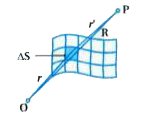 `sigma`is the surface charge DENSITY HENCE, charge on `DeltaS` surface element `DeltaQ = sigma.DeltaS, therefore sigma = (DeltaQ)/(DeltaS)` Suppose a POINT P (inside or outside) the surface whose position vector is `vecR`and distance from `DeltaS` is r. and unit vector is r.. Electric field at P due to charge on a `sigma DeltaS`, `DeltavecE = (ksigmaDeltaS)/(r.)^(2).hatr` Total electric field at P by superposition principle, `vecE = sum_(s) (ksigma.DeltaS)/(r.)^(2).hatr` By integration method, `vecE = int_(S)(ksigma.DeltaS)/(r.)^(2).hatr` |
|
| 2. |
In the last illustration, suppose that the battery is kept connected while the plates are pulled apart. What are the answers to the parts (a), (b), (c) and (d) in that case ? |
|
Answer» Solution : If the battery is kept connected, the potential difference ACROSS the capacitor plates always remains equal to the emf of battery and HENCE is constant. ` V =V_0 = 50 V ` ` C =( in _0 A)/(d) =( in _0 A)/( 2d) =(C_0)/(2) 1.77 xx 10^(-1) MUF ` ` Q =CV =(C_0 V_0)/(2) =(Q_0)/(2)=(Q_0)/(2) = 8.85 xx 10 ^(-4) mu C ` ` U= (1)/(2) CV^(2) =(1)/(2) ((C_0)/( 2)) V_0^(2) =(U_0)/(2) =2.21xx 10 ^(-5) J` `E =(V)/(d) =(V_0)/(2d_0)=(E_0)/(2) = 2500 V//m ` |
|
| 3. |
A cylinder of mass M and radius R moves with constant speed v through a region of space that contains dust particles of mass m which is at rest. There are n number of particles per unit volume. The cylinder moves in a direction perpendicular to its axis. Assume mlt ltM, and assumes the particles do not interact wilth each other. All the collision takes place is perfectly elastic and the surface of the cylinder is smooth. The drag force per unit length of the cyliner require to maintain the speed v contant for the cylinder is K/3nmRv^(2). Find the value of K? |
|
Answer» `f=int_(-(pi)/2)^(+(pi)/2)2mvcos^(2)theta(RD thetacostheta)lvn` `f/l=8/3mv^(2)nR`. 
|
|
| 4. |
Consider the following statement A and B and identify the correct answer A) Fresnel.s diffraction pattern occurs when the source of light or the screen on which the diffraction pattern is seen or when both are at finite distance from the aperture B) Diffraction light can be used to estimate the helical structure of nucleic acids |
|
Answer» A is FALSE but B is TRUE |
|
| 5. |
A thin circular ring of mass Mand radius r is rotating about its axis with a constant angular velocity omega. Four objects each of mass m, are kept gently to the opposite ends of two perpendicular diameters of the ring. The angular velocity of the ring will be |
|
Answer» `(Momega)/(4m)` `L=Iomega`= CONSTANT. Therefore, `I_(2)omega_(2) = I_(1)omega_(1)` or `omega_(2)=(I_(1)omega_(1))/(I_(2))=(Mk^(2)omega)/((M+4m)k^(2))=(Momega)/(M+4m)` |
|
| 6. |
An electron is projected with velocity 10^(7)m//s at an angle theta(=30^(@)) with horizontal, in a region of uniform electrilc fieldof 500N//C vertically upwards. Find the maximum distance covered by an electron in vertical direction above its initial level |
|
Answer» `14.2mm` |
|
| 7. |
Empirical formula for wave number of spectral lines of Balmer series for hydrogen atom is bar(V) = _________. |
| Answer» SOLUTION :`R[(1)/((2)^(2)) - (1)/((N)^(2))] ` where n = 3,4,5,.... | |
| 8. |
Two fixed, identical conducting plates (a and (3), each of surface area S are charged to - Q and q, respectively, where Q > q > 0. A third identical plate (lambda ), free to move Is located on the other side of the plate with charge q at a distance d as per figure. The third plate is released and collides with the plate f_3 . Assume the collision is elastic and the time of collision is sufficient to redistribute charge amongst beta and gamma. (a) Find the electric field acting on the plate gammabefore collision. (b) Find the charges on betaand gammaafter the collision. (c) Find the velocity of the plate gammaafter the collision and at a distance d from the plate beta |
|
Answer» Solution :(a) Net electric field at plate `gamma`before collision is vector sum of electric field at plate `gamma`due to plate a and p. The electric field at plate `gamma` due to plate `alpha` is, `vecE_(1) = -Q(S(2epsilon_(0))(-hati))` The electric field at plate `gamma` due to plane `beta` is, `vecE_(2) = q/(S(2epsilon_(0))(-hati)` `THEREFORE` Hence, the net electric field at plate `gamma` before collision is, `vecE = vecE_(1) + vecE_(2) = (q-Q)/(S(2epsilon_(0))(hati)` `therefore (Q-q)/(S(2epsilon_(0))` to the field, If `Q gt q` (b) During collision plates `beta` and `gamma`are in contact with each other, hence their POTENTIALS become same. Suppose charge on plate `beta`is `q_(1)`and charge on plate `gamma`is `q_2`. At any point O in between the two plates, the electric field must be zero. Electric field at O due to plate `alpha`, `vecE_(a) = Q/(S(2epsilon_(0))(-hati)` Electric field at O due to plate `beta` `vecE_(2) = q_(1)/(S(2epsilon_(0))(hati)` Electric field at O due to plate `gamma` `vecE_(y) = q_(2)/(S(2epsilon_(0))(-hati)` As the electric field at O is zero, therefore, `(Q + q_(2))/(S(2epsilon_(0)))= q_(1)/(S(2epsilon_(0))` `therefore Q + q_(2) = q_(1)` 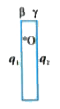 On solving eq. (1) and (2) we get, `q_(1) =(Q+ q/2)` = Change on plate `beta` `q_(1) = (q/2)` = charge on plate `gamma` (c) Let the velocity be v at the distance d from plate `beta` after the collision. If m is the mass of the plate `gamma`, then the gain in K.E. over the round trip must be equal to the work done by the electric field. `vecE_(2) = Q/(2epsilon_(0)S)(-hati) + (Q+q/2)/(2epsilon_(0)S)hati=(q/2)/(2 epsilon_(0)S)hati` Just before collision, electric field at plate: `gamma` is `vecE_(1) = (Q-q)/(2epsilon_(0)S) hati` and `vecF_(2) = vecE_(2).q/2 =(q/2)^(2)/(2epsilon_(0)S)hati` Total work done by the electric field is round trip MOVEMENT of plate `gamma` `W = (F_(1) + F_(2))d` `=((Q-q/2)^(2)d)/(2epsilon_(0)S)` If m is the mass of plate `gamma` , the K.E. gained by the plate =`1/2mv^(2)` According to work energy principle, `1/2mv^(2) = W RARR 1/2mv^(2) = ((Q-q/2)^(2)d)/(2epsilon_(0)S)` `thereforev= (Q-q/2)(d/(mepsilon_(0)S))^(1//2)` |
|
| 9. |
A vertical pipe at both ends is partially submerged in water. A tuning fork of unknown frequency is placed near the top of the pipe and made to vibrate. The pipe can be moved up and down and thus length of air column in the pipe, standing waves will be setup as a result of directions. Smallest value of length of air column, for which sound intensity is maximum, is 10 cm. (take speed of sound, v = 344 m/s] Frequency of the second overtone is |
|
Answer» 3400 HZ |
|
| 10. |
What is isotope? Give an example. |
| Answer» Solution :ISOTOPES are atoms of the same element having same atomic NUMBER Z, but different massnumber A. For example, hydrogen has three isotopes and they represented as `""_(1)^(1)"H"`(hydrogen), `""_(1)^(2)"H"`(deuterium), and `""_(1)^(3)"H"`(TRITIUM). | |
| 11. |
Can the sum of twovectors be scalar ? Can it be a numeric ? |
| Answer» SOLUTION :No, The sum of two vectors is ALWAYS a VECTOR. | |
| 13. |
A p-n junction is fabricated from a semiconductor with a band gap of 2.8 eV. Can it detect a wavelength of 600 nm? Justify your answer. |
| Answer» | |
| 14. |
Give an equation representing the decay of a free neutron? |
| Answer» Solution :`" "_(0)^(1)n to " "_(+1)^(1)p+" "_(-1)^(0)e+bar(NU)` | |
| 15. |
Two magnets are held together in a vibration magnetometer and are allowed to oscillate in the earth's magnetic field with like poles together, 12 oscillations per minute are made but for unlike poles together only 4 oscillations per minute are executed. The ratio of their magnetic moments is |
|
Answer» `3:1` |
|
| 16. |
In a p-n junction diode made with Ge, the thickness of depletion layer is 2xx10^(-6)m and barrier potential is 0.3V. Find the strength of the electric field at the junction. |
| Answer» Solution :`1.5xx10^(5)Vm^(-1)` from N to pside` | |
| 17. |
Why are microscopes fitted with a small aperture objectives? |
| Answer» SOLUTION :Let `theta` be angle between the marginal and central ray. It has been found that (Resolving power of microscope) `prop1/sintheta` smaller the angle Q, greater is the resolving power. THEREFORE, we have small APERTURE OBJECTIVES. | |
| 18. |
If vecA = 2 hati + hatj + hatk and vecB = hati + hatj + hatk are the two vectors, match the following answer the questions by appropriately matching the information given in the three columns of the following table: Which option represents a vector orthogonal to vecA xx vecB ? |
|
Answer» `(IV) (ii) (M)` |
|
| 19. |
The magnitude of potential barrier of germanium is about 0.3 V . a What does it mean ., b . What is the value of potential barrier for silicon ? |
|
Answer» Solution :a . The DEPLETION LAYER has the p.d = 0.3 EV . In order to PASS current through the junction , a voltage `GT 0.3` V is required . b. 0.7 V |
|
| 20. |
Find moment of inertia of a uniform rectangular plate (mass m) about axis AB lying in its plane and passing through center as shown in the figure. |
| Answer» SOLUTION :`ML^(2)//12` | |
| 21. |
The velocity filter of a mass spectrometer employs an electric field strength of 1.0 xx 10^(2) V/m and a perpendicular magnetic induction of 2.0 xx 10^(-4)T. The induction of the deflecting uniform magnolie Deld which is perpendicular to the beam is 9.0 xx 10^(-2) T. Ions with similar arges and with mass numbers 20 and 22 pass through the filter and make a 180^@ turn in the deflecting field (Fig. 28.12). What is the distance between the points S_1 and S_2? |
|
Answer» We obtain the difference sought by assurning the ion to be singly ionized, ie. by putting: q= e. |
|
| 22. |
The mode of propagation used by short wave broadcast service is |
|
Answer» SPACE wave |
|
| 23. |
When the voltage drop across a P.N junction diode is increased from 0.65V to 0.70V,the change in diode current is 5mA.The dynamic resistance of the diode is |
|
Answer» `20OMEGA` |
|
| 24. |
A convex spherical surface of radius of curvature 20cm seperates air and glass of refractive index 1.5.An object is placed in air at a distance of 100cm from the glass surface. At what position the image is formed ? |
| Answer» SOLUTION :`(-1)/U+ n/v= (n-1)/R, 1/100+1.5/v= (1.5-1)/20` v=100cm | |
| 25. |
At equilibrium, in a p-n junctiondiode the net current is |
|
Answer» due to DIFFUSION of majority CHARGE carriers. |
|
| 26. |
If unit of mass is taken as 1 kg, of time as I minute and that acceleration due to gravity istaken as 9.81 ms^(-2) , what is the unit of energy ? |
|
Answer» Solution :NEW unit of energy =`E_(1)` , New unit of mass `M_(1) = 1kg ` New unit of time `T_(1)=1` minute = 60 sec New unit of length `=L_(1)` `E_(1) [ M_(1)L_(1)T_(1)^(-2)]` New unit of acceleration due gravity , `g_(1)= 9.81 ms^(-2)` `g_(1)=L_(1)T_(1)^(-2)L_(1)=g_(1)T_(1)^(-2)=9.81xx(60)^(2)` meter `E_(1)=|1kg xx(9.81xx60^(2))^(2)m^(2)(60)^(-2)S^(-2)|` `E_(1)=(1xx9.81xx60xx60xx9.81xx60xx60)/(60xx60) kgm^(2)s^(-2)` `E_(1) = 3.464 xx10^(5) kg m^(2) sec^(-2)` `:.` The new unit of energy `E_(1)= 3.464xx10^(5)` JOULE . |
|
| 27. |
In space charge limited region, the plate current in a diode is 10 mA for a plate voltage 150 V. If the plate voltage is increased to 600 V, then the plate current will be |
|
Answer» `10 mA` Thus, `(i_(p_(2)))/(i_(p_(1)))=((V_(p_(2)))/(V_(p_(1))))^(3//2)=(600/150)^(3//2)=(4)^(3//2)=8` or `i_(p_(2))=i_(p_(1))xx8=10xx8mA=80mA` |
|
| 28. |
A particle moves in the xy plane according to the equation vec(r )= (hat(i) + 2hat(j))A cos omega t The motion of the particle is |
|
Answer» on a STRAIGHT line |
|
| 29. |
The mass of an atom is expressed in…… |
|
Answer» kg |
|
| 30. |
A uniform rod AB of length l and mass m is free to rotate about point A. The rod is released from rest in the horizontal position. Given that the moment of inertia of the rod about A is ml^(2)//3, the initial angular acceleration of the rod will be |
|
Answer» `(MGL)/2` `tau=mgxxl/2=(mgl)/2` Also `tau=Ialpha` `therefore` Angular ACCELERATION, `alpha=(tau)/I=(mgl//2)/(ml^(2)//3)=3/2g/l` 
|
|
| 31. |
(a) Derive the law of radioactive decay N=N_(0)e^(-lamdat) (b) The half- life of ""_(92)^(238)U undergoing alpha - decay is 4.5 xx10^(9) years. Find its mean life. (c) What fraction of the initial mass of a radioactive substance will decay in five half - life periods ? |
|
Answer» Solution :(a) According to the law of radioactive decay , we know that rate of disintegration of a radioactive sample is directly proportional to the actual quantity of that material at that instant. Mathematically , `(-dN)/(dt)=lamdaN` where `lamda` is the disintegration (or decay) constant of given radioactive substance `:. (dN)/N=lamda dt ` On INTEGRATION , we have `int_(N_0)^(N_t)(dN)/N=-lamdaint_(0)^(t)dtimplies[log_eN]_(N_0)^(N_t)=-lamda[t]_0^(t)` `implies log_(e) N_(t)-log_(e)N_(0)=-lamdat" or " log_(e)(N_t/N_0)=-lamdat` or `N_t/N_0=e^(-lamdat)impliesN_t=N_(0)e^(-lamdat)` (b) As half life period of `""_(92)^(238)U,T_(1/2)=4.5xx10^9` years `:.` Mean life `tau=(T_(1/2))/(0.693)=(4.5xx10^9)/(0.693)=6.5xx10^(9)` years (c) FRACTION of radioactive subsance LEFT intact after n = 5 half LIVES is = `[1/2]^n=[1/2]^(5)=1/32` `:.` Fraction of the initial mass of a radioactive substance decayed in 5 half lives `=1-(1)/32 = 31 / (32)` or 96.875% |
|
| 32. |
An infinitely long cylinder is kept parallel to an uniform magnetic field B directed along positive z-axis. The direction of induced current as seen from the z-axis will be |
|
Answer» clockwise of the positive z-axis |
|
| 33. |
In the depletion region of an unbiased p-n junction diode, there are |
|
Answer» HOLES |
|
| 34. |
A ray of light is incidentan angle of 50^(@) on one face of a cube of side 0.10 m. If the refractive index of the material of the glass cube is 1.55 then calculate the amount of lateral shift produced by it. |
|
Answer» Solution :Given `N = 1.55 t = 0.10m i = 50^(@) L.S =` ? `LS=(t sin(i-r))/(COS r)""`.......(1) `n= (sin i)/(sin r)""`.......(2) `therefore sin r= (sin50^(@))/(1.55)=(0.7660)/(1.55)=0.4942` `therefore r=29^(@)37. andcosr = cos 29^(@)37.` `=0.8694` `sin(50^(@)-29^(@)37.)=sin(49^(@)60.-29^(@)37.)` `=sin(20^(@)(20^(@)23.))=0.3493` `therefore` using the VALUES of cos r and `sin(i-r)` in (1) we get `L.S=(0.10xx0.3493)/(0.8694)=0.040m` Lateral shift produced is 0.040m |
|
| 35. |
The expression for critical frequency is |
|
Answer» `f_(c)=sqrt((N_("MAX")E^(2))/(4pi^(2)epsilon_(0)m))` |
|
| 36. |
What metal has in its absorption spectrum the difference between the frequencies of X-rays K and L absorption edges equal to Delta omega= 6.85.10^(18) S^(-1) ? |
|
Answer» Solution :The difference in FREQUENCIES of the `K` and `L` absorption edges is equal, accorfing to the Bohr picture, to the frequency of the `k_(alpha)` line(SEE the diagram below). Thus by Mosely's formule `DELTA omega =(3)/(4)R(Ƶ-1)^(2)` or `Ƶ=1+sqrt((4Delta omega)/(3R))=22`  The metal is titanium. |
|
| 37. |
A dish antenna with radius 10 m completely absorbs the radio waves with amplitude 2xx10^(-7)Vm^(-1) incident on it perpendicularly. Find force exerted on this antenna. |
| Answer» SOLUTION :`F=5.55xx10^(-23)N` | |
| 38. |
UV radiations of 6.2 eV fall on an aluminium surface whose work function is 4.2 eV. The kinetic energy of the fastest electron emitted by the sluminium surface will be |
|
Answer» `3.2xx10^(-19)J` |
|
| 39. |
A convex lens from a real image 16 cm long on a screen. Without altering the position of the object and screen, the lens is displaced so as to again get a real image 4 cm long on screen. What is size of the object ? |
|
Answer» 8 CM `O = sqrt(I_(1). I_(2) = sqrt(16 XX 4) = 8 cm`. |
|
| 40. |
If in a wheatstone bridge thebattery and galvanometer are interchanged the condition for balance |
|
Answer» Is disturbed `E= 50+(11xxr)` `E= 60+(lxxr)` Form equation (1) and (2) , we get , `50 +11r= 60 +r` `Rightarrow 10r = 10` `therefore `r=1 SUBSTITUTE in equation (1) `E=50+11= 61V` `therefore E= 61V, r=1Omega` |
|
| 41. |
What is the efficiency of a heat engine whose temperature of source and sink are 800 K and 600 K respectively? |
|
Answer» 1 `=1-(3)/(4)=(1)/(4)XX100` =25% |
|
| 42. |
A thin wire of length l and mass m is turned into the form of a semicircle. Its moment of inertia about an axis joining its free ends will be |
|
Answer» `mpil^(2)` MOMENT of mertta of nng about a DIAMETER =`(mR^(2))/2` M.I. of SEMICIRCLE = `1/2[m.(1/pi)^(2)]=(ml^(2))/(2pi^(2))` |
|
| 43. |
State the laws of radioactive decay. Define the term 'decay constant' for a radioactive substance. |
|
Answer» 1. Radioactivity is spontaneous process which does not depend upon external factors. 2. During disintegration either `ALPHA`- or `BETA`-particle is emitted. Both are never emitted simultaneously. 3. Emission of `alpha`-particle decreases atomic number by two and mass number by 4. 4. Emission of `beta`-particle increases atomic number by one but mass number remains the same. 5. Emission of `gamma`-rays does not change atomic or mass number. 6. The number of atomic disintegrated per second is DIRECTLY proportional to the number of radioactive atoms actually present at that instant. This law is called radioactive decay law. i.e. `-(dN)/(dt) prop N_(o)` |
|
| 44. |
A bulb with 1.2 ohm resistance is connected to an accumulator in series with a choke. Estimate the inductance of the choke, if the bulb starts to burn brightly 2.5 s after the circuit has been closed. |
|
Answer» |
|
| 45. |
Derive i+e=A+delta for a triangular glass prism. |
Answer» Solution :In figure the cross-section perpendicular to the rectangular SURFACE of a prism made up of a transparent MEDIUM is shown. A ray of monochromatic light is incident at point Q on the AB surface of the prism. According to Snell.s Law, it is refracted and travels along path QR. It experiences deviation `delta_1`, at point Q. Ray QR is incident on surface AC at point R and suffering deviation `delta_2`, due to refraction emerges in the DIRECTION RS. If the incident ray PQ is extended it advances in QE direction. When the emergent ray RS is extended backwards it meets PE in D. Incidence angle : Angle made by incident ray at a point on surface with normal is called incidence angle. `anglePQK = i` Refracted angle : Angle made by refracted ray at a point on surface with normal is called refracted angle. `angleRQL = r_1`, and `angleQRL = r_2` Emergence angle : Angle made by emergent ray with normal of surface is called emergence angle. `angle`TRS = e Angle of Deviation : “Angle between incident ray and emergent ray is called angle of deviation `(delta)`”. `angle epsilon DS =delta` In the figure in `squareAQLR,` `angleAQL = 90^@` and `angleARL= 90^@`are right angle. `therefore angleA+angleQLR=180^@` ... (1) Now, in `triangleQLR` `r_1+r_2+angleQLR=180^@` ...(2) From equation (1) and (2), `r_1+r_2+angleQLR=angleA+angleQLR=180^@` `therefore r_1+r_2=angleA` ... (3) From the geometry of the figure angle of deviation `delta` is the EXTERIOR angle for `angleDQR i.e. angleEDS = angleDOR` `therefore angleEDS=angleDQR+angleDRQ` `therefore delta=delta_1+delta_2` but, `angleDQR = angleDQL – angleRQL ` `delta_1=i-r_1`[`because angle PQK=angleDQL=i]` and,`angleDRQ=angleDRL-angleQRL` `delta_2=e-r_2` `delta=i-r_1+e-r_2` `delta=i+e-(r_1+r_2)` `thereforedelta=i+e-A` [`because` equation (3)] `thereforei+e=A+delta` This equation gives the relation between angle of deviation, angle of incident, angle of emergence and angle of prism. From above equation we say that angle of deviation depends on the angle of incidence. |
|
| 46. |
An electric dipole has the magnitude of its charge as a and its dipole moment is p. It is placed in a uniform electric field E. If its dipole moment is along the direction of the field, the force on it and its potential energy are respectively. |
|
Answer» 2q.E and MINIMUM |
|
| 47. |
A coil having resistance 15 Omega and inductance 10H is connected across a 90 Volt dc supply. Determine the value of current after 2sec. What si the energy stored in the magnetic field at that instant? |
|
Answer» |
|
| 48. |
A projectile is thrown with a velocity of 10sqrt(2) ms^(-1)at an angle of 45° with the horizontal. The time interval between the moments when the speeds are sqrt(125) ms^(-1) is (g=10ms^(-2)) |
Answer» SOLUTION :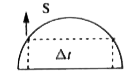 `u_(n) = 10, u_(y)=0` `v^(2) =v_(x)^(2) + v_(y)^(2)` `125 = 100 +v_(y)^(2)` `Deltat =(2v_(y))/g =(2 xx 5)/10 = 1s` |
|
| 49. |
For production of beats the two souces must have |
|
Answer» differnet FREQUENCIES and SAEM ampltude |
|
| 50. |
Three point masses each of mass'm' are joined together using a string to form an equilateral triangle of side 'a'. The system is placed on a smooth horizontal surface and rotated with a constant angular velocity 'omega' about a vertical axis passing through the centroid. Then the tension in each string is |
|
Answer» `ma OMEGA^(2)` |
|