

Saved Bookmarks
This section includes 7 InterviewSolutions, each offering curated multiple-choice questions to sharpen your Current Affairs knowledge and support exam preparation. Choose a topic below to get started.
| 1. |
The speed withwhicha bullentcan be firedis 150 ms^(-1). Calculate the greatest distanceto whichit canbe projectedandalsothe maximum height to whichit would rise . |
|
Answer» Solution :`R=(U^(2) sin 2alpha)/G =((150^(2) sin 90^(@))/9.8) = 2295.1` m `H_("max") =(u^(2)sin^(2)alpha)/(2g) =((150)^(2) sin^(2)45^(@))/(2 xx 9.8) = 573.97` m |
|
| 2. |
Estimate the distance for which ray optics a good approximation for an aperture of 4 mm and the wavelength is 400 nm. (or) Calculate the distance a beam of light of wavelength 400 nm can travel without significant broadening, if the aperture is 4mm wide. |
| Answer» Answer :A | |
| 3. |
A rectangular loop carrying a steady current is placed in a uniform magnetic field. Obtain the expression for the torque acting on the loop. |
| Answer» SOLUTION :REFER TEXT | |
| 4. |
Find the refractive index of the material of prism if a thin prism of angle A=6^(@) produces a deviation delta=3^(@). |
|
Answer» `1.5` `delta=A(mu-1)impliesmu=1+(delta)/A` `mu=1+3/6=1.5` `mu=1.5` |
|
| 5. |
In which type of material the magnetic susceptibility does not depend on temperature |
|
Answer» ferrite |
|
| 6. |
Two circular coils are made of two identicle wires of length 20 cm. One coil has number of turns 9 and the other has 3. If the same current flows through the coils then the ratio of magnetic fields of induclion at their centres is |
|
Answer» `1:9` |
|
| 7. |
A parallel beam of light of wavelength 5000 fot A is incident normally on a single slit of width 0.001 mm. The light is focussed by a convex lens on a screen placed in focal plane.The first minimum is formed for the angle of diffraction equal to : |
|
Answer» `0^(@)` `therefore sin theta = (lambda)/(a) = 0.5` `theta = 30^(@)`. |
|
| 8. |
When a charged particle enters perpendicular to a magnetic field, it experiences a force. Name the force. |
| Answer» SOLUTION :MAGNETIC LORENTZ FORCE | |
| 9. |
The distance of 2 short bar magnets from the centre of the magnetometer compass box are 5 cm and 10 cm, when the pointer shows no deflection. The magnetic moments of the magnetsin the ratio (in Tan A position) |
|
Answer» `5 : 10` |
|
| 10. |
Derive an expression for the electric potential at any point along the axial line of an electric dipole. |
|
Answer» <P> Solution :Consider a point P situated at a distance R from mid-point of an electric dipole along its axial line.Electric potential at P DUE to +ve CHARGE at B,` V_B = 1/(4pi epsi_0) . q/((r-a))` 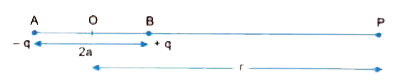 and electric potential at P due to - ve charge at A, `V_A = 1/(4pi epsi_0). ((-q))/((r+a))` `:.` Net electric potential at point P, `V = V_B + V_A = 1/(4pi epsi_0) . q/((r-a)) - 1/(4pi epsi_0) .q/((r + a))` `=q/(4 pi epsi_0)[1/((r-a)) - 1/((r + a))] = q/(4pi epsi_0) . (2a)/((r^2 -a^2)) = p/(4pi epsi_0(r^2 - a^2))` If `r gt gt a`, then we have `V = p/(4pi epsi_0r^2)`. |
|
| 11. |
A sample radio active subsistence has 10^(6)radio active radio active nuclei. It.s half-life is 20 sec. How many nuclei will remain after 10 seconds? |
|
Answer» `7 xx10^(5)` |
|
| 12. |
The current and voltage in ac circuit are given by I=5SIN(100t-pi/2)A V=200SIN(100) volt. The power dissipated in the circuit will be |
|
Answer» 20W |
|
| 13. |
The mass and energy equivalent to 1 a m u respectively are |
|
Answer» `1.67xx10^(-27)` g, 9.30 MEV |
|
| 14. |
A hemispherical bowl of radius R carries a uniform surface charge density of sigma. Find potential at a point P located just outside the rim of the bowl (see figure). Also calculate the potential at a point A located at a distance R/2 from the centre on the equatorial plane. |
|
Answer» <P> |
|
| 15. |
A battery of e.m.f. 10 V isconnected to resistances as shown in figure The potential difference V_A-V_B between the points A and B is |
| Answer» Answer :B | |
| 16. |
How are radio waves produced ? |
|
Answer» Solution :Accelerated MOTION of charges in conducting wires Alternatively: RAPID acceleration and DECELERATION of ELECTRONS in aerials. Alternatively: LC CIRCUIT Alternatively: Oscillating charge |
|
| 17. |
Four vessels A,B,C and D respectively, contains 20 g atom (T_(1//2=5h), 2g atom (T_(1//2)=1h), 5g tom (T_(1//2)=2h), and 10 g atom (T_(1//2)=3h) of different radio nuclides in the beginning. The maximum activity would be exhibited by the vessel is |
|
Answer» A |
|
| 18. |
During (beta^(-))decay (beta minus), the emission of antinenutrino particle is supported by which of the following statement(S) A) Angular momentum conservation holds good in any nuclear reaction B) Linear momentum conservation holds good in any nuclear reaction C) The KE of emitted beta -particle varies in any nuclear reaction |
|
Answer» A and B are CORRECT |
|
| 19. |
The penetrating powers of alpha,beta and gamma radiations, in decreasing order are : |
|
Answer» `GAMMA, ALPHA,BETA` |
|
| 20. |
Choose the correct statement about the center mass of a body, |
|
Answer» CENTER of mass always lies outside the body |
|
| 21. |
Discuss similarities and differences of Biot Savart law with Coulomb's law. |
|
Answer» Solution :1. SIMILARITIES and differences of Biot-Savart.s law with Coulomb.s law are as below. 2. Similarities : (1) Both depend INVERSELY on the square of distance. (2) Both are long range. (3) The principle of superposition applies to both fields. Thus, static electric field `E=(kQ)/r^(2)` `thereforeEpropQ` Similarly for Biot-Savart law, `B=mu_(0)/(4pi)(Idlxxhatr)/r^(2)` `thereforeBpropIdl` 3. Differences : (1) Magnetic field is produced due to VECTOR component `Idvecl`. Whereas electric field is produced due to scalar component dq. (2) The ELECTROSTATIC field is ALONG the displacement vector joining the source and the field point, whereas, the magnetic field is perpendicular to current element `Idvecl` and the plane containing the displacement vector `vecr`. (3) Biot-Savart.s law is depend on angle `(sintheta)`. The point on `Idvecl` element be `theta=0^(@)` so that `sin0^(@)=0` and no magnetic field on axial point whereas Coulomb.s law does not depend on angle `theta`. |
|
| 22. |
In a single slit diffraction with lambda = 500 nm and a lens of diameter 0.1 mm then width of central maxima, obtain on screen at a distance of l m will be ...... |
|
Answer» Solution :The WIDTH of central maximum means distance between first MINIMUM on both side of it. `2 SIN v_(1)=(2lambdaD)/(2)` `=(2xx5xx10^(-5)xx100)/(10^(-2))=10xx10^(-1) cm=10 mm` |
|
| 23. |
Whatis the rms value of the peak value of a.c. is 5amp. |
|
Answer» SOLUTION :`I_0=5amp` `RARR``I_0/sqrt2=5/sqrt2amp`. |
|
| 24. |
(A) : Nuclei having mass number about 60 are most stable.(R): When two or more light nuclei are combined into a heavier nucleus, then the binding energy per nucleon will increase. |
|
Answer» Both .A. and .R. are TRUE and .R. is the correct explanation of .A. |
|
| 25. |
The graph between resistivity and temperature, for a limited range of temperature, is a straight line for a material like |
|
Answer» copper 
|
|
| 26. |
A digital signalpossesses: |
|
Answer» continously VARYING values |
|
| 27. |
A stretched string is taken and stretched such that elongated by 1% then the fundamental frequency decreased by x xx 10^(-1) %what is the value of x ? |
|
Answer» |
|
| 28. |
Aniline on beingheatedwithCS_(2) in thepresence of HgCl_(2) gives- |
|
Answer» PHENYL THIOCYANATE 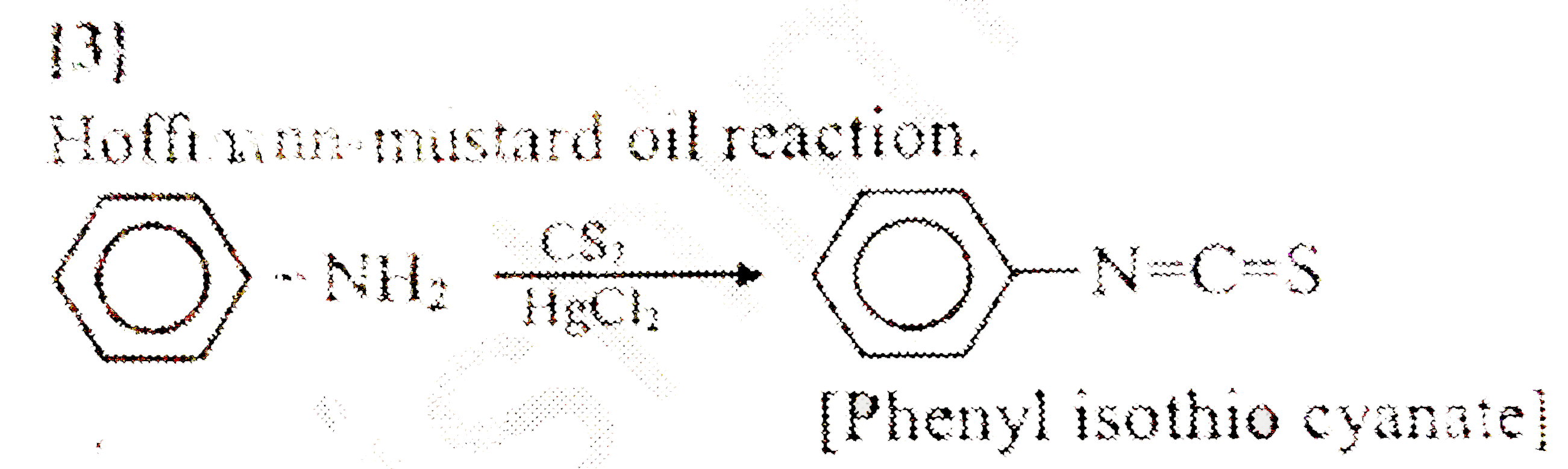
|
|
| 29. |
Which of the following relation shows current density ? |
|
Answer» `(I^(2))/(A)` CURRENT DENSITY J= `(I)/(A)` |
|
| 30. |
The earth moving round the sun in a circular orbit is acted upon by a force and hence work must be done on the earth by the force. Do you agree with this statement. |
| Answer» Solution :No, the CENTRIPETAL FORCE on the EARTH is at right ANGLES to its motion `theta -90^@` and hence `W=0. | |
| 31. |
A small strip of plane mirror A is set with its plane normal to the prinicipal axis of a convex mirror B and placed 10cm in front of B which it partly covers. An object is placed 20cm from A and the two virtual images formed by reflection in A and B coincide without parallax. The radius of curvature of B is |
|
Answer» `20cm` `(1)/(F)=(1)/(v)+(1)/(u)` and `R=2f` 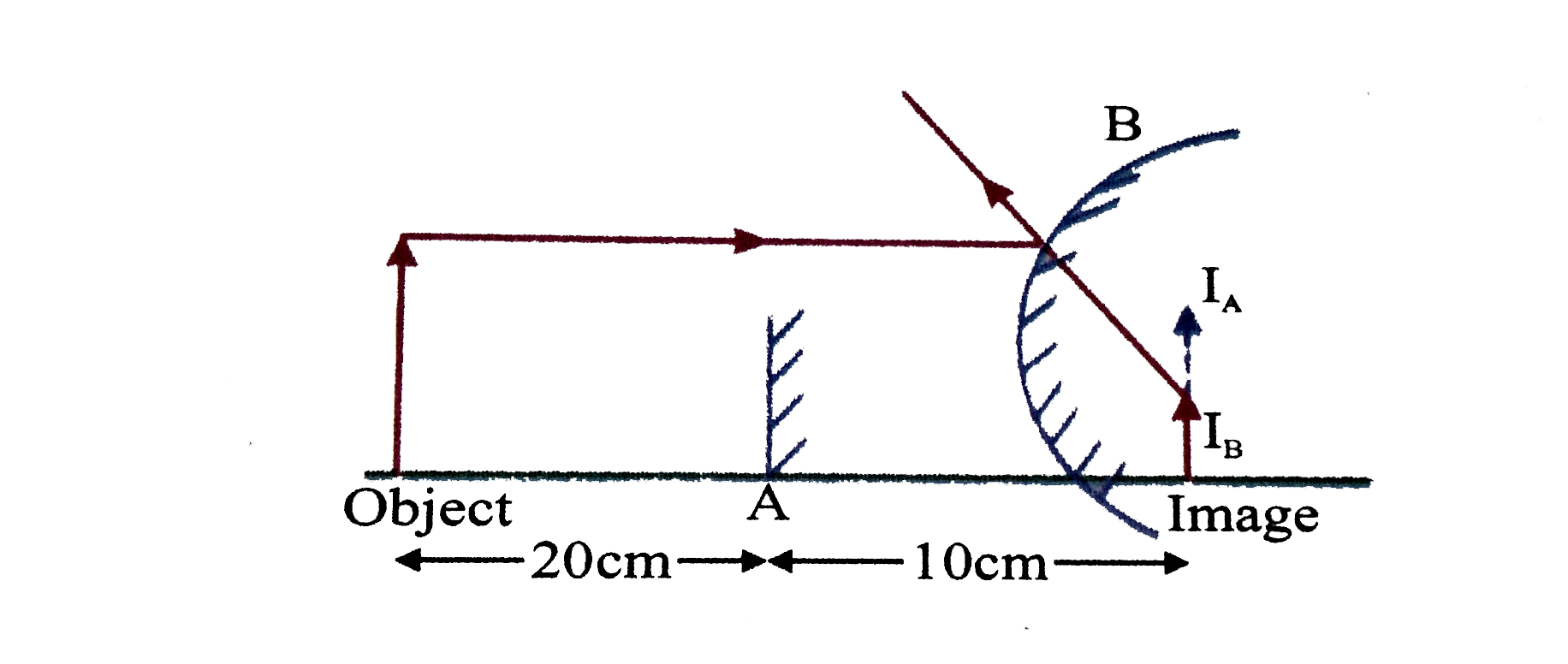
|
|
| 32. |
A conductor of length l is connected to a.d.c., source of potential V. if the length of the conductor is tripled by stretching it, keeping V constant, explain how to the following factors vary in the conductor? (i) Drift speed of electrons (ii) Resistance (iii) Resistivity. |
|
Answer» Solution :When the wire is stretched to thrice its length, the area is reduced to one-third, `therefore ` Let `l_(1)=l,l_(2)=3,A_(1)=A,A_(2)=A//3` Now `R_(1)=rho(l_(1))/(A_(1)) and R_(2)=rho(l_(2))/(A_(2))` `(R_(2))/(R_(1))=((l_(2))/(l_(1)))xx((A_(1))/(A_(2)))=3xx3=9` i.e., RESISTANCE will become 9 times. Resistivity depends upon the NATURE of the material of the conductor and temperature. it does not depend upon the dimensions of the wire. since material of the wire and the temperature remain constant, hence resistivity will remain constant. Drift vel., `v_(d)=(eEtau)/(m)=(eVtau)/(ml)` Since, e,V,`tau` and m are constant, hence when length is TRIPLED, the drift velocity becomes `1/3`rd that of the ORIGINAL length. |
|
| 33. |
A surface has emissive power 2.4 xx 10^(-2) watt/m^2 and perfectly black surface has emissive power of 3 xx 10^(-2) watt/m^2 . The emissivity of the surface is |
|
Answer» a)0.8 |
|
| 34. |
Two wires of same length are made into a circle and square respectively. Currents are passed in then such that their magnetic moments are equal. Then the ratio of the magnetic field at their respective centres (circle:square) is |
|
Answer» `(sqrt2pi^(3))/(32)` |
|
| 35. |
A thin rod AB of length a has variable massper unit length rho_(0) (1 + (x)/(a))where x is the distance measured from A and rho_(0)is a constant.Find minimum value of impulse P if B passes through a point vertically above A. |
|
Answer» |
|
| 36. |
The current in a coil changes from 3.50 A to 2.00 A in the same direction in 0.500s. If the average emf induced in the coil is 12.0mV. What is the inductanceof the coil? |
|
Answer» 2.00mH |
|
| 37. |
A closed coil having 50 turns is rotated in a uniform magnetic field B=2xx10^(-4) T about a diameter which is perpendicular to the field. The angularvelocity of rotation is 300 revolutions per minute. The area ofthe coil is 100 cm^(2) and its resistance is 4 Omega. Find (a) the average emf developed in half a turn from a position where the coil is perpendicular ot the magnetic field, (b) the average emf in full turn, (c) the net charge flown in part (a) and (d) the emf induced as a function of time if it is zero at t=0 and is increasing in positive direction. (e) the maximum emf induced. (f) the average of the square of emf inducd over a long period |
|
Answer» |
|
| 38. |
When hydrogen gas is excited at low pressure the resulting spectrum is a |
|
Answer» CONTINUOUS spectrum |
|
| 39. |
Which of the following radiation has the least wavelength? |
|
Answer» `GAMMA-` RAYS |
|
| 40. |
We call the rectifier which rectifies both the halves of each.ax. input as ? |
|
Answer» |
|
| 41. |
The Bohr model for the H-atom relies on the Coulomb's law of electrostatics. Coulomb's law has not directly been verified for very short distances of the order of angstroms. Supposing Coulomb's law between two opposite charge +q_(1), -q_(2) is modified to|vecF|=(q_(12))/((4piepsilon_(0))) 1/(r^(2)) , rgeR_(0)=(q_(1)q_(2))/((4piepsilon_(0))) 1/(R_(0)^(2)) ((R_(0))/r)^(epsilon), rleR_(0) Calculate in such a case, the ground state energy of a H-atom, if epsilon=0.1, R_(0)=1Å. |
|
Answer» Solution :We are given `|vecF|=(q_(1)q_(2))/((4piepsilon_(0))) 1/(r^(2)) , rgeR_(0)|vecE|=(q_(1)q_(2))/((4piepsilon_(0))) 1/(R_(0)^(2)) ((R_(0))/(r^(epsilon)))^(epsilon) , rleR_(0)` `in=0.1, R_(0)=1Å`. Let `in=2+delta`. `:. F=(q_(1)q_(2))/((4piepsilon_(0))) (R_(0)^(delta))/(r^(2+delta))=^^(R_(0)^(delta))/(r^(2+delta))` for `rleR_(0)` Where `^^=(q_(1)q_(2))/(4piepsilon_(0))=9xx10^(9) (1.6xx10^(-19))^(2)=23.04xx10^(-29)` So, `F=(mv^(2))/r=^^ (R_(0)^(delta))/(r^(2+delta)) or V^(2)=(^^R_(0)^(delta))/(mr^(1+delta)).......(i)` (i) As `mvr=nh, r=(nh)/(mv)` USING (i), `r=(nh)/m[m/(^^(R_(0)^(delta))]^(1//2) r^(1/2+delta/2)` Solving this for r, we get `r_(n)=[(n^(2)h^(2))/(m^^R_(0)^(delta))]^(1/(1-delta))` for `n=1, r_(1)=[(n^(2)h^(2))/(m^^R_(0)^(delta))]^(1/(1-delta))=[(1.05^(2)xx10^(-68))/((9.1xx10^(-31))(23.04xx10^(-29))10^(19))]^(1/2.9)=8xx10^(-11)m=0.08nmlt0.1nm` (ii) form `v_(n)=(nh)/(mr_(n))=nh((^^R_(0)^(delta))/(n^(2)h^(2)))^(1/(1-delta))` for `n=1, v_(1)=h/(mr_(1))=1.44xx10^(6)m//s` (iii) `K.E. =1/2mv_(1)^(2)=9.43xx10^(-19)J=5.9eV`P.E. `(TILL R_(0))=-(^^)/(R_(0))` P.E. form `R_(0)` to `r=^^R_(0)^(delta)int_(R_(0))^(r) (dr)/(r^(2+delta)) =(^^R_(0)^(delta))/(-1-delta) [1/(r^(1+delta))]_(R_(0))^(r) =-(^^R_(0)^(delta))/(1+delta) [1/(r^(1+delta))-1/(R_(0)^(1+delta))]=-(^^)/(1+delta)[R_(0)^(delta)/(r^(1+delta))-1/(R_(0))]` P.E. `=-(^^)/(1+delta)[(R_(0)^(delta)/(r^(1+delta))-1/(R_(0))+(1+delta)/(R_(0))]=(-^^)/(-0.9) [(R_(0)^(-1.9))/(r^(-0.9))-1.9/(R_(0))]=(2.3xx10^(-28))/0.9 [(0.8)^(0.9)-1.9]"joule"=-17.3eV` `:.` Total ENERGY =`(-17.3+5.9)eV=-11.4eV` |
|
| 42. |
Calculate the current amplification factor beta when change in collector current is 1mA and change in base current is 20muA. |
|
Answer» 50 |
|
| 43. |
Masses M_(1),M_(2) and M_(3) are connected by string of negligible mass which pass over massless and frictionless pulleys P_(1) and P_(2) as shown in figure 7.15. The masses move such that the string between P_(1) and P_(2) is parallel to the incline and the portion of the string between P_(2) and M_(3) is horizontal. The masses M_(2) and M_(3) are 4.0 kg each and the coefficient of kinetic friction between the masses and the surfces is 0.25. The inclined plane makes an angle of 37^(@) with the horizontal. If the mass M_(1)moves downwards with a uniform velocity, find (i) the mass of M_(1), (ii) the tension in the horizontal portion. (g=9.8 ms^(-2) , sin 37^(@)=(3)/(5)) |
|
Answer» |
|
| 44. |
In a track and field event, an athlete runs exactly once around an oval track, a total distance of 500 m. Find the runner's displacement for the race. |
Answer» Solution :If the runner RETURNS to the same position from which she left, then her DISPLACEMENT is zero.  The total DISTANCE covered is 500 m, but the net distance - the displacement is 0. |
|
| 45. |
You are given many resistance, capacitors and inductors. These are connected to variable DC voltage source (the first two circuits) or an AC voltage source of 50 Hz frequency (the next three circuits) in different ways as shown in column II. When a current (steady state for DC or rms for AC) flows through the circuit , the corrresponding voltage V_(1) and V_(2) . (indicated in circuit) are related as shown in column I . match the two |
|
Answer» |
|
| 46. |
A plane electromagnetic wave of frequency 52 MHz travels in free space along the x - direction. At a particular point in space and time, vec(E )=8.4hat(k)V//m. What is vec(B) at this point ? |
| Answer» SOLUTION :`VEC(B)=2.8xx10^(-8)HAT(i)T` | |
| 47. |
A carbon resistor has coloured bands orange, green, golden and silver then its resistance will be |
|
Answer» `2.5 pm 10% OMEGA` |
|
| 48. |
The escape velocity of a body on the surface of the earth is 11.2" km"//s If the earth's mass increases to twice its present value and radius of the earth becomes half, the escape velocity becomes |
|
Answer» `22.4" KM"//s` `:. "Escape velocity " (v_(e ))=sqrt((2GM_(e ))/(R_(e ))) prop sqrt((M_(e ))/(R_(e )))` Therefore `(v_(e ))/(v._(e ))=sqrt((M_(e ))/(R_(e ))XX(0.5 R_(e ))/(2M_(e )))=sqrt((1)/(2))=(1)/(2)` `v._(e )=2v_(e )=22.4" km"//s` |
|
| 49. |
(a)Explain any twofactors whichjustifythe needof modulatinga lowfrequencysignal. (b)Writetwoadvantages offrequencymodulationoveramplitudemodulation. |
|
Answer» Solution :(a)Size of theantenna or aerial: Fortransmtting a signalantennashouldhavea sizecomparableto thewavelength of the SIGNAL (at least `lambda//4` indimension ) . Foran ELECTROMAGNETIC WAVE of frequency 20kHz , thewavelength`lambda` is 15 KM. Actually sucha longantenna is notpossibletoconstruct andoperate. Hence direct transmissionofsuch basebandsignals is notpractical. (b)Effectivepowerradiated by anantenna :A theoreticalsignalsis notpractical . (length l)showsthat thepower radiated is proprtionalto `( l// lambda)^(2)` .Thisimpliesthat for the sameantenna lengththe powerradiated increases withdecreasing`lambda` i.e.,increasingfrequency. Hencethe effectivepower radiated byalongwavelenthbasebandsignalwouldbe small.For agoodtransmissionwe needhighpowersand hencethisalsopointsout to theneedof usinghighfrequencytransmission. (b)(i) THEREIS verylessnoisein frequencymodulation. (ii)Rangeof requencymodulationis larger . |
|
| 50. |
Define a wavefront. Using Huygen's principle, verifyi the laws of reflection at a plane surface. |
|
Answer» Solution :A wavefront is defined as a surface of contant phase. Let us consider a plane wavefront AB incident obliquely on a plane reflecting surface MM.. Let one end A of wavefront strikes the mirror at an angle `i` but the other end B has still to cover DISTANCE BC. The required for thie will be `l=(BC)/(c)`, where c is the speed of light. According to Huygen.s principle point A starts emitting secondary wavelents and in time t, these will cover a distance `ct=c.(BC)/(c)=BC` and as radius, draw a circular arc. draw tangent CD on this arc from the point C. OBVIOUSLY, CD is the reflected INCLINED at an angle r. Obviously the incident and reflected wavefront both are in the plane of paper.  Again in `DeltaABC` and `DeltaADC`, we have `BC=AD` (by construction) and AC is common. So, the two triangles are congruent and, HENCE `angleBAC=angleDCA` or `anglei=angler` i.e., the angle of reflection is EQUAL to the angle of incidence. |
|