

Saved Bookmarks
This section includes 7 InterviewSolutions, each offering curated multiple-choice questions to sharpen your Current Affairs knowledge and support exam preparation. Choose a topic below to get started.
| 1. |
Two wires of same radius having lengths l_1, and l_2 and resistivities rho_1 and rho_2 are connected in series. The equivalent resistivity will be |
|
Answer» `(rho_1l_2+ rho_2 l_1)/( RHO _1+ rho_2)` ` R = R_1+R_2` HENCE ` R_1 =( rho _1 l_1)/(A) .R_2 = ( rho _2 l_2) /(A), R = (rho (l_1+l_2))/( A)` ` THEREFORE(rho(l_1 +l_2))/(A)=( rho_1 l_1)/( A)+ (rho _1l_1)/(A)+( rho _1 l_2)/( A) =rho= (rho _1 l_1+rho_2l_2)/( l_1l_2)` |
|
| 2. |
Wavelength of length in different media are proportional to : |
|
Answer» SPEED of LIGHT in the medium |
|
| 3. |
A monochromatic light of wavelength 500 nm is incident normally on a single slit of width 0.2 mm to produce a diffraction pattern. Find the angular widthof central maximum obtainedon the screen, 1 m away. Estimate the number of fringes obtained in YDSE with fringe width 0.5 mm, which can be accommodated within the region of total angular spread of the central maximum due to a single slit. |
|
Answer» Solution :Calculation of angular width of central maxima Estimation of number of fringes. Angular width of central maximum `OMEGA=(2lamda)/a` `=(2xx5xx10^(-9))/(0.2xx10^(-3))` radin `=5xx10^(-3)` radin `beta=(lamdaD)/d` Lines width of central maxima in the diffraction pattern 2XD `omega'=(2lamdaD)/a` Let n be the number of interference fringes which can be accommodated in the central maxima. `:. nxxbeta= ` [Award the LAST 5 mark if the student WRITES the answer as 2 (taking `d=a`), or just attempts to do these calculation.] |
|
| 4. |
In a double-slit experiment, the fourth-order maximum for a wavelength of 450 nm occurs at an angle of theta= 90^(@). (a) What range of wavelengths in the visiblc range (400 nm to 700 nm) are not present in the third-order maxima? To eliminate all visible light in the fourth-order maximum, (b) should the slit separation be increased or decreased and (c) what least change is needed? |
| Answer» SOLUTION :(a) 600 nm, any wavelength greater than this will not be seen. Thus, `600 nm lt theta le 700 nm` are ABSENT, (b) the slit SEPARATION d NEEDS to be decreased, (C) 0.20 `mu m` | |
| 5. |
An analyser is inclined to a polariser at an angle of 30^(@). The intensity of light emerging from the analyser is 1/nth of that is incident on the polariser. Then n is equal to |
|
Answer» 4 |
|
| 6. |
What is the mass of muon plus (mu^(+))? |
| Answer» Solution :Mass of a MUON PLUS PARTICLE is 207 times the mass of an ELECTRON. | |
| 8. |
Given below are some famous numbers associated with electromagnetic radiations in different contexts in physics. State the part of the electromagnetic spectrum to which each belongs. 21 cm (wavelength emitted by atomic hydrogen in interstellar space). |
|
Answer» Solution :(a) Radio (short wavelength end) (B) Radio (short wavelength end) (c) Microwave (d) VISIBLE (Yellow) (E) X-rays (or soft `lamda`-rays) REGION |
|
| 9. |
Consider an atomic nucleus to be equivalent to a one- dimensional infinite potential well with L= 1.4 xx 10^(-14)m, a typical nuclear diameter. What would be the ground-state energy of an electron if it were trapped in such a potential well? (Note: Nuclei do not contain electrons.) |
| Answer» SOLUTION :`3.07xx10^(-10)J` | |
| 10. |
A body of 0.02 kg falls from a height of 5 mts into a pile of sands. The body penetrates the same at the distance of 5cm before stopping. What force the sand exerted on the body ? |
|
Answer» 20 MT |
|
| 11. |
Let E_(k) and E_(p) represent kinetic energy and potential energy respectively of the electron in a hydrogen atom. If the electron transits from the orbit n=2 to the orbit n=1 and the value of kinetic energy is E_(k)' and that of potential energy is E_(p)', then |
|
Answer» `E_(k)'=(E_(k))/(2),E_(p)'=2E_(p)` |
|
| 12. |
A chain is placed on smooth table with (1)/(4)th of its length hanging over the edge. If the length is 2 m and weight is 4 kg, the energy needed to pull it back to the surface of table is (g = 10ms^(-2)): |
|
Answer» 0.25 J `W=(mgl)/(2N^(2))=(mgl)/(2xx(4)^(2))=(mgl)/(32)=(4xx10xx2)/(2)` W=2.5 J. |
|
| 13. |
A block of metal is heated directly by dissipating power in the internal resistance of block. Because of temperature rise, the resistance increases exponentially with time and is given by R(t)=0.5e^(2t), where t is in seconds. The block is connected across a 110 V source and dissipates 7644 J heat over a certain period of time. Calculate this period of time. |
|
Answer» 0.5 s |
|
| 14. |
A negative charge is coming towards the obsever. The drection of the magnetic field produced by it will be (as seen by observer) |
|
Answer» Clockwise |
|
| 15. |
A inductor of 5 mH is connected to a source of 220 V . Find the inductive reactance and rms current in the circuit if the frequency of the source is 60 Hz. |
| Answer» SOLUTION :`X_L=1.884 OMEGA, I APPROX` 116.8 A | |
| 16. |
In the figure shown, the coefficient of friction between the two blocks is 0.1 and coefficient of friction between the block B and ground is 0.2, masses of A and B are 20kg and 40kg respectively. where a_(A)= acceleration of A and a_(B)= acceleration of B. {:(,"Column I",,"Column II"),((A),F=50N,(P),a_(A)=0m//s^(2)),((B),F=150N,(Q),a_(A)=0.5m//s^(2)),((C),F=200N,(R),a_(B)=0.5m//s^(2)),(,,(S),a_(B)=1.5m//s^(2)):} |
|
Answer» Solution :`f_("max")` between A and B `rArr0.1xx200rArr20N` `f_("max")` between A and GROUND `rArr0.2xx600=120N` `F=50N a_(A)=a_(B)=0 m//sec^(3)` `F=150N a_(A)=a_(B)=0.5 m//sec^(2)` 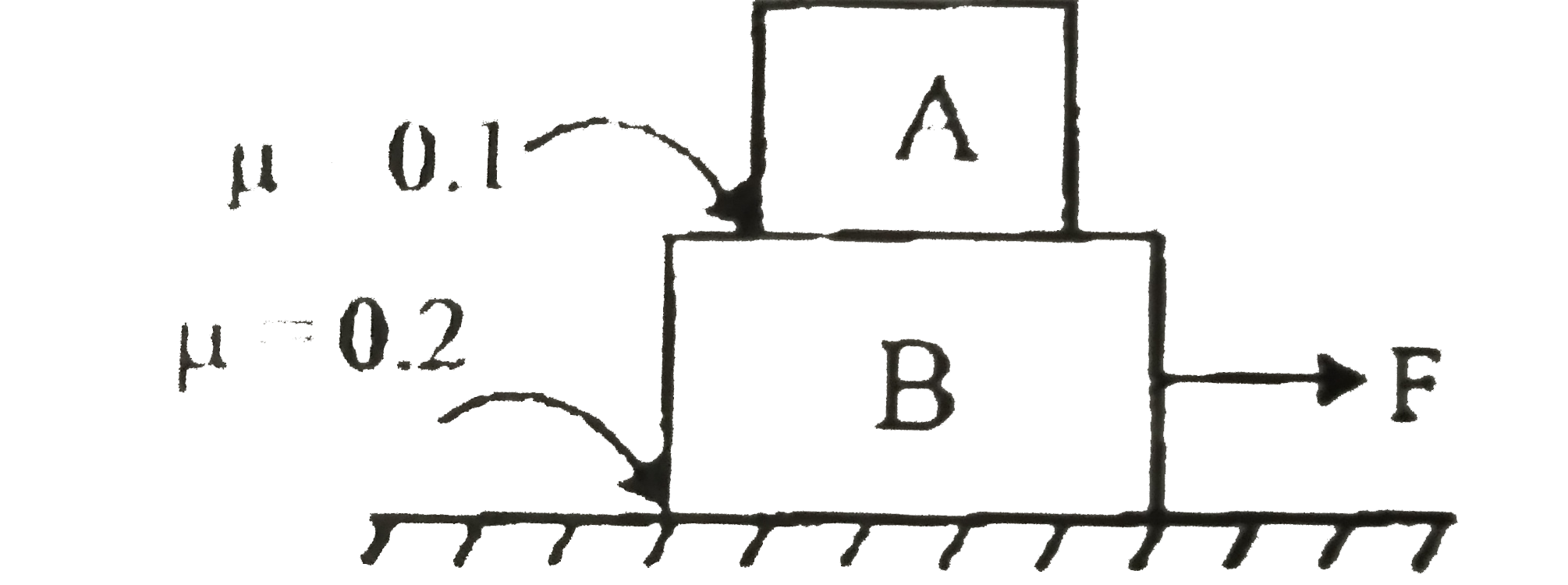 F=200N `a_(A)=1m//sec^(2) a_(B)=1.5m//sec^(2)` |
|
| 17. |
If a body of mass m moving with velocity v collides with another body of mass m at rest. If e is the coefficient of restitution then find the ratio of final velocities of two bodies : |
|
Answer» `(1+e)/(1-e)` |
|
| 18. |
calculate the tension in the string and angle madeby it with vertical if electric field is directed in horizontal direction. |
| Answer» SOLUTION :`7.84xx10^(-3)` N | |
| 19. |
Two coherent light beams of intensity I and 4I are superimposed. The maximum and minimum possible intensities in the resulting beams are |
|
Answer» 9I and I |
|
| 20. |
An LED is constructed from a pn junction based on a certain semi - conducting material whose energy gap is 1.9 eV .Then the wavelength of the emitted light is : |
|
Answer» `1.6xx10^(8)m` `E=(hc)/LAMDA` , `IMPLIES lamda =(hc)/E=(6.62xx10^(-34)xx3xx10^6)/(1.9xx1.6xx10^(-19))` `lamda = 6.5 xx10^(-7)m`. |
|
| 21. |
A point electric dipole of moment vec(p)_(1)=(sqrt(3)hat(i) +hat(j)) is held fixed at the origin. Another point electric dipole of moment vec(p)_(2) held at the point A (+a, 0, 0) will have minimum potential energy, if its orientation is given by the vector |
|
Answer» `SQRT(3) hat(i) +hat(j)` |
|
| 22. |
A loaded and completely sealed glass bulb weighs 156.25 gm inair at 15^(@)C, 57.5 gm when completely immersed in a liquid at 15^(@)C and 58.57 gm when completely immersed at 52^(@)C. Calculate the mean coefficient of real expansion of the liquid between 15^(@)C and 52^(@)C. alpha_("glass")9x10^(6).^(@)C^(-1) |
|
Answer» |
|
| 23. |
An LED is constructed from a p-n junction based on a certain semi-conducting material whose energy gap is 1.9 eV. Then, the wavelengthof the emitted light is |
| Answer» SOLUTION :`LAMBDA = 6.54 XX 10^(-7)` m | |
| 24. |
A circle of radius 'a' has charge density given by lambda= lambda_(0)cos^(2)theta on its circumference. What will be the total charge on the circle ? |
|
Answer» `pia lambda_(0)` `=int_(0)^(2pi) COS^(2)theta d theta =alambda_(0)pi = pialambda_(0)` |
|
| 25. |
What is an unpolarized light ? Explain with the help of suitable ray daigram how an unpolarized light can be polarized by reflection from a transparent medium. Write the expression for Brewster angle in terms of the refractive index of denser medium. |
|
Answer» Solution :In an UNPOLARISED light the vibrations of electric field VECTOR are in EVERY plane perpendicular to the direction of propagation of light. When unpolarised light is incident on the boundary between two TRANSPARENT media, the reflected light is polarised with its electric vector perpendicular to the plane of incidence when the refracted and reflected rays make a right angle with each other. Brewster angle `mu=tani_(B)` 
|
|
| 26. |
An objectis projected horizontally with speed1/2 sqrt((GM)/R) , froma pointat height3 R[ where R isradiusand Mis mass of earth, then objectwill ] |
|
Answer» Fall backon SURFACEOF EARTH by followingparabolic path |
|
| 27. |
The temperature of a paramagnetic material is 30^@C, the atomic concentration is 10^(27)m^(-3) the atomicmagnetic moment is two Bohr magnetons. Estimate by what number the number of atoms with magnetic moments oriented in the direction of the field exceeds the number of atoms with magnetic moments oriented against the field, if the field induction is 1.2 T. How will the result change, if the substance is cooled to the temperature of liquid nitrogen (-195.8^@C)? |
|
Answer» `N_(1)/N_(2)=(e^(-epsi_(1)//kT))/(epsi_(2)//hT)=e (epsi_(2)-epsi_(1))/(kT)=1+(epsi_(2)-epsi_(1))/(kT)` But `N_(1)` is the NUMBER of atoms whose magnetic moments are oriented ALONG the field the energy is `epsi_(1)-mu_(B) D, N_2` is the number of atoms, whose moments are oriented against the field, their ENERGYIS `epsi_(2)=p_(m)B`. we have `N_1/N_2=1+(2v_(m)B)/(kT)` |
|
| 28. |
A coil of 100 turns, radius 5cm carries a current of 0.1A. It is placed in a magnetic field of 1.5T initially with its plane perpendicular to the field. The work done to rotate it through on angle of 180^@is... xx 10^(-3) 'J |
| Answer» Answer :C | |
| 29. |
Solenoid S_1 has N turns, radius R_1 and length l. It is so long that its magnetic field is uniform nearly everywhere inside it and is nearly zero outside, Solenoid S_2 has N_2 turns, radius R_2ltR_1.and the same lengthas S_1 It lies inside S_1with their axes prallel. (a) Assume S_1 carries variable current i. Compute the mutual inductance characterizingthe emf inducedis S_2. (b) Now assume S_2 carries current i. Compute the mutual inductance to which the emf in S_1 is proportional. (c) State how we results of parts (a) and (b) compare with eachother. |
|
Answer» |
|
| 30. |
Give the definition of intensity of light and its unit. |
| Answer» Solution :Intensity of light REFER to the strength or brightness or amount of light PRODUCED by a specific source. It.s unit is CANDELA (CD) | |
| 31. |
An ideally efficient transformer has a primary power input of 10 kW. The secondary current when the transformer is on load is 25 ampere. If the primary to secondary turns ratio is 8:1, then the potential difference applied to the primary coil is |
|
Answer» `(10^(4)XX8^(2))/(25)V` `therefore e_(s)i_(s)=10^(4)rArr e_(s)=(10^(4))/(25)` `therefore (e_(s))/(e_(p))=(n_(s))/(n_(p))=(1)/(8)rArr e_(s)xx8=e_(p)` or `e_(p)=(10^(4)xx8)/(25)V` |
|
| 32. |
The value of the magnetic suseptibility for a superconductor is |
| Answer» SOLUTION :`-1` | |
| 33. |
Why are microwaves considered suitable for radar system used in aircraft navigation ? |
| Answer» Solution :Because their wavelength is SMALL, hence SIZE of radar antenna will be SMALLER. | |
| 34. |
A 220 V main supply is connected to a resistance of 100k Omega. The rms current is |
| Answer» Answer :B | |
| 35. |
The megnetic field in a travelling electromagnetic wave has a peak of 20 nT. The peak value of electric strength is: |
|
Answer» 3 v/m |
|
| 36. |
A spherical drop of capacitance 1 mu F having an energy of 64mJis at 4V. It is broken into eight drops of equal radii. The capacitance, potential and energy of each small drop is |
|
Answer» `1/8mu F,0.2and20 MJ` |
|
| 37. |
Momentum of photon of wavelength lambda is |
|
Answer» `(H)/(lambda)` |
|
| 38. |
A monochronic beam of lights falls on YDSE appartus at some angle (theta) as shown a thin sheet of glass (R.I = mu , "thickness =t") isinsertedin front of the lower slit S_(2) . Select the correct alternative . |
|
Answer» CENTRAL maxima will be at O always |
|
| 39. |
In an arrangement of double slit arrangement fig. The slits are illuminated by light of wavelenth 600 mm. The distance of the first point on the screen from the centre maximum where intensity is 75% of central maximum is |
|
Answer» Solution :`I_("max")= I_(1)= 4a^(2)""` (at CENTRAL maximum) `I_(2)= 75% " of "I_(1)""` (at point P) `=(3I)/(4)= (3)/(4)xx4a^(2)= 3A^(2)` Resultant AMPLITUDE at .P. is `A= sqrt(3)a` If `phi` is phase DIFFERENCE `A^(2)= A_(1)^(2)+A_(2)^(2)+2A_(1)A_(2) cos phi` `3Aa^(2)= A^(2)+A^(2)+2A^(2)cos phi : phi =(pi)/(3)` Then corresponding path difference `phi = (2pi x)/(lambda) implies x= (lambda)/(6) therefore` Path difference `x= y(d)/(D)` `y= 4.8xx 10^(-5)m`. |
|
| 40. |
In the question number 78, the surface charge density on the outer surface is |
|
Answer» `(-q)/(4piR_(1)^(2))` `=(+q)/(4piR_(2)^(2))` |
|
| 41. |
A uniform magnetic flux density of 0.1 Wbm^(-2) extends over a plane circuit of area 1m^(2) and is normal to it. How quickly must the field be reduced to zero if an emf of 100 volt is to be induced in the circuit? |
| Answer» SOLUTION :`10^(-3)s` | |
| 42. |
No . Of photoelectron emited by light with frequency f is proportional to ….[Here frequency fgt threshold frequency f_(0)] |
|
Answer» thereshold FREQUENCY |
|
| 43. |
Distance between divergent lens and object is m times than focal length. Linear magnification of lens is ...... |
|
Answer» m For lens,`1/f=1/v-1/u` `therefore u/f=u/v-1[because` MULTIPLIED by u] `thereforem=1/M-1` `therefore1/M=m+1` `therefore M=(1)/(m+1)` |
|
| 44. |
A nucleus X of mass M. intially at rest undergoes alpha decay according to the equation _(Z)^(A)Xrarr._(Z-2)^(A-4)Y+._(2)^(4)He The alpha particle emitted in the above proces is found to move in a circular track of radius r in a uniform magnetic field B. Then (mass and charge of alpha particle are m and q respectively) |
|
Answer» The ratio of kinetic energies of the alpha particle and (doughether NUCLEUS Y approximately equals `(M-m)/(m)` |
|
| 45. |
The hydrogen atom in the ground state excited by means of light of lambda= 975 Å. How many different hires are possible in resultant spectrum? |
|
Answer» 4 For n=1 to `n=oo`, transition is ionisation ENERGY of hydrogen, `13.6 =E_(0) (1/1^(2)-1/oo^(2)) or E_(0)=13.6eV` `E_(n)=-(13.6)/(n^(2))eV` `E_(n)=-(13.6)/(n^(2)eV` `E=hv=(hc)/(lambda)=2.04 XX 10^(-18)J` Let the ELECTRON jump from n=1 n=m after absorbing photon 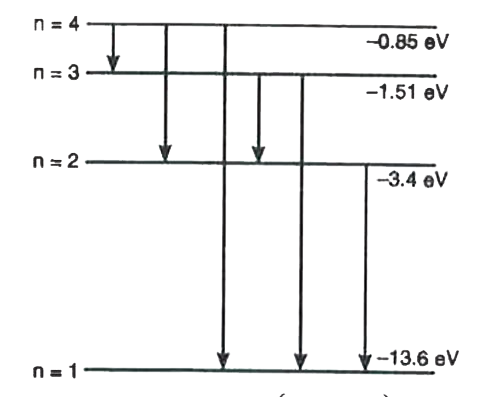 `triangleE=E_(m)-E_(1)=13.6 (1/1^(2)-1/m^(2))eV` then m=4 so there ar 6 possible lines EVOLVED. |
|
| 46. |
A narrow X-ray beam falls on a NaCl single crystal. The least angle of incidence at which the mirror reflection from the system of crystallographic planes is still observed is equal to alpha = 4.1^(@). The interplaner distance is d = 0.28nm. How high is the voltage applied to the X-ray tube? |
|
Answer» Solution :We have as in the above problem `(2picancelh c)/(LAMBDA) = EV` On the other hand, from Bragg's LAW `2d sin alpha = k lambda = lambda` SINCE `k = 1` when `alpha` takes its smaller value. Thus `V = (pi cancelh c)/(edsin alpha) = 30.974kV~~31kV`. |
|
| 47. |
In which of the following circuitsis the diode forward biased? |
|
Answer» |
|
| 48. |
Two identical blocks A and B each of mass M are connected to each other through a light string. The system is placed on a smooth hori-zontal floor. When a constant force F is applied hori zontally on the block A, find the tension in the string. |
|
Answer» Solution :The acceleration of the system of TWO blocks A and `B=("FORCE")/("Total MASS")` `THEREFORE a=(F)/(M+M)=(F)/(2M)`. If we consider the free body diagram of A, the forces acting on it are (i) the applied force F and (ii) the tension T on the string as SHOWN in the following fig. 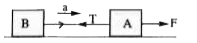 The resultant force `= F-T , Ma = F-T` `M((F)/(2M))=F-T "" (therefore a=(F)/(2M))` `(F)/(2)=F-T` 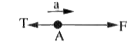 `T=(F)/(2)` (or) From FBD for B `T=Ma=M(F)/(2M)=(F)/(2)` `T=(F)/(2)` 
|
|
| 49. |
….. are used in the interceptor van used by traffic police. |
|
Answer» (A) RADIO |
|