

Saved Bookmarks
This section includes 7 InterviewSolutions, each offering curated multiple-choice questions to sharpen your Current Affairs knowledge and support exam preparation. Choose a topic below to get started.
| 1. |
Is Ohm's law universally applicable for all conducting elements? If not, give examples ofelements which do not obey Ohm's law. |
| Answer» Solution : No, Ohm.s law is not universally applicable. Some elements which do not obey Ohm.s laware semiconductor DIODE, solar cell, transistor, LED, ELECTROLYTES, DISCHARGE tube, fluorescent tube, CFL lamp, PHOTODIODE, photoelectric cell, ICs etc. | |
| 2. |
The ozone layer on the top of the stratosphere is crucial for human survival.Explain why? |
| Answer» Solution :Ozone layer ABSORBS the ULTRAVIOLET radiations from the sun and prevents it from reaching the EARTH’s SURFACE | |
| 3. |
Thetransfer ratio (beta) of a transistor is 50. The input resistance of the transistor when used in the common emitter configuration is 1kOmega. The peak value of the collector current for a peak value of AC input voltage of 0.01 V is |
|
Answer» `100muA` |
|
| 4. |
Considermetal ring kept on a horizontal plane . A bar magnet is held above the ring with its length along the axis is held abovethe ring with itslength along theaxis of the ring . Ifthe magnet is droppedfreely the acceleration of the falling magnet is : ( g is accelration dueto gravity) |
|
Answer» More than g |
|
| 5. |
What is the angular momentum of an electron in the third orbit of an atom? |
|
Answer» Solution :Here n = 3 , h = `6.6 xx 10^(-34)`JS ANGULAR momentum, `L = (NH)/(2pi) = (3 xx 6.6 xx 10^(-34))/(2 xx 3.14) = 3.15 xx 10^(-34)` Js |
|
| 6. |
An e.m.f of 5 millivolt is induced in a coil when in a nearby placed another coil the current changes by 5 ampere in 0.1 second . The coefficient of mutual induction between the two coils will be : |
|
Answer» 1 HENRY |
|
| 7. |
A straight wire of length 30cm and mass 60 mg lies in a direction 30° east of no1th. The earth's magnetic field at this site is horizontal and has a magnitude of 0.8 G. The current must be passed through the wire so that it may float in air is (g = 10 m//s^(2)) |
|
Answer» 5A |
|
| 8. |
A particle having mass 1 g and electric charge 10^(-8) Ctravels from a point A having electric potential 600 V to the point B having zero potential. What would be the change in its kinetic energy ? |
|
Answer» `-6 xx10^(-6) ` erg `:. ` Work done in moving `10^(-8)` C charge from point A to B `= 600xx10^(-8) =6xx10^(-6)J` ACCORDING to work energy theorem , `W = Delta :. W = Delta K = 6xx10^(-6)` J |
|
| 9. |
How can you rewrite the above equation in terms of area of the loop? |
| Answer» SOLUTION :`B =(mu_0 IR^2)/(2(R^2 + x^2)^(1//2)`, Where `A = PI R^2` is the AREA. | |
| 10. |
What is a cylindrical capacitor ? |
|
Answer» |
|
| 11. |
To boil a certain mass of water, a coil will take a time of t_(1) and another coil will take a time of t_(2). What will be the time taken when the coils are connected in (i) series (ii) in paralle? |
|
Answer» SOLUTION :(i) In series `H=(V^(2))/(R ).t` As H, V and are constants, `R prop t` `"In series,"R=R_(1)+R_(2)""therefore t_(s)=t_(1)+t_(2)` (ii) In parallel `R=(R_(1)R_(2))/(R_(1)+R_(2))""therefore t_(p)=(t_(1)t_(2))/(t_(1)+t_(2))` |
|
| 12. |
What characteristic property of nuclear force explains the constancy of binding energy per nucleon (BE/A) in the range of mass number 'A' lying 30 lt A lt 170 ? |
| Answer» Solution :SATURATION or short RANGE NATURE of nuclear forces. | |
| 13. |
In a Geiger-Marsden experiment, what is the distance of closest approach to the nucleus of a 7.7 MeV a-particle before it comes momentarily to rest and reverses its direction? |
|
Answer» Solution :The key idea here is that throughout the scattering PROCESS, the total mechanical energy of the system consisting of an a-particle and a GOLD nucleus is conserved. The system’s initial mechanical energy is `E_i`, before the particle and nucleus INTERACT, and it is equal to its mechanical energy `E_f` when the a-particle momentarily stops. The initial energy `E_i` is just the kinetic energy K of the incoming a- particle. The final energy `E_f` is just the electric POTENTIAL energy U of the system. The potential energy U can be calculated from Eq. Let d be the centre-to- centre distance between the a-particle and the gold nucleus when the a- article is at its stopping point. Then we can write the conservation of energy `E_i = E_f` as `K = 1/(4 pi epsilon_0) ((2e)(Ze))/(d) = (2 Ze^2)/(4 pi epsilon_0 d)` Thus the distance of closest approach d is given by `d = (2 Z e^2)/(4 pi epsilon_0 K)` The miximum kinetic energy found in `alpha`- particles of natural origin is `7.7 MeV` or `1.2 xx 10^(-12) J`. Since `1//4 pi epsilon_0 = 9.0 xx 10^(9) N m^2//C^2`. Therefore with `e = 1.6 xx 10^(-19) C`, we have `d = ((2)(9.0 xx 10^(9) Nm^2//C^2)(1.6 xx 10^(-10)C)^2 Z)/(1.2 xx 10^(-12) J)` `= 3.84 xx 10^(-16) Z m`. The atomic number of foil material gold is `Z = 79`, so that `d (Au) = 3.0 xx 10^(-14) m = 30 fm`. (1 fm (i.e. FERMI) = `10^(-15) m`.) The radius of gold nucleus is, therefore, less than `3.0 × 10^(-14)` m. This is not in very good agreement with the observed result as the actual radius of gold nucleus is 6 fm. The cause of discrepancy is that the distance of closest approach is considerably larger than the sum of the radii of the gold nucleus and the a-particle. Thus, the `alpha`-particle reverses its motion without ever actually touching the gold nucleus. |
|
| 14. |
A tuning fork vibrates and produces concentric circular transverse wave on the surface of water. If the distance between 10 crests is 9.0m and velocity of wave on the surface of water is 450m/s, the frequency of the tuning fork is |
|
Answer» 500Hz |
|
| 15. |
A person travels along a straight road for half the distance with velocity V_(1) and the reamaining half distance with velocity V_(1) and the remaining half distance with velocity V_(2) the average velocity is given by |
|
Answer» `V_(1)V_(2)` |
|
| 16. |
The voltage applied across a capacitor having a capacitance of 10muF is varies as shown in figure: At the time instant when the terminal voltage across capacitor is 600V calculate (a) The charge on capacitorltBrgt (b) The energy stored in the capacitor (c) Draw the curve of current in connecting wires as a function of time. |
|
Answer» |
|
| 17. |
A swimmer crosses a flowing stream of width d' to and fro in time t_(1). The time taken to cover the same distance up and down the stream is t_(2), If t_(3) is the time the swimmer would take to swim a distance 2d in still water, then |
|
Answer» Solution :Let v be the river velocity and U the velocity of swimmer in still water. Then `t_(1) =2(d/sqrt(u^(2)-v^(2)))`……..(i) `t_(2) =d/(u+v) +d/(u-v) = (2ud)/(u^(2) -v^(2))`…(ii) and `t_(3) =(2D)/u`…….(iii) from equations, (i), (ii), and (iii) `t_(1)^(2) =t_(2)t_(3) |
|
| 18. |
Light of wavelength 5900xx10^(-10)m m falls normally on a slit of width 11.8 xx 10^(0-7)m . The resulting diffraction pattern is received on a screen . The angular position of the first minimum is |
|
Answer» `30^(@)` |
|
| 19. |
A: In the middle to high latitudes on a dark night an aurora or the curtain of light hangs down from the sky. This curtain is local, several hundred kilometer high, several thousand kilometer long but less than 1 km thick. R: Electrons and protons trapped in the helical terrestiral magnetic field collide with atomsand molecules of air, causing that air to emit light. |
|
Answer» If both Assertion & Reason are true and the reason is the correct explanation of the assertion then mark (1) |
|
| 20. |
What is mean value of an AC over half cycle ? |
|
Answer» SOLUTION :`I_m = 21_0/pi`. `I_m`= MEAN value of AC over a half CYCLE. `I_m` = PEAK value |
|
| 21. |
Four indentical mirrors are made to stand vertically to form a square arrangement as shown in a top view. A ray starts from the midpoint M of mirror AD and after two reflections reaches corner D. Then, angle theta must be |
|
Answer» `tan^(-1)(0.75)` From figure,  `tantheta=(x)/((a//2))` ...(i) `tantheta=(a-x)/(y)` ...(ii) `tantheta=(a)/(a-y)` ...(iii) From (i) and (ii), we get `(2xy)/(a)=(a-x)/(y),2xy=a^(2)-xa` ...(iv) From (ii) and (iii), we get `(a-x)/(y)=(a)/(a-y)impliesa^(2)-ya-xa+xy=ya` `a^(2)-xa-ya+xy=ya` `3xy=2ayimpliesx=(2a)/(3)` (Using(iv)) Substituting this value of x in equation (i), we get `tantheta=((2a//3))/((a//2))=(4)/(3) :. cottheta=(1)/(tantheta)=(3)/(4)` or `theta=cot^(-1)(0.75)` |
|
| 22. |
Three vectors vecA, vecB, vecC are shown in the figure. Find angle between (i) vecA and vecB (i) vecand (iii) vecA and vecC |
Answer» Solution :To find the angle between TWO vectors we connect the TAILS of the two vectors. We can shift the vectors parallel to themselves such that tails of A, B and are connected as shown in figure. 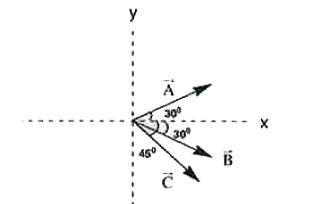 Nowwe observe that angle between `vecA and vecB` is `60^(@` B and C is `15^(@)` and between `vecA and vecC` is `75^(@)` |
|
| 23. |
A wire of resistance 18 ohm is drawn until its radius reduces 1//2^(th) of its original radius then resistance of the wire is |
|
Answer» `188Omega` |
|
| 24. |
The co-efficient of mutual inductance when magnetic flux changes by 2 * 10^(-2) Wb current changes by 0.01A is |
|
Answer» 2H |
|
| 25. |
Five point charges each of charges +q are placed of five vertices of a regular hexagon of side 'l'. Find the magnitude of the resultant force on a charge -q placed at the centre of the hexagon.(##U_LIK_SP_PHY_XII_C01_E09_018_Q01.png" width="80%"> |
|
Answer» Solution :From the adjoining it is that force on -q charge placed at centre point Odue to A and B are respectively balanced by force due to D and E respectively. ` therefore ` MAGNITUDE of resultant force =Force due to charge C ` "" =F= (1)/(4 PI in _0) .((q)(q))/(l^(2)) ` `RARR "" F= (1)/(4pi in _0) .(q^(2))/(l^(2))` |
|
| 26. |
Explain the results of Rutherford alpha-particle scattering experiment. |
|
Answer» Solution :(i) An atom has a lot of EMPTY space and contains a tiny matter known as nucleus whose size is of the order of `10^(-14)`m. (ii) The nucleus is positively charged and most of the mass of the atom is concentrated in nucleus. (III) The nucleus is SURROUNDED by negatively charged electrons. (iv) The electrons are not at rest and they revolve around the nucleus in circular ORBITS. |
|
| 27. |
For a single-slit of width "a", the first minimum of the interference pattern of a monochromatic light of wavelength lamda occurs at an angle of (lamda)/(a). At the same angle of (lamda)/(a), we get a maximum for two narrow slits separated by a distance "a". explain. |
|
Answer» Solution :We know that for a single-slit of width .a. we obtain NTH ORDER minimum due to superposition of wavelets passing through the slit at an angle `THETA` such that path difference between extreme waves is given by `asintheta=nalamda` Hence, for first minima `n=1,asintheta_(1)=lamdaimpliestheta_(1)=sin^(-1)((lamda)/(a))`. and for small value of `theta_(1)`, we can say that `theta_(1)=(lamda)/(a)` On the other hand, for interference pattern due to superposition of light waves coming from two coherent sources separated by a distnace .a., we obtain a maximum if path difference between corresponding waves is given by : `asintheta=nalamda` and for first maximum (n=1), we have `asintheta_(1)=lamdaimplies sintheta_(1)=(lamda)/(a)` and for small value of `theta_(1)`, we can say that `sintheta_(1)=theta_(1)=(lamda)/(a)`. |
|
| 28. |
State one feature by which the phenomenon of interference can be distinguished from that of the diffraction. A parallel beam of light of wavelength 600 nm is incident normally on a slit of width 'a'. If the distance between the slit and the screen is 0.8m and the distance of second order maximum from the centre of the screen 15 mm, calculate the width of the slit. |
|
Answer» Solution :For DISTINGUISHING FEATURE between interference and diffraction. Here `lamda=600nm=600xx10^(-9)m`, distance of screen from the slit D=0.8m, distance of 2nd order diffraction minimum from centre of screen x=15mm`=15xx10^(-3)m` `a=(nlamda)/(sintheta)=(nlamda*D)/(x)=(2xx600xx10^(-9)xx0.8)/(15xx10^(-3))=6.4xx10^(-5)m`. |
|
| 29. |
A circuit containing 80 mH inductor and a 60 muF capacitor in series is connected to a 230 V , 50 Hzsupply has a resistance of 15 Omega. Obtain the average power transferred to each element of the circuit, and the total power absorbed. |
|
Answer» SOLUTION :If `R = 15 Omega , " then " I_(rms) = (V_(rms) )/(SQRT(R^2 + (X_L - X_C)^2) ) = (230)/(sqrt( (15)^2 + (53.03 - 25.14)^2)) = 7.26 A` Average power `P_L = P_C = 0` ` P_R = I_(max)^2 R = (7.26)^2 xx 15 = 791 W` TOTAL power consumed = 791 W |
|
| 30. |
Derive an expression for potential energy of electric-dipole placed in an uniform electric field. |
|
Answer» Solution :We know that torque on an electric dipole placed in an electric field, `tau=pE SIN theta` By DEFINITION work done by torque on the dipole `dW=tau d theta` i.e., `dW=pEsin theta .d theta` Net work done to move from`theta_1` to `theta_2` is GIVEN by `W=int dW=int_(theta_1)^(theta_2) pE sin theta d theta` i.e.,`W=-pE (cos theta )_(theta_1)^(theta_2)` i.e., `W=-pE (cos theta_2 - cos theta_1)` Taking `theta_1=90^@` and `theta_2=theta` ,we can write , `W=-pE cos theta ` or `W=-vecp.vecE` . This work done will be storedin the form of potential energy . i.e.,`P.E.=-vecp.vecE` |
|
| 31. |
A charged particle moves along the y axis according to the law y = a cos omegat, and the point of observation P is located on the x axis at a distance l from the particle (l gt gt a). Find the ratio of electromagnetic radiation flow densities S_(1)//S_(2) at the point P at the moments when the corrdinate of the particle y_(1) = 0 and y_(2) = a. Calculate that ratio if omega = 3.3.10^(6)s^(-1) and l = 190 m. |
|
Answer» Solution :`P` is a fixed point at a distance `l` form the EQUILIBRIUM position of the particle. `l gt a`, to first in `(a)/(l)` the distance `P` and the instantaneous position of the particle is still `l`. For the first case `y = 0` so `t = T//4` the corresponding retarded time is `t' = (T)/(4)-(l)/(c )` Now, `ddot(y) (t') =- omega^(2) a cos omega ((I)/(4)-(l)/(c )) =- omega^(2) a sin((omega l)/(c ))` Thus`ddot(y) (t') =- omega^(2)a cos ((omegal)/(c ))` The radiation FLUXES in the two CASES are proprtional to `(ddot(y)(t'))^(2)` so `(S_(1))/(S_(2)) = tan^(2)((omegal)/(c)) = 3.06` on subsituation. |
|
| 32. |
(A): The apparent freequency remain same as the source of sound approaches a stationary observer with constant velocity. (R): The doppler effect does not depand on the distance between the source and observer. |
|
Answer» Both 'A' and 'R' are true and 'R' is the correct, EXPLANATION of 'A'. |
|
| 34. |
In the question number 40, if velocity is normal in the shorter side then voltage developed is |
|
Answer» `2.3xx10^(-4)V` 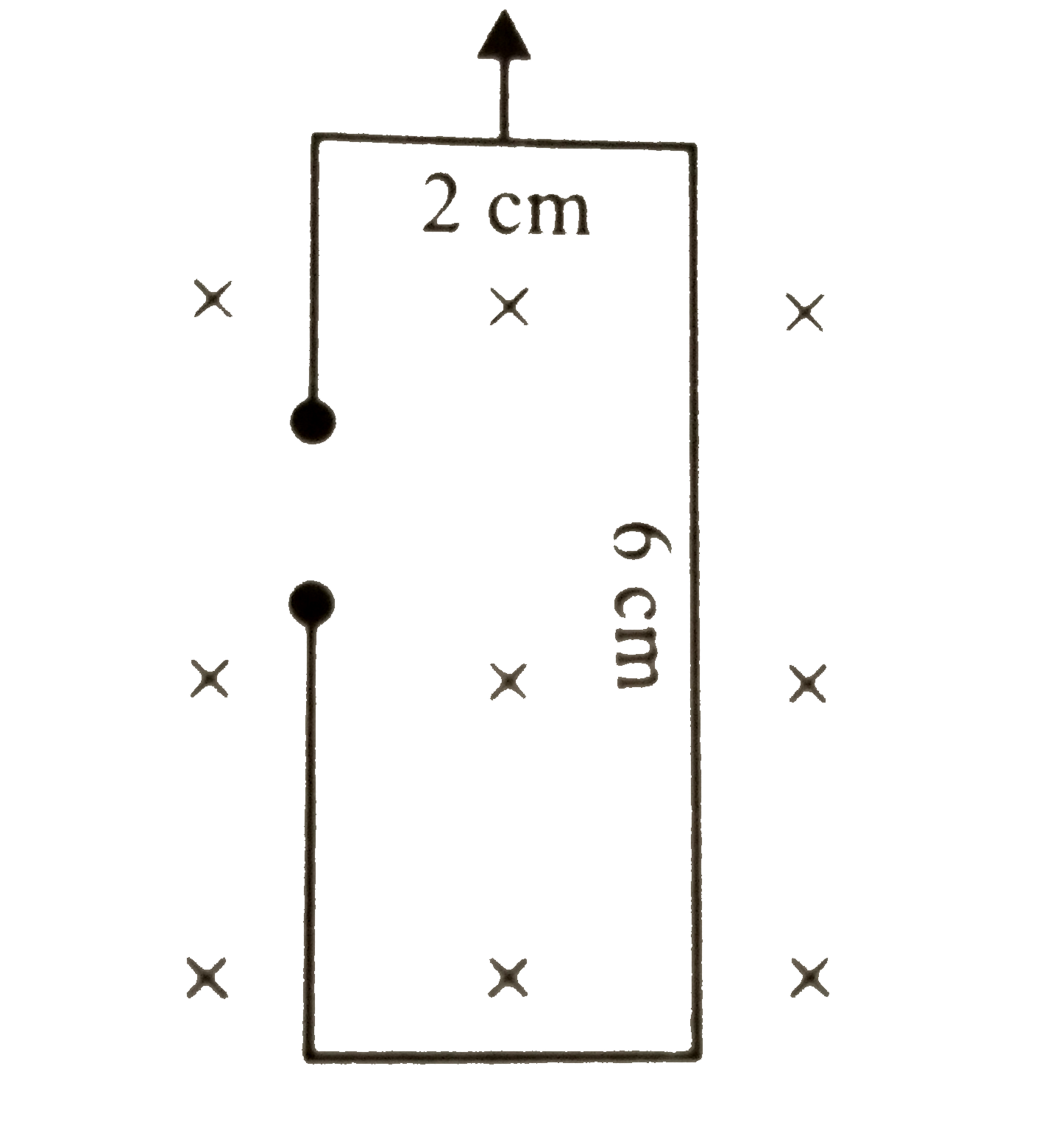 `epsi=Blv=0.4xx2xx10^(-2)xx2xx10^^(-2)=1.6xx10^(-4)V` |
|
| 35. |
In a closed end pipe of length 105 cm, standing waves are set up corresponding to the third overtone. What distance from the closed end, amongst the following, is a pressure Node? |
|
Answer» 20cm |
|
| 36. |
Distinguish between paramagnetic and ferromagnetic substances. |
Answer» SOLUTION :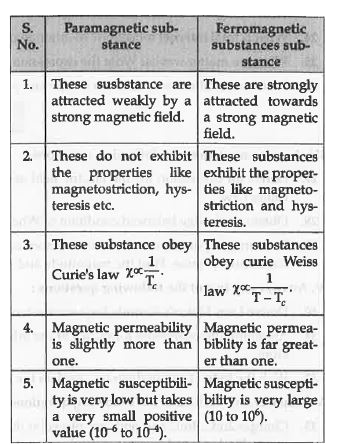
|
|
| 37. |
On the x-y plane to point charges +q and -q are placed at positiions (0,l) and (0,-l) respectively. Find an expression for the intensity of electric field at a point (0,y) where ygtl. Under what condition does the charge system bechave as a dipole and hence express the electric field in terms of the dipole moment of the dipole so formed. |
|
Answer» SOLUTION :Suppose, electric field intensity at the point C due to the charges A and B are `E_(1)` and `E_(2)`, RESPECTIVELY. `:.E_(1)=1/(4 pi epsilon_(0)) .q/((y-l)^(2))`, along `vec(CY)` `E_(2)=1/(4 pi epsilon_(0)) . q/((y+l)^(2))`, along `vec(CA)` 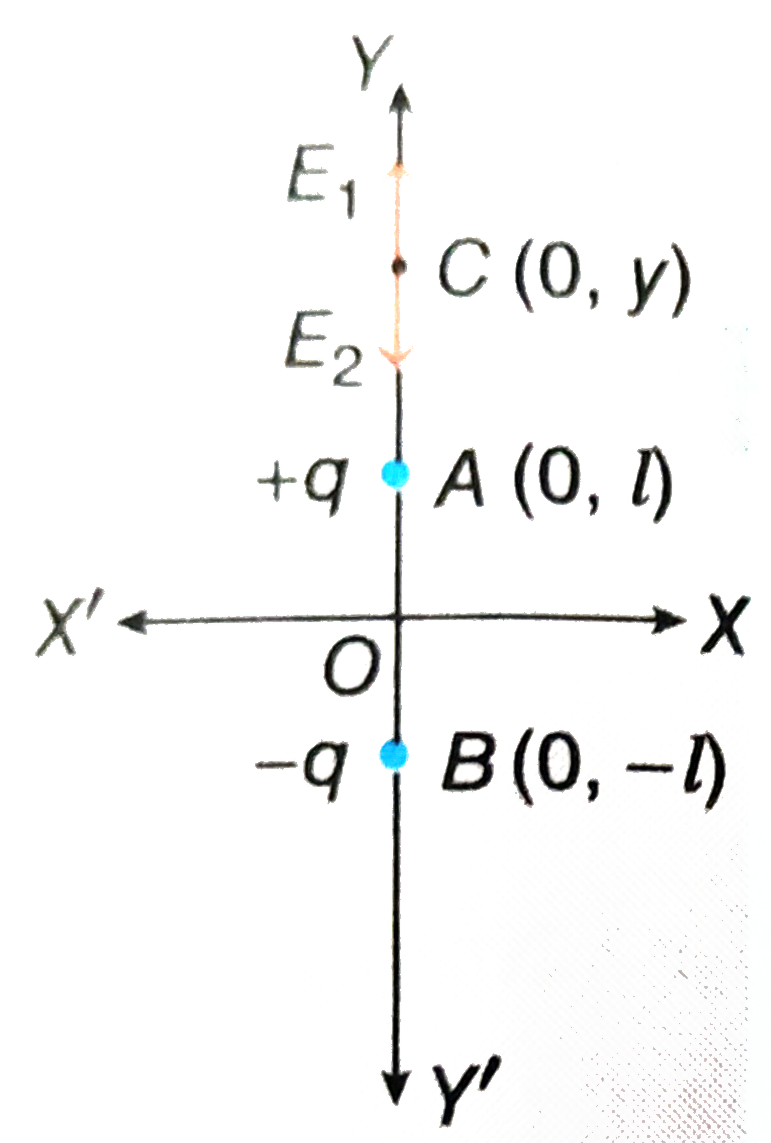 As `E_(1)` and `E_(2)` are acting the opposite directions and `E_(1)gtE_(2)`, the RESULTANT electric field at C is `E=E_(1)-E_(2)` `=1/(4 pi epsilon_(0)) . q.((y-l)^(2)) - 1/(4 pi epsilon_(0)) . q/((y+l)^(2))` `=q/( 4 pi epsilon_(0)) [ 1/((y-l)^(2)) - 1/ ((y+l)^(2))] = q/(4 pi epsilon_(0)) . (4yl)/((y^(2)-l^(2))^(2))` `=1/(4 pi epsilon_(0)) . (4qyl)/(y^(4)) [ :' y gtl]` `=1/(4pi epsilon_(0)) . (4ql)/(y^(3))`, along `vec(CY)` If the value of l issmall, the COMBINATION of the charges behave as an electric dipole with dipole moment, `p=qxx2l`. In that case `E=1/(4 pi epsilon_(0)) . (2p)/(y^(3))`, along `vec(CY)` |
|
| 38. |
A solenoid of length 8cm has 500 turns /m in it. If radius of coil is 3cm and if it is carrying a current of 2A, find the magnetic induction at a point 4cm from the end on the axis of the solenoid |
|
Answer» Solution :`B=(mu_(0)NI)/2(sinalpha+sinbeta)` `=(4pixx10^(-7)xx500xx2)/2xx2xx4/5=320pimuT` |
|
| 39. |
Because of tilting, which waves finally disappear? |
| Answer» Answer :B | |
| 40. |
A rod of lengths L is supported two ideal strings of length l such that the system hangs in a vertical plane. Case 1: Rod is kept horizontal displaced slightly perpendicular to the plane and allowed by oscillate. Case 2: Rod is given a small twist about central axis and then allowed to oscillate. Let T_(1), T_(2) be the period of oscillations in the two respective cases. |
|
Answer» `T_(1)=2pisqrt(l/g)` `-(2Tphi) L/2=(mL^(2))/12 (d^(2)theta)/(dt^(2))` `IMPLIES(d^(2)theta)/(dt^(2))=-((6g)/L)phi` or `(d^(2)theta)/(dt^(2))=-((3g)/l)theta` `impliesT_(2)=2pisqrt(l/(3g))` 
|
|
| 41. |
On which of the following factors does the intensityof heat radiations from a body depend |
|
Answer» TEMPERATURE of the body |
|
| 42. |
What are magnetic elements of earth ? _____ and _____ and _____ . |
| Answer» SOLUTION :DECLINATION , dip , horizontal compnent of EARTHS MAGNETIC FIELD . | |
| 43. |
Which book they hold in hand? |
|
Answer» MOTHER Greek |
|
| 44. |
Photoelectric threshold of silver is lambda = 2600 A^@ is incident on silver surface. What is the value of work function? |
|
Answer» Solution :Here `lambda_0 = 3800 A^@` work function `phi` or w= `hv_0 = (HC)/lambda_0` = `(6.63 xx 10^-34 xx 3 xx 10^8)/(3800 xx 10^-10)= 5.23 xx 10^-19 J (3.2 E V)` |
|
| 45. |
Explain the working of a pn-junction diode in forward- and reverse-biased modes. |
|
Answer» Solution :Forward-biased mode: A PN junction diode is said to be forward-biased when the positive terminal of a battery is connected to the p side of the junction and the negative terminal to the n side In this case, the DEPLETION the potential barrier is lowered. Then the diode has a very low resistance. 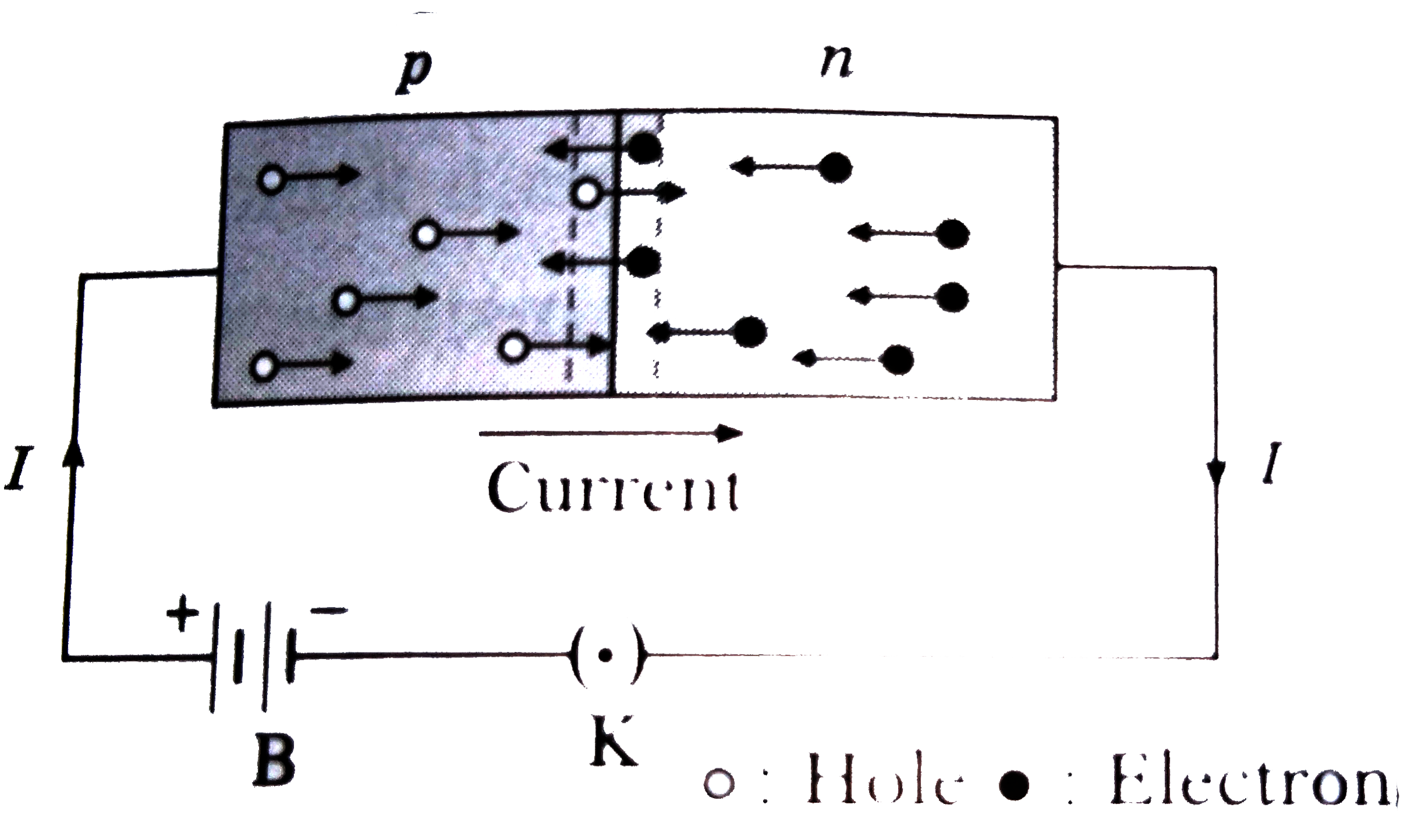 The electrons travel from then side to the p side and go to the positiverminal of the battery. The holes that travel fron the p side to the n side combine with the electrons injected into the n-region from the negative terminal of the battery. This way, the diode conductswhen forward biased and acts as a closed switch. The total current across the junction is CALLED the forward current and is due to motion of both electrons and holes. Reverse-biased mode : A pn-junction diode is said to be reverse biased when the positive terminal of the battery is connected to the n side of the junction, and the negative terminal to the p side. 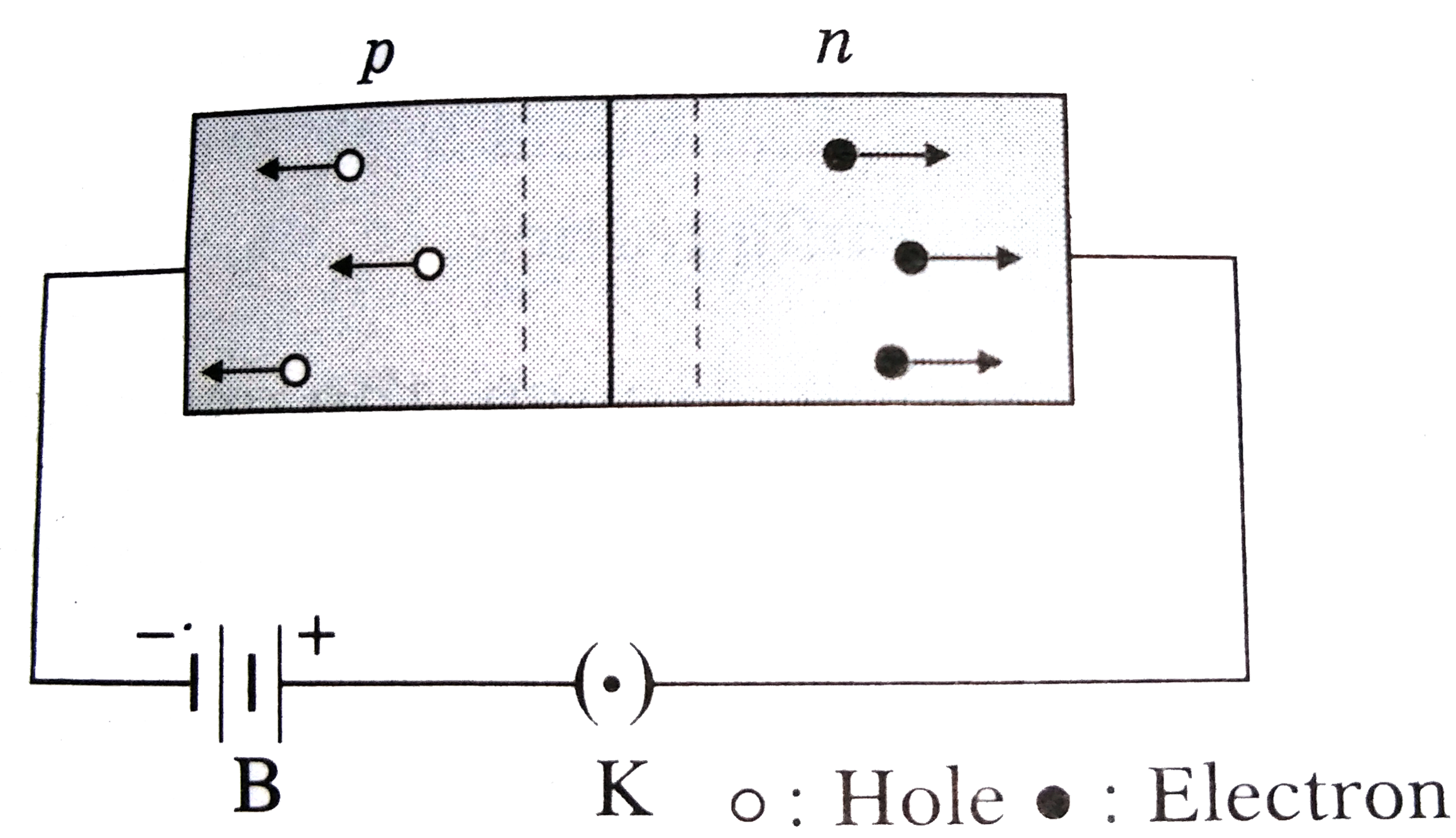 In this case, the depletion region widens and the potential barrier is increased so that the diode has a high resistance. The holes in the pregion combinewith the electrons injected into the pregion from the negative terminal of the battery.The way, the majority charge carrier concentration in each region decreases from the equilibrium concentration and the diffusion current across the jinction becomes zero. thus, the diode doesnot conduct when reverse biased and is said to be in a non-conducting state i.e., it acts as an open switch (ALMOST). However , there is a very small current due to the motion ofminority charge carries. The potential barrier sids the flow of minority CHANGE carriers, electrons in the p-region and holes in the n-region, to cross junction in opposite directions. This current is called the reverse current. |
|
| 46. |
The object distance u , the image distance v and the magnification m in a lens follow certain linear relations.These are |
|
Answer» `(1)/(U)` VERSUS `(1)/(V)` |
|
| 47. |
Letthe magnetic field on earth be modelled by that of a point magnetic dipole at the centre of earth the angle of dip at apointon the geographical equator |
|
Answer» is alwayszero |
|
| 48. |
Given below are some famous numbers associated with electromagnetic radiations in different contexts in physics. State the part of the electromagnetic spectrum to which each belongs.14.4 keV [energy of a particular transition in ""^(57)Fe nucleus associated with a famous high resolution spectroscopic method (Mossbauer spectroscopy)]. |
|
Answer» Solution :From E = hv, `therefore V=(E )/(H)=(14.4xx1.6xx10^(-16))/(6.6xx10^(-34))` `v=3.49xx10^(18)~~3.5xx10^(18)Hz` Above radiation is at the end of section of X - rays or in the BEGINNING of section of `gamma` - rays. |
|
| 49. |
A toroid of mean radius 'a', cross section radius 'r' and total number of turns N. It carries a current 'I'. The torque experienced by the toroid if a uniform magnetic field of strength B is applied. |
|
Answer» is zero |
|
| 50. |
A boy bubble has radius r. The surface tension of the soap film is T. The energy needed to double the diameter of the bubble without the change of temperature is |
|
Answer» `4pir^2T` |
|