

Saved Bookmarks
This section includes 7 InterviewSolutions, each offering curated multiple-choice questions to sharpen your Current Affairs knowledge and support exam preparation. Choose a topic below to get started.
| 1. |
In the circuit shown in fig, if the switch S is closed at t = 0 , the capacitor charges with a time constant |
|
Answer» `RC` |
|
| 2. |
If the angle between the vectors vec(A) and vec(B) is theta, the value of the product (vec(B)xxvec(A)).vec(A) is equal to: |
|
Answer» `BA^(2)sintheta` `vec(c ).vec(A)=(Basintheta)Acos90^@`=zero |
|
| 3. |
In long distance communication, the similar potential wave produced from a carrier wave is V = V_(0) sin Omegat. On the other side, potential wave corresponding to data signal is , v = v_(0) sin omega t, "" v_(0) lt lt Omega. Superimposing data signal on carrier wave, generally two types of modulated waves are produced, they are: (a) Amplitude Modulated (AM) wave: V_("AM") = V_(0) (1 + beta_(1) sin omega t ) sin Omega t where, beta_(1) = k_(1)(v_(0))/(V_(0)) = modulation index ""(k_(1) " " constant). Frequency Modulated (FM) wave: V_("FM") = V_(0) sin(Omegat - beta_(2) cos omega t ) where, beta_(2) = k_(2)(v_(0))/(omega) = modulation index "" (k_(2) = constant). Mathematical analysis of two modulated waves shows that, for AM wave, apart from Omega frequency, there are two sine wave components of frequencies Omega - omega and Omega + omega. As a result, the bandwidth of the waves becomes (Omega + omega)-(Omega-omega) = 2omega. On the other hand, in FM wave, the number of sine wave components are infinite and their frequencies areOmegan pm, Omega pm 2omega,... . Basides that, if the dissipated power for a transmitting antenna to transmit a carrier wave be P_(c ) and dissipated power for transmitting AM and FM wave be P_(AM)and P_(FM) then, P_(AM) = P_(c )(1 + (beta^(2))/(2)), P_(FM) = P_(c ) The unit of constant k_(1) |
|
Answer» does not have any UNIT |
|
| 4. |
In case of a simple harmonic motion, if the velocity is plotted along the X-axis and the displacement (from the equilibrium position) is plotted along the Y-axis, the resultant curve happens to be an ellipse with ratio: ("major axis(along X)")/("major axis (along Y)")=20pi What is the frequency of the simple harmonic motion ? |
| Answer» Answer :C | |
| 5. |
An equilateral glass prism has a refractive index of 1.5 Calculate the (a) angle of incidence for minimum deviation, (b) the minimum deviation, (c) the angle of emergence of the light at the maximum deviation . |
|
Answer» |
|
| 6. |
For an isosceles prism of angle A and refractive index mu it is found that the angle of minimum deviation delta_(m)=A.Which of the following options is/ are correct? |
|
Answer» At minimum deviation, the incident angle `i_(1)` and the refracting angle `r_(1)` at the first refracting surface are related by `r_(1)=(i_(1)//2)` |
|
| 7. |
The force exerted by a magnetic field on a wire having length L and current I is perpendicular to the wire and given as |F|=IL|B| . An experimetal plot shows (vecF) as function of L . The plot is a straightline with a slope S=(10 pm1 xx 10^(-5) AT. The current in the wire is (15 pm 1) mA. The percentage error B is approximately 4x . find the value of x. (All quantities are in SI unit) |
|
Answer» |
|
| 8. |
In a hydrogen tube it is observed that through a given cross-section 3.13xx10^(15) electrons persec. moving from right to left and 3.12xx10^(15) protons per sec are moving from left to right. The electric current in the discharge tube and its direction is |
|
Answer» `1.6muA" TOWARDS LEFT"` |
|
| 10. |
(A): A body can have acceleration even if its velocity is zero at a given instant of time. (R): A body is momentarily at rest when it reverses its direction of motion. |
|
Answer» Both (A) and (R) are TRUE and (R) is the CORRECT EXPLANATION of (A) |
|
| 11. |
lf theelectric field around a surface is given by |vecE|=(Q)/(E_(0)|vecA|) where vecA is the normal area of surface and Q_("in") is the charge enclosed by the surface. This relation of Gauss's law is valid when |
|
Answer» the SURFACE is EQUIPOTENTIAL. |
|
| 12. |
A battery of emf 1.4 volt and internal resistance 2Omega is connected to a resistor is of 100Omega through an ammeter. The resistance of the ammter is (4)/(3)Omega. A voltmeter has also been connected to measure the potentialdifference across the resistor 100Omega. If the ammeter reads 0.02A and voltmeter reading is 1.10 volt then error in the reading of voltmeter is x volt then find value ofx((100)/(25)) in nearest integer. |
|
Answer» `x=(42)/(31)-1.1=1.35-1.1=0.25` `x((100)/(25))=1` 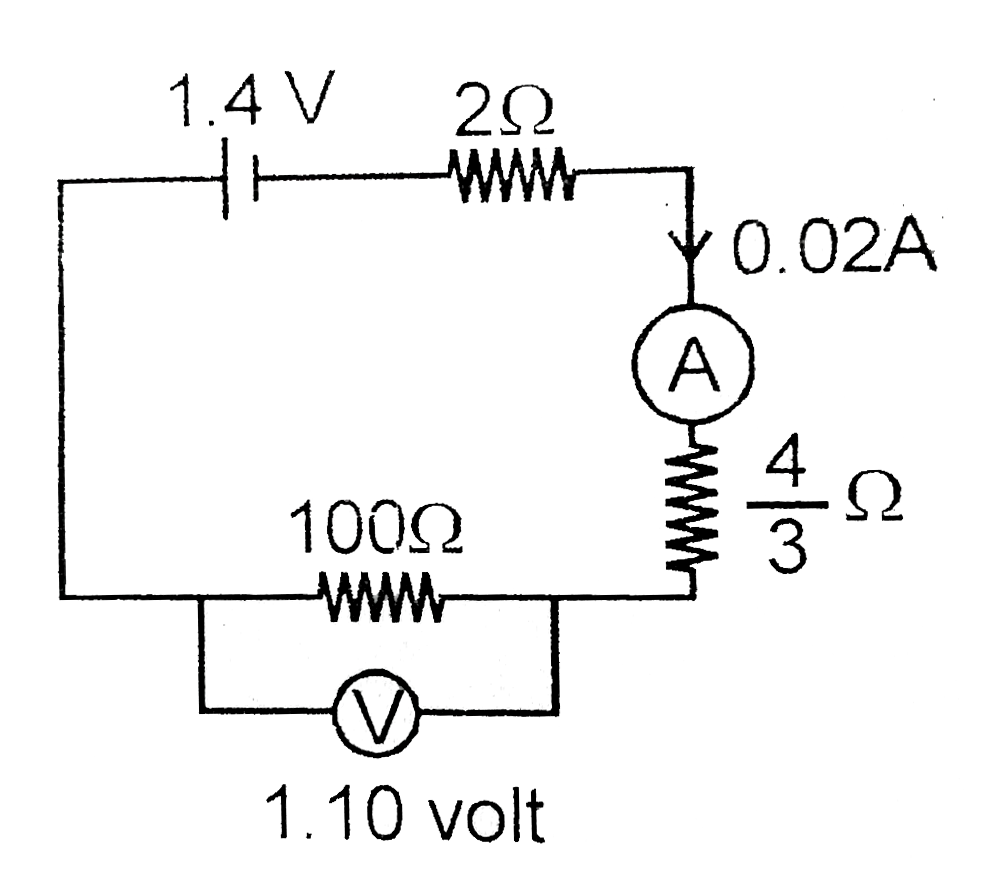
|
|
| 13. |
A coil of inductance 0.5 H is connected to a 18 V battery. Calculate the rate of growth of current. |
|
Answer» |
|
| 14. |
Find the final charges in steady state on the four capacitors of capacitance 2muF, 4mu F, 6mu F,and8mu F as shown in figure . (Assuming initiallythey are uncharged). Also find the current through the wire AB at steady state. |
|
Answer» |
|
| 15. |
Some rigid bodies connected with springs are shown in List-I. All the rigid bodies shown are in equilibrium and their time periods of oscillation are given in List-II |
|
Answer» <P>`{:(P,Q,R,S),(2,3,1,4):}` |
|
| 16. |
Modulation helps to reduce the antenna size in wireless communication-Explain. |
|
Answer» Solution :Antenna is used at both transmitter and RECEIVER end. Antenna height is an important parameter to be discussed. The height of the antenna must be a multiple of `(lambda)/(4)`, `H=(lambda)/(4)`……(i) where `lambda` is wavelength `(lambda-(c)/(v))`, is the VELOCITY of light and v is the frequency of the signal to be transmitted An example Let us consider two baseband signals. One signal is modulated and the other is not modulated. The frequency of the original baseband signal is taken as v = 10 kHz while the modulated signal is v = 1 MHz. The height of the antenna required to transmit the original baseband signal of frequency v = 10 kHz is `h_(1)=(lambda)/(4)=(c)/(4v)=(3xx10^(8))/(4xx1xx10^(3))=7.5km` ……(2) The height of the antenna required to transmit the modulated signal of frequency v=MH is `h_(2)=(lambda)/(4)=(c)/(4v)=(3xx10^(8))/(4xx1xx10^(6))=75M`......(3) Comparing equations (2) and (3), we can infer that it is practically feasible to co antenna of height 75 m while the one with 7.5 km is not possible. It clearly modulated signals reduce the antenna height and are required for long distance transmission |
|
| 17. |
In a Young's double slit experiment, bi - chromatic light of wavelengths 400 nm and 560 nm are used.The distance between slits is 0.1 mm and distance between plane of slits and screen is 1 m.The minimum distance between two successive regions of complete darkness is : |
|
Answer» 4 mm `therefore (2p - 1) (lambda_(1))/(2) = (2Q -1)(lambda_(2))/(2)` `(2p - 1) .(400)/(2) = (2q -1)(560)/(2)` `therefore (2p -1)/(2q -1) = (21)/(15) =(7)/(5)` i.e..4th minima of 400 nm coincides with 3rd minima of 560 nm POSITION of this minima is `y_(1) = (2p -1).(lambda_(1))/(2)(D)/(d)` ` = (2 xx 4 -1) ((400 xx10^(-9))/(2 xx 0.1 xx 10^(-3)) = 14 mm` Further 11th minima of 400 nm will coincide with 8th minima of 560nm(ratio (21)/(15)). Position of this minima is `y_(2) = (2 xx 11 -1)400 xx 10^(-9))/(2 xx 0.1 xx 10^(-3)) = 42 nm` `therefore y_(2) - y_(1) = 42 - 14 = 28 mm`. |
|
| 18. |
A cylinder of length 2a and radius .a. has the x-axis. It twoends (plane surfaces) are at x = a and x = 3a respectively. Point chargas +q are located at x = 2a and x = 0 respectively on the axis of cylinder. The electric flux through the curved surface of cylinder is (nearly) |
|
Answer» `0.6 (Q)/(epsilon_(0))` |
|
| 19. |
In the given circuit Rt Calculate (a) Current in each branch. (b) Power generated in each resistance. (c )Total power generated in the circuit. (d)Net current drawn from source. (e)Net impedance of the circuit. |
|
Answer» Solution :Impedence of each branch `Z_(1)=sqrt(R_(1)^(2)+X_(L)^(2))=sqrt(4^(2)+3^(2))=5` `Z_(2)=sqrt(6^(2)+8^(2))=10` `Z_(3)=sqrt((10)^(2)+(10-10)^(2))=10` (a) Current in each branch `I_(1)=(V)/(Z_(1))=(100)/(5)=20"amp"` `I_(2)=(100)/(10)=10"Amp"` `I_(3)=(100)/(10)=10"Amp"` (b)Power in each branch. `P_(1)=(I_(1))^(2)R_(1)=(20)^(2)(4)=160"watt"` `P_(2)=(I_(2))^(2)R_(2)=(10)^(2)(6)=600"watt"` `P_(3)=(I_(3))^(2)R_(3)=(10)^(2)(6)=1000"watt"` (c )Net power of the circuit. `P=P_(1)+P_(2)+P=3200"watt"` phase difference between voltage & current in each branch. `tanphi_(1)=(X_(L))/(R_(1))=(3)/(4)Rightarrow phi_(1)=37^(@)``tanphi_(2)=(X_(C))/(R_(2))=(8)/(6)Rightarrow phi_(2)=53^(@)` `tanphi_(3)=0 Rightarrow phi_(3)=0` 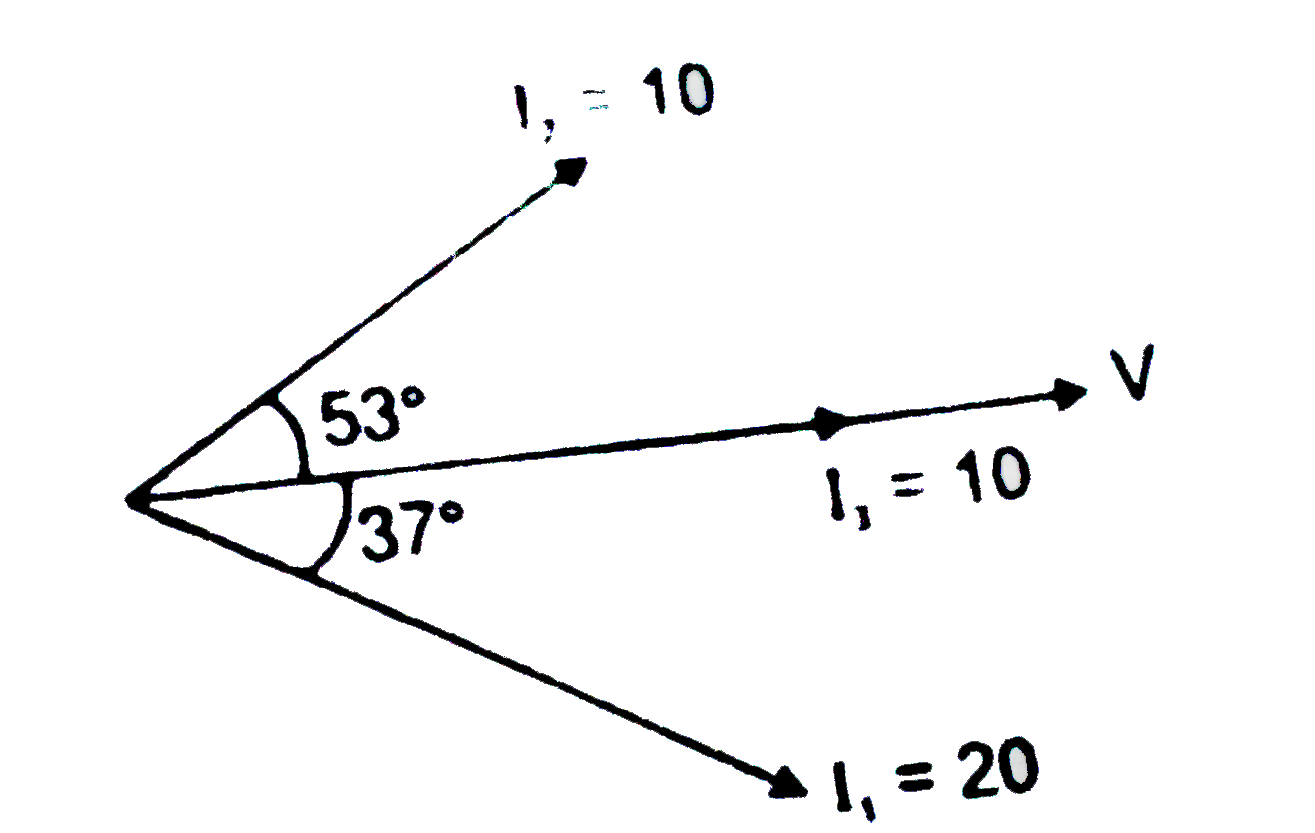 (d) Net current DRAWN from source. `sqrt((I_(1)cos 37^(@)+I_(2)cos53^(@)+I_(3))^(2)+(I_(1)sin 37^(@)-I_(2)sin 53^(@))^(2))=sqrt1040` (e )Net impendance of the circuit, `Z=(V)/(I)=(100)/(sqrt1040)` |
|
| 20. |
In the above question, if the rocket is to be launched with acceleration 3g' what is the minimum rate of burning the fuel ? |
|
Answer» `49 kg s^(-1)` |
|
| 21. |
Explain in detail how charges are distributed in a conductor and the principle behind the lightning conductor. |
Answer» SOLUTION :Distribution of charge in a conductor : Consider two conducting spheres A and B of radii `r_(1)` and `r_(2)` respectively connected to each other by a thin conducting wire as shown in the figure . The distacne between the spheres is much greater than the radii of either spheres. 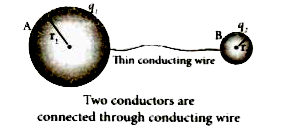 If a charge Q is introduced into any one of the spheres this charge Q is redistributed into both the spheres such that the electrostatic potential is same in both the spheres . They are now uniformly charged and attain electrostatic equilibrium . Let `q_(1)` be the charge residing on the surface of sphere A and `q_(2)` is the charge residing on the surgace of sphere B such that `Q= q_(1) + q_(2)` . The charges are distributed only on the surface and there is no net charge inside the conductor . The electrostatic potential at the surface and there is no net charge inside the conductor . The electrostatic potential at the surface of the sphere A is given by `V_(A) =(1)/(4epsilon_(0))(q_(2))/(r_(2))` The electrostatic potential at the surface of the sphere B is given by `V_(B) = (1)/(4piepsilon_(0))(q_(2))/(r_(2))` The surface of the conductor is an equipotential. since the spheres are connected by the conducting wire the surface of both the spheres together form an equipotential surface . This IMPLIES that `V_(A)= V_(B) "or " (q_(1))/(r_(1))=(q_(2))/(r_(2))` Let us take the charge density on the surface of sphere A is `sigma_(1)` and charge density on the surface of sphere B is `sigma_(2)` . This impliesthat `q_(1)= 4pir_(1)^(2)sigma_(1)` and `q_(2)= 4pir_(2)^(2)sigma_(2)`. Substituting these values into equation (3) we get `sigma_(1)r_(1)= sigma_(2)r_(2)` from which we conclude that `sigmar` = constant THUS the surface charge `sigma` is inversely proportional to the radius of the sphere . For a SMALLER radius the charge densitywill be larger and vice versa. Lightning arrester or lightning conductor : This is a device used top protect tall buildings from lightning strikes . It works on the principle of action at points or corona discharge. The device consists of a long thick copper rod passing from top of the building to the ground . The upper end of the rod has a sharp spike or a sharp needle. The lower end of the rod is onnected to the copper plate which is buried deep into the ground . When a negatively charged cloud is passing above the building it induces a positive charge on the spike. Since the induced charge density on thin sharp spke is large it results in a corona discharge. This positive charge ionizes the surrounding air which in turn neutralizes the negative charge in the cloud. The negative charge pushed to the spikes passes through the copper rod and is safely diverted to the Earth . The lightning arrester does not stop the lightning rather it divers the lightning to the groung safety. |
|
| 22. |
If two mirrors are kept at 60^@ to each other, then the number of images formed by them is ...... |
|
Answer» 5 =`(360^@)/(theta)-1` =6-1=5 |
|
| 23. |
An electron in moving along positive x-axis in the presence of uniform magnetic field along positive y-axis. What is the direction of the force acting on it ? |
| Answer» SOLUTION :In accordance with Fleming.s LEFT hand rule the FORCE is along NEGATIVE z-axis. | |
| 24. |
Show that drift velocity of electrons in a conductor is given by u = J/(ne) where J is the current density, n is the number of mobile electrons per unit volume and e is the charge carried by each electron. Calculate the same in a copper wire of radius of 0.6mm when a current of 1A flows through it assuming that one mobile electron is available from one atom of copper. Atomic weight of copper = 63.55, density of copper = 8930 kgm^(-3), Avogadro number = 6.01 xx 10^(26)Kg mol^(-1) and e = 1.6 xx 10^(-19)C |
|
Answer» |
|
| 25. |
If the net external force acting on a system is zero, then the centre of mass? |
|
Answer» MUST not move |
|
| 26. |
Figure 4-26 gives the path of a squirrel moving about on level ground, from point A (at time t = 0), to points B (at t = 5.00 min), C (at t = 10.0 min), and finally D (at t = 15.0 min). Consider the average velocities of the squirrel from point A to each of the other three points. Of them, what are the (a) magnitude and (b) angle of the one with the least magnitude and the ( c) magnitude and (d) angle of the one with the greatest magnitude? |
| Answer» SOLUTION :(a) 0.0083 m/s, (b) `0^(@)` (measured COUNTERCLOCKWISE from the +x axis), ( C) 0.11 m/s, (d) `297^(@)` (counterclockwise from +x) or `-63^(@)` (which is equivalent to MEASURING `63^(@)` CLOCKWISE from the +x axis). | |
| 27. |
A sonometer wire resonates with a given tuning fork for min standing waves with five antinodesbetween the two bridges when a mass of 9kg is suspended from the wire. When this mass is replaced by mass M. The wire resonates with the same tuning fork forming three antinodes for the same positions of the bridges. The value of M is |
|
Answer» 25kg |
|
| 28. |
The distance travelled by a falling body in the last second of its motion, to that in the last but one second is 7: 5, the velocity with which body strikes the ground is |
|
Answer» `19.6m//s` |
|
| 29. |
Who were not considered 'passive citizens'? |
|
Answer» Women |
|
| 30. |
Derive the lens formula 1/f = 1/v -1/ufor a concave lens, using the necessary ray diagram. |
Answer» Solution :The image formation of an object AB PLACED in front of a thin CONCAVE lens has been shown in Fig. 9.64. The image A.B. is a virtual, erect and diminished image formed between F and C. As AA.B.C and AABC are similar, hence  `(A.B.)/(AB) = (CB.)/(CB)`.......(i) Again as `triangleA.BF` and `triangleLCF` are similar, hence `(A.B.)/(LC) = (B.F)/(CF)` or `(A.B.)/(AB) = (B.F)/(CF)`.......(ii) `[THEREFORE LC = AB]` Comparing (ii) and (i), we get `(CB.)/(CB) = (B.F)/(CF) = (CF - CB.)/(CF)` As per sign convention being followed, `CB = -u, CB. = -V` and `CF = -f` `therefore (-v)/(-u) = ((-f)-(-v))/(-f)` or `vf = uf - uv` Dividing both sides by uvf, and rearranging the terms, we get `1/v - 1/u = 1/f`, which is the requisite lens formula. |
|
| 31. |
The path of the scattered alpha – particles is |
|
Answer» CIRCULAR |
|
| 32. |
A body is projected at an angle of 60^@ to horizontal with a constant horizontal velocity. If there be negligible air resistance the path of the body will be |
| Answer» Answer :A | |
| 33. |
A man walks up a stationary escalator in 90 sec.When this man stands on a moving escalator he goes up in 60 sec.The time taken by the man to walk up the moving escalator is |
|
Answer» 30 s |
|
| 34. |
Find the angular frequency of small oscillation of block m in the arrangement shown. Rod is massless. [Assume gravity to be absont] |
| Answer» SOLUTION :`sqrt((4k_(1) k_(3) + k_(1) k_(2) + 4k_(2) k_(3))/((4k_(3) + k_(2))m))` | |
| 35. |
In a transistor, base is made very thin. Why ? |
|
Answer» Solution :A transistor CONSISTS of two semiconductors SEPARATED by a very thin base. This thin base is called depletion layer. It OFFERS resistance to the motion of current carriers DEPENDS on the thickness of the base of the transistor. A thin transistor base will offer less resistance and this gives more current in the circuit. |
|
| 36. |
Calculate the distance between 5^(th) and 15^(th) bright fringes in an interference pattern obtained by experiment due to narrow slits separated by 0.2mm and illuminated by light of wavelength 560mm. The distance between the slit and screen is 1m. |
|
Answer» Solution :`x_(n)=(nlambdaD)/(d)` `x_(5)=(5xx560xx10^(-9)XX1)/(0.2xx10^(-3))=14xx10^(-3)m` `x_(15)=(15xx560xx10^(-19)xx1)/(0.2xx10^(-3))=42xx10^(-3)m` `x_(15)-x_(5)=(42-14)xx10^(-3)=28xx10^(-3)m` |
|
| 37. |
Find the potential difference between the points a and b of the circuit (figure6.28) and charge on capacitor 1. |
|
Answer» |
|
| 38. |
Give the differential equation for an LC oscillator in the absence of an ac source and resistor. |
| Answer» SOLUTION :The differential equation `=(d^(2)q)/(DT^(2))+((1)/(LC))q=0`. | |
| 39. |
Which geographical feature bounds India's mainland south of 22^(@)N latitude? |
| Answer» Answer :D | |
| 40. |
Two different coils have self-inductance L_(1)=8 mH, L_(2)=2 mH. The current in one coil is increased at a constant rate. The current in the second coil is also increased at the same rate. At a certain instant of time, the power given to the two coils is the same. At that time the current, the induced voltage and the energy stored in the first coil are i_(1), V_(1) and W_(1) respectively. Corresponding values for the second coil at the same instant are i_(2), V_(2) and W_(2) respectively. Then |
|
Answer» `(i_(1))/(i_(2))=(1)/(4)` or `(L_(1)(di)/(dt))i_(1)=(L_(2)(di)/(dt))i_(2)therefore (i_(1))/(i_(2))=(L_(2))/(L_(1))=(2)/(8)=(1)/(4)` Now `(V_(2))/(V_(1))=(L_(2)(di//dt))/(L_(1)(di//dt))=(2)/(8)=(1)/(4)` `therefore (W_(2))/(W_(1))=((1)/(2)L_(2)i_(2)^(2))/((1)/(2)L_(1)i_(1)^(2))=(2)/(8)xx((4)/(1))^(2)=4` |
|
| 41. |
A : Direct current is more dangerous than Alternating current of same value. R : An electrocuted person sticks to direct current line. While alternating current repeks the person from the line. |
|
Answer» If both Assertion & Reason are TRUE and the reason is the CORRECT explanation of the assertion, then mark (1) |
|
| 42. |
If K.E of electron in a Bohr's atom is proportional to e^2/r, its P.E. will be proportional to: |
|
Answer» `e^2/r` |
|
| 43. |
Define Energy band gap in solids. |
| Answer» SOLUTION :The energy GAP between the valence BAND and the conductionband is CALLED the Energy band gap. | |
| 44. |
Image thatindicate positive magnificationis |
|
Answer» erect |
|
| 45. |
Discuss the properties of neutrino and its role in beta decay. |
|
Answer» Solution :(i) Neutrino role in beta decay : During beta decay, a neutron in the parent nucleus is converted to the DAUGHTER nuclei by emitting only electron as given by `""_(Z)^(A)Xto""_(Z+1)^(A)Y+e^(-1)""...(1)` (ii) But the KINETIC energy of electron coming out of the nucleus did not match with the experimental results. In ALPHA decay, the aplha particle takes only certain allowed discrete energies whereas in beta decay, beta particle (i.e, electron) have a continuous RANGE of energies. (iii) But the conservation of energy and momentum gives specific single values for electron energy and the recoiling nucleus Y. (iv) It seems that the conservation of energy, momentum are violated and could not be explained why energy of beta particle have continuous range of values. (v) Neutrino (little neutral one) since it has no charge, have very little mass. Properties of neutrino : (1) It has zero charge (2) It has an antiparticle CALLED anti-neutrino. (3) Recent experiments showed that the neutrino has very tiny mass. (4) It interacts very weakly with the matter. Therefore, it is very difficult to detect. In fact, in every second, trillions of neutrinos coming from the sum are passing through our body without any interaction. |
|
| 46. |
The power of a heating coil is P.It is cut into two equal parts. The power of one of them across same mains is : |
| Answer» ANSWER :B | |
| 47. |
Discuss how Faraday's law of e.m induction is applied in an ac-generator for converting mechanical energy into elecrical energy. Obtain an expression for the instantaneous value of the induced emf in an ac generator. Draw graphs to show the phase relationship between the instantaneous (i) magnetic flux (phi) linked with the coil and (ii) induced emf (epsi) in the coil. |
|
Answer» SOLUTION :SEE Q. 30 (Or), 2008 (O.D-I), [Page 28] (i) GRAPH 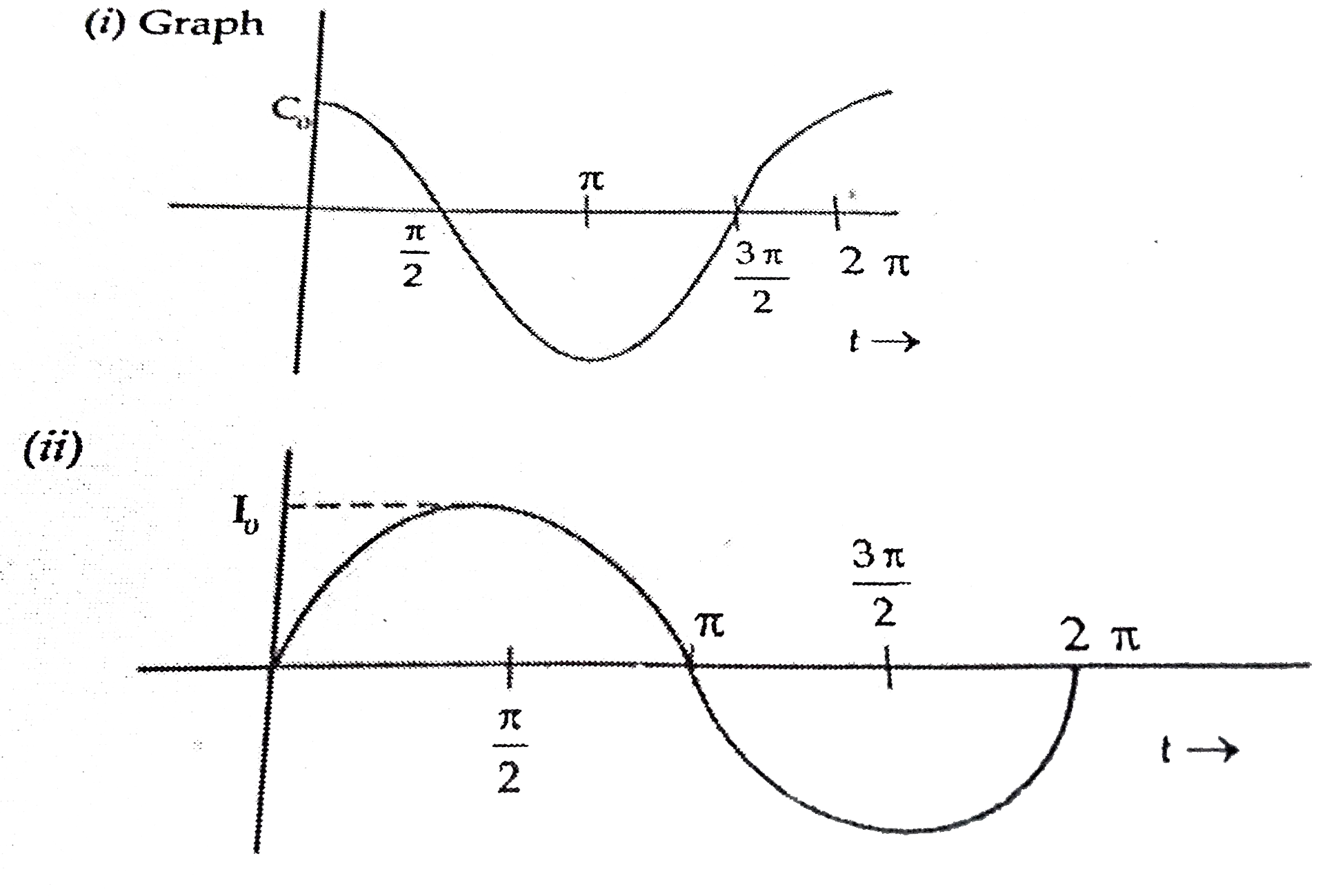
|
|
| 48. |
In the above question, the correct value of focal length f of lens as calculated from the graph is : |
|
Answer» `f = (1)/(OA)` when `U = oo, (1)/(u) = 0`, `(1)/(v) = OB = (1)/(f):.F = 1//OB`. |
|
| 49. |
A solid sphere, cube and a cylinder of same material and density, are heated to the same temperature. If height of cylinder radius of cylinder and sphere and side length of the cube all are equal to R, then the body that cool faster is |
|
Answer» sphere |
|
| 50. |
Assertion : In Zener diode depletion layer is thin. Reason: In reverse bias, strong electric field exists across the potential barrier. |
|
Answer» If both assertion and reason are true and the reason is the CORRECT explanation of the assertion |
|