

Saved Bookmarks
This section includes 7 InterviewSolutions, each offering curated multiple-choice questions to sharpen your Current Affairs knowledge and support exam preparation. Choose a topic below to get started.
| 1. |
A : Light from two coherent sources is reaching the screen. If the path difference at a point on the screen for yellow light is 3lambda"/"2, then the fringe at the point will be coloured. R : Two coherent sources always have same phase relationship at any point on the screen. |
|
Answer» Both A and R are true and R is the CORRECT EXPLANATION of A |
|
| 2. |
A point charge qis located at the centre of a ball made of uniform istopic dielectric with permittivity epsilon.Find the polarizaion P as a function of the radiusvector rrelativeto the centreof the system, as well as the chagre q' insidea sphere whose radius is less than radius of the ball. |
|
Answer» Solution :Inside the ball `vec(D) (vec( R)) = (q)/(4pi) (vec( r))/(r^(3)) = epsilon_(0) vec(E)`. ALSO`epsilon_(0) vec(E) + vec(P) = vec(D)` or `vec(P) = (epsilon - 1)/(epsilon) vec(D) = (epsilon - 1)/(epsilon) (q)/(4pi) (vec(r ))/(r^(3))` Also, `q' = -oint vec(p) .d vec(S) = - (epsilon - 1)/(epsilon) (q)/(4pi) INT d Omega = (epsilon - 1)/ (epsilon) q'` |
|
| 3. |
The displacement time graph of a particle moving along a straight line is shown. The accelerations of the particle during the regions OP, PQ and QR are |
|
Answer» `{:(OP,PQ,QP),(-,0,+):}` For part OP, the acceleration is positive as the velocity is INCREASING. Slope is increasing. For part PQ, the acceleration is zero. Horizontal straight line SHOWS that the velocity is zero. For part QR, acceleration is negative. It is retarded motion. Velocity is decreasing as the slope decreases with time. |
|
| 4. |
A thin rod length 'L' is lying along the x-axis with its ends at x=0 and x=L. Its linear density (mass/length) varies with x as k (x^(n))/(L), where n can be zero or any positive number. If the position x_(CM) of the centre of mass of the rod is plotted against 'n', which of the following graphs best approximates the dependence of x_(CM) on n? |
|
Answer»
n is positive and as its value increases, the rate of increase of linear mass density with increase in x increases. This SHOWS that the centre of mass will SHIFT towards that end the rod where `n=L` as the value of n increases. Therefore graph (b) is ruled out. The linear mass density `lambda=k((x)/(L))^(n)` Here `(x)/(L)le1` With increase in the value of n the centre of mass shift towards the end `x=L` such that first the shifting is at a higher rate with increase in the value of n and then the rate decreases with teh value of n. These characteristics are represented by graph (a) `x_(CM)=(underset(0)overset(L)intx(lambdadx))/(underset(0)overset(L)intlambdadx)=(underset(0)overset(L)intx(lambdadx)^(n))/(underset(0)overset(L)intlambdadx)=(underset(0)overset(L)intk((x)/(L))^(n).xdx)/(underset(0)overset(L)intk((x)/(L))^(n)dx)` `(k[(x^(n+2))/((n+2)L^(n))]_(0)^(L))/([(kx^(n+1))/((n+1)L^(n))]_(0)^(L))=(L(n+1))/(n+2)` For `n=0,x_(CM)=(L)/(2),n=1,x_(CM)=(2L)/(3)`, `n=2,x_(CM)=(3L)/(4)` |
|
| 5. |
A transistor-oscillator using a resonant circuit with an inductor L (of negligible resistance) and a capacitor C in series produce oscillations of frequency f. If L is doubled and C is changed to 4C, the frequency will be : |
|
Answer» `F//4` |
|
| 6. |
A conducting wire XY of mass m and neglibile resistance slides smoothly on two parallel conducting wires as shown in figure. The closed circuit has a resistance R due to AC. AB and CD are perfect conductors. There is a magnetic field vecB=B(t)hatk (i) Write down equation for the acceleration of the wire XY. (ii) If vecB is independent of time, obtain v(t), assuming v (0) =u_0. (iii) For (ii), show that the decrease in kinetic energy of XY equals the heat lost in. |
|
Answer» Solution :Suppose two parallel wire are at y = 0 and y = l Suppose at t = 0 time wire xy is at x = 0 and at t = t time it is at x = x place. (i) Magnetic flux linked with closed loop, `phi=vecB.vecA=BA cos 0=BA` =[B(t)](lx) Induced emf, `EPSILON=-(dphi)/(dt)` `epsilon=-d/(dt)[B(t)lx]` `=-l[B(t)(dx)/(dt)+x d/(dt)B(t)]` `epsilon=-lB(t)v-lx(DB(t))/(dt)`....(1) (Motional emf) (emf DUE to variation in magnetic field) Magnetic force on wire , F=IlB(t) `=epsilon/R lB(t) [ because I=epsilon/R]` `=[-lB(t)v-lx(dB(t))/(dt)]l/R B(t)` `ma=-l^2/R B(t) [vB(t)+x(dB(t))/(dt)]` Acceleration of wire, `a=-(l^2B(t))/(mR)[vB(t)+x(dB(t))/(dt)]` ...(2) (II) If magnetic field does not change with time `(dB(t))/(dt)=0` `therefore a=(-l^2B^2)/(mR)v` `therefore (dv)/(dt)=(-l^2B^2)/(mR)v` `therefore 1/v dv=(-B^2l^2)/(mR)dt` Taking integration and at t=0, v=`u_0` `int_(u_0)^v 1/v dv = int_0^t (-B^2l^2)/(mR)dt` `[ln v]_(u_0)^v =(-B^2l^2)/(mR)[t]_0^t` `ln v- m u_0=(-B^2l^2t)/(mR)` `ln v/u_0=e^(-(B^2l^2)/(mR)t)` `v=u_0 e^(-(B^2l^2)/(mR)t)` `v(t)=u_0 exp (-(B^2l^2t)/(mR))`...(3) (iii) Change in kinetic energy of wire, `DeltaK=1/2m u_0^2 -1/2 mv^2` `=1/2m u_0^2-1/2 m u_0^2 e^(-(2B^2l^2t)/(mR))` `DeltaK=1/2 m u_0^2[1-e^(-(2B^2l^2t)/(mR))]`...(4) Power dissipated in the terms of heat, `P=I^2R` `(dH)/(dt)=I^2R = epsilon^2/R` `dH=epsilon^2/R dt` `H=int_0^t epsilon^2/R dt`...(5) If B is constant then from equation (1), `epsilon=-B vl` `H=int_0^t (B^2v^2l^2)/R dt` `H=(B^2l^2)/R int_0^t v^2dt` `=(B^2l^2)/R int_0^t u_0^2 e^(-(2B^2l^2t)/(mR))dt` `=(B^2l^2)/R u_0^2([e^(-(2B^2l^2t)/(mR))]_0^t)/(((-2B^2l^2)/(mR)))` `=-m/2u_0^2[e^(-(2B^2l^2t)/(mR)-1)]` `H=1/2 m u_0^2 [1-e^(-(2B^2l^2t)/(mR))]`...(6) From equation (5) and (6) it is clear that change in kinetic energy is equal to produced heat energy. |
|
| 7. |
A series combination of a coil of inductance L and a resistor of resistance 12 Omega is connected across a 12 V, 50 Hz supply. Calculate L if the circuit current is 0.5 A. |
|
Answer» Solution :Impedance, `Z = (E)/(1) = (12)/(0.5) = 24 OMEGA` and `Z = sqrt(R^(2) + omega^(2)L^(2))` or `Z^(2) = R^(2) + omega^(2)L^(2)` or `L^(2) = (Z^(2) - R^(2))/(omega^(2))` Here `omega = 2pi V = 2 xx(22)/(7) xx 50` `= 31.4 "rad s"^(-1)` and `R = 12 Omega` `L^(2) = ((24^(2))-(12)^(2))/((314)^(2))` or `L = (12sqrt(3))/(314) = 0.066H` |
|
| 8. |
A rectangular coil of 25 turn, area of 25cm^2 and resistance of 4 ohm/turn is placed perpendicular to a varying magnetic field, which changes at the rate of 500T/s. What is induced current in the coil? |
|
Answer» SOLUTION :`e = NA(dB)/DT` = 25xx25xx10^-4xx500` `= 31.25B.pil^2/(2pi/omega)` and R = `25xx4 = 100Ohm` `THEREFORE I = e/R = 31.25/100 = 0.3125A` |
|
| 9. |
A buring candle is placed in front of a concave spherical mirror on its principal optical axis at a distance of (4//3)F form the pole of the mirror (here F is the focal length of the mirror). The candle is arranged at right angle to the axis. The image of the candle in the concave mirror impinges upon a convex mirror of focal length 2F . The distance between the mirrors is 3F and their axescoincide. The image of the candle in the first mirror plays the part of a virtual object with respect to the second mirror and gives a real image arranged between the two mirrors. Find the total linear magnification (magnitude only) of the system. |
|
Answer» `(1)/(-F)=(1)/(v)+(1)/(-4F//3)` `rArr v=-4F` Hence `m_(1)=(-v)/(u)=-3` For reflection by concave mirror, `u=F , f=+2F (1)/(2F)=(1)/(v)+(1)/(F)(1)/(v)=(1)/(2F)-(1)/(F)=-(1)/(2F)v=-2F` magnification by concave mirror. `m_(2)=-(-(2F)/(F))=2` Net magnification `=m_(1)m_(2)=(-3)(2)=-6` 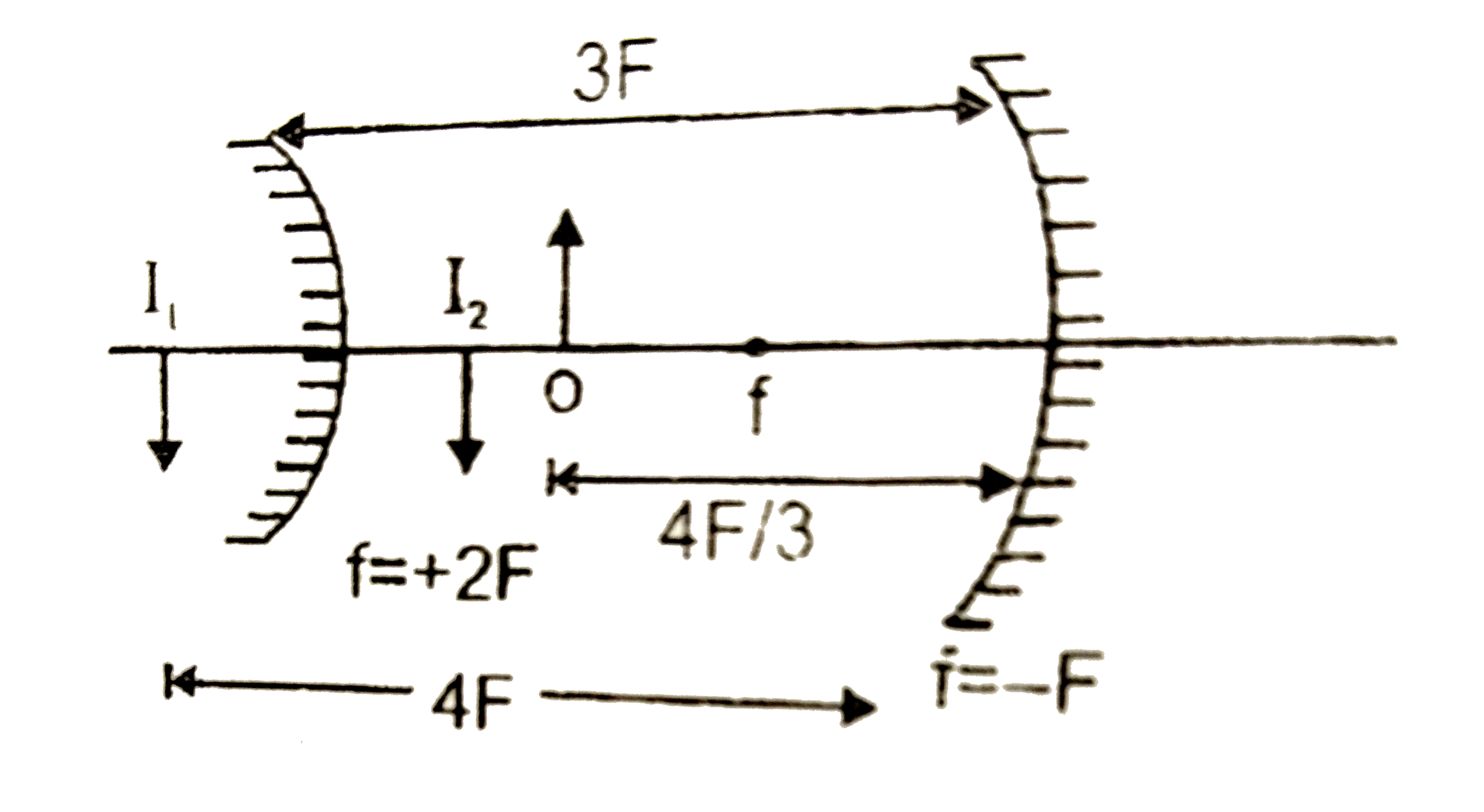
|
|
| 10. |
Two identical pith balls each of mass 'm' holding charge 'q' each are suspended by silk threads of equal length from same point. They move apart due to repulsion. If the separation between the two balls is 2x and each string makes small angle thetato the vertical. |
Answer» Solution : From fig `T COS theta = mg, T sin theta = F` `F/(mg ) = tan theta = x/(sqrt(1^2 - x^2))` If `theta` is small `Tan theta ~~ sin theta ~~ theta = x/1, F/(mg) gt gtx/1` Where `F = 1/(4 PI epsilon_0) (q^2)/(4x^2) implies (q^2)/(16 pi epsilon_0 x^2 mg) = x/1` `implies x = ((q^2 1)/(16 pi epsilon_0 mg))^(1//3)` `implies ` Tension in the string `T = sqrt(F^2 + (mg)^2)` In the above case if the balls are suspended in a liquid of density `rho` and the distance between the balls remains the same, then `(F)/(mg) = (F^1)/(mg^1) implies (F)/(F^1) = (mg)/(mg^1) implies (mg)/(mg (1 - (rho)/(d))) ( therefore k = (F_a)/(F_m))` `implies (1 - (rho)/(d)) = 1/K or K = d/(d - p)` (d is density of MATERIAL of the ball) `implies` In the above case if the charges on the two balls are different and the angles MADE by those two strings to the vertical are `theta_1 and theta_2` respectively, then `theta_1 = theta_2` (as F, mg are same) if `m_1 gt m_2 ` then `theta_1 lt theta_2` . `implies ` In the above application if the whole setup is kept in an artificial satellite (in zero gravity region) the angle between the two strings is `180^@` and tension in each string `1/(4 pi epsilon_0) (q^2)/(4 I^2)` |
|
| 11. |
Ground waves have a wavelength |
|
Answer» LESS than 200M |
|
| 12. |
Value of Coulombian constant in CGS unit is |
| Answer» Answer :D | |
| 13. |
Distinguish among paramagnetic , ferromagnetic and diamagnetic materials qualitatively. |
|
Answer» diamagnetic substances are repelled by magnets |
|
| 14. |
The wavelength of photon having energy of 35 keV is …….. (h=6.625xx10^(-34)J-s, c=3xx10^(8)ms^(-1), 1eV=1.6xx10^(-19)J). |
|
Answer» `35xx10^(-12)m` `E=hf=(hc)/(LAMBDA)` `THEREFORE lambda=(hc)/(E )` `=(6.625xx10^(-34)xx3xx10^(8))/(35xx10^(3)xx1.6xx10^(-19)) ` `=0.3549xx10^(-10)m` `=35.49xx10^(-12)m` |
|
| 15. |
(A):Average speed is equal to total distance travelled divided by total time taken . (R ):The average speed of an object may be equal to arithmetic mean of individual speed |
|
Answer» |
|
| 16. |
One gram ice is mixed with one gram of steam . After thermal equilibrium is reached, the temperature of the mixture is |
| Answer» ANSWER :A | |
| 17. |
Let vecv,v_(rms)andv_(p) respectively denote the mean speed, the root mean square speed and the most probable speed of the molecules in an ideal monatomic gas at absolute temperature T. The mass of a molecule is m. Then |
|
Answer» no molecule can have speed greater than `v_(RMS)` `v_(p)=sqrt((2RT)/(M))` `therefore v_(rms):barv:v_(p)=sqrt(3):sqrt(2.5):sqrt(2)` So, `v_(p)ltbarvltv_(rms)and(v_(rms))/(v_(p))=sqrt((3)/(2))orv_(rms)^(2)=(3)/(2)v_(p)^(2)` `therefore` Average kinetic energy `=(1)/(2)mv_(rms)^(2)=(1)/(2)mxx(3)/(2)v_(p)^(2)=(3)/(4)mv_(p)^(2)` |
|
| 18. |
Give the two differences between Collector region and Emitter region of a Transistor |
Answer» SOLUTION :
|
|
| 19. |
What are extrinsic semiconductor? |
| Answer» Solution :An EXTRINSIC semiconductor is a semiconductor doped by a specific IMPURITY which is able to deeply modify its electrical properties, making it suitable for ELECTRONIC applications (diodes, transistors ETC.) or optoelectronic applications (LIGHT emitters and detectors) | |
| 20. |
An early model for an atom considered it to have a positivelly charged point nucleus of charge +Ze surrounded by a uniform density of negative charge up to a radius R. The atom as whole is neutral. For this model , what is the electric field at a distance r from the nucleus whenr lt Rr =R?Use Gauss's theorem |
|
Answer» Solution :Let as shown in positive charge at the centre of the atom be +ZE and let density of negative charge be `rho `, such that total negative charge ` (4)/(3)pi R^(3) rho =-Ze` `rArr ""rho = ( 3Ze)/( 4 pi R^(3)) ` For any point P situated at a distance r `(rlt R ) `from the nucleus considering a sphere of radius r as the Gasussian surface , we have Charged enclosed ` ""q= ( +Ze)+ ` negative charge enclosed within the sphere of radius r `rArr ""q= Ze +(4)/(3)pi R^(3)rho =Ze -( Zer^(3))/( R^(3))=Ze [1-( r^(3))/( R^(3)) ]` ` therefore ` Flux on Gaussian surface `phi_in =E 4 pir^(2)=(1)/( in_0)q = (Ze)/( in_0)[1-(r^(3))/( R^(3)) ]` ` rArr ""E= "" (Ze)/( 4 pi in _0)[(1)/( r^(2)) -(r)/( R^(3)) ]` (b) For any point P situated on or OUTSIDE the atom (i.e., ` ge R ) ` total charge enclosed ` "" q= ( +Ze)+(-Ze)=0 ` HENCE ` "" phi_in =E. 4 pi r^(2) =(1)/( in_0) (0)=0 ` ` rArr "" E=0 ` ` (##U_LIK_SP_PHY_XII_C01_E10_029_S01.png" width="80%"> |
|
| 21. |
The forbidden energy gap in Ge is 0.72 eV. Given Ac=12400 eV - A. What is the maximum wavelength radiation that will generate electron hole pairs |
|
Answer» 172220 A |
|
| 22. |
A substance has a dielectric constant 2.0 and its dielectric strength is 20 xx 10^(6) V/m . It is taken as a dielectric material in a parallel plate capacitor. The minimum area of its each plate such that its capacitance becomes 8.85xx10^(-2) muFand it can withstand a potential difference of 2000 V is ...... |
|
Answer» Solution :The charge on capacitor `:. Q =CV = (8.85 xx10^(-8) ) xx(2000)` `:. Q = 17.7 xx10^(-5) C` The surface charge density on the PLATE `sigma = (Q)/(A) = (17.7xx10^(-5))/(A) C//m^(2)` The electric field when DIELECTRIC INSERTED `E = (E_(0))/(K) ` but `E_(0) = (sigma)/(epsilon_(0))` `:. E = (sigma)/(K epsilon_(0))= (Q)/(K epsilon_(0)A)` `:. A = (Q)/ (KEepsilon_(0))(17.7xx10^(-5))/(2xx20xx10^(6)xx8.85xx10^(-12))` `:. A = 0.5 m^(2)` |
|
| 23. |
A plano convex lens has focal length f = 20 cm. If its plane surface is silvered, then new focal length will be |
| Answer» ANSWER :C | |
| 24. |
The plane of dip circle is set in thegeographical meridian and the apparent dip is theata it is then set in a verticalplane prependicular to thegeopgraphical meridian the apparent dip becomes theta_(2)the angle of declinationalpha is given by |
|
Answer» `tan alpha=sqrt(tan theta_(1)xxtantheta_(2))` `tan theta_(1)=(V)/(H COS alpha)` `tan theta_(2)=(V)/(H cos (90^(@)-alpha)) =(v)/(Hsin alpha)` `THEREFORE (tantheta_(1))/(tan theta_(2))=(sin alpha)/(cos alpha)=tan alpha` |
|
| 25. |
One day Chetan's mother developed a severe stomach ache all of a sudden. She was rushed to the doctor who suggested for an immediate endoscopy test and gave an estimate of expenditure for the same. Chetan immediately contacted his class teacher and shared the information with her. The class teacher arranged for the money and rushed to the hospital. On realising that Chetan belonged to a below average income group family, even the doctor offered concession for the test fee. The test was conducted suessfully. Answer the following questions based on the above information : (a) Which principle in optics is made use of in endoscopy ? (b) Briefly explain the values reflected in the action taken by the teacher. (c) In what way do you appreciate the response of the doctor on the given situation? |
|
Answer» Solution :(a) Endoscopy is BASED on total internal reflection principle. It has tubes which are made up of optical fibres which are USED for transmitting and receiving electrical signals, which are converted to light by SUITABLE transducer. (B) Humanity and charity. (c) DOCTOR gave monetary help to Chetan by understanding his poor financial condition. |
|
| 26. |
3 मोल मेथेन अनु का ग्राम में भार होगा |
|
Answer» 16 |
|
| 27. |
The magnetic field in a plane electromagnetic wave is given byB_(y)=2xx10^(-7)sin (0.5xx10^(3)x + 1.5 xx 10^(11) t)T. What is the wavelength and frequency of the wave ? |
|
Answer» Solution :a) Comparing the given equation with `B_(y)=B_(0)sin[2pi[((x)/(lambda)+(t)/(T))]` we get, `lambda=(2pi)/(0.5xx10^(3))m=1.26cm` and `(1)/(T)=v=(1.5xx10^(11))//2pi=23.9GHz` b) `E_(0)=B_(0)c=2xx10^(-7)Txx3xx10^(8)m//s=6xx10^(1)V//m` The electric field component is perpendicular to the direction of PROPAGATION and the direction of magnetic field. THEREFORE, the electric field component along the z-axis is obtained as `E_(z)=60sin(0.5xx10^(3)x+1.5xx10^(11)t)V//m` |
|
| 28. |
In an x-ray tube, for an operating voltage, the cut off wavelength is lambda_(0) . If operating voltage is slightly increased by Delta Vthen choose correct statement: |
|
Answer» `lambda_(0)` change by `lambda_(0) (DELTA V)/V` |
|
| 29. |
An electron is travelling along the x-direction. It encounters a magnetic field in the y-direction. Its subsequent motion will be |
|
Answer» STRAIGHT LINE along the x-direction |
|
| 30. |
The total number of images formed by two plane mirrors ,inclined at an angle of 15^@ and an objectvitying symmetrically is |
|
Answer» 24 |
|
| 31. |
An observer looks at a tree of height 15 m with a telescope of magnifying power 10. To him, the tree appears |
|
Answer» 10 times taller |
|
| 32. |
A ball is coated with lamp black. Its temperature is 327^(@)C and is placed in the atmosphere at 27^(@)C , it's rate of loss of heat per unit area is R. if the temperature of the ball is 627^(@)C. Then the rate of loss of heat per unit area will be |
|
Answer» 2R `=((81+9)(81-9))/((36+9)(36-9))=(90xx72)/(45xx27)=(16)/(3)` |
|
| 33. |
Two resistance of 400Omega and 800Omegaare connected I series with 6 V battery of negligible internal resistance . A voltemeter of resistance 10000Omega is used to measure the potential difference across 400OmegaThe error in the measurement of potential difference in volt approximately is |
|
Answer» 0.01 |
|
| 34. |
The moment of inertia of a body about a given axis is 1.2 kg m^(2). · Initially, the body is at rest. In order to produce a rotational kinetic energy of 1500 J, an angular acceleration of 25 rad/s^(2) must be applied about that axis for a duration of |
|
Answer» 4s `alpha=25` RAD/`s^(2),omega_(1)=0,t=?` As `E_(r)=1/2Iomega^(2)rArromega=sqrt((2E_(r))/l),` `rArromega=sqrt((2xx1500)/(1.2))=50` rad/s From `omega=omega_(0)+alphat` `50=0+25t`, or t=2s |
|
| 35. |
White light used to illuminate two slits in a YDSE. The separation between the slits is d and the screen is at a distance D(D gt gt d) from the slits . At a point on the screen directly in front of one of the slits , which of the following wavelengths are missing . |
|
Answer» `(d^(2))/D` |
|
| 36. |
The position of a particle moving along the x-axis depends on the time according to the equation x=ct^(2)-bt^(3), where x is in meters and t in seconds. (a)What units must c and b have ?Let their numerical value be 3.0 and 2.0, respectively. (b)What distance does the particle move. (c)WHat is its displacement? At t=1.0,2.0,3.0 and 4.0 ,What are (d) its velocities and (e) its accelretions? |
| Answer» Solution :(a) `m//s^(2) m//s^(3)`,)(b) 1.0s ©82 m,(d) -80M, 0,-12,-36,72m//s (f) -6-18-30-42 `m/s^(2)` | |
| 37. |
The time dependance of a physical quantity P is given by P=P_(0)e^(alphat^(2) where alpha is a constant and t is time. Then constant alpha is : |
|
Answer» DIMENSIONLESS Hence correct CHOICE is `(b).` |
|
| 38. |
The energy of a photon of sodium light (lambda = 589 nm) equal to the band gap of a semiconducting material . ( a ) Find the minimum energy E required to create a hole - electron pair . ( b ) Find the value of E / KT at a temperature of 300 K. |
|
Answer» SOLUTION :The energy of the photon in `EV=(12400)/(lambda)` Wavelength of photon `=589nm=5890Å` `=(12400)/(5890)=2.1eV` Thus the band gap is 2.1 eV . This is also the minimum energy E required to push an electron from the valence band into the conduction band . Hence , the minimum energy required to create a hole - electron pair is 2.1eV . (b) At `T=300K, KT=(8.62xx10^(-5)eV//K)/(300K)` `=25.86xx10^(-3)eV`. Thus, `(E)/(kT)=(2.1eV)/(25.86xx10^(-3)eV)=81` The available thermal energy is nearly 81 times LESS than that of the required energy to create electron hole pair . So it is difficult for the thermal energy to create the hole - electron pair but a photon of light can do it EASILY . |
|
| 39. |
Check the correctness of the formula S=ut+ (1)/(3)at2 where S is the distance, u is velocity, a is acceleration and t is time. |
|
Answer» SOLUTION :Dimensionally LHS= [L] RHS =` [LT^(-1)] [T]+[LT^(-2)][T]^(2)` `[L] +[L]=[L ]` Since, the dimension of each term on both sides are same, the given equation is dimensionally CORRECT. |
|
| 40. |
Name three nuclei which lie on minima in binding energy curve. |
| Answer» SOLUTION :Three NUCLEI which lie on MINIMA are `._1He^2,._5B^(10),._3Li^(6)`. | |
| 41. |
A resistor of 200 Omega and a capacitor of 1.50 mu F are connected in series to a 220V, 50 Hz ac source. Calculate the voltage (rms) across the resistor and the capacitor. Is the algebraic sum of these voltages more than the source voltage ? If yes, resolve the paradox. |
|
Answer» Solution :Given `R=200Omega, C=15.0muF=15.0xx10^(-6)F` `V=220V, v=50Hz` (a) In order to calculate the current, we need the impedance of the circuit. It is `Z=sqrt(R^(2)+X_(C)^(2))=sqrt(R^(2)+(2pi vC)^(-2))` `=sqrt((200Omega)^(2)+(2xx3.14xx50xx15.0xx10^(-6)F)^(-2))` `=sqrt((200Omega)^(2)+(212.3Omega)^(2))` `=291.67Omega` Therefore, the current in the circuit is `I=(V)/(Z)=(220V)/(291.5Omega)=0.755A` (b) Since the current is the same throughout the circuit, we have `V_(R )=IR=(0.755A)(200Omega)=151V` `V_(C )=IX_(C )=(0.775A)(212.3Omega)=160.3V` The algebraic sum of the two voltages, `V_(R ) and V_(C )` is 311.3 V which is more than the source voltage of 220 V. How to resolve this paradox? As you have learnt in the text, the two voltages are not in the same phase. Therefore, they cannot be added LIKE ordinary NUMBERS. The two voltages are out of phase by NINETY degrees. Therefore, the total of these voltages must be obtained using the Pythagorean theorem: `V_(R+C)=sqrt(V_(R )^(2) +V_(C )^(2))` `=220V` Thus, if the phase difference between two voltages is properly taken into account, the total voltage across the resistor and the capacitor is EQUAL to the voltage of the source. |
|
| 42. |
A projectile is projected with initial velocity (6hat(i) + 8hat(j)) ms^(-1) if g = 10 ms^(-2) , then horizontal range is : |
|
Answer» 4.8m `:. |v|=sqrt(6^(2)+8^(2))=10ms^(-1)` ALSO `vcostheta=6` and `vsintheta=8` `g=10ms^(-2)` `:.R=(2vcostheta.vsintheta)/g` `=(2xx6xx8)/10=9.6m` |
|
| 43. |
Explain the formation of depletion layer and potential barier in a p-n junction. |
| Answer» SOLUTION :For formation of depletion LAYER and potential barrier in a p-n junction, SEE Short Answer Question Number 5. | |
| 44. |
In the above problem , find the distance of fourth maximafrom .O. |
|
Answer» `+3.6 `MM, -2.4 mm |
|
| 45. |
A glass plate has a thickness 't' and refractive index mu. The angle of incidence of a ray from air into the plate is equal to the critical angle for glass-air interface. The lateral shift (perpendicular distance between incident ray and emergent ray) of ray is given by |
|
Answer» `t(1-(1)/(SQRT(MU^2+ 1)))` |
|
| 46. |
What is the total force acting on the dipole placed in a uniform electric field? |
|
Answer» |
|
| 47. |
At any place on the earth, the angle between the magnetic meridian and the geographic meridian is called .... |
|
Answer» MAGNETIC DIP angle |
|
| 48. |
A vessel, whose bottom is flat and perfectly reflecting, is filled with water (index=4//3) upto a height = 40 cm . A point object in air above is moving towards the water surface with a constant speed =4 m//sWhat is the relative speed of its final image (in m//s), as seen by the object itself, at a moment when the object is 30 cm above the water surface? |
Answer» 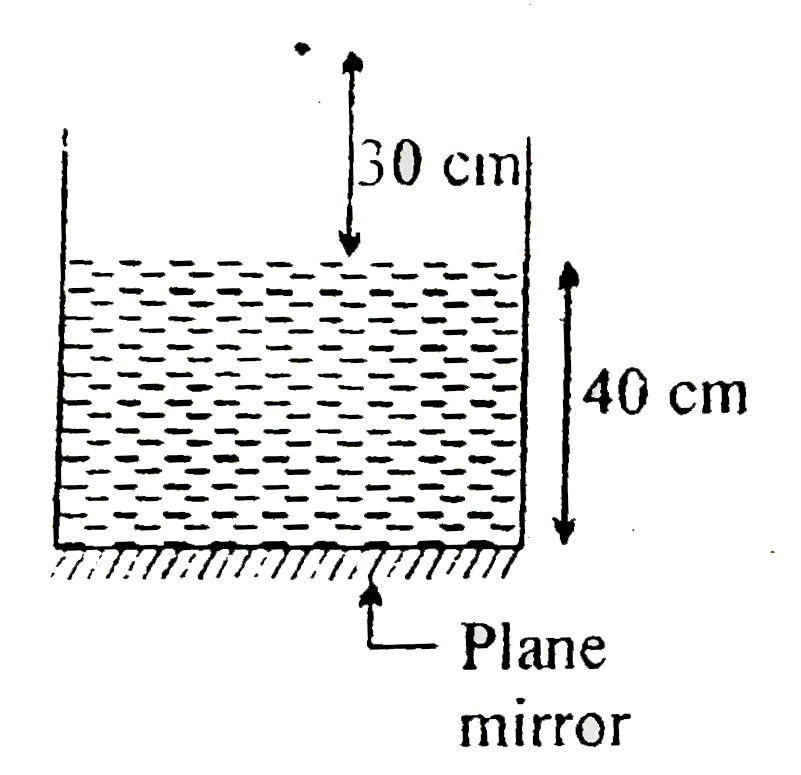 `v_(0)=-4m//s` `v_(i//m)=-muv_(0)` `v_(i//m)=+4//3xx4` `v_(i//m)=+16//3` `v_(i//G)=(V_(i//m))/MU` `v_(i//G)=(+16//3)/(4//3)=4` `v_(i//0)=4-(-4)=8m//s` |
|
| 49. |
As is rubber and wood are insulatores there are no free electron or currecnt carrless to then .Therefore carrect can and not flow through then On the other hand human body and earth are good conductor A current of 10 mA or more passing thought human body can be fated A current will flow only if the circuit is complete Read the above passage and answer the following position: (i) How can one repair on free line wires? (ii) Why is a current of 10mA or more passage though human body fated? (iii) What is the practical utility of this study? |
|
Answer» Solution :(i) To repair a live wire we should ASSUME that no current flows through th ebody .The poson must wave intaliating hand GLOWS of rubber and insulating shows of rubboer Then current will not pass through the body of the person and be will remain safe (ii) A current of `10mA` or more passing through human body upsets the any nerse carents that regular the body moscular active activios Due to it the hand MUSCLES contact and the person is unable to go off the live wires .This result in a severs SHOCK to the person .which may be fatal, (iii) The insulators work as protectors That is why a the electric wires used in a hour arre covent with insulating mateial to potect the person from the doctor contact ofcontact of the electric currennt The bodies of the electrons instraments like refrigerater electric oven are pervided with insudaces to evots leakuge of corrent from introment to earth c the insduring trads of wood or rubber to keep separete the live wires during speed wird is atoms |
|
| 50. |
Three rods of Copper, Brass and Steel are welded to - gether to from a Y-shaped structure. Area of cross-section of each rod = 4 cm^(2). End of copper rod is maintained at 100^(@)C whereas ends of brass and steel are kept at 0^(@)C. Lengths of the copper, brass and steel rods are 46, 13 and 12 cm respectively. The rods are thermally insulated from surroundings except at ends. Thermal conductivities of copper, brass and steel are 0.92,0.26 and 0.12 CGS units respectively. Rate of heat flow through copper rod is : |
|
Answer» `6.0` cal/s `rArr(0.92(100-T))/(46)=(0.26(T-0))/(13)+(0.12(T-0))/(12)` `rArrT=40^(@)C` 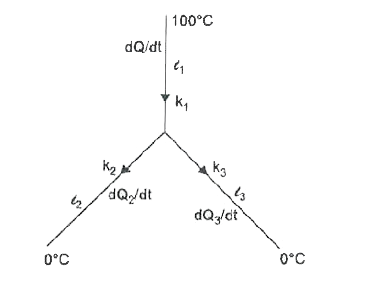 `(dQ_(1))/(dt)=(0.92xx4(100-40))/(40)=4.8" cal/s"` Correct choice is (d). |
|


