

Saved Bookmarks
This section includes 7 InterviewSolutions, each offering curated multiple-choice questions to sharpen your Current Affairs knowledge and support exam preparation. Choose a topic below to get started.
| 1. |
A : Spy satilight cameras use lenses with very large aperatures. R : In general, larger the aperture in an optical instrument, the greater the resolution. |
|
Answer» Both A and R are true and R is the CORRECT explanation of A |
|
| 2. |
A particle of mass 200 g is attached to an ideal string of length 1.30 m whose upper end is fixed to ceiling. The particle is made to revolve in a horizontal circle of radius 50 cm. The tension in the string is (g = 10 m/s^2) |
| Answer» Answer :d | |
| 3. |
Americans die each year from |
|
Answer» RESPIRATORY DISEASE |
|
| 4. |
One a plane mirror, a ray of light is incident at a angle of 30^(@) with horizontal. To make the reflected ray vertial, at what angle with horizontal must a plane mirror be places? |
|
Answer» `30^(@)` |
|
| 5. |
In the circuit diagram a capacitor which is initially uncharged is connected to an ideal cell of emf epsilon through a resistor 'R'. A leaky dielectric fills the space between the plates of dielectric. The capacitance of the capacitor with dielectric is C. Resistance of the dielectric is R' = R. |
|
Answer» Charge on the CAPACITOR as FUNCTION of time t is `(epsilon C)/(2)[1-e^(-(2t)/(RC))]`  `I'`= current through dielectric `=(q)/(C.R)` ….(i) By `K.V.L. epsilon-iR-(q)/(c)=0` ..(2) `i=I'+(dq)/(dt)=(q)/(RC)+(dq)/(dt)` ….(3) By `(2)` and `epsilon-((q)/(RC)+(dq)/(dt))R-(q)/(c)=0` `impliesepsilonC-2q-RC(dq)/(dt)=0` `impliesepsilonC-2q=RC(dq)/(dt)impliesint_(0)^(q)(dq)/(epsilonC-2q)=int_(0)^(t)(dt)/(RC)` `implies-(1)/(2)` ln `(epsilonC-2q)/(epsilonC)=(t)/(RC)impliesq=(epsilonC)/(2)(1-e^(2t)/(RC))` (II) `q_(max)=(epsilonC)/(2)` as `trarroo` and by (2) `epsilon-iR-(epsilon)/(2R)` at that time. |
|
| 6. |
The ionisation energy of hydrogen atom is 13.6 eV, the ionisation energy of a singly ionised helium atom would be ...... |
|
Answer» Solution :Ionisation energy `EpropZ^(2)` `:.(E_(He))/(E_(H))=(Z_(He)^(2))/(Z_(H^(2)))` `=((2)^(2))/((1)^(2))` `(E_(He))/(13.6)=4` `:.E_(He)=4xx13.6=54.4eV` |
|
| 7. |
If a rate change of current of 4As^(-1) induces an emf of 20mV in a solenoid, what is the self inductance of the solenoid? |
| Answer» SOLUTION :`5 XX 10^(-3)H` | |
| 8. |
Can a transformer be used in d.c. circuits ? Why? |
| Answer» SOLUTION : No, because there is no CHANGE in MAGNETIC FLUX in a d.c. CIRCUIT. | |
| 9. |
Assertion : The radius of a nucleus determined by electron scattering is found to be slightly different from that determined by alpha particle scattering . Reason : Electron scattering senses the charge distribution of the nucleus whereas alpha and similar particles sense the nuclear matter. |
|
Answer» If both ASSERTION and REASON are true and reason is the correct explanation of assertion . |
|
| 10. |
A rod lies parallel to the x axis of reference frame S, moving along this axis at a speed of 0.892c. Its rest length is 1.70m. What will be its measured length in frame S? |
|
Answer» |
|
| 11. |
An a.c. source with variable frequency is connected to a parallel plate capacitor . How will the displacement current be affected with the decrease in frequency of the source ? |
|
Answer» Solution :Displacement current decreases with decrease in frequency of a.c. source) [HINT : `I_(D)=in_(0)(dphi_(epsilon))/(dt)=in_(0)(d)/(dt)(EA)=in_(0)(d)/(dt)(V/d.A)` `=(in_0A)/(d).(dV)/(dt)=C(dV)/(dt)=C(d)/(dt)(V_(m)SINOMEGAT)=CV_(m)omegacosomegat"THUS"I_Dpropomega`] |
|
| 12. |
In a compound microscope, the objective and eyepiece have focal lengths 0.95 cm and 5 cm respectively and are kept at a distance of 20 cm .the final image is formed at a distance of 25 cm from the eyepiece. Calculate the position of the object and the total magnification . |
|
Answer» |
|
| 13. |
Give reasons for the The electric field, of the junction of a zener diode, is very high even for a small reverse bias voltage of about 5 V. |
| Answer» Solution :A zener diode is heavily doped and as a result the WIDTH of depletion region in a zener diode is extremely smal (even LESS than `10^(-6)` m). As a result, electric field (E = -`(DV)/(dr)`) at the junction dr becomes very HIGH even for a small reverse bias voltage of about 5 V. | |
| 14. |
An electrical technician requires a capacitance of 2 µF in a circuit across a potential difference of 1 kV. A large number of 1 µF capacitors are available to him each of which can withstand a potential difference of not more than 400 V. Suggest a possible arrangement that requires the minimum number of capacitors. |
| Answer» Solution :Eighteen `1muF`CAPACITORS ARRANGED in 6 parallel rows, each row consisting of 3 capacitors in series. | |
| 15. |
A galvanometer has a coil of resistance 100Omega andgives a full scale deflection for 30 volt range, the resistance required to be added will be |
|
Answer» `900Omega` RESISTANCE of galvanometer, `G=100Omega` Current for full SCALE deflection, `l_(g)=30mA=30xx10^(-3)A` Range of voltmeter, V=30V To convert the galvanometer into an voltmeter of a given range, a resistance R is connected in series with it. 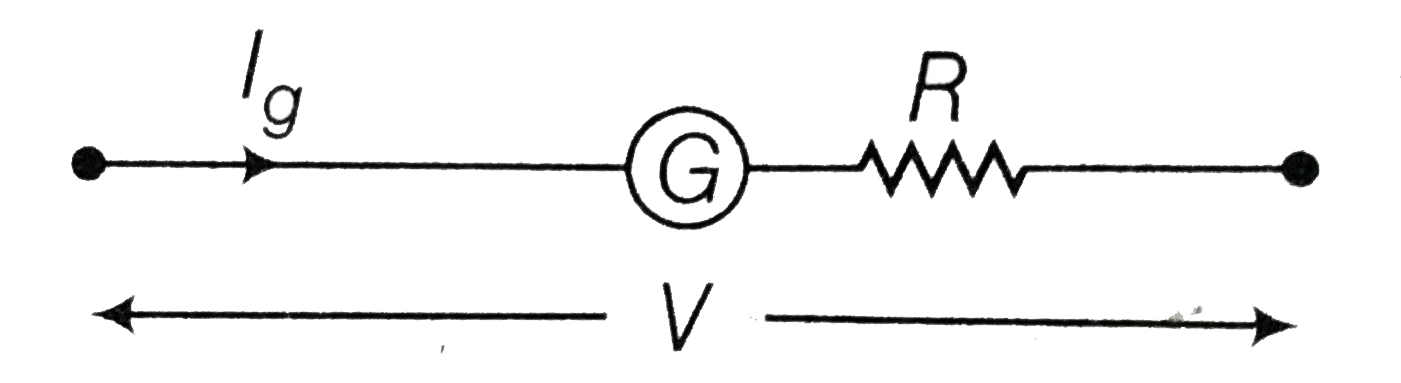 From figure, `V=l_(g)(G+R)` or `R=(V)/(l_(g))-G=(30)/(30xx10^(-3))-100Omega` `=1000-100=900Omega` |
|
| 16. |
lf a conductor has a potential V ne 0 and there are no charges anywhere else outside, then |
|
Answer» there MUST be charges on the surface of INSIDE itself |
|
| 17. |
Zeeman effect. In Bohr’s theory of the hydrogen atom the electron can be thought of as moving in a circular orbit of radius r about the proton. Suppose that such an atom is placed in a magnetic field, with the plane of the orbit at right angle to B. What if the electron is circulating counterclockwise? Assume that the orbit radius does not change. |
| Answer» SOLUTION :DECREASE | |
| 18. |
Zeeman effect. In Bohr’s theory of the hydrogen atom the electron can be thought of as moving in a circular orbit of radius r about the proton. Suppose that such an atom is placed in a magnetic field, with the plane of the orbit at right angle to B. If the electron is circulating clockwise, as viewed by an observer sighting along B, will the angular freuqency increase or decrease ? |
| Answer» SOLUTION :INCREASE | |
| 19. |
A :The accelerations of electron and proton are different in same electric field. R :Electric force acting on unit positive charge is independent of mass. |
|
Answer» Both ASSERTION and REASON are TRUE and the Reason is CORRECT explanation of the Assertion. |
|
| 20. |
Using the conditions of the foregoing problem, draw the approximate time dependence of moduli of the normal w_n and tangent w_tau acceleration vectors, as well as of the projection of the total acceleration vector w_v on the velocity vector direction. |
|
Answer» As `vecvuarr uarr hatu_t` all the moments of TIME. THUS `nu^2=nu_t^2-2g tnu_0sin alpha+g^2t^2` Now, `w_t=(dnu_t)/(dt)=(1)/(2v_t)(d)/(dt)(v_t^2)=1/v_t(g^2t-gv_0sin alpha)` `=-g/v_t(v_0sin alpha-g t)=-"g" (v_y)/(v_t)` Hence `|w_t|="g"(|v_y|)/(v)` Now `w_n=SQRT(w^2-w_t^2)=sqrt(g^2-"g"^2(v_y^2)/(v_t^2))` or `w_n="g"(v_x)/(v_t)` (where `v_x=sqrt(v_t^2-v_y^2)` As `vecvuarr uarr hatv_t` during time of motion `w_v=w_t=-"g" (v_y)/(v)` On the basis of obtained expressions or facts the sought PLOTS can be drawn as shown in the figure of answer sheet. |
|
| 21. |
Explain why elemental semiconductor cannot be used to make visible LEDs. |
|
Answer» Solution :BAND GAP in elemental semiconductors is not sufficient for emission of visible light. HENCE, they can not be employed for preparing LED which can emit visible light. (NOTE : Using elemental semiconductors, we can prepare LED which can emit infrared light). |
|
| 22. |
A beam of light of wavelength 590 nm is focused by a convex lens of diameter 10 cm at a distance of 20 cm from it. Find the diameter of the disc image formed. |
|
Answer» |
|
| 23. |
(a) When an unpolarized light of intensityI_(0) is passed through a polaroid , what is the intensity of the linearly polarized light ? Does it depend on the orintation of the polaroid ? Explain your answer.(b)A plane polarized beam of light is passed through a polaroid . Show graphically the variation of the intensity of thetransmitted light with angle of rotation of the polaroid in complete one rotation. |
|
Answer» Solution :(a)When an UNPOLARIZED light of intensity`I_(0)` is PASSED through a polaroid , its intensity becomes`(I_(0))/(2)`.No , it does not depend on the orientation of the polaroid as inunpolarized light ELECTRIC vectors are RANDOMLY polarized in all the directions. (b) 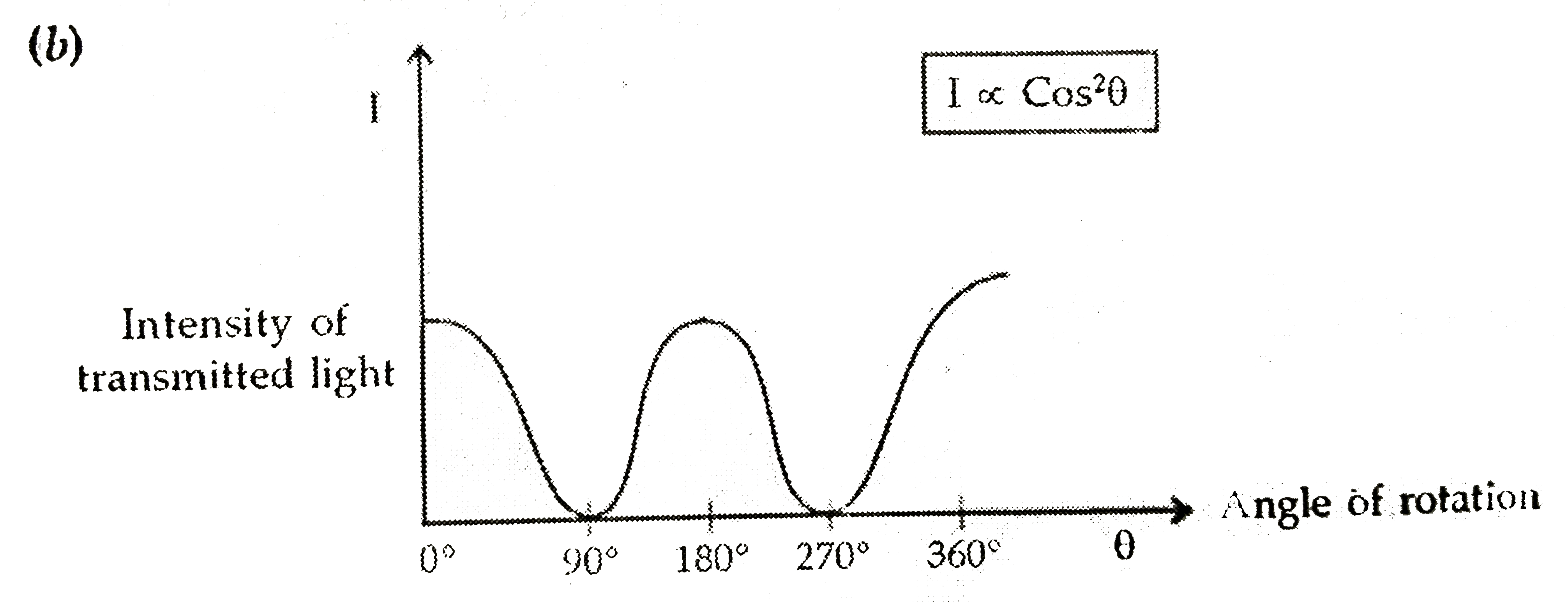
|
|
| 24. |
A transistor with alpha = 0.98is operated in common emitter circuit with a load resistance of 5kOmega . If the dynamic resistance of the base emitter junction is 7Omega , the voltage gain and power gain will be : |
|
Answer» `3500, 1.715 xx10^5` Voltage GAIN `A_v=beta (R_("out"))/(R_("in"))=(49xx5xx10^3)/70=3500` POWER gain = voltage gain `xx beta = 3500 xx 49` ` = 1.715xx10^5` |
|
| 25. |
A swimming pool always appears shallower than it really is. Explain. |
| Answer» SOLUTION :Light coming from the bottom SURFACE of swimming pool bends away from the NORMAL due to refraction. HENCE apparent depth of pool is less than the actual depth. | |
| 26. |
A conducting sphere A of radius r is attached on an insulating hand. Another sphere B of radius.R.is mounted on an insulating stand. Initially A is given a charge Q, it is bought in contact with B and removed. A is charged to O afer each contact. This process is repeated ni times Match the Column I with Column II and choose the correct option code. |
|
Answer» <P> |
|
| 27. |
A tank is filled with water up to a height H. When a hole is made at a distance h below the level of water. What will be the horizontal range of water jet ? |
|
Answer» a)`2sqrt(H(H-h))` |
|
| 28. |
A particle of unknown mass is acted upon by a force vecF=(100e^(-2t)hati) N. If at t = 0.00 s the particle is at rest, for the time interval t=0.00 s to t= 2.00 s find (a) the impulse on the particle and (b) the average force on the particle. |
|
Answer» |
|
| 29. |
The ratio of specific charge of proton to that of alpha-particle is: |
|
Answer» `1:4` `:. (S_(p))/(S_(alpha))=(e)/(m_(p))XX(4m_(p))/(2e)=(2)/(1)` |
|
| 30. |
Two concentric circular coils of 10 turns cach are situated in the same plane. Their radii are 20 cm and 40 cm and they carry respectively 0.2A and 0.3A current in oponite direction. The magnetic field io tesla at the centre is |
|
Answer» `[(35/4)mu_0]` |
|
| 31. |
A radiation of wavelength 300 nm is incident on a silver surface. Will photoelectrons be observed ? |
|
Answer» Solution :Energy of the incidet photon is `E = h upsilon = (hc)/(lambda)` (in JOULES) `E = (hc)/(lambda e)` (in eV) Substituting the known VALUES, we get `E = (6.626 xx 10^(-34) xx 3 xx 10^(8))/(300 xx 10^(-9) xx 1.6 xx 10^(-19))` E = 4.14 eV the WORK function of SILVER = 4.7 eV. Since the energy of the incident photon is less than the work function of silver, photoelectrons are not observed in this case. |
|
| 32. |
A radar has a power of 1kW and is operating at a frequency of 10 GHz. It is located on a mountain top of height 500m. The maximum distance upto which it can detect object located on the surface of the Earth is (Radius of Earth = 6.4 xx 10^(6)m) |
| Answer» Answer :A | |
| 33. |
Define magnetisation of a sample. |
|
Answer» Solution :Magnetisation of a sample is its net magnetic DIPOLE MOMENT per UNIT VOLUME. i.e., `botM=(botM_(net))/(V)` |
|
| 34. |
In figure , a solid sphere of radius a = 2.00cm is concentric with a spherical conductiosn shell of inner raedius b =2.00 a and outer radius c=2.40 a. the sphere has a net unifrom charge q_(1)=+5.00C. The shell has a net charge q_(2) =-q_(1). Distance (a) r=0 (b) r= a/2.00 (c) r=a (d) r = 1.50 a (e) r= 2.30a and (f) r= 3.50 a ? what si the net charge on the (g) inner and (h) outer surface of the shell ? |
|
Answer» |
|
| 35. |
In a Young's double-slit experiment if blue light is replaced by red light then the fringe width will _____. |
| Answer» SOLUTION :INCREASE. Because `betaproplamda` | |
| 36. |
A bullet of mass 0.1Kg moves with velocity 10 m/s it strikes a block and comes to rest after travels 0.5 m inside block. Find retardation of bullet |
|
Answer» |
|
| 37. |
Let us consider an infinite plane charged conducting plate. Now the charge distributes on both sides of the conducting plate. The field of such charged plate arises from the super-position of the fields of two sheets of charge. Can you guess the value of E for points outside the plate ? What will be the field inside the plate, and why? |
| Answer» Solution :`E= (sigma)/(epsi_(0))` and INSIDE the plate E= 0 | |
| 38. |
c) Is the magnification equal to the magnifying power in this case ? Explain. |
|
Answer» Solution :III) Magnifying power `=(d)/(U)=(25)/(7.14)=3.5` Yes, the magnification and magnifying power in this case are EQUAL, because image is formed at the least DISTANCE of distinct VISION. |
|
| 39. |
In the above example, find the angle of incidence at face AB, so that emergent ray grazes along the face AC'. |
Answer» SOLUTION :Calculation of angle of incidence at face AB.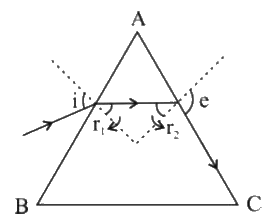 At face AC, let the angle of incidence be `r_(2)`, For grazing ray `e=90^(@)` `impliesmu=1/(sinr_(2))=r_(2)=SIN^(-1)(1/(sqrt(2)))=45^(@)` Let angle of REFRACTION at face AB be `r_(1)` Now `r_(1)+r_(2)=A` `:.R_(1)=A-r_(2)=60^(@)-45^(@)=15^(@)` Let anle of incidence at this face be i `MU=(sini)/(sinr_(1))` `impliessqrt(2)=(sini)/(sin 15^(@))` `:.i=sin^(-1)(sqrt(2).sin 15^(@))` |
|
| 40. |
Draw the labelled ray diagram for the formation of image by a compound microscope. Derive the expression for the total magnification of a compound microscope. Explain why both the objective and the eyepiece of a compound microscope must have short focal lengths. |
Answer» Solution :(a) Image formation by a compound microscope : A schematic diagram of a compound microscope is shown in Fig. 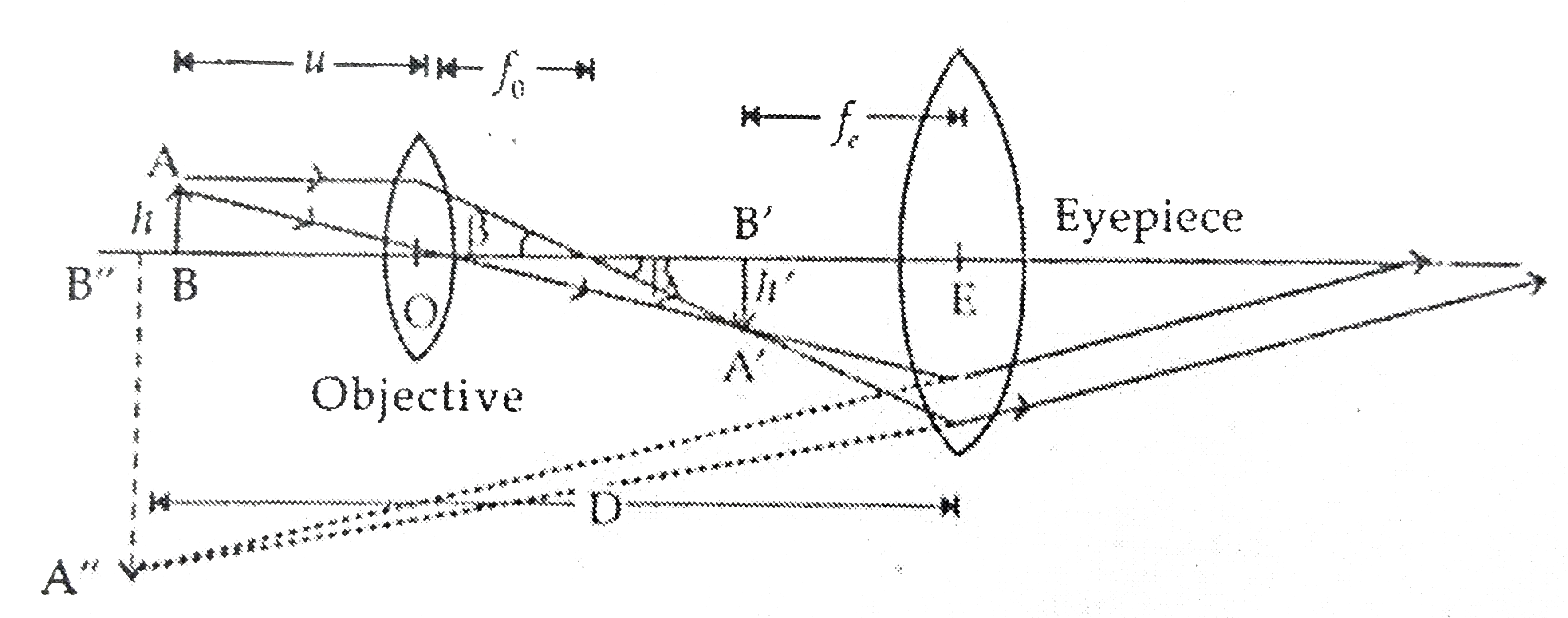 (b) Magnifying Power : The linear magnification `(m_(0))` due to the objective is `m_(0) = (A'B')/(AB) = (h')/(h)`..(i) Also `tan beta = (h)/(f_(0)) = (h')/(L)` `:. (h')/(h) = (L)/(f_(0))`...(ii) From (i) and (ii), we have `m_(0) = (L)/(f_(0))`..(iii) When h' is the size of the FIRST image, the object size being h and `f_(0)` being the focal LENGTH of the objective and L be the distance between the second focal POINT of the objective and first focal point of the eye PIECE (focal length `f_(E)`) is called the tube length of compound microscope. When the final image is formed at the near point, then the angular magnification `(m_(e))` of the eye piece is `m_(e) = (1 + (D)/(f_(e)))`...(iv) `:.` Total magnification of compound microscope is `m = m_(0).m_(e)` `m = ((L)/(f_(0))) (1 + (D)/(f_(e)))` [ From (iii) and (iv)] When the final image is formaed at infinity then, `m = ((L)/(f_(e))) ((D)/(f_(e)))` (c) For large magnifying power `f_(0) and f_(e)` both have to be small. Also `f_(0)` is taken to be smalller than `f_(e)` so that the field of view may be increased. |
|
| 41. |
According to kinetic theory, the molecules |
|
Answer» repel each other |
|
| 42. |
For a transistor beta= 40 and I_B = 25 muAI_B = 25 mu A. Find the value of l_E . |
|
Answer» SOLUTION :`beta = ((Delta I_C )/( Delta I_B ))_(V_(CE))` (If only d.c. values are considered) ` thereforeI_C= betaI_B= 40 xx 25 xx 10^(-6)=1000 xx 10^(-6) A ` ` thereforeI_E= I_B+I_C ` ` =( 25xx 10^(-6)+ 1000 xx 10^(-6) ) AMP ` ` = 1025mu A= 1.025mA ` |
|
| 43. |
Which one of the following groups of electromagnetic waves is in order of increasing frequency? |
|
Answer» MICROWAVES, ultraviolet RAYS, X-rays |
|
| 44. |
A solid sphere of mass 10 kg is placed over two smooth inclined placed as shown in figure. The normal reactions at 2 is (g = 10 m//s^(2)) |
|
Answer» 50 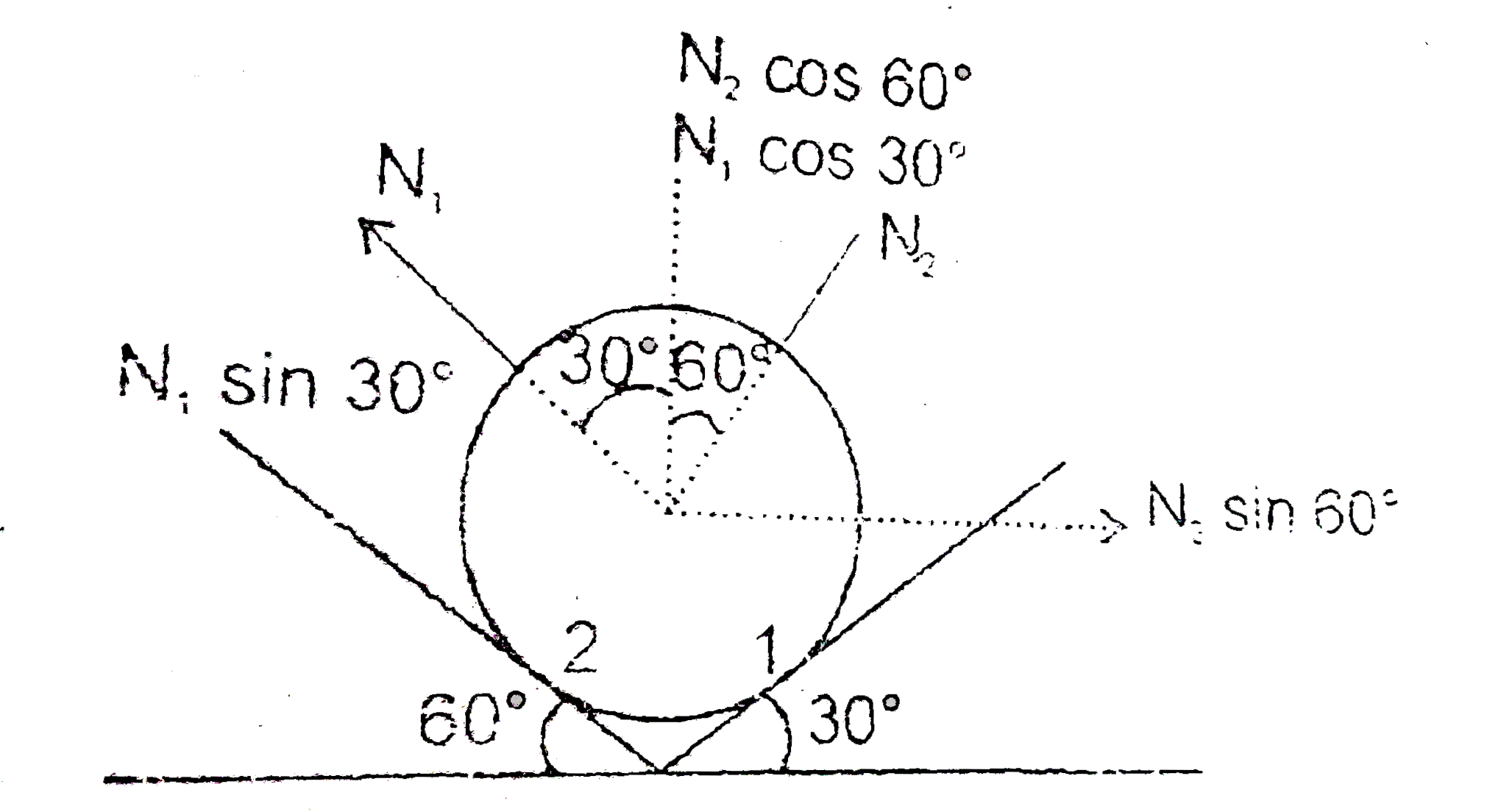 `N_(1) sin 30^(@) = N_(2) sin 60^(@)` `N_(1) cos 30^(@) + N_(2) cos 60^(@) = MG` Solving above equation `N_(2) = (mg)/(2) = (10 xx 10)/(2) = 50` |
|
| 45. |
Two moving coil meters M_1 " and " M_2 have the following particulars R_1 = 10 omega, N_1 = 30 ,""A_1 = 3.6 xx 10^(-3) m^2, B_1 = 0.25 T R_(2) =14 omega , N_2 = 42 A_(2) = 1.8 xx 10^(-3) m^2, B_(2) = 0.50 T (The spering constants are identical for the two meters ) Determine the ratio of (a) current sensitivity and (b) voltage sensitivity of M_2 "and "M_1 |
|
Answer» Solution :Current sensitivity , `(theta )/(I) = (BAN)/(C)` Ratio of SECOND to first is`((B_2A_2N_2)/(C_2))/((B_1A_1N_1)/(C_1))= (0.5 xx 1.8 xx 10^(-3) xx 42)/(0.25 xx 3.6 xx 10^3)=7/5 =1.4` b. Voltage sensitivity`(theta)/(V) = (BAN)/(C) xx 1/R` `1.4 xx (R_1)/(R_2) = 1.4 xx (10)/(14) =1` |
|
| 46. |
Why are de-Broglie waves associated with a moving football not visible ? The wavelength lamda of a photon and the de-Broglie wavelength of an electron have the same value. Show that energy of the photon is (2lamdamc)/(h) times the kinetic energy of the electron, where m, c and h have their usual meanings. |
|
Answer» Solution :de-Broglie waves associated with a MOVING football are not visible because in accordance with formula `lamda=(h)/(MV)`, the value of wavelength is extremely small (of the order of `10^(-34)`m). Energy of a photon of wavelength `lamda, E_(p)=hv=(hc)/(lamda)` if de-Broglie wavelength of electron be `lamda,` then `lamda=(h)/(mv) or V=(h)/(mlamda)` `THEREFORE` K.E. of an electron is `K_(e)=(1)/(2)mv^(2)=(1)/(2)m*((h)/(mlamda))^(2)=(h^(2))/(2mlamda^(2))`. . (ii) Dividing (i) by (ii), we have `(E_(p))/(K_(e))=(hc//lamda)/(h^(2)//2mlamda^(2))=(hc)/(lamda)xx(2mlamda^(2))/(h^(2))=(2mlamdac)/(h) or E_(p)=(2mlamdac)/(h)*K_(e)`. |
|
| 47. |
The masses of five balls at rest and lying at equal distance in a straight line are in geometrical progression with ratio 2 and their coefficients of restitution are each 2/3 . If the first ball is started towards the second with velocity u, then the velocity communicated to 5^(th) ball is |
|
Answer» `(5)/(9)u` |
|
| 48. |
Four identical spheres each of radius 10 cm and equal mass 1 kg each are placed on horizontal surface touching each other so that their centres are located at the vertices of a square of side 20 cm. What is the distance of their centre of mass from the centre of either sphere? |
|
Answer» 20 cm  The CENTRE of mass would lie at the POINT of intersection of the two DIAGONALS AC and BD and distance from each of the centre will be `10sqrt(2)` cm. |
|
| 49. |
The thermonuclear reaction of hydrogen inside the stars is taking place by a cycle of operations.The particular element which acts as a catalyst is |
|
Answer» Nitrogen `""_(6)^(12)C+""_(1)^(1)Hto""_(7)^(13)N+gamma+1.9MeV` ……….(i) `""_(7)^(13)Nto""_(6)^(13)C+e^(+)+v+1.20MeV` ……..(ii) `""_(6)^(13)C+""_(1)^(1)Hto""_(7)^(14)N+gamma+7.6 MeV`......(iii) `""_(7)^(14)N+""_(1)^(1)Hto""_(8)^(15)O+gamma+7.39 MeV`.......(IV) `""_(8)^(15)Oto""_(7)^(15)N+e^(+)+v+1.71MeV` ....(v) `""_(7)^(15)N+""_(1)^(1)Hto""_(6)^(12)C+""_(2)^(4)He+4.99MeV` .........(vi) In this set of reactions carbon is not DESTROYED but acts as a catalyst. |
|
| 50. |
Two resistors are connected in series with 5V battery of negligible internal resistance. A current of 2 A flows through each resistor. If they are connected in parallel with the samebattery a current of (25)/(3)A flows through combination. Calculate the value of each resistance. |
|
Answer» <P> Solution :Resistors in series `: R _(S) = R_(1) + R _(2)``I = (epsi )/(R _(s))` `R _(S) = (epsi )/(I) =5/2` `R_(1) + R _(2) =2.5` Resistors in PARALLEL `R _(p) = (R _(1) R_(2))/( R _(1) + R _(2))` `I = (epsi )/(R _(p))` `R _(p) = (epsi )/(I) = (5)/( 25//3) = 3/5` `R_(1) R _(2) = 3/5 XX (R_(1) + R _(2)) = 3/5 xx 2.5` `R_(1) R _(2) = 1.5` Solving equations (1) and (2),` R_(1) = 1.5 Omega and R_(2) = 1OMEGA ` |
|