

Saved Bookmarks
This section includes 7 InterviewSolutions, each offering curated multiple-choice questions to sharpen your Current Affairs knowledge and support exam preparation. Choose a topic below to get started.
| 1. |
In photoelectriceffect workfunctionofanymetalis2.5eV. Emittedelectronsarestoppedbythe potentialof-1.5 voltthen |
|
Answer» energyofincident PHOTONS is4 EV |
|
| 2. |
The fission of uranium nuclide |
|
Answer» ALWAYS leads to the same pair of FISSION produce say BARIUM and KRYPTON |
|
| 3. |
Based on which experiment did the Rutherford nuclear model come from? |
|
Answer» Solution :Ernst Rutherford was engaged in experiments on a-particles emitted by some radioactive elements and explanation of the results GAVE an explanation of the atomic model. According to this the entire positive charge and most of the mass of the atom is concentrated in small volume called the nucleus with electron revolving around the nucleus just as planets revolve around the Sun which is ALSO called PLANETARY model of atom or Rutherford nuclear model which we have accepted today. However, it could not explain why atoms EMIT light of only discrete wavelengths. For example, how could an atom as simple as hydrogen, CONSISTING of a single electron and a single proton, emit a complex spectrum of specific wavelengths? |
|
| 4. |
In the circuit shown in the figure, switch S is closed at time t = 0. Charge on positive plate of capacitor is q at time t. (a) Derive a differential equation for q at time t. (b) Solve the equation to write q as a function of time. (c) Put t = 0 and t = infty in your equation to get charge on the capacitor at these times. |
|
Answer» (B) `q=(48)/(5)[1-e^(-(5T)/(56))]` (c) `0 ; (48)/(5) muC` |
|
| 5. |
In hydrogon atom, electron excites from ground state to higher energy state and its orbital velocity is reduced to (1)/(3) rd of its initial value. The radius of the orbit in that higher energy state is : |
|
Answer» R 9 `mvr=(nh)/(2pi)` `i.,e v PROP (1)/(r),(v_(1))/(v_(2))=(r_(2))/(v_(1))` `:. (v)/(v//z)=(r_(2))/(R) rArr r_(2)=3R`. |
|
| 6. |
Calculate the deviation suffered by incident ray in situation as shown in figure after three successivereflections. |
|
Answer» `380^@ ` CLOCKWISE |
|
| 7. |
A disc of radius a is ridigly attached at its circumference to a rod of length 3a and the combination suspeded vertically from the other end of the rod. It is swinging in the plane of the disc such that the centre of disc has velocity v. If mass of disc and rod is m |
|
Answer» Kinetic energy of the DISC is `1/2mv^(2)` `=1/2 mv^(2)+/2xx1/2ma^(2)(v/(4a))^(2)` KE or rod `=1/2I omega^(2) =1/2 (M(3a)^(2))/3(v/(4a))^(2)` KE of system `=1/2 I` system `omega^(2)` `=1/2[(ma^(2))/2+(4a)^(2)+(m(3a)^(2))/2](v/(4a))^(2)` |
|
| 8. |
A : When an electric charge is distributed between two bodies , no charge is destroyed but the electrostatic energy decreases. R : Certain energy is dissipated in the form of heat. |
|
Answer» a ASSERTATION is CORRECT and Reason is correct and Reason EXPLAIN Assertation |
|
| 9. |
A hot placed in air cools down to a lower temperature. The rate of decrease of temperature isproportionalto the temperaturedifference from the surrounding. The body loses 60% and 80% of maximum heat it can loose in time t_(1) and t_(2) respectively. The ratio t_(2)//t_(1) will be |
|
Answer» `(ln(10))/(ln(2))` `-(dT)/(dt) alpha DeltaT ` or `(dT)/(dt)=-K DeltaT` Solved the above Eq., we get `T(t)=T_(0)+(T_(1)-T_(0))E^(kt) rArr e^(-kt)=(T(t)-T_(0))/(T_(1)-T_(0))` or `t=l/k ln (T_(1)-T_(0))/(T(t)-T_(0))` Where, `T_(1)=` temperature of BODY at `t=0` `T_(0)=` temperature of SURROUNDING. Let `T_(1)=0^(@)C` So, `t=1/k ln (-T_(0))/(T(t)-T_(0))= 1/k ln (-Q_(0))/(Q(t)-Q_(0))` [ `:.Q(t)=mcT(t)`] According to the question, the body loses 60% and 80% of maximum heat in time `t_(1)` and `t_(2)` then `t_(1)=1/k ln ((-Q_(0))/((60)/(100)Q_(0)-Q_(0)))` ...(i) `t_(2)=1/k ln ((-Q_(0))/((80)/(100)Q_(0)-Q_(0)))` ...(ii) DIVIDE Eqs. (ii) by (i), we get `t_(2)/t_(1)=(1/k ln ((-Q_(0))/((80)/(100)Q_(0)-Q_(0))))/(1/k ln ((-Q_(0))/(100-Q_(0))))` `rArr (t_(2))/(t_(1))=(ln((-Q_(0))/((80Q_(0)-100Q_(0))/(100))))/(ln((-Q_(0))/((60Q_(0)-100Q_(0))/100)))=(ln((-Q_(0)xx100)/(-20Q_(0))))/(ln((Q_(0)xx5)/(2Q_(0))))` `=(ln(5))/(ln(5/2))` Hence, the correct OPTION is (d). |
|
| 10. |
Answer the following questions: A piece of lead is hammered. Does the internal energy of the lead-increase ? Does the heat enter the lead from outside ? |
| Answer» SOLUTION :YES, it INCREASES, No. | |
| 11. |
A 100 Omega resistor is connected to a 220 V, 50 Hz ac supply. (a) What is the rms value of current in the circuit? (b) What is the net power consumed over a full cycle? |
|
Answer» SOLUTION :(a) 2.20A (B) 484W |
|
| 12. |
Define the term 'stopping potential' in relation to photoelectric effect. |
| Answer» Solution :In PHOTOELECTRIC effect, the STOPPING potential is the LEAST value of negative potential to be APPLIED in a photoelectric tube for which photoelectric current becomes zero. | |
| 13. |
A stone is dropped into a well and sound of impact of stone with water is heard after 2.056 second of the release of stone from top If g980 cm/s^(2) and velocity of sound is 350 m/s. Then depth of well is : |
|
Answer» 19.6 m `t = sqrt((2h)/(g)) + (H)/(V)` . ` t = sqrt((2 xx 29.6)/(9.8)) + (19.6)/(350)= 2 + 0.056= 2.056`SEC Hence the correct CHOICE is (a ). |
|
| 14. |
The angle of incidence for a ray of light at a refracting surface of a prism is 45^@. The angle of prism is 60^@. If the ray suffers minimum deviation through the prism, the angle of minimum deviation and refractive index of the material of the prism respectively, are |
|
Answer» `30^@,sqrt2` `45^@+45^@=60^@+delta_m [because i=eimplies delta=delta_m]` `THEREFORE delta_m=30^@`  `mu=(sin((delta_m+A)/(2)))/(sin""A/2)` `=(sin((60^@+30^@)/(2)))/(sin((60^@)/(2)))` `=(sin45^@)/(sin 30^@)` `=(1)/(sqrt2)xx2/1` `=sqrt2` |
|
| 15. |
A steel wire of length 7 m and cross section 1mm^(2) I suspended from a rigid support, with a steel weight of volume10^(3) cm^(3) hanging from its other end. Find the decrease in the length of the wire when the steel weight is completely immersed in water. Y_("steel") = 2xx 10^(11) N//m^(2)density of water= 10^(3) kg//m^(3) ] |
|
Answer» |
|
| 16. |
In above question, the work done in the two wire is |
|
Answer» 0.5 J, 0.03 J Where, Y,I and F are constants. `implies W prop (1)/(D^(2))` or `(W_(1))/(W_(2)) = (D_(2)^(2))/(D_(1)^(2)) = 16` Now, `W_(1) = (1)/(2) xx 10^(3 xx 1 xx 10^(-3) = 0.5 J` `:. W_(2) = (1)/(2) xx 10^(3) xx (10^(-3))/(16) = (1)/(32) = 0.03125` `(w_(1))/(W_(2)) = (0.5)/(0.3125) = 16` |
|
| 17. |
The effective resistance between A and B in the given circuit is. |
|
Answer» `20OMEGA` |
|
| 18. |
A particle of mass m and charge q moving with velocity v enters the region of uniform magnetic field at right angle to the direction of its motion. How does its kinetic energy get affected? |
| Answer» SOLUTION :The kinetic energy of charge particle remains unchanged because MAGNETIC field changes only the direction of MOTION of charge Q but does not change its SPEED. | |
| 19. |
The effective resistance between A and B in the given circuit is |
|
Answer» `18Omega` |
|
| 20. |
The normal activity of living carbon-containing matter is found to be about 15 decays per minute for every gram of carbon. This activity arises from the small proportion of radioactive ""_6^14C present with the stable carbon isotope ""_6^12C. When the organism is dead, its interaction with the atmosphere (which maintains the above equilibrium activity) cases and its activity begins to drop. From the known half-life (5/30 years) of ""_6^14C, and the measured activity, the age of the specimen can be approximately estimated. This is the principle of ""_6^(14)C dating used in archacology. Suppose a specimen from Mohenjodaro gives as activity of 9 decyas per minute per gram of carbon. Estimate the approximate age of the Indus-Vally civillisation. |
|
Answer» SOLUTION :NORMAL activity , `R_0 = 15` decays PER min. Present activity , R = 9 decays per min. `T_(1//2) = 5730` days `N = N_0 e^(-lambda t)` `R prop N and R_0 prop N_0` `(R )/(R_0) = N/(N_0) = e^(-lambda t)` `e^(-lambda t) = R/(R_0) = 9/15` `lambda t = log_e 15/9 = 2.303 log_(10) (5/9) = 0.511` `t = (0.511)/(lambda) = (0.511)/(0.693) xx T_(1//2) = (0.511)/(0.693) xx 5730 = 4225` years . |
|
| 21. |
(A) : The radiation force on an absorbing surface is twice that on a reflecting surface. (R) : The radiation force on a reflecting surface is twice that on an absorbing surface. |
|
Answer» Both 'A' and 'R' are TRUE and 'R' is the CORRECT EXPLANATION of 'A'. |
|
| 22. |
The number of signifigures in the numbers 4.8000xx10^(4) and 48000.50 are respectively |
| Answer» ANSWER :B | |
| 23. |
In the circuit shown in fig. C = 6 mu F . The charge stored in capacitor of capacity Cis |
| Answer» Answer :C | |
| 24. |
On what phenomenon mirage is formed ? |
| Answer» SOLUTION :TIR = TOTAL INTERNAL REFLECTION. | |
| 25. |
A coin kept on a rotating disc with its centre 5 cm away from the centre of the disc, just begins to slip when the frequency of rotation of the disc reaches 60 r.p.m. The coefficient of friction is,(g=9.8 m/s^2). |
|
Answer» 0.1012 |
|
| 26. |
Two radiations containing photons of energy twice and five times the work function of a metal are incident successively on the metal surface. The ratio of the maximum velocities of the emitted electrons in the two cases will be: |
|
Answer» `1:3` Then `phi_(0)=(1)/(2) mv_(1)^(2)` Also `5phi_(0)=phi_(0)+(1)/(2) mv_(2)^(2)` `:. 4phi_(0)=(1)/(2) mv_(2)^(2)` so `(v_(1)^(2))/(v_(2)^(2))=(phi_(0))/(4phi_(0))=(1)/(4) rArr (V_(1))/(v_(2))=(1)/(2)` |
|
| 27. |
Draw a plot showing the variation of photoelectric current with collector plate potential for two different frequencies, v_(1) gt v_(2), of incident radiation having the same intensity. In which case will the stopping potential be higher ? Justify your answer. |
Answer» Solution : A plot showing the variation of photoelectric current `i` with COLLECTOR plate potential for two DIFFERENT frequencies `v_(1) and v_(2)" "("where "v_(1)gtv_(2))` of incident radiation having the same intensity has been shown in figure. Stopping potential is higher for frequency `v_(1)`, i.e., `(V_(0))_(1)gt(V_(0))_(2)`. As per Einstein.s photoelectric equation, we have `hv=phi_(0)+K_(max)=phi_(0)+eV_(0)`. From this equation, it is very MUCH clear that value of stopping potential `V_(0)` will INCREASE with increase in the frequency of the incident radiation. in fact. `h(v_(1)-v_(2))=e[(V_(0))_(1)-(V_(0))_(2)]`. |
|
| 28. |
A student measures the time period of 100 oscillations of a simple pendulum four times. The data set is 90s and 92 s. If the minimum division in the measuring clock is 1s, the the reported means time should be : |
|
Answer» `92 pm 3s` |
|
| 29. |
A conductingframe in the shape of an equilateral triangle (mass m, side a) carrying a current I is placed vertically an a horizontal rough surface (coefficient of friction is mu). The frame is free to rotate about y- axis only. A magnetic field exists such that bar(B)=-B_(0)yhat(i). Then |
|
Answer» The maximum value of `B_(0)` so that the FRAM does not rotate `(2mumg)/(Ia^(2))` `=1xx((2dy)/(SQRT(3)))B_(0)yxx(sqrt(3))/2` 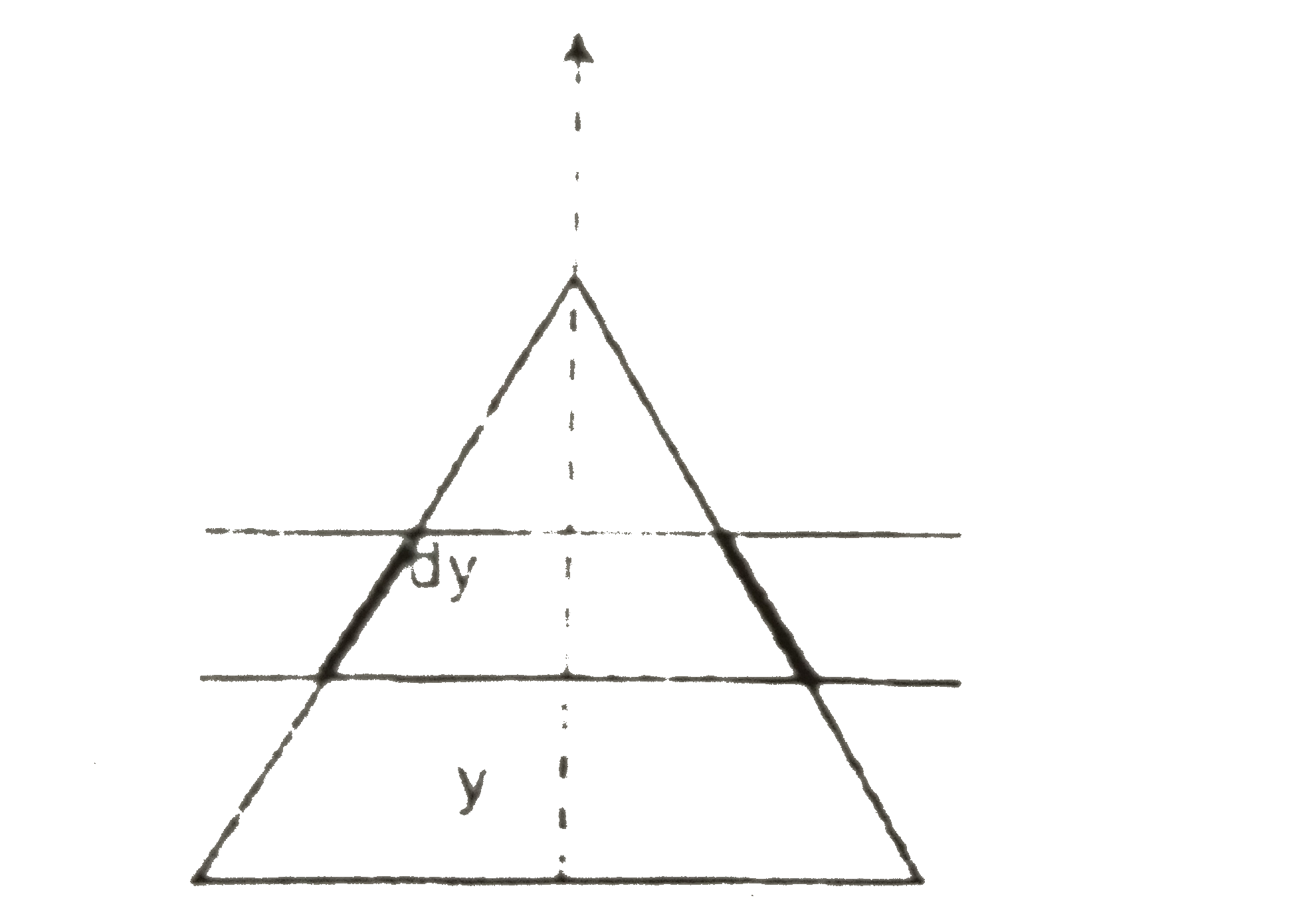 `impliestau=int_(0)^((sqrt(3)a)/2)(2B_(0)l_(y)dy)/(sqrt(3))XX((sqrt(3))/2a-y)` `=2/(sqrt(3))IB_(0) int^((sqrt(3))/2 a) ((sqrt(3))/2a-y)ydy=(IB_(0)a^(3))/8` `tau_(friction)=2{(mumg)/a int_(0)^(a//2) xdx}=(mumga)/4` For the frame to rotate `(IB_(0)a^(3))/8le(mumga)/4` `B_(0)le(2mumg)/(Ia^(2))` |
|
| 30. |
One mole of a mono- atomic ideal gas undergoes a quasi- static process, which is depicted by a straight line joining points (V_(0)T_(0)) " and " (2V_(0) , 3T_(0)) in a V - T diagram . What is the value of the heat capacity of the gas at the point (V_(0) , T_(0)) ? |
|
Answer» R ` :. ` Work done , `dW = PdV`CHANGE in internal energy is, `Delta U = nC_(V) Delta T` where `C_(V)` = specific heat at constant volume. Heat given in process is , `Delta Q = nCDelta T `, 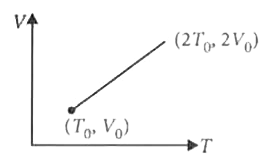 where n is number of moles of gas , C is molar heat capacity. ACCORDING to graph, temperature is increasing with increase in volume. It means that energy is used both in increasing internal energy and work done. According to `1^(st)` law of thermodynamics ` PdV + nC_(V)dT = nCdT` or ` P/n (DV)/(dT) + C_(V) = C` .....(i) At `(V_(0) , T_(0)) (dV)/(dT) = V_(0)/(2T_(0)) ` ....(ii) Again , `P_(0)V_(0) = nRT_(0) rArr P_(0)/n = (RT_(0))/V_(0) ` ....(iii) From (i), (ii) and (iii) , `C = (RT_(0))/V_(0) V_(0)/(2T_(0)) + 3/2 R = 2 R [ :. " for monoatomic gas , " C_(V) = 3/2 R]` |
|
| 31. |
A transistor having alpha=0.99 is used in a common base amplifier. If the load resistance is 4.5 kOmega and the dynamic resistance of the emitter junction is 50Omega, find (i) voltage gain (ii) power gain |
|
Answer» SOLUTION :(i) Voltage GAIN, `A_(V)=(alphaR_(L))/(R_(E))` `or A_(V)=(0.99xx4500)/(50)=89.1` (ii) `"Power gain"="CURRENT gain"xx"Voltage gain"` `or A_(p)=0.99xx89.1 or A_(p)=88.2` |
|
| 32. |
The difference between the molar specific heats of a gas is (R=8311 J/k mole K, J = 4200 J/k cal) |
|
Answer» 1.89 kcal/kmole K |
|
| 33. |
A conductor has a temperature independent resistance R and a total heat capacity C. At the moment t = 0, it is connected to a dc voltage V. Find the time dependence of the conductor.s temperature T assuming the thermal power dissipated into surrounding space to vary as q=k(T-T_(0)) where k is a constant. T_(0) is the environmentaltemperature (equal to conductor.s temperature at the initial moment). |
|
Answer» `T=(V^(2))/(KR)e^((-KT)/(C ))` |
|
| 34. |
Four capacitors are connected as shown in Fig.The equivalent capacitance between the points A and B is |
|
Answer» `12 mu F ` Hence `C_(eq) = 3 +3/3 = 3 + 1 = 4MUF` |
|
| 35. |
When liquid medicine of densityrho is to be put in the eye, it is done with the help of a dropper. As the bulb on the top of the dropper is pressed, a drop forms at the opening of the dropper. We wish to estimate the size of the drop. We first assume that the drop formed at the opening is spherical because that requires a minimum increase in its surface energy. To determine the size, we calculate the net vertical force due to the surface tension T when the radius of the drop is R. When this force becomes smaller than the weight of the drop, the drop gets detached from the dropper. After the drop detaches, its surface energy is: |
|
Answer» ` 1. 4 xx 10 ^(-6)J ` ` T =0.11Nm^ ( -1)`(from the above question) Surface energy`=4 xx (22)/(7) xx 1.4xx 10 ^(-3)xx 1.4 xx 10 ^(-3)xx 0.11= 2.7 xx 10 ^(-6)J` |
|
| 36. |
Which of the following is not due to total internal reflection? |
|
Answer» Working of optical fibre |
|
| 37. |
In a house there are four bulbs each of 50W and 5 fans each of 60W. If they are used at the rate of 6 hours a day. The electrical energy consumed in a month of 30 days is |
|
Answer» 90000 units |
|
| 38. |
For wave concerned with proton ,de-Broglie wavelength changes by 0.25 %.If its momentum changes by p_(0), initial momentum |
|
Answer» `100 p_(0)` EQUATION shows that as p decreases `lambda` increases. `therefore +(0.25)/(100)lambda=(h)/(p-p_(0))` `therefore (100.25 lambda)/(100)=(h)/(p-p_(0))` .........(2) TAKING RATIO of equation (2) and (1), `(100.25)/(100)=(h)/(p-p_(0))` `therefore 100.25 p-100.25 p_(0)=100p` `therefore 0.25 p=100.25 p_(0)` `therefore p=(100.25 p_(0))/(0.25) therefore p=401 p_(0)` |
|
| 39. |
Modern trains are based on Maglev technology in which trains are magnetically elevated, which runs its EDS (Electrodynamic suspension, EDS system can only levitate the train ) Maglev system. There are coils on both sides of wheels. Due to motion of train curren induces in the coil of track which elevate it. This is in accordance with Lenz's law. If trains lower down then due to Lenz's law a repulsive force increases due to which train gets uplifted and if it goes much high then there is a net downward force due to gravity. The advantage of maglev train is that there is no friction between the train and the track , thereby reducing power consumption and enabling the train to attain very high speeds. Disadvantage fo maglev train is that as it slows down the electromagnetic forces decreases and it becomes difficult to keep it elevated and as it moves forward according to Lenz law there is an electromagnetic drag force. What is the advantage of this system ? |
|
Answer» No friction HENCE no power consumption |
|
| 40. |
Initially the spheres A & B are at potential V_A and V_B The potential of A when sphere B is earthed |
|
Answer» `V_A` |
|
| 41. |
The wavelength of ultraviolet rays is of the order of: |
|
Answer» `10^(-3) m` |
|
| 42. |
A passenger in an aeroplane shall |
|
Answer» never see a rainbow. |
|
| 43. |
In previous problem, if fish is moving also in upward direction with speed 2m/s with respect to interface surface, then what is the velocity of bird with respect to fish. |
| Answer» SOLUTION :`6 m//s` | |
| 44. |
Modern trains are based on Maglev technology in which trains are magnetically elevated, which runs its EDS (Electrodynamic suspension, EDS system can only levitate the train ) Maglev system. There are coils on both sides of wheels. Due to motion of train curren induces in the coil of track which elevate it. This is in accordance with Lenz's law. If trains lower down then due to Lenz's law a repulsive force increases due to which train gets uplifted and if it goes much high then there is a net downward force due to gravity. The advantage of maglev train is that there is no friction between the train and the track , thereby reducing power consumption and enabling the train to attain very high speeds. Disadvantage fo maglev train is that as it slows down the electromagnetic forces decreases and it becomes difficult to keep it elevated and as it moves forward according to Lenz law there is an electromagnetic drag force.What is the disadvantage of this system ? |
|
Answer» Train EXPERIENCES upward FORCE according to Lenz's LAW |
|
| 45. |
Solve the foregoing problem if lambda_(1)=lambda_(2)=lambda |
|
Answer» Solution :(a) This case can be OBTAINED from the previous one on putting `lambda_(2)=lambda_(2)- epsilon` where `epsilon` is very SMALL and letting `epsilon rarr 0` at the end. Then `N_(2)=(lambda_(1)N_(10))/(epsilon)(e^(epsilont)-1)e^(-lambda_(1)t)= lambda_(1)te^(-lambda_(1)t)N_(10)` or dropping the subscrtipt 1 as the two VALUES are equal `N_(2)=N_(10)lambdate^(-lambda t)` (b) This is maximum when `(dN_(2))/(DT)=0 or t=(1)/(lambda)` |
|
| 46. |
In the primary circuit of a potentiometer, a cell of E.M.F 1 V and a rheostat of 15 Omega are connected in series. If the resistance of the potentiometer wire is 10 Omega the minimum voltage at the ends of the wire (in V) will be |
|
Answer» `0.1` |
|
| 47. |
A coil of effective area 2m^2 is placed at right angles to a uniform magnetic field of induction B. When the field reduces to ten percent of its original value in 0.6sec, an e.m.f. of 0.24 V induced in it. What is the magnitude of magnetic induction (B)? |
|
Answer» SOLUTION :DB = (1-0.1) B = 0.9B e = `dphi/dt` = d(BA)/dt = A(dB)/dt` `THEREFORE dB = (edt)/A ` `therefore 0.9B = (0.24xx0.6)/2 = 0.072` `therefore B =0.08Wb//m^2` |
|
| 48. |
Copper has 8.0xx 10^(28) electrons per cuble meter carrying a current and lying at right angle to a magnetic field of strength 5 xx 10^(-3) T. experiences a force of 8.0 xx 10^(-2) N.Calculate the drift velocity of free electrons in the wire. |
|
Answer» Solution :n = 8 `xx 10^(28) m^(-3), l = 1m ` A = 8 `xx 10^(-6) m^(-2) , e = 1.6 xx 10^(-9)` C Total charge contained in the wire q = volume of wire `xx `ne = alne = `8 xx 10^(-6) xx 1 xx 8 xx 10^(28) xx 1.6 xx 10^(19)`C `= 102.4 xx 10^(3)` C If `v_(d)` is the drift speed of electrons, then F = `qv_(d) B sin 90^(@) = qv_(d) B ` `therefore v_(d) = (F)/(qB) = (8.0 xx 10^(-2))/(102.4 xx 10^(3) xx 5 xx 10^(-3) ) MS^(-1)` `v_(d) = 1.56 xx 10^(-4) ms^(-1)` |
|
| 49. |
Modern trains are based on Maglev technology in which trains are magnetically elevated, which runs its EDS (Electrodynamic suspension, EDS system can only levitate the train ) Maglev system. There are coils on both sides of wheels. Due to motion of train curren induces in the coil of track which elevate it. This is in accordance with Lenz's law. If trains lower down then due to Lenz's law a repulsive force increases due to which train gets uplifted and if it goes much high then there is a net downward force due to gravity. The advantage of maglev train is that there is no friction between the train and the track , thereby reducing power consumption and enabling the train to attain very high speeds. Disadvantage fo maglev train is that as it slows down the electromagnetic forces decreases and it becomes difficult to keep it elevated and as it moves forward according to Lenz law there is an electromagnetic drag force. Which force causes the train to elevate up ? |
|
Answer» Electrostatic FORCE |
|