

Saved Bookmarks
This section includes 7 InterviewSolutions, each offering curated multiple-choice questions to sharpen your Current Affairs knowledge and support exam preparation. Choose a topic below to get started.
| 1. |
Figure shows an object 'o' placed in front of a biconvex lens (mu=3/2) behind which there is water (mu=4/3) and a plane mirror at a distanc eoff 20m. A point object 'O' is placed at a distance of 45cm from the lens as shown in the figure. The position of the image of the object coincides with the object itself, then radius of curvature of the lens is |
|
Answer» 20cm from (1) and (2) `R=30cm` |
|
| 2. |
E.m.f can be induced in a coil placed in an external magnetic field by: |
|
Answer» A) CHANGING the INTENSITY of magnetic field |
|
| 3. |
Two monochromatic rays of light are incident normally on the face AB of an isosceles right-angled prism ABC. The refractive indices of the glass prism for the two rays '1' and '2' are respectively 1.35 and 1.45. Trace the path of these rays after entering through the prism. |
Answer» SOLUTION :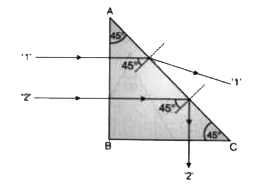
|
|
| 4. |
In Young.s double slit experiment sodium light is replaced by blue lamp, then the fringe width |
|
Answer» increase |
|
| 5. |
The moving coil galvanometer has 120 turns, a width of 2 cm and a length of 250 C.G.S.unit .If the controlling couple due to the the twist in suspension is 18 dyne-cm.Then the current flowing through it is : |
|
Answer» `10^(-2) A` |
|
| 6. |
The radius of curvatureof eachsurface of a convex lens of refractive index 1.5 is 40 cm. Calculate its power. |
|
Answer» Solution : Here, `N = 1.5 , R_(1) = +40 cm = 0.04 m` `R_(2) = - 40 cm = - 0.04 m` POWER (p) = `(1)/(F) = (n-1) ((1)/(R_(1)) - (1)/(R_(1)))` `=(1.5-1)[(1)/(0.04)-(1)/((-0.04))]=0.5xx(2)/(0.04)` P = 2.5 D |
|
| 7. |
Explain why heavy water is used as moderator in a nuclear reactor. |
| Answer» Solution :A GOOD MODERATOR shows down neutrons and does not absorb them. Heavy water slows down the FAST MOVING neutrons through elastic collisions. It has negligible cross-section for neutron absorption. | |
| 8. |
Calculate the electric and magnetic fields produced by the radiation coming from a 100 W bulb at a distance of 3m. Assume that the efficiency of the bulb is 2.5% and it is a point source. |
| Answer» SOLUTION :`4.07 V//m, 1.4xx10^(-8)T` | |
| 9. |
The core of a transformer is laminated because |
| Answer» SOLUTION :i) To REDUCE eddy CURRENT loss ,II) To reduce hystersis loss | |
| 10. |
Dray the ray diagram showing virtual images formation by a concave mirror |
Answer» SOLUTION :
|
|
| 11. |
Define mass defect. |
|
Answer» |
|
| 12. |
Discuss polarisation by selective absorption. |
|
Answer» Solution : (i) Selective absorption is the property of a material which transmits waves whose electric fields VIBRATE in a plane parallel to a certain direction of orientation and absorbs all other waves. (ii) The polaroids or polarisers are thin commercial sheets which make use of theproperty of selective absorption to producean intense beam of plane polarised light. Selective absorption is also called as dichroism. (iii) Tourmaline is a natural polarising material. (iv) Polaroids are also made ARTIFICIALLY. (v) Small needle shaped crystals of quinine iodosulphate have the property of polarising light. (vi) A number of these crystals with their AXES parallel to one another packed in between two transparent PLASTIC sheets serve as agood polaroid. (vii) New TYPES of polaroids are prepared in which thin film of polyvinyl alcohol is used. These are colourless crystals which transmit more light, and give better polarisation. |
|
| 13. |
A particle is moving with velocity 5 m/s towards cast and its velocity changes to 5 m/s north in 10 s, find the acceleration . |
|
Answer» `sqrt(2) ` North- West `OT = sqrt(5^(2)+5^(2))= 5sqrt(2)` Acceleration = `("Change in velocity" )/("TIME TAKEN ")` `(5sqrt(2))/(10)= (1)/(sqrt(2))m//s^(2)` (North -west ) 
|
|
| 14. |
In case of linearly polarized light, the magnitude of the electric field vector: |
|
Answer» is PARALLEL to the DIRECTION of propagation |
|
| 15. |
Does the phenomem of in terference obey the law of conservation of energy ? |
| Answer» Solution :Yes, at the point of DESTRUCTIVE interference the intensity of light is zero. But, this ENERGY is redisturbed to mthe bright fridge region. The total intensity from TWO SLITS is `a^2a^2=2a^2`. Where a is the amplitude of the wave for each SLIT. The intensity of bright point is zero and hence average intensity is ` 0+4a^2/2=2a^2`. Thus ,law of conservation of energy is obeyed. | |
| 16. |
An electron ,an alpha -particle and a duteron have the same kinetic energy .which of these particles has the longest de-Broglie wavelength? |
| Answer» SOLUTION :ELECTRON | |
| 17. |
If vector vecC is added to vector vecD, the results is a third vector that is perpendicular to vecD and has a magnitude equal to 3 vecD. What is the ratio of the magnitude of vecC to that of vecD ? |
|
Answer» `1.8` |
|
| 18. |
A short bar magnet with its nroth polefacing north forms a neutral point at p in thehorizontal plane if the magmnet is rotatedby 90^(@)the net magnetic inductino atP is |
|
Answer» 0 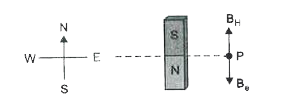 neutral pointobtained on equatorial lineand at neutral point `B_(H)=B_(e )` where `B_(H)`=Horizontalcomponetn of earth magnetic FIELD`B_(e )`=Magnetic fieldto bar magnet on it equation line |
|
| 19. |
The electric field intensity at all points in space is given by vec(E ) = sqrt(3hat(i)) - hat(j) volts/metre. The nature of equipotential lines in x - y plane is given by |
|
Answer»
|
|
| 20. |
A man weighing 60 kg lifts a body of 15 kg to a top of building 10 m high in 30 minutes. His efficiency is : |
|
Answer» 0.4 |
|
| 21. |
In an LCR series circuit, at resonance |
|
Answer» is always in PHASE with the voltage |
|
| 22. |
The displacemet of the medium in a sound wave is given by the equation y_(1) =Acos(ax +bt)where A, a and b are positive constants. The wave is reflected by an obstacle situated at x = 0. The intensity of the reflected wave is 0.64 times that of incident wave: Write the equation of the reflected wave: In the resultant wave formed after reflecting find the maximum and minimum values of particles speed in the medium |
|
Answer» `V_("max") = 1.8 AB, V_("MIN") = 0 Ab` |
|
| 23. |
(a) Describe briefly how a dffraction pattern is obtained on a screen due to a single narrow slit illuminated by a monochromatic source of light. Hence obtain the conditions for the angular width of secondary maxima and secondary minima. (b) Two wavelengths of sodium light of 590 nm and 596 nm are used in turn to study the diffraction taking place at a single slit of aperture 2 xx 10^(-6) m. The distance between the slit and the screen is 1.5 m. Calculate the separation between the positions of first maxima of the diffraction pattern obtained in the two cases. |
|
Answer» SOLUTION :`lambda_1 = 590 nm = 590 xx 10^(-9) m` `lambda_2 = 596 nm = 596 xx 10^(-9) m` `D = 1.5 m , a = 2 xxx 10^(-6) m` x is DISTANCE of first secondary maxima for CENTRE of SCREEN `x = 3/2 (LAMBDA D)/a` For two wavelengths `lambda_1 and lambda_2` we have `x_1 = 3/2 (lambda_1D)/a, x_2 = 3/2 (lambda_2D)/(a)` `x_2 - x_1 = 3/2 D/a (lambda_2 - lambda_1)` `= 3/2 xx (1.5)/(2 xx 10^(-6)) xx 6 xx 10^(-9)` `= 6.75 xx 10^(-3) m`. |
|
| 24. |
The displacemet of the medium in a sound wave is given by the equation y_(1) =Acos(ax +bt)where A, a and b are positive constants. The wave is reflected by an obstacle situated at x = 0. The intensity of the reflected wave is 0.64 times that of incident wave: Write the equation of the reflected wave |
|
Answer» `y=0.8 Acos(BT-AX)` |
|
| 25. |
The net value of an external torque acting on a system of particle is zero about a certain axis of rotation. Which of the following statements will hold good for the system? (a) The forces may be acting radially from a point on the axis (b) The forces may be directed along the axis of rotation (c ) The forces may be actingparallel to the axis of rotation (d) The torques caused by some forces are equal and opposite to those caused by other forces. |
|
Answer» (i) only |
|
| 26. |
A car stereo working at stabilized voltage supply of 9 v DC and has a zener diode of 9V, 0.25W. But the voltage supply inside the car is 12V DC.Which mode of bias will you suggest to connect zener diode voltage regulator? |
| Answer» SOLUTION :REVERSE BIAS | |
| 27. |
Assertion (A): In our domestic electric circuit an electric bulb glows immediately when theswitch is put in ON mode.Reason (R) : The drift velocity of electrons in metal wires is very high. |
|
Answer» If both assertion and reason are true and the reason is the CORRECT explanation of the assertion. |
|
| 28. |
Where on the surface of the earth is the angle of dip 90^(@) ? |
| Answer» SOLUTION :MAGNETIC POLES. | |
| 29. |
In LED, a specially disigned.diode, which emits light energy is_____biased. |
|
Answer» |
|
| 30. |
The resistivity of cylindrical conductor carrying steady current along its length varies linearly with the distance from the current carrying end as given by rho=rho_(0)(1+(x)/(l)) where l is the length of the conductor and x is the distance from the current entry and. rho_(o) is a positive constant. |
|
Answer» Electric field varies linearly with X |
|
| 31. |
One refracting surfaceof an isosceles glass prism is coated with mercury. A ray of light is incident normally on the other refracting surface and is reflected twice within the prism. Lastly the ray is incident normally on the base of the prism and emerges from the prism. Calculate the angles of the prism. |
|
Answer» |
|
| 32. |
In hydrogen atom electron makes transist from n = 3 orbit to n = 2 orbit in time 1.2xx10^(-8) s. Then calculate the average torque (in Nm) that acts during this transition. |
|
Answer» `1.055xx10^(-26)` `((n_(2)h)/(2pi)-(n_(1)h)/(2pi))/(Deltat)=((n_(2)-n_(1))h)/(2piDeltat)` `=((3-2)xx6.625xx10^(-34))/(2xx3.14xx1.2xx10^(-8))=8.79xx10^(-27)` |
|
| 33. |
Which of the following cocepts applies to both sound waves and electromagnetic wave: (a)Polarisation and (b) intensity? Explain the same. |
|
Answer» Solution :Sound wave are longitudnal waves WHEREAS electromegnetic wave are TRANSVERSE waves. The concept of polarisation APPLIES only to electromagnetc wave and not to sound waves because a wave is said to be polarised when its VIBRATIONS or oscillations are restricted in a perticular direction perpendicular to wave propagation, which is possible for transeverse wave and not for longitudnal wave. The concept of intensity applies to both, sound waves and electromagnetic waves. In case of sound waves, the intensity is related to the amplitude of pressure variation whereas in the case of electromagnetic waves, it related to the amplitude of oscillating electric or magnetic FIELD. |
|
| 34. |
What is the wavelength of a photon of energy 1 eV ? |
|
Answer» `12.4xx10^(3)Å` `RARR (E)/(c)=(h)/(lambda) rArr E=(hc)/(lambda)` `rArr lambda=12*375xx10^(3) Å` |
|
| 35. |
Three identical cells, each of emf 2V and internal resistance 0.2 ohm, are connected in series to an external resistor of 7.4 ohm. Calculate the current in the circuit and the terminal potential difference across an equivalent. |
| Answer» SOLUTION :` I= 0.75, V = 5.55 V ` | |
| 36. |
There is a fixed positive charges Q at O, and A and B are points equidistant from O. A positive charge +q is taken slowly by an external agent from A to B along the line AC and then along the line CB. |
|
Answer» The TOTAL work done on the charge is zero. (a) is correc because potential of `A` and `B` is same. (b) is correct because charge is going from LOW potential to high potential. Electric potential energy increases and electrostatic forces do negative work. Similarly (c) is ALSO correct. 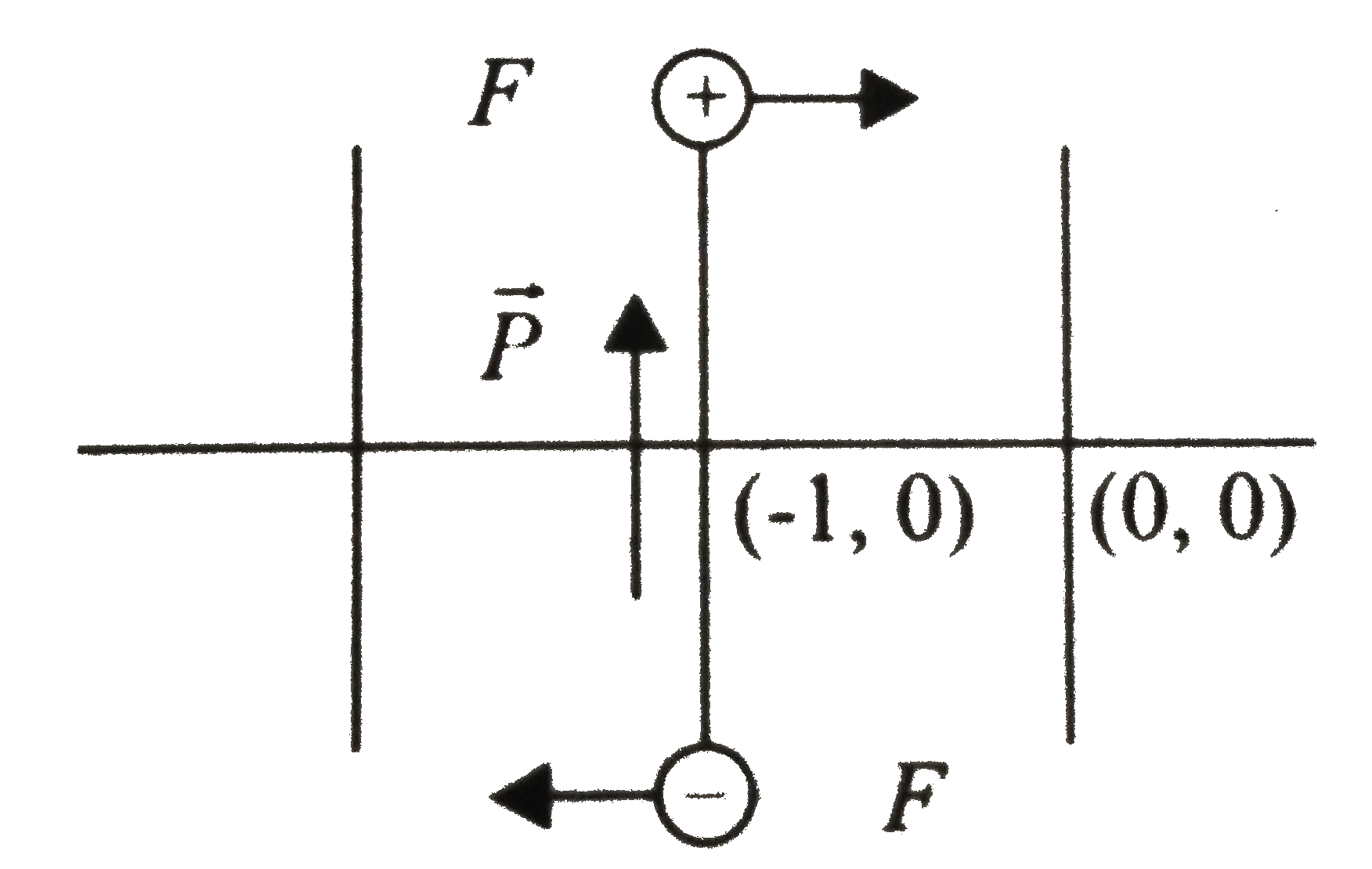
|
|
| 37. |
In above problem the gravitational potential is . |
|
Answer» LINEARLY DEPENDENT on R |
|
| 38. |
In young's experiment, the upper slit is covered by a thin glass plate of refractive index 4/3 and of thickness 9lamda, where lamda is the wavelength of light used in the experiment. The lower slit is also covered by another glass plate of thickness 2D & refractive index 3/2, as shown in figure. If I_(0) is the intensity at point P due to slits S_(1) & S_(2) each, then: |
|
Answer» <P>Intensity at point `P` is `4I_(0)` `S_(1)` is `=t(mu_(1)-1)=9lamda(4/3-1)=3lamda` Optical path DIFFER due to `S_(2)` is `=t(mu_(2)-1)=2lamda(3/2-1)=LAMDA` Path diff. at point `PP=3lamda-lamda=2lamda` Phase diff. `(2pi)/(lamda)xx2lamda=4pi` So net intensity at point `P` is `I_("net")=I_(0)+I_(0)+2I_(0)cos 4 pi` `I_("net")=4I_(0)` Optical path is consrved by `S_(1)` is more so fringe will shift at upper side. 
|
|
| 39. |
An alpha particle with kinetic energy 7.70 MeV collides with an ""^(14)N nucleus at rest, and the two transform into an ""^(17)O nucleus and a proton. The proton is emitted at 90^(@) to the direction of the incident alpha particle and has a kinetic energy of 4.44 MeV. The masses of the various particles are alpha particle, 4.002 60u, ""^(14)N, 14.003 07 u, proton, 1.007 875 u, and ""^(17)O, 16.999 14 u. In MeV, what are (a) the kinetic energy of the oxygen nucleus and (b) the Q of the reaction? (Hint: The speeds of the particles are much less than c.) |
|
Answer» |
|
| 40. |
The angular frequency of a pendulum is omega rad s^(-1). If the length is made one fourth of the original length, the angular frequency becomes : |
|
Answer» `(omega)/(2)` `:.omega.=sqrt((g)/((l)/(4)))=sqrt((4g)/(l))=2sqrt((g)/(l))impliesomega.=2omega` So correct choice is (B). |
|
| 41. |
What is the period of small oscillations of the block of mas m if the springs are ideal andpulleys are messless ? |
|
Answer» `(PI)/(2)sqrt((m)/(k))` `{:(-x_(2)+2x=0),(x_(2)=2x),(-x_(1)+x_(2)+x_(2)),(x_(1)=2x_(2)),(x_(1)=4x):}` 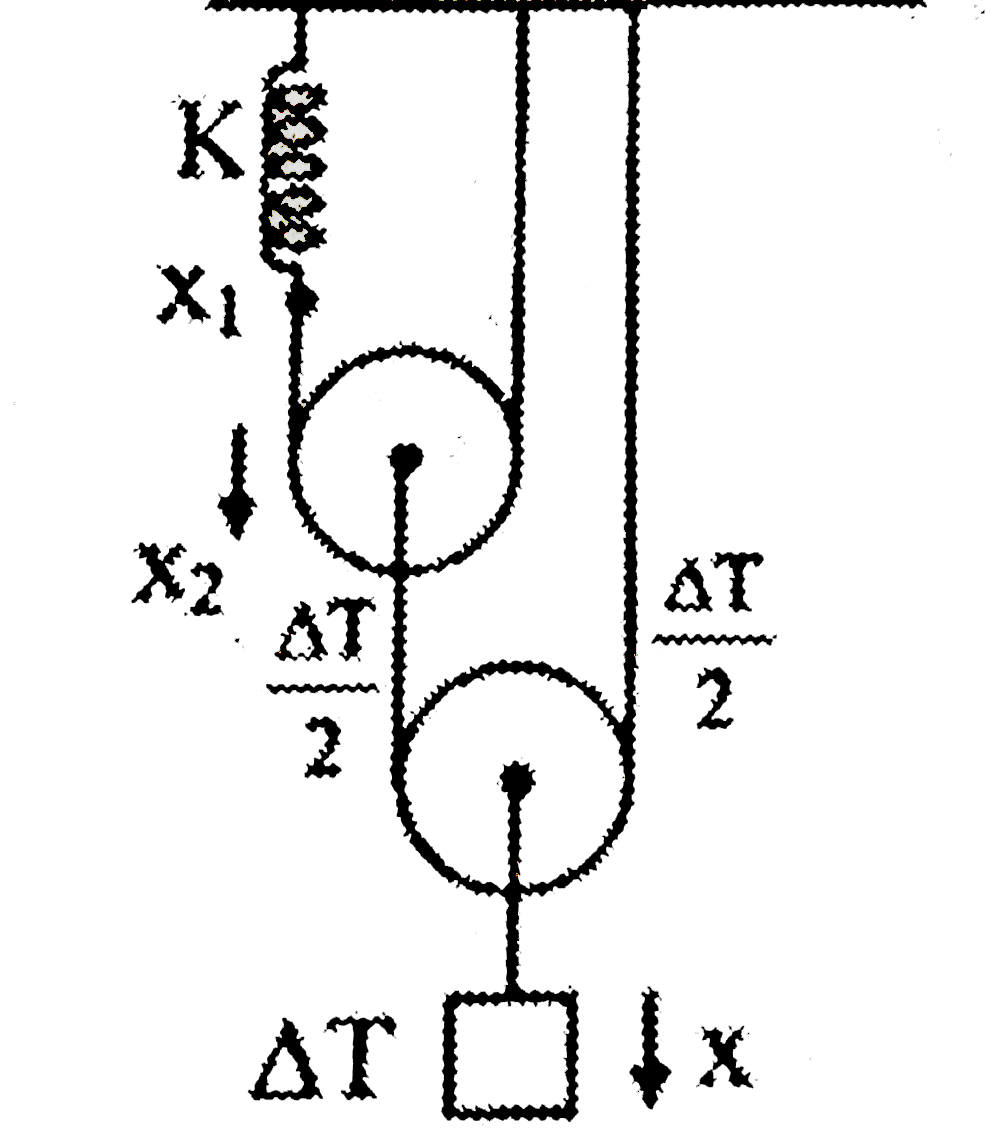 `2Kx_(1)=(DeltaT)/(2)` `DeltaT=4Kx_(1)` `rArr16 kx` `a=(16Kx)/(m)` `omega=Gsqrt((K)/(m))` `T=(2PI)/(4)sqrt((m)/(K))=(pi)/(2)sqrt((m)/(K))` |
|
| 42. |
A photomental is illuminated by lights of wavelenght lambda_(1) and lambda_(2) respectively. The maximum kinetic enegies of electrons emitted in the two cases are E_(1) and E_(2) respectively. The work function of metal is. |
|
Answer» `(E_(2)lambda_(1)-E_(1)lambda_(2))/(lambda_(1))` |
|
| 43. |
What is the length of a half wave dipole anternna at 30 MHz? |
|
Answer» 10 m |
|
| 44. |
Find the percentage change in power supplied by the cell after the switch ‘S’ is closed in the circuit shown below. All resistances are identical |
|
Answer» |
|
| 45. |
What is the biological importance of ozone layer |
|
Answer» a) it stops ultraviolet rays |
|
| 46. |
Which one of the following statements concerning a collection of gas molecules at a certain temperature is true? |
|
Answer» All molecules move with the same VELOCITY. |
|
| 47. |
A step-up transformer operates on a 230V line and supplies 2A to a load. The ratio of primary and secondary windings is 1 : 25, then the current in primary is .... |
|
Answer» 15 A `N_2/N_1=I_1/I_2` `THEREFORE I_1=I_2xxN_2/N_1` `therefore I_1=2xx25/1` `therefore I_1`= 50 A |
|
| 48. |
A spring of natural length 10 m and spring constant 10 N/m is connected to a ring of mass 0.1 kg, which if free to move on a frictionless horizontal bar as shown in the figure. The ring is pulled away from 'B' towards 'A' at an angle of 53^(@) with vertical, and released. Find the speed of the ring at 'C' ? |
|
Answer» 90 m/s Between POSITION 'A' and 'B' `(1)/(2) k (20 - 10)^(2) - (1)/(2) k (20 - 12)^(2)` `= (1)/(2) mv^(2)` `RARR 18 k = mv^(2)` `V_(B) = sqrt((36.K)/(m)) = sqrt((36 xx 10)/(0.1)) = 60 m//s` and by smmetry : velocity at 'C' will be zero |
|
| 49. |
How much in per cent, does the threshold energy of gamma quantum exceed the bindign energy of a deuteron (E_(b)=2.2 MeV) in the reaction gamma+H^(2) rarrn+p? |
|
Answer» <P> Solution :The formula of problem 6.271 does not APPLY here because the photon is always reletivistic. At threshold, the energy of the photon `E_(gamma)` implies a momentum `(E_(gamma))/(c )`. The velocity of center of mass with respect to the rest frame of initial `H^(2)` is`(E_(gamma))/((m_(n)+m_(p))c)` Since both `n & P` are at rest in `CM` frame at threshold, we write `E_(gamma)=(E_(gamma)^(2))/(2(m_(n)+m_(p))c^(2))+E_(B)` by conservation of energy. Since the first term is a small CORRECTION, we have `E_(gamma)~=E_(b)+(E_(b)^(2))/(2(m_(n)+m_(p))c^(2))` Thus `(deltaE)/(E_(b))=(E_(b))/(2(m_(n)+m_(p))c^(2))=(2.2)/(2xx2xx938)= 5.9xx10^(-4)` or nearly `0.06%` |
|


