

Saved Bookmarks
This section includes 7 InterviewSolutions, each offering curated multiple-choice questions to sharpen your Current Affairs knowledge and support exam preparation. Choose a topic below to get started.
| 1. |
A cricket ball having a mass of 0.15 kg is moving with uniform speed of 126 km/h strikes the bat of the player at its middle who holds it firmly at its position. After hitting the bat the ball moves straight back along the same path. If the collision is assumed to be perfectly clastic and bat and ball remain in contact only for a small fraction of time 0.001s the force that batsman has to apply to hold the ball for that short interval would be: |
|
Answer» 105 N =`(2mv)/(t)=(2xx0.15xx35)/(0.001)` =`(70xx15xx10^3)/(100xx1)` =`1.50xx10^4` |
|
| 2. |
A body is projected with an angle theta. The maximum height reached is h. If the time of flight is 4 sec and g=10m//s^2, the value of, then the value of his |
| Answer» ANSWER :B | |
| 3. |
An iron rod of length 1.5 m lying on a horizontal table is pulled up form one end along a vertical line so as to move it with a constant velocity 3m/s, while the other end of the rod slides along the floor. After how much time the speed of the end sliding on the floor equals to the speed of the end being pulled up |
|
Answer» `(1)/(2 sqrt2) s ` 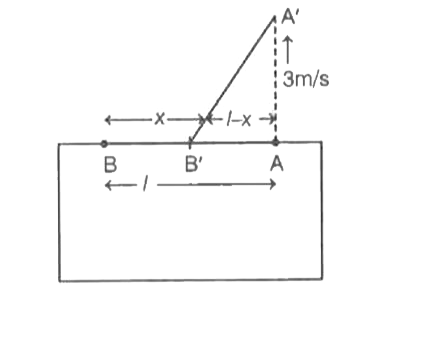 Given, AB is an iron ROD whose length is given by `I = .5 m` VELOCITY of end A ` v = 3 m//s ` Let t be the time when both the ends have same speed. SINCE, end has ALWAYS a constant velocity therefore the velocity of end Bat point B' is also become 3 m/s. In the position of B'A' of the rod, ie, after time t. ` (l - x)^2 + (3t)^2 = l^2` ` (1.5 - x)^2 + 9t^2 = (1.5)^2` `2.25 + x^2 - 3x + 9t^2 = 2.25 ` ` x^2 - 3x + 9t^2 = 0 "" ....(i) ` As rod is moving with a constant velocity then from equation of the motion ` x = ut+ 1/2 at^2` ` x = 3t"" ...(ii)"" [ because " velocity w = 3 m/s and accleration a = 0" ]` From EQN. (i) and (ii) ` (3t)^2 - 3 (3t) + 9t^2 = 0` ` 9t^2 - 9t + 9t^2 =0` `18 t^2 - 9t = 0 rArr t = 1/2 ` |
|
| 4. |
In problem No. 1, when switch is shifted from position A to B, what is the time period of resulting charge oscillation ? |
|
Answer» `(2PI)/(sqrt(LC))` |
|
| 5. |
The refractive index of transparent cylindrical rod is (2)/(root_3) . As shown in the figure the ray i incident at the mid point of its one end. For which angle of incidence, the ray become parallel to the length of rod ? |
|
Answer» `sin^-1((1)/(root_3))`  According to Snell.s law `n = (sin theta)/(sin alpha)` ` therefore(2)/(sqrt3)=(sintheta)/(sin alpha)`….....(1) Now, from Snell.s law, In `n_2sin theta_2=n_1sin theta_1,n_2/n_1sin theta_2=sintheta_1` `nsin beta=sin90^@` `therefore" "n sin beta=1` `sin beta=1/n=(sqrt3)/(2)` `therefore beta=60^@` `thereforealpha=90^@-beta=90^@-60^@=30^@` `therefore` By SUBSTITUTING VALUE of a in equation (1), `(2)/(sqrt3)=(sintheta)/(sin30^@)` `sin theta=(2)/(sqrt3)xx1/2` `sin theta=(1)/(sqrt3)` `thereforetheta=sin^(-1)((1)/(sqrt3))` |
|
| 6. |
State and explain Curie's Law in magnetism. |
| Answer» SOLUTION :Magnetic susceptibility of a paramagnetic substance is inversely PROPORTIONAL to the absolute TEMPERATURE. | |
| 7. |
A particle of charge q and mass m moves in a circualrorbit of radius r either anglular speed omegatheratio of themagnitude of its magneticmomentto that of its angular momentum depends on |
|
Answer» `OMEGA` and Q |
|
| 8. |
The area of Television telecast is made twice, the height of antenna will be changed as: |
|
Answer» halved `a=pi r^(2)` (r = d) `=pi d^(2)=pi(sqrt(2hR))^(2)=pi. 2hR` `:. a prop H` `:.` a. = 2A, h. = 2H |
|
| 9. |
When hydrogen gas is raised from the ground state to an excited state |
|
Answer» both K.E and P.E increase |
|
| 10. |
Water is heated from 0°C to 10°C then its volume |
|
Answer» increases So correct choice is (B). |
|
| 11. |
Five foils, each of area A, are placed one above the other separateed by dielectrics of thickness d and dielectric coefficient epsi. Find the equivalent capacitance between a and b, if plates 1 and 4 are joined, and 3 and 5 are joined. |
|
Answer» |
|
| 12. |
If a source is transmitting electromagnetic waves of frequency 8.2 xx 10^(6) Hz, then wavelength of the electromagnetic waves transmitted from the source will be : |
|
Answer» 36.6 m |
|
| 13. |
(a) Derive the expression for the magnetic field due to a current carrying coil of radius r at a distance x from the centre along the X-axis. (b) A straight wire carrying a current of 5 A is bent into a semicular arc of radius 2 cm as shown in the fig. FInd th magnitude and direction of the magnetic field at the centre of the arc. |
|
Answer» |
|
| 14. |
Grasshopper A taken (2)/(3) rd time in covering the same distance than that of grasshopper B. Grasshopper spent negligible time on the ground while taking the maximum jump to cover the distance. Find the ratio of jump (distance) of grasshopper A to jump of grasshopper B. |
|
Answer» 0.67 Distance covered is same `U_(A) cos 45^(@)t_(A)=u_(B) cos 45^(@)t` Given `t_(A)=(2)/(3)t_(B)` `(t_(A))/(t_(B))=(2)/(3)t_(B)` `(t_(A))/(t_(B))=(2)/(3)=(u_(B))/(u_(A))=(g^(R)B)^(1//2)/((g^(R)A)^(1//2))` `(R_(A))/(R_(B))=(9)/(4)=2.25` |
|
| 15. |
Calculate the resultant inductance of two inductor L_(1) and L_(2) when they are connected in parallel in A.C. circuit. |
|
Answer» Solution :Let `Z_(L_(1))` and `Z_(L_(2))` be the inductive reactance of two coils. SINCE they are connected in parallel,the resultant reactance will be, `Z= ( Z_(L_(1)) Z_(L_(2)))/( L_(L_(1))+ Z_(L_(2)))= ( J X_(L_(1)) xx jX_(L_(2)))/(jX_(L_(1))+jX_(L_(2)))` `:. Z = (jX_(L_(1))X_(L_(2)))/(X_(L_(1))+ X_(L_(2)))`.....(i) If the resultant inductance is equal to L, then `Z = j OMEGA L`. `X_(L _(1) )= omegaL_(1)` and `X_(L_(2)) = omega L_(2)` then Putting this VALUES in equation (1). `:. j omega L = ( j omega^(2) L_(1) L_(2))/( omega L_(1) + omegaL_(2))` `:. L = ( L_(1) L_(2))/( L_(1) + L_(2))` |
|
| 16. |
A vernier callipers is constructed by using two identical triangular wedges each of angle of inclination alpha=60^(@). Assume that one division is equivalent to 1mm. While measuring length AB, the reading of lower wedge is 8th mark and 7th mark of upper wedge coincide with. a particular mark of lower wedge. Mark the correct option (s) |
|
Answer» Least COUNT is 1 mm |
|
| 17. |
संबंध f = R/2 सत्य है |
|
Answer» उत्तल दर्पण के लिए , परंतु अवतल दर्पण के लिए नहीं |
|
| 18. |
A body of mass 1g and carrying a charge 10^(-8)C passes from two points P and Q. P and Q are at electric potentials 600 V and 0 V respectively. The velocity of the body at Q is 20 cms^(-1). It velocity in ms^(-1)at P is |
|
Answer» `SQRT( 0.028 )` |
|
| 19. |
The linear momentum P of a body varies with time is given by a equation P = x + yt^(2) where x and y are constants. The net force acting on the body for one directional motion is proportional to : |
|
Answer» <P>`t^(2)` ` :.Fpropt.`(d) is the CHOICE |
|
| 20. |
A semiconductor is known’ to have an electron concentration of8xx10^12 per cm^3 and hole concentration of 4xx10^13percm^3 . Then it is |
|
Answer» a p-type semiconductor |
|
| 21. |
Plutonium decays with a half-life of 24000 years. If plutonium is stored for 72000 years, what fraction of it remains ? |
| Answer» SOLUTION :`N/N_(0)=(1/2)^(t/T_(1/2))=(1/2)^(72000/24000)=(1/2)^(3)=1/8 impliesN=N_(0)/8` | |
| 22. |
In the uranium radioactive series, the initial nucleus is _92U^238 and that the final nucleus is _82Pb^206. When uranium nucleus decays to lead, the number of alpha- particles and beta- particles emitted are : |
|
Answer» `8alpha, 6beta` |
|
| 23. |
Which of the following expressions is a polynomial in one variable ? |
|
Answer» `X+2/X+3` |
|
| 24. |
Derivethe equationforthin lensand obtainitsmagnification . |
|
Answer» Solution :(i) Consider an object OO' of height `h_1` placed on the principal axis with its height perpendicular to the principal axis. (ii) The RAY OP passing through the pole of the lens goes undeviated. The inverted real image Il' formed has a height `h_2`.(iii) 'The LATERAL or transverse magnification m is defined as the ratio of the height of the mage to that of the object. ` m = (II')/(OO') "" ...(1)` From the two similar triangles `trianglePOO'` and `triangle PII' `, we can write, ` (II')/(OO') = (PI)/(PO) "" ....(2)` Applying sign CONVENTION, ` (-h_2)/(h_1) = (v)/( - u)` Substituting this in the equation (1) for magnification, `m =(- h_2)/(h_1) = (v)/(-u)` After rearranging, `m = h_2/h_1 = v/u` (iv) The magnification is negative for real image and positive for virtual image. In the case of a concave lens, the magnification is always positive and less than one. (v) The equations for magnification by combining the lens equation with the formula for magnification as, ` m = h_2/h_1 = (f)/(f + u)" or "m = h_2/h_1 = (f - v)/(f)` |
|
| 25. |
The electric field strength in N C^(-1) that is required to just prevent a water drop carrying a change 1.6 xx 10^(-19)C from falling under gravity is (g = 9.8 m s^(-2), the mass of water drop = 0.0016 g ) |
|
Answer» `9.8 xx10^(-16)` |
|
| 26. |
Twobeams of red and violet colours are made to pass separately through a prism (angle of the prism is 60^(@)). In the position of minimum deviation, the angle of refraction will be |
|
Answer» `30^(@)` for both the colours In the POSITION of minimum DEVIATION for any wavelenght, `r_(1) = r_(2) = (A)/(2) = (60^(@))/(2) = 30^(@)` |
|
| 27. |
Which of the following is incorrect regarding the first law of thennodynamics ?. |
|
Answer» It INTRODUCES the concept of the entropy |
|
| 28. |
Magnetic flux phi_(B) through a plane of area 'A' placed in a uniform magnetic field vceB is given as: phi_(B)= vceB.vceA = BA cos theta where theta is the angle between vceB and vceA. The above relatio can be extended to curved surfaces and non-uniform fields. In general, if the magnetic field has different magnitudes an directions at various parts of a surface, then the magnetic flux through the surface is given by phi_(B)=int vec B.dvecA On the basis of the experimental observations, Faraday concluded that an emf is induced in a coil when magnetic flux through the coil changes with time. Faraday stated his conclusions in the form of a law called Faraday's law of electromagnetic induction. As per this law, the induced emf is given by varepsilon = -(dphi_(B))/dt The negative sign in the expression indicates the direction of induced emfe and hence the direction of current in a closed loop. In the case of a closely would coil of N turns, change of flux associated with each turns is the same and so that total induced emf is given by varepsilon=-N(dphi_(B))/dt From above relations it is clear that the magnetic flux can be changed by changing any one or more of the terms vceB, vceA and theta. (a) Give SI unit of magnetic flux. (b) How is it related to tesla ? (c) Obtain dimensional formula of magnetic flux. (d) A loop of area 4 xx 10^(-3)m^(2) is placed with its plane perpendicular to a uniform magnetic field of 0.02 T. If the loop is quickly removed from the magnetic field within a time of 2 ms, what is the magnitude of induced emf across the two ends of the loop ? (e) If the resistance of the loop be 0.2Omega and a sensitive milliammeter be connected between the two ends of loop, what will be the reading of milliammeter? |
|
Answer» SOLUTION :(a) SI unit of magnetic FLUX is weber (Wb). (b) `1Wb=1Tm^(2)`, (c) Since `|varepsilon|=phi_(B)/t, "hence" [phi_(B)]=[varepsilon]xx[t]=[ML^(2)T^(-3)A^(-1)]xx[T]=[ML^(-2)T^(-2)A^(-1)]` (d) Here `phi_(i) = BA = 0.02 xx 4 xx 10^(-3) = 8 xx 10^(-5) "Wb and" phi_(f)=0` `therefore |varepsilon|=(phi_(i)-phi_(f))/t=(8 xx 10^(-5) -0)/(2XX10^(-3))= 4 xx 10^(-2)V=0.04V` |
|
| 29. |
The kinetic energy of a particle varies with time according to the relation E_(k) = (8t + 6) K The force acting on the particle (k = constant) |
|
Answer» is constant Differentiating w.r.t. t `(1)/(2)m.2upsilon(dnu)/(dt)=k(8+0)=8k` `(d)/(dt)(m upsilon)=(8k)/(upsilon)implies(dp)/(dt)=(8k)/(upsilon) or FPROP(1)/(upsilon)` HENCE CORRECT choice is (b). |
|
| 30. |
Three capacitors of capacitance 1,2 and ,3 muF are connected in such a way that the first and the second are in parallel anad the third is in series with the combinationof the other two. Calculate the equivalent capacitance. If a potential difference of 200 V is applied across the combinnation, what is the charge on each capacitor? |
|
Answer» |
|
| 31. |
Two long parallel wires are at a distance 2d apart. They carry steady equal currents flowing out of the plane of the paper as shown. The variation of the magnetic field B along the line XX' is given by |
|
Answer»
|
|
| 32. |
The velocity of a body of mass 2 kg is given byvecupsilon=(2t overset(wedge)(i)+t^(2)overset(wedge)(j))Find the momentum of the body after 2 seconds. |
|
Answer» `(8overset(wedge)(i)+8overset(wedge)(j))KG ms^(-1)` `vecupsilon=(2thati+t^(2)hatj)` velocity after 2 sec `vecupsilon`= `vecupsilon_(t)=(2xx2hati+4hatj)` `(4hati+4hatj)` MONENTUM`vecp_(t)=m vecupsilon_(t)` `=2(4hati+4hatj)` |
|
| 33. |
The acceleration of a particle increasing linearly with timer is be. The particle starts from the origin with an initial velocity, The distance travelled by the particle in time will be |
|
Answer» `ut+(BT^(3))/(3)` |
|
| 34. |
An object is placed 12 cm to the left of a diverging lens of focal length -6.0 cm. A converging lens of focal length of 12.0 cm is placed at a distance d to the right of the diverging lens. Find the distance d that corresponds to a final image at infinity. |
|
Answer» Solution :Applyinglensformula` (1)/(V)- (1)/(u ) = (1)/(f)` twice we have ` (1)/(v_1) - (1 )/(-12) =(1)/(-6)` `impliesv_1=- 4 cmand (1)/(oo) - (1)/(v_1 -d) = (1)/(12) impliesd= 8 CM` |
|
| 35. |
According to kinetic theory of gases the gas consists of large no of small |
|
Answer» ions |
|
| 36. |
What do you mean by hysteresis ? |
| Answer» Solution :Lagging BEHIND of MAGNETIC field `(vecB ) ` [or MAGNETISATION `vecM` ] in a sample as COMPARED to the magnetic intensity `(vecH)` is called hysteresis. | |
| 37. |
If the frequency of incident light on a certain metal is 8.2xx10^(14)Hz, having threshold frequency 3.3xx10^(14)Hz, then cut off potential is : |
|
Answer» 3. 0 V At V= CUT off potential, `eV=(1)/(2) mv^(2)` `:.V=(h(v-v_(0)))/(E)=2`volt |
|
| 38. |
A flat dielectric disc disc of radius R carries an excess charge on its surface. The surface charge density is sigma. The disc rotates about an axis perpendicular to its plane passing through the center with angular velocity omega. Find the magnitude of the torque on the disc if it is placed in a uniform magnetic field whose strength is B which is directed perpendicular to the axis of rotation |
|
Answer» `(1)/(4) sigma omega PI ` B R |
|
| 39. |
Mention the factors on which the self inductance of a solenoid depends. |
| Answer» Solution :(1) Permeability of the substances used as the core, (2) NUMBER of TURNS of the COIL, (3) Area of cross section, (4) Length of the solenoid. | |
| 40. |
An achromatic combination of lenses produces |
|
Answer» COLOURED images |
|
| 41. |
The displacement of a particle performing S.H.M. is given by x=3sin 5pit+ 4 cos5pit, where distance is in metre and time is in second. What is the amplitude of motion ? |
|
Answer» 5 m |
|
| 42. |
A capacitor in an LC oscillator has a maximum potential difference of 17V and a maximum energy of 160 mu J.When the capacitor has a potential difference of 5V and an energy of 10 mu J, what is the energy stored in the magnetic field? |
|
Answer» `10 MU J` `THEREFORE U_(m) = 160 - U_(e)` ` = 160 - 10 = 150 mu J` |
|
| 43. |
For a prism of refractive index 1.732, the angle of minimum deviation is equal to the angle of prism. Then the angle of the prism is |
|
Answer» `60^@` `therefore 1.732=(2sinA//2cosA//2)/(sinA//2)` `therefore 0.866=cos""A/2` `therefore 30^@=A/2` `therefore A=60^@` |
|
| 44. |
Electromagnatic waves are transverse in nature is evident by |
|
Answer» Polarization |
|
| 45. |
a. Why de-Broglie wave associated with a moving car is not visible ? b. What is de-Broglie hypothesis? c. Give expressions for de-Broglie wavelength. |
|
Answer» <P> Solution :a. Mass is too largeb. Every material particle in the state of MOTION possesses an ASSOCIATED wave where WAVELENGTH is given by `lambda=(h)/(p)`, where h is the Plank.s constant and p- the momentum. C. `lambda=(h)/(p)` |
|
| 46. |
The energy released in a typical nuclear fusion reaction is approximately |
| Answer» Answer :A | |
| 47. |
A convex lens is placed between an object and a screen which are a fixed distance apart. For one position of the lens the magnification of the image obtained on the screen is m_1. When the lens is I moved by a distance d, the magnification of the image obtained on the same screen is m_2. The focal length of the lens is (m_1 gt m_2) |
|
Answer» `(d)/((m_1 - mu_2))` |
|
| 48. |
Sound waves transfer |
|
Answer» only ENERGY not moment |
|
| 49. |
Assertion: A body kept inside a spherical shell does not experience any gravitational force. Reason : The body inside a spherical shell is protected from the gravitational attraction of bodies outside the shell. |
|
Answer» Both Assertion & Reason are TRUE & the Reason is a correct explanation of the Assertion. |
|


