

Saved Bookmarks
This section includes 7 InterviewSolutions, each offering curated multiple-choice questions to sharpen your Current Affairs knowledge and support exam preparation. Choose a topic below to get started.
| 1. |
Direction of the first secondary maximum in the diffraction pattern at a single-slit is given by (Here a=width of the slit and theta=angle of diffraction) |
|
Answer» `ASINTHETA=(LAMDA)/(2)` |
|
| 2. |
How all materials bodies are constituted ? |
| Answer» Solution :All material BODIES are MADE UO of samll PARTICLES called ATOMS. | |
| 3. |
Consider a p-n junction as a capacitor, formed with p and n-materials acting as thin metal electrodes and depletion layer width acting as separation. between them. Biasing on this, assume that a n-p-n transistor is working as an amplifier in CE configuration. If C_(1) and C_(2) are the base-emitter and collector-emitter junction capacitance, then |
|
Answer» `C_(1) gt C_(2)` |
|
| 4. |
A short bar magnet placed with its axis at 30° with an external field 1000G experiences a torque of 0.02 Nm. (i) What is the magnetic moment of the magnet. (ii) What is the work done in turning it from its most stable equilibrium to most unstable equilibrium position? |
| Answer» SOLUTION :(i) 0.4 Am`""^2`', (II)0.08 J | |
| 5. |
In closed organ pipe at one end……………. |
|
Answer» P-5, Q-1, R-1, S-5 |
|
| 6. |
When Lithium is bombarded by 10 MeV deutrons, neutrons are observed to emerge at right angle to the direction of incident beam . Calculate the energy of these neutrons and angle of recoil of the associated Beryllium atom. GivenMass of ._0n^1=1.00893 amu Mass of Li^7=7.01784 amu Mass of H^2=2.01472 amu Mass of Be^8=8.00176 amu |
|
Answer» |
|
| 7. |
What is mass number? |
| Answer» Solution :The TOTAL number a nucleons (protons plus to neutrons)is called MASS number (or atomic mass number) and is REPRESENTED by the symbols A .The name is used SINCE mass of a nucleus is very closely A TIMES the mass of nucleons. The neutrons number N=A-Z. | |
| 8. |
Positronium is the term for a system made up of an electron and a position revolving about a common centre of mass. Find the interparticle distance and the energy of the positronium in the ground state. |
|
Answer» |
|
| 9. |
There are 5 xx 10^21 atoms in a object of 1 g. If one electron is removed from 0.01% atom, what will be the charge on the sphere ? |
|
Answer» `+0.08` No. of atoms which removes electrons `n = 0.01 % of N` `= N xx 10^(-4)` `=5 xx 10^(21) xx 10^(-4)` `=5 xx 10^(17)` `THEREFORE` Positive charge on object by removing .n. electrons, `therefore Q = "ne"` `=5 xx 10^(17) xx 1.6 xx 10^(-19)` `=8 xx 10^(-2)` `=+0.08 C` |
|
| 10. |
A wire of 10 ohm resistance is stretched to thrice its original length. What will be its (i) new resistivity and (ii) new resistance? |
|
Answer» SOLUTION :(i) Resistivity `rho` remains unchanged because it is the property of the material of the wire. (ii) In both cases, volume of wire is same, so `V=A.l.=Al` `(A.)/(A)=(l)/(l.)=(l)/(3L)=(1)/(3)"" [because l.=l+2l=3l]` `therefore (R.)/(R )=(rho(l.)/(A.))/(rho (l)/(A))=(l.)/(l)XX(A)/(A.)=(3)/(1)xx(3)/(1)=9` HENCE, `R.=9R=9xx 10=90Omega` |
|
| 11. |
Who appeared like small spots? |
|
Answer» Boys |
|
| 12. |
A circuit having resistor of 2 mega-ohm and capacitor of 1 muF is placed in series with a battery of 2 volt. Find the time after which the charge reaches 86.4% of its maximum value. |
|
Answer» Solution :`C = 1 mu F = 10^(-6)` Farad, R= 2 mega ohm `=2 xx 10^6 ` ohm, E= 2 VOLT Now , `Cr= 10^(-6) xx 2 xx 10^6 = 2s` and `q/q_0 = (86.4)/(100) = 0.864` According to the relation `q= q_0 [1-e^(-1//CR)]` we get: `q/q_0 = 1- e^(-1//CR)` or , `0.864 = 1- e^(-1/2)` `e^(-1/2) = 1- 0.864 = 1.36 impliese^(1/2) = 1/(0.136)` `t= 2` In (7.352) = 4 sec |
|
| 13. |
A charge Q is kept at the centre of a circle of radius 'r' If permittivity of the free space is e, then work done in carrying a charge q along the diameter of the circle from one end to the other will be |
|
Answer» `(QQ )/( 4 pi in_0 in_r R)` |
|
| 14. |
A heating element using nichrome connected to a 230 V supply draws an initial current of 3.2 Awhich settles after a few seconds to a steady value of 2.8 A. What is the steady temperature of the heating element if the room temperature is 27.0^@C? Temperature coefficient of resistanceof nichrome averaged over the temperature range involved is 1.70 xx 10^(-4) ""^@C^(-1) . |
|
Answer» Solution :Here V = 230 V and at `T_1 = 27^@C` , current `I_1 = 3.2 A` ` therefore R_1 = (V)/(I_1) = (230)/(3.2) Omega` Again at a steady temperature `T_2` of the heating ELEMENT , current `I_2 = 2.8A` `therefore R_2 = (V)/(I_2) = (230)/(2.8) Omega` Moreover temperature coefficient of resistance `alpha = 1.70 XX 10^(-4) ""^@C^(-1)` using the relation `R_2 = R_1 [1+ alpha (T_2 - T_1) ]` , we have `T_2 -T_1 = (R_2 - R_1)/(R_1- alpha) = ( (230)/(2.8) - (230)/(3.2) )/( (230)/(3.2) xx 1.7 xx 10^(-4) ) = 840` `T_2 = T_1 + 840 = 27 + 840 = 867^@C` |
|
| 15. |
In interference of light, beta is frings widh. The distance of nth maxima from the centre of interference pattern is : |
|
Answer» `X_n=N.BETA` |
|
| 16. |
What does Lencho do when he receives the letter signed God? |
|
Answer» He does not get surprised |
|
| 18. |
A compass needle free to turn in a horizontal plane is placed at the centre of circular coil of 30 turns and radius 12 cm. The coil is in a vertical plane making an angle of 45^@ with the magnetic meridian. When the current in the coil is 0.35 A, the needle points west to east. (a) Determine the horizontal component of the earth's magnetic field at the location. (b) The current in the coil is reversed, and the coil is rotated about its vertical axis by an angle of 90^@ in the anticlockwise sense looking from above. Predict the direction of the needle. Take the magnetic declination at the places to be zero. |
|
Answer» Solution :Here N= 30 , R= 12 cm = 0.12 m , I = 0.35 A Let magnetic field due to current FLOWING in the coil be B given by, `B= (mu_0 NI)/(2R)` and is DIRECTED normal to be plane of coil as shown in Fig. The field B can be resolved into two components , namely B cos `45^@` along W-E DIRECTION into two componenets , namely B cos `45^@` along W-E direction and B sin `45^@` along N-S direction. The magnetic needle can point west to east only when component B sin `45^@` is just balanced by `B_H`, the horizontal component of earth.s magnetic field at that place . Thus, `B_H = B sin 45^@ = (mu NI)/(2R) sin 45^@` `therefore B_H = (4pi xx 10^(-7) xx 30xx0.35)/(2xx 0.12) xx 1/(sqrt2) = 3.9 xx 10^(-5) T. ` (b) When current in the coil is reversed and the coil is turned through `90^@`in the anticlockwise sense looking from above, the direction of magnetic needle will get reversed i.e. it will point from east to west . 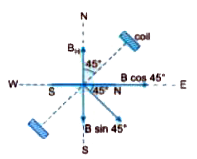
|
|
| 19. |
According to the Faraday's law of electromagnetic induction____ |
|
Answer» ELECTRIC FIELD is produced due to the change in magnetic flux with time. |
|
| 20. |
Electrons in a television are accelerated through a potential difference of 30 kV before they strike the screen. Calculate the wavelength of the most energetic X-ray photon emitted from it. |
|
Answer» Solution :If ENTIRE kinetic energy of electron is converted into a photon then it will be the most energetic photon. Hence, CORRESPONDING wavelength can be written as follows : `eV=hc//lambda` `RARR lambda=(hc)/(eV)=(6.63xx10^(-34)xx3xx10^8)/(1.6xx10^(-19)xx30000)=4.1xx10^(-11)` m `rArr lambda_"MIN"=41xx10^(-12)`m = 41 PM |
|
| 21. |
N = 2.5.10^(3) wire turnsare uniformly wound on a woodern toroidal core of very smalll cross-section. A current I flowsthroughthe wire. Find the magenticinductioninsidethe coreto thatat the centre ofthetoroid. |
|
Answer» Solution :Suppose `a` is the radius of cross section of the core. The windinghas a pitch `2piR//N`, so the SURFACE current DENSITY is `vec(J_(s)) = (I)/(2pi R//N) vec(e_(1))+ (1)/(2pi a) vec(e_(2))` where `vec(e_(1))` is a unit vector along the CROSSSECTION of the core and `vec(e_(2))`is a unit vector along its length. The magentic field insidethe crosssection of thecoreis due to first term above, and is given by `B_(varphi) 2pi R = mu_(0) NI` (`NI` is TOTAL current due to the abovesurface current(first term)) Thus , `B_(varphi) = mu_(0) NI//2pi R` The magentic field at the centre of the corecan be obtainedfrom the basic formula. `d vec(B) = (mu_(0))/(4pi) (vec(J_(s)) xx vec(r_(0)))/(r_(0)^(3)) dS` and is due to the second term. So, `vec(B) = B_(s) vec(e_(z)) = vec(e_(z)) (mu_(0))/(4pi) (I)/(2pi a) int (1)/(R^(3)) Rd varphi xx 2pi a` or, `B_(x) = (mu_(0) I)/(2R)` The ratio of the two magentic field, is `= (N)/(pi)` |
|
| 22. |
What is the relation between radius of curvature ( r ) andfocal length (f) of a spherical mirror ? |
|
Answer» |
|
| 23. |
A wire of length 'I' is bent into a circular loop of radius R and carries a current I. The magnetic field at the centre of the loop is 'B '. The same wire is now bent into a double loop. If both loops carry the same current I and it is in the same direction, the magnetic field at the centre of the double loop will be |
|
Answer» zero |
|
| 24. |
Is thefrequency of oscillation of magnetic energy or electrostatic energy is same as that of charge in LC oscillator ? |
|
Answer» |
|
| 25. |
Identify the correct statement from the following: |
|
Answer» Cyclotron frequency is DEPENDENT on speed of the charged particle |
|
| 26. |
At a certain location in Africa, a compass points 12^@ west of the geographic north. The north tip of the magnetic needle of a dip circle placed in the plane of magnetic meridian points 60^@ above the horizontal. The horizontal component of the earth's field is measured to be 0.16 G. Specify the direction and magnitude of the earth's field at the location. |
|
Answer» Solution :Here magnetic declination `theta = 12^@ ` west, angle of dip `delta = 60^@ and B_H=0.16 G` `thereforeB_E =(B_H)/(cos delta) = (0.16)/(cos 60^@) =0.32 G` As Africa is in southern hemisphere, the south pole of magnetic COMPASS TILTS downwards. It means that magnetic FIELD of earth POINTS upwards there. HENCE, the earth.s magnetic field at the given place is 0.32 G and it lies in a vertical plane `12^@` west of the geographic meridian making an angle of `60^@` (upwards) with the horizontal direction. |
|
| 27. |
In Young’s double slit experiment, the 1 fringe width is beta. If the entire arrangement is now placed inside a liquid of refractive index ti. the fringe width will become |
|
Answer» `MU BETA` |
|
| 28. |
Some amount of radiactive substance Chalf life 10days) is spread inside room and consequently the level of radiation becomes 50 times the permissible level for normal occupancy of the room. The number of days after which the room will be ready for safe occupation is (50+x) where x = ______ (Nearly round off to the nearest integer) |
|
Answer» 6 |
|
| 29. |
In the circuit diagrams (A,B,C and D) shown below, R is a high resistance and S is a resistance of the order of galvanometer resistance G. The correct circuit, corresponding to the half deflection method for finding the resistance and figure of merit of the galvanometer, is the circuit labeled as: |
|
Answer» CIRCUIT A with ` G=( RS )/( (R-S))` |
|
| 30. |
In a Young's double slit experiment, the slits are separated by 0.28 mm and the screen is placed 1.4 m away. The distance between the central bright fringe and the fourth bright fringe is measured to be 1.2 cm. Determine the wavelength of light used in the experiment. |
|
Answer» SOLUTION :`d=0.2mm=0.28xx10^(-3)m, D=1.4m""N=4, y_(n)=1.2xx10^(-2)m` `y_(n)=(n lamda D)/d, lamda=(y_(n) . D)/(ND)"" lamda=(1.2xx10^(-2)xx0.28xx10^(-3))/(4xx1.4)=6xx10^(-7)m=600nm` |
|
| 31. |
Let magnetic flux be phi_(B) , induced emf be xi and power P. All the three quantities related with each other, that is, if we vary the magnetic flux, induced emf and power change according the variation of magnetic flux. In the given table, Column I shows the variation of magnetic flux, Column II shows the effect on induced emf and Column III shows the effect on power. What are the conditions for a coil entering the magnetic field? |
|
Answer» (I) (iii) (L) |
|
| 32. |
The current gain of a transistor in common emitter configuration is 70. If emitter is 8.8 mA, then find (i) base current (ii) collector current. (iii) the current gain in common base configuration. |
|
Answer» Solution :`"Current gain, "beta=(I_(C ))/(I_(B)), I_(E)=I_(B)+I_(C )` (i) `I_(C )=betaI_(B)"or"I_(C )=70I_(B)` `"Since "I_(E)=I_(B)+I_(C )"or"I_(E)=I_(B)+70I_(B)` `orI_(E)=71I_(B)` `therefore I_(B)=(I_(E))/(71)=(8.8)/(71)=0.124mA` (ii) Collector current `=I_(C)` `I_(C )=70I_(B) or I_(C )=70xx0.124=8.68mA` (III) Current gain in common BASE configuration `ALPHA=(beta)/(1+beta) or alpha=(70)/(71)=0.986` |
|
| 33. |
The distance between an object and the screen is 100 cm. A lens produces an image on the screen when the lens is placed at either of the positions 40 cm apart. The power of the lens is nearly. |
|
Answer» 3 dipoter |
|
| 34. |
A monochromatic beam of light falls on YDSE apparatus at some angle (theta) as shown, a thin sheet of glas (R.I. = mu, thickness = t) is insdted in front of the lower slit S_(2). Select the correct alternative. |
|
Answer» CENTRAL MAXIMA will be at O always |
|
| 35. |
Let magnetic flux be phi_(B) , induced emf be xi and power P. All the three quantities related with each other, that is, if we vary the magnetic flux, induced emf and power change according the variation of magnetic flux. In the given table, Column I shows the variation of magnetic flux, Column II shows the effect on induced emf and Column III shows the effect on power. What are the conditions for a coil out of the field? |
| Answer» Answer :(3) `to` (d) | |
| 36. |
Let magnetic flux be phi_(B) , induced emf be xi and power P. All the three quantities related with each other, that is, if we vary the magnetic flux, induced emf and power change according the variation of magnetic flux. In the given table, Column I shows the variation of magnetic flux, Column II shows the effect on induced emf and Column III shows the effect on power. What are the conditions for a coil moving in the magnetic field? |
|
Answer» (III) (II) (L) |
|
| 37. |
Derive the expression for the torque acting on an electric dipole, when it is held in a uniform electric field. Identify the orientation of the dipole in the electric field, in which it attains stable equilibrium. |
|
Answer» SOLUTION :Consider an electric dipole AB placed in a uniform electric field `vecE` oriented at an angle `theta` with the field. As shown, forces qE and qE act on the two charges in mutually opposite directions. As the two forces act at two different points non-linearly, they constitute a couple whose torque is given by: 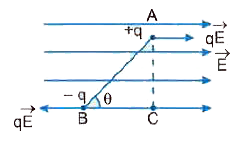 torque `tau =(qE).` Normal DISTANCE between the forces =`qE 2a sin theta= PE sin theta "" [ :.p =q(2a)]` The torque has a tendency to align the dipole along the direction of electric field. In vector notation, we can write that, `vectau= vecpxxvecE.` When electric dipole is parallel to the electric field `vecE, theta=0^(@)` and so the torque `vectau=vec0` . Moreover, potential energy of dipole [U= -pE sin `theta`] is minimum having a value U = -pE. So this REPRESENTS the stable equilibrium POSITION of dipole. |
|
| 38. |
Obtain the equation for apparent depth. |
|
Answer» Solution :Light from the object O at the bottomof the tank passes from MEDIUM (water) to rarer medium (air) to reach our eyes. It deviates away from the normal in therarermedium at the point of INCIDENCE B. The refractive index of the denser medium is `n_(1)` and rarer medium `n_(2)`. Here, `n_(1) gt n_(2)`. The ANGLE of incidence in the denser medium is i and the angle of refraction in the rarer medium is r. The lines N N. and OD are parallel. Thus angle `angle DIB` is also r. The anles i and r are very small as the diverging light from O entering the eye is verynarrow. The Snell.s law in product from for this refraction is, `n_(1) sin i = n_(2) sin r` As the angles i and r are small, we canapproximate, ` sin i approx tan i,` `n_(1) tan i = n_(2) tan i` intriangles `Delta DOB and Delta DIB`, `tan(i)=(DB)/(DO)andtan(r)=(DB)/(DI)` `n_(1)=(DB)/(DO)=n_(2)(DB)/(DI)` DB is cancelled on both sides, DO is theactual depth d and DI is the APPARENT depth d.. `n_(1)(1)/(d)=n_(2)(1)/(d.)rArr(d.)/(d)=(n_(2))/(n_(1))` Rerranging the above equation for the apparent depth d.. `d. = (n_(2))/(n_(1)) d` As the rarer medium is air and its refractive index `n_(2)` can be taken as I, `(n_(2) = 1).` Andthe refractive index `n_(1)` of denser medium could then be taken as `n, (n_(1) = n)`. In that case, the equation for apparent depth becomes, `d. = (d)/(n)` |
|
| 39. |
The dimensions of S = (1//mu_(0)) vecExxvecB are |
| Answer» ANSWER :D | |
| 40. |
Derive the energy expression for hydrogen atom using Bohr atom model. |
|
Answer» Solution :The energy of an electron in the `n^(th)` orbit Since the electrostatic force is a conservative force, the potential energy for the `n^(th)` orbit is `U_(n) = (1)/(4piepsilon_(0))((+Ze)(-e))/(r_(n)) = - 1/(4 piepsilon_(0))(Ze^(2))/(r_(n))` `= -(1)/(4 epsilon_(0)^(2))(Z^(2)me^(4))/(h^(2)n^(2))(because r_(n) = (epsilon_(0)h^(2))/(PIME^(2))(n^(2))/(Z))` The kinetic energy for the `n^(th)` orbit is `KE_(n) = 1/2 mv_(n)^(2) = (me^(2))/(8epsilon_(0)^(2)h^(2))(Z^(2))/(n^(2))` This implies that `U_(n) = -2KE_(n)`. Total energy in the `n^(th)` orbit is `E_(n) = KE_(n) + U_(n) = KE_(n) - 2KE_(n) = - KE_(n)` `E_(n) = -(me^(4))/(8epsilon_(0)^(2)h^(2))(Z^(2))/(n^(2))` For hydrogen atom (Z = 1), `E_(n) = -(me^(4))/(8 epsilon_(0)^(2)h^(2)) (1)/(n^(2))`joule ....(1) where n stands for principal quantum number. The negative sign in equation (1) indicates that the electron is bound to the nucleus. Substituting the values of mass and charge of an electron (m and e), permittivity of free space`epsilon_(0)` and Planck.s constant h and EXPRESSING in TERMS of EV, we get `E_(n) = -13.6(1)/(n^(2))eV` For the first orbit (ground state ), the total energy of electron is `E_(1) = -13.6 eV`. For the second orbit (first excited state), the total energy of elctron is `E_(2) = -3.4 eV`. For the third orbit(second excited state), the total energy of electron is `E_(3) = -1.51 eV` and so on. Notice that the energy of the first excited state is greater than the ground state, second excited state is greater than the first excited state and so on. Thus, the orbit which is closet to the nucleus `(r_(1))` has lowest energy (MINIMUM energy compared with other orbits). So, it is often called ground state energy (lowest energy state) . The ground state energy of hydrogen`(-13.6 eV)` is used as a unit of energy called Rydberg(1 Rydberg = -13.6 eV).The negative value of this energy is because of the way the zero of the potential energy is defined. When the electron is taken away to an infinite distance (veryfar distance) from nucleus both the potential energy and kinetic energy terms vanish and hence the total energy also vanishes. |
|
| 41. |
How are electromagnetic waves produces by oscillating charges ? Draw a sketch of linearly polarised em waves propagating in z-direction. Indicate the direction of oscillating electric and magnetic fields |
| Answer» SOLUTION :An oscillating charge produces an oscillating electric FIELD in SPACE, which produces an oscillating magnetic field. The oscillating electric and magnetic fields REGENERATE each other, and this results in the production of em WAVES in space. | |
| 42. |
A T.V Tower has a height of 300m. What is the maximum distance upto which this T.V. transmission can be received ? |
|
Answer» SOLUTION :MAXIMUM DISTANCE, `d=sqrt(2hR)` `d=sqrt(2xx300xx6.4xx10^(6))` or `=61.96xx10^(3)m` `=61.96 KM` |
|
| 43. |
A boat is sent across a river with a velocity 8 km/h. If the resultant velocity of the boat is 10 km/h, then what is the velocity of the river ? |
|
Answer» `12.8` km/h |
|
| 44. |
A crane with a steel cable of length 11 m and radius 2.0 cm is employed to lift a block of concrete of mass 40 tons in building site. Young's Modulus of steel is 2.0 xx 10^(11) Pa, what will be roughly the increase in the length of the cable while lifting the block ? (Take g = 10 ms^(-2)) |
|
Answer» 0.75 cm `=(4xx11)/(pixx4xx2)xx10^(-2)=1.75xx10^(-2)m` `=1.75cm` So CORRECT choice is (C). |
|
| 45. |
In the given circuit it is observed that the current I is independent of the value of theresistance R_(5). Then what is the relation the resistance values must satisfy. |
|
Answer» Solution :`R_(1)R_(4)=R_(3)R_(2)` `"HINT : "(R_(3))/(R_(4))=(R_(1))/(R_(2))` `RARR R_(1)R_(4)=R_(3)R_(2)` 
|
|
| 46. |
A long solenoid of radius R carries a time (t)-dependent current I(t)= I_(0)t^(2) (1-t). A conducting ring of radius 3R is placed co-axially near its middle. During the time interva 0 le t le 1, the induced current (I_(R )) in the ring varies as: [Take resistance of ring to be R_(0)] |
|
Answer»
`phi= BA = mu_(0) n I pi R^(2)` `V_(R )= (d phi)/(DT) = -mu_(0)n pi R^(2) (dI)/(dt)= -mu_(0)n pi R^(2) I_(0) (2T- 3t^(2))` `I_(R )= (V_(R ))/(R_(0)) = -(mu_(0)piR^(2)I_(0))/(R_(0)) (2t- 3t^(2))` `I_(R )= - (1)/(R_(0))mu_(0)pi R^(2) I_(0)t (2-3t)` `I_(R )= 0 " at " t= 0 and t= (2)/(3)` 
|
|
| 47. |
In the circuit shown in fig, the energy stored in both capacitors is U_(1). If swich S is opened anda dielectricslab of constant5 is put in free spaces of the capacitors, the energy stored is found to be U_(2). Calcualte U_(1)//U_(2). |
|
Answer» `U_(1) = (1)/(2) CV^(2) = CV^(2)` when `S` is open and ELECTRIC is introduced. CAPACITY of each condenser `= KC = 5 C`. Condenser to left is connected to battery. Its potential remains `V`. But condenser on right is not connectedto battery. So on introducing DIELECTRIC its potential becomes `(V)/(5)` `:.` Total energy, `U_(2) = (1)/(2) (5 C) V^(2) + (1)/(2) (5C) ((V)/(5))^(2)` `= (1)/(2) (5 C) V^(2) (1 + (1)/(25))` `U_(2) = (5 CV^(2))/(2) xx (26)/(25) = (13)/(5) CV^(2)` `:. (U_(1))/(U_(2)) = (CV^(2))/((13)/(5) CV^(2)) = (5)/(13)` |
|
| 48. |
A time varing current i is passed through a resistance R as shown in figure. The total heat generated in the resistance is |
|
Answer» `11 i_(0)^(2) Rt_(0)` `int_(0)^(t_(0)) ((3 i_(0))/(t_(0)) t )^(2) Rdt + (3 i_(0))^(2) R (2 t_(0) - t_(0)) + i_(0)^(2) R (3 t_(0) - 2 t_(0))` `= 3 i_(0)^(2) Rt_(0) + 9 i_(0)^(2) Rt_(0) + i_(0)^(2) Rt_(0) = 13 i_(0)^(2) Rt_(0)` |
|
| 49. |
A radio nuclide with half life T = 69.31second emits beta-particles of average kinetic energy E = 11.25eV. At an instant concentration of beta-particles at distance, r = 2m from nuclide is n = 3 xx 10^(13) per m^(3). (i) Calculate numberof nuclei in the nuclide at that instant. (ii) If a small circular plate is placed at distance r from nuclide such that beta-particles strike the plate normally and come to rest, calculate pressure experienced by the plate due to collision of beta-particle. (Mass of beta-particle = 9 xx 10^(-31)kg) (log_(e) 2 = 0.693) |
Answer» 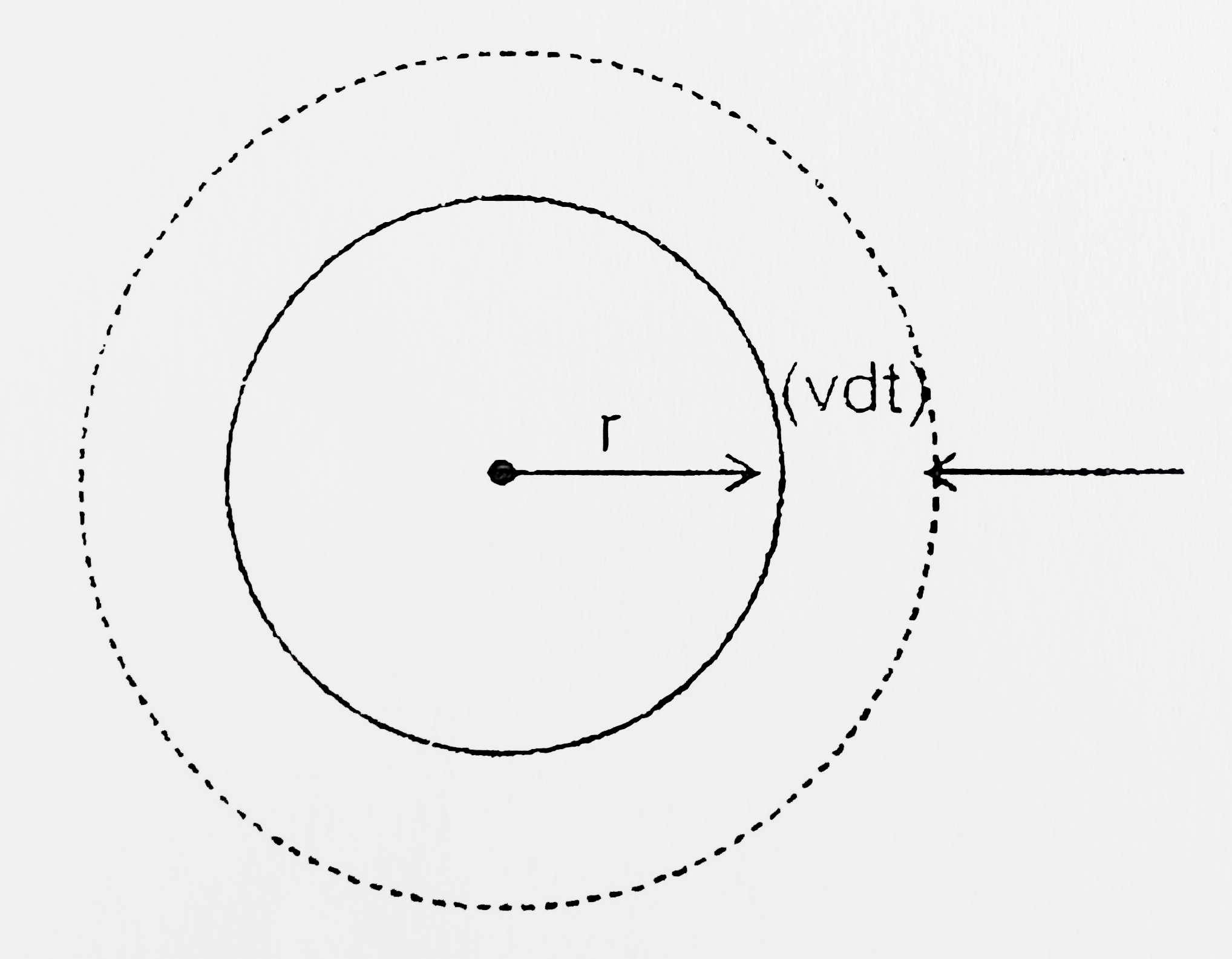 Volume of this space `=4 pi r^(2)(v dt)` `:.` Concentration of `b`-particles at distance `r` from nuclide is `n=(A dt)/(4pi^(2)(vdt))` oractivity of the nuclide, `A=4 pi r^(2)vn` But activity, `A= lambda N` where `N` is number of nuclei Hence, `N=(4pir^(2)vn)/(lambda)` butdecay constant `lambda=(log 2)/(T)` `N=(4pir^(2)vnT)/(0.6931)`........(1) Kinetic energy of `beta`-particle `E=(1)/(2)mv^(2)` `v=SQRT((2E)/(m))` substituting this VALUE in equation (1) , `N=(4pir^(2)nT)/(0.6931)sqrt((2E)/(m))=9.6 pi xx10^(22)` (ii) At distance `r` from the nuclide `(A//4 pi r^(2)) beta`-particle cross UNIT area per second. Let area of small circular plate be `S`, then number of `beta`-particle striking the plate per second `=(A)/(4pir^(2))S=(lambdaN)/(4pir^(2))S=(0.6931NS)/(4pir^(2)T)` Momentum of each particle just before collision is `mv` and after collision particles come to rest or momentum becomes Zero. `:.` Momentum transferred to plate due to collision is `Delta p= mv-0= mv` Due to transfer of momentum, the plate experiences a force which is equal to rate of transfer of momentum. `:.` Force, `F=Delta pxx"no".` of particles striking per second or `F=mvxx(0.6931NS)/(4pir^(2)T)` Pressure, P= Force per unit area `:. P=(F)/(S)=(0.6931N)/(4pir^(2)T)mv` but `v=sqrt(2E)/(m)` `:."" P=(0.6931N)/(4pir^(2)T)sqrt(2mE)=1.08xx10^(-4)Nm^(-2)` |
|
| 50. |
A thin uniform equilateral plate rests in a vertical plane with one of its vertex A on a rough horizontal floor and another vertex B on a smooth vertical wall. If the coefficient of friction mu = 1/(sqrt3), then the least angle theta its base AB can make with the horizontal surface is |
|
Answer» `theta = COT^(-1) [mu + 1/(sqrt3)]` |
|


