

Saved Bookmarks
This section includes 7 InterviewSolutions, each offering curated multiple-choice questions to sharpen your Current Affairs knowledge and support exam preparation. Choose a topic below to get started.
| 1. |
The ratio of wavelength of the last line of Balmer series and the last line of Lyman series is .... |
|
Answer» `1:1` `(1)/(lambda_(B))=R[(1)/(2^(2))-(1)/(OO^(2))]` For LAS line `n=oo` `:.(1)/(lambda_(B))=(R)/(4)....(1) [ :. (1)/(2^(2))-(1)/(oo^(2))]` For Lyman series, `(1)/(lambda_(L))=R[(1)/(1^(2))-(1)/(oo^(2))]` For las line `n=oo` `:.(1)/(lambda_(L))=R....(2)` `:.` Taking ratio of equation (2) and (1) `lambda_(B)=Rxx(4)/(R)-4` `:. lambda_(B) :. lambda_(B)=4:1` |
|
| 2. |
The transition from the state n = 4 to n = 1 in a hydrogen like atom result in ultraviolet radiation. Infrared radiation will be obtained in the transition from |
|
Answer» `2 rightarrow 1` |
|
| 3. |
A circular coil of 16 turns and radius 10 cm carrying a current of 0.75 A rests with its plane normal to an external field of magnitude 5.0xx10^(-2)T. The coil is free to turn about an axis in its plane perpendicular to the field direction . When the coil is turned slightly and released , it oscillates about its stable equilibrium with a frequency of 2.0 s^(-1) . What is the moment of inertia of the coil about its axis of rotation ? |
|
Answer» Solution :`N = 16 , r = 10 CM = 10 xx10^(-2) m, I = 0.75A` `B = 5.0 xx10^(-2)T, upsilon=2.0s^(-1)` `T=2pisqrt(I/(mB))" or"upsilon=1/((2pi))sqrt((mB)/I)` `:.I=(mB)/(4pi^2upsilon^2)=(ANIB)/(4pi^2upsilon^2)=(pir^2xxNIB)/(4pi^2upsilon^2)=((10xx10^(-2))^2xx16xx0.75xx5.0xx10^(-2))/(4xx(22)/(7)xx4)` `=(10^(-2)xx16xx0.75xx5xx10^(-2)xx7)/(4xx4xx22)=(0.75xx35xx10^(-4))/22=1.2xx10^(-4)kg m^2` |
|
| 4. |
Fast moving neutrons are retarded |
|
Answer» by using LEAD obstacle |
|
| 5. |
An aeroplane is flying in a horizontal direction with a velocity 600km/hour and a height of 1960m. When it is vertically above the point A, on the ground a body is dropped from it the body strike the ground at point B . Calculate the distance AB. |
|
Answer» 3.333 |
|
| 6. |
A body is throw up with a velocity 'u'.It reaches maximum height 'h'.If its velocity of projection is doubled the maximum height it reaches is ____ |
|
Answer» 4h |
|
| 7. |
A square loop of side 12 cm with its sides parallel to X and Y axes is moved with a velocity of 8 "cm s"^(-1) in the positive x-direction in an environment containing a magnetic field in the positive z-direction. The field is neither uniform in space nor constant in time. It has a gradient of 10^(-3) "T cm"^(-1) along the negative x-direction (that is it increases by 10^(-3) "T cm"^(-1) as one moves in the negative x-direction), and it is decreasing in time at the rate of 10^(-3) T s^(-1). Determine the direction and magnitude of the induced current in the loop if its resistance is 4.50 mOmega . |
Answer» Solution :Here magnetic field changes with position and time both. Hence we have two values of induced emf say `epsilon_1` and `epsilon_2` respectively. Situation given in the STATEMENT is shown in the figure given below. 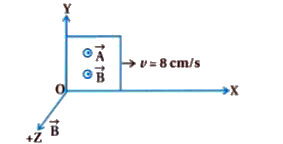 `epsilon_1=-(dphi)/(dt)=-d/(dt)(AB cos 0^@) (because vecA||vecB)` `therefore epsilon_1=-A (dB)/(dt)` `=-A("dB"/"dx")("dx"/"dt")` `=-l^2(dB)/(dx)v` `=-(0.12)^2 (-10^(-3)/10^(-2))(8xx10^(-2))` ( `because (dB)/(dx)` along +X axis is `-10^(-3) T/"CM"`) `therefore epsilon_1=1.152xx10^(-4)` V....(1) `epsilon_2=-(dphi)/(dt)=-d/(dt)(AB)` `therefore epsilon_2=-A (dB)/(dt)` `=-l^2/(dB)/(dt)` `=-(0.12)^2(-10^(-3))` `therefore epsilon_2=0.144xx10^(-4)` V ...(2) Induced current `I=("effective induced emf"(epsilon))/"equivalent resistance (R)"` `therefore I=(epsilon_1+epsilon_2)/R` ( `because` Here `epsilon_1 gt 0, epsilon_2 gt 0 rArr epsilon=epsilon_1+epsilon_2`) `therefore I=((1.152+0.144)xx10^(-4))/(4.5xx10^(-3))` `therefore I=2.88xx10^(-2)`A Here, as the loop moves along + X axis, outward magnetic flux linked with it GOES on decreasing and so according to Lenz.s law, induced current should flow anticlockwise in the loop so that outward magnetic flux can increase. |
|
| 8. |
Heat given to a body which raises its temperature by 1^(@)C is |
|
Answer» water equivalent `THEREFORE` Correct choice is (b). |
|
| 9. |
A gas can be taken from A to B via two different processes ACB and ADB. When path ACB is used 60 J of heat flows into the system and 30 J of work is done by the system. If path ADB is used work done by the system is 10 J. The heat Flow into the system in path ADB is: |
| Answer» Answer :D | |
| 10. |
The self inductance associated with a coil is independent of ___________. |
|
Answer» current |
|
| 11. |
In a current carrying long solenoid the magnetic field produced inside the solenoid does not depend upon |
|
Answer» number of TURNS PER unit LENGTH |
|
| 12. |
When you have learned to integrate derive the Poisson formula for an adiabatic process. |
|
Answer» `m/M C_(mv) dT + pdV = 0`. Differentiating the Mendeleev-Clapeyron equation, we OBTAIN `pdV = V dp = m/M RdT` Eliminating dT from these EXPRESSIONS, we obtain after some transformations `gamma (dV)/V = (dp)/p =0` INTEGRATING , we obtain `gamma int_(v_0)^V (dV)/V + int_(p_0)^(p) (dp)/(p) = 0` From which `gamma ln V - gamma ln V_0+ ln p - ln p_0 = 0 , " or " ln (pV^(gamma)) = ln (p_0v_0^(gamma))` Therefore, `pV^(gamma) = p_0 V_(0)^(gamma)`. |
|
| 13. |
A point charge Q is placed at point O as shown in the figure. Is the potential difference V_A-V_B positive, negative or zero, if Q is (i) positive (ii) negative ? |
|
Answer» SOLUTION :(i) If CHARGE Q is POSITIVE, then `V_A - V_B = Q/(4pi epsi_0) [ 1/r_A - 1/r_B] = +ve` (ii) If charge Q is negative, then `V_A-V_B` is negative. 
|
|
| 14. |
A body of mass 2kg is projected from the ground with a velocity 20ms^(-1) at an angle 30^(@) with the vertical. If t_(1) is the time in seconds at which the body is projected and t_(2) is the time in seconds at which it reaches the ground, the change in momentum in kgms^(-1) during the time (t_(2)-t_(1)) is |
|
Answer» 40 |
|
| 15. |
An electric field is uniform and in the positive xdirection for positivex and uniform with the same magnitude but in the negative x direction for negative x. It is given that E= 200 hati N//C" for "x gt 0 and E=- 200 hati N//C" for "3 lt 0. A right circular cylinder of length 20 cm and radius 5 cm has its centre at the origin and its axis along the x-axis so that one tace is at x = +10 em and the other is at x=10 cm a. What is the net outward flux through cach flat face? b. What is the flux through the side of the cylinder? c. What is the net outward flux through the cylinder? |
|
Answer» Solution :From the figure, on the left face. E and `triangleS` are parallel. Therefore, the outward flux is `phi_(L)=E triangle S=-200 hati. triangleS=+ 200 triangleS," since"hati. Triangl S=-triangleS` `=+200 xx PI (0.05)^(2) =+ 1.57 Nm^2 C^(-1)` On the right face, E and `triangleS` are parallel and therefore. ` phi_(R)=E. triangleS=+1.57 Nm^(2) C^(-1)` (B). For any POINT on the side of the CYLINDER, E is perpendicular to `triangleS and` hence `E. triangleS=0`. Therefore, the flux out of the side of the cylinder is zero. c. Net outward flux through the cylinder. `phi =1.57 +1.57+0=3.14 N m^(2) C^(-1)` 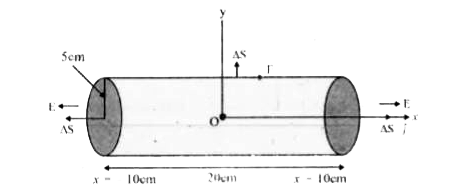 d. The net charge withing the cylinder can be formed by using Gauss. law which gives. `q=epsi_(0) phi =3.14 xx 8.854xx 10^(-12) C= 2.78 xx 10^(-11)C` |
|
| 16. |
An object of mass m is performing simple harmonic motion on a smooth horizontal surface as shown in figure. Just as the oscillating object reaches its extreme position, another object of mass 2m is dropped on it, which sticks to it. For this situation, mark out the correct statement(s). |
|
Answer» AMPLITUDE of oscillation REMAINS unchanged. |
|
| 17. |
The earth's magnetic field varies from point to point in space. Does it also change with time ?If so, on what time scale does it change appreciably ? |
| Answer» Solution :Yes, earth's field UNDERGOES a change with time. For example, daily CHANGES, annual changes secular changes with period of the order of 1960 years and IRREGULAR changes like MAGNETIC storms. Time scale for APPRECIABLE change is roughly a few hundred years. | |
| 18. |
A biconvex lens made of a transparent material of refractive index 1.33. Will the lens behave as a converging or a diverging lens ? Give reason. |
|
Answer» Solution :As a DIVERGING LENS. Ligh rays diverge on GOING from a rarer to a DENSER medium. |
|
| 19. |
A body weighs one Newton at the surface of the earth. What will be it’s weight at a height equal to half the radius of the earth ? |
|
Answer» SOLUTION :`g^'/g=(GM)/(R+h)^2xxR^2/(GM)=R^2/(R+R/2)^2 THEREFORE=((R^2xx4)/(9R_2))g=4/9g "Force" `=72xx4/9=32 N` |
|
| 20. |
A potentiometer wire is 100 cm long and a constant potential difference is maintained across it. Two cells are connected in series first to support one another and then in opposite direction. The balance points are obtained at 50 cm and 10 cm from the positive end of the wire in the two cases. The ratio of emf's is : |
|
Answer» `5:1` |
|
| 21. |
A 20kg monkey slides down a vertical rope with a constant acceleration of 7m//s^2. If g =10 ms^(-2), What is the tension in the rope ? |
|
Answer» 30N |
|
| 22. |
Apulse of light of duration 100mus is obsorbed completely by a small object initially at rest, power of the pulse is 30 mv and the speed of light is 3xx10^8 ms^(-1). The final momentum of the object is: |
|
Answer» `0.3xx10^(17) KG ms^(-1)` |
|
| 23. |
What is the smallest value of current that can be measured with a moving coil galvanometer, tangent galvanometer? |
| Answer» SOLUTION :The smallest value of CURRENT that can be measured by a moving coil galvanometer is `10^(-9)` | |
| 24. |
In the equation ((1)/(Pbeta))=(y)/(K_(B)T) when P is the pressure y is the distance k_(B) is Boltzmann constant and T is the temperature . Dimensions of are |
|
Answer» `M^(-1)L^(1)T^(2)` |
|
| 25. |
In a nuclear reaction, which of the following is conserved ? |
|
Answer» ATOMIC number |
|
| 26. |
What will be the value of input A and B for the boolean equation (bar(A+B))*(bar(A*B))=1? |
|
Answer» Solution :0, 0 `(bar(A+B))*(bar(A*B))=1` `therefore (BARA*barB)*(barA+barB)=1` `therefore (barA*barA)*barB+barA*(barB*barB)=1` `therefore barA*barB+barAbarB=barA*barB` The TRUTH table is as FOLLOWS:  `therefore` From truth table if Y = 1 then A = 0, B = 0 |
|
| 27. |
The magneticintensity at a pointdistant x from a pole of strength m is given by |
|
Answer» `( mu_0 m)/(4 PI X^(2))` |
|
| 28. |
A travelling wave on a long stretched string along the positive x-axis is given by y = 5mm e^((-1/(56 -x/(5cm)))^(2)). Using this equation answer the following questions. The velocity of the wave is |
|
Answer» 1 m/s |
|
| 29. |
Assertion:Horizontal component of eath's magnetic field (H) has been chosen as a magnetic element instead of the vertical component (V). Reason: Most of our experiments are performed in horizontal configuration. So, H is more relevant. |
|
Answer» If both Assertain and Reason are true and Reason is the correct EXPLANATION of Assertain |
|
| 30. |
A travelling wave on a long stretched string along the positive x-axis is given by y = 5mm e^((-1/(56 -x/(5cm)))^(2)). Using this equation answer the following questions. At t = 0, x = 0, the displacement of the wave is |
| Answer» ANSWER :C | |
| 31. |
A travelling wave on a long stretched string along the positive x-axis is given by y = 5mm e^((-1/(56 -x/(5cm)))^(2)). Using this equation answer the following questions. The plot of y and x at t = 10 s is best indicated by |
|
Answer»
|
|
| 32. |
The magnetic field due to a current carrying circular coil on the axis, at a large distance r from the centre of the coil, varies approximately as .......... |
|
Answer» `1/R` |
|
| 33. |
कोई भी सदा जीवित नहीं रहता, फिर भी जिंदगी लगातार चलती है। यह कथन निम्न की भूमिका कावर्णन करता है- |
|
Answer» भ्रूणीय परिवर्धन |
|
| 34. |
The half life of a radioactive substance is 20 minutes. The time taken between 50% decay and 87.5% decay of the substance will be |
|
Answer» 10 minutes 87.5% decay `rarr 12.5%` remaining `therefore` time for 50% `rarr 25%` = 20min time of `25% rarr 12.5 = ul("20 min")` `ul("40 min")` |
|
| 35. |
The velocity of a moving galaxy is 300 km s^(-1) and the apparent change in wavelength of a spectral line emitted from the galaxy is observed as 0.5 nm. Then, the actual wavelength of the spectral line is |
|
Answer» `3000 Å` `v = 300 kms^(-1) = 300 xx 10^(3) ms^(-1)` As `(Deltalambda)/(lambda) = (v)/(c) rightarrow = lambda = (Deltalambda c)/(v)` `therefore lambda = (0.5 xx 10^(-9)m)(3 xx 10^(8) ms^(-1))/(300 xx 10^(3)ms^(-1)) = 5 xx 10^(-7) m` `= 5000 xx 10^(-10) m = 5000 Å`. |
|
| 36. |
A bread toaster and a bulb are connected parallel in a circuit. The toaster produces more heat than the bulb. Which of the following statements is true? |
|
Answer» Resistance of TOASTER is GREATER than RESIS- tance of bulb. |
|
| 37. |
Two charges pm 10 muC are placed 5.0 mm apart. Determine the electric field at (a) a point P on the axis of the dipole 15 cm away from its centre O on the side of the positive charges, as shown in Fig. (a) and (b) be a point Q, 15 cm away from O on a line passing through O and normal to the axis of the dipole, as shown in Fig (b). |
|
Answer» Solution :Field at P due to charge `+10 muC=(10^(-5))/(4 pi (8.854 xx 10^(-12))) xx (1)/((15-0.25)^(2) xx 10^(-4))` `=4.13 xx 10^(6) NC^(-1)` along BP Field at P due to charge `-10muC=(10^(-5))/(4pi (8.854 xx 10^(-12))) xx (1)/((15+0.25)^(2) xx 10^(-4))` The RESULTANT electric field P due to the two charges at A and B is `= 2.7 xx 10^5 NC^(-1)` along BP. In this EXAMPLE, the ratio OP/OB is quite large (= 60). Thus, we can expect to get approximately the same result as above by directly using the formula for electric field at a far-away point on the axis of a dipole. For a dipole consisting of charges `pm q`, 2a distance apart, the electric field at a distance r from the centre on the axis of the dipole has a MAGNITUDE `E=(2p)/(4pi epsi_(0) r^(3)) " when r" gt gt a` where p=2a q is the magnitude of the dipole moment. The direction of electric field on the dipole axis is always along the direction of the dipole moment vector (i.e., from -q to q). Here, `p =10^(-5) xx 5 xx 10^(-3)= 5 xx 10^(-8)Cm` Therefore`E=(2 xx 5 xx 10^(-8))/(4pi (8.854 xx 10^(-12))) xx (1)/((15)^(2)xx 10^(-6)) =2 .6 xx 10^(5) NC^(-1)` along the dipole moment direction AB, which is close to the result OBTAINED earlier. Field at Q due to charge `+10muC" at B "=(10^(-5))/(4pi (8.851 xx 10^(-12))) xx (1)/([15^(2) +(0.25)^(2) ] xx 10^(-4))` Field at Q due to charge `-10muC" at A"=(10^(-5))/(4pi (8.854 xx 10^(-12))) xx (1)/([15^(2)+(0.25)^(2)] xx 10^(-4))` `=3.99 xx 10^(6) NC^(-1)" along QA"`. Clearly, the components of these two forces with equal magnitudes cancel along the direction OQ but add up along the direction PARALLEL to BA. Therefore, the resultant electric field at due to the two charges at A and B is `=2 xx (0.25)/sqrt(15^(2)+(0.25)^(2)) xx 3.99 xx 10^(6)" along BA="1.33 xx 10^(5) NC^(-1)" along BA"`. As in (a), we can expect to get approximately the same result using the formula for dipole field at a point on the normal to the axis of the dipole. When `r gt gta, E=p/(4pi epsi_(0) r^(3))=(5 xx 10^(-8))/(4 pi (8.854 xx 10^(-12)) xx (1)/((15)^(3) xx 10^(-8)) =1.33 xx 10^(5) NC^(-1)` The direction of electric field in this case in opposite to the direction of the dipole moment vector. |
|
| 38. |
For a short bar magnet ("B-axial")/("B-equatorial") is ….... |
|
Answer» `1:2` `B_("equator") = (mu_0)/( 4pi ) (m)/( x^3)` (where `xgt gt gt 2l` ) `THEREFORE (B_("AXIAL"))/( B_("equator")) = (2)/(1) = 2:1` |
|
| 39. |
Half-life of a radioactive substance A is two times the half-life of another radioactive substance B. Initially the number of nuclei of A and B are N_A and N_Brespectively. After three half lives of A number of nuclei of both are equal. Find the ratio N_(A)//N_(B) |
|
Answer» |
|
| 40. |
When there is no overlapping and different colors occupy distinct and separate positions, so that different lines are sharply separated and focused is ? |
| Answer» SOLUTION :PURE SPECTRUM | |
| 41. |
An object is placed at 20 cm in front of a concave mirror produces three times magnificed real image. What is the focal length of the concave mirror ? |
|
Answer» 15 cm Linear magnification `m = (f)/(f - U)` Given, object displaced u = - 20 cm `(therfore "all REAL image are inverted")` So, "" `-3 = (f)/(f - (-20))` `rArr "" -3 = (f)/(f + 20) rArr - 3F - 60 = f` `4f = - 60 rArr f = - (60)/(4) = - 15 cm` Since, mirror is concave f = - 15 cm. |
|
| 42. |
If a tuning fork of frequency (f_(0)) 340 Hz and tolerance pm1% is used in the resonance column method for determining the speed of sound. If the first and the second resonance are measured at l_(1) = 24.0 cm and l_(2) = 74.70 cm, then the permissible error in speed of sound is |
|
Answer» `1.2%` |
|
| 43. |
A current of 5 mA passing thrugh a tangent galvanometer producer deflection of 45^@.The current required to produce a deflection of 60^@ is: |
|
Answer» 9.66mA |
|
| 44. |
Two charges 3x10^(-8)C & -2x10^(-8)C are located 15 cm apart. At what point on the line joining the two charges is the electric potential zero? Take the potential infinity to be 0. |
Answer» Solution : Let us take the ORIGIN O at the location of the positive charge. The line joining the two charges is taken to be the x-axis, the negative charge is taken to be on the right side of the origin (Fig.). Let P be the required point on the x-axis where the potential is zero. If x is the x-coordinate of P, obviously x must be positive. (There is no POSSIBILITY of potentials due to the two charges adding up to zero for x < 0.) If x lies between O and A, we have. `(1)/(4pi epsi_0) [ (3 xx 10^(-8))/(x xx 10^(-2)) - (2 xx 10^(-8))/((15 - x) xx 10^(-2))] = 0` Where x is in cm. That is, ` 3/x - (2)/(15 - x) = 0` Which gives x = 9 cm If x lies on the extended line OA, the required condition is ` 3/x - (1)/(x - 15) = 0` Which gives x = 45 cm Thus , ELECTRIC potential is zero at 9cm and 45cm away from the positive charge on the side of the negative charge. NOTE that the formula for potential used in the culculation required choosing potential to be zero at infinity. |
|
| 45. |
Which of the following is true about ionic solids |
|
Answer» In fused state, lonic SOLIDS do not CONDUCT electricity |
|
| 46. |
The refractive index of the material of prism is 72 and Its refracting angle is 30°. One of the refracting surfaces of the prism is made a mirror in wards. A beam of monochromatic light enters the prism from the other surface and the ray retraces from the mirrored surface. The angle of incidence is |
| Answer» Solution :`r_(2)=0` FIND `r_(1) + r_(2)=A,sini_(1)=musinr_(1)` | |
| 47. |
A concave mirror is held in water. What should be he change in the focal length of the mirror? |
| Answer» SOLUTION :No CHANGE: The FOCAL length of a concave mirror does not depend on the NATURE of the MEDIUM | |
| 48. |
What is the work done by the electric field of a nucleus, in a complete circular orbit of the electron ? What in elliptic orbit ? |
| Answer» Solution :In both CASES, the work DONE by the ELECTRIC field of nucleus is ZERO, because `ointoversetto(E)oversetto(di)=SIGMA` | |
| 49. |
A P - type semiconductor has acceptor level 57 meV above the valence band. The maximum wavelength of light required to create a hole is (Planck's constant h=6.6 xx10^(-34) J-s) |
|
Answer» `57Å` |
|
| 50. |
Half lives of two radioactive elements A and B are 20 minutes and 40 minutes respectively. Initially, the samples have equal number of nuclei. Calculate the ratio of decayed numbers of A and B nuclei after 80 minutes. |
|
Answer» Solution :80 minutes = 4 half lives of A = 2 half live of B Let the initial number of nuclei in each sample be N. `N_(A)` after 80 minutes = `(N)/(2^(4))` Number of A NUCLIDES decayed = `(15)/(16)N` `N_(B)` after 80 minutes =` (N)/(2^(4))` Number of B nuclides decayed = `(3)/(4)N` Required RATIO = `(15)/(16) xx (4)/(3) = (5)/(4)` `N_(A) : N_(B) = 5 : 4` |
|


