Saved Bookmarks
This section includes 7 InterviewSolutions, each offering curated multiple-choice questions to sharpen your Current Affairs knowledge and support exam preparation. Choose a topic below to get started.
| 1. |
A : The resolving power of both miroscope and telescope depends on the wavelength of the used. R : The resolving power of a lens is the ability to resolve the two images so that they are distinctly identified. |
|
Answer» Both A and R are TRUE and R is the correct explanation of A |
|
| 2. |
The behaviour of the control unit of an automatic gas cooker is given below . Cooking time is different by different dishes . Hence cooking time must be adjusted properly . This control unit can be constructed by using logic gates . a . What is meant by logic gates ? b . Which gate is suitable for the above control unit ? c. Construct a simple circuit diagram of control unit(Using symbol of logic gate and block diagram of others) |
|
Answer» Solution :a Electronic CIRCUIT in which the output follows some logical relationship with the input is called the LOGIC gate . B. NAND c 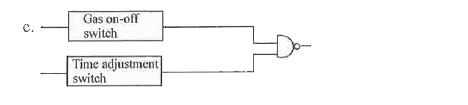
|
|
| 3. |
A capacitor is charged from a battery through a resistance of 1 M Omega. If it takes 1 sec for the charge to reach one-half of its final value then capacity of capacitor is |
|
Answer» `0.36 MU F` |
|
| 4. |
In Young's double slit experiment, the slit are 2 mm apart and are illuminated by photons of two wavelengths lambda = 12000 Å andlambda_(2)=10000 Å. At what minimum distance from the common central bright fringe on the screen 2 m from the slit will a bright fringe from one interference pattern coincide with a bright fringe from the other? |
|
Answer» 4 mm `:.n barX_(1)=n_(2)barX_(2)` `:.(n_(1)lambda_(1)D)/(d)=(n_(2)lambda_(2)D)/(d)` `:. n_(1) lambda_(1)=n_(2)lambda_(2)` `:. (n_(1))/(n_(2))=(lambda_(2))/(lambda_(1))=(10000Å)/(12000Å)=(5)/(6)` `:.n_(1)=5 th and n_(2)=6th` fringes are superposing Now distance of central fringe from mid point `x=(n_(1) lambda_(1)D)/(d)` `=5xx12000xx10^(-4)xx(2)/(2xx10^(-3))` `=6000xx10^(-7)` `=6xx10^(-3)m=6 mm` This distance can be determine by `x=(n_(2) lambda_(2)D)/(d)` also. |
|
| 5. |
Ram ans Shyam purchased two electric tea kettles A and B of same size, same thickness, and same volume of 0.4L. They studied the specification of kettles as under Kettle A: specific heat capacity = 1680 Jkg^(-1)K^(-1) Mass = 200 g Cost = Rs. 400 Kettle B: Specific heat capacity= 2450 Jkg^(-1) K^(-1) Mass = 400 g Cost = Rs. 400 When kettle A is switched on with constant potential source, the tea begins to boil in 6 min. When kettle B is switched on with the same source separately, then tea begins to boil in 8 min. The efficiengy of kettle is defined as (Energy used for liquid heating)/(Total energy supplied) They made discussion on specification and efficiency of kettles and subsequently prepared a list of questions to draw the conclusions. Some of them are as under (assume specific heat of tea liquid as 4200J kg^(-1)K^(-1) and density 1000 kgm^(-3) If both the kettles are joined with the same source in series one after the other, then boiling starts in kettle A and kettle B after |
|
Answer» FOUR times of their original time But `R_(A) = R_(B) or V^2/R_(A) xx 6 = V^2/R_(A) xx 6 = V^2/(4R_(A)^(2)) R_(A) xx t_(A)` `t_(A) = 24min.` (ii) `V^2/R_(B) xx 8 = V^2/(R_(A)+R_(B))^2 R_(B) xx t_(B)` `8/R_(B) = R_(B)/(4R_(B^2)) t_(B) or t_(B) = 32min.` |
|
| 6. |
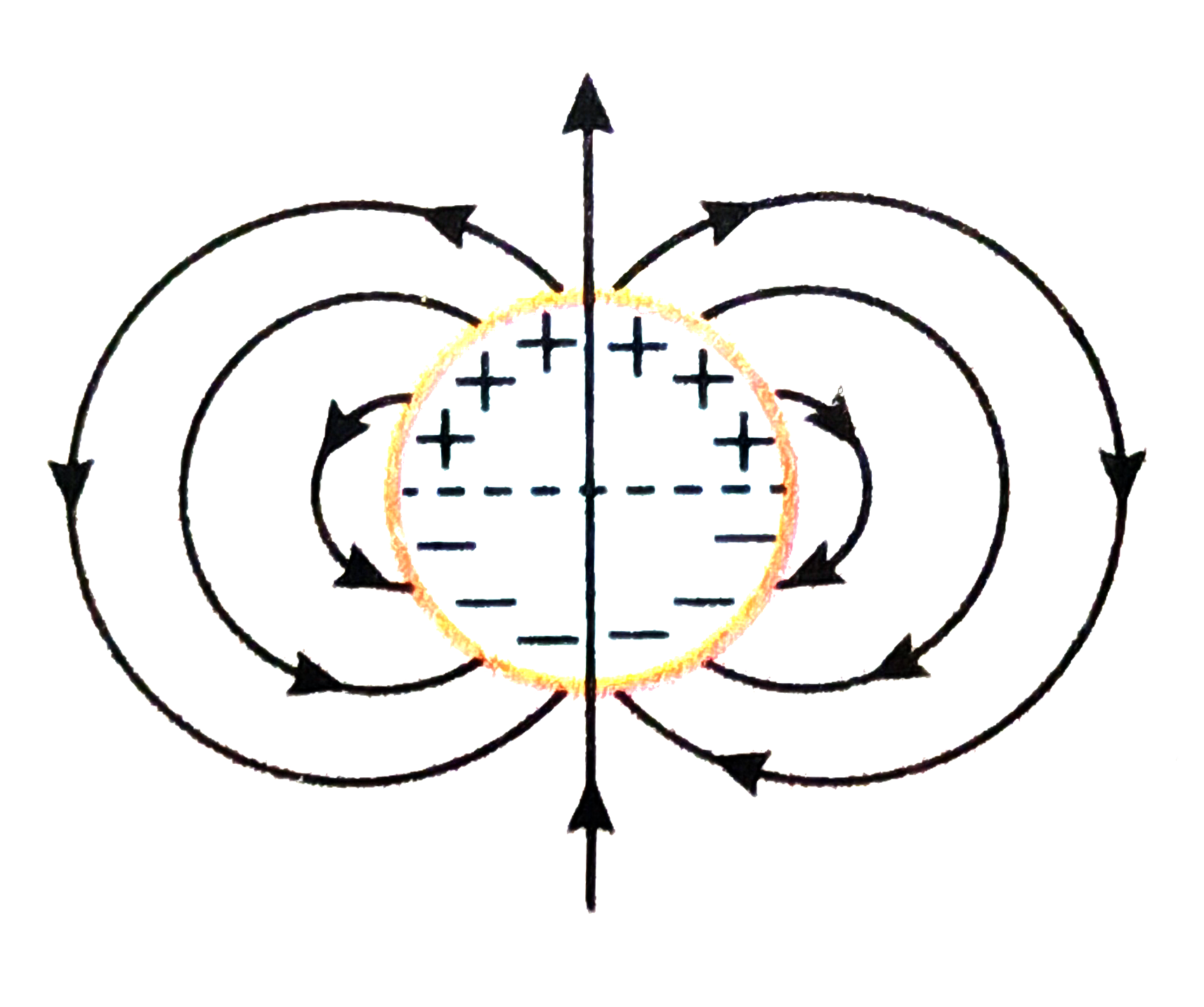
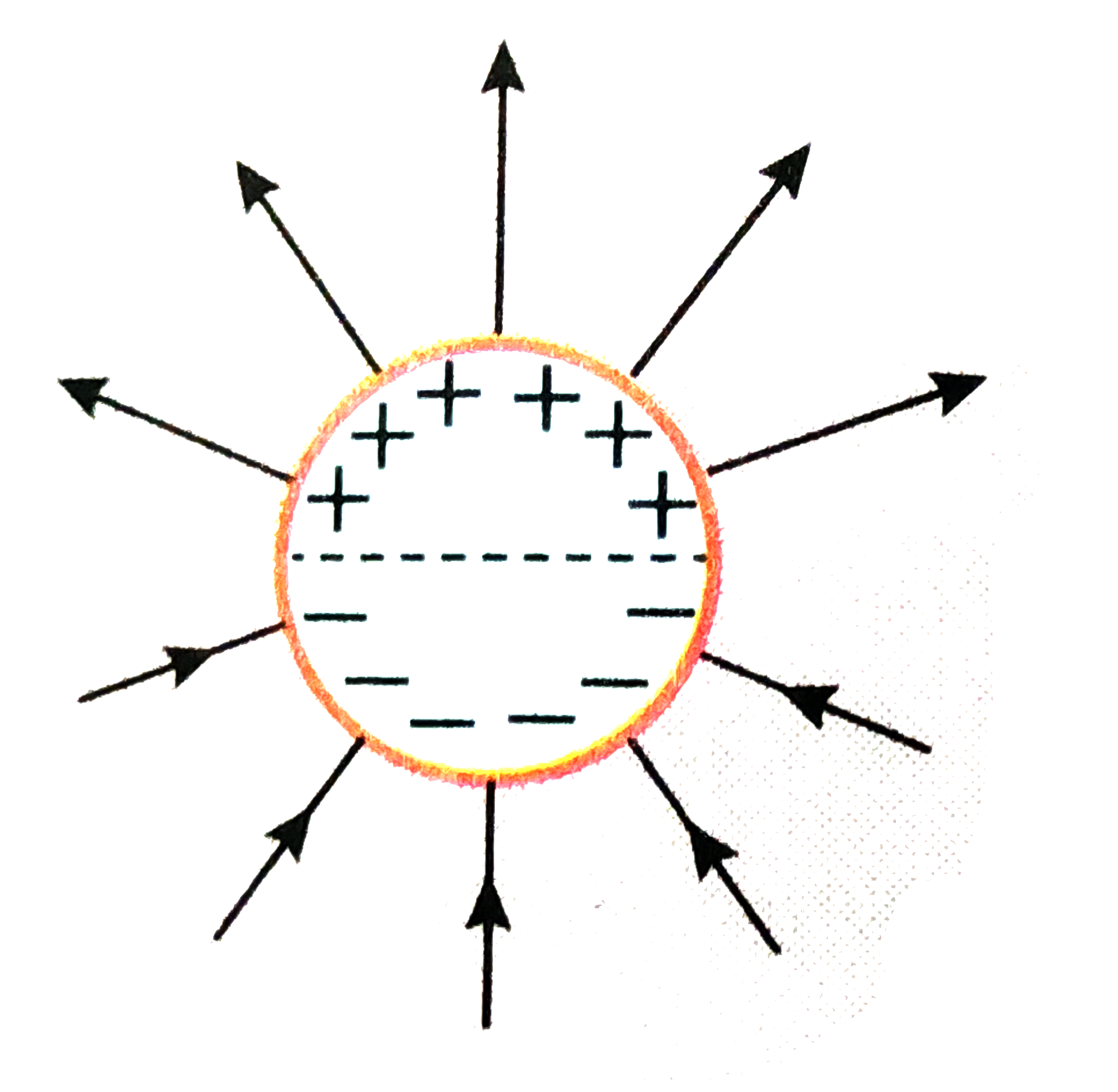
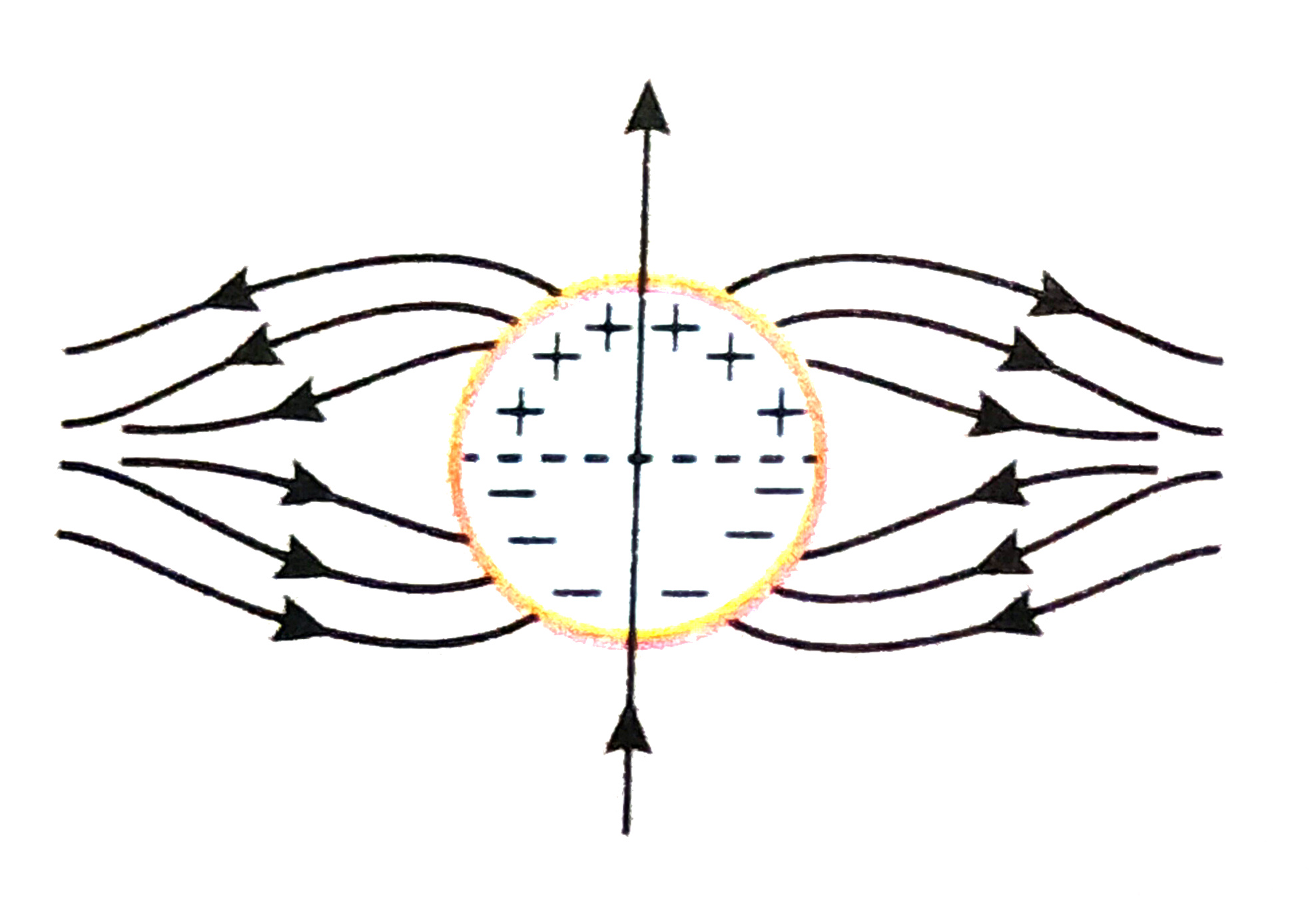
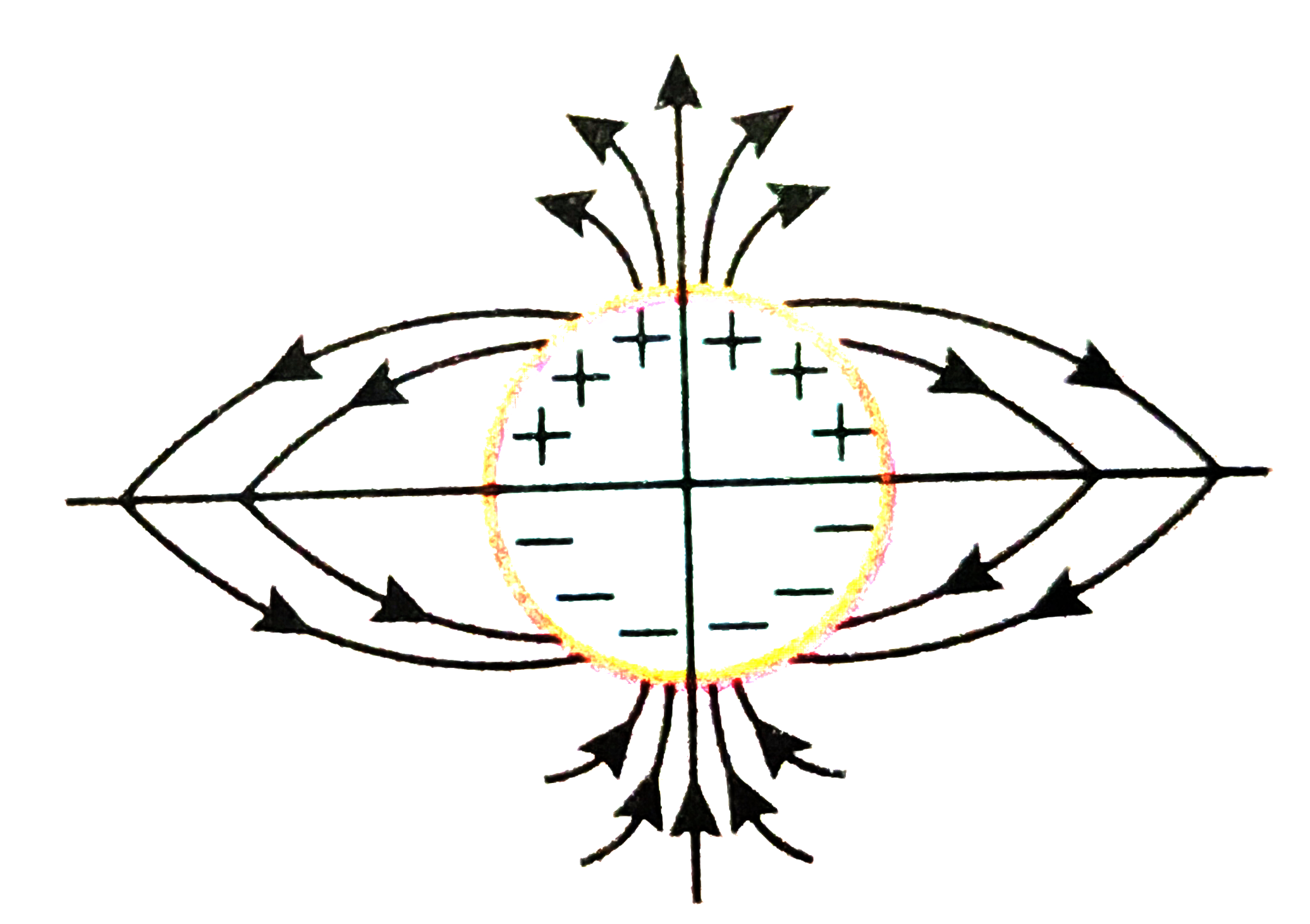
A long cylindrical shell carries positive surface charge sigma in the upper half and negative surface charge -sigma in the lower half. The electric field lines around the cylinder will look like figure given in (figures are schematic and not drawn to scale) |
|
Answer»
|
|
| 7. |
Write the application of series RLC resonant circuit. |
| Answer» Solution :The phenomenon of ELECTRICAL resonace is possible when the circuit containss both L and C. Only then the voltage across L and C cancel ONE another when VL and VC are `180^(@)` out of PHASE and the circuit becomes purely resitive. This implies that RESONANCE will not OCCUR in a RL and RC circuits. | |
| 8. |
Ram ans Shyam purchased two electric tea kettles A and B of same size, same thickness, and same volume of 0.4L. They studied the specification of kettles as under Kettle A: specific heat capacity = 1680 Jkg^(-1)K^(-1) Mass = 200 g Cost = Rs. 400 Kettle B: Specific heat capacity= 2450 Jkg^(-1) K^(-1) Mass = 400 g Cost = Rs. 400 When kettle A is switched on with constant potential source, the tea begins to boil in 6 min. When kettle B is switched on with the same source separately, then tea begins to boil in 8 min. The efficiengy of kettle is defined as (Energy used for liquid heating)/(Total energy supplied) They made discussion on specification and efficiency of kettles and subsequently prepared a list of questions to draw the conclusions. Some of them are as under (assume specific heat of tea liquid as 4200J kg^(-1)K^(-1) and density 1000 kgm^(-3) Efficiency of kettle A is |
|
Answer» `63.34%` `eta = (0.4 xx 4200 (theta - theta_1))/(420 xx 6.4(theta-theta_1)) xx 100 = 62.5%` `H_(A) = 0.2 xx 1680 (theta-theta_1) + 0.4 xx 4200 (theta-theta_1)` `= 420 xx [0.8 +4] (theta - theta_1)` `H_(B) = 0.4 xx 2450 (theta-theta_1) + 0.4 xx 4200 (theta-theta_1)` `= 420 xx (2.4 + 4)(theta-theta_1)` . `H_(A)/H_(B) = 4.8/6.4 = 3/4` `H_(A) = V^2/R_(A) xx 6` `H_(B) = V^2/R_(B) xx 8` `H_(A)/H_(B) = R_(B)/R_(A) xx 3/4 but H_(A)/H_(B) = 3/4 ` Then `R_(B) = R_(A)` |
|
| 9. |
Ram ans Shyam purchased two electric tea kettles A and B of same size, same thickness, and same volume of 0.4L. They studied the specification of kettles as under Kettle A: specific heat capacity = 1680 Jkg^(-1)K^(-1) Mass = 200 g Cost = Rs. 400 Kettle B: Specific heat capacity= 2450 Jkg^(-1) K^(-1) Mass = 400 g Cost = Rs. 400 When kettle A is switched on with constant potential source, the tea begins to boil in 6 min. When kettle B is switched on with the same source separately, then tea begins to boil in 8 min. The efficiengy of kettle is defined as (Energy used for liquid heating)/(Total energy supplied) They made discussion on specification and efficiency of kettles and subsequently prepared a list of questions to draw the conclusions. Some of them are as under (assume specific heat of tea liquid as 4200J kg^(-1)K^(-1) and density 1000 kgm^(-3) Efficiency of kettle B is . |
|
Answer» `82.5%` `eta = (0.4 xx 4200 (theta - theta_1))/(420 xx 6.4(theta-theta_1)) xx 100 = 62.5%` `H_(A) = 0.2 xx 1680 (theta-theta_1) + 0.4 xx 4200 (theta-theta_1)` `= 420 xx [0.8 +4] (theta - theta_1)` `H_(B) = 0.4 xx 2450 (theta-theta_1) + 0.4 xx 4200 (theta-theta_1)` `= 420 xx (2.4 + 4)(theta-theta_1)` . `H_(A)/H_(B) = 4.8/6.4 = 3/4` `H_(A) = V^2/R_(A) xx 6` `H_(B) = V^2/R_(B) xx 8` `H_(A)/H_(B) = R_(B)/R_(A) xx 3/4 but H_(A)/H_(B) = 3/4 ` Then `R_(B) = R_(A)` |
|
| 10. |
Mention any one application of potentiometer |
|
Answer» SOLUTION : Potentiometer is used 1. To compare emf.s of TWO cells 2. To measure internal RESISTANCE of a CELL |
|
| 11. |
Ram ans Shyam purchased two electric tea kettles A and B of same size, same thickness, and same volume of 0.4L. They studied the specification of kettles as under Kettle A: specific heat capacity = 1680 Jkg^(-1)K^(-1) Mass = 200 g Cost = Rs. 400 Kettle B: Specific heat capacity= 2450 Jkg^(-1) K^(-1) Mass = 400 g Cost = Rs. 400 When kettle A is switched on with constant potential source, the tea begins to boil in 6 min. When kettle B is switched on with the same source separately, then tea begins to boil in 8 min. The efficiengy of kettle is defined as (Energy used for liquid heating)/(Total energy supplied) They made discussion on specification and efficiency of kettles and subsequently prepared a list of questions to draw the conclusions. Some of them are as under (assume specific heat of tea liquid as 4200J kg^(-1)K^(-1) and density 1000 kgm^(-3) Ratio of efficiency consumed charges for one time boiling of tea in kettle A to that in kettle B is |
|
Answer» `3:5` `eta = (0.4 xx 4200 (theta - theta_1))/(420 xx 6.4(theta-theta_1)) xx 100 = 62.5%` `H_(A) = 0.2 xx 1680 (theta-theta_1) + 0.4 xx 4200 (theta-theta_1)` `= 420 xx [0.8 +4] (theta - theta_1)` `H_(B) = 0.4 xx 2450 (theta-theta_1) + 0.4 xx 4200 (theta-theta_1)` `= 420 xx (2.4 + 4)(theta-theta_1)` . `H_(A)/H_(B) = 4.8/6.4 = 3/4` `H_(A) = V^2/R_(A) xx 6` `H_(B) = V^2/R_(B) xx 8` `H_(A)/H_(B) = R_(B)/R_(A) xx 3/4 but H_(A)/H_(B) = 3/4 ` Then `R_(B) = R_(A)` |
|
| 12. |
Ram ans Shyam purchased two electric tea kettles A and B of same size, same thickness, and same volume of 0.4L. They studied the specification of kettles as under Kettle A: specific heat capacity = 1680 Jkg^(-1)K^(-1) Mass = 200 g Cost = Rs. 400 Kettle B: Specific heat capacity= 2450 Jkg^(-1) K^(-1) Mass = 400 g Cost = Rs. 400 When kettle A is switched on with constant potential source, the tea begins to boil in 6 min. When kettle B is switched on with the same source separately, then tea begins to boil in 8 min. The efficiengy of kettle is defined as (Energy used for liquid heating)/(Total energy supplied) They made discussion on specification and efficiency of kettles and subsequently prepared a list of questions to draw the conclusions. Some of them are as under (assume specific heat of tea liquid as 4200J kg^(-1)K^(-1) and density 1000 kgm^(-3) If resistances of coil of kettles A and B are R_(A) and R_(B), respectively, then we can say |
|
Answer» `R_AgtR` `eta = (0.4 xx 4200 (theta - theta_1))/(420 xx 6.4(theta-theta_1)) xx 100 = 62.5%` `H_(A) = 0.2 xx 1680 (theta-theta_1) + 0.4 xx 4200 (theta-theta_1)` `= 420 xx [0.8 +4] (theta - theta_1)` `H_(B) = 0.4 xx 2450 (theta-theta_1) + 0.4 xx 4200 (theta-theta_1)` `= 420 xx (2.4 + 4)(theta-theta_1)` . `H_(A)/H_(B) = 4.8/6.4 = 3/4` `H_(A) = V^2/R_(A) xx 6` `H_(B) = V^2/R_(B) xx 8` `H_(A)/H_(B) = R_(B)/R_(A) xx 3/4 but H_(A)/H_(B) = 3/4 ` Then `R_(B) = R_(A)` |
|
| 13. |
Assertion : they tyre's of aircraft's are slightly conducting. Reason: If a conductor is connected to ground, the extra charge induced on conductor will flow to ground. |
|
Answer» If both ASSERTION and REASON are true and the reason is the correct EXPLANATION of the assertion. Explanation : during take off and landing, the friction between tyres and the RUN way MAY cause electrification of tyres. Due to conducting to a ground and election sparking is avoided. |
|
| 14. |
A standing electromagnetic wave E=E_(m) cos kx. Cosomegat is sustained along the x axis in vacuum. Find the projection of the Poyntind vector on the x axis S_(x)(x,t) and the mean value of that projectionaveraged over an oscillation period. |
|
Answer» SOLUTION :`oversetrarr(E) = oversetrarr(E_(m)) cos KX omega t` `oversetrarr(H) = (oversetrarr(k) xx oversetrarr(E_(m)))/(mu_(0)omega) sin kx sin omegat` `oversetrarr(S) = oversetrarr(E) xx oversetrarr(H) = (oversetrarr(E_(m)) xx (oversetrarr(k)xx oversetrarr(E)_(m)))/(mu_(0)omega) (1)/(4) sin 2kx sin 2 omegat` Thus `S_(X) = (1)/(4) epsilon_(0) cE_(m)^(2) sin 2kx sin 2 omegat` (as `(1)/(mu_(0)c) = epsilon_(0)c)` |
|
| 15. |
A particle has an initial velocity of 3hat(i) + 4hat(j) and an A A acceleration of 0.4 hat(i) + 0.3 hat(j) . Its speed after 10 s is : |
|
Answer» 7 UNITS `vec(v)~~7hati+7hatj` `:. |v| ~~sqrt(7^(2) + 7^(2))=7sqrt(2)`units |
|
| 16. |
The magnetic susceptibility of an ideal diamagnetic substance is |
|
Answer» `+1` |
|
| 17. |
In the given circuit Fig. 5.11, the base current is 10 muA and the collector current is 52 mA. Can this transistor be used as an amplifier ? |
|
Answer» |
|
| 18. |
In Einstein's view, all motions are"____________" |
|
Answer» meaningless |
|
| 19. |
In an a.c. circuit, the applied voltage is E=E_0sinomegatand the resulting current in the circuit is I=I_0sin(omegat-pi/2). The power consumed in the circuit is given by : |
|
Answer» `P=E_0I_0/2` |
|
| 20. |
An alternating e.m.f is applied to a circuit containing L and C in parallel . The phase difference between the branch current I_L and I_C is : |
| Answer» ANSWER :D | |
| 21. |
A wire when connected to 220V mains supply has power dissipation P_1 . Now ,the wire is cut into two equal pieces which are connectedin parallel to the main suplly. Power dissipationin this case is p_2. Then P_2:P_1 is : |
|
Answer» 1 |
|
| 22. |
A charge – Q is placed at some distance from a neutral conductor. Charge is induced on its surface. In the neighbourhood of a point P on its surface, the charge density is sigma C//m^2. Consider a small area DeltaS on the surface of the conductor encircling point P. Find the resultant force experienced by the area DeltaS due to charge present on the surface elsewhere and the charge – Q. |
|
Answer» |
|
| 23. |
Two charge +q and - q are attached to the two ends of a light rod of length L, as shown in figure. The system is given a velocity v perpendicular to magnetic field vecB . The magnetic force on the system of charges and magnitude of force on one charge by the rod, are respcetively. |
|
Answer» ZERO, zero |
|
| 24. |
During beta^(-) emission |
|
Answer» A NEUTRON in the NUCLEUS decays EMITTING an electron |
|
| 25. |
Two capacitors of capacitance C and 3C are charged to potential difference V_(0) and 2V_(0), respectively, and connected to an inductor of inductance L as shows in Fig. Initially, the current in the inductor is zero. Now, switch S is closed. The maximum current in the inductor is |
|
Answer» `(3V_(0))/(2) sqrt((3C)/(L))` `:.` e.m.f. across `L = 0`, so potential difference across the capacitor will be same. From the law of CONSERVATION of charge on PLATES `2` and `3`, `3CV + CV = 6 CV_(0) - CV_(0)` `rArr V = (5V_(0))/(4)` LOSS in energy of capacitor = energy stored in inductor `rArr (1)/(2) CV_(0)^(2) + (1)/(2) 3C(2V_(0))^(2) - (1)/(2) XX 4CV^(2) = (1)/(2) LI^(2)` `rArr I = (3)/(2) V_(0) sqrt((3C)/(L))` 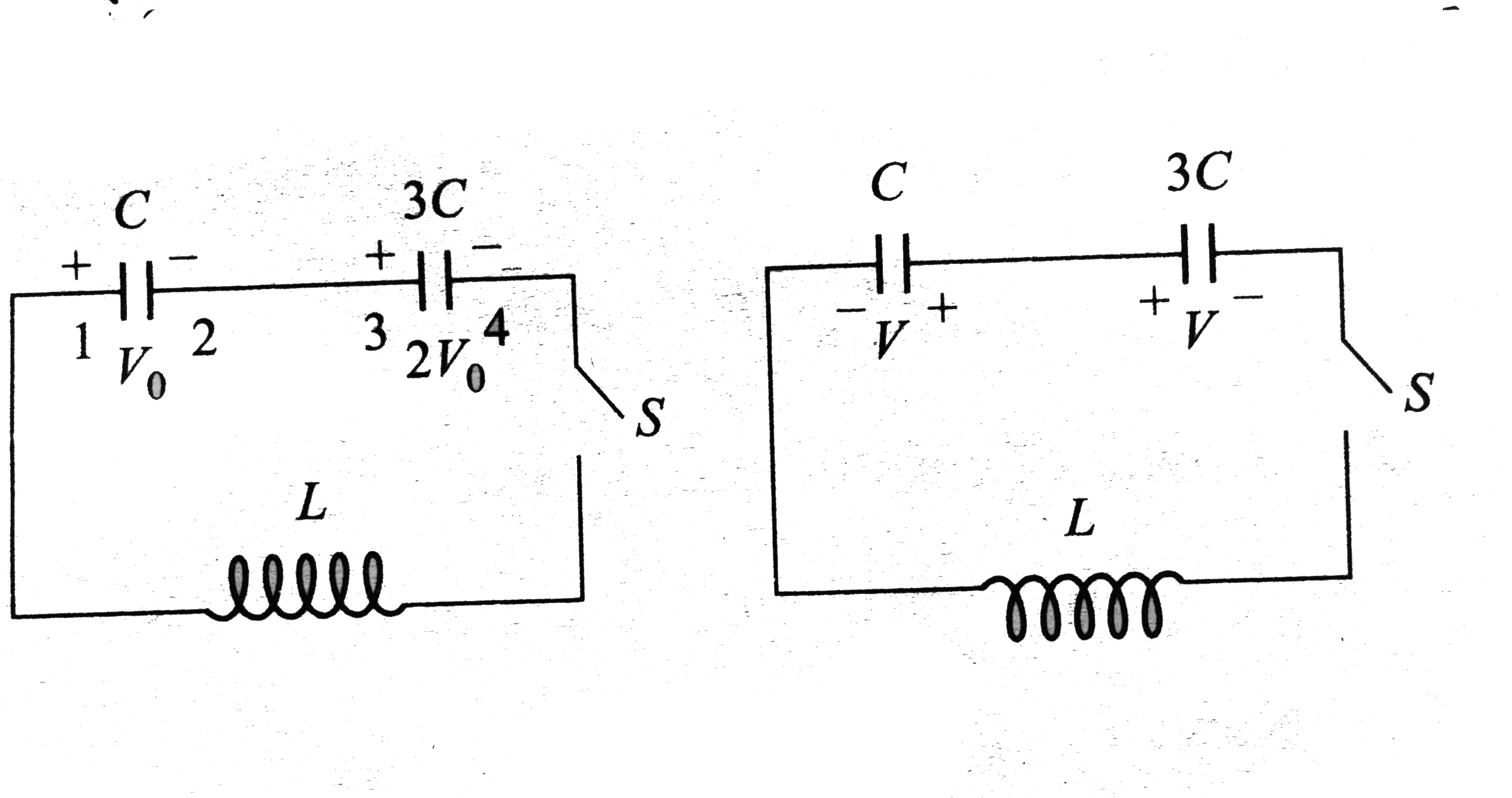 
|
|
| 26. |
Two capacitors of capacitance C and 3C are charged to potential difference V_(0) and 2V_(0), respectively, and connected to an inductor of inductance L as shows in Fig. Initially, the current in the inductor is zero. Now, switch S is closed. Potential difference across capacitor of capacitance C when the current in the circuit is maximum is |
|
Answer» `(V_(0))/(4)` `:.` e.m.f. across `L = 0`, so potential difference across the capacitor will be same. From the law of conservation of charge on plates `2` and `3`, `3CV + CV = 6 CV_(0) - CV_(0)` `rArr V = (5V_(0))/(4)` Loss in energy of capacitor = energy stored in inductor `rArr (1)/(2) CV_(0)^(2) + (1)/(2) 3C(2V_(0))^(2) - (1)/(2) xx 4CV^(2) = (1)/(2) LI^(2)` `rArr I = (3)/(2) V_(0) sqrt((3C)/(L))` 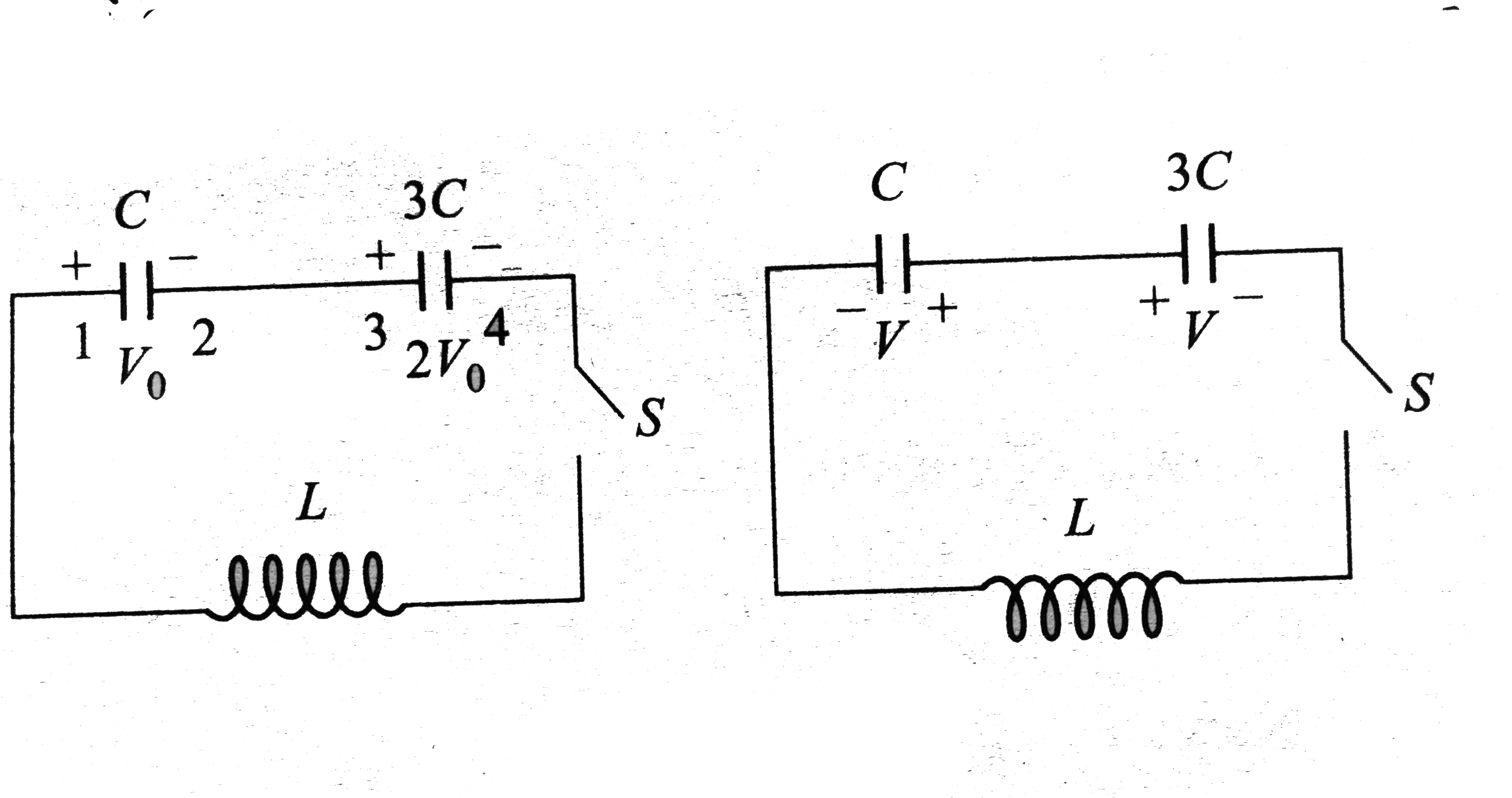 
|
|
| 27. |
Two capacitors of capacitance C and 3C are charged to potential difference V_(0) and 2V_(0), respectively, and connected to an inductor of inductance L as shows in Fig. Initially, the current in the inductor is zero. Now, switch S is closed. Potential difference across capacitor of capacitance 3C when the current in the circuit is maximum is |
|
Answer» `(V_(0))/(4)` `:.` e.m.f. across `L = 0`, so potential difference across the capacitor will be same. From the law of conservation of charge on PLATES `2` and `3`, `3CV + CV = 6 CV_(0) - CV_(0)` `rArr V = (5V_(0))/(4)` Loss in energy of capacitor = energy stored in inductor `rArr (1)/(2) CV_(0)^(2) + (1)/(2) 3C(2V_(0))^(2) - (1)/(2) xx 4CV^(2) = (1)/(2) LI^(2)` `rArr I = (3)/(2) V_(0) sqrt((3C)/(L))` 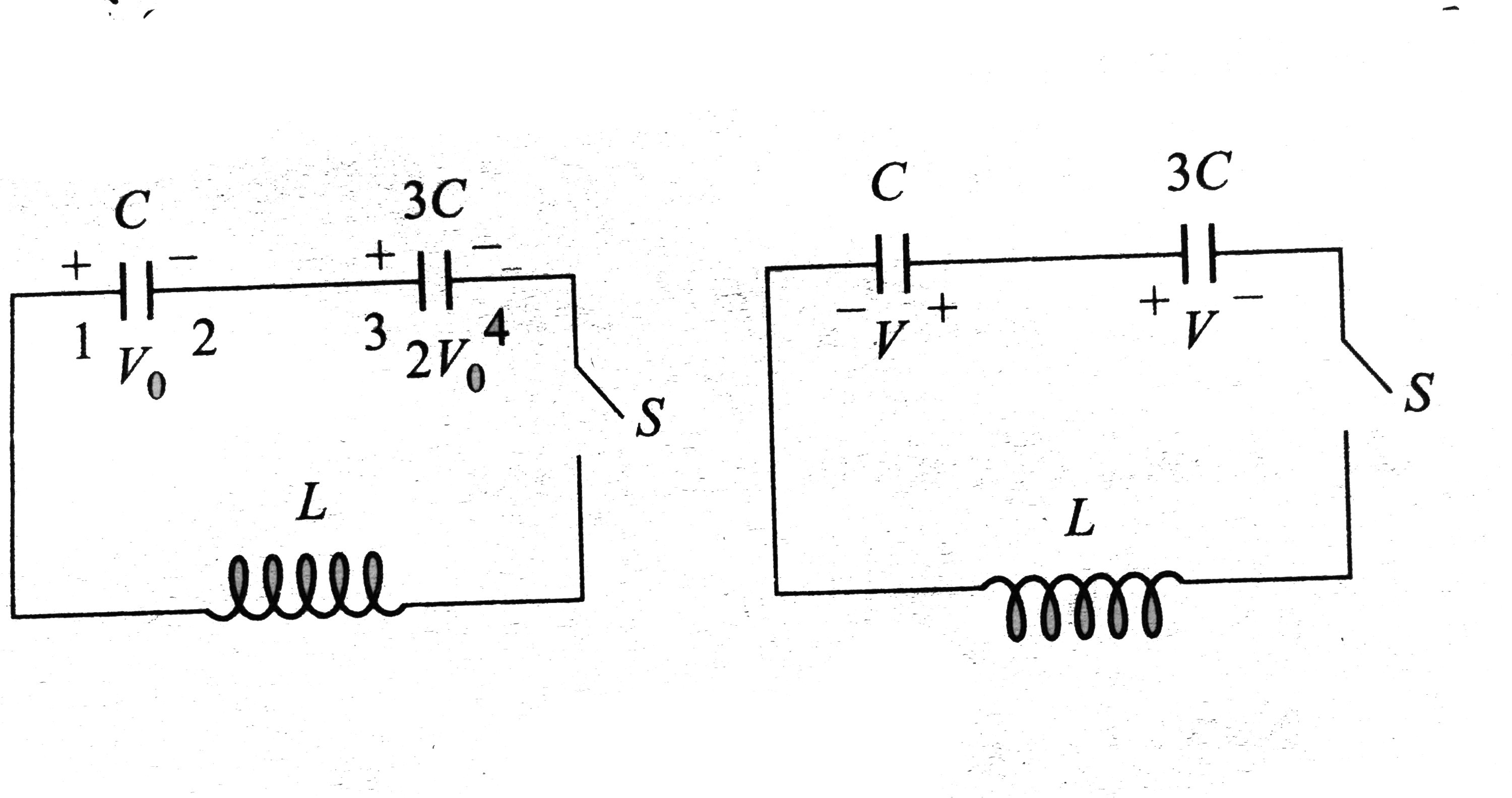 
|
|
| 28. |
A black body has maximum wavelength lamda_(m) at 2000 K. Its corresponding wavelength at 3000 K will be : |
|
Answer» `3/2lamda_(m)` Correct CHOICE is (c ). |
|
| 29. |
Both the capacitorsshownin figure are made of square plates of edge a . The separations between the platesof the capacitorsand d_(1) and d_(2) as shown in the figure. A battery of V volt and a resistance R are connectedas shown in figure. At steady state an electron is projected between the plates of the lower capacitor from its lower plate along the plate as shown. Minimum speed should the electron be projected is given by (1)/(sqrt(n))((Vea^(2))/(md^(2)))^(1//2) so that it does not collide with any plate? Consider only the electric forces then find the value of n. |
|
Answer» |
|
| 30. |
A square loop of side 12 cm with its sides parallel to X and Y axes is moved with a velocity of 8 cm. s^(-1) in the positive x-direction in an environment containing a magnetic field in the positive z-direction. The field is neither uniform in space nor constant in time. It has a gradient of 10^(-3)T.cm^(-1) along the negative x-direction and is decreasing in time at the rate of 10^(-3)T.s^(-1). Determine the direction and magnitude of induced current in the loop if its resistance is 4.50 m Omega. |
|
Answer» SOLUTION :Rate of change of B DUE to variation with time `=A.(dB)/(dt)=(12xx10^(-2))^(2)xx10^(-3)` `=1.44xx10^(-5)Wb.s^(-1)` Rate of change of B due to variation with space `=A.(dB)/(dx).(dx)/(dt)=(12xx10^(-2))^(2)xx10^(-3)xx8xx10^(-2)` `=11.52xx10^(-5)Wb.s^(-1)` Total rate of change of flux `=(1.44+11.52)xx10^(-5)Wb.s^(-1)` `=12.96xx10^(-5)Wb.s^(-1)` `THEREFORE e=12.96xx10^(-5)V` `therefore I=(e)/(R)=(12.96xx10^(-5))/(4.5xx10^(-3))=2.88xx10^(-2)A` |
|
| 31. |
Statement-1 : The Doppler effect occurs in all wave motions. because Statement-2 : The Doppler effect can be explained by the principal of superposition of waves. |
|
Answer» STATEMENT -1 is TRUE, statement -2 is True, Statement -2 is a correct EXPLANATION for Statement -1. |
|
| 32. |
A microscope is focussed on a point object, and then its objective is raised through a height of 2cm when a glass slab of refractive index 1.5 is placed over this point object such that it is focussed again. The thickness of the glass slab is |
|
Answer» 6cm |
|
| 33. |
The mathematicalequation for magnetic field lines of force is |
|
Answer» |
|
| 34. |
A circular loop of radius R in X-Y plane with its centre at origin is carrying current I. The total magnetic flux through X-Y plane is |
|
Answer» DIRECTLY PROPORTIONAL to I |
|
| 35. |
A ray of light is incident normally on one face of 30^@ - 60^@ - 90^@ prism of refractive index 5/3 immersed in water of refractive index 4/3 as shown in figure. |
|
Answer» the exit angle `theta_2` of the ray is `sin^(-1) (5//8)` |
|
| 36. |
From the condition of the foregoing problem, find how much (in %) the energy of the emitted photon differs from the energy of the corresponding transition in a hydrogen atom. |
|
Answer» |
|
| 37. |
Capacitance of a spherical conductor of radius r is given as_____________ . |
| Answer» SOLUTION :`4 PI epsi_0 R` | |
| 38. |
In circular coil, when number of turns is doubled and resistance becomes 1/4th of initial value, the inductance becomes |
|
Answer» 8 times `rArr (L)/(L.)=((N)/(N.))^(2)=((N)/(2N))^(2)=(1)/(4)rArr L.=4L`. So, INDUCTANCE BECOMES 4 times of its initial. |
|
| 39. |
Find the maximum height attained by a body projected with a speed v=v_(e)//2. Where v_(e )= escape velocity of any object at earth's surface. |
|
Answer» Solution :`DeltaKE+DeltaPE=0` `implies-(1)/(2)mv^(2)+GMm((1)/(R )-(1)/(R+h))=0` Put `v=(v_(E ))/(2)=SQRT((GM)/(2R))` `:.h=R//3` |
|
| 40. |
For a light emitting diode (LED) the forbidden energy gap E_(g) between the valence band and conduction band should have a value |
|
Answer» `E_(g) LT 0.7 `eV |
|
| 41. |
The half - life period of a radioactive element x is same as the mean life time of another radioactive element yInitially both of them have the same number of atoms. Then,n |
|
Answer» X and Y decay at same rate always i.e. `T_X gt T_Y THEREFORE lambda_X lt lambda_Y` `because R=lambdaN` and N is same for both, `therefore R_X lt R_Y` or `R_Y gt R_X` i.e. Y will decay faster than X. |
|
| 42. |
Two clocks are being tested against a standard clock located in a national laboratory. At 12:00:00 noon by the standard clock , the readings of the two clocks are : If you are doing an experiment that requires 'precision time interval' measurements, which of the two clocks will you prefer? c |
| Answer» Solution :The range of variation over the SEVEN days of observations is 164 s for CLOCK 1 , and 32 s for clock 2. The average reading of clock 1 is much CLOSER to the standard time than the average reading of clock 2. The important point is that a clock is zero error is not as significant for precision work as its variation, because a .zero-error. can always be easily corrected. Hence clock 2 is to preferred to clock 1. | |
| 43. |
The mean lives of a radioactive substance are 1620 year and 405 yearfor alpha - emission andbeta -emission respectively . Find the time during which three-fourth of sample will decay if it is decayed both byalpha -emission and beta -emission simultaneously. |
|
Answer» Solution : The decay constant `lamda` is reciprocal of the mean life, `tau` Thus `lamda_(alpha) = 1/(1620)` Per year and `lamda_(beta) =1/(405)`Per year `:.` Total decay constant , `lamda= lamda_(alpha) + lamda_(beta)` or `lamda=1/(1620) +1/(405) = 1/(324)` per year We know that `N = N_(0) e^(-lamdat)` When`(3)/4 th` part of the sample has disintegrated, `N=N_(0)//4` `:. N_(0)/4 = N_0 e^(lamdat)" or " e^(lamdat) = 4` TAKING LOGARITHM on both sides , we get `lamdat = log_(e) 4 " or " t = 1/lamdalog_(e) 2^(2) = 2/lamdalog_(e)2` `= 2 XX 324 xx 0.693 = 449` year . |
|
| 44. |
In a UDSE , if theslits are of unequal width : |
|
Answer» FRINGES will not be formed |
|
| 45. |
An electron moves in Bohr's orbit. The magnetic field at the centre is proportional to |
|
Answer» `N^(-5)` |
|
| 46. |
Let vec( a) _(1) and vec( a) _(2) are the acceleration of wedges A and B. Let vec(b)_(1) and vec(b)_(1) be the accelerations of C and D relative to wedges A and B respectively. Choose the right relation : |
|
Answer» `vec(a)_(1)-vec(a)_(2) +vec(B)_(1)-vec(b)_(2)=0` |
|
| 47. |
Below are shown the energy levels for a particular atom. A photon with wavelength is emitted when the system transist from the fourth energy level (4E) to the first energy level (E). When the system transist from the (7)/(3)E energy level to E energy level photons emitted with wavelength lamda_(2), then (lamda_(1))/(lamda_(2))=....... |
|
Answer» `(9)/(4)` `4E-E=(hc)/(lamda_(1))` `:.3E=(hc)/(lamda_(1))implieslamda_(1)=(hc)/(3E)` For transition from `(7)/(3)` E to E, `(7)/(3)E-E=(hc)/(lamda_(2))` `:.(4E)/(3)=(hc)/(lamda_(2))implieslamda_(2)=(3hc)/(4E):.(lamda_(1))/(lamda_(2))=(4)/(9)` |
|
| 48. |
What is the least quantity of the magnitude of the charge that can be given to or removed from a body ? |
| Answer» SOLUTION :`+-1.6xx10^(-19)` | |
| 49. |
A quadratic polynomial, whose zeroes are-3 and 4, |
|
Answer» `X^2 -X+12` |
|
| 50. |
In the figure, light is incident on the thin lens as shown. The radius of curvature for both the surface is R. Determine the focal length of this system. |
|
Answer» Solution :Forrefractionat firstsurface , `(mu_2)/(v_i)-(mu_1) /(-oo) = (mu_2 -mu_1)/(+R ) `…..(i) for refraction at `2^(ND) ` surface, ` (mu_3)/(v_2) -(mu_2)/(v_1) =(mu_3 - mu_2)/(+R) `….(II)  Addingequation(i) and (ii) we get `(mu_3)/(v_2) = (mu_3 -mu_1)/(R ) or v_2 = (mu_3 R)/( mu_3 -mu_1)` Therefore, focallengthof thegivenlenssystemis`(mu_3 R )/( mu_3 -mu_1)` |
|