Saved Bookmarks
This section includes 7 InterviewSolutions, each offering curated multiple-choice questions to sharpen your Current Affairs knowledge and support exam preparation. Choose a topic below to get started.
| 1. |
It is now believed that protons and neutrons (which constitute nuclei of ordinary matter) are themselves built out of more elementary units called quarks. A proton and a neutron consist of three quarks each. Two types of quarks, the so called 'up' quark (denoted by u) of charge + (2/3)e and the 'down' quark (denoted by d) of charge (-1/3) e, together with electrons build up ordinary matter. (Quarks of other types have also been found which give rise to different unusual varieties of matter.) Suggest a possible quark composition of a proton and neutron. |
|
Answer» <P> SOLUTION :p,UUD, N,UDD |
|
| 2. |
In the following circuit, 18 Omega resistor develops sec J/2 due to current flowing through it. The power developed across 10 Omega resistance is |
| Answer» Answer :B | |
| 3. |
When a magnetic field is applied on a stationary electron, it |
|
Answer» a. remains stationary |
|
| 4. |
Calculate (i) current in the 6Omega resistor, (ii) terminal voltage across the 4V cell in the circuit shown in figure. |
|
Answer» |
|
| 5. |
The change in the gravitational potential energy when a body of mass m is raised to a height nR above the surface of the earth is (here R is the radius of the earth) |
|
Answer» `((n)/(n+1))mgR` `U=-(GM m)/(r )` At the surface of earth r=R, `:. U_(S)=-(GM m)/(R )=-mgR""(`:.`g=(GM)/(R^(2))` At the HEIGHT h=nR from the surface of earth `r=R+h=R+nR-R(1+n)` `U_(h)=-(GM m)/(R(1+n))=-(mgR)/((1+n))` `:.` Change in gravitational potential energy is `Delta U=U_(h)-U_(S)=-(mgR)/((1+n))-(-mgR)` `=-(mgR)/(1+n)+mgR=mgR(1-(1)/(1+n))=mgR((n)/(1+n))` |
|
| 6. |
Two identical capacitors of 12 pF each are connected in series across a 50 V battery. Calculate the electrostatic energy stored in the combination. If these were connected in parallel across the same battery, find out the value of the energy stored in this combination. |
|
Answer» Solution :Here `C_1 = C_2 = 12 PF = 12 xx 10^(-12) F and V = 50 V`. When the two CAPACITORS are connected in series, the equivalent capacitance `C_s = (C_1C_2)/(C_1 +C_2) = ((12 xx 10^(-12))xx(12 xx 10^(-12)))/((12 xx 10^(-12) + 12 xx 10^(-12)))=6 xx 10^(-12) F` and energy stored in the series combination `u_s = 1/2 C_s V^2 = 1/2 xx 6 xx 10^(-12) xx (50)^2 = 7.5 xx 10^(-9)J = 7.5 nJ` When the same capacitors are connected in parallel, the equivalent capacitance `C_p =C_1 + C_2 = 12 xx 10^(-12) + 12 xx 10^(-12) = 24 xx 10^(12)F` `:.` Energy stored in parallel combination `u_p =1/2 C_p V^2 = 1/2 xx 24 xx 10^(-12) xx (50)^2 = 30 xx 10^(-9)J = 30 nJ` |
|
| 7. |
The group of discrete but closely spaced energy levels for the electrons in a particular orbit what we call ? |
|
Answer» |
|
| 8. |
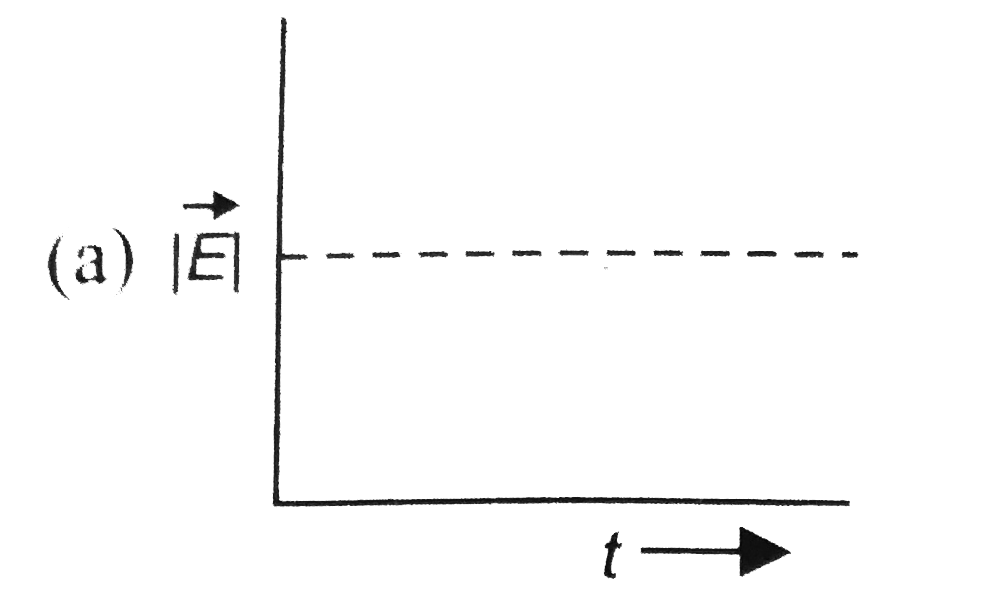
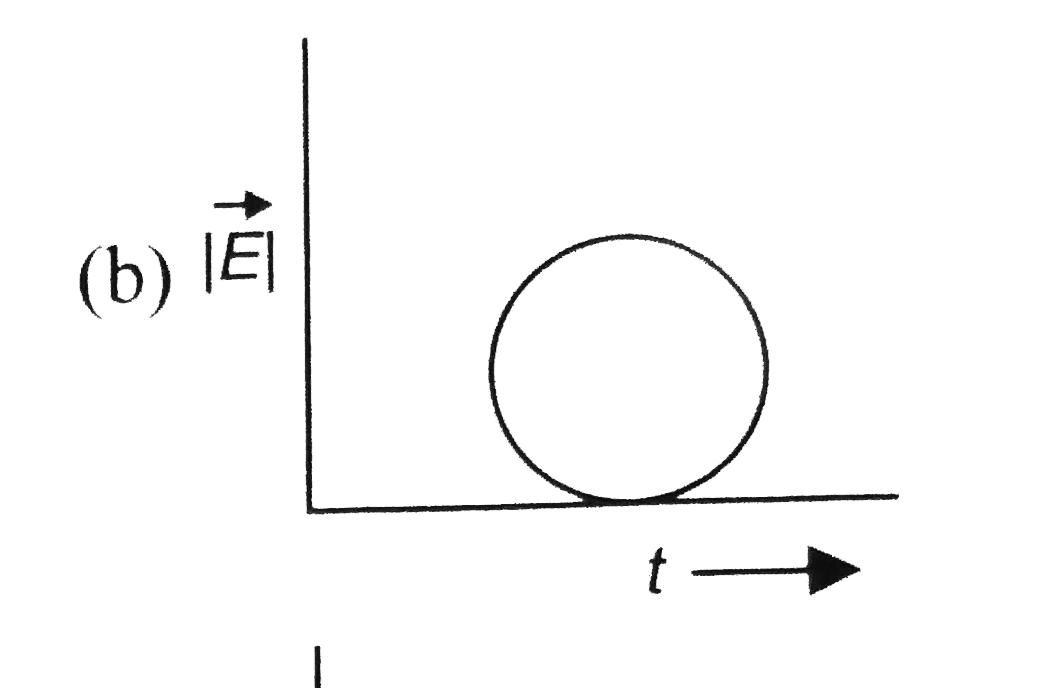
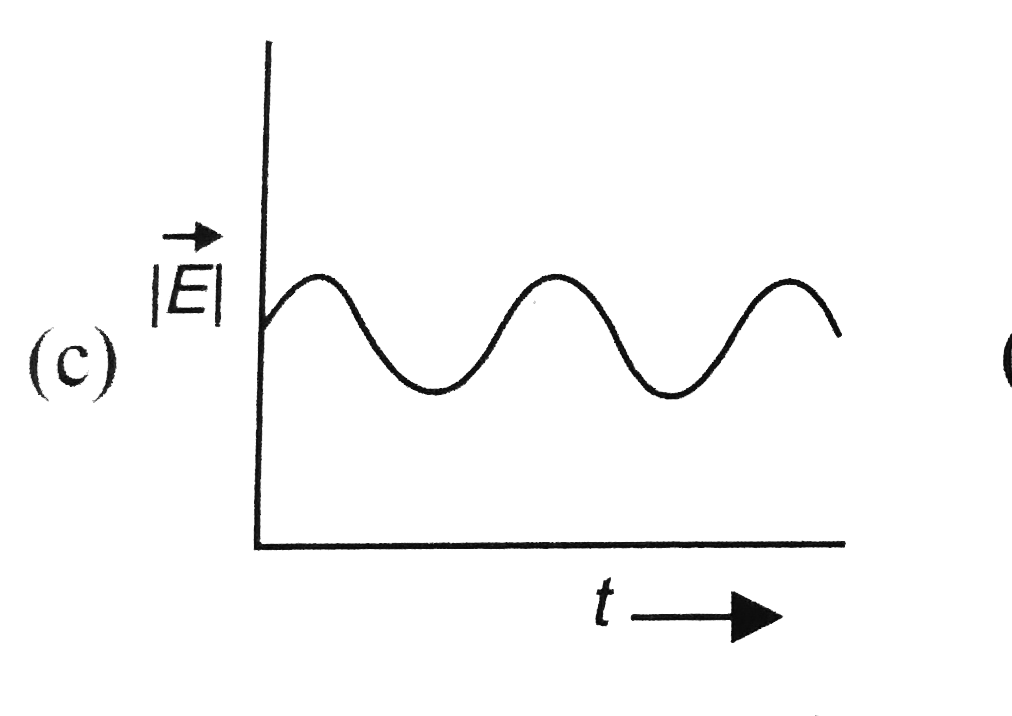
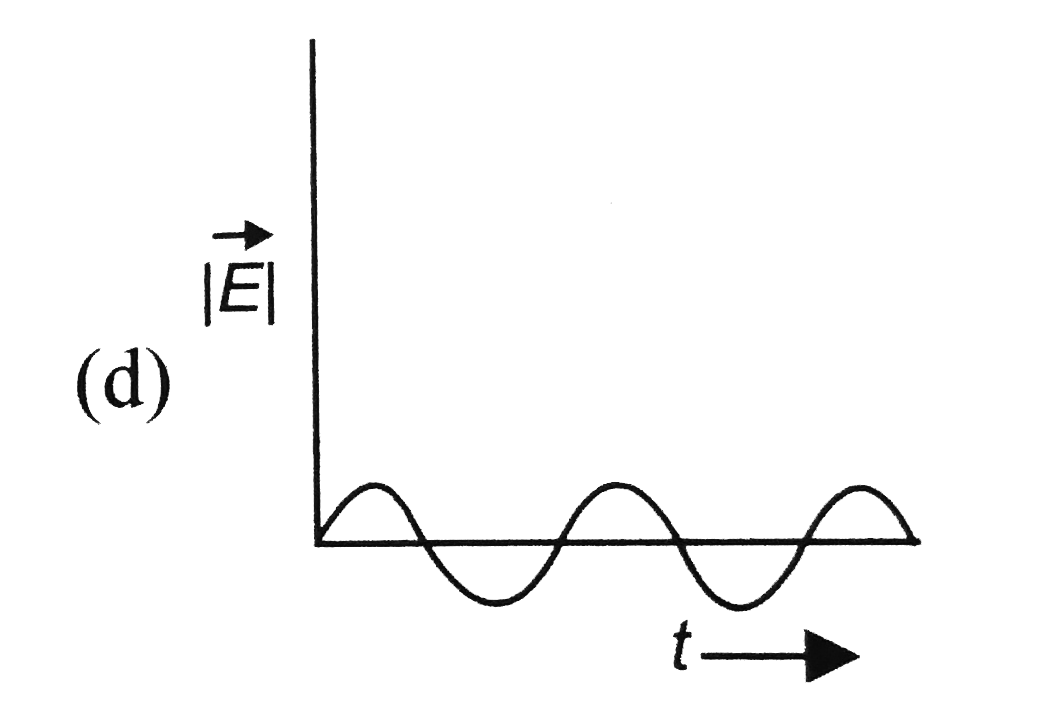
Which of the following diagram represents the variation of electric field vector with time for a circularly polarised light? |
|
Answer»
`E_(x)=E_(0) sin omega t` `E_(y)=E_(0) cos omega t= E_(0) sin (omegat+(pi)/(2))` where `E_(0)` is amplitude. Resultant amplitude `|vec(E )|^(2)=E_(0)+ E_(0) +2E_(0).E_(0) cos. (pi)/(2)` `|vec(E )|=E_(0)SQRT(2)=` constant |
|
| 9. |
Shown in the figure is a system of three particles connected by two springs. The accelerations of A, B and C at any instant are 1 m//sec^(2), 2 m//sec^(2) and 1//2 m//sec^(2) respectively directed as shown in the figure. External force acting on the system is : |
| Answer» ANSWER :C | |
| 10. |
What is the work done by the field of a nucleus in a complete circular orbit of the electron ? What if the orbit is elliptical ? |
| Answer» SOLUTION : As the electric FIELD is a conservative field, hence work DONE for a complete revolution of anelectron in the electric field of nucleus MUST be ZERO whether the orbit is circular or elliptical. | |
| 11. |
A plane tansmission grating 6000 lines per cm is used to obtain a spectrum of light from a sodium lamp in the secondorder.Find the angular separation between two sodium line s whose wavelengths are 5890 Å and 5896 Å ,respectively. |
|
Answer» |
|
| 12. |
The work functions for metals A,B and Care 1.92 eV, 2.0 eV and 5.0 eV respctively. The metals which will emit photoelectrons for a radiation of wavelength 4100Å is // are |
|
Answer» A only E = 3.04 eV Since energy of incident radiation is greater than the work function of metals A and B. So metal A and B will emit photoelectrons. |
|
| 13. |
A current carrying wire LN is bent in the form as shown below. If wire carries a current of 10 A and it is placed in a magnetic field of 5T which acts perpendicular to the paper outwards then it will experience a force |
|
Answer» Zero |
|
| 14. |
The threshold wave length for photo electric emission from a material is 5,200A^(@), photo electrons will be emitted when this material is illuminated with monochromatic radiation from а |
|
Answer» 50 watt infrared LAMP |
|
| 15. |
The sky looks blue due to- |
|
Answer» RED light is absorbed |
|
| 16. |
Let f: Rrarr R be defined by f (x) = 3x AAXepsilonR,then f is- |
|
Answer» One-one |
|
| 17. |
In the above question, the energy sypplied by the battery is |
|
Answer» `3 XX 10^(-4)J` |
|
| 18. |
Write range of wave length of X - rays. |
|
Answer» 0.001 NM to 1 nm |
|
| 19. |
The photon of frequency v has a momentum associated with it. If C is the velocity of light, the momentum is |
|
Answer» `(hv)/(C)` |
|
| 20. |
There are two cavities (Fig.) with small holes of equal diameters d = 1.0 cm and perfectly reflecting outer surfaces. The distance between the holes is l = 10 cm. A constant temperature T_(1) = 1700K is maintained in cavity 1. Calculate the steady-state temperature inside cavity 2. |
|
Answer» Solution :Taking account of cosine low of emission we write for the enegry radiated per second by the hole in cavity `# 1` as `di(OMEGA) = A cos thetad Omega` where `A` is an consatnt, `d Omega` is an element of SOLID angle around some DIRECTION defined by the symbol `Omega`. Integrating over the whole forwed hemisphere we get `I = A underset(0)overset(pi//2)int cos theta2pi sin theta d theta = pi 4`  We find `A` by equating this to the quantity `sigmaT_(1)^(4).(pid^(2))/(4)sigma` is stefan-Boltzman constant and `d` is the diameter of the hole. Then `A = (1)/(4) sigma d^(2)T_(1)^(4)` Now energy reaching `2` form `1` is `(cos theta = 1)` `(1)/(4)sigmad^(2)T_(1)^(4).Delta Omega` where `Delta Omega = ((pid^(2)//4))/(l^(2))`is the solid angle substended by the hole of `2` at `1`. {We are ASSUMING `dlt lt l` so `Delta Omega =` area of hole`//("disatnce")^(2)}`. This must equal `sigmaT_(2)^(4)pid^(2)//4` which is the energy EMITTED by `2`. Thus equating `(1)/(4)sigmad^(2)T_(1)^(4) (pid^(2))/(4l^(2)) = sigmaT_(2)^(4) (pid^(2))/(4)` or `T_(2) = T_(1) sqrt((d)/(2l))` Substituting we get `T_(2) = 0.380kK = 380 K`. |
|
| 21. |
The half life of radium is about 1200 years.if hundred gram of radium is existing now than 25g will remain undecayed after |
|
Answer» 1800 years |
|
| 22. |
Relation between pressure (p) and energy (E) of a gas is |
| Answer» Answer :a | |
| 24. |
A 12.3 eV electron beam is used to bombard gaseous hydrogen at room temperature. Upto which energy level the hydrogen atoms would be excited? Calculate the wavelengths of the second member of Lyman series and second member of Balmer series. |
|
Answer» Solution :The ENERGY of electron in the nth ORBIT of hydrogen atom is `E_n=-13.6/n^2eV` when the incident beam of energy 12.3 eV is absorbed by hydrogen atom. Let the electron jump from n = 1 to n = n level. `E=E_n-E_1` `12.3=-13.6/n^2 -(-13.6/1^2)` `RARR 12.3=13.6[1-1/n^2]` `rArr 12.3/13.6=1-1/n^2` `rArr 0.9=1-1/n^2` `rArr n^2=10 rArr` n=3 That is the hydrogen aton WOULD be excited upto second excited state. For Lyman Series `1/lambda=R[1/n_f^2-1/n_i^2]` `rArr 1/lambda=1.097xx10^7[1/1-1/9]` `rArr 1/lambda=1.097xx10^7xx8/9` `rArr lambda=9/(8xx1.097xx10^7)=1.025xx10^(-7)`=102.5 nm For Balmer Series `1/lambda=1.097xx10^7[1/4-1/16]` `rArr 1/lambda=1.097xx10^7xx3/16` `rArr 1=4.86xx10^(-7)m rArr ` 1= 486 nm |
|
| 25. |
The width of forbidden gap in silicon crystal is 1.1eV. When the crystal is converted into n-type semiconductor, then the distance of fermi energy level from conduction band is |
|
Answer» EQUAL to 0.55eV |
|
| 26. |
In communication, signal is transmitted from a source to a receiverthrough a medium. Different types of media offer different band widths. What do you understand by amplitude modulation? |
| Answer» Solution :In AMPLITUDE MODULATION the amplitude of the CAR rier is VARIED in accordance with the INFORMATION signal. | |
| 27. |
A photoelectric surface is illuminated successively by monochromatic ligth of wavelength lambda and (lambda)/(2). If the maximum kinetic energy of the emitted photoelectrons in the second case is 3 times that in the first case, the work function at the surface of material is........................ |
|
Answer» `(hc)/(lambda)` `3KE_(1) = (2hc)/(lambda) - phi` `KE_(1) = (2hc)/(3 lambda) - (phi)/(3)""…(2)` Equating (1) and (2) `(hc)/(lambda) - phi""= (2hc)/(3 lambda) - (phi)/(3)` `(hc)/(3 lambda) = (2 phi)/(3) RARR phi = (hc)/(2 lambda)` |
|
| 29. |
A charge following through a conductor per time is defined as |
|
Answer» Current |
|
| 30. |
The difference in angular momentum associated with the electron in the two successive orbits of hydrogen atom is: |
|
Answer» `H/pi` |
|
| 31. |
Figure showns. In cross section m three solid cylinders, each of length L and uniform charge Q. Concntric with each cylinder is a cylindrical Gaussion surface, with all three surfaces having the same radius. Rank the Gussion surface according to the electric field at any point on the suface, greatest first. |
| Answer» Answer :d | |
| 32. |
Light propogates x cm distance in a medium of refractive index mu in time t_(0). In the same time t_(0), light propogates a distance of x/6 cm in a medium of refractive index mu. If mu'=kmu find the value of k. |
|
Answer» |
|
| 33. |
Who translated this chapter Yayati? |
|
Answer» C. RAJGOPALACHARI |
|
| 34. |
In a science fiction novel, a starship takes three days to travel between two distant space stations according to its own clocks. Instruments on one of the space stations indicate that the trip took four days. How fast did the starship travel, relative to the space station? |
|
Answer» `1.98xx10^(8)m//s` |
|
| 35. |
Intensity of electromagnetic waves I is given as I = ____________E_(0)^(2)= _____________B_(0)^(2). |
| Answer» Solution :`(1)/(2)in_(0)c E_(0)^(2),(1)/(2)(cB_(0)^(2))/(mu_(0))` | |
| 36. |
A fly ball is hit to the outfield. During its flight (ignore the effects of the air), what happens to its (a) horizontal and (b) vertical components of velocity? What are the (c ) horizontal and (d) vertical components of its acceleration during ascent, during descent, and at the topmost point of its flight? |
| Answer» SOLUTION :(a) `v_(x)` constant, (b) `v_(y)` INITIALLY positive, DECREASES to zero, and then becomes progressively more negative, ( c) `a_(x)=0` throughout, (d) `a_(y)=-G` throughout | |
| 37. |
If a body having a surface area 5 cm^2 and a temperature of 727^@C radiates 300 joule of energy each minute, then emissivity is (sigma = 5.67 10^(-8) W/m^2 sK^4) |
|
Answer» 0.18 |
|
| 38. |
Two plane mirrors are placed parallel to each other and 40 cm apart. An object is placed 10 cm from one mirror. What is the distance from the object to the image for each of the five images that are closest to the object? |
| Answer» SOLUTION :20CM, 60CM, 80CM, 100CM, 140cm | |
| 39. |
The ratio of de-Broglie wavelength associated with a proton and a mu-particle accelerated through the same potential difference 'V' is |
|
Answer» `1:2` |
|
| 40. |
A diatomic molecule is made of two masses m_(1)andm_(2) which are separated by a distance r. If we calculate its rotational energy by applying Bohr's rule of angular momentum quantization, its energy will be given by : |
|
Answer» `((m_(1)+m_(2))N^(2)H^(2))/(2m_(1)m_(2)r^(2))` `because r_(1)=(m_(2)r)/(m_(1)+m_(2))""...(1)` and `r_(2)=(m_(1)r)/(m_(1)+m_(2))""...(2)`  `E=(1)/(2)Iomega^(2)=(1)/(2)(m_(1)r_(1)^(2)+m_(2)r_(2)^(2))omega^(2)""...(3)` `because mvr=(nh)/(2pi)=omegaIimpliesomega=(nh)/(2piI)""...(4)` (put equations (1), (2) and (4) in (3)) we get `E=((m_(1)+m_(2))n^(2)h^(2))/(2m_(1)m_(2)r^(2))` |
|
| 41. |
The Fig. 6.23 shows two identical rectangular loops (1) and (2), placed on a table along with a straight long current carrying conductor between them. What will be the directions of the induced currents in the loops when they are pulled away from the conductor with same velocity v ? (ii) Will the emf induced in the two loops be equal ? Justify your answer. |
|
Answer» Solution :(i) In ACCORDANCE with Lenz.s law induced current flows in an anticlockwise direction in loop number (1), but flows in clockwise direction in loop number (2). Due to current I magnetic field `vecB` developed AROUND loop (1) is perpendicular to the plane of PAPER and pointing outward. On MOVING the loop away the induced emf tends to strengthen the magnetic field and hence induced current flows in anticlockwise direction. Similarly, it can be shown that induced current in loop (2) will flow in clockwise direction. (ii) The magnitude of induced emf in two loops will be different because rate of CHANGE of magnetic flux in them are different. |
|
| 42. |
A particle of mass [1 x 10^(-20)]kg and charge [1.6 x 10^(-19)]C travelling with a velocity of [1.28 x 10^6]m/s in the +X direction enters a region in which a uniform electric field (bar E) and a uniform magnetic field of induction (bar B) are present such that Ex = Ey= 0 and Ez = -102.4 kV/m and Bx = Bz = 0, By 8 x 10² wb/m^2. The particle enters this region at the origin at time t = 0. : What is the resultant force on the particle in the above problem ? |
| Answer» SOLUTION :The two forces acting on charge (force due to elec TRIC field and another force due to magnetic field) are of same MAGNITUDE but OPPOSITE in direction. Hence NET force is zero. | |
| 43. |
The objects in the figure are constructed of uniform wire bent into the shape shown. Find the position of the position of the centre of mass of each shape. |
Answer» Solution :(a) The centre of mass of each wire of length L will lie on its mid-point. Each rod will have same mass (say m) so, the centre of mass (C ) of the system will be at the mid-point of the line-segment joining `C_(1)` and `C_(2)`. Hence OC is the bisector of the ANGLE `theta`.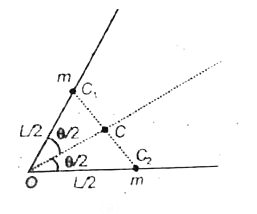 From the figure, clearly, `OC = (L)/(2)cos.(theta)/(2)` (b) Figure (b), shows `C_(1), C_(2)` and `C_(3)` as the positions of the centre of masses of the wires. `C_(4)` is the position of the centre of mass of the two vertical rods. Hence at `C_(4)`, the mass 2m has been supposed to be placed.  Now, `C_(1)C=(2m)/(m+2m)(C_(1)C_(4))=(2)/(3).(L)/(2)=(L)/(3)` (c ) Putting `theta = 90^(@)` in (a) we get the position of c.m. `OC=(L)/(2)cos 45^(@)=(L)/(2sqrt(2))` 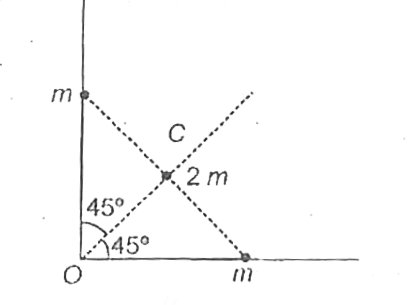 (d) The position of the centre of mass (C ) of the system is given by `C_(1)C=(2m)/(m+2m)(C_(1)C_(4))` `=(2)/(3)((L)/(2)sin 60^(@))` `= (L)/(sqrt(3))` 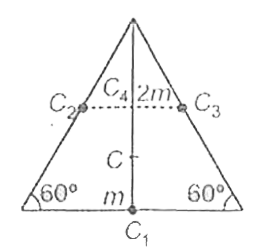
|
|
| 44. |
Two projectiles A and B are thrown from the samepoint with velocities v and v/2 respectively. If B is thrown at an angle 45° with horizontal, what is the inclination of A when their ranges are the same ? |
|
Answer» `sin^(-1)(1/4)` and range of A, `R_(1)=(v^(2)sin2theta)/g` As `R_(1)=R_(2) :. (v^(2)sin2theta)/g=v^(2)/(4)` `sin2theta=1/4implies 2theta=sin^(-1)(1/4)` `theta=1/2in^(-1)(1/4)` |
|
| 45. |
A heavy nucleus P of mass number 240 and binding energy 7.6 MeV per nucleon splits in to two nuclei Q and R of mass numbers 110, 130 and binding energy per nucleon 8.5 MeV and 8.4 MeV, respectively. Calculate the energy released in the fission. |
|
Answer» Solution :As per QUESTION total binding ENERGY of heavy nucleus =`240xx7.6=1824` MeV Total binding energy of nucleus Q =` 110 xx 8.5 = 935` MeV and total binding energy of nucleus R = `130 xx8.4 = 1092` MeV `:.` Total binding energy of splitted nuclei Q and R = 935 + 1092 = 2027 Mev `:.` Energy RELEASED in the fission = 2027 -1824 = 203 MeV |
|
| 46. |
A Proton is projected with a uniform velcoity v long the axis of a current carrying solenoid, then |
|
Answer» the proton will be accelerated ALONGTHE axis |
|
| 47. |
Find the average binding energy per nucleon of ._7N^14 and ._8O^16. Their atomic masses are 14.008 u and 16.000 u. The mass of ._1H^1atom is 1.007825 u and the mass ofneutron is 1.008665 u. Which is more stable? |
|
Answer» Solution :The average binding energy per nucleon `=[[Zm_H+(A-Z)m_n-._zM^A]]/A` The average binding energy per nucleon of `._7N^14` `=([7xx1.007825+7xx1.008665-14.008]uxxc^2)/14` `=[[14.115430-14.008]931.5)/14` MeV `=(0.10743xx931.5)/14` MeV = 7.148 MeV The average binding energy per nucleon of `._8O^16` `=([8xx1.007825+8xx1.008665-16.000]uxxc^2)/A` `=(0.131920xx931.5)/16` MeV= 7.680 MeV `therefore ._8O^16` is more STABLE than `._7N^14` . |
|
| 48. |
Electromagnetic radiation is emitted by accelerating charges. The rate at which the e nergy is emitted from an accelerating charge that has charge q and acceleration a is given by dE/dt = q^(2)a^(2)//6piepsilon_(0)c^(3) , where c is the speed of light. A proton and an electron of kinetic energy 6 Me V is traveling in a particle accelerator in a circular orbit of radius0.75 m. What fraction of its energy does the proton emit per second? |
|
Answer» `2.8 xx 10^(-8) s^(-1)` |
|
| 49. |
An oscillating LC circuit has a current amplitude of 750 mA, a potential amplitude of 250 mV, and a capacitance of 220 muF. What are (a) the period of oscillation, (b) the maximum energy stored in the capacitor, (c) the maximum energy stored in the inductor, (d) the maximum rate at which the current changes, and (e) the maximum rate at which the inductor gains energy? |
|
Answer» |
|
| 50. |
A metal rod has length L, radius of its cross-section r.Youngs modules Y and thermal coefficient of linear expansion is α.It is clamped between two rigid supports with negligible tension.If its tempareture is increased by T^⋅ C,then force exerted by the rod on any of the supports is |
|
Answer» `2π^2YT` |
|