

Saved Bookmarks
This section includes 7 InterviewSolutions, each offering curated multiple-choice questions to sharpen your Current Affairs knowledge and support exam preparation. Choose a topic below to get started.
| 1. |
Explain the force acting on electric dipole when it is placed parallel or anti parallel to electric field. |
Answer» SOLUTION :When `vecp` is PARALLEL to `vecE`or antiparallel to `vecE`. In either case, the net TORQUE is zero, but there is a net force on the dipole if `vecE`is not uniform. 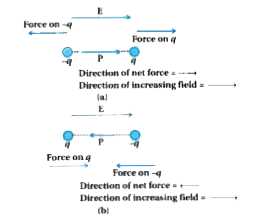 It is easily seen that when `vecp` is parallel to `vecE` , the dipole has a net force in the direction of increasing field. When `vecp` is antiparallel to `vecE`, the net force on the dipole is in the direction of decreasing filed. In general, the force depends on the orientation of `vecP` with respect to `vecE`. |
|
| 2. |
An ammeter and a voltmeer are connected as in figures in order to measure an unknown resistance. Justify quantitatively which connection is to be perfected. |
|
Answer» |
|
| 3. |
How did Newton account for different colours of light? |
| Answer» SOLUTION :NEWTON assumed that DIFFERENT colours are due to different sizes of CORPUSCLES. | |
| 4. |
A ball falls on an inclined plane as shown. The ball is dropped from height h. Coefficient of restitution for collision is e and the surface is frictionless. If h_1, h_2,......h_nare heights of projectile from inclined and t_1, t_2,....t_nare their corresponding time of flights, then choose the correct options. |
|
Answer» `t_1, t_2, ……t_n` FORM a geometric progression of COMMON ratio e `u_(x_1) = u sin theta & u_(y_1) = e u sin theta` As between two successive collision, Sy = 0 `implies `(v_y = u_y) "" implies u_(y_2) = e^2u cos theta` `u_(y_3) = e^3 u cos theta.... and so on. `implies t_(n) = (2 e^n u cos theta)/(g cos theta) = e^n (2u)/g`..... common ratio = e `& ""h_(n) = ((u_(yn))^(2))/(2a_y) = (e^(2n) u^2 cos theta)/(2 g) implies common ratio = e^2`. 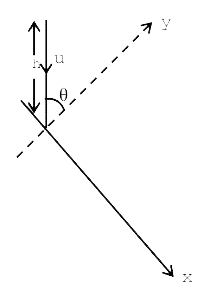
|
|
| 5. |
One mole of ideal gas undergoes a cyclic process ACBA as shown in figure. Process AC is adiabatic. The temperatures at 1, B and C are 300 K,600 K and 450 K respectively. Choose the correct statement. |
|
Answer» In process CA, change in internal energy is 225 R. ` = 1 XX 3/2 R xx (450 - 300) = 225 R` ` Delta U_(BA) = nC_(V) (T_(A) - T_(B)) = 1 xx 3/2 R xx (300 - 600) = - 450 R` ` Delta U_(CB) = nC_(V) (T_(B) - T_(C)) = 1 xx 3/2 R xx (600 - 450) = + 225 R` ` Delta U_(ABCA) = Delta U_(CA) + Delta U_(AB) + Delta U_(BC) = 0 ` |
|
| 6. |
An alpha -particle after passing through a potential difference of V volts collides with a nucleus . If the atomic number of the nucleus is Z then the distance of closest approach of alpha– particle to the nucleus will be |
|
Answer» `14.4(Z)/(V)Å` |
|
| 7. |
A sound wave is travelling along x-direction with a velocity of 300 m/s and has a frequency of 400 Hz . If its amplitude is 2cm, its equation is |
|
Answer» `y = 0.02 sin8pi (300T -X)m` |
|
| 8. |
In transmission through the layers of ionosphere, if the frequency of radio wave increases, how does the refractive index of the layers change? |
|
Answer» |
|
| 9. |
Two infinite plane sheets of charge A and B of positive charge have surface charge densities Ksigma and sigma, respectively. A metallic ball of mass m and charge +q is attached to a thread and the thread is tied at point P on sheet A. Initially ball is equilibrium at plate P when sheets are uncharged. Find the correct options (K is a constant.) |
|
Answer» If `Kgt1, ANGLE THETA = tan^(-1)(Ksigmag)/(2epsilon_0mg)`. If `Klt1`, force due to charge on plate `B` will be greater than the force due to charge on plate `A`, and so ball will remain in CONTACT with plate `A`. It is alos true for `K=1`. `T cos theta=mg` `T SINTHETA=((K-1)sigmaq)/(2epsilon_(0))` Dividing EQUATION (i) and (ii), we get `theta=tan^(-1)[((K-1)sigmaq)/(2epsilon_(0)mg)]` for `Kgt1` 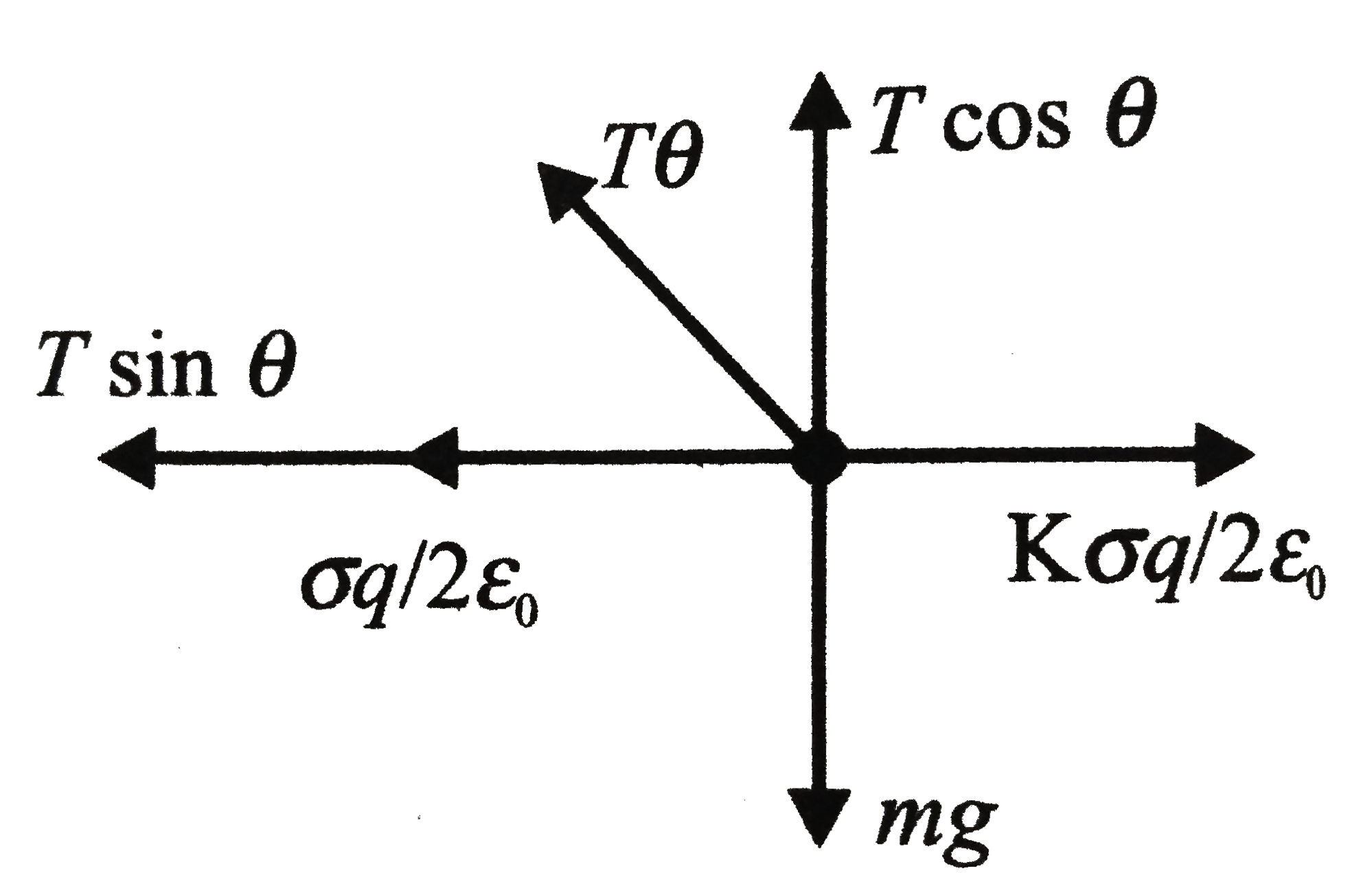
|
|
| 10. |
A stone of mass 2.0 kg is tied to the end of a string of m length. It is whirled in a horizontal circle. If the breaking tension of the string is 400 N, calculate the maximum velocity of the stone. |
|
Answer» SOLUTION :`m=2.0 kg, r =2m`, TENSION = 400 N. When the tension in the STRING reaches the breaking tension, the velocity of the body becomes MAXIMUM. Let the maximum velocity be v. Tension = centripetal FORCE `400=(mv^(2))/(r ) rArr 400=(2xx v^(2))/(2)` `v^(2)=400 , v=20 ms^(-1)`. |
|
| 11. |
The magnetic field in aplane electromagnetic wave is given by B = 2 xx 10A^(-7) sin (0.5 xx I0^(3)xx+I.5 xx 10^(11)t)T. (a) What is the wavelength and frequency o f the wave ? (b) Write an expression fo r the electric field. |
|
Answer» Solution : (a) Comparing the given equation with`B_(y)=B_(0)SIN[2pi[((X)/(lambda)+(t)/(T))]` we get `lambda=(2pi)/(0.5xx10^(3))m = 1.26cm` and `(1)/(T)=v=(1.5xx10^(11)//2pi)=23.9 GHz` (B) `E_(0) = B_(0)c = 2xx10^(-7) -7 T XX 3 xx 10^(8) m //s = 6 xx 10^(1) V //m` The electric field component is perpendicular to the direction of propagation and the direction of magnetic field. Therefore, the electric field component along the z- axis is obtained as `E_(z) = 60sin(0.5xx 10^(3) xx +1.5xx10^(11) t)V//m` |
|
| 12. |
A series LCR a.c. circuit has L = 2.0 H, C = 32 μF and R = 10 Omega. (a) At what angular frequency of a.c. will it resonate ? (b) Calculate the Q value of the circuit. |
|
Answer» Solution :Here L = 2.0 H, C = 32 μF =`32xx10^(-6)F`, and R=10`OMEGA` (a) `therefore` RESONANT angular frequency `omega_(r)=1/(SQRT(LC))=1/(Sqrt(LC))=1/(sqrt(2.0xx32xx10^(-6)))=125rads^(-1)` (b) The Q-value of the circuit=`(Lomega_(r))/R=(2.0xx125)/10=25` |
|
| 13. |
What is intensity of magnetisation . |
| Answer» Solution :It is GIVEN by `I = mu/V` , where `mu` is the magnetic MOMENT and V is volume SPECIMEN. | |
| 14. |
A convex lens of focal length 0.5m in air has a refractive index of 1.5.What will be its focal length when immersed in water of refractive index 1.33 ? |
|
Answer» Solution :`(1)/(f) = ( N -1) ((1)/( R_(1)) +( 1)/( R_(2)))` For air `(1)/(0.5) = ( 1.5 -1) ((1)/( R_(1)) + (1)/( R_(2)))`....(i) For WATER `(1)/( f_(W)) = ((n_(g)) /(n_(w)) - 1)((1)/( R_(1)) + (1)/(R_(2)))` `(1)/(f_(w)) = ((1.5)/(1.33)-1) ((1)/(R_(1)) +(1)/(R_(2)))`....(2) DIVIDING equation(1) by (2) `f_(w) = 1.956m` |
|
| 15. |
The intensity of magnetization of a bar magnet is 5.0 xx 10^(4) A m^(-1) The magnetic length and the area of cross-section of the magnet are 12 cm and 1 cm^(2) respectively. The magnitude of magnetic moment of this bar magnet is (in SI unit) |
|
Answer» 0.6 `I = 5.0 XX 10^(4)Am^(-1)` Magneetic length, `L = 12 cm = 12 xx 10^(-2)m` Area of magnetisation, `I = "Magnetic moment (M)"/"Volume (V)"` or M = IV = IAL `=(5.0 xx 10^(4)A m^(-1)) (1xx 10^(-4) m^(2))(12 xx 10^(-2)m)` `= 60 xx 10^(-2)A m^(-2) = 0.6A m^(2)` |
|
| 16. |
Potential difference between centre & the surface of sphere of radius R and uniform volume charge density rho within it will be : |
|
Answer» `(RHOR^(2))/(6 in_(0))` |
|
| 17. |
The shape of the interference fringes in Young's double - slit experiment when D (distance between slit and screen) is very large as compared to fringe width is nearly |
| Answer» Solution :straight line. | |
| 18. |
Figure show a conducting loop ADCA carrying current I and placed in a region of uniform magnetic field B_(0). The part ADC forms a semicircle of radius R. The magnitude of force on the semicircle part of the loop is equal to |
|
Answer» `piRiB_(0)` |
|
| 19. |
Draw a graph showing the variation of binding energy per nucleon with mass number of different nuclei. State two inferences from this graph. |
Answer» Solution :The graph is shown in the Two important inferences from this graph are : (i) Nuclei in mass number range 30 - 170 are highly stable. (ii) Nuclei of ELEMENTS either having very small (A < 20) or very large (A > 208) value of mass number are unstable because their BINDING ENERGY per nucleon is small. |
|
| 20. |
The position x of a particle varies with time (t) as x=at^2 - bt^3 . The acceleration at time t of the particle will be equal of zero. When is equal to |
|
Answer» `2a/3b` |
|
| 21. |
Fraunhoffer diffraction experiment at a single slit using light of wavelength 400 mm, the first minima is formed at an angle of 30^(@). Then the direction theta of the first secondary maximum is given by : |
|
Answer» `tan^(-1)(3/4)` `d = (400 xx 10^(-9))/(sin 30^(@)) = (400 xx 10^(-9))/(1/2)= 8 xx 10^(-7) m` Again `d sin theta = (3 lambda)/(2)` i.e. `sin theta = (3lambda)/(2a) = (3 xx 4 xx 10^(-7))/(2 xx 8 xx 10^(-7)) = 3/4` i.e.`theta= sin^(-1)3/4` |
|
| 22. |
What is AC ? |
| Answer» Solution :An AC is that current WHOSE MAGNITUDE continuously CHANGE and direction is PERIODICALLY reversed. | |
| 23. |
Give four properties of electric lines of force. Or. Give important properties of electric lines of forces. |
|
Answer» SOLUTION :Properties of electric lines of force. (i) the lines of electric force start from a POSITIVE charge and end on a negative charge. (ii) The lines of force touch the surface on the conductor, where they either start from one end always at RIGHT angle. (iii) The lines of force never cut each other. if two lines of force intersect at a point, it will mean two directions of electric instensity at that point which is evidently not possible. (iv) The lines of force contract LENGTHWISE. this explain attraction between opposite CHARGES. (v) Two lines of force mutually repel each other when they proceed in the same direction i.e. they exert a lateral repulsion. this explains the repulsion between similar charges. (vi) The density or relative closeness is an indication of relative strength of field in various regions. |
|
| 24. |
(A) : In electromagnetic waves electric field and magnetic field lines are perpendicular to each other.(R) : Electric field and magnetic field are self sustaining. |
|
Answer» Both 'A' and 'R' are TRUE and 'R' is the CORRECT explanation of 'A'. |
|
| 25. |
A car moving with constant acceleration covers the distance between two points 180 m apart in 6 sec.Its speed as it passes the second point is 45 m/s.What is its acceleration and its speed at the first point |
|
Answer» `-5 m//s^(2),`15 m/s |
|
| 26. |
(a) Show that the de-Broglie wavelength lamda of electrons of kinetic energy K is given by the relation lamda=(h)/(sqrt(2mK)) (b) Calculate the de-Broglie wavelength of an electron beam accelerated through a potential difference of 60 V. |
|
Answer» <P> Solution :(a) We know that de-Broglie wavelength of an electron `lamda=(H)/(P)`If K be the kinetic energy and m the mass of electron, then `p=sqrt(2mK)`, and HENCE relation for de-Broglie wavelength becomes: `lamda=(h)/(sqrt(2mK))` (b) Here V=60V and we know that for electron `e=1.6xx10^(-19)C, m=9.11xx10^(-31)kg and h=6.63xx10^(-34)Js` `therefore`de-Broglie wavelength `lamda=(h)/(sqrt(2meV))=(6.63xx10^(-34))/(sqrt(2xx9.11xx10^(-31)xx1.6xx10^(-19)xx60))m` `=1.586xx10^(-10)m or 1.586Å`. |
|
| 27. |
Menton the physical significance of Lenz's law with an example? |
| Answer» Solution :The direction of the INDUCED emf is given by the lenz.s law. For example, when the north POLE of a magnet is moved towards a coil, the induced current in the coil will be such that the face of the coil facing the magnet acquires north polarity, in order to oppose the motion of the magnet. So mechanical energy has to be supplied TOMOVE the magnet towards the coil. this mechanical energy is converted into electrical energy. THUS Lenz.s law tells us the CONSERVATION of energy in electromagnetic induction. | |
| 28. |
In a series RL circuit, the resitance and inductive reactane are the same. Then the phase difference between the voltage and current in the circuit is |
|
Answer» `pi/4` |
|
| 29. |
Obtain the formula for the effective capacitance of the series combination of different n capacitors. |
Answer» Solution :Figure shows n CAPACITORS of capacitance `C_(1) , C_(2), C_(3) cdots, C_(n)` are arranged in series. 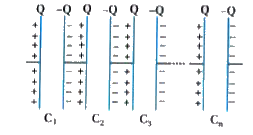 The characteristics of series combination sudthat the charges on two plates are the same each capacitor and potential difference of eacl capacitor is DIFFERENT . Suppose the potential difference `V_(1), V_(2),cdots, V_(1)` of capacitor of capacitance `C_(1), C_(2),cdots, C_(1)` respectively . The total potential difference of SERIE combination, `V= V_(1)+V_(2)+V_(3)+cdotsV_(n)` `:. V=(Q)/(C_(1))+(Q)/(C_(2))+(Q)/(C_(3))+ cdots (Q)/(C_(n))` `:. (V)/(Q)=(1)/(Q)+(1)/(C_(2))+(1)/(C_(3))+cdots (1)/(C_(n))` If charge Q and potential difference V are of the combination then effective capacitance of a series combination of n capacitors, `(1)/(C) = (1)/(C_(1))+(1)/(C_(2))+(1)/(C_(3))+cdots (1)/(C_(n))` Hence the value of effective capacitance is even smaller than the smallest value of the capacitors which are CONNECTED series combination . The reciprocal of the effective capacitance of capacitors coMected in series is the sum of the reciprocals of the individual capacitances. |
|
| 30. |
Given the resistances of 1Omega , 2Omega , 3Omegahow will we combine them to get an equivalent resistance of (i) (11/3) Omega, (ii) (11/5) Omega, (iii) 6 Omega , (iv) (6/11) Omega? |
|
Answer» Solution : (i) By connecting PARALLEL combination of `2Omega`and `1 Omega`in SERIES with 3 `Omega ` we have Total resistance ` = 3 + (1)/(1/1 + 1/2) = 11/3 Omega` (ii) By connecting parallel combination of 2 `Omega ` and 3 `Omega`in series with 1 `Omega`, we have Total resistance = `1 + (1)/( (1/2 + 1/3)) = 11/5 Omega` (III) By connecting all the three resistances in series Total resistance `= 1 + 2 + 3 = 6.Omega` (iv) By connecting all resistances in parallel Total resistance ` = (1)/(1/2 + 1/2 + 1/3) = 6/11 Omega` |
|
| 31. |
Which of the following are not electromagnetic waves? |
|
Answer» Ultraviolet RAYS |
|
| 32. |
(a) Draw a schematic sketch of a cyclotron. Explain clearly the role of crossed electric and magnetic field in accelerating the charge. Hence , derive the expression for the kinetic energy aquired by the particles. (b) An alpha- particle and proton are released from the center of the cyclotron and made to accelerate. (i) Can both be accelerated at the same cyclotron frequency? Give resons to justify your answer. (ii)when they are accelerated in turn, which of the two will have higher velocity at the exit slit of the dees? |
|
Answer» Solution :(a) Labelled diagram of cyclotron is shown in Fig. (b) Principle : (i)A Positively changed ion can be accelerated to a high energy with help of smaller values of OSCILLATING electric field by making it to cross the same electric filed time and again . (ii)A charged ion moving perpendicular to a magnetic field describes a circular path. Working: The ion produced at P is accelerated towards the DEE `(D_1`say) which is at a negative potential at that instant. Inside dee `D_1`the ion describes a semi-circular path with a constant speed (say `v`)such that radius of circular path is given by `r = (mv)/(Bq)` and time taken by the ion to describe a semi - circular path `t = (pi r)/(v) = (pi m)/(Bq) ` = a constant. According to cyclotron condition if during this time t the direction of oscillating electric field just gets reversed, the ion will be further accelerated towards dee `D_2` and describe a bigger semi-circular path inside `D_2` and so on. If v be the frequency of oscillating electric field, then `t = (pi m)/(B Q) = 1/(2V) "or" v = (Bq)/(2 pi m)` This frequency of oscillating electric field is COMMONLY referred as the cyclotron frequency. From the expression it is clear that the cyclotron frequency depends on magnetic field B as well as the charge and mass of ion beam to be accelerated. However, the cyclotron frequency is independent of hte speed of the charged particle or radius of semi-circular path described by them. When the radius of circular path of ion becomes almost equal to the radius of dees, it is taken out through an exit port. If R = maximum radius of ion path then maximum energy acquired by the ion `K_("max") = 1/2 mv_("max")^(2) = 1/2 m ((BqR)/(m))^(2) = (B^2 q^2 R^2)/(2m)`. (b) (i) As cyclotron frequency depends on both charge and mass of ion to be accelerated, it is obvious that an a-particle and a proton cannot be accelerated at the same cyclotron frequency. (ii) As `r = (mv)/(qB)` Hence, at the exit slit of hte dees of a cyclotron `v = (qBR)/(m)` As `(q/m)_("proton") > (q/m)_(alpha - "particle")` , the proton will have higher velocity thant alpha particle. 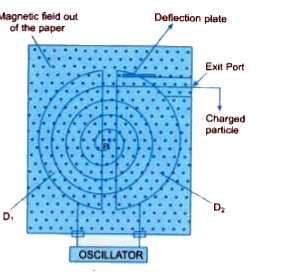
|
|
| 33. |
There are two circular coils P and Q placed coaxially at a distance x from each other. Radius of P is a, and that of Q is b and a gt gt b. Current I is established in P for some time. Find the charge that flows through Q in this time interval. |
|
Answer» Solution :Magnetic field due to the coil P at a distance x from its centre on its axis is given by the following relation: `B=(mu_(0)Ia^(2))/(2(a^(2)+x^(2))^(3 // 2))` Since coils are coaxial hence magnetic field is perpendicular to the plane of coil Q. Coil Q is very small, hence, we can assume field to be the same everywhere on the plane of coil Q Magnetic flux linked with the coil Q can be written as follows: `phi=B(PIB^(2))=(mu_(0)Ia^(2))/(2(a^(2)+x^(2))^(3 // 2))(pib^(2))` `phi=(mu_(0)piIa^(2)b^(2))/(2(a^(2)+x^(2))^(3 // 2))` Let current is turned off in time interval `Deltat` then final flux becomes zero and hence change in flux is same as initial flux. `DELTAPHI=(mu_(0)piIa^(2)b^(2))/(2(a^(2)+x^(2))^(3 // 2))` ...(i) Average emf induced in the coil Q. `EPSILON=(Deltaphi)/(Deltat)` Average current through the coil Q can be written as follows: `i=(epsilon)/(R)=(1)/(R)(Deltaphi)/(Deltat)` hence, charge flow through the coil Q can be written as follows: `Deltaq=iDeltat=(Deltaphi)/(R)` Substituting AP from equation (i) we get charge flow through the coil Q as follows: `Deltaq=(mu_(0)piIa^(2)b^(2))/(2R(a^(2)+x^(2))^(3 // 2))` |
|
| 34. |
In the given question let the charge be released from rest at point B . What will be its kinetic energy when it crosses point A ? |
|
Answer» SOLUTION :ANSWER ( 100 J) Decreases in P.E `= U_(B)-U_(A)= 100` J `:. ` Increases in KE =KE at A = 100 A |
|
| 35. |
A narrow sound pulse ( for example, a short pip by a whistle ) is sent across a medium. (a) Does the puslehave a definite (I) frequency , (ii) wavelength, (iii) speed of propagation ?(b) If the pulse rate is 1 afterevery 20s ( that is the whistle blown for a split of second after every 20s) , is the frequency of the noteproduced by the whistle equal to 1// 20 or 0.05 H z ? |
|
Answer» Solution :(a) A short PIP bya whistle has neither a definite WAVELENGTH nor a definite frequency. However its speed of propagation is fixed, being equal to speed of sound in air. (b) No, frequency of the NOTE produced by whistle is not `1// 20 =0.05Hz`. Rather0.05 Hz is the frequencyof repetition of the short pipe of the whistle. |
|
| 36. |
Dimensional formulae are used A) to convert one system of units into another B) to find proportionality constants C) to check the correctness of an equation |
|
Answer» Onily A & B are TRUE |
|
| 37. |
An emf induced in a secondary coil is 20000V when the current breaks in the primary. The mutual inductance is 5H and the current reaches to zero in 10^(-4) S in primary. Calculate the maximum current in the primary before the break. |
|
Answer» 1A |
|
| 38. |
When an electric dipole of moment | vec(p) | = q xx 2a is held at an angle theta, with the direction of uniform externalelectricfield vec(E), a torquetau = pE sin theta acts on the dipole. This torquetries to align the electric dipole in the direction of the field. Whenvec(p) is alongvec(E), theta^(@) , tau= pE sin 0^(@) = zero. The dipole is in stabel equilibrium. The energy possessed by the dipoleby virtue of its particular position in the electric field is called potential energy of dipole. U = W = -pE (cos theta_(2) - cos theta_(1)) theta_(1) = 90^(@) is the position of zero potential energy. :. U = W = -pE (cos theta - cos 90^(@)) = -pE cos theta.For stable equillibrium, theta0^(@), :. U = -pE = minimum. Read the abovepassageand answer the followingquestions : (i) What is the directionof torqueacting on electric dipoleheld at an angle with uniform external electric field ? (ii) An electricdipole of length10cmhavingcharges +- 6xx10^(-3) C,placed at 30^(@) with respect to a uniform electric field experiences a torque of magnitude 6 sqrt(3) N-m. Calculate. (a) magnitude of electric field. (b) potential energy of dipole. (iii) What is the physicalsignificance of this concept in our day to day life ? |
|
Answer» Solution :(i) `tau = PE sin theta` can berewritten in vector form as : `vec(tau) = vec(p) xx vec(E)` Therefore, the directionof torque `vec(tau)`is PERPENDICULAR to both `vec(p) andvec(E)`. It is determined by RIGHT handed screwrule. (ii) Here, `2a = 10 cm = 10^(-1)m, q = +- 6xx10^(-3) C, theta = 30^(@) tau = 6 sqrt(3) N-m = ?, U = ?` From `tau = pF sin theta = q (2a) E sintheta` `6 sqrt(3) = 6xx10^(-3) (10^(-1)) E sin 30^(@) = 6xx10^(-4) E xx (1)/(2) = 3xx10^(-4) E` `E = (6 sqrt(3))/(3xx10^(-4)) = 2 sqrt(3) xx10^(4) NC^(-1)` `U =-pE cos theta = -q (2a) E cos theta = -6xx10^(-3) (10^(-1)) (2 sqrt(3) xx10^(4)) cos 30^(@)` `= -6xx10^(-4)xx2 sqrt(3) xx10^(4) xx (sqrt(3))/(2) = -18J` (iii) From teh given paragraph, we find that electricdipole held in an externalfield will be in stable equilibrium only when it is aligned along the field and it possessesminimum potentialenergy. The sameis true in day to day life. At your work place, your boss tries always to align you along his/her plan. Your job/position is secured/stable after you are perfectly alignedand your persnal whims are at lowest ebb. |
|
| 39. |
A magnetic needle is placed in a uniform magnetic field and is aligned with the field. The needle is now rotated by an angle of 60^(@) and the work done is W. The torque on the magnetic needle at this position is |
|
Answer» `2sqrt3W` where M is the magnetic moment of the magnetic needle. Here, `theta_(1) = 0^(@),theta_(2) = theta = 60^(@)` `therefore W = MB(cos0^(@) - cos60^(@))` `W = MB (1-1/2)=(MB)/2` .....(i) Torque on the needle is `vectau=vecM XX VECB` In magnitude, `tau = MBsintheta` `tau = MB SIN 60^(@) = sqrt3/2MB` .....(ii) Dividing (ii) by (i), we get `tau/W = sqrt3/2 MB xx 2/(MB) = sqrt3 or tau = sqrt3W` |
|
| 40. |
A semi circular current loop is placed in an uniform magnetic field of 1 tesla as shown. If the radius of loop is 1 m, the magnetic force on the loop is |
|
Answer» 4N |
|
| 41. |
The dimensions of the magnetic field B are |
|
Answer» `M L T^(-2) A^(-1)` |
|
| 42. |
The electrical conductivity of a semiconductor .increases when electromagnetic radiation of wavelength shorter than 2500 nm is incident on it. What is the hand gap energy in eV for the semiconductor ? [h=6.63xx10^-34J-s] |
|
Answer» `0.9eV` |
|
| 43. |
The block of mass m_(1) and m_(2) are connected with a spring of netural length l and spring constant k. The systeam is lying on a smoth horizontal surface. Initially spring is compressed by x_(0) as shown in figure. Show that the two blocks will perform SHM about their equilibrium position. Also (a) find the time period, (b) find amplitude of each block and (c) length of spring as a funcation of time. |
Answer» SOLUTION :(a) Hence both the blocks willbe in equilibrium at the same time when spring is in its natural length. Let `EP_(1)` and `EP_(2)` be equilibrium positions of block `A` and `B` as shown in figure. 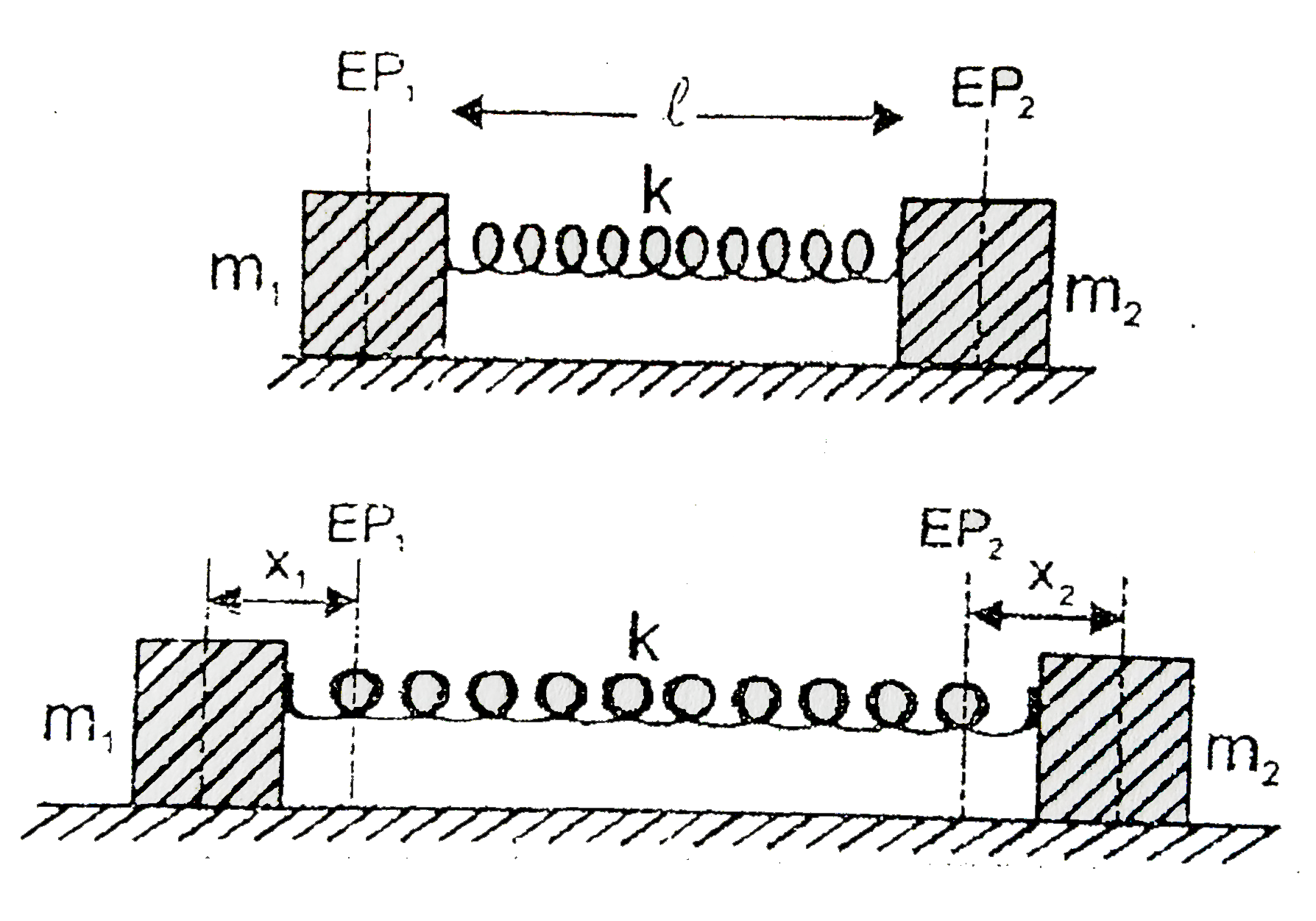 Let at any time during oscillations, blocks are at a DISTANCE of `x_(1)` and `x_(2)` from their equilibrium positions. As no external force is acting on the spring on the spring block systeam `:. (m_(1) + m_(2))Deltax_(cm) = m_(1)x_(1) - m_(2) x_(2) = 0` or`m_(1)x_(1) - m_(2) x_(2)` for `1st` particle, force equation can be written as `k(x_(1) + x_(2)) = -m_(1)(d^(2)x_(1))/(dt^(2))` or `k(x_(1) + (m_(1))/(m_(2))x_(1)) = - m_(1)a_(1)` or, `a_(1) = -(k(m_(1) + m_(2)))/(m_(1)m_(2))x_(1) :. omega^(2) = (k(m_(1) + m_(2)))/(m_(1)m_(2))` Hence, `T = 2pisqrt((m_(1)m_(2))/(k(m_(1) + m_(2)))) = 2psqrt((mu)/(K))` where `mu = '(m_(1)m_(2))/((m_(1) + m_(2))` which is known as reduced MASS Ans (a) Similarly time PERIOD of `2`nd particle can be found. Both will be having the same time period. (b) Let the amplitude of blocks be `A_(1)` and `A_(2)`. `m_(1)A_(1) = m_(2)A_(2)` By energy conservation, `(1)/(2)k(A_(1) + A_(2))^(2) = (1)/(2) kx_(0)^(2)` or, `A_(1) + A_(2) = x_(0)` or, `A_(1) + A_(2) = x_(0)` or, `A_(1) + (m_(1))/(m_(2))A_(1) = x_(0)` or, `A_(1) = (m_(2)x_(0))/(m_(1) + m_(2))` similarly, `A_(2) = (m_(1)x_(0))/(m_(1) + m_(2))` (c) Consider equilibrium position of `1`st particle as origin, i.e. `x = 0`. `x` co-ordinate of particles can be written as `x_(1) A_(1)cosomegat` and `x_(2) = l - A_(2)cosomegat` length `= x_(2) - x_(1)` `= l - (A_(1) + A_(2))cosomegat` 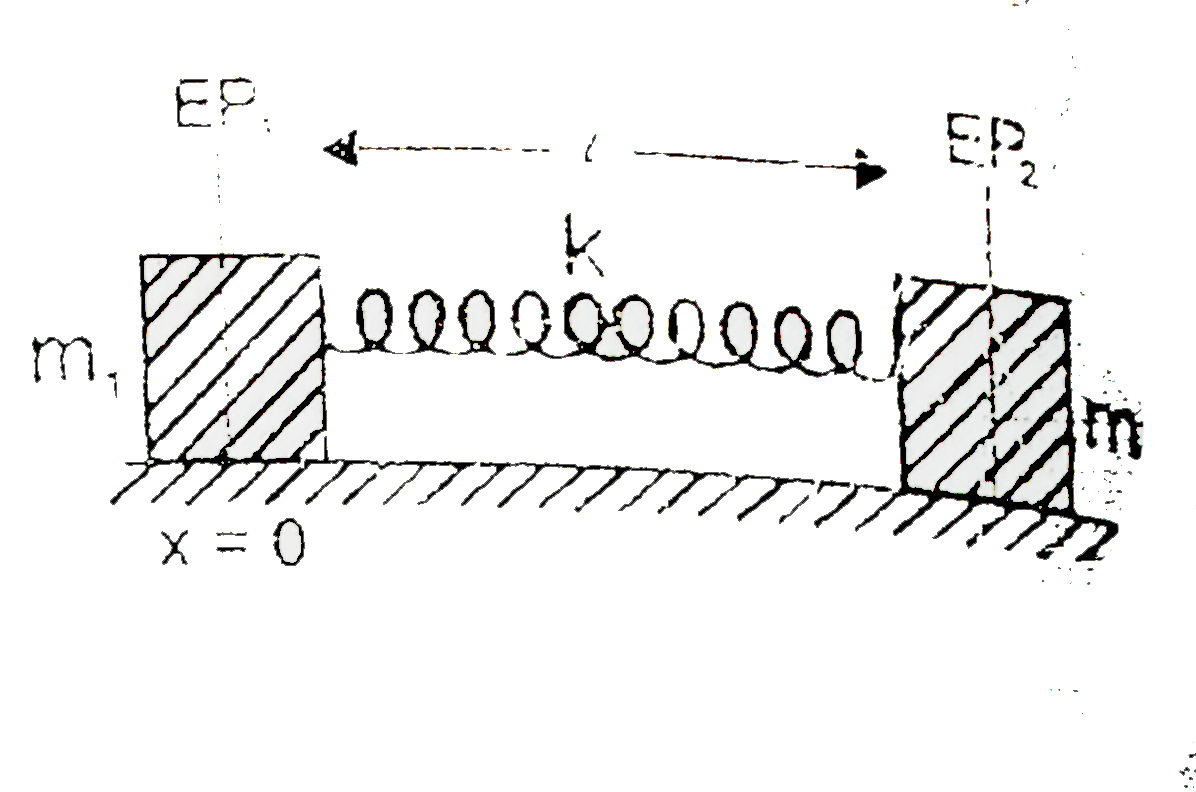
|
|
| 44. |
A long wire carries a steady current. It bent into a circle of one turn and magnetic field at the centre of the coil is B. It is then bent into a circular loop of n turns. The magnetic field at the centre of the coil will be : |
| Answer» ANSWER :A | |
| 45. |
A metal surface ejects electrons when hit by green but more when hit by yellow light. The electrons will be ejected when the surface is hit by |
|
Answer» BLUE light |
|
| 46. |
A radioactive sample S_1 having the activity A_1, has twice the number of nuclei as another sample S_2 of activity A_2." If "A_2= 2A_1, then the ratio of half-life of S_1 to the half-life of S_2 is : |
|
Answer» 4 where `T_(1//2)` is the half-life of a radiactive SAMPLE. `A_(i)/A_(2)=(N_(1))/T_(1) xx T_(2)/N_(2)` `T_(1)/_(2)=A_(2)/A_(1) xx N_(1)/N_(2)` `=(2A_(1))/(A_(1)) xx (2N_(2))/(N_(2))=4/1` |
|
| 47. |
What do you know about GPS? Write a few applications of GPS. |
|
Answer» Solution :GPS stands for Global Positioning System. It is a global navigation satellite system that offers geolocation and time information to a GPS receiver anywhere on or near the Earth. GPS system works with the assistance of a satellite network. Each of these satellites broadcasts a precise signal like an ordinary radio signal. These signals that convey the location data are received by a low-cost aerial which is then translated by the GPS SOFTWARE. The software is able to recognize the satellite, its location, and the time taken by the signals to travel from each satellite The software then processes the data it accepts from each satellite to ESTIMATE the location of the receiver Applications Global positioning system is highly useful many fields such as fleet vehicle management (for tracking cars, trucks and buses), wildlife management (for counting of wild animals) and engineering (for making TUNNELS, bridges etc). |
|
| 48. |
State the conditions which must be satisfied for two light sources to be coherent. |
|
Answer» SOLUTION :(i) Two sources must EMIT light of same wavefront (or frequency). (II) ORIGINATING phase difference between two light sources must be EITHER zero or having a constant value, which should not change with time. |
|
| 49. |
The spectral line emitted by a star, known to have a wavelength of 6500 Å, when observed in the laboratory appears to have a wavelength 6525 Å. What is thespped of the star in the line of light relative to the earth fro receding or approaching? |
|
Answer» `1.154 xx 10^(6) ms^(-1)` receding `Delta lambda = lambda - lambda. = 6525 - 6500` ` = 25 Å(+ ve)` Doppler.s shift `Delta lambda = -(v)/(C) lambda` `therefore v = -(Delta lambda)/(lambda) c = - (25)/(6500) xx 3 xx 10^(8)` ` = -1.154 xx 10^(6) ms^(-1)` `-ve` sign indicates that STAR is receding from the earth. |
|
| 50. |
A cylinder of fixed capacity 67 .2 litres contains helium gas at STP. Th~ amount of heat needed to rise the temperature of the gas in the cylinder by 20 °C is (R = 8.31 Jmol^(-1)K^(-1)) |
|
Answer» 748 J |
|