Saved Bookmarks
This section includes 7 InterviewSolutions, each offering curated multiple-choice questions to sharpen your Current Affairs knowledge and support exam preparation. Choose a topic below to get started.
| 1. |
Assertion (A) :Electric field lines can never cross other . Reason ® :Electric fields due to a number of point charges at a given point superimpose and give one resultant electric field. |
|
Answer» |
|
| 2. |
The diameter of a stretched string is increased 3%, keeping the other parameters constant then thevelocity is x% increases what is the value of x ? |
|
Answer» |
|
| 3. |
Which of the following rays are not electromagnetic wave ? |
| Answer» Answer :C | |
| 4. |
In the ground state ofhydrogen atom orbital radius is 5.3 xx 10^(-11)m. The atom is excited such that atomic radius becomes 21.2 xx 10^(-11) m. What is the principal quantum number of the excited state of atom ? |
| Answer» SOLUTION :`n=2 "as" r_n ALPHA n^2` | |
| 5. |
Mobilities of electrons and holes in a sample of intrinsic germanium at room temperature are 0.36m^2/ /"volt"-sec and 0.17m^2//"volt"-sec respectively. If the electrons and hole densities are each equal to 2.5xx10^19//m^3, calculate the conductivity. |
| Answer» Solution :The CONDUCTIVITY of an INTRINSIC semiconductor is GIVEN by :`s=n_ie(mu_e+mu_h)` Here`n_i=2.5xx10^19//m^3,e=1.6xx10^-19C,mu_e=0.36m^2//"volt"-SEC,mu_h=0.17m^2//"volt"-sec,sigma=2.5xx10^19xx1.6xx10^-19(0.36+0.17)=212S//m`. | |
| 6. |
Two parallel horizontal conductors are suspended by light vertical threads 75.0 cm long. Each conductor has a mass of 40.0 gm per metre, and when there is 110 current they are 0.5cm apart. Equal magnitude current in the two wires result in a separatio11 of 1.5cm. Find the values and directions of currents. |
|
Answer» Solution :The situation is shown in figure. Here, we have `Tcostheta=mg`  `Tsintheta=F=(mu_(0))/(4PI)l.(2i_(1)i_(2))/d` or `Tsintheta=(mu_(0))/(4pi)l.(2i^(2))/d` from the above equations `tantheta=(mu_(0))/(4pi).1.(2i^(2))/d.(1)/(mg)` where `THETA` is small, `tantheta~~sintheta` From figure `sinteta=(0.5xx10^(-2))/(75xx10^(-2))` `m=40.0xx10^(-3)` 1kg where l = LENGTH of conductor in meter Substituting in eq. (), we get `(0.5xx10^(-2))/(75xx10^(-2))`= `10^(-7).1.(2i^(2))/((1.5xx10^(-2)))xx1/((40xx10^(-3))1xx9.8)` Solving, we get i = 14 amp. As conductors are repelled, the currents in them are in OPPOSITE directions . |
|
| 7. |
A photon is scattered at an angle theta = 120^(@) by a stationary free electron. As a result, the electron acquires a kinetic energy T = 0.45MeV. Find the energy that the photon had prior to scattering. |
|
Answer» Solution :From the COMPTON formula `lambda = lambda_(0)+(2picancel h)/(mc)(1-cos theta)` From conservation of energy `(2picancel h c)/(lambda_(0))= (2picancel h c)/(lambda)+T = (2pi cancelh c)/(lambda_(0)+(2pi cancel h)/(mc)(1-cos theta))+T` or `(4pi cancel h)/(mc)SIN^(2)((theta)/(2)) = (T)/(2pi cancel h c) lambda_(0) (lambda_(0)+(4pi cancel h)/(mc)sin^(2)((theta)/(2)))` or introducing `cancel h omega_(0) = 2pi cancelh c//lambda_(0)` `(2sin^(2)theta//2)/(mc^(2)) = (T)/(cancel h omega_(0)) ((1)/(cancel h omega_(0))+(2)/(mc^(2))sin^(2)((theta)/(2)))` Hence `((1)/(cancel omega_(0)))^(2) +2(1)/(cancelh omega_(0))sin^(2)((theta)/(2))/(mc^(2))-(2sin^(2)((theta)/(2)))/(mc^(2)T) = 0` `((1)/(cancelh omega_(0))+(sin^(2)((theta)/(2)))/(mc^(2)))^(2)=(2sin^(2)((theta)/(2)))/(mc^(2)T)+((sin^(2)((theta)/(2)))/(mc^(2)))^(2)` `(1)/(cancel h omega_(0)) = (sin^(2)((theta)/(2)))/(mc^(2)) [sqrt(1+(2MC^(2))/(TSIN^(2)theta//2))-1]` or `cancel h omega_(0) = (mc^(2)//sin^(2)theta//2)/(sqrt(1-(2mc^(2))/(Tsin^(2)((theta)/(2)))))-1` `=(T)/(2)[sqrt(1+(2mc^(2))/(Tsin^(2)theta//2))+1]` SUBSTITUTING we get `cancel h omega_(0) = 0.677MeV` |
|
| 8. |
An unstable nucleus decays in three different modes, each mode having a different half life T_(1), T_(2),T_(3)(T_(1)gt gt T_(2) gt gt T_(3)). The overall half life of a sample will be given by |
|
Answer» `T~~T_(1)` |
|
| 9. |
A thin wire of linear charge density is bent in the form of a triangle ABC and animaginary cube of side .a. is taken with vertex A at the centre of the top face and vertices B,C at the opposite edge centres of the bottom face. The total electric flux linked with the cube is |
|
Answer» `(lambdaa(SQRT3+1))/(in_(0))` |
|
| 10. |
A copper ring as shown in the figure is held horizontally and a bar magnet is dropped through the ring with its length along the axis of the ring. The acceleration of the falling magnet while it is passing through the ring is |
|
Answer» EQUAL to that DUE to gravity |
|
| 11. |
In Young's double slit experiemnt using monochromatic light, fringe pattern shifts by a certain distance on the screen when a mica sheet of refractive index 1.6 and thickness 1.964 mm is introduced in the path of one of the twao waves.If now mica sheet is removed and distance between slit and screen is doubled, distance between successive max. or min. remains unchanged.The wavelength of the monochromatic light used in the experiment is : |
|
Answer» `4000 Å` `therefore x = ((mu - 1)t.D)/(d)` Also fringe width, `alpha = (2 lambda D)/(d)` As `alpha = x` `therefore (2lambda D)/(d) = ((mu - 1)t.D)/(d)` or `lambda = ((mu - 1)t)/(2) = 5892 Å` |
|
| 12. |
Two projectile are projected simultaneously from a point on the ground "O" and an elevated position "A" respectively as shown in the figure. If collision occurs at the point of return of two projectiles on the horizontal surface, then find the height of "A" above the ground and the angle at which the projectile "O" at the ground should be projected. |
|
Answer» SOLUTION :There is no initial separation between two projectile is x-direction. For collision to occur, the relative motion in x-direction should be zero. In other words, the component velocities in x-direction should be equal to that two projetiles cover equal horizontal distance at any given time. HENCE, `u_(Ox)=u(Ax)` `impliesu_0costheta=u_A` `impliescostheta=(u_A)/(u_0)=5/(10)=1/2=cos60^(@)` `impliestheta=60^(@)` We should ensure that collision does occur at the point of RETURN. It means that by the time projectiles travel horizontal distances required, they should also cover vertical distances so that both projectile areat "C" at the same time. In the nutshell, their timesof flight should be equal. For projectile from "O" `T=(2u_Osintheta)/(g)` For projectile from "A", `T=sqrt((2H)/(g))` For projectile from " A" `T=(2u_0sintheta)/g=sqrt(((2H)/(g)))` Squaring both sides and putting values, `impliesH=(4u_(O)^(2)sin^2theta)/(2g)` `impliesH=(4xx10^2sin260^(@))/(2XX10)` `H=20((sqrt3)/(2))^2=15m` We have deliberately worked out this problem taking advantage of the fact that projectiles are colliding at the end of their flights and hence their times of flight should be equal. We can, however, proceed to analyze in typical manner, using CONCEPT of relative velocity. The initial separation between two projectiles in the vertical direction is "H". This separation is covered with the component of relative in vertical direction. `impliesv_(OAy)=u_(Oy)-u_(Ay)=u_Bsin60^(@)-0=10xx(sqrt3)/2` `=5sqrt3m//s` Now, time of flight of projectile from ground is : `T=(2u_0sintheta)/(g)=(2xx10xxsin60^(@))/(10)=sqrt3` Hence, the vertical displacement of projectile from "A" before collision is : `impliesH=v_(OAy)XT=5sqrt3xsqrt3=15m//s` |
|
| 13. |
The resistivity of indium arsenide is 2.5xx10^(-3) ohm m, its Hall constant is 10^(-2)m^(3)//C. Assuming the conductivity to be due to carriers of one sign only, find the concentration and the mobility of the charge carriers. Compare with Problem 31.3. |
|
Answer» |
|
| 14. |
Two polaroids are crossed to each other. Now, one of them is rotated through 45^(@). The percentage of incident unpolarised light that passes through the system will be |
| Answer» ANSWER :B | |
| 15. |
In a grating experiment red line of wavelength 7000xx10^(-10)m in the third order coincides with violet line in the fifth order. What is the wavelength of the voilet line? |
|
Answer» |
|
| 16. |
For a glass prism (n=sqrt(3)) the angle of minimum deviation is equal to the angle of the prism. Find the angle of prism. |
|
Answer» Solution :Here, `D_(m) =A` and `n= sqrt(3)` `therefore n= sqrt(3) =(SIN(A+D_(m))/2)/(sin(A/2)) =(sin(A+A)/2)/(sin(A/2)) =(sinA)/(sinA/2) = (2 sin A/2 cos A/2)/(sin A/2) = 2 cos A/2` `therefore cos A/2 = sqrt(3)/2` or `A/2 = cos^(-1)(sqrt(3)/2) = 30^(@) rArr A= 60^(@)` |
|
| 17. |
A ray of light is incident at an angle of incidents 60^(@) on a transparent glass slab. The angle between the reflected ray and the refracted ray is 90^(@). What is the refractive index of the slab? |
|
Answer» |
|
| 18. |
Waves from two different sources overlap near a particular point. The amplitude and frequencies of two waves are same. The ratio of intensity when two waves are same. The ratio of intensity when two waves arrive in same phase to that when they arrive 90^@ out of phase is : |
| Answer» ANSWER :A | |
| 19. |
One explanation which the author gets about children choosing to remain barefoot is: |
|
Answer» they have no money |
|
| 20. |
What is linear magnification ? Obtain equation of linear magnification for concave mirror. |
|
Answer» Solution :Linear magnification (m) is the ratio of the height of the image (h.) to the height of the object (h). `thereforem=(h.)/(h)` … (1)  Object of AB = h height is PLACED on principal axis in front of concave mirror as shown in figure. Two RAYS AQ and AP intersect at A. after reflecting from mirror and A. is image of A. Rays from object AB FORM image after reflecting from mirror at A.B.. Let A.B. = h.. As per figure, triangles A.B.P and ABP are therefore `(B.A.)/(BA)=(B.P)/(BP)` According to sign CONVENTION B.A. =- h., BA = h Putting B.P = - v and BP = - u `(-h)/(h)=(-v)/(-u)` `therefore (h.)/(h)=-v/u` `therefore m= -v/u` (`therefore` From equation (1)) For real image, image formed is inverted hence its magnification is negative and for virtual image, image formed is erect hence its magnification is positive. |
|
| 21. |
In the circuit What should be the value of r in ohmso that power developed in the resistor r will be maximum ? |
Answer» 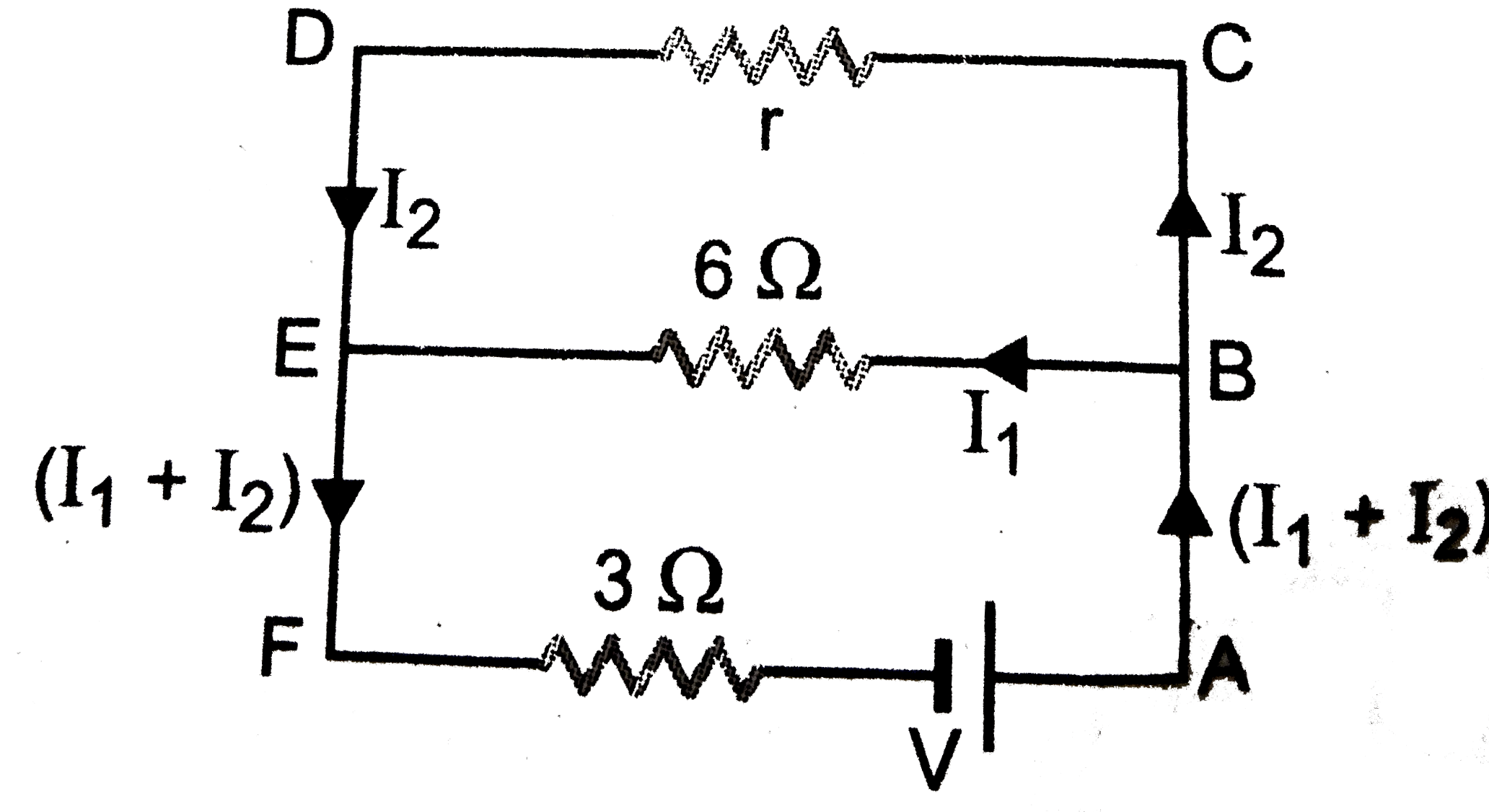 Using kirchhoff's SECOND law, in closed circuit `ABEFA` we have `6 I_(1) = 3(I_(1) +I_(2)) - V = 0` or `V = 9 I_(1)+3I_(2)`….(i) Usingkirchhoff's second law , in closed circuit `BCDEB` we have `R I_(2) - 6 I_(2) = 0 or I_(1) = (I_(2))/(6) r` From (i) `V = 9 xx (I_(2))/(6) r + 3I_(2) = (3)/(2) I_(2) r + 3I_(2) = (3I_(2))/(2) (r + 2)` or `I_(2) = (2V)/(3(r+2))` Power develeped in resisteor `r`, `P = I_(2)^(2) = (4V^(2))/(9(r+2)^(2)) xx r` Power developed is maximum, when `(r+ 2)^(2)` is minimum or `(r+ 2)^(2) = 0` or `r^(2) + 4R + 4 = 0` or `r^(2) - 4r + 4 + 8 r = 0` or `(r - 2)^(2) + 8r = 0 or r = 2 Omega` |
|
| 22. |
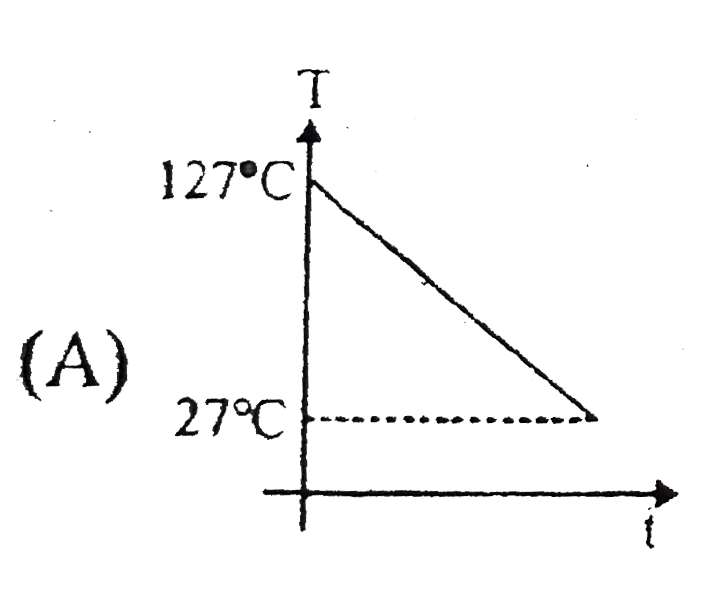
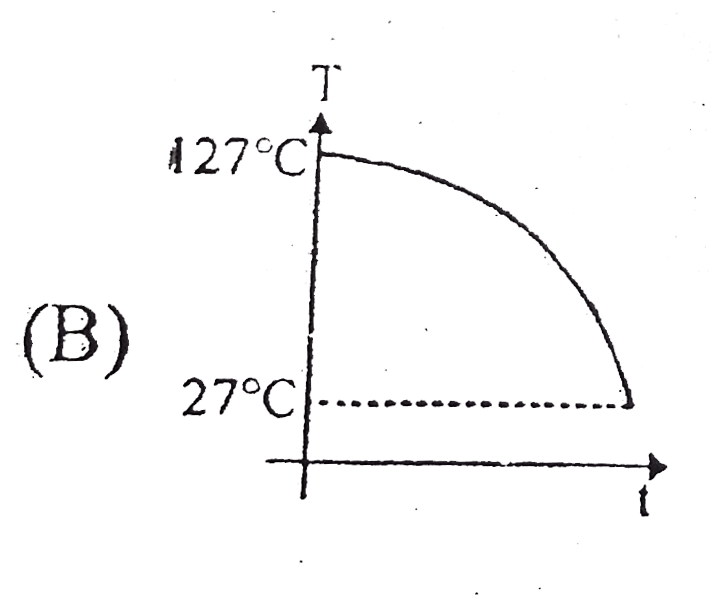
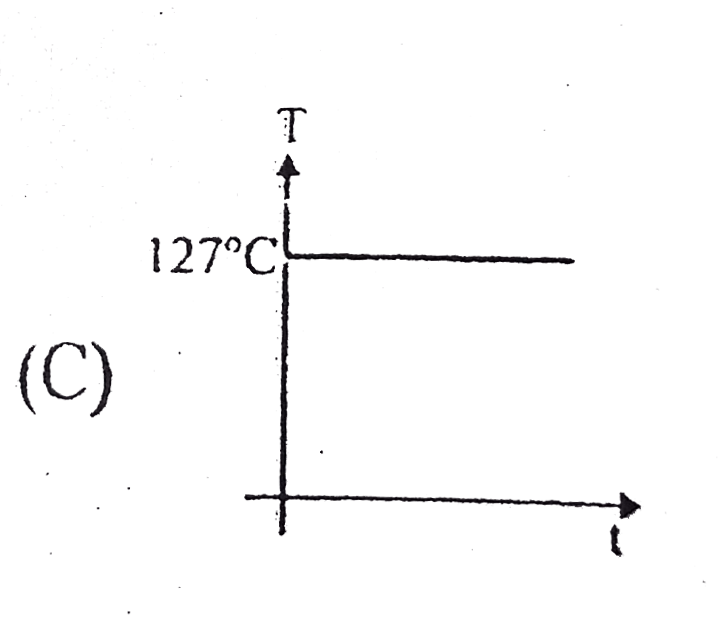
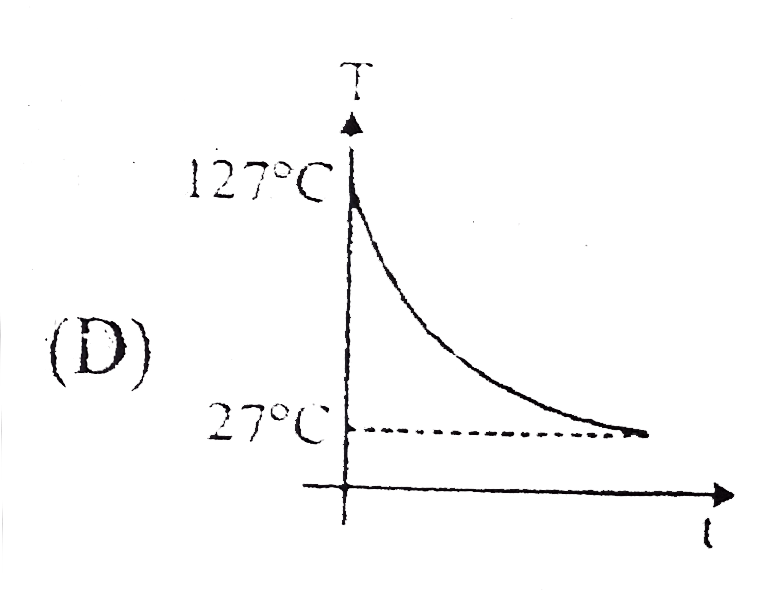
A silver ball painted black is kept inside a box which is maintained at a temprature of 27^(@)C the ball is maintained initially at a constant temperature of 127^(@)C by making the radiation to fall on it through a small hole in the box latter on due to some chemical reaction between silver and paint the paint uniformly evaporates from the surface of ball exposing the silver if same amount of radiation continues to fall on ball then temperature of ball as a function of time is hown as :(Assume emissivity of silver is zero and paint to be black body also assume radiation to be the only mode of heat transfer) |
|
Answer»
`P_(AB)+P_(ab)=P_(cm)` `eAsigma T_(0)^(4)=eAsigmaT_(1)^(4)=eAsigmaT_(B)^(4)` `T_(B)`=remains constant as `(T_(0)` and `T_(1))` are constant |
|
| 23. |
When a solid with a band gap has a donor level just below |
|
Answer» an insulator |
|
| 24. |
(I) Carrier signal does not have information. (II) Carrier wave usually have a much higher frequency. (III) Carrier signal is used ot carry the baseband signal (IV) Carrier signal cannot be transmuted to long distance with less attenuation. |
|
Answer» I,II and III only |
|
| 25. |
Find the under which the charged particles moving with differnet speeds in the presence of electirc and magnetic field vactors can be used to select charaged particles of a particular spped. |
|
Answer» Solution :If the electic and magetic fields are perpendicular to each other and ALSO perpendicular to the velocity, then `E = Ehat(J)` `B = Bhat(k) and velocity, V = Vhat(i)` So,`vec(F) = q _(vec(E)) = q E vec(j) ` = `F_(B) = q VB_(1) = q (Vhat(i) xxBhat(k)) = qBhat(j)` Therefore,` F = q (E - VB)hat(j)` So, `F_(e) and F_(B)`are in opposite diraction, it is ao adjusted for `vac(E) and vac(B)` that magnitudeare EQUAL . Total force on change is zero and it will move in the field undeflected, i.e., q E = q VB Therefore, ` V= (E)/(B)` . This is the condition for selecting charged PARTICLE of a particular velocity. from beam of particles moving with different sppeds. |
|
| 26. |
A spherical capacitor consists of _____ concentric spherical conducting shells whose space between them is filled by ____. |
|
Answer» |
|
| 27. |
When is H_(alpha) line of the Balmer series in the emission spectrum of hydrogen atom obtained ? |
|
Answer» Solution :`H_(alpha)` LINE of the Balmer series in the emission SPECTRUM of hydrogen ATOM is obtained in the visible region. `barv=R[(1)/(2^(2))-(1)/(n_(1)^(2))]` where `n_(i)=3,4,5,…….` |
|
| 28. |
A magnetic needle free to rotate in a vertical plane parallel to the magnetic meridian has its north tip pointing down at 22^@ with the horizontal . The horizontal component of the earth's magnetic field at the place is known to be 0.35 G . Determine the magnitude of the earth's magnetic field at the place. |
|
Answer» SOLUTION :`theta=22^@,H_E=0.35xx10^(-4)T,B_E=`? `H_E=B_Ecostheta,:.B_E=H_E/(COSTHETA)=(0.35xx10^(-4))/(cos22^@)=0.38xx10^(-4)T " or " 0.38 G` |
|
| 29. |
In L-C oscillator circuit ……….. |
|
Answer» when Q = 0, I is MAXIMUM |
|
| 30. |
When a wire of length 10 m is subjected to a force of 100 N along its length, the lateral strain produced is 0.01 xx 10^(-3) . The Poisson's ratio was found to be 0.4. If the area of cross-section of wire is 0.025 m^2, its Young's modulus is |
|
Answer» `1.6xx10^8 N m^(-2)` Longitudinal strain = `"Lateral strain"/"Poisson.s ratio"` `= (0.01xx10^(-3))/0.4` …(i) Young.s modulus , `Y="Normal stress"/"Longitudinal strain"` (Using (i)) `Y=F/(AXX((0.01xx10^(-3))/0.4))` `=(100xx0.4)/(0.025xx0.01xx10^(-3))N m^(-2) = 1.6xx10^8 N m^(-2)` |
|
| 31. |
For satellite communication which wave is used ? |
| Answer» Answer :A | |
| 32. |
Let us consider a diatomic gas whose molecules have the shape of a dumbell. In this model, the center of mass of the molecule can translate in the x,y and z directions. In addition, the molecule can rotate about three mutually perpendicular axes. We can neglect the rotation about the y -axis because the moment of inertia I_(y) and the rotational energy 1/2 I_(y)omega^(2) about this axis are negligible compared with those associated with the x and z axes. (If the two atoms are taken to the point masses, then I_(y) is identically zero). Thus, there are five degrees of freedom: three associated with the translation motion and two associated with the rotational motion. Because each degree of freedom contributes, on average, 1/2k_(B)T of energy per molecule, the total internal energy for a system of N molecules is: E_("int")=3N(1/2k_(B)T)+2N(1/2k_(B)T)=5/2NK_(B)T=5/2nRT...........(i) We can use this result to find the molar specific heat at constant volume: C_(v)=1/n (dE_("int"))/(dT)=1/n d/(dT)(5/2nRT)=5/2R................(ii) From equation (i) and (ii) we find that C_(P)=C_(V)+R=7/2R gamma=(C_(P))/(C_(V))=(7//2R)/(5//2r)=7/5=1.40 In the vibratory model, the two atoms are joined by an imaginary spring. The vibrational motion adds two more degrees of freedom, which correspond to the kinetic energy and the potential associated with vibrations along the length of the molecule about its centre of mass. The root mean square angular velocity of a diatomic molecule (with each atom of mass m andn interatomic distance a) is given by: |
|
Answer» `sqrt((mk_(B)T)/(ma^(2)))` `I_(x)=I_(y)impliesmur^(2)=m/2 a^(2) {MU=(m_(1) m_(2))/(m_(1)+m_(2))}` `(ma^(2))/2 omega^(2)=2/2 KLT mu= m/2` `omega= sqrt((2KT)/(ma^(2)))` |
|
| 33. |
Let us consider a diatomic gas whose molecules have the shape of a dumbell. In this model, the center of mass of the molecule can translate in the x,y and z directions. In addition, the molecule can rotate about three mutually perpendicular axes. We can neglect the rotation about the y -axis because the moment of inertia I_(y) and the rotational energy 1/2 I_(y)omega^(2) about this axis are negligible compared with those associated with the x and z axes. (If the two atoms are taken to the point masses, then I_(y) is identically zero). Thus, there are five degrees of freedom: three associated with the translation motion and two associated with the rotational motion. Because each degree of freedom contributes, on average, 1/2k_(B)T of energy per molecule, the total internal energy for a system of N molecules is: E_("int")=3N(1/2k_(B)T)+2N(1/2k_(B)T)=5/2NK_(B)T=5/2nRT...........(i) We can use this result to find the molar specific heat at constant volume: C_(v)=1/n (dE_("int"))/(dT)=1/n d/(dT)(5/2nRT)=5/2R................(ii) From equation (i) and (ii) we find that C_(P)=C_(V)+R=7/2R gamma=(C_(P))/(C_(V))=(7//2R)/(5//2r)=7/5=1.40 In the vibratory model, the two atoms are joined by an imaginary spring. The vibrational motion adds two more degrees of freedom, which correspond to the kinetic energy and the potential associated with vibrations along the length of the molecule about its centre of mass. A diatomic molecule is moving without rotation or vibration with velocity v_(rms) such that it is oriented along x- axis. It strikes a wall in yz- plane while moving in +ve x direction. The spring constant can be assumed to be K and time of collision is negligible. After all collision are over: |
|
Answer» The molecule is MOVING along -ve X-DIRECTION and oscillating about its CENTRE of mass |
|
| 34. |
The critical angle for a transparent medium is 45^@. The R.I.of the medium is: |
| Answer» ANSWER :B | |
| 36. |
The gyromagnetic of an electron = _______ specific charge of an electron. |
|
Answer» 1 = `E/(2m)=1/2(e/m)"where "e/m` = SPECIFIC charge = `1/2xx` specific charge |
|
| 37. |
What is the magnitude of the equatorial and axial fields dut to a bar magnet of length 5.0 cm at a distance of 50 cm from its mid - point ? The magnetic moment of the bar magnet is 0.40Am^2 . |
|
Answer» SOLUTION :`B_E=(mu_0m)/(4pir^3)=(10^(-7)xx0.4)/((0.5)^3)=(10^(-7)xx0.4)/(0.125)=3.2xx10^(-7)T` `B_A=(mu_02m)/(4pir^2)=6.4xx10^(-7)T` |
|
| 38. |
Relation between (A) and (B) is : |
|
Answer» ANOMERS |
|
| 39. |
The colour of the second line of Balmer series is |
|
Answer» Blue |
|
| 40. |
A small particle of mass m is attached at B to a hoop of mass m and radius r, whole system is placed on the rough horizontal ground. The system is released from rest when B is dierctly above A and rolls without slipping. Find the angular acceleration of the system at the instant when AB becomes horizontal as shown in the figure. |
|
Answer» Solution :Assuming that the hoop rotates by `theta` (so that the attached particle also rotates by `theta`) STARTING from its initial position, we find the ANGULAR SPEED of the hoop `+` particle. The INSTANTANEOUS axis of rotation is located at `P`. we apply conservation of mechanical energy to get `mgR(1-costheta)=(1)/(2)(2mR^(2))omega^(2)+(1)/(2)m(2Rcos"(theta)/(2)omega)^(2)` Differentiating and PUTTING `theta=90^(@)` We solve for `alpha = omega(domega)/(d theta)` and get `4alpha=(3g)/(2R)` or `alpha=(3g)/(8R)` 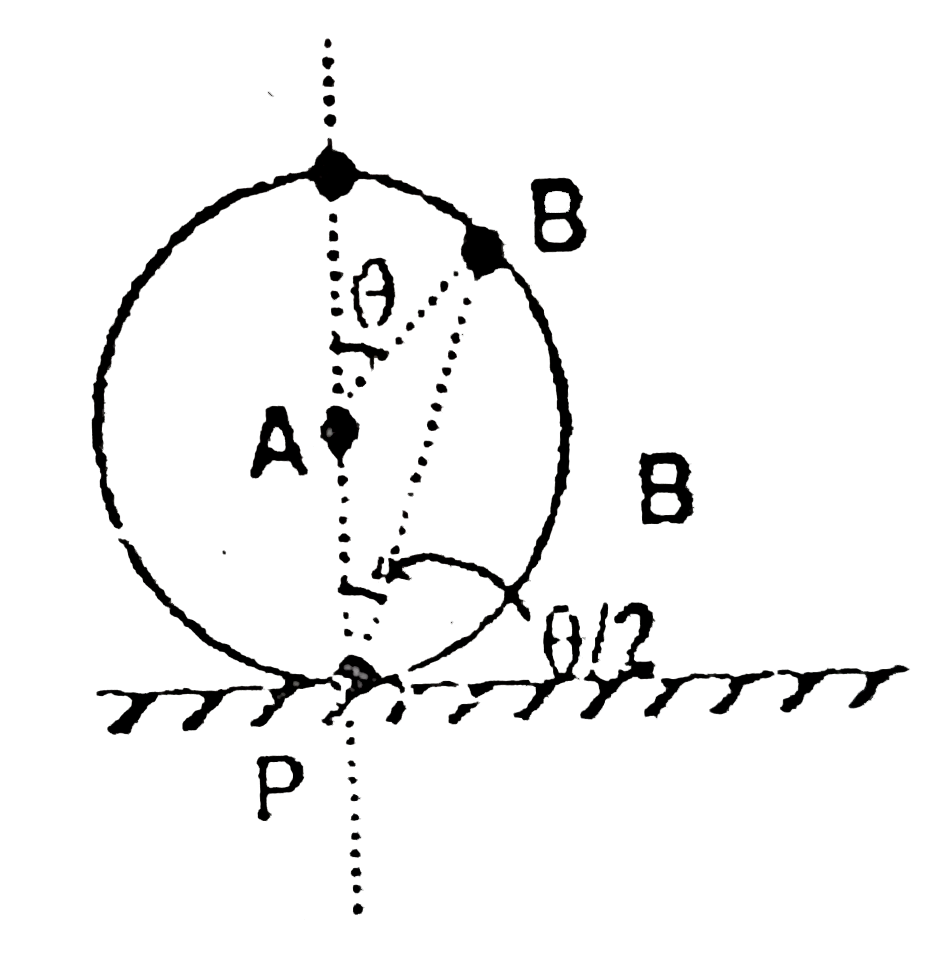
|
|
| 41. |
What is sky wave communication Why is this mode of propagation restriced to the frequenceies only upto few MHz? |
|
Answer» SOLUTION :Sky wave communication: It is the mode of wave propagation in which the RADIOWAVES emitted from the transmitter antenna reach the receiving antenna after reflection by the ionosphere. In sky wave propagation, the radio waves of frequency range from GENERALLY 1710 KHz to 40 MHz are used. This mode of propagation is used by SHORT wave broad cast service. The electromagnetic waves of frequencies greater than 40 MHz penetrate the ionosphere and ESCAPE. |
|
| 42. |
The current in theforward bias is known to be more ( ~ mA) than the current in the reverse bias ( ~muA) .What is the reasonthen to operate the photodiodes in reverse bias ? |
|
Answer» SOLUTION :Consider the CASE of an n-type semconductor . Obviously, the majority carrier density ( n ) is considerably larger than the minority hole density p( i.e., `n gt gt p ) `. On illumination, let the excess electrons and holes generated be `Delta n ` and `Delta p` , respectively. ` n' = n + Delta n ` `p' = p +Delta p` Here n' and p' are the electron and hole concentrations at any particular illumination and n and p are carriers concentrationwhen there is no illumination. Remember `Delta n = Delta p ` and `n gt gt p` . HENCE,the fractional change in the majoritycarriers (i.e., `Delta n //n ) ` WOULD be much less than that in the minoritycarriers ( i.e., `Delta p //p ` ) . In general, we can state thatthe fractional change due to the photo-effects on the minority carrier dominated REVERSE bias current is more easily measurable than the fractional changein the forward bias current. Hence, photodiodes are preferablyused in the reverse bias condition for measuring light intensity . |
|
| 43. |
A glass slab consists of thin uniform layers of progressively decreasing refractive indices [Fig. 2.95] such that the refractive index of any layer is mu - m Delta mu . Here mu and Delta mu denote the refractive index of the 0 th layer and the difference in refractive index between any two consecutive layers respectively. The integerm = 0,1,2,3 cdots denotes the numbers of the successive layers. A rays light from the 0 th layer enters the 1 st layer at an angle of incidence of 30^(@). After undergoing the m th refraction, the ray emerges parallel to the interface. If mu = 1.5 and Deltamu - 0.015 the value of m is |
|
Answer» 20 `mu_(1)sini_(1) = mu_(2) sini_(2) = mu_(n)sin_(n)` `therefore " " musin30^(@) = (mu - mDeltamu)sin90^(@)` `or, 1.5 sin30^(@) = (1.5 - m XX 0.015) xx 1 or, 0.015m = (3)/(4)` `therefore " " m = (3)/(4) xx (1000)/(15) = 50` |
|
| 44. |
Identify the statements areTrue of False. a. The equation (mu_(2))/(v)-(mu_(1))/(u)=(mu_(12)-mu_(1))/(R) is applicabeltoa plane surface for R=oo . h. In the above equation, mu_(1) is medium in which the object is placed and mu_(2)is the medium in which the image is formed. c. In the figure shown, the real image of object O is formed at a distance 5R in the medium. d. In figure, the image of an object O place on the center face of the sphere is formed at infinity,. e. In fig , the image of an object O placed on the opposite face of the sphere is foremd at infinity. |
|
Answer» Solution :a. True. For plane surfaces, `(mu_(2))/(v)=(mu_(1))/(u)` B. False. In the EQUATION, `(mu_(2))/(v)-(mu_(1))/(u)=(mu_(2)-mu_(1))/(R)` `mu_(1)` is the MEDIUM which comes before the boundary and `mu_(2)` is the medium which comes after the boundary. c. True. `(mu_(2))/(v)-(mu_(1))/(u)=(mu_(2)-mu_(1))/(R)` Here, `mu_(2)=1.5,mu_(1)=1, u=5R, R=+R` `(1.5)/(v)-(1)/(-5R)=(1.5-1)/(+R)` `(1.5)/(v)=(1)/(2R)-(1)/(5R)=(3)/(10R)` `v=5R` d. False. All the rays COMING out from the object are radial. The radial rays are not devited with the change in medium. e. True. `(mu_(2))/(v)-(mu_(1))/(u)=(mu_(2)-mu_(1))/(R)` Here, `mu_(2)=1, mu_(1)=2, R=-R` `u=-2R` `(1)/(v)-(2)/(-2R)=(1-2)/(-R)=(1)/(R)` or `(1)/(v)=(1)/(R)-(1)/(R) `rArr v=oo` 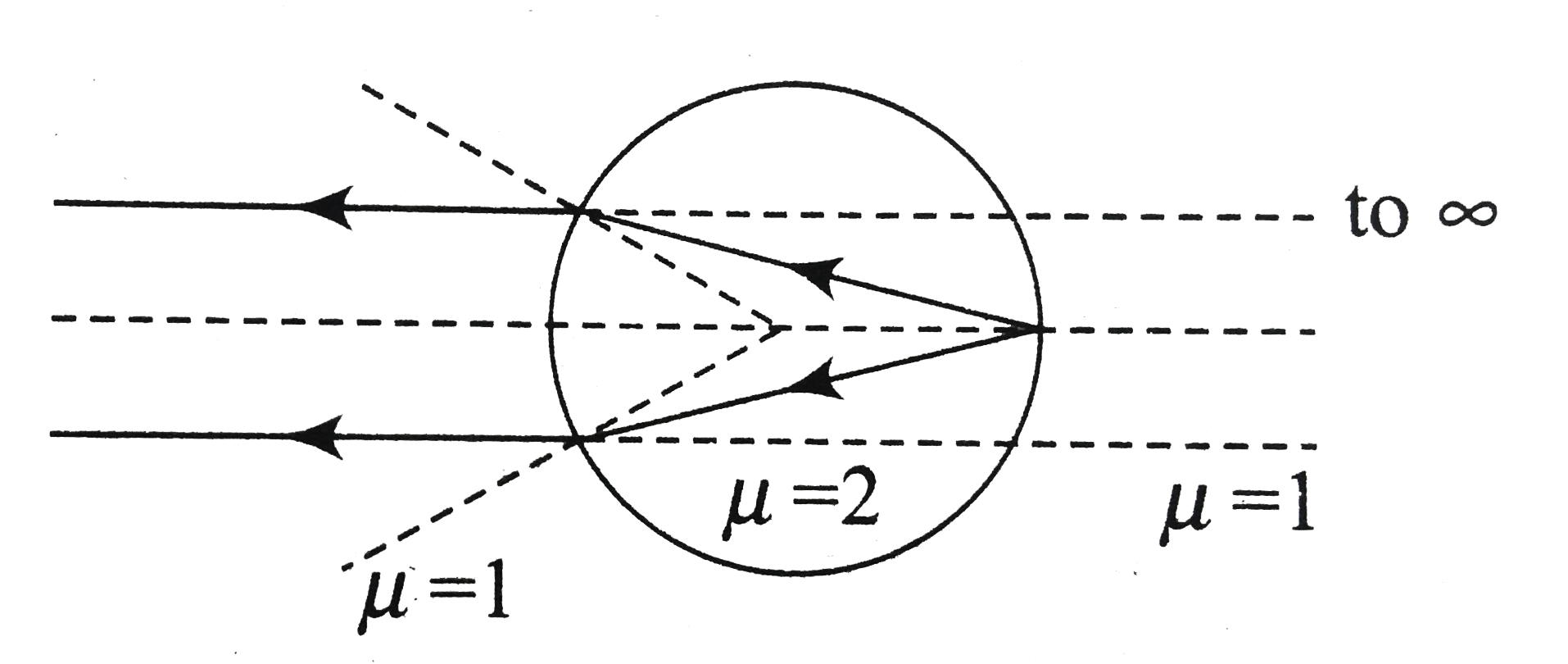
|
|
| 45. |
In both p and n type semiconductors , actually electrons are flowing . What difference do you observe in the motion of electron in these two semiconductors ? |
|
Answer» Solution :ELECTRONS in the VALENCE BOND are flowing in p-type semiconductor . Electrons in conduction BAND are flowing in n-type semiconductor. |
|
| 46. |
A current is established in a discharge tube of cross section 8xx10^(-4)m^(2) when a sufficiently high potential difference (say 32 kV) is applied across the two electrodes in the tube. The gas ionises, electrons move towards the positive terminal and positive ions towards the negative terminal. What are the magnitude and sense of the current in a hydrogen discharge tube in which 3xx10^(18) electrons and 2xx10^(18) protons move past the cross - sectional area of the tube in each second? |
|
Answer» Solution :The current due to electrons will be `I_(e)-(n_(e))/(t)xxq_(e)-3xx10^(18)xx1.6xx10^(-19)=0.48A` The DIRECTION of `I_(e)` current is from anode to cathode. Current due to protons will be `I_(p)=(n_(p))/(t)xxq_(p)=2xx10^(18)xx1.6xx10^(-19)=0.32A` The direction of `I_(p)` current is from anode to cathode. So, the total current is `I=I_(e)+I_(p)=0.48+0.32=0.8A`from anode to cathode of DISCHARGE tube. |
|
| 47. |
कौन-से राज्य में सरिस्का वन्य जीव अभ्यारण स्थित है? |
|
Answer» मध्य प्रदेश |
|
| 48. |
The number of silicon atoms per m^(3) is 5 xx 10^(28). This is doped simultaneously with 5 xx 10^(22) atoms per m^(3) of Arsenic and 5 xx 10^(20) per m^(3) atoms of Indium. Calculate the number of electrons and holes. Given that n_(i) = 1.5 xx 10^(16) m^(-3). ls the material n-type or p-type? |
|
Answer» Solution :When a SEMICONDUCTOR has both donor (pentavalent) and acceptor(trivalent) atoms then for charge neutrality, following condition should be FULFILLED: `N_(D) - N_(A) - n_(e) - n_(h) ""`.... (1) Where `N_(D)` are donor atoms and `N_(A) ` are acceptor atoms . Also for a semiconductor having `n_(i)`intrinsic charge carriers, we have `n_(e).n_(h) = n_(i)^(2)""`....(2) From equation (1), `(n_(e) + n_(h) )^(2) = (n_(e) - n_(h))^(2) + 4 n_(e) n_(h) = (N_(D) - N_(A) )^(2) + 4 n_(i)^(2) ""`....(3) ` therefore ""n_(e) + n_(h) = sqrt((N_(D) - N_(A))^(2) + 4 n_(i)^(2)) ""`.... (4) adding (1) and (4) , we have `n_(e) = (1)/(2) [ N_(D) - N_(A) + sqrt((N_(D) - N_(A))^(2) + 4 n_(i)^(2)) ] ` Given, `N_(D) = 5 xx 10^(22) m^(-3), N_(A) = 5 xx 10^(20) m^(-3) = 0.50 xx 10^(22) m^(-3), and n_(i) = 1.5 xx 10^(16) m^(-3)` ` n_(e) = (1)/(2) [ (5 xx 10^(22) - 0.05 xx 10^(22) ) + sqrt((4.95 xx 10^(22))^(2) + 4 xx (1.5 xx 10^(16))^(2) )] ` = 4.95` xx 10^(22) m^(-3)` As `"" n_(e).n_(i) = n_(i)^(2)` ` rArr "" n_(h) = ((1.5 xx 10^(16))^(2))/(4.95 xx 10^(22)) = (2.25 xx 10^(32))/( 4.95 xx 10^(22)) = 4.5 xx 10^(9) m^(-3)` Since `n_(e) gt n_(h),` the CRYSTAL is N-type. |
|
| 49. |
Three capacitors of capacity C_(1), C_(2), C_(3) are connected in series. Their total capacity will be |
|
Answer» `C_(1)+C_(2)+C_(3)` |
|
| 50. |
Which series of hydrogen spectrum lies in ultraviolet region ? |
| Answer» Solution :Lyman series | |