

Saved Bookmarks
This section includes 7 InterviewSolutions, each offering curated multiple-choice questions to sharpen your Current Affairs knowledge and support exam preparation. Choose a topic below to get started.
| 1. |
The graph between velocity and position for a damped oscillation will be- |
|
Answer» Straight line 
|
|
| 2. |
The capacitor C of a spherical conductor of radius R is proportional to |
| Answer» | |
| 3. |
ग्लूकोस का पानी मे घुलना किस विधि द्वारा होता है- |
|
Answer» विलायक संकरण द्वारा |
|
| 4. |
A potentiometer wire has a potential gradient of 0.0025 volt/cm along its length. Calculate the length of the wire at which null-point is obtained for a 1.025 volt standard cell. Also, find the emf of another cell for which the null-point is obtained at 860 cm length |
|
Answer» |
|
| 5. |
The graph shows variation of I with f for a series R-L-C network. Keeping L and C constant. If R decreases :- |
| Answer» Answer :A | |
| 6. |
The amplitudes E_(0) and B_(0) of electric and the magnetic component of an electromagnetic wave respectively are related to the velocity c in vacuum as |
|
Answer» a. `E_(0)B_(0)=(1)/(C )` |
|
| 7. |
Suppose theta is the polarising angle for a transparent medium and the speed of light in that medium is w. Then according to Brewtser law |
|
Answer» `theta = cot^(-1) (v//c)` |
|
| 8. |
The moment of inertia of earth as a homogenous sphere of average density 5500 (kg)/m^3 and radius 6400 km about its own axis of rotation is |
|
Answer» `9.0 xx10^37 kgm^2` |
|
| 9. |
Consider a transparent hemisphere (n=2) in front of which a small object is placed in air (n=1) as shown. What is the nature of final image of object x=2R |
|
Answer» Erect & magnified TAKING refraction first at curve surface `2/v_(1)+1/x=1/R Rightarrow v_(1)=(2Rx)/(x-R)` for plane surface `v'=v_(1)-R Rightarrowv'=(xR+R^(2))/(x-R)Rightarrow1/v-(2(x-R))/(R(x+R))=0` `1/v=(2(x-R))/(R(x+R))` for virtual IMAGE `1/vlt0 Rightarrow(2(x-R))/(R(x+R))lt0` `xltR` (2)For`x=2R` `v_(1)=(4R^(2))/R=4R Rightarrow u=-2R` `m_(1)=mu_(1)/mu_(2).v/u=1/2. (4R)/((-2R))=-1` `m_(2)=1 Rightarrow m_(1)m_(2)=-1` Image is real inverted and same size. 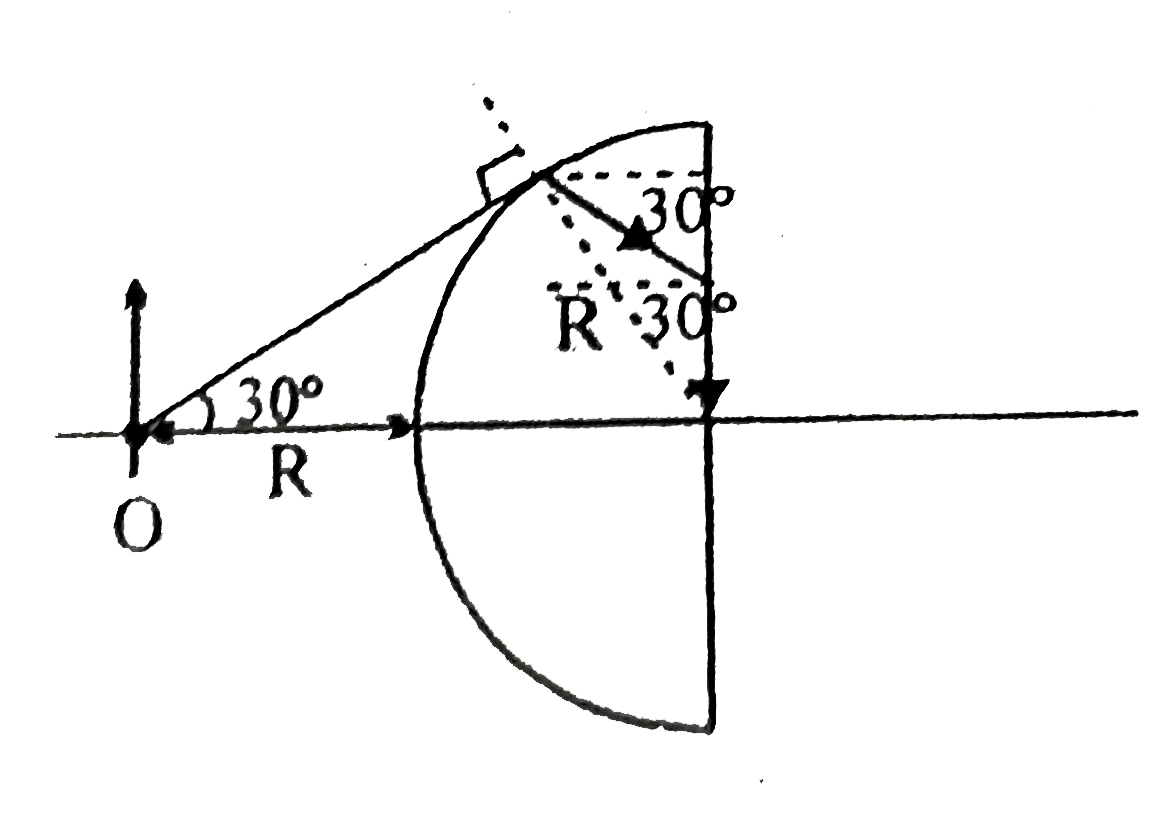
|
|
| 10. |
An oil drop of charge of 2 electrons fall freel with as terminal speed. Calculate the mas of oil drop so, it can move upward with same terminal speed, if electric field of 2xx10^(3) V//m is applied. |
|
Answer» `3.0xx10^(-17)kg` `qE-mg=6pi eta rv=F` …………..(ii) From eqs (i) and (ii) we GET `qE=6 pi eta rv+mg=2MG` `E=(2mg)/q=(2mg)/(2e)=(mg)/e` `m=(2xx10^(3)xx1.6xx10^(-19))/10=3.2xx10^(-17)kg` |
|
| 11. |
Three particles of same mass m are fixed to a uniform circular hoop of mass m and radius R at the comer of an equilateral triangle. The hoop is free to rotate in a vertical plane about a point on the cirumference opposite to one of the masses. Find the equivalent length of the simple pendulum. |
|
Answer» |
|
| 12. |
Is the following circuit correctly drawn |
|
Answer» Yes |
|
| 13. |
Albert Einstein, the great physicist proposed a clear picture to explain photoelectric effect. Explain Einsteins photoelectric equation |
| Answer» SOLUTION :`hV=phi_0+1/2mv^2` | |
| 14. |
A bar magnet is situated on a table along east-west direction in the magnetic field of earth. The number of neutral points, where the magnetic field is zero, are |
|
Answer» 2 |
|
| 15. |
When the frequency of the light used is changed from 4xx10^(14)s^(-1) to 5xx10^(14)s^(-1), the angular width of the principal (central) maximum in a single slit fraunhoffer diffraction pattern changes by 0.6 radian. What is the width of the slit (assume that the experiment is performed in vacuum) ? |
|
Answer» `1.5xx10^(-7)m` `therefore`Angular width of central maximum, `theta=(beta_(0))/(D)=(2lamda)/(d)` On differentiating both sides, we GET `Deltatheta=(2Deltalamda)/(d) implies d=(2Deltalamda)/(Deltatheta)` Now, `Deltalamda=((c)/(upsilon_(1))-(c)/(upsilon_(2)))=(3xx10^(8))/(4xx10^(14))-(3xx10^(8))/(5xx10^(14))` `=10^(-6)(0.75-0.6)=0.15xx10^(-6)=1.5xx10^(-7)m` `therefore`Width of the slit, `d=(2xx1.5xx10^(-7))/(0.6)=5xx10^(-7)m`. |
|
| 16. |
A rod of length l=100cm is fixed at 30cm from both end. If velocity of transverse wave in rod is v(cms^(-1)), then chose the correct option(s) |
|
Answer» FUNDAMENTAL FREQUENCEY (in Hz) of transverse wave in rod is `v/40` `(n+1/2) (lamda)/2=30` `((2n+1))/m=6/4implies=m=((2n+1))/3` `n=1 m=2, lamda=40 cm` `n=4, m-6, v=flamdaimpliesf//40=f_(0)` `n=7, m=10` `lamda=8` second overtone `n=10m m=14` `lamda=40/7impliesf_(3)=(7v)/40` |
|
| 17. |
If the immediate insignificant digit to be dro- pped is 5 then there will be two different cases A) If the preceding digit is even, it is to be unchanged and 5 is dropped. B) If the proceding digit is odd, it is to be raised by 1. |
|
Answer» Only A is CORRECT |
|
| 18. |
Calculate the wavelength of the first spectral line in the corresponding Lyman series of the hydrogen atom. |
|
Answer» Solution :For first SPECTRAL line of Lyman SERIES, `n_(F)=1,n_(i)=2` `:.` Wavelength `(1)/(lamda)=R((1)/(n_(f)^(2))-(1)/(n_(i)^(2)))` or `(1)/(lamda)=R[(1)/(1^(2))-(1)/(2^(2))]` `implies(1)/(lamda)=R[1-(1)/(4)]` or `lamda=(4)/(3R)` `("":.R=` Rydberg constant `=1.0973xx10^(7)m^(-1)`) `:.lamda=(4)/(3xx1.0xx10^(7))` `=1210Å` |
|
| 19. |
Define electrical conductivity of a metallic wire. Write its SI unit. |
| Answer» SOLUTION :RECIPROCAL of resistivity of a conductor is called its conductivity. Alternatively conductance of a UNIT cube of a conductor is called its electrical conductivity. Its SI unit is `SM^(-1)`. | |
| 20. |
a. How is the flux linkage through a coil related to current? b. What is the constant of proportionality that appears in the above relation? c. Define the constant of proportionality d. Give its dimensions and S.I. unit. |
|
Answer» Solution :a. For a CURRENT carrying COIL, flux is proportional to current. i.e., `phi_(B)propIorphi_(B)=LI` b. Coefficient of self induction (L). c. Self inductance of a coil is the magnetic flux linked with the coil when UNIT current flows through it. d. Dimension of `L=[ML^(2)T^(-2)I^(-2)]` and S.I. unit is henry. |
|
| 21. |
To know the surface of matter on smallest scale we allow an energetic charged particle to slam into a solid target or allow two energetic charged particle to collide head on. We use cyclotrons to give very high kinetic energy to the charged particles, we arrange for the proton to circulate in a magnetic field and give it a modest electrical kick once per revolution. Two hollow D shaped objects, called does are part of an electrical oscillator that alternates the electric potential difference across the gap between the does back ad forth. the does are immersed in a magnetic field whose direction is out of the plane of page and that is set up by a large electromagnet, suppose a proton injected by a source S at the centre of the cyclotron, initially moves towards a negatively charged de. It will accelerate toward this doe and enter it. Once inside, it is shielded from electric fields by the copper walls of the dee: that is the electric field does not enter the dee. The magnetic field however is not screened by the copper dee. So, the proton moves in a circular path whose radius, which depends on speed is given by r = (mv)/(qB) The key to the operation of cyclotron is that the frequency f at which the proton circulates in the field and thaat does not depend on its speed must be equal to the fixed frequency F_(oce) of the electrical oscillator. The resonance condition is given by qB = 2 pi m F_(oce) If a proton circulates 200 times in a magnetic field of 1.5 T and receives an energy boost of 100 keV every time it completes an orbit it will end up with a kinetic energy of |
|
Answer» 100 KeV |
|
| 22. |
To know the surface of matter on smallest scale we allow an energetic charged particle to slam into a solid target or allow two energetic charged particle to collide head on. We use cyclotrons to give very high kinetic energy to the charged particles, we arrange for the proton to circulate in a magnetic field and give it a modest electrical kick once per revolution. Two hollow D shaped objects, called does are part of an electrical oscillator that alternates the electric potential difference across the gap between the does back ad forth. the does are immersed in a magnetic field whose direction is out of the plane of page and that is set up by a large electromagnet, suppose a proton injected by a source S at the centre of the cyclotron, initially moves towards a negatively charged de. It will accelerate toward this doe and enter it. Once inside, it is shielded from electric fields by the copper walls of the dee: that is the electric field does not enter the dee. The magnetic field however is not screened by the copper dee. So, the proton moves in a circular path whose radius, which depends on speed is given by r = (mv)/(qB) The key to the operation of cyclotron is that the frequency f at which the proton circulates in the field and thaat does not depend on its speed must be equal to the fixed frequency F_(oce) of the electrical oscillator. The resonance condition is given by qB = 2 pi m F_(oce) Suppose a cyclotron is operated at an oscillator frequency of 24 MHz and has a dee of radius 26.5 cm. Then what is the magnitude of the magnetic field needed for deuterons to be accelerated in the cyclotrons? |
|
Answer» 1.57 T |
|
| 23. |
Obtion the dimensional formula of mu_0. |
| Answer» SOLUTION :`B=(mu_0I)/(2A),mu_0=(B2A)/I = (A^-1MT^-2L)/A = A^-2MLT^-2` | |
| 24. |
To know the surface of matter on smallest scale we allow an energetic charged particle to slam into a solid target or allow two energetic charged particle to collide head on. We use cyclotrons to give very high kinetic energy to the charged particles, we arrange for the proton to circulate in a magnetic field and give it a modest electrical kick once per revolution. Two hollow D shaped objects, called does are part of an electrical oscillator that alternates the electric potential difference across the gap between the does back ad forth. the does are immersed in a magnetic field whose direction is out of the plane of page and that is set up by a large electromagnet, suppose a proton injected by a source S at the centre of the cyclotron, initially moves towards a negatively charged de. It will accelerate toward this doe and enter it. Once inside, it is shielded from electric fields by the copper walls of the dee: that is the electric field does not enter the dee. The magnetic field however is not screened by the copper dee. So, the proton moves in a circular path whose radius, which depends on speed is given by r = (mv)/(qB) The key to the operation of cyclotron is that the frequency f at which the proton circulates in the field and thaat does not depend on its speed must be equal to the fixed frequency F_(oce) of the electrical oscillator. The resonance condition is given by qB = 2 pi m F_(oce) What is the resulting kinetic energy of deuterons? |
|
Answer» `3.99 XX 10^(-12) J` |
|
| 25. |
A light ray is incident on a horizontal plane mirror at an angle of 45^(@). At what angle should a second plane mirror be placed in order that the refelcted ray finally be reflected horizontally form the second mirror, as shown in figure |
|
Answer» `theta=30^(@)` So, `/_DCB/_CBQ=180^(@)` `/_DCN+/_NCB+/_CBQ=180^(@)` `alpha+alpha+45^(@)=180^(@)` `alpha=67.5^(@)` But `/_NCS=90^(@)` So, SECOND mirror is at an ANGLE of `22.5^(@)` with horizontal . |
|
| 26. |
The total energy of an electron in the ground state of an hydrogen atom is -13.6eV The corresponding K.E of the electron is |
|
Answer» 6.8eV |
|
| 27. |
The wavelength of a photon of momentum 6.6×10^(–24)Kg- m//swill be - |
|
Answer» 10Å |
|
| 28. |
Refractive index of diamond is 2. Speed of ligh in it is ...... Cm//s. |
|
Answer» `6xx10^(10)` `THEREFORE 2.0 =(3xx10^(10))/(v)` `therefore v=3/2xx10^(10)` `therefore v=1.5xx10^(10)" "cm//s` |
|
| 29. |
At higher forward voltages , a junction diode is likely to : |
| Answer» Answer :A | |
| 30. |
Define the term electrical conductivity of a metallic wire. Write its SI unit. |
| Answer» Solution :The RECIPROCAL of the resistivity of a material is CALLED its CONDUCTIVITY and is denoted by `SIGMA` | |
| 31. |
A ball is dropped from a height of 9m on a fixed plane floor. What distance will it describe before it comes to rest ?(The coefficient of restitution is e= 1/2) |
|
Answer» SOLUTION :DISTANCE TRAVELLED S=(1+l^2)/(1-l^2)H0=(1+1/4//(1-1/4)xx0.9=5/3xx0.9=1.50m` |
|
| 32. |
Two long straight parallel conductors carrying currents I_1 and I_2 along the same direction are separated by a distance 'd'. How does one explain the force of attraction between them? If a third conductors carrying a current I_3 in the opposite direction is placed just in the middle of these conductors , find the resultant force acting on the third conductor. |
|
Answer» Solution :Let two long straight parallel conductor carrying currents `I_1 and I_2` in same direction are separated by a DISTANCE .d. (fig.). Then at a point N on conductor 2, a magnetic field `B_1 = (mu_0 I_1)/(2 pi d)` is set up due to `I_1`, and it is directed normal to hte plane of paper of paper poiniting into it. The conductor 2 caryying CURRENT `I_2`experience a force per unit length `F_(21) = B_(1) I_2 = (mu_0 I_1 I_2)/(2 pi d)`, whose direction in accordance with Fleming.s left hand rule is toward conductor 1. Thus, the force is attractive in nature. Let a conductor 3 carrying current `I_3` in opposite direction be placed just in the MIDDLE of these conductors. Then this conductor experiences force `vec(F_(31))` due to condcutor 1 and `vec(F_(32))` due to conductor 2, which are in the directions as shown in Fig. Obivously net force `vec(F_3) = vec(F_31) - vec(F_32) = (mu_0 I_1 I_3)/(2 pi (d/2)) - (mu_0 I_2 I_3)/(2 pi (d/2))` `= (mu_0 I_3)/(pi d) (I_1 - I_2)` towards conductor 2. 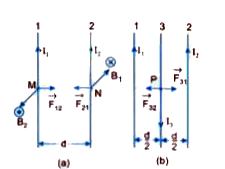
|
|
| 33. |
Two loud speakers are located 3.35 m apart on an outdoor stage. A listener is 175 m from one and 19.5 m from the other. During the sound check, a signal generator drives the two speakers in phase with the same amplitude and frequency. The transmitted frequency is swept through the audible range (20 Hz to 20 kHz). (a) What is the lowest frequency f_("min".1) that gives minimum signal (destructive interference) at the listener's location? By what number mustf_("min".1)be multiplied to get (b) the second lowest frequency f_("min".2)that gives minimum signal and (c) the third lowest frequency f_("min".3)that gives minimum signal? (d) What is the lowest frequency f_(max.1) that gives maximum signal (constructive interference) at the listener's location? By what number must f_(max.1) be multiplied to get (e ) the second lowest frequency f_(max.2) that gives maximum signal and (f) the third lowest frequency f_(max.3) that gives maximum signal? |
| Answer» SOLUTION :(a) 2.0 m , (B) FACTOR of 3 , (c ) factor of 5, (d) 172 Hz , (E ) factor of 2, (f ) factor of 3 | |
| 34. |
In Young's experiment fifth bright fringe produced by light of 4000Åsuperposes on the fourth bright fringe of an unknown wavelength. Find the unknown wavelength. |
|
Answer» Solution :Here, `lamda_(1)=4000Å,n_(1)=5,n_(2)=4` Distance between two consecutive fringes for wavelength `lamda_(1)` is `beta_(1)` and that for wavelength `lamda_(2)` it is `beta_(2)`. Here distance of `n_(1)^(TH)` fringe from central MAXIMUM=distance of `n_(2)^(th)` fringe from central maximum. `:.n_(1)beta_(1)=n_(2)beta_(2)` `:.n_(1)(lamda_(1)D)/(d)=n_(2)(lamda_(2)D)/(d)""[:.beta=(lamdaD)/(d)]` `:.n_(1)lamda_(1)=n_(2)lamda_(2)` `:.lamda_(2)=(n_(1)lamda_(1))/(n_(2))` `:.lamda_(2)=(n_(1)lamda_(1))/(n_(2))` `:.lamda_(2)=(5xx4000)/(4)` `:.lamda_(2)=5000Å` |
|
| 35. |
Explain thermionic emission, field emission and photoelectric emission. |
|
Answer» SOLUTION :(i) Thermionic EMISSION : It can be caused by supplying the minimum required energy by heating the METAL surface to a suitable temperature. (ii) Field emission : It can be caused by applying an electric field to the metal surface of the ORDER of `10^(8)Vm^(-1).` (iii) Photelectric emission : It can be caused by applying the minimum required energy by illuminating the metal surface with light of suitable frequency. |
|
| 36. |
Given : vec(a) + vec(b) + vec(c) = 0 . Out of the three vectors vec(a), vec(b) and vec(c) , two are equal in magnitude. The magnitude of the third vector is sqrt(2) times that of either of the two having equal magnitude. The angles between the vectors are : |
|
Answer» 90°, 135°, 135° Given `veca + VECB + vecc=0` or `veca +vecb=-vecc` or `(veca+vecb).(veca+vecb)=(-vecc).(-vecc)` or `a^(2)+a^(2)+2a^(2)costheta=2a^(2)` or `vec(b)+vecc=-veca` or same as above or `a^(2)+2a^(2)+2(a)(sqrt(2)a)costheta=a^(2)` or `costheta=-(2a^(2))/(2sqrt(2)a^(2))=-1/sqrt(2)` `theta=135^@` SIMILARLY, we can work out the third angle. |
|
| 37. |
Define the term 'drift velocity' of charge carriers in a conductor and wire its relationship with the current flowing through it. |
| Answer» Solution : DRIFT velocity is defined as the AVERAGE velocity acquired by the free electrons in a CONDUCTOR under the INFLUENCE of an electric field applied across the conductor. It is DENOTED by vd. | |
| 38. |
Assertion:An artificial satellite with a metal surface is moving above the earth in a circular orbit. A current will be induced in satellite if the plane of the orbit is inclined to the plane of the equator. Reason: The current will be induced only when the speed of satellite is more than 8 km//sec. |
|
Answer» If both ASSERTION and REASON are t rue and the reason is the correct explanation of the assertion. |
|
| 39. |
What is meant by conservation of total charges ? |
| Answer» Solution :The total electric charge in the UNIVERSE is constant and charge can neither be created nor be DESTROYED. In any physical process, the NET change in charge will ALWAYS be zero. | |
| 40. |
A parallel beam of monochromatic light of frequency v is indcident on a surface. The intensity of the beam is I and area of the surface is A. Find the force exerted by light of beam on the surface is perfectly reflecting and the light beam is incident at an angle of incidence theta. (The speed of light is denoted as c.) |
|
Answer» `(2lAsin^(2)theta)/(pic)` ` p_("incidnet") = (I) /(c) cos^(2) theta ` , where , c is velocity of light . since , light wave reflects also from reflecting surface , hence hthe recoil due to the REFLECTED wave will further contribute to the radiation pressure . ` thereforep_("emitted") = (I)/(c)cos^(2) theta ` ` thereforep_("net") = P_("incident" ) + p_("emitted") ` ` = (I)/(c)cos^(2) theta+ (I)/(c) cos^(2) theta ` ` p_("net") = (2I)/(c) cos^(2) theta ` ` therefore ` Force exerted by the light beam , ` F= P_("net") XX "Area (A) " = (2IA cos^(2) theta )/(c) ` |
|
| 41. |
The equation of stationary wavein stretched string is given by y=5sin(pix/3)cos40pit where x and y are in cm and t in sec. The separation between two adjacent node is, |
|
Answer» 1.5cm |
|
| 42. |
Find the temperature in kelvin scale at which the fundamental frequency of an organ pipe isindependent of small variation in temperature in terms of the coefficient of linear expansion (alpha) of the material of the tube. |
|
Answer» `T_0 = (5)/(2 ALPHA)` |
|
| 43. |
To measure the flow rate in a gas pipeline a narrowing is made in it and the pressure difference between the wide and the narrow parts of the pipe is measured (Fig.). Find the gas flow rate, if its density is 1.4 kg//m^3, the diameter of the pipe is 50 mm, the diameter of the narrowing is 30 mm and the pressure difference is 18 mm of water. The compressibility of the gas is to be neglected. |
|
Answer» `DELTA p = (rho v^2)/2 ((D^4)/(d^4) - 1)` where D and d are the diameters of the pipeline and of the narrowing. The flow rate is `mu = rho S v = 1/4 pi rho v D^2` and the pressure drop `Delta p = rho_0 gh`, where `rho_0` is the density of water. After some simple transformations we obtain the final expression for the flow rate. |
|
| 44. |
What was the grandmother's routine in city? |
|
Answer» She USED to FEED the sparrows |
|
| 45. |
A plane is flying at a constant height and constant speed of 300sqrt2 m//s along (hati+hatj)/(sqrt2) vector. At time t = 0, an observer in a car moving with velocity 30hatjm//s is at -300hatjm and the plane is at 400 km. At this instant a stone is thrown from the plane vertically upwards w.rt. the plane and with a velocity of 10(30hati+27hatj+hatk) m//s relative to the car. (take g = 10 m//s^(2)). The distance(in km) between the stone and the car when the stone hits ground is 4.73K. Find K (Take sqrt2 = 1.41) |
|
Answer» |
|
| 46. |
When two waves of amplitudes alpha_1 and alpha_2 have phase difference of (3pi/2) the resultant amplitude is : |
|
Answer» `(a_1+a_2)` |
|
| 47. |
A concave lens of glass, refractive index 1.5, has both surfaces of same radius of curvature R. On immersion in a medium of refractive index 1.75, it will behave as a |
|
Answer» convergent LENS of focal length 3.5R `(1)/(F)=(._(G)^(m)mu-1)((1)/(R_(1))-(1)/(R_(2)))` Now, `._(g)^(m)mu=(._(g)mu)/(._(m)mu)=(1.5)/(1.75)` For concave lens, as shown in figure, in this case `R_(1)=-R` and `R_(2)=+R` `:.(1)/(f)=((1.5)/(1.75)-1)(-(1)/(R)-(1)/(R))=+(0.25xx2)/(1.75R)` `RARR f=+3.5R` Thepositive sign shows that the lens behaves as a convergent lens. (a) is the correct OPTION. 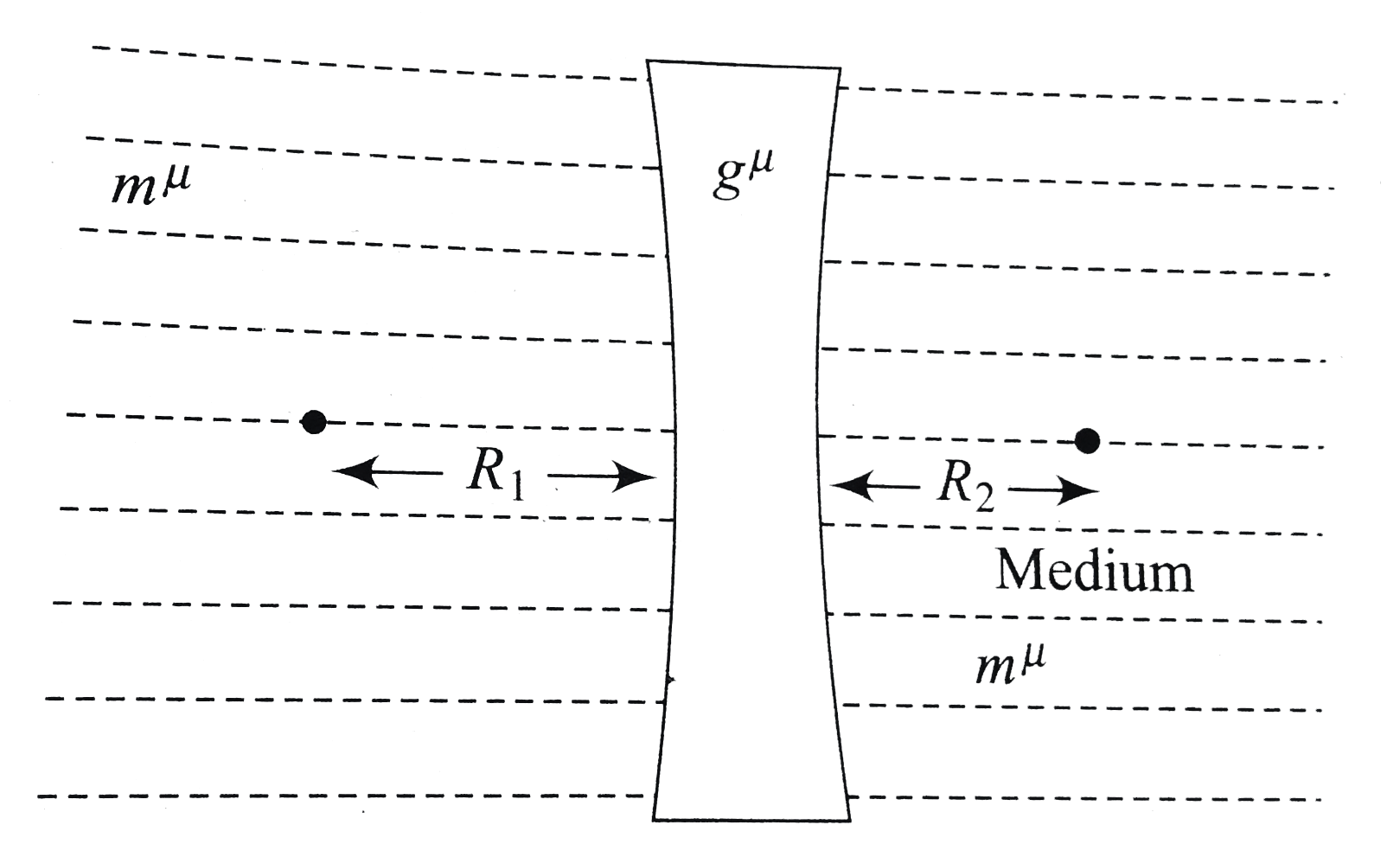
|
|
| 48. |
Under what condition does an electron moving through a magnetic field experiencemaximum force ? |
| Answer» Solution :When the ELECTRON is moving in a DIRECTION PERPENDICULAR to htat of magnetic field. | |
| 49. |
The displacement of the interfering light wates are y_(1) = 4 sin omega t and y_(2) = 3 sin(omega t + (pi)/(2)).The amplitude of the resultant wvae is : |
|
Answer» 5 `therefore` RESULTANT amplitude, `a_(R) = sqrt(a_(1)^(2) +a_(2)^(2))` ` = sqrt (4^(2) + 3^(2)) = sqrt 25 = 5` |
|