

Saved Bookmarks
This section includes 7 InterviewSolutions, each offering curated multiple-choice questions to sharpen your Current Affairs knowledge and support exam preparation. Choose a topic below to get started.
| 1. |
The figure shows positions of object O and its diminished image I. This is possible If: |
|
Answer» a convex mirror is PLACED to the RIGHT of I |
|
| 2. |
अन्तः स्तर (endometrium) का सुधार किसके द्वारा होता है- |
|
Answer» इस्ट्रोजेन |
|
| 3. |
A cubical vessel of side 1 m contains one mole of nitrogen at a temperature of 300 K. If the molecuels are assuming to move with the rms velocity further if the vessel now thermally insulated moved with a constant speed v and then suddenly stopped and this results in rise of temperature by 2^(@)C, find v. |
|
Answer» SOLUTION :When container is moving at speed v, the kinetic energy in the nitrogen molecules is `E_(k)=(1)/(2)Mv^(2)` `=(1)/(2)xx28xx10^(-3)xxv^(2)` [Mass of 1 mole of gas `=28xx10^(-3)kg`] When the container is suddenly stopped, this kinetic energy is TRANSFORMED into thermal energy and increases the internal energy of gas as container is insulated. If temperature increment of gas is `DELTAT`, rise in its internal energy is `DeltaU=(F)/(2)nR DeltaT` `DeltaU=(5)/(2)nR DeltaT` `=(5)/(2)xx1xx8.314xx2` `=41.57` joule From energy conservation, we have `(1)/(2)xx28xx10^(-3)XX v^(2)=41.57` or `""v=sqrt((41.57xx2)/(28xx10^(-3)))` `=54.5" m"//"s"` |
|
| 4. |
A thin annular metal disc of inner and outer radii a and b respectively , is freely suspended from a point on its outer circumference . The length of the corresponding equivalent simple pendulum is |
|
Answer» `(a^2+B^2)/(2B)` |
|
| 5. |
At what distance from a convex mirror of focal length 2.5 should a boy stand so that his image has a height equal to half the original height? |
|
Answer» 2.5 m from the MIRROR |
|
| 6. |
If there were no atmosphere, the average temperature on the surface of the earth would be: |
|
Answer» lower |
|
| 7. |
Two parallel, long wires carry currents i_1& i_2 (i_1gt i_2)when the currents are in the same direction, the magnetic induction at a point midway between the two wires is X. If the direction of i_2is reversed, the magnetic induction becomes 2x, then i_1//i_2is |
|
Answer» 1 |
|
| 8. |
A concave mirror has a focal length 20cm. The distance between the two positions of the object for which the image size is double of the object size is |
|
Answer» 20cm |
|
| 9. |
A thin wheel can stay upright on its rim for a considerable length of time when rolled with a considerable velocity, while falls from its upright position at the slightest disturbance, when stationary, Explain. |
| Answer» SOLUTION :Equilibrium of the wheel when it is still and standing UPRIGHT on its rim is unstable. Moreover, when a wheel is running it possesses an angular momentum in the HORIZONTAL direction which is conserved QUANTITY of the MOTION. | |
| 10. |
In Young.s double slit experiment, using monochromatic light of wavelength lamda , the intensity of lightat a point on the screen where path difference is lamdais K units. The intensity of light at a point where path difference is lamda//3 is. |
|
Answer» 4K ` phi = ( 2 pi)/( LAMDA)D = (2 pi)/(3 )` ` I= 4I_0 1/4= I_0 …… (1) ` ` "//"^(LY)I=K= 4I_0…..(2)` Fromeqns1 and 2wearriveat option(D ) |
|
| 11. |
Two identical condensers M and N are connected in series with a battery. The space between the plates of 'M' is completely filled with dielectric medium of dielectric constant 8 and a copper plate of thickness / 2 is introduced between the plates of N. (d = distance of separation of the plates). Then the potentials of M and N are respectively. |
| Answer» Answer :A | |
| 12. |
A square frame ABCD is made of insulated wires and there is a short dipole, with dipole moment p, fixed in the plane of he figure. The dipole is lying at the centre of the square, making an angle theta, as shown in the figure. If four point charges are placed at the four point charges are placed at the four corners of the square, then the magnitude of force exerted by the dipole on the system of charges is |
|
Answer» `(6Kpq)/(R^(3))` |
|
| 13. |
Three ammeters — 1, 2 and 3 have different internal resistances r_(1), r_(2) and r_(3) respectively. Internal resistance r_(1) isknown but r_(2) and r_(3) are unknown. The angular deflection of pointer in each ammeter is proportional to the current. Initially, the three ammeters were connected in series to a voltage source (fig. a) and deflections for the three ammeters were theta_(1), theta_(2) and theta_(3) respectively. The three ammeters were then connected in parallel to the same voltage source (fig. b). This time the deflections were observed to be theta'_(1),theta'_(2) and theta'_(3) respectively. (a) Find r_(2) and r_(3). (b) If theta_(2) = theta_(3) but theta'_(3) gt theta'_(2) then which one is larger r_(2) or r_(3) ? |
|
Answer» (b) `r_(2) GT r_(3)` |
|
| 14. |
Two charged particules traverse identical helical paths in a completely opposite sense in a uniform magnetic field B=B_(0)k |
|
Answer» They have EQUAL z-components of momenta |
|
| 15. |
Decreasing order of stability of given carbocatons is as : (i) (ii) CH_(2)=CH-overset(o+)CH_(2) |
|
Answer» `iiigtiigtivgti` 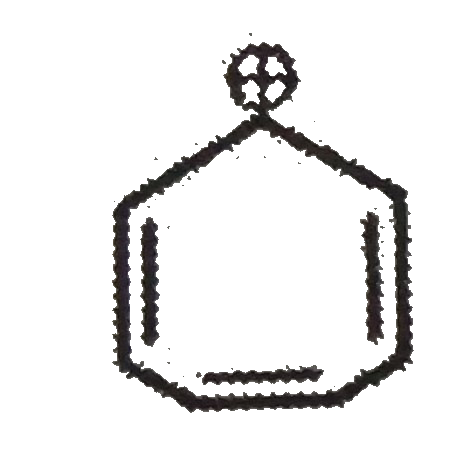 It is most stable in above carbocation due to DELOCALIZATION in a SINGLE ring. Stability of compound `PROP` no. of resonatig structure |
|
| 16. |
Assertion :- Unlike charges are projected in opposite direction in transverse magnetic field, then they are deflected in same direction. Reason :- If a voltmeter connected across two peripherial points of farday copper discgenerator, its reading is zero . |
|
Answer» If the ASSERTION & Reason are True& the Reason is a correct EXPLANATION of the Assertion . |
|
| 17. |
A silver wire has a resistance of 2.1 Omegaat 27.5^@C,and a resistance of 2.7 Omega at 100^@C . Determinethe temperature coefficient of resistivity of silver. |
|
Answer» SOLUTION :Here `T_1 =27.5^@C , R_1 = 2.1 Omega , T_2 = 100^@C and R_2 = 2.7 Omega` From the relation `R_2 = R_1 [1+ ALPHA (T_2- T-1) ]` , we have TEMPERATURE coefficient of resistivity of SILVER `alpha = (R_2 - R_1)/(R(T_2 - T_1)) = (2.7 - 2.1)/(2 (100 - 27.5) ) = (0.6)/(2.1 xx 72.5) = 0.0039^@C^(-1)` |
|
| 18. |
which option is correct for One poise |
|
Answer» 1 dyne SEC/`cm^2` |
|
| 19. |
If this telescope is used to view a 100 m tall tower 3 km away, what is the height of the image of the tower formed by the objective lens ? |
|
Answer» 4.67 CM |
|
| 20. |
What is the dimension of co-efficient viscosity? |
|
Answer» Solution :Since F = `ETA A(v/r)` `eta = (Fr)/(AV) therefore [eta] = (M^1L^1T^-2 XX L)/(L^2 xx LT^-1) = M^1L^-1T^-1` |
|
| 21. |
A sound wave of frequency v travels horizontally to right. It is reflected from a large vvertical plane surface moving to the left with a speed v. The speed of sound in the medium is c, then |
|
Answer» the frequency of the reflected wave is `(V(C+v))/(c-v)` `n'=((c+v))/(lambda)=(v(c+v))/(c)` Now, these waves are reflected by the moving target (Which now act as a source). THEREFORE, apparent frequency of reflected second `n''=((c)/(c-v))n'=v((c+v)/(c-v))` The wavelength of reflected wave `=(c)/(n'')=(c(c-v))/(v(c+v))` The number of beats heard by stationary listener `=n''-v=v` `((c+v)/(c-v))-v=(2"vv")/((c-v))` Hence, option (a) is correct. |
|
| 22. |
A glass sphere of refractive index 1.5 forms the real image of object O at point I as shown in the figure when kept in air of refractive index 1. If the value of x is kR. Find k |
|
Answer» Consider first refraction at point `N` `1.5/V-1.0/(-R)=(1.5-1.0)/(+R)implies1.5/v=1/(2R)-1/Rimpliesv=-3R` 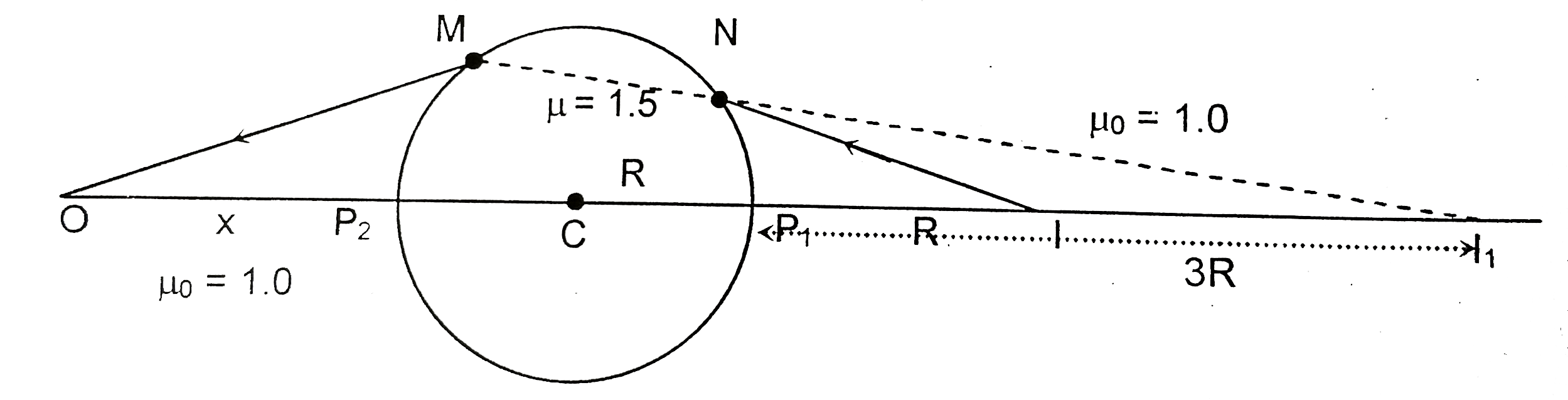 Consider second refraction at point `M`, for this `I`, wil behaves normal object so `1.0/v-1.5/(-5R)=(1.0-1.5)/(-R)` `implies1/v+3/(10R)=1/(2R)=5/(10R)` `implies 1/v=5/(10R)-3/(10R)=1/(5R)` `implies v=5R` `impliesx=5Rimpliesk=5` |
|
| 23. |
Compare the radii of two nuclei with mass numbers 8 and 64. Also compare their densities. |
|
Answer» `1:3,1:1` |
|
| 24. |
The angle subtended at the eye by an object is equal to the angle subtended at the eye by the virtualimage produced by a magnifying glass. In what sense then does a magnifying glass provide angular magnification ? |
| Answer» Solution :a. Eventhough the absolute image size is bigger than the object size, the angular size of the image is equal to the angular size of he object. The magnifier help in the following WAY : without it object would be PLACED no closer than 25 cm , with it the object can be placed is in this sense that angular magnification si ACHIEVED. | |
| 26. |
A thin plane strip is suspended from a fixed support through a string of length l. Material of the strip is such that is absorbs all the light falling on it. A parallel beam of light with power P moving horizontally is striking the plane strip . Find the angle made by string with the vertical if strip remains in equilibrium . If strip is slightly disturbed from its equilibrium position and then released , its equilibrium position and then released , what will be time period of resulting oscillation ? |
Answer» Solution :If light of power P is falling normally on perfectly absorbing surface , then force applied bythe light beam on surface is P/C and in this case , the force is ACTING along horizontal direction as shown in figure. 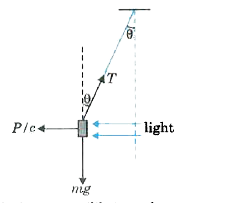 Let `theta` be the angle made by string with the VERTICAL when in equilibrium , then we can write the following equation: ` T cos theta = MG ` `T sin theta = P/c` To find the angle `theta` , we can divide the above two equations as follows : `tan theta=P/(mgc)impliestheta=tan^(-1)(p/(mgc))` Tension of the string can be written as follows : `T=sqrt(((P)/(c))^2+(mg)^2)` Hence EFFECTIVE gravity can be written as follows : `g. =T/m=sqrt((P/(mc))^2+g^2)` Time period of oscillation can be written as follows: Time period `2pisqrt(l/(g.))` `implies` Time period `=2pisqrt(l/(sqrt((P/(mc))^2)+g^2))` |
|
| 27. |
Draw the circuit arrangement for studying the V - I characteristics of a p-n junction diode in (i) forward and (ii) reverse bias. Briefly explain how the typical V - I characteristics of a diode are obtained and draw these characteristics. |
Answer» Solution : (i) Forward biasing :  V-I characteristics : The VI characteristics are OBTAINED by connecting the battery, to the DIODE, through a potentiometer (or rheostat). The APPLIED voltage to the diode is changed. The values of current, for different values of voltage, are noted and a graph between V and I is plotted. The V-I characteristics, of a diode, have the form shown here. 
|
|
| 28. |
Liquid oxygen remains suspeded twopolesof a magnet because it is |
|
Answer» diamgnetic |
|
| 29. |
Three small identicalnetural balls aretheverstices of anequilateral triangle. Theballs are connected toa largecharged sphere heldabovetheplane of theplane of thetrianglesymmerticaly with repect to theballs . The firstandthe second balls acquire charge q_(1) and q_(2) respectively . How much is q_(3) ?.Theconnecting wires are thin. |
|
Answer» |
|
| 30. |
A block slides from an inclined plane of inclination 45^(@)If it takes twice the time with friction than that without friction, the coefficient of friction between block and surface is : |
|
Answer» 1 Acc. with friction `a_(2) = g sin theta- mug COS theta` Now `(t_(1))/(t_(2))=sqrt(a_(2)/(a_(1))) or(t_(2))/(t_(1))=sqrt(a_(1)/(a_(2)))` `2=sqrt((gsintheta)/(gsin theta- mug cos theta))` `4=(sin theta)/(sin theta-mu cos theta)=(1)/(1-mu tan theta)` `4=(1)/(1-mu)=1 or(As theta=45^(@)` `4-4mu=1 or 4mu=3mu=3//4=0.75` (b) is the choice. |
|
| 31. |
Dimensional formula of self inductance is ...... |
|
Answer» `M^1 L^1 T^(-2) A^(-2)` `therefore` UNIT of `L=V_S/A=J/C xx S/A =J/A_S = S/A` `therefore` Unit of `L=J/A^2 RARR [L]=(M^1L^2T^(-2))/A^2` `therefore [L]=M^1 L^2 T^(-2) A^(-2)` |
|
| 32. |
An object is placed in front of a concave mirror. It is observed that a virtual image is formed. Draw the ray diagram to show the image formation and hence derive the morror equation 1/f=1/u+1/v. (b) An object is placed 30 cm is front of a plano-convex lens with its spherical surface of radius of curvature 20cm. If the refractive index of the material of the lens 1.5, find the position and nature of the image formed. |
Answer» Solution :(a) Let a linear object AB be placed normally on the principal, axis of a CONCAVE mirror between its pole and principal focus so that its virtual and erect image A.B. is formed behind the mirror as shown here. Since aperture of mirror is small the arc MP MAY be considered to be a straight chord. Since `triangleCAB and triangleCA.B.` are similar triangles, we have 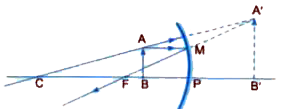 `(A.B.)/(AB)=(CB.)/(CB) ............(i)` Again `triangleFA.B. and triangleFM` are similar triangles, we have `(A.B.)/(MP)=(B.F)/(PF) .......(ii)` Since MP is equal to AB, equation (ii) may be written as `(A.B.)/(AB)=(B.F)/(PF) ......(iii)` Comparing (i) and (iii), we get `(CB.)/(CB)=(B.F)/(PF) or (CP+PB.)/(CP-PB)=(PB.+PF)/(PF)` Taking cartesisan sign convention, we can write that `CP=R=-2f, PF=-f, PB=-u and PB.=+V`, Thus, we have `((-2f) +(+v))/((-2f)-(-u))=((+v)+(-f))/((-f))` `rArr 2f^(2)-vf=-2fv+2f^(2)+uv-uf` `rArr vf+uf=uv` Dividing throughtout by uvf, we get `1/u+1/v=1/f` (b) Hert, u=-30 cm, `R_(1)=+20cm, R_(2)=oo` and refractive index of lens n=15 `1/f =(n-1) (1/R_(1)-1/R_(2))=(1.5-1) (1/(20) -1/oo) =1/(40)` `f=40cm` Now, as PER relation `1/v-1/u=1/f`, we have `1/v=1/u+1/f=1/(-30)+1/(40)=-(1)/(120)` The -ve sign of v shows that the image is virtual, errect and on same side of lens as the object is. |
|
| 33. |
Assertion:Current is passed through a metallic wire, heating it red. When cold water is poured on half of its portion, then rest of the half portion become more hot. Reason: Resistances decreases due to decrease in temperature and so current through wire increases. |
|
Answer» If both assertion and reason are TRUE and the reason is the correct explanation of the assertion. |
|
| 34. |
Draw a ray diagram to show the formation of the image of an object placed between the optical centre and principal focus of a convex lens. Deduce the relationship between the object distance, image distance and focal length under the conditions stated. |
|
Answer» Solution :The image formation of a linear object AB placed between the OPTICAL centre C and principal focus F. of a convex lens has been shown in Fig. 9.63. The image A.B. is VIRTUAL, erect and magnified. As `DeltaA.B.C` and `DeltaABC` are similar. Hence, `(A.B.)/(AB) = (CB.)/(CB)` Again `triangleA.B.F.` and `triangleLCF` are similar, hence, `(A.B.)/(LC) = (B.F)/(CF)` or `(A.B.)/(AB) = (B.F)/(CF)`......(II) `[therefore LC = AB]`  comparing (i) and (ii) we get `(CB.)/(CB) = (B.F)/(CF) = (CB. + CF)/(CF)` As per sing convention `CB = -u, CB. =-v` and `CF = +f` `therefore (-v)/(-u) = (-v+f)/f` or `-VF = uv - uf` Dividing both sides by UVF, and on rearranging, we get `1/v -1/u =1/f`, which is the requisite lens formula. |
|
| 35. |
The three rods described in the previous question are placed individually, with their ends kept at the same temperature difference. The rate of heat flow through C is equal to the rate of combined heat flow through A and B. k_c must be equal to |
|
Answer» `k_(A)+k_(B)` |
|
| 36. |
There exists a uniform and constant magnetic field of strengthB in the space betweent he plates of a charged parallel plate capacitor. The charge density on the plate is sigma and length of the plate is l. An electron is projected in the space between the plates along the length of the plate. It is foudn that velcoity of the electron does not change. Find the time taken by the electron to come outof the capacitor. The figure describes the situtation. Ignore the gravity. |
|
Answer» `dF=(dvec(r)xxvec(B))=i DRB(ox"INSIDE")` Due to QR and SP TORQUE about point O ( perpendicular distance ) `=r sin alpha,d tau_(0)=(r sin alpha)dF=` `rsin alpha i d B=r i dr sin alpha(mu_(0)i_(0))/(2pir),tau_(0)=(mu_(0)ii_(0))/(2pi)sin alphaint_(a)^(b)dr,` `tau_(0)=(mu_(0)ii_(0)sin alpha(b-a))/(2pi)` NET Torque `=2[(mu_(0)ii_(0)(b-a)sin alpha)/(2pi)]=(mu_(0)ii_(0)(b-a)sin alpha)/(pi)` |
|
| 37. |
The angle at which transmission intensity is max. Is |
|
Answer» `30^(@)` For `I_(3)` to be max. `sin^(2)2theta = 1` then `theta_(1) = 45^(@)`. |
|
| 38. |
Calculate the power of lens of the spectacles necessary to rectify the defect of nearsightedeness fof a person who could see clearly onlyup to a distance of 1.8 m. |
|
Answer» <P> Solution :The maximumdistance the person COULD SEED is, x = 1.8 mThe lens should have a focallength of f = - x m = - 1.8 m it is a concaveor diverging lens. The POWER of the lens is, `P = (1)/(1.8m)` = 0.56 diopter |
|
| 39. |
Consider alpha-, beta- particles and gamma- rays, each having an energy fo 0.5Mev in increasing order f penertation power, the radiations are: |
|
Answer» `alpha, beta, GAMMA` |
|
| 40. |
Define ionisation energy. What is its value for a hydrogen atom ? |
| Answer» Solution : Ionisation ENERGY of an atom is defined as the energy required to REMOVE an ELECTRON from its ground state energy level to its free state. Ionisation energy for a hydrogen atom is 13.6 EV. | |
| 41. |
The diameter of the sun subtends an angle of 0.5^(@) at the pole of the concave mirror. The radius of curvature of the mirror is 1.5 m. Find the diameter of the image of the sun. Consider the distance of sun from the mirror infinite |
|
Answer» Solution :Image of the sun due to given concave mirror is shown in the FIGURE Suppose diameter of sun is `D_s` and diameter of its image is `D_i` From the figure `D_i= 2BF` As the sun RAYS coming from the far distance its image is formed on the focal point F ofconcave mirror.  `therefore` Image distance v = PF = f (focal length ) and if diameter of sun formed angle `alpha`at the pole of mirror, In `Delta PFB, angle PFB = (alpha)/92 = (0.5^@)/(2) = ` will be `0.25^@` and ` TAN (alpha)/(2) = (BF)/(PF)` `= (D_i)/(2f) [ because @BF = D_i and PF = f]` `therefore D_ = 2f xx tan (alpha)/(2)` `= 2 xx 75 xx tan(0.25^@)` `= 150 xx 0.00435 = 0.6525 CM ` |
|
| 42. |
The displacement time graph of a body is shown in figure. The velocity-time graph of the motion of the body will be |
|
Answer»
|
|
| 43. |
A rigorous quantum-mechanical calculation shows that in a hydrogen atom a transition between two sublevels of the fundamental state (see the previous problem) results in the emission or absorption of photons corresponding to a wavelength of 21.1 cm. Experiment is in excellent agreement with this result (to 11 significant figures!). Making use of classical concepts, try to find the wavelength corresponding to the transition between two sublevels of the ground state of a hydrogen atom, and compare the result with the actual wavelength. |
|
Answer» `lamda=(hc)/(epsi_(ph))=(4pihca_(0)^(3))/(4mu_(0)mu_(p)mu_(e))=(4pixx6.62xx10^(-34)xx3.00xx10^(8)xx5.29^(3)xx10^(-33))/(4xx4pixx10^(-7)xx1.41xx10^(-26)xx9.28xx10^(-24))=0.56m=56cm` It FOLLOWS that the classical calculation does not produce the CORRECT wavelength, but the order of magnitude is right. |
|
| 44. |
The dimensions of electric susceptibility are the same as those of |
|
Answer» electric POLARISATION |
|
| 45. |
Which of the following properties is 'False' for a bar magnet? |
|
Answer» Its poles cannot be separated. |
|
| 46. |
In example 31 consider and elastic collision between a neutron and a light uucle like carbon and colculate fractional KE lost. |
|
Answer» Solution :`f_(1)=((m_(1)-m_(2))/(m_(1)+m_(2)))^(2)` using the result of solved EXAMPLE 31 `m_(2)=12m_(1)` `f_(1)=((m_(1)-m_(2))/(m_(1)+m_(2)))^(2),` Using the result of solved example 18. `f=((m_(1)-12m_(2))/(m_(1)+12m_(1)))^(2),` Using `m_(2)=12m_(1)` `=((-11)/(13))^(2)` `=121/169` Expressed as percent it is `(12100)/(169)=71.6%` and `f_(2)=28.4%` In PARTICLE, however this NUMBER is smaller as head-on COLLISION are none. |
|
| 47. |
In the given network of resistors, each of resistance R, calculate the equivalent resistance between the junctions A and E |
| Answer» SOLUTION :`(7R)/(12)` | |
| 48. |
निम्नलिखित संख्याओं का दशमलव रूप में व्यक्त कीजिए: 1/3 |
|
Answer» `0.bar3` |
|
| 49. |
(a)Why are infrared waves often called heat waves? Explain.(b) What do you understand by the statement, "Electromagnetic waves transport momentum"? |
|
Answer» <P> Solution :(a) The frequencies of infrared waves are lower than the visible light vibrate not only the electrons but entire atoms or molecular of a BODY. This vibration increases the internal ENERGY and temperature of the structure. That is why infrared waves are often called heat waves. .(b)We know that, E/m wavetransfers energy, but E/m wave ALSO has momentum and thismomentum canbe transferred to the surface on which it is incident. Any type of particle or wave thnt is in motion carries momentum either linear or angular, depending on the motion of the PARTICAL or wave. The exact value of the momentum of a wave was given by De Broglie by his equation. `Plambda = h` `lambda = h//p` where p = momentum. |
|
| 50. |
Give object and image distances, type, size and magnification for object placed in front of thin lens. |
|
Answer» Solution :Convex lens : (i) OBJECT position : (u = `infty`) Image position : At F Image type : Real and inverted Image size : Highly diminished MAGNIFICATION :m `lt lt` -1  (ii) Object position : Between 2F and `infty` Image position : Between F and 2F Image type : Real and inverted Image size : Diminished Magnification :m `lt` -1  (iii) Object position : At 2F (u = 2F) Image position : At 2F Image type : Real and inverted Image size : Same as of object Magnification : m = -1  (iv) Object position : Between F and 2F Image position : Between 2F and `infty` Image type : Real and inverted Image size : Magnified Magnification : m `gt `-1  (v) Object position : At F Image position : At `infty` Image type : Real and inverted Image size : Highly magnified Magnification : m `gt gt`-1  (vi) Object position : Between F and P Image position : In direction of object Image type : Virtual and erect Image size : Magnified Magnification : m `gt` 1  Concave lens : (vii) Object position : At `infty` Image position : At F (towards object) Image type : Virtual and erect Image size : Point like Magnification : m `lt lt ` + 1  (viii) Object position : At any distance on axis Image position : Between optical CENTRE and F Image type : Virtual and erect Image size : Diminished Magnification : m `lt` +1 
|
|


