Saved Bookmarks
This section includes 7 InterviewSolutions, each offering curated multiple-choice questions to sharpen your Current Affairs knowledge and support exam preparation. Choose a topic below to get started.
| 1. |
For an optical communication system, operating at lambda = 800 nm, only 1 % the optical source frequency is the available channel band width. How many channels can be accomodated for transmitting video T.V. signal requiring an approximate band width of 4.5 MHz? |
|
Answer» Solution :Optical source FREQUENCY, `v = c/lambda = ( 3xx 10^8)/(800 xx 10^(-9)) = 3.75 xx 10^(14) Hz` Band width of channel = 1%of source frequency =` 1/100 xx 3.75 xx 10^(14) = 3.75 xx 10^(12) Hz` Number of channels for video T.V. SIGNAL`= (3.75 xx 10^(12))/(4.5 xx 10^(6)) = 8.3 xx 10^(5) `. |
|
| 2. |
A 50 V, 10 W lamp is run on 100 V, 50 Hz a.c. mains Calculate the inductance of the chock coil required. |
|
Answer» Solution :VOLTAGE marked on lamp, V = 50 V POWER, P = 10 W `therefore` Resistance of lamp, `R = (V^(2))/(P) = (50 xx 50)/(10) = 250 Omega`. Current rating of lamp, `I_(rms) = (P)/(V) = (10)/(50) = (1)/(5)A` The given circuit is EQUIVALENT to LR circuit. Here `E_(rms) = 100 V, v = 50 Hz` When the lamp is worked on a.c. the IMPEDANCE of the circuit is `Z_(L) = (E_(rms))/(I_(rms)) = (100)/((1)/(5)) = 500` ohm `Z_(L)^(2) = R^(2) + omega^(2)L^(2)` , `Z_(L)^(2) = R^(2) + 4pi^(2)v^(2)L^(2)` `rArr 4pi^(2) xx (50)^(2) L^(2) = 500^(2) - 250^(2) = 3 xx 250^(2)` `rArr = (250sqrt(3))/(2pi xx 50) = (5sqrt(3))/(2pi) = 1.38 H` |
|
| 3. |
Superconductors exhibit ...... |
|
Answer» ferromagnetism |
|
| 4. |
Wattless current is possible in a circuit having ……….. |
|
Answer» only R |
|
| 5. |
A string oscilating at foudamental frequency under a tension of 225 N produces 6 beats per second with a sonometer . If the tension is 256 N then again oscillating at fundamental note it produces beats per second with the same sonometer. What is the frequency of the sonometer ? |
|
Answer» 256 If the freq. of sonometer = n , then `(n - 6)/(n + 6) = sqrt((225)/(256)) = (15)/(16)` 16n - 96 = 15n + 90 n = 90 + 96= 186 correct choice is (d). |
|
| 6. |
An electron is accelerated through a potential difference of 100 V, then de-Broglie wavelength associated with it is approximately ___________Å. |
|
Answer» |
|
| 7. |
What is a larva? |
|
Answer» an insect at the STAGE when it has just come out of an egg and has a short FAT soft body with no legs |
|
| 8. |
When is the equilibrium of a current carrying coil is stable or unstable ? |
| Answer» SOLUTION :The torque on a current carrying COIL placed in a uniform MAGNETIC field is `oversettotau=oversettoMxxoversettoB`. The coil will be STABLE when the angle between `oversettoM` and `oversettoB` is ZERO. For any other angle of is unstable. | |
| 9. |
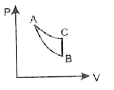
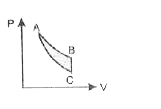
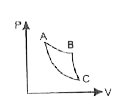
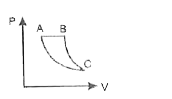
If AB is an isothermal, BC is an isochoric and AC is an adiabatic, which of the graph correctly represents them in Fig. ? |
|
Answer»
`therefore` Correct choice is (b). |
|
| 10. |
State the condition under which the phenomenon of diffraction of light takes place. Derive an expression for the width of the central maximum due to diffraction of light at a single slit. A slit of width 'a' is illuminated by a monochromatic light of wavelength 700 nm at normal incidence. Calculate the value of 'a' for position of (i) first minimum at an angle of diffraction of 30. (ii) first maximum at an angle of diffraction 30. |
|
Answer» Solution :`lambda = 700 nm = 700 xx 10^(-9) m` `theta = 30^@` (i) For first minima `a SIN theta = n lambda` `n = 1 , a sin 30 = lambda` `a = (lambda)/(sin 30^@) = 2lambda = 2 xx 700 xx 10^(-9)` `= 14 xx 10^(-7) m`. (ii) For first maxima, `a sin theta = (2n + 1) lambda/2` `a sin 30^@ = (3lambda)/2` `a = (3 lambda)/(2 xx sin 30^@) = 3 lambda = 3 xx 700 xx 10^(-9)` `= 21 xx 10^(-7) m`. |
|
| 11. |
The decelerationof a cartravelingon astraighthighwayisafunctionof itsinstantaneousvelocityv givenbyomega= a sqrt (v)whereaisa constant. If theinitialvelocityofthe caris 60km/h , thedistanceof thecar willtraveland thetimeittakesbeforeit stopesare |
|
Answer» `2/3 m,1/2 s` But` omega= ( DV)/(dt)implies(dv )/(dt)=- a sqrt(v)` ` (-dv ) /( sqrt(v))= a. dtimpliesint _(v_f)^(0)( dv) /(sqrt(v))= inta dt ` ` | 2 sqrt(v ) |_(v_f)^(0)-a timplies(dv) /( DX). ( dx) /( dt =- a sqrt(v) ` `( dv )/( dx ). v =- asqrt(v) impliesdv impliesdv sqrt(v)=- a . dx ` ` INT _(v_0)^(0) sqrt(v)dv =- aint _(0)^(s )ds ` After solving, we get ` s=(2)//(3a) . V_(0^(3/2))` |
|
| 12. |
An astronomical refracting telescope will have large angular magnification and high angular resolution when it has an objective lens of ...... |
|
Answer» small focal length and small diameter Focal length of objective `(f_(0))` should be greater of focal length of eye piece `(f_(e))` should be smaller and ANGULAR resolution = `=(D)/(1.22 lambda)` `:.`Angular resolution `propD( :.1.22 lambda` is constant) Hence, high angular resolution can be OBTAINED if diameter (D) by lens is large. |
|
| 13. |
An electric charge in uniform motion produces |
|
Answer» an ELECTRIC FIELD only |
|
| 14. |
The scientific principle involved in LASER is |
|
Answer» NEWTON's LAWS of motion |
|
| 15. |
There is no electron in nucleus then how does beta-emission take place from the nucleus ? |
| Answer» Solution :INSIDE a nucleus when a NEUTRON is converted to a proton, an ELECTRON is PRODUCED . Hence , it comes out as a `beta` - PARTICLE . The nuclear force has no influence on this electron . | |
| 16. |
Can a charge move in a magnetic field without experiencing a force? |
| Answer» SOLUTION :If a CHARGE moves PARALLEL or antiparallel to an external field, then it does not EXPERIENCE a force | |
| 17. |
An experiment measures quantities a,b,c and then X is calculated from X=(a^(1//2)b^(2))/(c^(3)). If the percentage errors in a,b,c are+-1% +-3% and +-2% respectively, then the percentage error in X can be : |
|
Answer» `+-12.5%` `(DELTAX)/(X)xx100=(1)/(2)(Deltaa)/(a)xx100+2(Deltab)/(b)xx100+3(Deltac)/(c )xx100` `(1)/(2)xx1+2xx3+3xx2=12*5%` Hence correct CHOICE is `(a)`. |
|
| 18. |
Obtain the expression for the deflecting torque acting on the current carrying rectangular coil of a galvanometer in a uniform magnetic field. Why is a radial magnetic field employed in the moving coil galvanometer? |
Answer» Solution :Consider a rectangular coil PQRS, of length `l` and breadth b, of a galvanometer carrying a current I, placed in a uniform magnetic field B such that a vector normal to the plane of the coil subtends an angle `theta` from the direction of B.  In this situation forces `F_(1) and F_(2)` having magnitude I b B `sin theta` are acting on arms PQ and RS. The forces are equal, opposite and collinear, hence they cancel out. Again forces `F_(3) and F_(4)` having magnitude `IlB` are acting on each of the two arms QR and SP. These forces too are equal and opposite but these are non-collinear and FORM a couple whose torque is given as: `tau=(IlB)xxb sin theta=I(lb)B sin theta=IAB sin theta` where `A=lb=` area of the LOOP. If instead of a single loop, we have a rectangular coil having N TURNS, then torque `tau=NIAB sin theta` In vector notation `vectau=NI(vecA xx vecB)=(vecm xx vecB)`, where `vecm=NI vecA=` magnetic moment of current carrying coil. A radial magnetic field, in which `theta=90^(@)`, is employed in the moving coil galvanometer because now torque acting on the coil does not change with orientation of the coil. |
|
| 19. |
Diagrammaticallyrepresentthe positionofadipole in (i)stable(ii) unstableequilibriumwhen placed ina uniformelectricfield. |
Answer» SOLUTION :DEPICTION of orientation for stable and unstable EQUILIBRIUM. 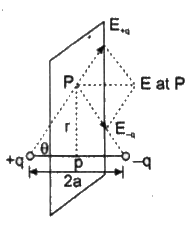 Stable equilibrium `theta=0^(@)` 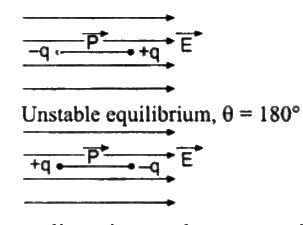
|
|
| 20. |
A straight horizontal conducting rod of length of 0.45 m and mass 60 g is suspended by two vertical wires at its ends. A current of 5.0 A is set up in the rod through the wires. (a) What magnetic field should be set up normal to the conductor in order that the tension in the wire is zero? (b) What will be the total tension in the wires if the direction of current is reversed keeping the magnetic field same as before? (Ignore the mass of the wires) g = 9.8 m s^(-2) |
|
Answer» Solution :(a) Magnetic FORECE `F = B I l`. When this force is balanced by the downward wight, the net tension in the wires will be zero. `B I l = mg` `implies B = (m g)/(I l) = (0.06 xx 9.8)/(5.0 xx 0.45) = 0.26 T` Thus, a horizontal magnetic field `VECB` of 0.26 T normal to the CONDUCTOR be appled in such a direction that Fleming.s LEFT hand rule gives a magentic force upwards. (b) On REVERSING current the tension in the wires will be `= B I l + m g = mg + mg = 2 mg = 2 xx 0.06 xx 9.8 N = 1.18 N`. |
|
| 21. |
Describe Young's double slitexperiment to produce interference pattern due to a monochromatic source of light. Deduce the expression for the fringe width. |
|
Answer» Solution :Simplest experiment to show interference of LIGHT is Young's double slit experiment : `DELTA` is a narrow slit (of width about 1 mn) illuminated by a monochromatic source of light. At a suitable distance (`~~10mm`) form `delta," two slits " S_1 and S_2` are placed PARALLEL to S. When a screen is placed at a large distance (about 2m) from the slit `S_1 and S_2`, alternate dark and bright bands appear on the screen. These are the interference bands or fringas. The bond disappear when either slit is covered. Explanation : According to Huygen's pricipal, the monochromatic source of light illuminating the slit S tends out spherical wavefront. The two waves of same amplitude and same freqency superimpose on each other. Dark fringes appear on the screen when the crest of one wave falls on the trough of other and they neutralise the effect of each other. Bright fringes appear on the screen when the crest of one wave coincides with the crest of other and they reinforce each other. Expression for the fringe width : Let d= distance between slits `S_1 and S_2` D= distance of screen from two slits and x = distance between the central maxima O and OBSERVATION point P. 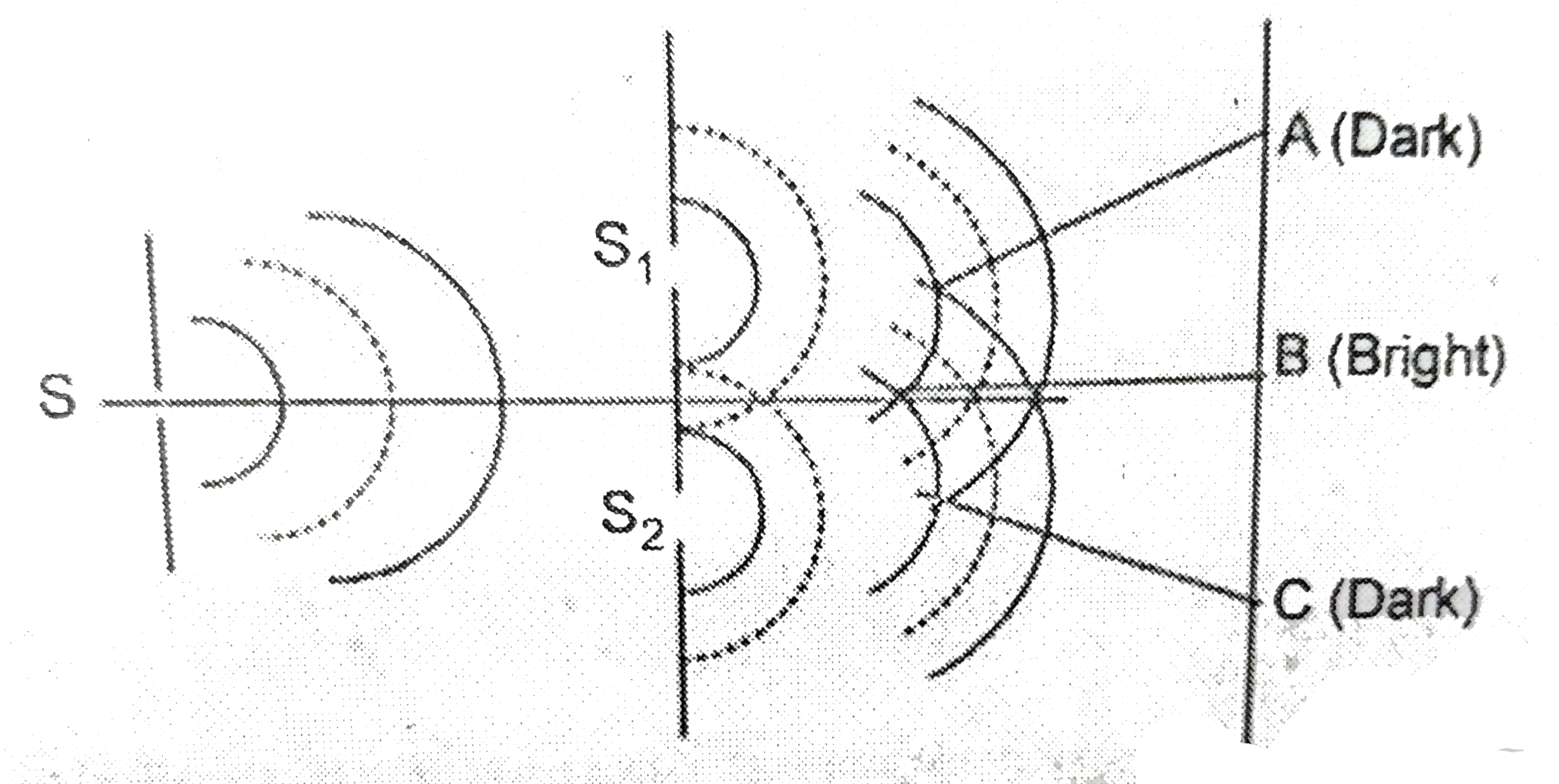 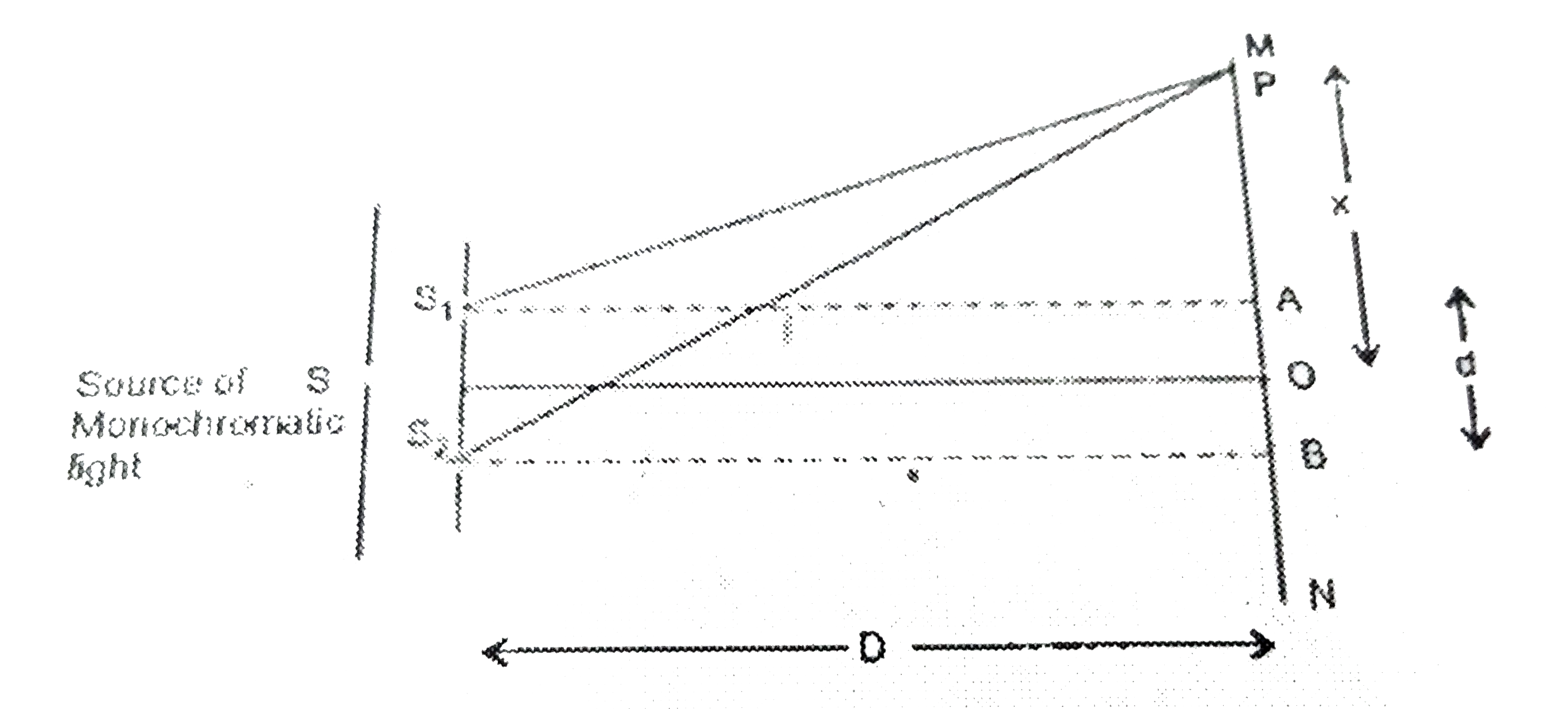 Light waves spread out from S and fall on both `S_1 and S_2`. The spherical waves emanating from `S_1 and S_2` will produce interference frings on the screen MN. In right `Delta S_1 AP`, we have, `(S_1P)^2=(S_1A)^2+(AP)^2` `S_1P=sqrt(D^2+(x-d/2)^2)=sqrt(D^2[1+((x-d/2)^2)/D^2])` `S_1P=D[1+((x-d/2)^2)/D^2]=D+((x-d/2)^2)/(2D)` Similarly `S_2P=D+((x+d/2)^2)/(2D)` Hence, path difference `= S_2P-S_1P` `=D+((x+d/2)^2)/(2D)-D-((x-d/2)^2)/(2D)=1/(2D)[x^2+d^2/4+xd-x^2-d^2/4+xd]` `=1/(2D).2xd=(xd)/D`. Now the intesity at point P is MAXIMUM or minimum according as the path difference is an integral multiple of wavelength or an odd intefral multiple of half wavelength. (i)For Brigth fringe (constructive interference) : We will have constructive interference resulting in abright fringe when path difference `=nlambda` `(xd)/D=nlambdarArrx=(nlambdaD)/d` `:._n=(nlambdaD)/d` where,`n=0pm1pm2...` Since, the separation between the centres of two consecutive bright fringes is called fringe width. It is denoted by `beta` `:. " Fringe width," beta=x_(n+1)-x_n`. `beta=((m+1)lambdaD)/d(nlambdaD)/d=(lambdaD)/d(n+1-n)` `:.beta=(lambdaD)/d` (ii)For Dark fringe (destructive interference): We will have destructive interference resulting in a dark fringe when path difference `=(2n+1)lambda/2` `(xd)/D =(2n+1)lambda/2rArr x=((2n+1)lambdaD)/(2d)` `:.x_n=((2n+1)lambdaD)/(2d)`, where,`n=0,pm1,pm2,...` Fringe width`beta=x_(n+1)-x_n` `=([2(n+1)+1]lambdaD)/(2d)-((2n+1)lambdaD)/(2d)=(2n+2+1-2n-1)(lambdaD)/(2d)=(2lambdaD)/(2d)` `:.beta=(lambdaD)/d` Hence, all bright and dark fringes are of equal width. Observations : (i)Fringe width is directly proportional to the wavalength of light i.e. `betaalphalambda`. (ii)Fringe width is inversely proportional to the distance between screen and two sourves i.e. `betaalpha1/d`. (iii)Fringe width is directly proportional to the distance between screen and two sources i.e. `betaalphaD` |
|
| 22. |
Which one of the following phenomena is not explained by Huygens construction of wavefront? |
|
Answer» refraction |
|
| 23. |
The wavelength of de-Broglie wave associated with a neutron of mass m at absolute temperature T is given by ……….. (here K is the Boltzman constant) |
|
Answer» `(h)/(sqrt(2mkT))` `THEREFORE m^(2)V^(2)=3mkT therefore mv=sqrt(3mkT)` `therefore` de-Broglie wavelength , `lambda=(h)/(mv) therefore lambda=(h)/(sqrt(3mkT))` |
|
| 24. |
Prove that a closed equipotential surface with no charge within ilself must enclose an equipotential volume. |
|
Answer» Solution :Let us assume that in a closed equipotential. surface with no CHARGE the potential is changing: from position to position. Let the potential just INSIDE the surface is different to that of the surface causing in a potential gradient`(dV)/(dr)` . It means `E ne 0`electric field comes into existencel which is given by as` E =- (dV)/(dr)` . It means, there will be field lines pointing inwards or outwards from ·the surface. These lines cannot be again on the surface as the surface is equipotential. It is possible only when the other end of the field lines are originated from the charges inside. This contradicts the original assumption. HENCE, the entire volume inside must be equipotential. |
|
| 25. |
The de Broglie wavelength of an electron accelerated by a voltage of 50V is closed to abs e = 1.6 xx 10^(-19)c,m_e = 9.1 xx 10^(31)kg, h = 6.6 xx 10^(-34) Js |
|
Answer» `1.2^@` |
|
| 26. |
A screw gauge with a pitch of 0.5mm and a circular scale with 50 divisions is used to measure the thicknes of a thin sheet of Aluminium. Before starting the measurement, it is found that wen the jaws of the screw gauge are brought in cintact, the 45^(th) division coincide with the main scale line and the zero of the main scale is barely visible. what is the thickness of the sheet if the main scale readind is 0.5 mm and the 25th division coincide with the main scale line? |
|
Answer» `Deltaf=F[(C(c-V))/(v(c+v))]` |
|
| 27. |
For a given angle of projection, if the time of flight of a projectile is doubled, the horizontal range will increase to : |
|
Answer» four TIMES Now `T^(2)=(4u^(2)SIN^(2)THETA)/(g^(2))=(2(2u^(2)sintheta.sintheta)/g^(2))` `g t^(2)=(2u^(2)sin2theta)/g.tantheta` `g t^(2)=Rtantheta` As .g. and tan`theta` are constants R `prop T^(2)` When .T. is doubled .R. becomes 4 times. |
|
| 28. |
A: In satellite communication, generally we keep different uplink and downlink frequencies. R: In case of failures, the detection of faulty link becomes easier if frequencies are kept different. |
|
Answer» |
|
| 29. |
A radio cn tune over the frequency range of a portion of Mw broadcast band (800 kHz to 1200 kHz ) . If its circuit has an effective inductance of 200 muH, what must be the range of its veriable capacitor ? |
|
Answer» Solution :Frequency of OSCILLATION is given by f = `(1)/(2 pi) (1)/(sqrt(LC))` Where L is the inductance and C is the capacitance of oscillating circuit `THEREFORE "" C = (1)/(4 pi^(2)f^(2) L)` Now For `L_(1) = 200 mu H= 2 xx 10^(-4) `H and `f_(1) = 1200` kHz = 12 `xx 10^(5)` HZ `C_(1) = (1)/(4 xx pi^(2) xx (12 xx 10^(5))^(2) xx 2 xx 10^(-4))` `rArr "" C_(1) = ` 88.04 pF for `"" L_(2) = 200 mu H = 2 xx 10^(-4) ` H `f_(2)= 800 ` kHz = `8 xx 10^(5)` Hz `C_(2) = (1)/( 4 xx pi^(2) (8 xx 10^(5))^(2) xx 2 xx 10^(-4))` `rArr "" C_(2) = `197 .8 pF The variable capacitor should have a RANGE of about 8 pF to 198 pF. |
|
| 30. |
Two buses leave with a minute gap and move with acceleration of 0.2 ms - How long after the departure of the second bus do the distance hew them become equal to three times its initial value? |
|
Answer» Solution :Initial distance between two BUSES is `s_1 =(1)/(2)at^(2)=(1)/(2)0.2xx(60)^(2)=360 m`. Let after t SECOND from the departure of second bus the disatance between two buses becomes `s_1-s_2=3xx360=1080` m `s_1=(1)/(2)a(t+60)^(2)=(1)/(2)xx0.2(t+60)^(2)` `s_2 =(1)/(2)(0.2)(t)^(2)` On solving, we GET t=60s =1 min |
|
| 31. |
A metallic wire of 1 m length has a mass of 10 xx 10^(-3) kg If a tension of 100 N is applied to a wire, What is the speed of transverse wave ? |
|
Answer» 100 `ms^(-1)` `therefore "" m = (M)/(l)= 10 xx 10^(-3) ` kg/m v = `SQRT((T)/(m)) = sqrt((100)/(10 xx 10^(-3)) ) ` `v = sqrt((100)/(10^(-2))) = sqrt(100 xx 10^(2)) = 100 ` m/s . Correct choice is a. |
|
| 32. |
A rocket goes away from Earth at speed of 6 xx 10^(7) m//s and it has blue light in it, what will be the wavelength of light observed by observer at Earth? Wavelength of blue ligth =4600 Å |
|
Answer» `4600Å` `:. Deltalambda= lambda.-lambda` `:. lambda.=1.2 lambda` `=1.2xx4600Å` `:. Lambda.=5520Å` |
|
| 33. |
What was the fear in Douglas' mind? |
|
Answer» To be defeated |
|
| 34. |
Excess pressure inside a drop and a bubble of same radii and of same liquid are in the ratio |
|
Answer» |
|
| 35. |
Standing waves are produced in 10m long stretched string. If the string vibrates in 5 segments and wave velocity is 20m/s, the frequency is, |
|
Answer» 2Hz |
|
| 36. |
Figure shows an uneven arrangement of electrons (e) and protons (p) on a circular arc of radius r = 2.50 cm, with angles theta_(1) = 30.0^(@), theta_(2) = 50.0^(@), theta_(3) = 30.0^(@), and theta_(4) = 20.0^(@). What are the (a) magnitude and (b) direction (relative to the positive direction of the x axis) of the net electric field produced at the net electric field produced at the center of the arc ? |
| Answer» SOLUTION :(a) `2.51 XX 10^(-6)N//C`, (B) `-76.4^(@)` from X axis | |
| 37. |
The ratio of the acceleration due to gravity on two planets P_(1) and P_(2) is k_(1). The ratio of their respective radii is k_(2). The ratio of their respective escape velocities is: |
|
Answer» `sqrt((k_(2))/(k_(1)))` So the CORRECT choice is (c ). |
|
| 38. |
A capacitor is made of two circular plates each of radius 12 cm, and separated by 5.0 cm. The capacitor is being charged by an external source. The charging current is constant and equal to 0.15 A.Is Kirchhoff's first rule (junction rule) valid at each plate of the capacitor? Explain. |
| Answer» SOLUTION : YES, because the CONDUCTION current entering a plate and the displacement current LEAVING the plate are IDENTICAL. | |
| 39. |
A capacitor is made of two circular plates each of radius 12 cm, and separated by 5.0 cm. The capacitor is being charged by an external source. The charging current is constant and equal to 0.15 A. (a) Calculate the capacitance and rate of change of potential difference between the plates. |
|
Answer» Solution :`because V=Q/C` or , `(dV)/(dt)=1/C (DQ)/(dt)=I/C` In this CASE, `C=(in_0A)/d=(8.854xx10^(-12)xx3.14xx(12xx10^(-2))^2)/(5xx10^(-2))` `=8xx10^(-12)F`=8 pE `THEREFORE (dV)/(dt)=I/C=0.15/(8xx10^(-12))=1.875xx10^10 V.s^(-1)` |
|
| 40. |
Prove that an inductor offers an easily path to dc and a resistive path to ac. |
| Answer» SOLUTION :Inductive reactance `X_L=L_omega`. It FOLLOWS that `X_L=0` for dc (since `OMEGA`=0) and has a finite value for ac . HENCE an inductor offers an easy path to dc and a resistive path to ac. | |
| 41. |
A thin hollow cylinder open at both ends (i) Slides without rotating (ii) Rolls without slipping, with the same speed. The ratio of kinetic energies in the two cases is |
|
Answer» `1:1` K.E. of rolling body= K.E. of translation+ K.E. of rotation `E=1/2mv^(2)+1/2Iomega^(2)=1/2mv^(2)+1/2mR^(2).OMEGA^(2)` `E=1/2mv^(2)+1/2mv^(2)=mv^(2)` `therefore("Translation K.E.")/(.TOTAL K.E.")=1/2.(mv^(2))/(mv^(2))=1/2` |
|
| 42. |
What are drawbacks of Thomson's model ? |
| Answer» Solution :(i) It could not EXPLAIN STABILITY of atom, LARGE scaterring of `alpha-particles`. (II) PRESENCE of discrete spectral lines. | |
| 43. |
The phase difference between incident wave and reflected wave is 180^@, when a ray of light : |
|
Answer» STRIKES GLASS from air |
|
| 44. |
if a=0.72, r=0.24, then value of t is |
|
Answer» 0.02 `t=1-(a+r)` `=1-(0.72+0.24)` `=(1-0.96)` `=0.04`. |
|
| 45. |
For light diverging from a point source : a) the wavefront is spherical b) the intensity decreases in proportion to the distance squared c) the wavefront is parabolic d) the intensity at the wavefront does not depend on the distance |
|
Answer» only ..a.. and ..B.. are correct |
|
| 46. |
A ball at O is in equilibrium as it is attached with two strings AO and DO, which are tied atA and D. AO = DO= a(sqrt5). The charges at A, B, C, abd D are +q, +Q, +2Q, and -q, respectively. Find the correct options. The ball at O is positively charged. |
|
Answer» The ball O cannot remain in equilibrium. For ball `O` (positively charged) to be in equilibrium at the middle of `BC` 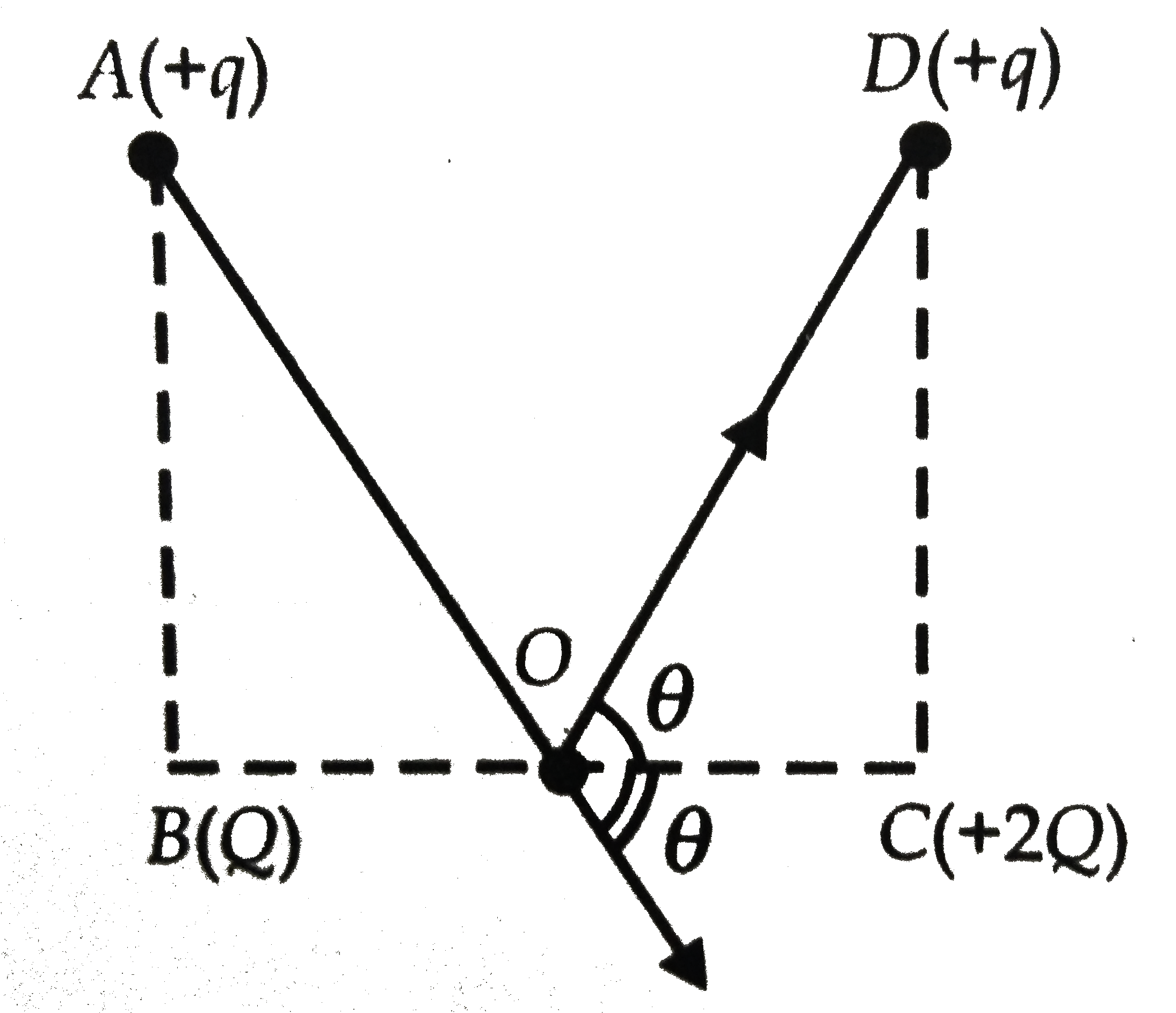 `[(q)/(4piepsilon_(0)(asqrt(5))^(2))+(q)/(4piepsilon_(0)(asqrt(5))^(2))]cos theta+(Q)/(4piepsilona^(2))` `=(2Q)/(3piepsilon_(0)a^(2))` `q=(5sqrt(5)Q)/(2)`(as `cos theta=(a)/(asqrt(5)`) If `q=5sqrt(5)Q//2,` ball will be in equilibrium , even if charge are interchanged (a) is WRONG and (c) and (d) are CORRECT. If charge as `C` is `+Q`, then `(2qcostheta)/(5)+Q=Q` or `(2qcostheta)/(5)=0` `Qcancel=0,theta=90^(@)`, which is not possible (b) is wrong. |
|
| 47. |
The distance between the atomic centres in a nitrogen molecule is 1.094 xx 10^(-10) m. Find the moment of inertia of the molecule and the temperature at which molecular collisions cause the state of the rotational motion to change. |
|
Answer» |
|
| 48. |
An electric field is uniform and in the positivex direction for postivex and uniform with the same magnitude but in the negative x direction xit is given that E=200 I N/Clength 20 cm and radius 5 cmhasits centre at the origin and its axis x =-10 cm(a) what is the net ioutward flux througheachflate face (b) what is the flux through the side of the cylinder (C ) what is the net outward flux thoght the cylinder (d) what is the net chargeinside the cylinder |
|
Answer» Solution :(a) we cansee from thethat on the leftfaceE and `triangle S`are parallel therefore the OUTWARD fluxis (b) for any pointon the side of the cylinder E is perpwendicular to `triangle S` and hence E `triangleS=0`thereforethe fluxout of the side ofthe cylinder is zero (C ) net outward FLUX throughthe cylinder `Phi =1.57 +1.57 +0=3.14 N m^(2) c^(-1)` 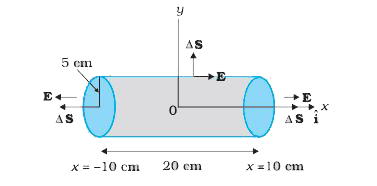 (d) the netcharge within the cylinder can be foundby using gauss.slaw which GIVES `q=epsilon_(0) Phi` `=2.78 xx10^(-11) c` |
|
| 49. |
The moving coil of a galvanometer 4 cm long and 1.5 cm wide, made of 200 turns of thin wire, works in a magnetic field with induction of 0.1 T. The plane of the coil is parallel to lines of induction. Find the torque acting on the coil when a current of 1 mA flows in it. |
|
Answer» |
|
| 50. |
A wire has a resistance of 2.5Omega at 100^(@)C. Temperature coefficient of resistance of the material alpha=3.6xx10^(-3)K^(-1). Find its resistance at 0^(@)C. |
|
Answer» SOLUTION :`alpha=(R_(t)-R_(0))/(R_(0)(t_(2)-t_(1))),3.6xx10^(-3)=(2.5xxR_(0))/(R_(0)xx100)` `R_(0)=(2.5)/(1.36),R_(0)=1.83Omega` |
|